Exploring Standards and Developing a Measure for
Evaluating Iranian EFL Teachers’ Professional
Competence in the Private Sector
MaliheAlsadat Mousavi
1Mahmood Reza Atai
2Esmat Babaii
3Received: 22/04/2016 Accepted: 09/08/2016 Available online: 01/11/2016
Abstract
The primary foundation of teacher evaluation is establishing standards for assessing the optimal characteristics of qualified teachers. The present study aimed at exploring standards of professional competence of adult-level Iranian EFL teachers in the private sector and developing a questionnaire to assess their professional competence. To this end, initially, the members of the professional community including teacher trainers, supervisors, teacher educators, and teachers themselves were selected and interviewed to set standards through adapting TESOL (2003) standards of professional EFL teachers. Content analysis of the interviews showed that the members of the professional community recognized 38 performance indicators out of 65 performance indicators suggested by TESOL (2003) as appropriate, inclusive, and necessary to evaluate Iranian in-service EFL teachers' professional competences in the private sector. Then, a self-assessment questionnaire was designed to evaluate the professional competence of Iranian EFL teachers in the private sector. The questionnaire was administered to 344 EFL teachers in order to examine its reliability and construct validity. The results indicated that the aforementioned questionnaire is a valid and reliable measure of the professional competence of Iranian EFL teachers in the private sector. Researchers hope the emerged standards and the newly-developed instrument would be eventually implemented at national level to secure consistency in EFL teachers’ quality assurance in the private sector.
Keywords: TESOL standards, EFL teacher evaluation, professional competence, private sector, Iran
1. Corresponding Author-Department of Linguistics and Foreign Languages, Payame Noor University, Tehran, Iran, Email: [email protected]
2. Department of Applied Linguistics and TEFL, Kharazmi University, Tehran, Iran, Email: [email protected]
3. Department of Applied Linguistics and TEFL, Kharazmi University, Tehran, Iran, Email: [email protected]
1. Introduction
Evaluation has always been of great significance in policy and practice of English language teaching (ELT) and has been linked with various aspects of TESOL including teacher development, teaching methodology, and curriculum design (Davison & Cummins, 2007). Luo and Dappen (2004) highlight the value of evaluation and state that evaluation aims at judging worth, merits, and shortcomings of educational programs. They hold that evaluation serves as an important instrument towards improving educational quality of a program.
A review of the related literature on teacher evaluation in ESL contexts reveals that evaluation studies have basically concentrated on evaluating teachers' English language competence (e.g., Kiely & Rea-Dickens, 2005), evaluating teachers’ level of teaching competence (e.g., Hamdan, Ghafar, & Li, 2010), designing teacher evaluation and appraisal systems (e.g., Kaufman, 2007), and describing performance appraisal of ESL teachers (e.g., Stoynoff, 2007). Furthermore, the studies of teacher evaluation in EFL contexts have mainly focused on evaluating the contribution of native speaker teachers in EFL contexts (e.g., Kiely & Rea-Dickens, 2005), evaluating English language competencies of EFL teachers (e.g., Coniam & Falvey, 2005), evaluating the accountability of English teachers after training (e.g., Weir & Roberts, 1994), developing new approaches to teacher appraisal and evaluation (e.g., Murphey & Yaode, 2007), evaluating teacher effectiveness (e.g., Eken, 2007), and evaluating EFL teacher evaluation processes (e.g., Burden & Troudi, 2007; Davidson, 2007; Wise, Darling-Hammond, McLaughlin, & Bernstein, 1984).
The review of teacher evaluation studies in the Iranian ELT literature also reveals that Iranian scholars have mostly investigated the procedures of teacher evaluation in the private sector (e.g., Akbari & Yazdanmehr, 2011; Ostovar-Namaghi, 2013). Regarding Iranian language program evaluation policies in the public sector, Atai and Mazlum (2013) hold that English teachers in the public schools are evaluated the same way as other teachers, such as chemistry teachers, are evaluated. Navidnia (2013) developed a model and suggested assessment procedures for Iranian EFL teachers in public schools. However, there has been scant attempt to set standards and develop an instrument for evaluating Iranian EFL teachers in the private sector.
English in the public sector are mostly directed towards knowledge of the language and its usage rather than functional communication or use. Hence, Iranian students typically tend to attend private language institutes to learn English due to the shortcomings in the public sector (Davari & Aghagolzadeh, 2015; Kazemi & Soleimani, 2013). This has led to the growth of a new booming market in Iranian private sector for ELT education and increasing numbers of learners and teachers (Aghagolzadeh & Davari, 2014).
Stoynoff (2007) highlights the importance of context in evaluation studies and argues that evaluation cannot be considered apart from the social and political contexts in which it occurs because the above factors may affect the design and suitability of an evaluation system for its designated purposes. A historical review of language teaching and learning in Iran reveals that prior to the Islamic revolution in 1979, private language institutes came to existence in a growing number of large cities and burdened the responsibility of English extension in the Iranian social context (Davari & Aghagolzadeh, 2015) and most of the language teachers in the language institutes were native speakers of English living in Iran (Nezakat-Alhossaini & Ketabi, 2013). However, as Aliakbari (2002) points out, foreign language teaching and learning were marginalized after the Islamic revolution. While after three decades, globalization, modernization, and the desire to access technology have overcome the reductionist approach and resistance to the English language and led to the growing of interest in language teaching and learning and flourishing of private English language institutes (Riazi, 2005).
Hence, taking into consideration the growing interest in learning EFL in the private sector and the lack of national standards for EFL teachers’ evaluation in this sector, we aimed at setting standards and designing an appropriate instrument to evaluate EFL teachers’ professional competence in the private sector. Smith (2005) argues that standards are required when we are engaged in evaluation processes focusing on teaching. McCloskey, Thornton, and Touba (2007, p.7) declare that "there is little documentation of the processes used to develop standards for evaluating teachers" and believe in contextualization of standards to enhance their effectiveness. Likewise, scholars such as Burton (2007) and Stoynoff (2007) contend that teacher evaluation can be conducted by adapting the existing resources such as TESOL standards.
professionalism. On the other hand, NCATE identifies four domains for setting standards including content knowledge, pedagogical knowledge, learning environments, and professional knowledge (Kuhlman & Knezevle, 2013).
Consequently, we drew upon TESOL (2003) standards and attempted to adapt them to the Iranian EFL context in order to make an instrument aiming at evaluating professional competence of EFL teachers in the private sector. According to TESOL (2003) standards, professional competence of ESL/ EFL teacher is made up of five domains including language, culture, instruction, assessment, and professionalism which is considered as the core component of the professional competence of EFL teacher. “Language and culture are considered as foundational knowledge domain in which teachers must be competent. Moreover, teaching competence is applied in the instruction and assessment domains. Thus, the four outer domains form the content and skill areas of TESOL” (Burton, 2007, p.30). How they intersect in each teacher's performance represent teacher's professionalism. Figure 1 below presents TESOL standards.
Figure 1. TESOL standards for P-12 teacher education programs. Adapted from TESOL / NCATE program standards: Standards for the accreditation of initial programs in P-12 ESL
teacher education (p. 4), by the TESOL Task Force on ESL Standards for P–12 Teacher
Education Programs, 2003, Alexandria, VA: TESOL Inc.
2. Research Questions
sector. Taking into consideration TESOL (2003) standards of professional competence of ESL/ EFL teacher, the following research questions were posed:
1. What are the desired quality standards for evaluating the professional competence of in-service EFL teachers in Iranian ELT private sector? 1.1. What are the desired quality standards for evaluating Iranian in-service EFL teachers’ abilities in describing language and understanding language acquisition and development processes in the private sector?
1.2. What are the desired quality standards for evaluating Iranian in-service EFL teachers’ abilities in planning, managing, and implementing instructions domain in the private sector?
1.3. What are the desired quality standards for evaluating Iranian in-service EFL teachers’ assessment skills in the private sector?
1.4. What are the desired quality standards for evaluating Iranian in-service EFL teachers’ cultural competence in the private sector?
1.5. What are the desired quality standards for evaluating Iranian in-service EFL teachers’ professionalism skill in the private sector?
3. Methodology
3.1 Participants
The data were collected from two groups of participants in this study. Initially, 20 experts, henceforth called the members of the professional community, shared their ideas to set standards for the purpose of designing EFL teacher evaluation questionnaire and assessing its content and face validity. Then, 344 in-service EFL teachers in the private sector completed the final version of the questionnaire to estimate its reliability and construct validity.
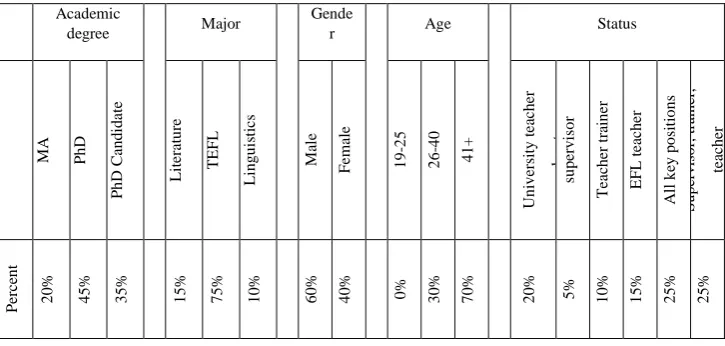
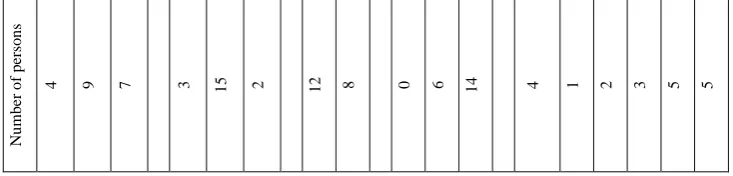
occupied all the ELT key positions in Iran including university teacher educator in the major state universities of Iran, supervisor in the private sector, teacher trainer in the public and private sector, and EFL teacher in the private sector in their teaching experience profiles, 20 % (4) of them were university teacher educators at the major state universities in Tehran teaching pre-service EFL teachers at different levels "BA, MA, and PhD" and making major decisions in ELT community in Iran, and 25% (5) of the professional community members held three dominant positions as teacher trainer, supervisor, and at the same time EFL teacher in the main branches of wide-expanded private institutes. In fact, we can consider them as head teacher trainers and head supervisors having control over all other branches of these wide-expanded private institutes. Moreover, 10% (2) of the members just worked as teacher trainers, 5% (1) of them just worked as a supervisor, and 15% (3) of them just worked as EFL teachers in the prestigious institutes in the private sector (see Table 1).
An analysis of background education of the professional community members shows that 75% (15) of them have studied TEFL; 10 % (2) of them have graduated in linguistics; and the rest (15% (3) of them) have studied English literature (see Table 1). With regard to their degree, 45% (9) of interviewees were PhD holders, 35% (7) of them were PhD candidates and 20 % (4) of them held MA degree (see Table 1).
Table 1. Demographic Information of the Members of the Professional Community
Academic
degree Major
Gende
r Age Status
MA Ph
D P h D C an d id at e Li te ra tu re TEFL Li n g u is ti cs M al e F emal e 19 -25 26 -40 4 1 + U n iv er si ty t ea ch er ed u ca to r su p er v iso r Te ac h er t ra in er EFL t ea ch er A ll k ey p o si ti o n s S u p er v iso r, t ra in er , te ac h er P er ce n t 2 0 % 4 5 % 3 5 % 1 5 % 7 5 % 1 0 % 6 0 % 4 0 %
N u mb er o f p er so n s
4 9 7 3 15 2 12 8 0 6 14 4 1 2 3 5 5
Next, 344 in-service EFL teachers responded to the designed questionnaire in order to do a pilot study and check its construct validity. Kahn (2006) suggests that a minimum sample size of 300 is confident for the result of factor analysis of the questionnaire. Table 2 displays the demographic information of EFL teachers responding to the questionnaire.
Table 2. Demographic Information of In-service EFL Teachers in the Private Sector
Academic degree Major Gende
r Age
Teacher years of experience BA M A S tu d en ts
MA Ph
D P h D Ca n d id ate Tran sla ti o n Li tera tu re TE F L Li n g u isti cs Oth er field s M ale F em ale 19 -25 26 -40 41+ 1 -4 y ea rs 5 -1 0 y ea rs 11 -1 5 y ea rs M o re th an 1 5 y ea rs 4 9 .3 % 2 6 .2 % 2 0 % 0 .3 % 4 .2 % 2 3 .1 % 1 6 .1 % 3 2 % 7% 2 1 .8 % 3 7 .9 % 6 2 .1 % 3 1 .4 % 6 0 .3 % 8 .3 % 4 3 .1 % 3 4 .8 % 1 3 .8 % 8 .3 % 3.2 Procedure
selected purposively to be the members of the professional community in order to assess and contextualize teacher evaluation standards. To this end, we delivered TESOL (2003) teacher education standard to the professional community. Next, to achieve consensus and make decision about standards of evaluating Iranian in-service EFL teachers in the private sector, we interviewed all the members of the professional community. It should be noted that each interview lasted 60 to 90 minutes depending on the status and working experience of the professional community members. All the interviews were audio-recorded and transcribed for content analysis. Furthermore, the members of the professional community were asked to answer standards for standards assessment form (see Appendix A) in each domain i.e. language, culture, assessment, professionalism, managing, planning, and implementing instruction.
Then, the researchers identified emerging standards after performing content analysis of interviews and analyzing responses of the professional community to the standards for standards assessment form. Inter-coder reliability was also estimated to show that coding scheme was consistent across two coders. Finally, the self-assessment questionnaire to evaluate EFL teachers' professional competence was developed. First, the questionnaire was delivered to 5 teacher educators to check its face and content validity as well as clarity and wording of the items. Second, the questionnaire was distributed among 600 in-service adult-level teachers; however, 344 of the questionnaires were analyzed to estimate its construct validity and reliability.
4. Results and Discussion
4.1 Setting Context-Specific Standards
As far as the level of importance of each domain of professional competence in evaluating in-service Iranian EFL teachers is concerned, all members of the professional community stated that "EFL teachers’ competence in describing language and understanding language acquisition and development processes has paramount importance in teacher evaluation". As stated by one of teacher trainers, “describing language and understanding
language acquisition and development processes for the one supposed to be an EFL teacher is a prerequisite and inadequate mastery over language becomes a barrier to get to know about the culture, focus on assessment, and involve in instruction".
Reviewing and discussing 23 performance indicators in language domain with the members of the professional community revealed their strong consensus over 13 performance indicators. In fact, they mostly claimed that "in-service EFL teachers in the private sector are supposed to be able to apply their knowledge of phonology, morphology, syntax, semantics, and pragmatics to help EFL learners in acquiring language proficiency”. Likewise, they believed that EFL teachers should provide students with rich language exposure, comprehensible input, scaffolding, meaningful interaction, appropriate instruction, feedback, and effective learning strategies.
Moreover, the members of the professional community responded to standards assessment form and assessed the performance indicators in language domain as a whole regarding the content of the standards and their clarity. They mostly showed agreement on the necessity, importance, appropriateness, and coverage of the needed content. However, nearly more than half of them declared that in-service EFL teachers and supervisors in the private sector cannot fully understand what each performance indicator means in the language domain. In other words, they declared that technical linguistic and teaching terms are mystifying and abstruse for some in-service EFL teachers regarding their educational levels and fields of study.
Discussing the assessment skill of in-service EFL teachers, 75% of the members of the professional community believed that assessment skill is very important in evaluating in-service EFL teachers while 25% of them reported that "this skill is moderately important in the private sector”. One of the teacher trainers who has worked in the widely-expanded institutes declared that “we have everything preplanned by the language centers, and EFL teachers do not have that much agency in testing departments”. Likewise, one of the teacher educators who had an administrative position in one of the widely-expanded language centers stated that "only some EFL teachers as testing experts are employed in testing department and it is not necessary for all in-service EFL teachers to acquire testing skill.”
assessing language skills and components, and doing and modeling peer and self-assessment techniques, while they showed disagreement regarding the other performance indicators related to assessment. Verifying the content and clarity of performance indicators in the assessment domain, the majority of the members of the professional community contended that "in-service EFL teachers cannot fully comprehend what each performance indicator means in the assessment domain". To reiterate, they expressed considerable disagreement over importance, appropriateness and coverage of performance indicators in the assessment domain.
With reference to cultural knowledge of teachers, 50 % of the professional community members stated that "cultural knowledge of in-service EFL teachers is very important", 35% of them declared that "cultural knowledge of EFL teachers is moderately important", and 15% believed that it has little importance. Suffice to say that the members of the professional community believe that "knowing cultural value of the target language is not the main criterion for assessing EFL teachers in our country since there is sensitivity to the very idea of cultural assault". In fact, they put emphasis on critical understanding of culture and intercultural competence of in-service EFL teachers in the private sector. Moreover, responses to standards assessment form demonstrated substantial disagreement of the members of the professional community over the content and clarity of the performance indicators in culture domain. In fact, they asserted that performance indicators in culture domain are not appropriate, inclusive, and necessary for evaluating Iranian in-service EFL teachers in the private sector.
Regarding planning, managing, and implementing instruction, 95% of the members of the professional community asserted that "in-service EFL teachers require to be competent in this domain”, while 5% of them believed that possessing these skills is moderately important for EFL teachers. It is worth mentioning that the majority of the members of the professional community asserted that planning and managing skill is as important as language proficiency for EFL teachers. Indeed, they stated that "planning, implementing and managing skills occupy the second position of importance after language proficiency".
language proficiency are not the responsibilities of language teachers in the private language institutes. Analyzing responses of the professional community to the standards assessment form also showed their disagreement regarding the clarity, importance, and necessity of the performance indicators in planning, managing, and implementing instruction.
In relation to the core component of professional competence of EFL teachers “professionalism”, 75% of the members of professional community considered it as important skill, while 25% of them believed that it is moderately important in evaluating Iranian EFL teachers. One of EFL teachers stated that “moving towards professionalism is a must".
However, the members of the professional community argued that some of the performance indicators in professionalism such as EFL teachers’ awareness of law in EFL profession should not be used in evaluation of Iranian in-service EFL teachers due to the lack of national law and guidelines in this regard. They also contended that there is a degree of exaggeration in demonstrating the performance of EFL teachers such as EFL teacher advocacy for the access of EFL learners to all available academic resources as well as EFL teacher ability to serve as language, education, and professional resource. In other words, they believed that expecting EFL teachers to display the aforementioned qualities is demanding.
Finally, seeking the level of agreement of the members of the professional community over adapting performance indicators of TESOL (2003) standards to evaluate professional competence of EFL teachers, the researchers coded the whole interview transcription about 400 pages to estimate the level of agreement between two coders. Mackey and Gass (2005) stated that establishing coding reliability is crucial part of the qualitative data to ensure that coding scheme is consistent across multiple coders. Hence, estimating the level of agreement of two coders in this study, the researchers obtained the Phi-coefficient of inter-coder reliability of 0.91.The results of content analysis of interviews and analysis of responses of the professional community to standards assessment form presented that the members of the professional community reached consensus over 38 performance indicators out of 65 performance indicators suggested by TESOL (2003) to evaluate in-service EFL teachers' professional competences in the private sector. The number of emerging standards in each domain is displayed in Table 3.
Table 3. The Number of Emerging Standards and the Rank Order of Each Competence for Evaluating Iranian Adult-Level EFL Teachers' Professional Competence
The number of emerging standards for each component Component of EFL teacher professional
competence Rank
15
Describing language and understanding language acquisition and development process 1
7
Planning, managing, and implementing instruction
2
6
Assessment skills 3
4
Cultural competence 4
6
Professionalism skill 5
4.2. Developing a self-assessment questionnaire
First a 49-item self-assessment questionnaire was developed based on the emerged quality standards of the professional competence of Iranian EFL teachers in the first phase of the study (see Appendix B) and 5 teacher educators examined the face validity and wording of the questionnaire. As they suggested, some items were revised due to measuring more than one parameter or vagueness of the wording. Furthermore, two EFL teachers working in language institutes were asked to go through the items, answer them, and provide feedback at the presence of the researcher. Hence, some technical words, to mention a few, speech register and lexicon were changed to formal and informal language and vocabulary, respectively. Furthermore, examples for some terms such as learning style and strategies, or writing mechanism were provided. Next, the questionnaire was piloted and distributed among EFL teachers in different provinces of Iran. The data were also subjected to principal component analysis (PCA) using SPSS Version 21 to check whether the questionnaire was measuring the components and standards over which the researchers and the members of professional community reached consensus following the standard setting process.
4.2.1. Component 1: Describing language and understanding language acquisition and development process
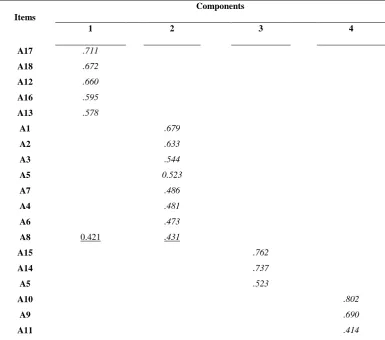
Items 1 to 18 measure teachers' abilities in describing language and understanding language acquisition and development processes. PCA of these items revealed the presence of four components with eigenvalues exceeding 1, explaining 31. 034 %, 7.60 %, 6.523 %, and 5.869 % of the variance respectively. As seen in Table 4, items 1, 2, 3, 4, 5, 6, and 7 strongly loaded on the second component. It should be mentioned that these items respectively measure EFL teachers' conscious knowledge about their own competence in teaching phonology, morphology, syntax, vocabulary, pragmatics, discourse, and language proficiency.
Table 4. Rotated Component Matrix of Factor Analysis on the Items related to EFL Teachers’ Competence in Describing Language and Understanding Language Acquisition and Development
4.2.2. Component 2: Planning, Managing, and Implementing Instruction
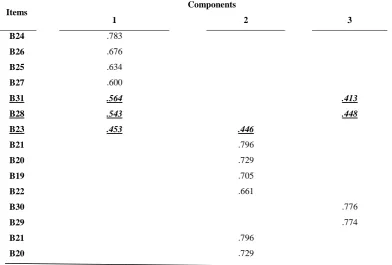
Items B19 to B31 of the questionnaire were designed to measure EFL teachers' ability in planning, managing, and implementing instructions. It should be noted that items 19 to 22 are related to EFL teachers' skill in planning instruction and items 23 to 37 are related to EFL teachers' skill in managing and implementing instruction. PCA of items B19 to B31 revealed the presence of three components with eigenvalues exceeding 1, explaining 38.96%, 9.24%, 7.95 % of the variance respectively.
As illustrated in Table 5, items 19, 20, 21, and 22 which measure EFL teachers' planning skills in the classroom environment loaded on the second component. However, the items related to managing and implementing instructions
Items
Components
1 2 3 4
A17 .711
A18 .672
A12 .660
A16 .595
A13 .578
A1 .679
A2 .633
A3 .544
A5 0.523
A7 .486
A4 .481
A6 .473
A8 0.421 .431
A15 .762
A14 .737
A5 .523
A10 .802
A9 .690
component since they are related to EFL teachers’ competence in employing technology for teaching English (see Table 5). As displayed in Table 5, items 23, 28, and 31 loaded on two components; though, deleting these items did not change the reliability of the questionnaire considerably. In fact, the reliability index was reduced to 0.94; whereas, it was initially 0.95. Hence, decision was made to delete these items since each one measured several factors at the same time.
Table 5. Rotated Component Matrix of Factor Analysis on the Items related to the Planning, Managing, and Implementing Instruction Skills of EFL Teachers
Items Components
1 2 3
B24 .783
B26 .676
B25 .634
B27 .600
B31 .564 .413
B28 .543 .448
B23 .453 .446
B21 .796
B20 .729
B19 .705
B22 .661
B30 .776
B29 .774
B21 .796
B20 .729
4.2.3. Component 3: Assessment Skills
competence in modeling and helping learners to do self and peer assessment loaded on the second component.
Table 6. Rotated Component Matrix of Factor Analysis on the Items related to the Assessment Skills of EFL Teachers
Item Components
1 2
C33 .843
C34 .821
C35 .664
C32 .621
C33 .843
C34 .821
C37 .888
C36 .846
C38 .633
4.2.4. Component 4: Intercultural competence
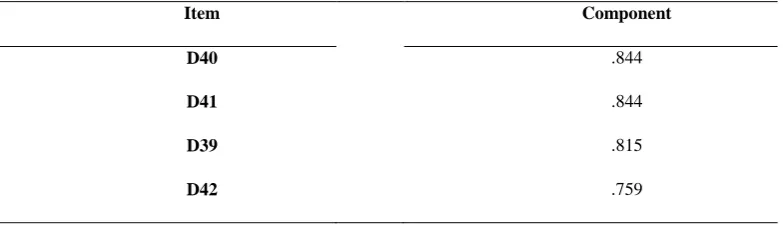
Items 39 to 42 measure intercultural competence of EFL teachers including their ability to present similarities and differences between target language culture and their own language culture and make students familiar with critical thinking skill to enable them absorbing and rejecting target culture norms. PCA of these four items revealed the presence of one component with eigenvalues exceeding 1, explaining 66.15% of the variance. Table 7 also shows that all items strongly loaded on one component.
Table 7. Rotated Component Matrix of Factor Analysis on the Items related to the Intercultural Competence of EFL Teachers
Item Component
D40 .844
D41 .844
D39 .815
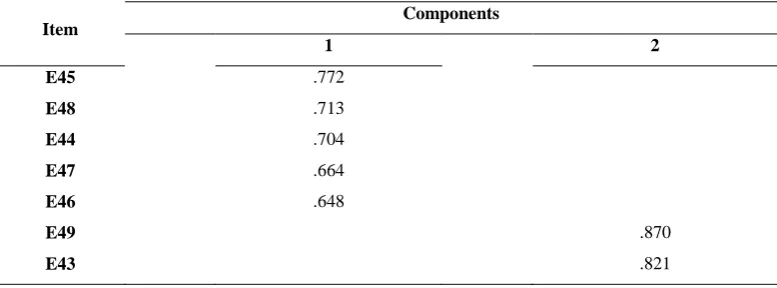
related to EFL teachers' professional development and collaboration as well as their partnership and advocacy. PCA of the aforementioned items revealed the presence of 2 components with eigenvalues exceeding 1, explaining 37.44% and 20.44% of the variance respectively. As displayed in Table 8, items 44, 45, 46, 47, and 48 strongly loaded on the first component showing EFL teachers competence in professional development and collaboration (see Table 8), while items 43 and 49 loaded on the second component relating to EFL teachers' professional partnership and advocacy.
Table 8. Rotated Component Matrix of Factor Analysis on the Items related to the professionalism skill of EFL Teachers
Item Components
1 2
E45 .772
E48 .713
E44 .704
E47 .664
E46 .648
E49 .870
E43 .821
The descriptive statistics of Iranian adult-level EFL teacher professional competence in responding to the self-assessment questionnaire is presented in Table 9. The mean and standard deviation of EFL teachers' scores in each of the components as well as the total score of EFL teachers’ professional competence are reported in Table 9. EFL teachers' professional competence scores were calculated by adding up the values of the options they selected (from 1 to 5) in assessing themselves and responding to the items. The higher a teacher’s score on each of the components or total, the more competent the teacher is in that competence or her professional competence. For instance, a teacher with a total professional competence score of 243 is more competent than a teacher with an overall score of 171. In the same token, a teacher whose competence score on assessment skills is 60 is more competent than a teacher with a score of 47 on the same component.
Component
N of Items
Minimum Maximum Mean Std. Deviation Understanding and
describing language
18 32.00 90.00 66.6380 10.39440
Planning, managing, and implementing instruction
13 21.00 65.00 47.7057 8.51810
Assessment skills 7 7.00 35.00 24.4491 5.56230 Intercultural skill 4 4.00 20.00 12.9115 3.71610 Professionalism skill 7 7.00 35.00 21.7917 5.40074
Total Score of EFL Teachers
49 85.00 238.00 171.5144 27.69664
5. Discussion and Conclusion
The findings of the present study shed light on the qualities adult-level EFL teachers should possess to work in the Iranian ELT private centers. More specifically, the present study explored the quality standards of the professional competence against which Iranian EFL teachers in the private sector can be evaluated. The review of the existing literature in the Iranian ELT context revealed that teacher evaluation studies in the private sector have mainly addressed describing and assessing the procedures of teacher evaluation (Akbari & Yazdanmerh, 2011; Ostovar-Namaghi, 2013).
Since there are no published national standards to evaluate EFL teachers’ professional competence in the private sector in spite of the current booming trend of private language learning institutes, the present researchers followed Burton (2007) and Stoynoff (2007) who stress contextualization and adaptation of the existing valid standards such as TESOL in exploring context-specific standards to evaluate professional competence of Iranian EFL teachers. Additionally, the researchers partially employed McCloskey et al.’s (2007) standard setting process in setting valid and reliable standards to evaluate professional competence of EFL teachers in the private sector.
indicators out of twenty-three indicators suggested by TESOL in language domain. Moreover, it is reasonable to assume that based on TESOL standards and emerged standards to evaluate Iranian EFL teachers, language competence of EFL teachers is defined as the connection between teachers’ linguistic competence and teaching abilities. In the same vein, Wright (2002) declared that “becoming a language teacher involves a number of related processes in particular learning to create connection between linguistic or content and teaching aspects of language teaching” (p.113).
Planning, managing, and implementing instruction has got the second place of importance regarding teachers’ professional competence. However, fourteen TESOL performance indicators were reduced to seven performance indicators since the members of the professional community believed that supervisors rather than teachers bear the responsibility of planning, managing, and implementing instruction in language institutes.
In fact, the emerged standards in planning, managing, and implementing instruction domain explain that Iranian EFL teachers should demonstrate their abilities in organizing teaching-learning process around language learning objectives, planning learner-centered instruction, helping learners to develop speaking, listening, reading, and writing skills, using technology to support learners’ learning, and employing varieties of tasks and activities for teaching language skills.
Considering the required skill of EFL teachers in assessment domain, the members of the professional community hold low expectation of in-service EFL teachers. Indeed, they considered TESOL standards in the assessment domain demanding for in-service EFL teachers due to the fact that EFL teachers in the private sector mainly are not in charge of language testing. Consequently, twelve suggested performance indicators in assessment domain were reduced to six mainly focusing on EFL teachers’ awareness of various kinds of tests and purposes of tests, ability to assess learners’ language skills and language components, modeling self-assessment, helping learners in self-peer assessment, and using criterion-referenced test. On the contrary to the member of professional community as Iranian experts in EFL field who assume assessment as moderately important competence for EFL teachers, Popham (2009) holds that assessment literacy is regarded as a target for teachers' professional development and surely it leaves significant impacts on the way these teachers assess their students. Therefore, the present study findings can help Iranian professionals in the ELT context to work towards raising standards in assessment domain for Iranian EFL teacher professional development.
context not the EFL one. Indeed, the members of the professional community claimed that teachers should possess intercultural awareness accompanied by critical thinking. Findings of the present study, in terms of cultural competence of EFL teachers, are in line with Kramsch’ s (1995) and Secrue’s (2006) studies asserting that language teaching is no longer a linguistic task. Rather, it should work for the attainment of intercultural competence and critical thinking.
With regard to professionalism, eleven performance indicators of TESOL standards are reduced to six performance indicators considered necessary and appropriate to evaluate Iranian in-service EFL teachers in the private sector. To reiterate, it should be noted that the members of the professional community reached consensus over a number of TESOL standards including EFL teacher knowledge of research and history of ELT, partnership, and professional development and collaboration, nevertheless, they argued that performance indicators related to EFL teachers’ advocacy are demanding.
It should be reiterated that the present research aimed at localizing the standards and designing an instrument to evaluate professional competence of EFL teachers in the private sector. The results may contribute to implementing a unified system of EFL teacher evaluation system in the context of private sector. The emerged standards for professional competence of EFL teachers can also be used as a guideline to English language teaching profession development as well as EFL teachers’ professional development in the private sector.
Moreover, researchers hope the emerged standards and the newly-developed instrument for assessing professional competence of Iranian EFL teachers in the private sector would be considered and eventually implemented at national level so that we may secure consistency in EFL teachers’ quality assurance in the private sector. Indeed, based on the emerged standards, national-level policy makers may design and issue national certificates for EFL teachers working in the private sector. As Thaine (2004) puts it, the nature of evaluation of teaching is complex and problematic; however, quality assurance and accountability in the real working environment are the expectations of EFL learners.
Aghagolzadeh, F., & Davari, H. (2014). Iranian critical ELT: A belated but growing intellectual shift in Iranian ELT community. Journal for Critical Education Policy Studies, 12 (1), 391-410.
Akbari, R. & Yazdanmehr, E. (2011). EFL teachers’ recruitment and dynamic assessment in private language institutes of Iran. Journal of English Language Teaching and Learning, 8, 29-51.
Aliakbari, M. (2002). Culture in language teaching (doctoral dissertation). University of Isfahan, Iran.
Atai, M.R., & Mazlum, F. (2013). English language teaching curriculum in Iran: planning and practice. Curriculum Journal, 24 (3). 389-411.
Burden. P., & Troudi, S. (2007). An evaluation of student ratings of teaching in Japanese university context. In C. Coombe, M. Al-Hamly, P. Davidson, and S.Troudi (Eds), Evaluating teacher effectiveness in EFL/ ESL contexts (pp. 152-167), Ann Arbor, Michigan: University of Michigan Press.
Burton, J. (2007). Seeking the standard: Using extensive resources to support EFL teachers in evaluation process. In C. Coombe, M. Al-Hamly, P. Davidson, & S. Troudi (Eds.), Evaluating teacher effectiveness in EFL/ ESL contexts (pp. 25-39), Ann Arbor, Michigan: University of Michigan Press.
Coniam, D., & Falvey, P. (2005). High-stakes testing and assessment: English language teacher benchmarking. In J. Cummins & C. Davison (Eds.),
International handbook of English language teaching (Vol. 1, pp. 457- 470). Norwell, MA: Springer.
Davari, H., & Aghagolzadeh, F. (2015). To teach or not to teach? Still an open question for the Iranian education system. In C. Kennedy (Ed.), English language teaching in the Islamic Republic of Iran: Innovations, trends and challenges (pp.11-19).London: British Council.
Davidson, P. (2007). Faculty attitudes toward three methods of evaluating teacher effectiveness. In C. Coombe, M. Al-Hamly, P. Davidson, & S. Troudi (Eds.), Evaluating teacher effectiveness in EFL/ ESL contexts (pp. 183-199), Ann Arbor, Michigan: University of Michigan Press.
Davison, C., & Cummins, J. (2006). Assessment and evaluation in ELT: Shifting paradigms and practices. In J. Cummins & C. Davison (Eds.), International handbook of English language teaching (Vol. 1, pp. 415–420). Norwell, MA: Springer.
S. Troudi (Eds.), Evaluating teacher effectiveness EFL/ ESL contexts (pp. 167-183), Ann Arbor, Michigan: University of Michigan Press.
Hamdan, A. R., Ghafar, M. N., & Hwe Li, L. T. (2010). Teacher competency testing among Malaysian school teachers. European Journal of Social Sciences, 12
(4), 610-617.
Hamly, P. Davidson, & S. Troudi (Eds.), Evaluating teacher effectiveness in EFL/ESL contexts (pp. 137-152). Ann Arbor, Michigan: University of Michigan Press.
Kahn, J. H. (2006). Factor analysis in counseling psychology research, training, and practice: Principles, advances, and applications. The Counseling Psychologist, 34, 684-718.
Kaufman, D. (2007). A multidisciplinary approach to assessment in teacher education. In C. Coombe, M. Al-Hamly, P. Davidson, & S. Troudi (Eds.), Evaluating teacher effectiveness EFL/ ESL contexts (pp. 25-39), Ann Arbor, Michigan: University of Michigan Press.
Kazemi, A., & Soleimani,N. (2013). On Iranian EFL teachers' dominant teaching styles in Private language centers: Teacher- centered or student- centered?
International Journal of Language Learning and Applied Linguistics World, 4(1), 193-202.
Kiely, R., & Rea-Dickins, P. (2005). Program evaluation in language education. Hampshire: Palgrave McMillan.
Kramsch, C. (1995). The cultural component of language teaching. Language, Culture, and Curriculum, 8 (2), 83-92.
Kuhlman, N., & Knezevic, B. (2013). The TESOL guidelines for developing EFL standards. TESOL International Association.
Luo, M., & Dappen, L. (2004). Mixed–methods design for an objective-based evaluation of a magnet school assistance project. Evaluation and Program Planning, 28, 109-118.
Mackey, A., & Gass, S.M. (2005). Second language research: Methodology and design. London: Lawrence Erlbaum Associates.
McCloskey, M.L., Thornton, B., & Touba, N. (2007). New standards for a new era: Developing tools to assess the qualified teacher. In C. Coombe, M. Al
Murphey,T., & Yaode,Q. (2007). A Coherent approach to faculty appraisal. In C. Coombe, M. Al-Hamly, P. Davidson, & S. Troudi (Eds.), Evaluating teacher effectiveness in EFL/ESL contexts (pp. 89-106). University of Michigan.
classes in Iran. Procedia of Language Studies Conference, Turkey, 526-536. Ostovar-Namaghi, S.A. (2013). Language teachers' perceptions of evaluation criteria
in Iran. The Reading Matrix, 13 (1), 45-60.
Popham, W. J. (2009). Assessment literacy for teachers: Faddish or fundamental?
Theory into Practice, 48(1), 4-11.
Razmjoo, S.A., & Riazi, A. M. (2006). Do high schools or private institutes practice communicative language teaching: A case study of Shiraz teachers in high schools and institutes. The Reading Matrix, 6(3), 340-366.
Riazi, A. (2005). The Four language stages in history of Iran. In A.M.Y. Lin, & P.W. Martin(Eds.), Decolonization, globalization: language in education policy and practice. Clevendon: Multilingual Matters.
Secru, L. (2006). The foreign language and intercultural competence teacher: the acquisition of the new professional identity. Intercultural Education,17(1), 55-72.
Smith, K. (2005). New methods and perspectives on teacher evaluation: Who evaluate what and for which purpose? In D. Beijaard, P.C. Meijer, G. Morine- Dershimer, & H. Tillema (Eds.), Teacher professional development in changing conditions (pp. 95-114). Netherlands: Springer.
Stoynoff, S. (2007). Building a context- specific teacher evaluation system for an ESL Program. In C. Coombe, M. Al-Hamly, P. Davidson, & S. Troudi (Eds.), Evaluating teacher effectiveness in EFL/ESL contexts (pp.106-119). Ann Arbor, Michigan: University of Michigan Press.
TESOL. (2003). TESOL / NCATE program standards: Standards for the accreditation of initial programs in P-12 ESL teacher education. Alexandria, VA.
Thaine, C. (2004). The assessment of second language teaching. ELT Journal, 58
(4), 336-345.
Weir, C., & Roberts, J. (1994). Program evaluation in ELT. Oxford: Blackwell. Wise, A. E., Darling- Hammond, L., Mclaughlin, M.W. & Berstein, H.T. (1984).
Teacher evaluation: A study of effective practices. Santa Monica, CA: RAND.
Appendix A: Standards for Standards Assessment Form
Note: Adapted from McCloskey, Thornton, and Touba (2007)
Content Str
ong
ly
dis
ag
re
e
D
isagr
ee
T
o som
e
ext
en
t
agre
e
agre
e
Str
ong
ly
agre
e
Is each standard important and inclusive in scope?
Does each standard appropriate for Iranian in-service EFL teachers in the private sector? Does each standard fit within what in-service Iranian EFL teachers in the private sector should know and be able to do?
Do the standards cover the breadth of the content needed by Iranian in-service EFL teachers in the private sector in this area?
Do the standards incorporate all what Iranian in-service EFL teachers in the private sector need to know in that domain?
Clarity
Can Iranian in-service EFL teachers and
supervisors in the private sector understand what each standard means?
Appendix B: EFL Teacher Professional Competence Assessment Questionnaire Dear Instructors
This questionnaire aims at assessing your professional competence as an English Language Teacher. An EFL teacher's professional competence includes ability to describe and understand language system, intercultural competence, assessment skills, planning, implementing, and managing instruction skills, and professionalism skills. Note: We reassure you that your answers will be kept confidential.
Participant Background Information
a. Academic degree: BA MA Student MA PhD Student PhD b.Major: Translation Literature TEFL Linguistics
Other fields
c. Gender: Male ……. Female……
d. Age: 19-25 26-40 41+
e. How long have you been teaching English in Language Institutes?
1 to 4 years 5 to 10 years 11 to 15 years more than 15 years F. Have you ever taken real or mock exams such as FCE, IELTS, or TOEFL?
Yes No
If yes, what was your score? ---
How do you assess your own abilities in the following domains?
1. Describing and understanding language system, 2. Intercultural competence, 3. Assessment skills, 4. Planning, implementing, and managing instruction
skills, and
5. Professionalism skills.
Rate your own abilities: (Never= 1, A little=2, somewhat= 3, Much=4, A great deal=5)
A: Describing and Understanding Language system
1
I help learners to develop strategies to learn the phonological system of English in order to develop their proficiency.
2 I teach learners to apply their knowledge of morphology to expand their English vocabulary.
3 I teach learners effective strategies to check their own grammatical structure in spoken and written language.
4
I teach learners effective strategies for acquiring and using vocabulary meaningfully in spoken and written form.
5
I help learners understand how context affects the use and form of oral and written communication by providing models.
6 I teach learners to use mechanics of writing (Comma, semi colon, dash) appropriately.
7 I teach learners to evaluate their own writings in English.
8 I am a proficient user of English language.
9 I try to read different texts for students to support their language learnings.
10 I show videos to learners to support their language learnings.
11 I establish and maintain a (Q & A) question-based classroom.
12 I provide opportunities for students to interact and develop their language.
13
I pay attention to individual differences such as "age, literacy level, personality, and socioeconomic status of
the learners" in classroom activities.
independents, ………….."
15
I make learners get familiar with their own learning strategies such as " self-monitoring, repetition, note-taking, questioning, ……".
16 I provide individual, focused feedback appropriate to learners' needs.
17
I usually use visual, gestures, demonstration and linguistic support such as repetition, paraphrasing to help learners understand me. 18 I regularly use pair and group work to allow learners
to engage in conversation with me and others.
B. Planning, Managing, and Implementing Instruction
1 2 3 4 5 19 I am able to organize a teaching-learning process
around language learning objectives.
20 I plan lessons so that students can meet the leaning objectives.
21 I Plan learner-centered instruction.
Note: In learner-centered classes, both teachers and
students reflect on the learning process. Teachers
encourage learners to share the responsibility for their
learning.
22 I plan students' learning experiences based on assessment of their language proficiency levels. 23 I help learners develop listening skill by using listening
24 I help learners develop reading skill by using reading strategies.
25 I help learners develop speaking skill by practicing formal and informal language.
26 I help learners develop writing skill at different proficiency levels.
27 I use technology to support language learning.
28 I use internet and its different facilities to teach English.
C. Assessment Skills
1 2 3 4 5 29 I am aware of various kinds of tests such as diagnostic,
achievement, and proficiency tests.
30 I assess individual learners' language skills including reading, writing, speaking, and listening.
31 I am able to assess learners' knowledge of language components; i.e. grammar, pronunciation, and vocabulary.
32 I encourage learners to monitor their own performance.
33 I model self and peer-assessment techniques in the class.
34 I help learners to do self-peer assessment in the classroom.
Note: Intercultural competence is the ability to communicate effectively and appropriately with people of other cultures. That is, an intercultural competent person should observe rules, norms, and expectations of the relationship.
1 2 3 4 5 36 I help learners gain intercultural literacy about world
Englishes.
37 I try to make students familiar with the cultural
differences between their own language culture and the target language culture they are developing.
38 I explain intercultural issues to learners through
presenting similarities and differences in an attempt to improve their intercultural competence.
39 I make students familiar with basis of critical thinking in order to enable them make appropriate decisions regarding absorbing or rejecting target cultural norms. E. Professionalism Skills
1 2 3 4 5 40 I am a member of professional associations such as
TELLSI "Teaching English Language and Literature Society of Iran".
41 I have a plan to develop myself based on my needs and interests.
42 I collaborate with other teachers in order to improve my own abilities in teaching.
43 I take part in the in-service training courses offered by institutes.
in my teaching.
45 I am familiar with different teaching methods and use them appropriately in my classroom based on the needs of my students.