Iranian Journal of Electrical & Electronic Engineering, Vol. 14, No. 2, June 2018 162
Realization of Novel Cascadable Current-Mode All-pass
Sections
A. Kumar* and B. Chaturvedi*(C.A.)
Abstract: This paper introduces four new resistorless circuits of first-order current-mode all-pass filter (CMAPF) based on dual-X current conveyor transconductance amplifier (DXCCTA). All the four circuits use a single DXCCTA and a capacitor for their realization. The main features of the proposed CMAPFs are: use of minimum active and passive components, resistorless realization, electronically adjustable pole frequency, easily cascadable, good sensitivity performance with respect to active and passive elements, low total harmonic distortion of output current (0.74%) and good operating frequency range (39.2 MHz). The non-ideal analysis of the proposed circuits has also been explored. Moreover, two applications of the proposed first-order CMAPF in terms of second order CMAPF and current-mode quadrature oscillator are also presented. HSPICE simulations have been carried out with 0.18 µm CMOS process parameters to validate the proposed circuits.
Keywords: All-pass Filter, Quadrature Oscillator, Electronic Tuning, Cascadable, DXCCTA.
1 Introduction1
HE wide range of applications of all-pass filters (APFs) have made them important cell for communication systems. Their main applications include phase shifters while maintaining amplitude to be constant, generation of quadrature signals or multiphase signals [1] and design of high-Q band-pass circuits. Both the voltage-mode as well as current-mode first-order APFs based on numerous high performance active elements are presented in the literature [2-23]. However, current-mode circuits have gained significant attention because they have increased bandwidth, simple structures of circuits, widespread dynamic range and low power consumption [24]. Therefore, designers have shown interest to develop the first order current-mode all-pass filter (CMAPFs) while focusing on reducing the number of active and passive elements, resistor less
Iranian Journal of Electrical & Electronic Engineering, 2018. Paper first received 18 April 2017 and accepted 16 December 2017. * The authors are with the Department of Electronics and Communication Engineering, Jaypee Institute of Information Technology, Noida, U.P., 201304, India.
E-mails: [email protected] and [email protected]. Corresponding Author: B. Chaturvedi.
realization, ease of cascadability, electronic tunability of pole frequency etc.
The circuits of APFs presented in [2,4-9,11-16,18,19] have the advantage of cascadability and do not have any component matching restrictions. Additionally the circuits presented in [2-5,7,9,12,14,15,17,18,20,21,23] are based on single active element and circuits presented in [2,3,9-16,19] have the property of electronic tuning. However, these APFs suffer from one or more of the following weaknesses; no resistorless realization [4-7,9,17,18,20-23], no electronic tuning 8,17-18,20-23], use of more than one passive components [4-7,9,17,18,20-23] and lower pole frequency [2-23]. In this paper four novel circuits of CMAPF that
comprise single dual-X current conveyor
transconductance amplifier (DXCCTA) [25] and a capacitor are proposed. Thus, no external resistor is required for their realization. The input impedance of the proposed CMAPFs is low and output impedance is high. Therefore, the proposed circuits are easily cascadable. Moreover, the pole frequency is electronically tunable. The sensitivity performance of the proposed circuits is also found good. Furthermore, the presented CMAPFs exhibit low total harmonic distortion (THD) for the output current. A comparison of the presented CMAPFs with few of the previously
T
Iranian Journal of Electrical & Electronic Engineering, Vol. 14, No. 2, June 2018 163
reported APFs is shown in Table. 1. Two applications in terms of second order CMAPF and current-mode quadrature oscillator (CM-QO) are also given. HSPICE simulation results using 0.18 µm are depicted to examine the performance of the presented circuits.
2 DXCCTA Basics
DXCCTA [25] combines the feature of both DXCCII [26] and OTA. The symbol and CMOS implementation of DXCCTA are shown in Fig. 1(a) and (b), respectively. In CMOS implementation of DXCCTA, the MOS transistors, M1-M20 form the input stage,
DXCCII and MOS transistors, M21-M32 form the output
stage, OTA. The current mirror formed by M14 and M15
forces the drain currents of M1 and M2 to be equal.
Thus, voltage of X+ terminal becomes equal to voltage
of Y terminal. The transistors M3-M5, M16-M18 form the
inverting voltage follower which causes the voltage at terminal, Y to be followed in inverting manner by voltage at terminal, X-. Moreover, the gate voltages of M12 and M13 are equal which causes the current at
terminal, X+ to be followed by current at terminal, Z+. Similarly the current of terminal, X- is transferred to the terminal, Z-. In OTA stage, the MOS transistors, M21
-M22, M25-M26 form a single input balanced output
differential amplifier. The current mirrors formed by MOS transistors M24-M25, M26-M27 and M31-M32 cause
the output of differential amplifier to appear at terminal, O+. The MOS transistors, M23, M28-M30 form an inverter
thus, current at O- terminal flows in opposite direction of current at O- terminal. The following hybrid matrix gives the port relationships of DXCCTA
Table 1 Comparison of the proposed CMAPF with few of the already existing APFs.
Ref.
No. ABB used
ABB count
Passive components
count
Resistorless
realization Cascadable
Component matching constraints
Electronic tunability
CMOS technology
(µm)
Operational frequency
(MHz)
2 DV-DXCCII 1 1 Yes Yes No Yes 0.18 27
3 EX-CCCII 1 1 Yes No No Yes 0.25 1.9
4 MO-DXCCII 1 2 No Yes No No 0.35 1.57
5 DX-MOCCII 1 2 No Yes No No 0.35 6.36
6 DO-CCII 2 2 No Yes No No 0.5 30.3
7 DXCCII 1 2 No Yes No No 0.35 1.51
8 DO-CCII 2 1 Yes Yes No No 0.13 6.37
9 CBTA 1 2 No Yes No Yes 0.18 1
10 CCCII 2 1 Yes No No Yes 0.25 2
11 CDTA 2 1 Yes Yes No Yes NA 0.318
12 CDTA 1 1 Yes Yes No Yes 0.35 1.35
13 CCCCTA 2 1 Yes Yes No Yes NA 0.2
14 CCTA 1 1 Yes Yes No Yes NA 0.284
15 CFCTA 1 1 Yes Yes No Yes 0.25 2
16 ACA & CF 3 1 Yes Yes No Yes 0.18 1
17 MO-DXCCII 1 3 No Yes Yes No 0.18 21.3
18 DXCCII 1 2 No Yes No No 0.5 25
19 DDCC 2 1 Yes Yes No Yes 0.5 1.17
20 CCII 1 3 No No Yes No NA 0.001
21 CCIII* 1 4 No No Yes No NA 0.001
22 DVCC* 2 3 No No Yes No 0.5 1.5
23 CCII* 1 3 No No Yes No NA 110
P DXCCTA 1 1 Yes Yes No Yes 0.18 39.2
Abbreviations:- DV-DXCCII: Differential voltage dual-X second generation current conveyor, EX-CCCII: Extra-X current controlled conveyor, MO-DXCCII: Multi-output dual-X second generation current conveyor, DX-MOCCII: dual-X second generation multioutput current conveyor, DO-CCII: Dual output second generation current conveyor, DXCCII: Dual-X second generation current conveyor, CBTA: Current backward transconductance amplifier, CCCII: current controlled current conveyor, CDTA: Current differencing transconductance amplifier, CCCCTA: Current controlled current conveyor transconductance amplifier, CCTA: current conveyor transconductance amplifier, CFCTA: Current follower cascaded transconductance, DDCC: Differential difference current conveyor, DVCC: Differential voltage current conveyor, ACA & CF: Adjustable current amplifier & current follower, DXCCTA: Dual-X current conveyor transconductance amplifier, ABB: Active building block, NA: Not applicable, *: 1st
structure, P: Proposed.
Iranian Journal of Electrical & Electronic Engineering, Vol. 14, No. 2, June 2018 164
0 0 0 0
1 0 0 0
1 0 0 0
0 1 0 0
0 0 1 0
0 0 0
0 0 0
Y
X
Y X
X Z
X Z
Z
O m
O m
I
V
V V
I I
I I
V
I g
I g
(1)
The transconductance, gm in Eq. (1) depends on the bias
current IB and it is expressed as gm k In B where
kn = µn COX (W/L) is the physical parameter of MOS
transistors. It is well known that physical parameter, kn
is temperature dependent [27] thus, the
transconductance, gmis also temperature dependent and
its value decreases with increase in temperature.
3 Proposed First-order Current-mode All-pass Filters
The newly proposed first-order current-mode all-pass filters, I, II, III and CMAPF-IV are shown in Fig. 2(a), (b), (c) and (d), respectively. The CMAPF-I and CMAPF-III employ one DXCCTA and one capacitor only whereas, CMAPF-II and CMAPF-IV employ one multiple output DXCCTA along with a single capacitor. It is to be mentioned that in case of CMAPF-III and CMAPF-IV the voltage of Z+ terminal (VZ+) is transferred in terms of current to
the O+ and O- terminals instead of voltage of Z- terminal (VZ-). Therefore, a little change in CMOS
implementation (terminal Z+ is connected to the gate of M21 instead of terminal Z-) is needed in case of
CMAPF-III and CMAPF-IV. Using the port
relationships of DXCCTA given in Eq. (1), all the proposed CMAPFs are analyzed and transfer function obtained after analysis is given as follows:
m
out
m in
g s
I C
g I
s C
(2)
The pole frequency, ω0 and frequency dependent phase
angle, φ(ω) are given as
0
n B
m k I
g
C C
(3)
1
( ) 2 tan
m C g
(4)
It is to be noted from Eq. (3) that electronic adjustment of ω0 is possible by means of bias current IB.
Furthermore, the input impedance of all CMAPFs is low and output impedance of all CMAPFs is high. Thus all the proposed CMAPFs are easily cascadable.
3.1 Non-Ideal Analysis
The following equation gives the port relationships for the non-ideal model of DXCCTA
1 2
1 2
1 2
, ,
, ,
,
X Y X Y
Z X Z X
O m Z O m Z
V V V V
I I I I
I g V I g V
(5)
(a) (b)
Fig. 1 a) Symbol of DXCCTA, b) CMOS implementation of DXCCTA [25].
(a) (b) (c) (d)
Fig. 2 Proposed first-order current-mode all-pass filter circuits: a) CMAPF-I, b) CMAPF-II, c) CMAPF-III and d) CMAPF-IV.
Iranian Journal of Electrical & Electronic Engineering, Vol. 14, No. 2, June 2018 165
where, β1, β2 and α1, α2 are the voltage transfer gains (Y
to X+, and Y to X-) and current transfer gains (X+ to Z+, and X- to Z-), respectively. The γ1 and γ2 are the
transconductance inaccuracies from Z- to O+ terminal and from Z- to O- terminal, respectively. It is to be further mentioned that in case of CMAPF-III and CMAPF-IV, the expressions of IO+ and IO- are given as
follows:
1 and 2
O m Z O m Z
I g V I g V (6)
Considering the non-ideal port relationships given in Eq. (5) and (6), the all four CMAPFs are reanalyzed and provide the following transfer functions
1 1 1 2 2 CMAPF-I: m out m in g s I C g I s C (7) 2 1 2 1 2
CMAPF-I :I (2 1) (2 1)
m out m in g s I C g I s C (8) 1 2 1 2 2 CMAPF-III: m out m in g s I C g I s C (9) 2 2 1 2 2
CMAPF-I :V (2 1) (2 1)
m out m in g s I C g I s C (10)
Equations (7) to (10) provide the following pole frequency 2 0 m g C
(11)
The sensitivities of ω0 with respect to active
components and capacitor are given as
0 0 0 0
1 1 2 1
2 m 1 , 1 and , , , 0
f f f f
g C
S S S S (12)
Equation (12) reveals that none of the sensitivity is in excess of unity in magnitude. Therefore, the proposed CMAPFs enjoy good sensitivity performance.
4 Simulation Results
HSPICE simulation results using 0.18 µm CMOS process parameters have been carried out to validate the proposed circuits of CMAPF. The W/L ratios of MOS transistors are given in Table 2. The minimum length of transistors is selected (just double of the technology used) keeping in view the practical aspects of
integration. The supply voltages of ± 1.25 V are used and biasing voltage used is VBB = 0.42 V. The proposed
filter is designed for 39.78 MHz frequency. The bias current is fixed to IB = 26 µA for which value of gm is
0.5 mS. The value of capacitor used is C = 2 pF. Fig. 3 shows the simulated phase response along with the magnitude response. A 90º phase shift occurs at pole frequency of f0 = 39.2 MHz (1.47% error) which is very
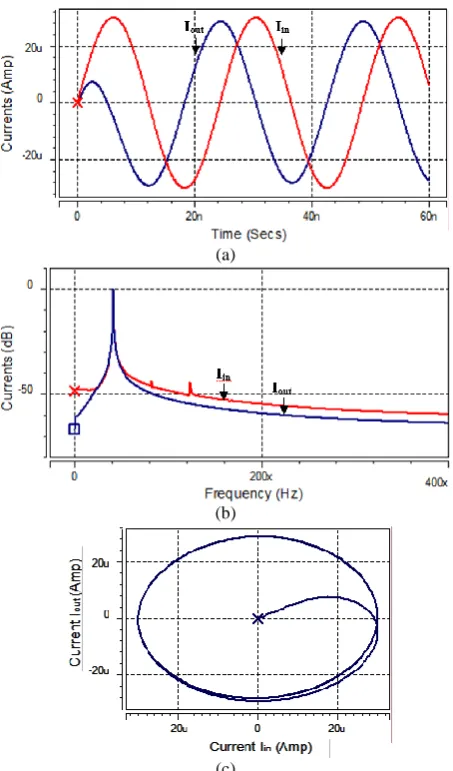
close to the theoretically designed pole frequency. The transient responses of input and output at pole frequency are shown in Fig. 4(a) and their simulated frequency spectrums are depicted in Fig. 4(b). The Lissajous pattern shown in Fig. 4(c) confirms the quadrature relationship between input and output. The output waveform at pole frequency shows a total harmonic distortion (THD) of 0.74%. Additionally, the variation of THD (%) with the amplitude of input current is plotted in Fig. 5. It is to be noted from the Fig. 5 that for an amplitude range up to 50 µA, the THD is not higher than 2%.
Furthermore, the phase responses of output current for different values of bias current (IB = 20, 25, and 30 µA)
are shown in Fig. 6. The pole frequency varying against the bias current IB is plotted in Fig.7. The bias current is
varied from 10 µA to 40 µA with 5 µA step size and a frequency range of 14 MHz to 56.1 MHz is achieved for this range of bias current. Next, the performance of the proposed circuit is tested for temperature variation. The input and output waveforms at different temperatures (25°C, 50°C, 75°C and 100°C) are shown in Fig. 8. The plot of variations of pole frequency and THD against the temperature is also shown in Fig. 9. As discussed in Section 2, the transconductance, gm decreases with
increase in temperature therefore, the pole frequency also decreases with increase in temperature since pole frequency is directly proportional to gm as to be seen
from Eq. (3). Fig. 9 shows that pole frequency decreases from 39.2 MHz to 33 MHz as temperature is increased from 25°C to 100°C. Moreover, THD of the output current varies from 0.74% to 0.92% when temperature is varied from 25°C to 100°C. It is to be observed that THD is less than 1% for a wide range of temperature variation.
Table 2 W/L ratios of MOS transistors.
MOS Transistors W(µm)/L(µm)
M1, M2 0.72/0.36
M3, M4, M5, M24, M25 1.44/0.36
M14, M15 1.34/0.36
M16, M17, M18 2.4/0.36
M6, M7, M8, M9, M10, M11, M12, M13,
M19, M20 4.8/0.36
M21, M22 3.6/0.36
M23, M26, M29, M30 2.88/0.36
M27, M28, M31, M32 0.36/0.36
Iranian Journal of Electrical & Electronic Engineering, Vol. 14, No. 2, June 2018 166 Fig. 3 Phase response and magnitude response.
(a)
(b)
(c)
Fig. 4 a) Transient responses of input and output at pole frequency, b) Frequency spectrums and c) Lissajous pattern at pole frequency.
Fig. 5 THD variation against input current Iin.
Fig. 6 Phase responses at different bias currents.
Fig. 7 Pole frequency variation against bias current, IB.
Fig. 8 Input and output waveforms at different temperatures (25°C, 50°C, 75°C and 100°C).
Fig. 9 Pole frequency and THD variations against temperature.
Iranian Journal of Electrical & Electronic Engineering, Vol. 14, No. 2, June 2018 167 5 Applications of the Proposed CMAPFs
5.1 Second Order CMAPF
To verify the property of cascadability of the proposed first order CMAPF-I, a second order CMAPF is realized by cascading the two first order CMAPF-I as shown in Fig. 10. The circuit employs two DXCCTA and two capacitors. The transfer function obtained from the analysis of circuit is given as
1 1 2 2
1 1 2 2
out m m
in m m
I sC g sC g
I sC g sC g
(13)
The pole frequency and phase angle obtained from Eq. (13) are given as
1 2
1 2
0
1 2
m m
g g
C C
(14)
1 1 1 2
1 2
( ) 2 tan 2 tan
m m
C C
g g
(15)
It is clear from Eq. (15) that a second order all-pass filter provides a phase shift of 0º to -360º when frequency is varied from 0 to ∞.
The circuit of second order CMAPF is designed for a pole frequency of 39.7 MHz. The bias currents used are
IB1 = IB2 =26 µA for which gm is 0.5 mS. Two capacitors
used are C1 = C2 = 2 pF. Fig. 11 shows the simulated
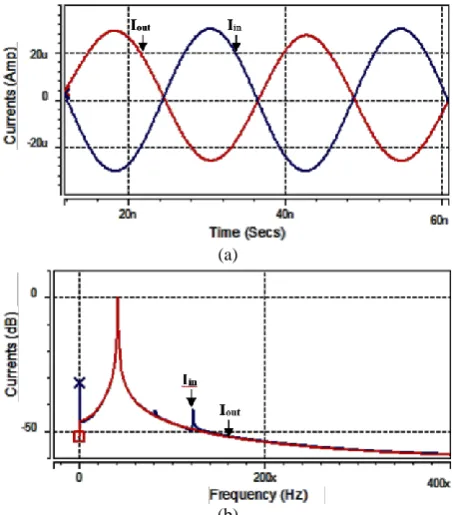
magnitude response and phase response. It is to be noted that -180º phase shift arises at pole frequency of 39.2 MHz (1.47% error) which is almost similar to theoretically designed pole frequency. Additionally the simulated transient responses of input and output at pole frequency and their frequency spectrums are shown in Fig. 12(a) and (b), respectively. It is to be clearly seen from the Fig. 12(a) that input and output have a phase difference of 180º at the pole frequency.
Fig. 10 Circuit of the proposed second order CMAPF.
Fig. 11 Simulated phase and magnitude responses.
(a)
(b)
Fig. 12 a) Transient responses of input and output and b) Frequency spectrums.
5.2 Current-Mode Quadrature Oscillator
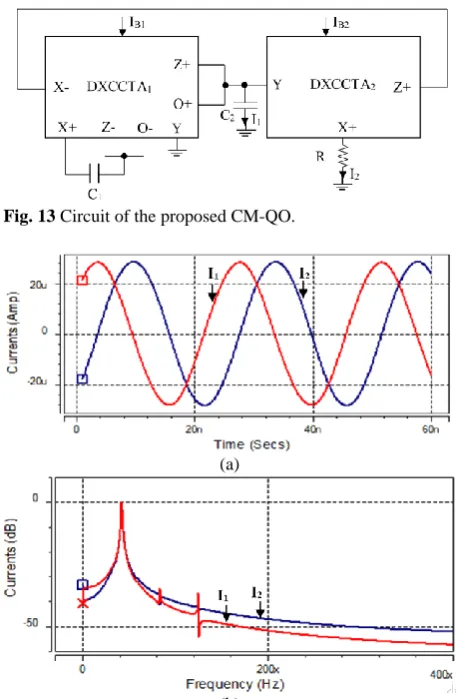
A common technique to realize an oscillator circuit is to use an APF together with an integrator. The proposed current-mode quadrature oscillator (CM-QO) is also realized using CMAPF-I and an integrator formed with the help of DXCCTA. Fig. 13 shows the circuit of CM-QO. The characteristic equation obtained from the analysis of the circuit can be found as
2 2 1
1 2 1 2
( )
0
m m
g RC C g
s s
RC C RC C
(16)
The oscillation frequency (f0) and condition of
oscillation (CO) from Eq. (16) are found as
0
1 2
1 2
m g f
RC C
(17)
2 1
CO : g RCm C (18)
For equal value of capacitors the CO in Eq. (18) becomes as
CO : g Rm 1 (19)
The quadrature current outputs I1 and I2 are related as
1 2 2
I j RC I (20)
Equation (20) confirms the quadrature relationship between the two current outputs.
The proposed CM-QO is designed for an oscillation
Iranian Journal of Electrical & Electronic Engineering, Vol. 14, No. 2, June 2018 168 Fig. 13 Circuit of the proposed CM-QO.
(a)
(b)
Fig. 14 a) Transient responses of quadrature current outputs and b) Frequency spectrums.
frequency of 42 MHz with bias current IB1 = IB2 =
26 µA. The passive components used are C1 = C2 = 2 pF
and R = 1.8 KΩ. Fig. 14(a) and (b) show the transient responses of quadrature current outputs and their frequency spectrums, respectively. The simulated oscillation frequency (41.5 MHz) is found very close to the designed oscillation frequency.
6 Conclusion
Four resistorless circuits of first order CMAPF based on single DXCCTA and one capacitor have been introduced in this paper. The proposed circuits use minimum number of active and passive components and can be cascade easily to realize the higher order of all-pass filter. Moreover, the pole frequency is adjustable through bias current, IB. The circuits have the good sensitivity performance and they also exhibit low THD up to a reasonable range of input current. Furthermore, the applications of the proposed first order CMAPF in terms of second order CMAPF and CM-QO are presented. All the proposed circuits have good operational frequency. HSPICE simulation results have been depicted to validate the theoretical analyses.
Furthermore, the proposed CMAPF circuits are expected to find applications in single side band suppressed carrier modulation (SSB-SC) circuits and in phase equalizers. The proposed CM-QO can also be expected useful in many applications such as single side band generation, quadrature mixers, selective voltmeters etc. in the areas of communication and measurement systems.
References
[1] R. Schauman and E. Valkenburg, Design of Analog
Filters, New York, Oxford University Press, 2001.
[2] B. Chaturvedi and J. Mohan, “Single DV-DXCCII based voltage controlled first order all-pass filter with inverting and non-inverting responses”, Iranian
Journal of Electrical and Electronic Engineering,
Vol. 11, No. 4, pp. 301–309, 2015.
[3] S. Maheshwari and D. Agrawal, “High performance voltage-mode tunable all-pass section”, Journal of
Circuits, Systems, and Computers, Vol. 24, No. 6,
2015.
[4] J. Mohan, B. Chaturvedi and S. Maheshwari, “Novel current-mode all-pass filter with minimum component count”, International Journal of Image,
Graphics and Signal Processing, Vol. 5, No. 12,
pp. 32–37, 2013.
[5] J. Mohan and S. Maheshwari, “Cascadable current-mode first-order all-pass filter based on minimal components”, The Scientific World Journal, 2013.
[6] J. Mohan and S. Maheshwari, “Two active elements based allpass section suited for current-mode cascading”, International Journal of Electrical
Engineering, Vol. 7, pp. 1217–1221, 2013.
[7] J. Mohan, “Single active element based current-mode all-pass filter”, International Journal of
Computer Applications, Vol. 82, No. 1, pp. 23–27,
2013.
[8] E. Yuce, “A first-order fully cascadable current-mode universal filter composed of dual output CCIIs and a grounded capacitor”, Journal of Circuits,
Systems, and Computers, Vol. 25, No. 5, 15 pages,
2016.
[9] U. E. Ayten, M. Sagbas and S. Minaei, “Realization of low-voltage modified CBTA and design cascadable current-mode all-pass filter”,
Radioengineering, Vol. 23, No. 1, pp. 523–531,
2014.
[10]S. N. Songkla and W. Jaikla, “Realization of electronically tunable current-mode first-order allpass filter and its application”, International
Journal of Electronics and Electrical Engineering,
Vol. 6, No. 1, pp. 40–43, 2012.
Iranian Journal of Electrical & Electronic Engineering, Vol. 14, No. 2, June 2018 169
[11]W. Tangsrirat, T. Pukkalanun and W.
Surakampontorn, “Resistorless realization of current-mode first-order allpass filter using current differencing transconductance amplifiers”,
Microelectronics Journal, Vol. 41, pp. 178–183,
2010.
[12]N. Pandey and S. K. Paul, “Single CDTA-based current mode all-pass filter and its application”,
Journal of Electrical and Computer Engineering,
2011.
[13]W. Jaikla, A. Noppakarn and S. Lawanwisut, “New gain controllable resistor-less current-mode first order allpass filter and its application”,
Radioengineering, Vol. 21, No. 1, pp. 312–316,
2012.
[14]S. Summart, et al, “CCTA based current-mode first order filter and its application in quadrature oscillator”, Przeglad Elektrotechniczny, Vol. 89, No. 6, pp. 104-108, 2013.
[15]A. Chaichana, M. Kunmngern, M. Siripruchyanun and W. Jaikla, “Amplitude controllable current-mode first order allpass filter including minimum component count circuits”, Telecommunications and
Signal Processing (TSP), 38th International
Conference on. IEEE, pp. 1–4, 2015.
[16]N. Herencsar, et al, “Pole frequency and pass-band gain tunable novel fully-differential current-mode all-pass filter”, IEEE International Symposium on
Circuits and Systems (ISCAS), pp. 2668–2671, 2015.
[17]J. Mohan and S. Maheshwari, “Generalized current-mode configuration with low input and high output impedance”, IU-Journal of Electrical & Electronics
Engineering, Vol. 16, No. 1, pp. 1971–1979, 2016.
[18]S. Maheshwari and B. Chaturvedi, “High-input low-output impedance all-pass filters using one active element”, IET Circuits, Devices &
Systems, Vol. 6, No. 2, pp.103–110, 2012.
[19]B. Chaturvedi and S. Maheshwari, “An ideal
voltage-mode all-pass filter and its
application”, Journal of Communication and
Computer, Vol. 9, pp. 613–623, 2012.
[20]I. A. Khan and S. Maheshwari, “Simple first order all-pass section using a single CCII”, International
Journal of Electronics, Vol. 87, No. 3, pp.303–306,
2000.
[21]S. Maheshwari and I. A. Khan, “Novel first order all-pass sections using a single CCIII”, International
Journal of Electronics, Vol. 88, No. 7, pp.773–778,
2001.
[22]S. Maheshwari, “High input impedance
voltage‐mode first‐order all‐pass
sections”, International Journal of Circuit Theory
and Applications, Vol. 36, No. 4, pp. 511–522,
2008.
[23]S. Maheshwari, “New voltage and current-mode
APS using current controlled
conveyor”, International Journal of
Electronics, Vol. 91, No. 12, pp.735–743, 2004.
[24]C. Toumazou, F. Lidjey and D. Haigh, Analog IC
design: the current mode approach, Peter
Peregrinus, U.K., 1990.
[25]A. Kumar and B. Chaturvedi, “Novel CMOS dual-X current conveyor transconductance amplifier realization with current-mode multifunction filter and quadrature oscillator”, Circuits, Systems and
Signal Processing, pp. 1–28, 2017.
[26]A. Zeki and A. Toker, “The dual-X current conveyor (DXCCII): A new active device for tunable continous-time filters”, International
Journal of Electronics, Vol. 89, pp. 913–923, 2002.
[27]W. K. Chen, Analog and VLSI circuits, CRC Press, Taylor and Francis Group, 2009.
A. Kumar received B. Tech degree in Electronics and Communication Engineering from Uttar Pradesh Technical University in 2007 and M. Tech degree in Electronics and Communication Engineering from National Institute of Technology, Kurukshetra in 2009. He is pursuing Ph.D. from Jaypee Institute of Information Technology and about to submit his Ph.D. His research areas are analog circuits and analog signal processing applications. He has published around 14 international journal and conference research papers.
B. Chaturvedi received B. Tech. degree in Electronics and Communication Engineering and M. Tech. degree in Electronics Engineering, with specialization in Electronic Circuits and System Design He has completed his Ph.D. in Electronics Engineering from Department of Electronics Engineering of Aligarh Muslim University, Aligarh, India. He is currently working as Assistant Professor in the Department of Electronics and Communication Engineering of Jaypee Institute of Information Technology, Noida, India. His research interests include Analog Signal Processing, Circuits and Systems. He has published more than 40 research papers in reputed international journals and conferences and also authored one book chapter.
![Fig. 1 a) Symbol of DXCCTA, b) CMOS implementation of DXCCTA [25]. (a) (b) (c)](https://thumb-us.123doks.com/thumbv2/123dok_us/24662.2002712/3.595.58.543.423.747/fig-symbol-dxccta-b-cmos-implementation-dxccta-b.webp)