Journal of Computing and Security
A CCA2-Secure Incomparable Public Key Encryption Scheme
Bahman Rajabi
a, Ziba Eslami
a,b,∗
aDepartment of Computer Science, Shahid Beheshti University, G.C.,Tehran,Iran
bCyberspace Research Institute, Shahid Beheshti University, Tehran, Iran
A R T I C L E I N F O.
Article history:
Received:31 May 2016
Revised:15 October 2016
Accepted:05 December 2016
Published Online:25 January 2017
Keywords:
Public Key Encryption, Anonymity, Key Privacy, Data Privacy, Incomparability
A B S T R A C T
In 2003, Waters, Felten and Sahai introduced a novel cryptographic primitive called Incomparable Public Key cryptosystem to protect anonymity of message receivers in an untrusted network. In this setting, a receiver is allowed to create many anonymous identities for himself without divulging the fact that all these identities refer to the same receiver. Recently, Lee and Lim improved the solution of Waters et al. with a more efficient decryption process. Both of these schemes are based on the ELGamal encryption scheme and are CCA1-secure in the sense of data privacy and IK-CPA-secure in the sense of key privacy. In this paper, we employ the Cramer-Shoup encryption scheme to propose the first example of an incomparable public key encryption scheme which is CCA2-secure in data privacy and IK-CCA-secure in key privacy. Therefore, our scheme outperforms existing incomparable public key schemes in security properties.
c
2016 JComSec. All rights reserved.
1
Introduction
It is a well known fact that in the context of public key encryption, public keys are usually closely related to the identity of recipients. Therefore, a wide range of research in public key cryptography is done to devise cryptographic schemes which guarantee the anonymity of recipients against eavesdroppers as well as message senders [1–16]. One approach to achieve anonymity against eavesdroppers is using public key encryption schemes with key privacy property introduced in 2001 by Bellare et al.[17]. This property has important applications in building (receiver) anonymous chan-nels, or privacy-enhanced authentication/signature schemes. Key privacy ensures that for a specific adver-sary, it is impossible to determine which of the keys has been used to encrypt a given ciphertext. Hence,
∗ Corresponding author.
Email addresses:b [email protected](B. Rajabi),
z [email protected](Z. Eslami)
ISSN: 2322-4460 c2016 JComSec. All rights reserved.
key privacy provides some anonymity for receiver from the point of view of the adversary. However, this is not enough to guarantee recipient’s anonymity against senders. In other words, if senders share the same pub-lic key to encrypt messages to be sent for an anony-mous receiver, they can obtain some information to compromise the anonymity of that public key’s owner. As an example, Bellare et al. showed that the basic ElGamal encryption achieves key privacy but if two recipients in a network use different cyclic groups then, anonymity can be compromised either due to the con-tents of messages or public keys themselves.
idea of re-encryption is using a public key encryption scheme with key privacy property such that without any knowledge of the corresponding public key, a ci-phertext C can be changed into another ciphertext
C1and both of these ciphertexts can be decrypted to
the same plaintext with the same secret key.
To achieve receiver’s anonymity against senders, in 2003, Waters et al. proposed an ‘incomparable’ pub-lic key scheme [15]. In this approach, a receiver can create as many anonymous identities (public keys) as desired and give them to different senders. It is even possible to give multiple anonymous identities to the same sender if the receiver is carrying on multiple in-dependent conversations with that sender. This will prevent compromising receiver’s anonymity against coalition of senders as well. In this approach, the recip-ient is allowed to issue several public keys, all related to his unique secret key. The main idea here is using a public key encryption scheme with the property of key privacy in such a way that it is computationally impossible to distinguish that two given public keys are related to the same recipient. To do so, Waters et al. introduced the notions of equivalent public keys, key incomparability and incomparable public key en-cryption scheme. Two public keys which correspond to the same secret key are called equivalent . A public key encryption has key incomparability if it is not pos-sible to distinguish two equivalent public keys from two non-equivalent public keys. Finally a public key encryption scheme which has key incomparability is called incomparable public key encryption scheme.
We have grounds to prefer incomparable public key scheme over universal re-encryption scheme. In the universal re-encryption scheme , the senders know the (unique) public key of the intended recipient. Hence, a coalition of senders can be a threat to the anonymity of the recipient. Moreover, we need some trusted centers to change chiphertexts which leads to lose self-reliance in security. However, if each recipient is able to create a large number of anonymous identities such that no (feasible) entity is able to determine that those anony-mous identities correspond to the same receiver, then all users in the system can be regarded as potential re-cipients of every ciphertext. This ability would further prevent them from aggregating the information they have about the receiver which is important in an envi-ronment where senders can find a little information about each receiver.
In Waters et al.’s scheme, every recipient in a mul-ticast group must first completely decrypt a message in order to find out if it belongs to him or not. In 2011, Lee and Lim proposed a modification of Waters et al’s scheme in which the number of computations that the recipient has to carry out is reduced while
the security level remains unchanged. Here, the re-cipient can first determine whether a ciphertext is directed to him, and only if the direction is correct, he decrypts it [11]. Both Waters et al.’s and Lee and Lim’s schemes are based on homomorphic encryption and therefore, their schemes can not achieve security level better than nonadaptive chosen ciphertext at-tacks (CCA1) in the sense of data privacy. On the other hand, both of these schemes are based on ElGa-mal encryption scheme which Bellare et al. [17] have shown to achieve indistinguishability of keys under chosen plaintext attacks (IK−CP Asecurity in the sense of key privacy). Therefor, both of these scheme hasIK−CP Asecurity (see Lemma 1 of Section 6). In this paper, we propose the first example of an incomparable public key encryption scheme which is secure against adaptive chosen ciphertext attacks (CCA2 secure) in data privacy and achieves indistin-guishability of keys under adaptive chosen ciphertext attacks (IK−CCA) in key privacy. Our scheme is based on Cramer-Shoup encryption scheme [18, 19] and its decryption procedure is done in two steps as in [11]. Therefore, the proposed scheme outperforms existing incomparable public key encryption schemes either in terms of computation or security.
The paper is organized as follows. In Section 2, we provide notations, assumptions and definitions re-quired in the rest of the paper. In Section 3, we review related work including existing incomparable public key encryption schemes together with a description of Cramer Shoup scheme. A general construction for an
HP KEwith key incomparability is given is Section 4. Section 5 presents our incomparable public key en-cryption scheme and Section 6 provides an analysis of the scheme. Comparison with the existing literature is done in Section 7 and finally conclusions are provided in Section 8.
2
Preliminaries
In this section, we briefly provide the notations, defi-nitions and assumptions used throughout the paper.
2.1 Notations
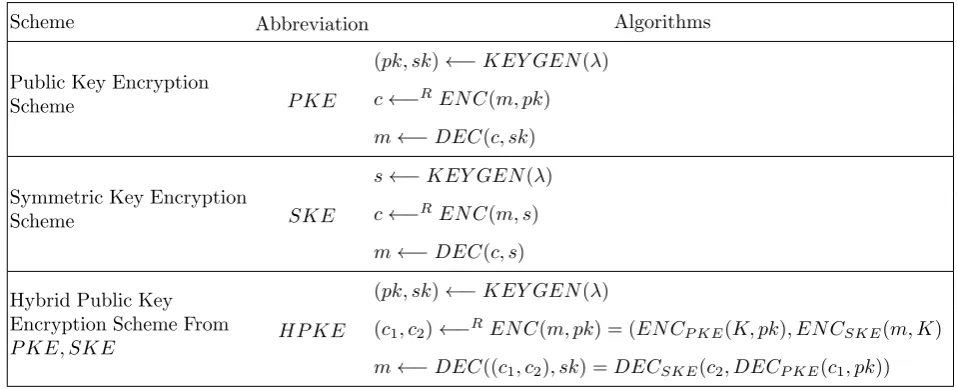
In Table 1, we useλ, pk, sk, m andc to denote the security parameter, the public key, the secret key, the plaintext and the ciphertext in an encryption scheme, respectively. By (c1, c2, . . .)←−A(b1, b2, . . .) we mean
a deterministic algorithmAwhich takesb1, b2, . . .as
input and producesc1, c2, . . .as output. In the case of
a probabilistic algorithm we use the notation←−R.
Table 1. Table of notations.
Scheme Abbreviation Algorithms
Public Key Encryption Scheme
(pk, sk)←−KEY GEN(λ)
P KE c←−REN C(m, pk)
m←−DEC(c, sk)
Symmetric Key Encryption Scheme
s←−KEY GEN(λ)
SKE c←−REN C(m, s)
m←−DEC(c, s) Hybrid Public Key
Encryption Scheme From
P KE, SKE
(pk, sk)←−KEY GEN(λ)
HP KE (c1, c2)←−REN C(m, pk) = (EN CP KE(K, pk), EN CSKE(m, K)
m←−DEC((c1, c2), sk) =DECSKE(c2, DECP KE(c1, pk))
encryptmusingSKEwith the keyK. AP KEwhich is used in the structure of aHP KE is calledkey en-capsulation mechanism (KEM) of thatHP KE.
2.2 Privacy notions
In this paper, the following notions of privacy are considered.
2.2.1 Notions of data privacy
Data privacy of an encryption scheme has been well documented in the literature [8, 20]. We consider three types of adversarial attacks: chosen plaintext attacks (CP A), nonadaptive chosen chiphertext at-tacks (CCA1) and adaptive chosen ciphertext attacks (CCA2). In this section, we provide a breif description of these notions.
Consider the following experiment for any public key encryption scheme Π = (Gen, Enc, Dec):
The CP A indistinguishability experiment
EXPCP A
A,Π (λ):
(1) A key pair, public keypkand secret keyskis generated by runningGen(1λ).
(2) The adversaryAis given input 1λand access to
EncP KE(−, pk).Aoutputs a pair of messages
m0, m1.
(3) A random bitb ← {0,1} is chosen, and then a ciphertextc ←Encpk(mb) is computed and
given toA.
(4) The adversary A continues to have access to
EncP KE(−, pk), and outputs a bitb0.
(5) The output of the experiment is defined to be 1 if
b0=b, and 0 otherwise. (In caseEXPCP A
A,Π (λ) =
1, we say thatAsucceeded .)
Definition 1. (CP A security) A public key
en-cryption scheme Π = (Gen, Enc, Dec) has indis-tinguishable encryptions under a chosen-plaintext attack (or is CPA-secure) if for all probabilistic polynomial-time adversariesAthere exists a negligi-ble functionneglsuch that
P r[EXPACP A,Π (λ) = 1]<1/2 +negl(n),
where the probability is taken over the random coins used byA, as well as the random coins used in the experiment.
If in step 2 of the above experiminent, the adversary
A has access to the decryption oracle DECsk, we
come up with the experimentEXPCCA1
A,Π (λ) and can
define CCA1 security in the same manner. CCA2 security is achieved based onEXPCCA2
A,Π (λ) in which
the adversaryAhas oracle access toDECsk in steps
2 and 4.
The relation between these security notions are as follows:
CP A≤CCA1≤CCA2
In other words, if a scheme isCCA2 secure, then it is alsoCCA1 secure and if a scheme isCCA1 secure, then it is alsoCP Asecure.
2.2.2 Notions of key privacy
The notion of key privacy in the public key encryp-tion was introduced by Bellare et al.[17]. Key privacy provides anonymity of public keys. In the formaliza-tion of key privacy in the public key encrypformaliza-tion set-ting, the adversary has access to a pair of public keys
pk0, pk1and a ciphertextcwhich is the encryption of
Let Π be aP KEscheme andACP Abe the adversary
who is given two public keys. Consider the key privacy experimentEXPAIK−CP A
CP A,Π (λ), played betweenACP A and a challenger, as follow:
• Two key pairs (pk0, sk0),(pk1, sk1) are generated
by runningKEY GEN(λ).
• The adversary ACP Ais given inputλ,pk0 and
pk1. It outputs a messagem.
• The challenger chooses a random bitb∈ {0,1}, computes the ciphertextc=EN CP KE(m, pkb)
and givesctoACP A.
• The adversary tries to guess which public key was used to encryptmand he outputs a bit b0. The output of the experiment is defined to be 1 ifb0=b, and 0 otherwise.
We define the advantage of the adversary via
AdvIKA −CP A
CP A,Π (λ) = |P r[EXP
IK−CP A
ACP A,Π (λ) = 1]
−P r[EXPAIK−CP A
CP A,Π (λ) = 0]|.
Definition 2. (IK −CP Asecurity) The scheme Π has indistinguishability of keys under chosen-plaintext attacks (or is IK −CP A secure) if the function AdvIKA −CP A
CP A,Π (λ) is negligible for polyno-mial time adversaryACP Awhose time complexity is
polynomial inλ.
Consider the experiment EXPAIK−CCA
CCA,Π (λ) the same as EXPAIK−CP A
CP A,Π (λ) except that in this case, the adversary ACCA has access to decryption
ora-clesDECSK0 andDECSK1 as well. It is mandated thatACCAnever queriesDECsk0 orDECsk1 on the challenge ciphertextc.
Definition 3. (IK −CCAsecurity) The scheme Π has indistinguishability of keys under chosen-cipherext attacks (or is IK −CCA secure) if the function AdvIKA −CCA
CCA,Π (λ)) is negligible for any poly-nomial time adversaryACCAwhose time complexity
is polynomial inλ.
It is therefore easy to see that we have
IK−CP A≤IK−CCA.
In other words, if a scheme isIK−CCAsecure, then it is alsoIK−CP Asecure.
2.3 Hardness Assumptions
Security of our proposed scheme is based on the fol-lowing assumptions.
Target Collision Resistant (T CR) Hash Func-tion assumpFunc-tion:A family of hash functions is said to be collision resistant if upon drawing a functionH
at random from the familyH, it is infeasible for an
adversary to find two different inputsxandy such thatH(x) =H(y).
A weaker notion is that of atarget collision resis-tant family of hash functions. In this case, it should be infeasible for an adversary to choose an inputx, draw a random hash functionH, and then find a dif-ferent input y such that H(x) = H(y). Such hash function families are also called ”universal one-way hash functions”.
Decisional Diffie−Hellman (DDH) assump-tionConsider a (multiplicative) cyclic group G of orderqand generatorg. TheDDHassumption states that, givengaandgbfor uniformly and independently
chosena, b∈Zq, the valuegab”looks like” a random
element inG. This intuitive notion is formally stated by saying that the following two probability distribu-tions are computationally indistinguishable (in the security parametern=log(q)).
- T1= (g, ga, gb, gab), whereaandbare randomly
and independently chosen from Zq (T1 is also
known asDH-quadruple).
- T2 = (g, ga, gb, c), where a andb are randomly
and independently chosen from Zq and c is a
random element inG.
3
Related Work
In this section, we first review existing incomparable public key encryption schemes,i.e. Waters et al.’s [15] and Lee and Lim’s [11] schemes. We then provide details of the Cramer-Shoup’sP KE which we later use for peresenting our proposed incomparable public key encryption scheme.
3.1 Waters et al’s Public Key Encryption Scheme
Waters et al.P KEscheme is based on ELGamalP KE
and consists of four algorithms (SETUP, KEYGEN, ENC, DEC) as follows ([15]).
SETUP: On input security parameterλ, the setup algorithm SETUP generates a secure safe prime
p, where p= 2q+ 1 for a prime numberq, sets a cryptographically secure hash functionH, sets a secure symmetric encryption schemeE, and outputs the system parameterI= (p, q, H, E).
KEYGEN:
- On input system parameterI, generatesaat random inZq∗, and sets the private keysk=a. - On input private keysk, generates a generator
g ∈Zp∗ of the orderqat random, and sets a public keypk= (g, ga).
recipient computes another generator h=gx for
randomly chosen 1< x < q, issues the public key (h, ha).
ENC: On input public keypk = (g, ga) and a mes-sagem, the encryption algorithmEchoosesr∈Zq∗
at random and outputs the ciphertext
C=EN CP KE(m, pk)
=(gr, gar.K, H(r), ESKE((r,(g, ga), m), K)).
DEC: On input private key sk and a ciphertext (c1, c2, c3, c4), the decryption algorithm DEC
* ComputesK=c3/ga.
* ComputesDSKE(c4, K) = (r0, pk0, m).
* Checks the equalities H(r0) = c4, gr 0
=
c1mod pand the validity of the public keypk0.
* Outputs m as the plaintext only if all the checks are correct.
3.2 Lee and Lim’s Public Key Encryption Scheme
Lee and Lim’sP KEscheme consists of four algorithms (SETUP, KEYGEN, ENC, DEC) as follows ([11]).
SETUP: On input security parameterλ, the setup algorithm SETUP generates a secure safe prime
p, wherep= 2q+ 1 for a prime numberq, sets a cryptographically secure hash functionH, sets a secure symmetric encryption schemeE, and outputs the system parameterI= (p, q, H, E).
KEYGEN:
- On input system parameterI, generatesa, bat random inZq∗, and sets the private keysk= (a, b).
- On input private keysk, generates a generator
g ∈ Zp∗ of the orderq at random, and sets a public keypk= (g, ga, gb).
To obtain another equivalent public key forsk, the recipient computes another generatorh=gx
for randomly chosen 1< x < q, issues the public key (h, ha).
ENC: On input public keypk = (g, ga) and a mes-sagem, the encryption algorithmEchoosesr∈Zq∗
at random and outputs the ciphertext
C=EN CP KE(m, pk)
=(gr, gar, gbr.K, H(r), EK(r,(g, ga), m)).
DEC: On input private key sk and a ciphertext (c1, c2, c3, c4, c5), the decryption algorithm DEC,
first checks the equalityca1−c2= 0mod p, only if
the equality holds, proceeds as follows: * ComputesK=c3/ga.
* ComputesDSKE(c5, K) = (r0, pk0, m).
* Checks the equalities H(r0) = c
4, gr 0
=
c1mod pandgar 0
=c2mod pand the validity
of the public keypk0.
* Outputsmas the plaintext only if all the checks are correct.
3.3 Cramer-Shoup’s Public Key Encryption Scheme
Assume thatGis a group with a subgroupGbof prime
order q such that the DDH problem is hard in Gb.
Also assume thatH is aT CRhash function fromG3
toZq. The Cramer-ShoupP KE’s algorithms are as
follows ([18, 19]).
KEYGEN: The key generation algorithm on input of the security parameterλ, chooses random ele-mentsx1, x2, y1, y2, z∈Zqandg1, g2∈Gbsuch that
g2=gw1 for somew∈Zq. It computesc=gx11g x2
2 ,
d=gy1
1 g y2
2 ,h=gz1 and setssk= (x1, x2, y1, y2, z)
andpk= (g1, g2, c, d, h).
ENC: To encrypt a messagem∈G, the encryption algorithm choosesr∈Zq at random. It computes
u1 =gr1,u2 =gr2,e=mhr, α=H(u1, u2, e) and
v=crdrα. The ciphertext is (u1, u2, e, v).
DEC: To decrypt a chiphertext (u1, u2, e, v), the
de-cryption algorithm computesα=H(u1, u2, e), and
tests ifux1+αy1
1 u
x2+αy2
2 =v. If this condition does
not hold, the decryption algorithm outputs “reject”; otherwise, it outputsm= e
uz 1 .
4
General
Construction
of
HP KE
with Key Incomparability
The aim of this section is to show that constructing an
HP KEwith key incomparability and desired security properties, reduces to choosing aKEM with desired security properties and proving that thisKEM has key incomparability property. Note that the key com-ponent of such anHP KEis itsKEM. This is because first, public keys in theHP KEare generetaed by the key generation algorithm in itsKEM. So, if there is a feasible secure approach for theKEM to create as many public keys as desired related to a secret key, then the approach can be used for theHP KE, too. Second, if a properSKE is used together with the
KEMto build theHP KE, then the resultingHP KE
inherits security properties (key privacy and data pri-vacy) of theKEM as well. We state the following two lemmas to prove this. In subsequent sections, we prove that under certain hardness assumptions, the Cramer-ShoupP KE achieves key incomparibility and can be used as aKEM with this general construction.
Lemma 1. If aP KE achieves some key privacy se-curity, then anyHP KE that uses this P KE as its
KEM, achieves the same key privacy security.
Proof. Let Π be theHP KE that uses Π0,Π00 as its
exists a polynomial time adversaryAwho can com-promise key privacy of Π with a non-negligible advan-tage, then we can construct a polynomial time dis-tinguisher Dfor compromising key privacy of Π0 as well. Suppose that the distinguisher is given two pub-lic keys pk0, pk1, a messagem and a chiphertextcb.
Its goal is to determine whethercb is the encryption
of m under the public key pk0 or pk1 in the setting
Π0.Demulates the key privacy experiment forAin
the manner described below and observes outputs of
D. IfAoutputs 0 thenDguesses thatcbmust be
en-cryption of m under the public key pk0, while if A
outputs 1 thenDguesses thatcbis the encryption of
munder the public keypk1. In detail:
Distinguisher D: D is given as input a quadruple (m, pk0, pk1, cb).
- The distinguisher D runs KEY GEN(λ) and givespk0, pk1 toAin the setting Π .
- Agenerates a messagem0 and gives it toD. - Dcomputesc0=EN CSKE(m0, m) in setting Π00
(Dusesmas a key) and givesc= (cb, c0) toA.
- A uses his ability to guess whetherc is the en-cryption of m0 under the public keypk0 or pk1
in the setting Π and outputs a bitb0.
- If b0 = 0,Doutputs ”cb is the encryption ofm
under the public keypk0”. Otherwise,Doutputs
”cb is the encryption ofm under the public key
pk1”
Note that whatDoutputs is in the setting Π0. From the above it is obvious that for i = 0,1 we have:
cb=EncP KE(m, pki) in setting Π0if and only ifc=
EN C(m0, pki) in setting Π.
Since the output ofDis based on the output ofA
and D makes a true guess if and only ifA makes a true guess, then the advantage ofAin the key privacy experiment for the setting Π is equal to the advantage of D in the key privacy experiment for the setting Π0. Hence, if Π0 (as a KEM) achieves IK −CCA
(or IK −CP A) key privacy security level then Π (as aHP KE based on Π0) preservesIK−CCA(or
IK−CP A) as well.
Analogous to Lemma 1, we can relate the data privacy properties of aHP KE to the key privacy of itsKEM.
Lemma 2. If KEM and SKE are CCA2 secure, then so isHP KE.(Theorem 5 [19])
5
Our Proposed Scheme
We make novel use of the Cramer-Shoup cryptosystem and its properties to realize an incomparable public key encryption scheme. In our scheme, every recipient in the multicast group can identify the ciphertext
di-rected to him in the multicast address more efficiently. The details of each algorithm of ourP KEscheme are as follows:
SETUP: On input of the security parameterλ, the setup algorithm:
• Generates a group G with a subgroup Gb of
prime orderqsuch that theDDH problem is hard inGb. For exampleGb could be the
sub-group of quadratic residues inZp∗for the prime numberp. Here, we havep= 2q+ 1 whereqis also prime [21].
• Sets a family of T CR hash functions and chooses a random functionH of this family.
• Sets a semantically secure symmetric encryp-tion schemeE ={E, D}.
• Outputs the system parametersI= (p, G, H,E). These parameters are common to all recipients.
KEYGEN: The key generation algorithm consists of two phases defined as follows.
phase 1: On input of the system parameters
I, the algorithm chooses x1, x2, y1, y2, z ∈ Zq∗
at random, and sets the secret key sk = (x1, x2, y1, y2, z).
phase 2: On input of the secret keysk, the algo-rithm generates random elementsg1 of orderq
and for somew∈Zq, and sets a public keypk=
(g1, g2, c, d, h) such thatc=g1x1g x2
2 ,d=g y1
1 g y2
2 ,
h=g1z. To obtain another equivalent public key
forsk, the recipient choosesg10 ∈ Gof orderq
andg20 = gw 0
1 for some w0 ∈ Zq different from
(g1, g2) and sets pk0 = (g10, g20, c0, d0, h0) where
c0= (g10)x1(g0
2)x2,d0 = (g10)y1(g20)y2,h0= (g01)z.
The output is the multiple key (sk, pk, pk0, ...). Ev-ery recipient runs this algorithm to generate his se-cret key and some public keys (as many as needed).
ENC: On input of the public keypk= (g1, g2, c, d, h)
and a messagem, the encryption algorithm chooses
r ∈ Zq and K ∈ G at random and outputs the
chiphertext
C= (g1r, gr2, hrK, crdrα, ESKE((pk, r, m), K))
whereα=H(gr
1, gr2, hrK).
DEC: On input of the secret keysk and a cipher-textC= (c1, c2, c3, c4, c5) the decryption algorithm
DEC proceeds as follow:
step 1 Computesα=H(c1, c2, c3). Then checks
if cx1+y1α
1 c
x2+y2α
2 = c4 or not. If the equality
does not hold, unhands the message, otherwise continues to the next step.
step 2
- ComputesK=c3
cz 1 .
- ComputesDSKE(c5, K) = (pk, r, m) where
D is the decryption algorithm ofE.
algo-rithm SETUP. The recipient with the secret key (x1, x2, y1, y2, z) generates g1, g2 ∈ G at random
and stores the public key (g1, g2, g1x1g x2
2 , g y1
1 g y2
2 , g1z)
in his public key table to record it as being valid. To construct another public key from the se-cret key (x1, x2, y1, y2, z), the recipient generates
another pair s1, s2 ∈ Gb, issues the public key
(s1, s2, sx11s x2
2 , s y1
1 s y2
2 , sz1) with another identity and
adds this public key in his public key table. When a re-cipient see a ciphertext in the address of the multicast group, he checks the first step of DECto determine if the message belongs to him or not. If the equality doesn’t hold, he rejects the message otherwise he saves that message to decrypt it in proper time.
6
Analysis of Our Scheme
In this section, we show that our proposed scheme achieves key incomparability,CCA2-security in data privacy andIK−CCA-security in key privacy. The security of our scheme is based on the hardness of the
DDH problem.
6.1 Key Incomparability
Theorem 1. If theDDHassumption holds inGb, then
our proposed schemeΠachieves key-incomparability.
Proof. We show that if there exists a polynomial time adversary A who can distinguish whether two given public keys are related to the same secret key or not, then this adversary can be used to solve an instance of the DDH problem, thus contradicting the assumption of the theorem.
Consider the following experiment which is designed based on definitions in [11, 15].
public key incomparability experimentP ubKAinc,Π(λ) - The challenger runsSET U P(λ) and generates
two secret keyssk= (x1, x2, y1, y2, z) andsk0=
(x01, x02, y10, y02, z0) such thatsk6=sk0 .
- The challenger generates two public keyspk, pk0
related to the secret keysk and givespkto the adversaryA.
- The challenger generates a public keypk1related
to secret keysk0.
- The challenger chooses a random bitt ∈ {0,1}
and givespkttoA.
- Atries to findtand outputs a bitt0.Awins this game ift0 =t.
We setP ubKAinc,Π(λ) = 1 ifAwins this game. Letεbe the advantage ofAfor the above game, then we have
ε=P r(P ubKAinc,Π(λ) = 1)−1
2
In the game P ubKinc
A,Π(λ), the challenger has to
choosesk 6=sk0. We setEi ={(sk, sk0)|ski 6=ski0},
1≤i≤5 whereskiandski0are theith component of
skandsk0, respectively. Then a selected pair (sk, sk0) in the above game will be at least in one ofEis.
As-sume thatAis an adversary who can win the game
P ubKinc
A,Q with a non-negligible advantageε. Then
at least for one ofEis,Ahas an advantage more than ε
5. We now show how A can be used to construct a
probabilistic polynomial time distinguisherDfor the
DDHproblem.
Suppose that the distinguisher is given a quadruple
T = (g, ga, gb, gc) as input and its goal is to determine
whether T is a Diffie-Hellman (DH) quadruple or not.Demulates the gameP ubKinc
A,Π(λ) forAin the
manner described below, and observes whatDoutputs. In each case, ifA outputs 0 thenDguesses thatT
must be aDH quadruple, while ifAoutputs 1 then
Dguesses thatT is not aDH quadruple. In detail: Distinguisher D: A quadruple T = (g, ga, gb, gc) is given as input .
• Druns SETUP(λ), choosesI∈ {1,2,3,4,5} at random and follows the caseI.
case 1 (x1 6= x01): In this case, D chooses
x2, y1, y2, z∈Zq ,g2∈Gat random and gives
(g, g2, gag2x2, g y1gy2
2 , g z)
toAaspk(indeedDsetssk= (a, x2, y1, y2, z)
without knowing the value of a). D chooses
r∈Zq at random and gives
(gb, g2r, gcgrx2
2 , g by1gry2
2 , g bz)
toAaspkt.
case 2 (x2 6= x02): In this case, D chooses
x1, y1, y2, z∈Zq ,g2∈Gat random and gives
(g2, g, gx1ga, g2y1g y2, gz
2)
toAaspk(indeedDsetssk= (x1, a, y1, y2, z)).
Dchoosesr∈Zq at random and gives
(g2r, gb, grx1
2 g c, gry1
2 g by2, gbz
2 )
toAaspkt.
case 3 (y1 6= y10): In this case, D chooses
x1, x2, y2, z∈Zq ,g2∈Gat random and gives
(g, g2, gx1g2x2, g agy2
2 , g z)
toAaspk(indeedDsetssk= (x1, x2, a, y2, z)).
Dchoosesr∈Zq at random and gives
(gb, g2r, gbx1g bx2
2 , g cgry2
2 , g bz)
toAaspkt.
case 4 (y2 6= y20): In this case, D chooses
x1, x2, y1, z∈Zq ,g2∈Gat random and gives
(g2, g, gx1gx2, gy21g a, gz
toAaspk(indeedDsetssk= (x1, x2, y1, a, z)).
Dchoosesr∈Zq at random and gives
(g2r, gb, grx1
2 g
bx2, gry1
2 g c, gbz
2 )
toAaspkt.
case 5 (z 6= z0) In this case, D chooses
x1, x2, y1, y2 ∈ Zq , g2 ∈ G at random and
gives
(g, g2, gx1g2x2, g y1gy2
2 , g a)
toAaspk(indeedDsetssk= (x1, x2, y1, y2, a)).
Dchoosesr∈Zq at random and gives
(gb, gr2, gbx1grx2
2 , g by1gry2
2 , g c)
toAaspkt.
• Aoutputs a bitt.
• Ift= 0,Doutputs ”T is aDH quadruple” and ift= 1,Doutputs ”T is not aDH quadruple”. For a givenT,D(T) = 1 if and only ifDtruly guess whetherT is aDHquadruple or not. SinceDoutputs
T is aDH quadruple if and only ifAoutputs 0, then for the casei, we have
P r(Doutputs”T is a DH quadruple”|I=i) =
P r(Aoutputs0|Ei),
where the probability is conditioned on the event that caseiis selected byD. But for each of the above cases we havepkandpktare related to the same secret key
if and only ifc=abif and only ifTis aDHquadruple. Then
pr(D(T) = 1|I=i) =pr(P ubKAinc,Π(λ) = 1|Ei).
On the other side, we have
P r(D(T) = 1)−1
2 =
5
X
i=1
P r(I=i)P r(D(T) = 1|I=i) −1
2 =
5
X
i=1
P r(I=i)P r(P ubKAinc,Π(λ) = 1|Ei) −
1 2 =1
5
5
X
i=1
P r(P ubKAinc,Π(λ) = 1|Ei) −
1 2 =1
5
5
X
i=1
(P r(P ubKAinc,Π(λ) = 1|Ei) −
1 2)≥
1 5 ×
ε
5 =ε
25.
Therefore, if is non-negligible (i.e., our proposed scheme does not achieve key-incomparability), the distinguisher D can solve the DDH problem with non-negligible advantage 25ε which is clearly a contra-diction to theDDHassumption inG.
6.2 Key Privacy
Key privacy plays an important role in providing anonymity of public keys. Hence, we have to show that our proposed scheme achieves some key privacy security levels. The aim of this section is to prove that our proposed scheme isIK−CCAsecure. To do so, we note that our proposed scheme is a hybrid scheme based on Cramer-Shoup encryption scheme as aKEM. Then, we use Lemma 1 and the following theorem which has been proved by Bellare et al. in [17] to establish our claim.
Theorem 2. LetGbe a group with a subgroupGbof
prime orderqand letCS be the associated Cramer-Shoup scheme. If theDDHproblem is hard inGb, then
CSis anonymous in the sense ofIK−CCA. (theorem 3.2 [17])
Therefore, the next theorem follows directly from Lemma 1 and Theorem 2.
Theorem 3. If theDDHproblem is hard inG, then the proposed scheme isIK−CCA-secure in the sense of key privacy.
6.3 Data Privacy
In our scheme, we have adopted the idea of Wa-ters et al.’s scheme to Cramer-Shoup’s encryption scheme. This is achieved through the following lemma of Cramer and Shoup.
Lemma 3. If theDDH assumption holds forGand theT CRassumption holds forH, then Cramer-Shoup encryption scheme isCCA2secure.(Theorem 2 [19])
We used Cramer and Shoup’sP KEas theKEMof ourHP KEand a family of semantically secureSKE
then the following theorem results from the Lemmas 3, 2.
Theorem 4. Our proposed scheme isCCA2secure.
7
Comparison
Table 2. Comparison of the existing incomparable public key encryption schemes.
Scheme Incomparability Efficient Decryption Key privacy Data Privacy
Waters et al. [15] Yes No IK−CP A CCA1
Lee and Lim[11] Yes Yes IK−CP A CCA1
Our Scheme Yes Yes IK−CCA CCA2
8
Conclusion
Existing incomparable public key cryptosystems pro-posed by Waters et al. and Lee and Lim are based on the ElGamal encryption scheme. Both of these schemes haveIK−CP A(indistinguishability of keys under chosen plaintext attacks) in key privacy. On the other hand, The homomorphic property of the ElGamal implies that these schemes can not achieve security level better thanCCA1. In this paper, we employ the Cramer-Shoup encryption scheme to pro-pose an incomparable public key encryption scheme which achievesCCA2 security in data privacy and has IK −CCA (indistinguishability of keys under adaptive chosen ciphertext attacks) in key privacy.
References
[1] Hung-Yu Chien. Improved Anonymous Multi-receiver Identity-Based Encryption.
The Computer Journal, 55(4):439–446, 2012. doi: 10.1093/comjnl/bxr086. URL http: //comjnl.oxfordjournals.org/content/55/ 4/439.abstract.
[2] Chun-I Fan and Yi-Fan Tseng. Anonymous multi-receiver identity-based authenticated en-cryption with cca security. Symmetry, 7 (4):1856–1881, 2015. ISSN 2073-8994. doi: 10.3390/sym7041856. URL http://www.mdpi. com/2073-8994/7/4/1856.
[3] Philippe Golle, Stanislaw Jarecki, and Ilya Mironov. Cryptographic Primitives Enforcing Communication and Storage Complexity, pages 120–135. Springer Berlin Heidelberg, Berlin, Hei-delberg, 2003. ISBN 978-3-540-36504-4. doi: 10.1007/3-540-36504-4 9. URLhttp://dx.doi. org/10.1007/3-540-36504-4_9.
[4] Philippe Golle, Markus Jakobsson, Ari Juels, and Paul Syverson. Universal Re-encryption for Mixnets, pages 163–178. Springer Berlin Heidelberg, Berlin, Heidelberg, 2004. ISBN 978-3-540-24660-2. doi: 10.1007/ 978-3-540-24660-2 14. URL http://dx.doi. org/10.1007/978-3-540-24660-2_14.
[5] Graeme Horsman and Lynne R. Conniss. An investigation of anonymous and spoof
{SMS} resources used for the purposes of cyberstalking. Digital Investigation, 13: 80 – 93, 2015. ISSN 1742-2876. doi: http: //dx.doi.org/10.1016/j.diin.2015.04.001. URL
http://www.sciencedirect.com/science/ article/pii/S1742287615000419.
[6] SK Hafizul Islam, Muhammad Khurram Khan, and Ali M. Al-Khouri. Anonymous and provably secure certificateless multireceiver encryption without bilinear pairing. Security and Commu-nication Networks, 8(13):2214–2231, 2015. ISSN 1939-0122. doi: 10.1002/sec.1165. URL http: //dx.doi.org/10.1002/sec.1165.
[7] Marzieh Ispareh and Behrouz Tork Ladani. A Conceptual Framework for Specification, Analy-sis, and Design of Anonymity Services. In Pro-ceedings of the 2009 EDBT/ICDT Workshops, EDBT/ICDT ’09, pages 131–138, New York, NY, USA, 2009. ACM. ISBN 978-1-60558-650-2. doi: 10.1145/1698790.169881978-1-60558-650-2. URL http: //doi.acm.org/10.1145/1698790.1698812. [8] Jonathan Katz and Yehuda Lindell. Introduction
to modern cryptography. CRC press, 2014. [9] Markulf Kohlweiss, Ueli Maurer, Cristina
Onete, Bj¨orn Tackmann, and Daniele Ven-turi. Anonymity-Preserving Public-Key En-cryption: A Constructive Approach, pages 19– 39. Springer Berlin Heidelberg, Berlin, Hei-delberg, 2013. ISBN 978-3-642-39077-7. doi: 10.1007/978-3-642-39077-7 2. URLhttp://dx. doi.org/10.1007/978-3-642-39077-7_2. [10] Guido Lang and Tamilla Mavlanova. Perceptions
and Use of Anonymous Communication across Cultures. Journal of International Technology and Information Management, 24(1):4, 2015. [11] Hyang-Sook Lee and Seongan Lim. An
ef-ficient incomparable public key encryption scheme. Information Sciences, 181(14):3066 – 3072, 2011. ISSN 0020-0255. doi: http: //dx.doi.org/10.1016/j.ins.2011.03.009. URL
http://www.sciencedirect.com/science/ article/pii/S002002551100137X.
ISBN 978-3-642-45204-8. doi: 10.1007/ 978-3-642-45204-8 25. URL http://dx.doi. org/10.1007/978-3-642-45204-8_25.
[13] Farahnaz Rezaeian Zadeh and Shohreh Ajouda-nian. A Novel Solution for Author Attribution Problem in Anonymous E-mail. Journal of Com-puting and Security, 1(4), 2015. ISSN 2383-0417. URL http://jcomsec.org/index.php/ JCS/article/view/95.
[14] Y. M. Tseng, Y. H. Huang, and H. J. Chang. CCA-secure Anonymous Multi-receiver ID-based Encryption. In2012 26th International Confer-ence on Advanced Information Networking and Applications Workshops, pages 177–182, March 2012. doi: 10.1109/WAINA.2012.50.
[15] Brent R. Waters, Edward W. Felten, and Amit Sahai. Receiver Anonymity via Incomparable Public Keys. In Proceedings of the 10th ACM Conference on Computer and Communications Security, CCS ’03, pages 112–121, New York, NY, USA, 2003. ACM. ISBN 1-58113-738-9. doi: 10.1145/948109.948127. URLhttp://doi.acm. org/10.1145/948109.948127.
[16] Jianhong Zhang and Jian Mao. An improved anonymous multi-receiver identity-based encryp-tion scheme. International Journal of Commu-nication Systems, 28(4):645–658, 2015. ISSN 1099-1131. doi: 10.1002/dac.2693. URL http: //dx.doi.org/10.1002/dac.2693.
[17] Mihir Bellare, Alexandra Boldyreva, Anand Desai, and David Pointcheval. Key-Privacy in Public-Key Encryption, pages 566–582. Springer Berlin Heidelberg, Berlin, Heidelberg, 2001. ISBN 978-3-540-45682-7. doi: 10.1007/ 3-540-45682-1 33. URL http://dx.doi.org/ 10.1007/3-540-45682-1_33.
[18] Ronald Cramer and Victor Shoup. A prac-tical public key cryptosystem provably secure against adaptive chosen ciphertext attack, pages 13–25. Springer Berlin Heidelberg, Berlin, Hei-delberg, 1998. ISBN 978-3-540-68462-6. doi: 10. 1007/BFb0055717. URL http://dx.doi.org/ 10.1007/BFb0055717.
[19] Ronald Cramer and Victor Shoup. Design and Analysis of Practical Public-Key Encryp-tion Schemes Secure against Adaptive Chosen Ciphertext Attack. SIAM Journal on Com-puting, 33(1):167–226, 2003. doi: 10.1137/ S0097539702403773. URLhttp://dx.doi.org/ 10.1137/S0097539702403773.
[20] Mihir Bellare, Anand Desai, David Pointcheval, and Phillip Rogaway.Relations among notions of security for public-key encryption schemes, pages 26–45. Springer Berlin Heidelberg, Berlin, Hei-delberg, 1998. ISBN 978-3-540-68462-6. doi: 10. 1007/BFb0055718. URL http://dx.doi.org/
10.1007/BFb0055718.
[21] Dan Boneh. The Decision Diffie-Hellman prob-lem, pages 48–63. Springer Berlin Heidelberg, Berlin, Heidelberg, 1998. ISBN 978-3-540-69113-6. doi: 10.1007/BFb0054851. URL http://dx. doi.org/10.1007/BFb0054851.
Bahman Rajabi received his B.S. degree in Mathematics in 2007 from Shahrood Uni-versity, Semnan, Iran. In 2010, he received his M.S. degree in Mathematics from Shahid Beheshti University, Tehran, Iran. He is cur-rently a Ph.D. student in the Department of Mathematic, Shahid Beheshti University. His research interests include cryptographic protocols and network security.