Forough Rafii1, Maryam Jan Amiri1*, Afsaneh Dehnad2, Hamid Haghani3
1. Department of Medical Surgical, School of Nursing and Midwifery, International Campus, Iran University of Medical Sciences, Tehran, Iran. 2. Department of Management and Information, Faculty of Management and Information, Iran University of Medical Sciences, Tehran, Iran. 3. Department of Biostatistics, School of Public Health, International Campus, Iran University of Medical Sciences, Tehran, Iran.
* Corresponding Author: Maryam Jan Amiri, MSc.
Address: School of Nursing and Midwifery, Iran University of Medical Sciences, Rashid Yasemi St., Vali Asr Av., Tehran, Iran. Tel: +98 (937) 3461484
E-mail: [email protected]
Research Paper:
The Effect of Workshop and Multimedia Training Methods on
Nurses’ Knowledge and Performance on Blood Transfusion
Background: Blood transfusion faults and its consequences are major concerns of health care systems. This study aimed to determine the effects of workshop and multimedia training methods on nurses’ knowledge and performance about blood transfusion.
Methods: It was a controlled quasi-experimental study. Sampling was conducted. Data were collected from 37 participants in three hospitals during 2016 by a three-part questionnaire consisting of nurses’ demographic information, routine blood transfusion knowledge (RBTQ) questionnaire, and Purfarzad-performance-evaluation questionnaire. Statistical analyses were conducted using SPSS V. 20.
Results: Nurses’ knowledge and performance levels in workshop and multimedia groups increased from the average to the good level. No significant differences was found between workshop and multimedia groups regarding knowledge (P = 0.474) and performance scores (P = 0.984). Results of paired T-Test showed no significant differences before and after knowledge evaluation in control group (P = 0.262), while it revealed significant differences in workshop and multimedia group so that, the knowledge scores level increased from average to good (P = 0.474). Mean (±SD) performance scores in multimedia group were 70.36 (7.06) and 79.78 (0.91) before and after intervention, respectively. Therefore, before training the performance of groups was in average levels but they improved to the good levels after training (P = 0.984). Paired T-Test for workshop and multimedia groups before and after intervention revealed significant differences (P < 0.001).
Conclusion: This study showed that workshop and multimedia training methods are effective in promoting the nurses’ knowledge and performance. None of these two methods outweighed the other. One reason in this regard might be due to mutual connection between teacher and students, the possibility to ask and answer the questions, discussing in workshop method, and the possibility to repeat the concepts and regulate the pace of training based on individuals learning abilities in multimedia method.
A B S T R A C T
Keywords:
Workshop, Multimedia, Knowledge,
Performance, Nurse, Blood transfusion
Article info:
Received: 04 Jun. 2016
Accepted: 02 Sep. 2016
Citation: Rafii, F., Jan Amiri, M., Dehnad, A., & Haghani, H., 2016. The Effect of Workshop and Multimedia Training Methods on Nurses’ Knowledge and Performance on Blood Transfusion. Journal of Client-Centered Nursing Care, 2(4), pp. 223-230. https://doi.org/10.32598/jccnc.2.4.223
:
1. Background
owadays, organizations allocate lots of their resources to educate their personnel
(Alavi et al. 2009). In nursing education, the relationship between education and nursing services are growing, as well. Because of the need for creating dynamicity in this field and importance of nursing education through the life time (Heravi et al. 2004), the necessity of a cost-effec-tive, practical and most effective training program is dis-closed. With a continuous training, nurses can properly react to the rapid alterations in health system and upgrade their job skills. The science has a half-life of 2.5 years, and afterward would be considered as outdated and old. In addition, with the rapid advances in health related knowledge and technologies, basic training of nursing is practical only in a 10-year period (Jalali et al. 2004).
Thus, updating knowledge, which is mentioned in clini-cal governance and effective on knowledge and perfor-mance of medical staff as well as nurses is very impor-tant. Learning domains is divided into three major parts, namely, knowledge, attitude, and performance and train-ing the nurses in all parts is necessary (Seif 2011). There is a relationship between knowledge and performance, for instance, one with a limited knowledge might be un-able to perform or behave professionally in his or her job
(Izad Panah 1994;Aghajan et al. 2013).
One of the big challenges in nursing education is pro-viding an effective training method. There are variety of training methods, including workshop method. Work-shop method consists of educational sessions held in order to teach a specific updated knowledge or skill for limited numbers of participants. In workshop classes, ev-ery educator can share and discuss his or her experiences about the topics and exchange his or her ideas and points of view with other participants (Haghani et al. 2012).
Educational technology has hastily advanced through its path. Early in this century, the importance of the au-diovisual instruments in education was revealed and thereafter, a great evolution has happened in this area. The prophecy of educational technology is to provide such conditions that make learning processes more effi-cient and easier, improve creative capabilities of educa-tors so that, they are responsible for their own learning, and encourage participants to interact with a larger com-munity (Sabeghi, Heydari & Borhani 2012).
One of the educational methods is multimedia method. Multimedia means communicating and transferring
top-ics and concepts with the use of different media such as speech, music, images, text, animation, and interac-tive and user-friendly interfaces environments. With the arrival of Windows 95 operating system and improve-ments of computers’ sound and image, multimedia was introduced. This tool is effective on better learning because it is interesting, cost-effective, low size, and engages various senses (van den Brink, Jager & Tost
2013). However, despite new learning methods, which are based on problem solving and using the internet and computers, the workshop method still remains one of the popular methods (Marambe, Edussuriya & Dayaratne
2012;Lai, Ngim & Fullerton 2012).
Blood transfusion is one of the interventions that nurs-ing knowledge has a great impact on decreasnurs-ing its com-plications and dangers; it is reported that, lots of mor-talities caused by blood transfusion is due to the lack of knowledge (Hijji, Arwa & Dabbour 2012). There is no systemic report on the blood transfusion errors and mis-takes in Iran. In the UK, from 2005 to 2010, a number of 7048 blood transfusion complications was reported. In addition, from 3054 reports given in 2011, half of the mis-takes were related to the basic information about blood transfusion, like patient identification (Hijji et al., 2010).
Various studies have investigated the causes of this re-ported errors and mistakes which has been led to wrong administration of blood products. Some of the reasons were insufficient or inappropriate training of doctors and nurses in blood transfusion concepts and also lack of personnel (Purfarzad et al. 2012;Stainsby et al., 2005). According to above-mentioned, addressing the nurses training and retraining issues in order to update their knowledge and improve their performance is necessary. Thus, this study aimed to investigate and compare the effects of workshop and multimedia training methods on knowledge and performance of the nurses in the field of blood transfusion in hospitalized patents.
2. Materials & Methods
Study design and participantsThis is a controlled quasi-experimental study. This re-search conducted with the approval of the University Research Ethics Committee with code No. IR.IUMS. REC.1395.9211196222 and approval of Iran Research Council and MS Society. Before starting the study, writ-ten and oral consent were taken from patients. Study population were nurses working in oncology, surgery, and emergency departments of three hospitals affiliated to Iran University of Medical Sciences (Firooz Abadi,
Firoozgar, and Rasool Akram hospitals). All participants had BS and were included into the study based on conve-nience sampling. Inclusion criteria were as follows: be-ing engaged for at least six months in current work place, not being NGO workers, and providing direct care to the patients. Exclusion criteria were non-cooperation during the study and any department displacement. Participants were divided into three groups (workshop, multimedia, and control), consisting 37 participants in each group.
Data collection
Data were collected through a three-part questionnaire. In section one, there were 7 demographic questions (age, sex, blood transfusion performance history, education, and emergency, surgery, and/or oncology work experiences).
The second section was routine blood transfusion knowledge questionnaire with 32 questions that evalu-ates nurses’ knowledge about blood transfusion in a self-reporting format. The least and the highest scores were 0 and 32, respectively. Scores less than or equal to 50% of total score (0-16) assumed as poor knowledge, scores between 51% to 75% (17-24) of total scores assumed as average knowledge, and finally scores more than 75% (25-32) of total score assumed as good knowledge. The questionnaire should be answered in 30 minutes (Purfar-zad et al. 2012). The validity of this questionnaire has been confirmed and its Cronbach α test was estimated as 0.8 to confirm its reliability (Hijji, Arwa & Dabbour 2012). Ten members of science committee of Iran University of Medical Sciences confirmed the questionnaire’s validity. In terms of reliability, internal correlation was used and Cronbach α was 0.789 for this questionnaire.
The third part evaluated the nurses performance toward blood transfusion. In this regard, the self-reporting per-formance-evaluator questionnaire was used (Purfarzad et al. 2012). The mentioned questionnaire comprised 20 questions about nurses’ performance in terms of blood
transfusion with the 5-point Likert-type scale. The scores were between 0 and 80. Scores less than or equal to 75% (0-60) rated as poor score, scores between 76% to 90% (61-72) rated as average score, and scores more than 90% (73-80) rated as good score. The questionnaire should be answered in 10 minutes. The questions were about nec-essary actions before, during, and after blood transfusion and incidence of possible adverse reactions. The validity of this questionnaire was confirmed and the Cronbach α test has estimated as 0.7 in terms of its reliability (Pur-farzad et al. 2012). In the current study, to determine the scientific validity of data collector’s tools, content valid-ity method was used; the questionnaire was evaluated by the use of related articles and textbooks and also advice of 10 professors. Internal correlation was used and the Cronbach α was 0.759 for this questionnaire. It is worth mentioning that in order to prevent data contamination, performance questionnaire was distributed after collect-ing the knowledge questionnaire.
Intervention
Before intervention, a pretest was obtained from all participants. The workshop group received four sessions containing presentation, slideshows, group discussion, question and answer, and practice; each session took approximately 4 hours. The multimedia group received a multimedia file (visual and audio). The storyline soft-ware was used in multimedia group. Educational con-tents were identical in both groups and the only differ-ence was educational methods. The presented topics were derived from scientific websites, resources and articles. The content of topics was about process, history and applications of blood transfusion, necessary actions before, during, and after blood transfusion and having best performance encountering blood transfusion com-plications. Two weeks after intervention a posttest was obtained from 3 groups.
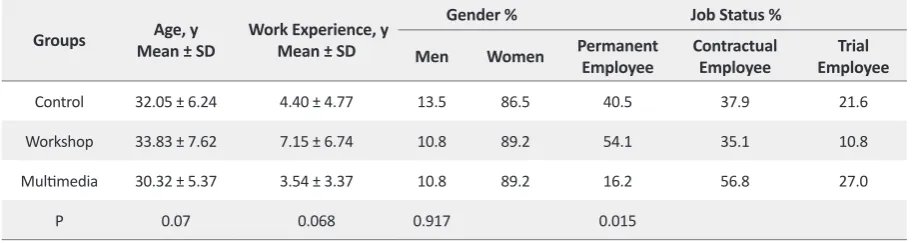
Table 1. Demographic characteristics of participants (n = 111)
Groups Mean ± SDAge, y Work Experience, yMean ± SD
Gender % Job Status %
Men Women Permanent Employee ContractualEmployee EmployeeTrial
Control 32.05 ± 6.24 4.40 ± 4.77 13.5 86.5 40.5 37.9 21.6
Workshop 33.83 ± 7.62 7.15 ± 6.74 10.8 89.2 54.1 35.1 10.8
Multimedia 30.32 ± 5.37 3.54 ± 3.37 10.8 89.2 16.2 56.8 27.0
P 0.07 0.068 0.917 0.015
Data analysis
Data were assessed by descriptive (frequency, mean and standard deviation) and inferential statistics, Chi Square, Kruskal-Wallis, ANOVA, and Scheffe post hoc tests using SPSS V. 20. P values less than 0.05 were con-sidered as statistically significant.
3. Results
Demographic characteristics of participants (Table 1)
disclosed that based on ANOVA analyses, 3 groups did not have any significant mean age differences. In addi-tion, based on Chi-square and Kruskal-Wallis analyses, three groups were homogenous in terms of sex and work experience, respectively. However, Chi-square analyses revealed a significant differences in job status between groups (P < 0.05). Overall, homogeneity analyses of this study exhibited that three groups were homogenous in terms of age, sex, and work experience but were differ-ent in terms of job status.
Table 2 results based on Fischer test, show that the blood transfusion times had significant differences in three groups (P = 0.031). It is worth mentioning that, the major-ity (40.5%) of participants in the control group had already performed blood transfusion (1-4) times, whereas, in the workshop group the majority (29.7%) had never experi-enced blood transfusion. In addition, 35.1% of multimedia group performed more than 12 times of blood transfusion.
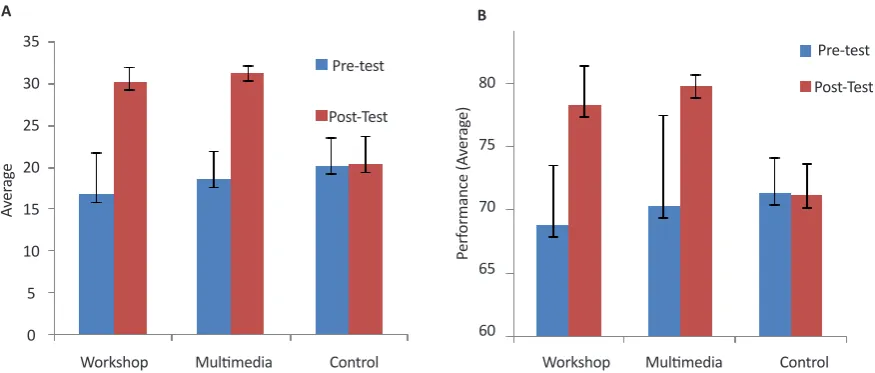
Results of participants’ knowledge evaluation showed that in workshop group, Mean (±SD) scores of knowl-edge before and after training were 16.68(4.93) and 30.37(1.60), in multimedia group 18.62(3.36) and 31.40(0.86), and in control group 20.18(3.36) and 20.35(3.41), respectively (Figure 1).
Results of paired T-Test in each group revealed that mean score of knowledge in control group did not show any significant differences before and after study (P = 0.262). Whereas, mean score of knowledge had sig-nificant differences between workshop and multimedia groups before and after study (P < 0.001). In addition, Table 2. Distribution and homogeneity of blood transfusion times between groups (n = 111)
Group Blood Transfusion Times %
0 1 - 4 5 - 8 9 - 12 12 <
Control 21.6 40.5 16.2 5.4 16.2
Multimedia 10.8 21.6 24.3 8.1 35.1
Workshop 29.7 27.0 5.4 18.9 18.9
P 0.031
Client-CenteredNursingCare
Client-CenteredNursingCare
A B
Figure 1. Mean knowledge (A) and performance (B) scores of nurses before and after the study
Workshop Workshop
35
30
25
20
15
10
5
0
80
75
70
65
60
Av
er
ag
e
Multimedia Control Multimedia Control
Pe
rformance (A
ver
ag
e)
Pre-test Pre-test
Post-Test
scores increased from average to good in both groups. Mean (±SD) score of performance in workshop group be-fore and after training was 68.87(4.61) and 78.26(3.06), respectively and the scores rose from average to good.
Mean (±SD) score of performance in multimedia group before and after training was 70.36(7.06) and 79.78(0.91), respectively. Thus, although, majority of the study subjects were at average level before the tion, they upgraded to the good level after the interven-tion. Furthermore, performance scores of control group before and after study were 71.35(2.74) and 71.10(2.52), which indicates no significant changes (P < 0.001).
Results of ANOVA illustrated that knowledge scores be-fore intervention at least in one group was significantly different from others. Scheffe test indicates that mean knowledge score in control group was significantly differ-ent from workshop group and was higher in control group (P = 0.002) (Table 3). Due to the results of ANOVA, per-formance scores did not have any significant differences between groups before intervention (P = 0.117) (Table 3). Scheffe test revealed that mean performance scores in three groups were different from each other and was low-er in the control group and highlow-er in multimedia group.
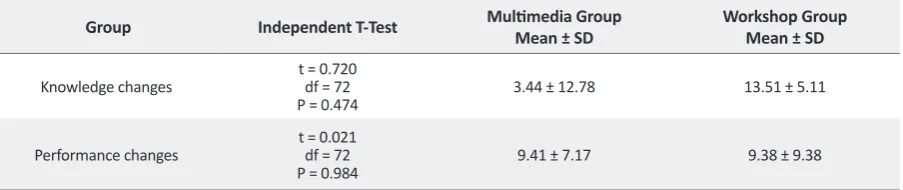
Based on Table 4 results, independent T-Test revealed that there was no significant difference between
work-shop and multimedia groups in terms of knowledge and performance scores after intervention (P = 0.474). Thus, although both methods are effective in upgrading the knowledge and performance scores, none of the men-tioned methods outweighed the other one.
4. Discussion
This study showed conspicuous changes in knowledge and performance scores in both experimental groups af-ter the inaf-tervention. Knowledge and performance levels increased from average to the good levels, which indi-cates the effectiveness of both training methods. A study evaluated the knowledge of Brazilian nurses on blood transfusion; the results were similar to our study. This study revealed that lack of knowledge in some aspects is critical and may endanger the patients’ health. Further-more, it can decrease the effectiveness of blood transfu-sion and put the patients at the risk of receiving contami-nated blood (Hijji, Arwa & Dabbour 2012). Since the control group did not receive any intervention, obviously there was no significant changes in this group before and after the study. Purfarzad et al. (2012) reported that there was a need for increasing the knowledge about blood transfusion complications and improving the related per-formances, and emphasized on the importance of training programs and the vital role of managers in controlling and supervising this issue.
Table 3. Mean ± SD knowledge and performance scores comparison in three groups before intervention (n = 111)
Group Knowledge Mean ± SD PerformanceMean ± SD
Workshop 16.86 ± 4.93 46.87 ± 4.61
Multimedia 18.62 ± 3.36 70.36 ± 7.06
Control 20.18 ± 3.36 71.35 ± 2.74
Analyses of variance F = 6.529 P = 0.002 P = 0.117
Client-CenteredNursingCare
Table 4. Knowledge and performance changes of intervention groups (n = 111)
Workshop Group Mean ± SD Multimedia Group
Mean ± SD Independent T-Test
Group
13.51 ± 5.11 3.44 ± 12.78
t = 0.720 df = 72 P = 0.474 Knowledge changes
9.38 ± 9.38 9.41 ± 7.17
t = 0.021 df = 72 P = 0.984 Performance changes
According to the results, knowledge changes before and after intervention had statistically significant differ-ences in three groups (P < 0.001). Results of the after in-tervention analyses disclosed that changes in the control group was very small and it was significantly different from the other groups. Knowledge score changes was not significantly different between workshop and multi-media groups, thus they were identically effective. Based on our knowledge, there was not any similar study which compare workshop and multimedia training methods. So comparison of our results with the results of other studies was not possible.
Aghajani et al. (2013) in their study evaluated the im-pact of multimedia training on knowledge and perfor-mance of surgical technology students and observed significant differences between knowledge (P = 0.01) and performance (P = 0.03) of participants before and after the intervention. Tukey test in the mentioned study revealed that the highest differences and impacts was ob-served on participants’ knowledge. Thus, the mentioned study implies the effectiveness of multimedia method on upgrading knowledge and performance of participants, as well. In the quasi-experimental study of Perfeito et al. pleural drainage technique was taught to 35 medical stu-dents with the multimedia and workshop methods. There was no significant differences between two groups in the mentioned study (Perfeito et al. 2008).
Changes of performance scores in workshop and multi-media groups were not statistically different. So that, no method overweighed the other. The study of Alijanpour et al. (2014) which investigated the effects of multimedia and practical training on cardiac and pulmonary resuscitation in medical students, reported that practical method is more effective than multimedia method regarding students’ bet-ter performance and skill earning. The results of mentioned study is not similar to our results.
In this study, the two intervention methods were equally effective. In workshop training method, individuals can learn better through discussing the issues, exchanging their experiences, and actively participating in the edu-cational process. They can memorize the subjects more precisely and remember them easily (Berahmandpour &
Ardestani 2012). On the other hand, in multimedia train-ing method, individuals can learn better through simulta-neous using of the senses, ability to repeat the concepts, giving exam at the same time with learning, and the abil-ity to adjust the speed of training with learning capabili-ties (Wang 2008). Thus, both mentioned methods are ef-fective on learning.
Because of the continuous expansion of Nursing and Medical Sciences, the research on methods which pro-mote knowledge and performance in nursing seems nec-essary. Therefore, it is important to know and identify the effective and new methods and technologies in nursing education. In order to improve nursing education, it is vital to include some theoretical courses to train and re-train nurses during education and after graduation. Thus, they can provide better, faster and more comprehensive service to the patients. According to the findings of this study to improve nurses’ knowledge and performance, both methods are useful, but this study suggests that in-tegration of both methods (workshop and multimedia) could be more effective on improving nurses’ knowl-edge and performance.
Acknowledgements
This paper was extracted from the MSc. thesis of Ms. Jan Amiri, Department of Nursing and Midwifery, Iran University of Medical Sciences.
Conflict of Interest
The authors declared no conflict of interests.
References
Aghajani, M., et al., 2013. [Designing multi-media mearning software (MLS): Effects on surgical technology students’
knowledge, attitude and practice (Persian)]. Life Science
Jour-nal, 10(10s), pp. 7-11.
Alavi, S. S., Ebrahimzade, I., Karimzadgan-Moghaddam, D., et al., 2009. [The comparison of rapid E-learning approach and traditional E-learning in staff In-service training in Tehran
university of medical sciences (Persian)]. Journal of Knowledge
& Health, 4(1), pp. 16-23.
Alijanpour, E., et al., 2014. [Assessment of different cardio-pul-monary resuscitation teaching approach on quality of
educa-tion in medical student, Babol 2011 (Persian)]. Medical Journal
Of Mashhad University Of Medical Sciences. 56(6), pp. 376-82.
Berahmandpour, F., & Ardestani, M. S., 2012. [Guidance for
selec-tion of media and methods of health educaselec-tion (Persian)]. Arman,
Tehran.
Haghani, F., Memarzadeh, M., & Eghbali, B., 2012. [Effects of “Teaching Method Workshop” on general surgery residents′
teaching skills (Persian)]. Journal of Education and Health
Promo-tion, 1(1), p. 38. doi: 10.4103/2277-9531.104808.
Heravi, M., Jadid Milani, M., & Rejeh, N., 2004. [The effect of lec-ture and focus group teaching methods on nursing students
learning in community health course (Persian)]. Iranian Journal
Hijji, B. M., Arwa, A. E., Dabbour, R. S., 2012. Measuring knowl-edge of blood transfusion; A survey of Jordanian nurses. American International Journal of Contemporary Research, 2(10 ), pp. 77-94.
Hijji, B. et al., 2010. Nurses’ practice of blood transfusion in the
United Arab Emirates: An observational study. Journal of
Clinical Nursing, 19(23-24), pp. 3347–57. doi:
10.1111/j.1365-2702.2010.03383.x
Izad Panah, A. M., 1994. [Reviewing the view points of head nurses and patients about the professional competence of new nurse working in hospitals affiliated to the Ministry of Health, Treatment and Medical Education in Mashhad (MSc. thesis) (Persian)]. Shahid Beheshti University of Medical Sciences, Tehran.
Jalali, R., Abdul-Maleki, P., & Kahrizi, M., 2006. [Continuous
nursing education from nurses’ point of view (Persian)].
Jour-nal of Kermanshah University of Medical Sciences, 10(1), 67-75.
Lai, N., Ngim, C., & Fullerton, P., 2012. Teaching medical stu-dents neonatal resuscitation: Knowledge gained and retained
from a brief simulation-based training workshop. Education for
Health, 25(2), pp. 105-10. doi: 10.4103/1357-6283.103457
Magnussen, L., Ishida, D., & Itano, J., 2000. The impact of the use of inquiry-based learning as a teaching methodology on the
development of critical thinking. Journal of Nursing Education,
39(8), pp. 360-4.
Marambe, K., Edussuriya, D., & Dayaratne, K. M. P., 2012. At-titudes of Sri Lankan medical students toward learning
com-munication skills. Education for Health, 25(3), pp. 165-71. doi:
10.4103/1357-6283.109796
Perfeito, J. A. J. et al., 2008. [Development and assessment of a multimedia computer program to teach pleural drainage techniques (Portuguese)]. Jornal Brasileiro de Pneumologia. ; 34(7), pp. 437–444. doi: 10.1590/s1806-37132008000700002
Purfarzad, Z., et al., 2012. [Nurses’ knowledge and practice of blood transfusion in hospitals of Arak in 2010 (Persian)].
Khoon, 1(9), pp. 337-45.
Sabeghi, H., Heydari, A., & Borhani, F., 2012. [Assessment of the effect of continuing education program on nurse’s knowl-edge, attitude and performance about documentation (Per-sian)]. Evidence Based Care, 2(1), pp. 75-83.
Seyf, A. A., 2011. Measurement, assessment and evaluation of
education (Persian)], 28th edn, Dowran Pub, Tehran.
Stainsby, D. et al., 2005. Reducing adverse events in blood
trans-fusion. British Journal of Haematology, 131(1), pp. 8–12. doi:
10.1111/j.1365-2141.2005.05702.x
van den Brink, K., Jager, R. S., & Tost S., 2013. Educational
multi-media in school. An evaluation study. Paper presented at The
IEEE International Conference on Multimedia Computing and
Sys-tems, Marrakech, Morocco.
Wang, L., 2008. Developing and evaluating an interactive multi-media instructional tool: Learning outcomes and user
experi-ences of optometry students. Journal of Educational Multimedia