HOW EFFECTIVE IS EU IN PROVIDING SECURITY? ANALYSIS OF
THE COREPER AND PSC IN TH
DIPLOMACY
Maria Mirona MUREA, PhD
The Faculty of International Business and Economics, Bucharest Academy of Economic Studies [email protected]
Abstract: The European Union represents a unique form of cooperation between 28 Member States, which accessed this economic and political partnership on a voluntary basis. The EU enlagrement process has been perceived by the EU, as an opportunity to further and deepen the integration process of the continent through peaceful means. EU has proven a transformational polity, providing proper political mechanisms beyond the state, which leads to the question wether there exist proper
mechanisms for a diplomacy beyond the state, thus transforming the EU into a complex international
Common Foreign Security Policy (CFSP). The level of institutionalization and the manner of delegating competencies at supranational level allowed the development of a diplomatic governance of the Community. Put under a magnifying glass, the progress of EU integration is influenced by two major groups of diplomats, that represent the central crafting of a new European security space on behalf of the Member States: the Committee of Permanent Representatives II (also known as COREPER) and the Political and Security Commitee (PSC). COREPER is focused around internal security issues, while the PSC is concentrates its attention around solving external security and crisis situation issues. Cooperation in the field of internal affairs is an area of high importance in the current international relations. Border management, migration, asylum, the fight against organized
article analyses th
Who is EU representing, or on whose behalf
Keywords: COREPER, PSC,
JEL Classification: F02, F50, H77
Introduction
Commitee (PSC). COREPER is focused aorund internal security issues, while the PSC is concentrates its attention around solving external security and crisis situation issues (Davis Cross, pp. 1-2.)
The institutional EU architecture relies on bodies where topical discussions can be undertaken: alongside the European Council, European Parliament and EU Council foreign Council of Ministers, the COREPER and the PSC represent instruments that help create the work agenda and, based on co-operation, address internal and external EU diplomatic issues.
What is COREPER and how does it work?
Each EU Member State is entitled to a national delegation sent to Brussels, that acts as a national embassy in relations with the European Union. These delegations are headed by senior diplomats, also as Ambassador Extraordinary and Plenipotentiary. All these diplomats form the Committee of Permanent Representative (COREPER). The main task of COREPER is to act as a Secretary for the EU policy. COREPER also coordinates the work of 250 committees and working parties regarding technical issues (DAC, 2012, p.10). The COREPER Members are, basically, the extension of the national government of Member States in Brussels, coming from Departments of the Foreign Services of their countries, or form other Government Departments, such as: Agriculture, Trade and Industry, Finance, Employment, etc. The designated individuals rely on a high experience and contacts in their domestic countries and their field of work, alongside being familiar with the EU decision-making mechanisms, thus creating a link between the domestic and EU-level, based on policy co-ordination. COREPER relies on a high number of employees acting as the COREPER staff, that provides help on a daily basis. One criticism of the COREPER action- -making mechanism is the creation of an erosion in distinguishing between national and EU
policy-the domestic governance (Blair, n.d., pp. 2-3).
From a hystorical perspective, COREPER was founded in 1958, after the Coordination Commitee (COCOR) model and in 1967, Article 4 of the Merger Treaty allowed the merger of the two bodies. Even if it belongs to the EU institutional architecture, COREPER is not an EU institution or a decision- responsible for preparing the work of the Council and for carrying out the tasks assigned to by the Council
and working Method, p.1).
The COREPER acts like a filter, allowing a positive coordination of the horizontal policies between the Member States, parallel with consulting actions for Member States. As a mediator between the EU and its Member States, COREPER has facilitated the consolidation of diplomats as mediators between their home state and other external actors, emphasizing on the importance of cross-national relations ( ). COREPER consists of diplomats of the Member States, and its successful actions as a policy-making instrument are reflected by the low percentage of decisions that are taken at Ministerial level only 10-15% (Quinn, 2011, p. 31), leaving the remaining 85-90% of decision-making for the COREPER, despite the pressure emerged from the high number of national interests.
After the Lisbon-Treaty 2009 the European External Action Service EEAS and the HR/VP share the competence of ensuring horizontal coherence in the field of CSFP, the CORPER becomes less relevant (Helwig, Ivan, Kostanyan, 2013, p. 16).
What is PSC ?
agreed policies (Howorth, 2010, p.4, 6). PSC members are focused around expediency rather than real deliberation and the institution is more acts more on a persuasive level rather than on bargaining, proving a weaker institution, compared to COREPER (Davis Cross, p. 17.). According to Nice Treaty, PSC may be authorized by the Council to take the appropiate decision itself, in case of a crisis, for crisis-management operation and for the duration of the crisis. PSC prepares the agenda for the General Affairs and External Relations Council (***, Committees and working parties, 2016, p.3) and the issues prepared by PSC have to pass the COREPER that addresses also the Foreign Affairs Council FAC issues, that are non-crisis and non-security related (Helwig, Ivan, Kostanyan, 2013, p. 26).
According to ... the PSC keeps track of the international situation in areas linked to CFSP, provides guidelines for othet Committees and acts as a co-ordination and supervisation body for the working groups. It leads the political dialogue and, under the auspice of the Council, it takes responsibility for the political direction and development of military capabilities. In a situation of a crisis, the PSC is the body that deals
with it, by eamanin -making
process inside the three pillars (***, Council Decision, 2001, p. 2).
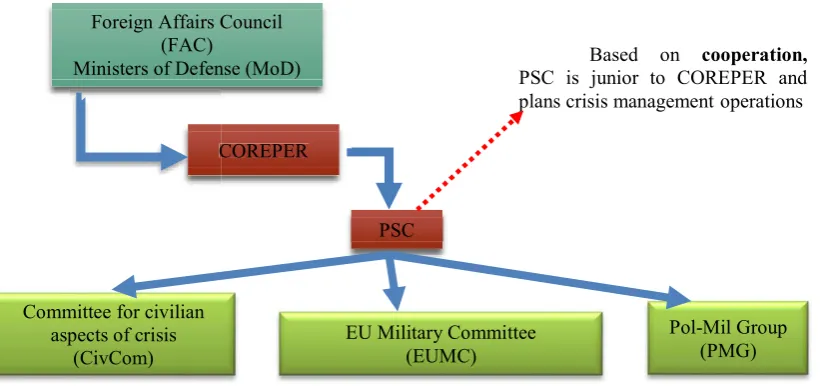
Basically, PSC is the junior to COREPER and acts in terms of suboridnation and co-operation, as Figure No. 1 describes it below.
Figure 1: COREPER and PSC schematic interaction
Source: Own conception, based on Roux, P., 2012, EU Capability Development Pooling and Sharing, european Union External Action, EU Military Staff, March, slide no. 3, available on: http://slideplayer.com/slide/740994/, [May 4th 2017]
The Department of Political Affairs, created in 2012, works closesly with the PSC and includes the chair of the PSC, ensuring a close co-operation with the chairmen of the working groups. From a functional perspective, this department is the quivalent of the political departments of National Ministries of Foreign Affairs, having a vital importance for the future policy direction of the EEAS (Helwig, Ivan, Kostanyan, 2013, p. 16).
European Security Strategy EES a document adopted by the European Council in December 2003. The EES analyses the threats that EU is confronted with, takes into consideration the need to reinforce teralism for the establishemnt of new world order (Heusgen, 2004, p. 7). The progress made by EU towards creating a
Foreign Affairs Council (FAC)
Ministers of Defense (MoD)
COREPER
PSC
Committee for civilian aspects of crisis
(CivCom)
EU Military Committee (EUMC)
Pol-Mil Group (PMG) Based on cooperation,
coherent foreign policy and an effective crisis management stresses out the need for action and the importance of bilateral and multilateral cooperation and the creation of a defence agency (Solana, 2004, p. 53) that acts to the benefit of the entity.
According to World Bank Database definition on military expenditure, the data provided are include all current and capital expenditures on the armed forces, including peacekeeping forces; defense ministries and other government agencies engaged in defense projects; paramilitary forces, if these are judged to be trained and equipped for military operations;
and military space activities .
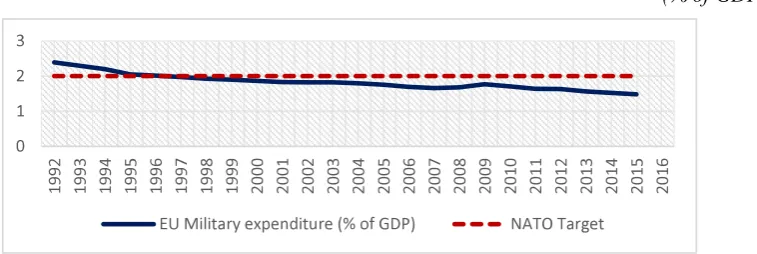
The selected data are have a yearly frequency, starting from 1992 the year of the Maastricht Treaty signing to 2015 the last series available. They are expressed as a percentage of GDP and includes all Member States of EU. The data are compared to
target, which represents an aim, rather than a binding commitment (***, GDP-based Targets in dent trend, with the exception of 2009, when, at communitary level, 1.77% of GDP was allocated for this area. This data shows a paradox: during the global economic and financial crisis, the trend was descendent, with the exception of the year 2009, leading towards the conclusion that Member States were focused on facing the economic and finanacial challenges derived from the crisis, alongside the awareness of critical political situations, as a consequence of the economic one.
Figure 2: expenditures
(% of GDP)
Source: Own conception, based on data from World Bank,
http://databank.worldbank.org/data/reports.aspx?source=2&series=MS.MIL.XPND.GD.ZS&country=#, [May 4th 2017]
As an entity, the EU shows a sluggish evolution in meeting the NATO target, however, there registered declines, relying mainly on the help of NATO, in case of a military crisis.
inside the EU borders, contrary to the Westphalian diplomacy a regulatory system allowing the nation-states to interact and survive in an environment that is dominated by anarchy. The foreign ministers of the Member States maintain the priorities of their national security agenda, adding the co-operation inside the Common Foreign Security Policy CSFP and NATO to fight against transnational threats such as: terrorism, illegal arms proliferation, organized crime ( , 2003, p. 12).
Conclusion
common one, relying on the help provided by NATO or by other Member States, in case of a security emergency. This type of diplomatic approach referes to a realistic point of view for each Member State,
hin the liberal theory. At EU level, the importance of close co-operation between Member States in the area of CFSP is constantly stressed, the main scope being to provide security inside and outside EU borders. From an institutional point of view, the close co-operation of COREPER with PSC offers a safe environment on paper, but the diplomatic actions required for the recent crisis management, make it difficult for these bodies to help provide security. After the Lisbon- es: democracy, peace, cooperation, sustainable economic growth, solidarity and the global economic and financial crisis
s commitment towards democracy and human rights.
References
[1] Archick, K., (2013) European Union Enlargement, Congressional Research Service, July 2nd, available on http://www.fas.org/sgp/crs/row/RS21344.pdf, [April 14th 2017]
[2] Bilateral Diplomacy in the European Union: Towa
-Dicussion Papers in Diplomacy, Netherlands Institute of International Relations
a. http://www.clingendael.nl/sites/default/files/20080400_cdsp_diplomacy_batora.pdf, [April
14th 2017]
[3] Does the european union Transform the Institution of Diplomacy?, le on:
https://www.clingendael.nl/sites/default/files/20030700_cli_paper_dip_issue87.pdf, [April 14th
2017]
[4] Permanent Representations to the European Union Diplomatic Studies Programme Newsletter,No. 4, May, available on
a. https://www.researchgate.net/profile/Alasdair_Blair/publication/249027771_Permanent_repre
sentations_to_the_European_Union/links/00b7d53cd9d6303181000000.pdf, [May 3rd, 2017]
[5] Buonanno, L., Caviedes, A., Dowley, K., Nugent, N., (2013) SUNY Guide to the Model European Union, Eighth Edition, Institute for European Union Studies SUNY, October, available on
http://www.newpaltz.edu/polisci_intlrela/bluebook_2014.pdf, [April 14th 2017]
[6] Davis Cross, M., K., Crafting European Security: The Practice of Diplomacy and EU Integration, available on
a. http://stockholm.sgir.eu/uploads/Mai%27a%20Cross%20Crafting%20European%20Security%
20paper.pdf, [April 14th 2017]
[7] Helwig, N., Ivan, P., Kostanyan, H., (2013) The New EU Foreign Policy Architecture. Reviewing the First two Years of the EEAS, Centre for European Policy Studies (CEPS), Brussels, available on: https://www.ceps.eu/system/files/EEAS%202%20years%20on.pdf, [May 4th 2017] [8] The European Security Strategy as a response to new challenges in EU foreign and security policy Civilian Perspective or Security Strategy? European Development Policy Confronting New Challenges in Foreign and Security Policy, International Conference, November 23rd, available on:
a. http://www2.weed-online.org/uploads/eu_civilian_perspective_2005.pdf#page=54, [May 5th
2017]
[9]
nd%20Security%20Committee,%20A%20Case%20Study%20in%20%E2%80%98Supranational%
20Intergovernmentalism%E2%80%99.pdf, [May 3rd 2017]
[10] Quinn, P. (ed.), (2011) Making European Diplomacy Work: Can the EEAS Deliver?, College of Europe, Departmenet of EU International Relations and Diplomatic Studies, Bruges.
[11] Roux, P., 2012, EU Capability Development Pooling and Sharing, european Union External Action, EU Military Staff, March, available on: http://slideplayer.com/slide/740994/, [May 4th2017]
[12] the European Security Civilian
Perspective or Security Strategy? European Development Policy Confronting New Challenges in Foreign and Security Policy, International Conference, November 23rd, available on:
a. http://www2.weed-online.org/uploads/eu_civilian_perspective_2005.pdf#page=54, [May 5th
2017]
[13] ***, (2016), Committees and working parties, CVCE. EU, available on:
http://www.cvce.eu/content/publication/2007/3/9/095df3b3-4959-4a09-aaeb-e5649940c9cc/publishable_en.pdf, [May 3rd 2017]
[14] ***, COREPER: Tasks and Working Method, available on
a. http://www.eurocollege.ru/fileserver/files/COREPER_9-5.pdf, [April 14th 2017]
[15] ***, Council Decision, (2001), Official Journal of the European Communities, January, (2001/78/CFSP), available on
a. http://www.consilium.europa.eu/uedocs/cmsUpload/l_02720010130en00010003.pdf, [May 4th
2017]
[16] ***, (2012) European Union, Development Assistance Committee (DAC), Peer Review 2012, Organisation for Economic Co-operation and Development, 2012, available on
http://www.oecd.org/dac/peer-reviews/50155818.pdf, [April 14th 2017]
[17] ***, GDP-based Targets in International Organisations, available on: http://www.asoulforeurope.eu/sites/www.asoulforeurope.eu/files/media_pdf/ASFE%20GDP%20Ta
rgets%20in%20International%20Organisations.pdf, [May 4th 2017]