1
Macrostructural Study of Digital Judgments from England and Wales. A Comparative Analysis
Francisco Godoy-Tena
1 Lecturer, Universidad Autónoma de Madrid, Spain.
ARTICLE INFORMATION
Original Research Paper Received Dec. 2018 Accepted Mar. 2019 Keywords: Judgments, Macrostructure, England and Wales, Comparative analysis
ABSTRACT
Judgments constitute the most important court document in every legal system in the world, which requires a complete and accurate understanding of it by both expert and non-expert readers. The main aim of this research is to analyse a digital corpus of 25 judgments given in England and Wales, countries ruled by the Common Law system. The main goal of this study is to deepen into those heterogenous court judgments in order to show their rich, but complex, nature by means of an internal description of the documents. The study method of these judgments, previously mentioned, is based on Teun A. van Dijk’s macrostructure theory, which semantically creates an interior design for a comprehensive understanding of the documents. The results of this study finally revealed an independent structure inside the document with some common elements that frame most of the documents. Thanks to this study, non-specialist readers and researchers from different fields of study, such as Translation and Interpreting (English < > Spanish), or Law (Common Law < > Civil Law), will have a first-hand description that summarises the most common features of such an important legal document: court judgments.
1. Introduction
Without any doubt, students, translators, interpreters, linguists, researchers, or expert and non-expert readers may encounter several complexities when considering a legal document. Due to this reason, they need to have a clear understanding of these legal records in order to accomplish their tasks. Within the wide variety of legal documents, one of the most important ones is the judgment. However, judgments reveal a considerable structural complexity, especially those from the Common Law system, which had its origin in England, and it was widely extended to other countries for centuries. This legal system, also known as English Law, is basically characterised as the non-existence of a written code and, as a consequence, it lies on the precedent. Due to this reason, unlike judgments from Civil Law (also Continental Law), a more strictly codified legal system inherited from the Roman Law and adopted in continental Europe and spread to other countries, Common Law judgments have a much more flexible structure than Civil Law ones. As a result of this elaborate structure, the comprehensive understanding of these documents seems to be harder to achieve.
The main goal of this research is twofold. On the one hand, our intention is to avoid that understanding uncertainty to those who may deal with these Common Law judgments, especially scholars who are more familiarised with codified judgments from Civil Law. Therefore, we have analysed a corpus of Common Law judgments by using the macrostructure analysis, created and further developed by the Dutch linguist Teun Adrianus van Dijk in the late 1970s and early 1980s. Thanks to this theory, the documents analysed can be
Modern Journal of Language Teaching Methods (MJLTM) ISSN: 2251-6204
www.mjltm.org
clearly fragmented and described with a semantic unity that may articulate them internally. On the other hand, such a linguistic description may reveal certain properties that each of the judgments shares, even though there exists an enormous variety of structures that make these documents difficult to understand.
2. Literature Review
Although the German linguist Bierwisch was the first scholar to use this term in 1965, the macrostructure theory has been studied for year. Many researchers have considered this theory in order to do some studies in several fields, although the linguist Teun A. van Dijk conducted some research at the end of the 1970s and in the early 1980s, based on Literary Theory, General Discourse Theory, Pragmatics, and Cognitive Psychology.
Nevertheless, there have been other researchers who studied macrostructure, discourse analysis, and judgments in detail. Due to the big amount of studies, below we mention some of them:
Kintsch and van Dijk (1978) proposed a macrostructural model that could semantically help in the text comprehension and production.
Van Dijk and Kintsch (1983), who had a thorough explanation of discourse analysis and macrostrategies.
Bower and Cirilo (1985) also pointed out that the Cognitive Psychology adquires and represents the world knowledge, as well as its subsequent organization by means of different lexical levels.
Nwogu (1997) carried out a study of the structure information in medical research papers.
Wodak and Meyer (2001: 21), who applied it to the cognitive use of Psychology.
More recently, we can mention the following studies:
Villamir Portilla (2004), who did a more specific study of judgments in Colombia.
Hall-Mills (2010), who made an analysis of writings from elementary students.
Holl (2011) studied German and Spanish divorce judgments.
Lara Chagoyán (2011) conducted some research of judgment structures in Mexico.
Vázquez y del Árbol (2008, 2014, 2016) used macrostructure for translation and lecturing purposes.
Macris (2018), who used macrostructure theory in a literary analysis.
Altman et al. (2018), who researched in the macrostructure for bilingual English-Hebrew children and their language impairment.
Children were the target research for other macrostructure experts, such as Hall-Mills and Apel (2015) and Appose and Karuppali (2018).
3. Research Question
This study has a principal purpose, which is to offer an answer to the subsequent question:
How can we establish a macrostructural analysis in the heterogenous structure of court judgments from England and Wales?
4.1 Materials
The main aim of this study is the compilation of a digital corpus of 25 court judgments from England and Wales. The analysis of this corpus is addressed to set a macrostructural pattern in order to make Common Law
3 court judgments, highly heterogeneous and flexible, more understandable to potential readers from Translation, Foreign Language, Linguistics and Law studies, among others.
These court-related documents were compiled by selecting modern judgments (from 2013 to 2016), with different issues and from different parts of England and Wales. In addition, this research also took into account the different Courts in England and Wales in order to select a proportional number of judgments in each of those Courts in order to cover a wide scope of the legal bodies in both countries.
4.2 Procedure
All these judgments from the digital corpus were thoroughly read and analysed by considering certain factors. Firstly, the method of analysis was based on Teun A. van Dijk’s macrostructural theory. This scientific-based theory points out the internal structure of the documents by means of a semantic interpretation of the content that is included inside them.
Van Dijk (1980a: V) defines “macroestructure” as
[a] higher-level semantic or conceptual structures that organize the ‘local’ microstructures of discourse, interaction, and their cognitive processing. They are distinguished from other global structures of a more schematic nature, which we call superstructure. These are, so to speak, the global ‘form’ of the macrostructural ‘content’.
This macrostructural study sheds light on the complex structure of court judgments in England and Wales. This research analysed, fragmented and detailed the internal semantically-based composition of these judgments by using different tables to disclose a method to describe the structure of these court documents.
The text analysis reveals some complete information about each of the macrostructural sections in which court judgments are divided. Nevertheless, we have considered to make a further explanation by incorporating our own division in order to identify clearly the common sections in each and every judgment that has been studied. Our sections are displayed in the table 1 below:
Table 1. Macrostructural sections of judgments from England and Wales
Heading: introductory section. It includes extralinguistic parts (coat of arms, codes), name of the Court, name of the parties, name of the Judge, Lord, or Lady, date and name of the solicitors.
Main body: main and essential part of the judgments, the main body states the explanation of the case, the solicitors’ statements, together with the evidence and further explanations from the judgment. This is the most complex part of the judgment, as it reveals a Judge-made disposition and fragmentation.
Closure: final part of the judgment. It comprises the Judge’s resolution of the case.
Thus, the following section will deal with a more detailed description of those macrostructural sections. In this way, we will observe the most noticeable features of court judgments that have been analysed after the research.
5. Results 5.1. Heading
The heading of court judgments from England and Wales is located at the very beginning of them, preceeding the date. This section shows some variety in the elements that compose the macrostructural section. Due to the complexity of this first section, we believe it would be appropriate to list the most distictive characteristics observed in these judgments.
First of all, the coat of arms, a distinctive extralinguistic element, appears at the top of the court judgments.
In addition, the heading “Judiciary of England and Wales” appears below the coat of arms, although it does not appear in all our judgments from England and Wales, so they will be explained in a table below.
The third noticeable element is the code number. This feature is slightly more complex, since such a code is not included in all the judgments. In some of them, we can observe a “Neutral Citation Number” in the left column, and a “Case Number” on the right hand side of the document. In some others, however, such codes are omitted.
The Neutral Citation Number, introduced in England and Wales judgments in 2001, is a unique way to cite judgments by the HM Courts and Tribunal Services in the United Kingdom. This number refers to a judgment itself. Holborn describes this as follows:
… as a consequence of the much wider availability of unreported cases from electronic sources, and because of electronic promulgation of law reports series, the Lord Chief Justice issued on 11 January 2001 the Practice Direction (Judgments: Form and Citation) [2001] 1 W.L.R. 194. This introduced three matters: the provision of a court-assigned number for every judgment; paragraphing of judgments; and the authorisation of the citation before the courts of reported cases derived from an electronic version of the reports. The first two innovations together provide a so-called ‘neutral citation’, which uniquely identifies a case, and a passage in it, whether or not it is reported. This comprises the year, an abbreviation for the court, the number of the case, and then any reference to a particular paragraph in square brackets. Thus:
Smith v Jones [2001] EWCA Civ 10 at [30]
This refers to case no 10 of the Court of Appeal (Civil Division) – EW for England and Wales – of 2001 and a passage at para 30. The Practice Direction initially applied to judgments of the Court of Appeal, Civil and Criminal Divisions, and the Administrative Court (Queen’s Bench cases on judicial review, etc). It is to be extended in due course to the other Divisions of the High Court. The House of Lords has also adopted the practice – its abbreviation is UKHL, reflecting its wider jurisdiction.
Holborn, 2006: 187
Those Neutral Citation Numbers were gradually introduced in England and Wales judgments as follows:
Neutral Citation Number adopted from 11th January 2001:
House of Lords: [year] UKHL number.
(NB This series of neutral citations ceased in 2009, when the Supreme Court replaced the House of Lords as the UK’s Highest Court of Appeal.)
Privy Council: [year] UKPC number.
Privy Council (Devolution cases): [year] UKPC D number.
England and Wales Court of Appeal (Civil Division): [year] EWCA Civ number.
England and Wales Court of Appeal (Criminal Division): [year] EWCA Crim number.
England and Wales High Court (Administrative Court): (during 2001): [year] EWHC Admin number.
(From 2002): [year] EWHC number (Admin).
Neutral Citation Number adopted from 14th January 2002:
England and Wales High Court (Chancery Division): [year] EWHC number (Ch).
England and Wales High Court (Patents Court): [year] EWHC number (Pat).
England and Wales High Court (Queen’s Bench Division): [year] EWHC number (QB).
5
England and Wales High Court (Commercial Court): [year] EWHC number (Comm).
England and Wales High Court (Admiralty Court): [year] EWHC number (Admlty).
England and Wales High Court (Technology and Construction Court): [year] EWHC number (TCC).
England and Wales High Court (Family Division): [year] EWHC number (Fam).
England and Wales High Court (Mercantile Court): [year] EWHC number (Mercantile).
(NB If using Westlaw, this style of citation is not recognised; the citation is instead the same as that of Queen’s Bench judgments, i.e. [2008] EWHC 11 (QB).)
Neutral Citation Number adopted from 1st October 2009:
UK Supreme Court: [year] UKSC number.
Neutral Citation Number adopted from 22nd April 2014:
England and Wales Family Court: [year] EWFC number.
England and Wales Court of Protection: [year] EWCOP number.
Even though tribunals are not part of our study, several of them also have Neutral Citation Numbers:
Competition Appeal Tribunal: [year] CAT number.
Upper Tribunal (Administrative Appeals Chamber): [year] UKUT number (AAC).
Upper Tribunal (Immigration and Asylum Chamber): [year] UKUT number (IAC).
Upper Tribunal (Lands Chamber): [year] UKUT number (LC).
Upper Tribunal (Tax and Chancery Chamber): [year] UKUT number (TCC).
The following information provided by the analysed judgments from England and Wales is the court name (and division, when applicable), together with the location of the hearing, both of them on the left hand side of the document.
The following element is the Royal Court of Justice, address, and the date of publication, located on the right. Next, the name of the Judge, Lord or Lady who delivers the judgment. Below this information, this study states some external information from the procedural scope, as the name of the parties. Such macrostructure is common to several judgments from England and Wales.
Below it, we can observe the name of the socilitors or Queen’s counsels of both parties in all the judgments analysed in the digital corpus. Finally, the hearing date and, in most of them, additional notes, such as “Approved Judgment” (which indicates that such a judgment has been previously reviewed before its publication).
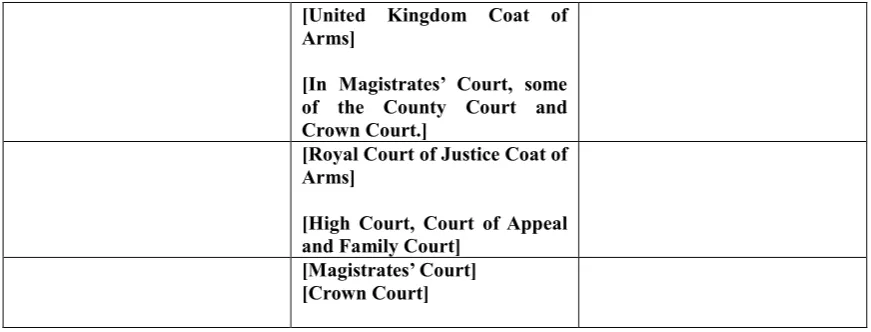
The following table summarises the initial section of judgments from England and Wales (table 2):
Table 2. Macrostructural summary of the Heading
[United Kingdom Coat of Arms]
[In Magistrates’ Court, some of the County Court and Crown Court.]
[Royal Court of Justice Coat of Arms]
[High Court, Court of Appeal and Family Court]
[Magistrates’ Court] [Crown Court]
Judiciary of England and Wales
[Crown Court]
In the [nombre del Court] [Family Court]
[County Court]
[High Court. Family Division]
[Summary]
Re [inicial] and [inicial]
In the matter of [inicial] [Crown Court]
In the matter of [legislación] [Magistrates’ Court] [Name of the parties]
[Hearing Date]
Neutral Citation Number
[It is not in all the judgments. It may appear with the Case Number]
Case Number
[It is not in all the judgments. It may appear with the Neutral Citation Number]
In the [Court, Location]
[In High Court of Justice: Chancery / Queen’s Bench / Family Division]
[In some cases, the judgment states it more explicitly: Administrative Court].
[In some cases the appropriate legislation]
[Address]
[Publication date] [Name of the Judge / Lord or
Lady]
Between
[Nombre del Claimant]
-and- / v
[Nombre del Defendant] [No names in the event of minors]
[Name of the solicitors in both parties]
[Name of the Claimant’s socilitors] [Name of the Defendant’s solicitors]
[Hearing date] Hearing date: [day] [month] [year]
[In some cases, indented to the left. Some of the judgments have it centred.]
5.2. Main Body
The main body of court judgments from England and Wales develops a remarkable variety of macrostructures, as this is the longest section of the document. Its length varies from two to three paragraphs to more than 10 in many cases, with an average of six paragraphs.
The main body begins with the name of the Judge, Lord or Lady, and it finishes with the conclusion of the judgment. Due to the length of this part of the judgment, we can notice a great macrostructural variety in the
7 analysed corpus, so it is essential to provide an insight of our results with the aim of pointing out the most remarkable aspects of these court documents.
In the first part of the main body, our judgments introduce again the name of the Judge, Lord or Lady who pronounces the judgment, except in judgments passed at the Magistrates’ Court and in one coming from the Crown Court.
The “Introduction” of the case begins the main body of the judgments from England and Wales, and it explains the unlawful act of the case. This section has a great selection of possible headings, such as “Introduction”, “Introduction and Factual Background”, “Introduction and Executive Summary”, “The Background Facts”, “(The) Background”, “Essential Background” or “Some Common Ground”.
Such introduction details the parties’ identities, their background (especially those of the Defendant-s), the charges, together with the statements and evidence from both parties.
However, this first part of the main body has a clear distinction when it comes to appeal cases (some of the judgments from the Family Court, and those from the Court of Appeal). In those situations, this initial part introduces the previous judgment as well as appropriate legislation for such appeal. We now mention the next judgments:
Case number [2014] EWHC 3311 (Fam), High Court Family Division.
We can also observe the introduction of the pertinent legislation in appeal cases, such as:
Case name: The Court of Appeal (Palermo) v Domenico Rancadore, Magistrates’ Court.
Case number [2014] EWHC 185 (Ch), High Court Chancery Division.
Case number [2015] EWHC 1183 (CH), High Court Chancery Division.
The next macrostructural section is called “The Agreed Facts”, “The History of Proceedings”, “This Case”, “Summary of Facts”, “The Facts” or “Factual Background”, and it is sometimes linked to the previous macrostructural section, previously explained. This has some common features in most of the judgments:
Firstly, judgments enumerate chronologically the unlawful events. This feature is noticeable in judgments coming from the Family Court, such as under the following heading: “The History of the Proceedings: from [day] [year] to [month] [year]”. Some of those descriptions have a great length, such as some judgments from the High Court.
In addition, this section gives some details about the Defendant-s, the pertinent legislation of the case, and the precedent of the previous judgment, such as the case number [2016] EWHC 503 (Fam) from the Family Division, introduced under the title “Threshold”. The Judges introduce all the required evidence to such a case, as it has been observed in video recordings (case Regina vs Paul Meehan from the Magistrates’ Court) or mobile messages (case number [2015] EWFC 26 from the Family Court).
From the second macrostructure we can observe a considerable distinction in judgments from England and Wales. Such complexity is based on the Judge’s opinion (Ratio Decidendi) in each and every point of the arguments to be considered for their final conclusion.
This second part of the macrostructure includes the witness and the solicitors’ statements with sometimes more than 90 paragraphs, such as the Case Number [2014] EWHC 185 (Ch) from the High Court (Chancery Division).
There is not, therefore, a single heading that may entail this macrostructural section. Instead, the analysis
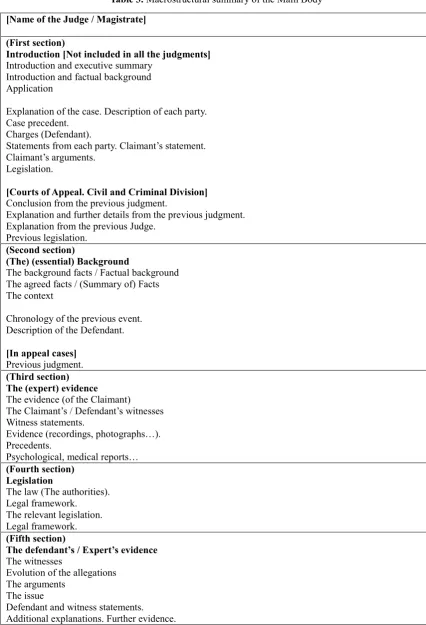
shows a great diversity of contents under several headings of the main body. Such a complex macrostructure of the main body is detailed in the following summarised table (table 3):
Table 3. Macrostructural summary of the Main Body
[Name of the Judge / Magistrate]
(First section)
Introduction [Not included in all the judgments] Introduction and executive summary
Introduction and factual background Application
Explanation of the case. Description of each party. Case precedent.
Charges (Defendant).
Statements from each party. Claimant’s statement. Claimant’s arguments.
Legislation.
[Courts of Appeal. Civil and Criminal Division] Conclusion from the previous judgment.
Explanation and further details from the previous judgment. Explanation from the previous Judge.
Previous legislation.
(Second section)
(The) (essential) Background
The background facts / Factual background The agreed facts / (Summary of) Facts The context
Chronology of the previous event. Description of the Defendant.
[In appeal cases] Previous judgment.
(Third section) The (expert) evidence
The evidence (of the Claimant) The Claimant’s / Defendant’s witnesses Witness statements.
Evidence (recordings, photographs…). Precedents.
Psychological, medical reports…
(Fourth section) Legislation
The law (The authorities). Legal framework. The relevant legislation. Legal framework.
(Fifth section)
The defendant’s / Expert’s evidence
The witnesses
Evolution of the allegations The arguments
The issue
Defendant and witness statements. Additional explanations. Further evidence.
9
Discussion / Court’s findings
Ourconclusion
5.3. Closure
We have called the third section of the judgments from England and Wales “Closure”, and it closes all court judgments from England and Wales. This final macrostructure includes the judgment conclusion, although it may provide additional information that we will further develop in this part of our study.
Most of the judgments under study include the section “Conclusion”. Nevertheless, such a macrostructure may present other names or, in some cases, the conclusion does not have an independent section from the previous one. This situation is frequent, as we can observe in the following cases:
Case Number [2016] EWHC 503 (Fam) from the High Court (Family Division).
Case Number [2014] EWHC 185 (Ch) from the High Court (Chancery Division).
As it was previously stated, some judgments from England and Wales have an additional part that gathers other elements, as for instance Case Number 7LS 574445 Miles Oliver Taylor v Richard Jennison Bell and Robert Chester Haworth from the County Court, which includes an in-depth explanation of the costs.
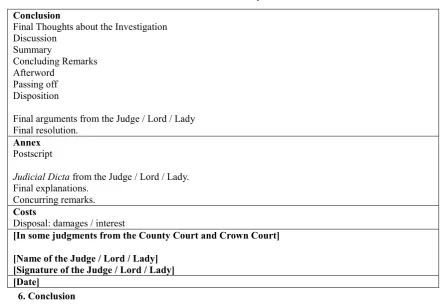
Finally, we summarise the Closure macrostructure in the table below:
Table 4. Macrostructural Analysis of the Closure
Conclusion
Final Thoughts about the Investigation Discussion
Summary
Concluding Remarks Afterword
Passing off Disposition
Final arguments from the Judge / Lord / Lady Final resolution.
Annex
Postscript
Judicial Dicta from the Judge / Lord / Lady. Final explanations.
Concurring remarks.
Costs
Disposal: damages / interest
[In some judgments from the County Court and Crown Court]
[Name of the Judge / Lord / Lady] [Signature of the Judge / Lord / Lady] [Date]
6. Conclusion
At the beginning of our study we raised the following question:
How can we establish a macrostructural analysis in the heterogenous structure of court judgments from England and Wales?
We will summarise the main points below:
Firstly, we noticed the great variety of macrostructural sections in each of the court judgments from England and Wales. This is mainly visible in the heading and, especially, in the main body of the documents. This is due to a lack of a single codification that can set out the writing rules of court judgments. The internal macrostructure of judgments from England and Wales are developed from the Judge’s arguments throughout these instruments.
This lack of a codification implies, therefore, a more flexible macrostructure of English and Welsh judgments. As there is not a written codification that sets forth the internal structure of judgments, the Judge, Lord or Lady may have a wider autonomy and independence when they issue a court judgment. The Judge may have the opportunity to establish each and every fact that has occurred in the case in order to codify the essential details of such judgment, which becomes an individual code (“lex specialis”). Due to this reason, the English and Welsh court judgments are independent entities which are individually created by the Judges (Judge-made law), as they develop their Ratio Decidendi throughout their judgment.
These densely-argumented explanations by the Judge (Ratio Decidendi and Obiter Dicta) is extensive, with more than 30 paragraphs in most of the judgments under research. Therefore, most of them have been fragmented into several subdivisions with their own independent sections. Due to this reason, so as to avoid ambiguity, judgments take advantage of this freedom to divide them into several macrostructures with different, but clearly defined, sections in order to make them more understandable to the readers. Such complexity is also remarkable in other parts of the document. This is the case of the witness statements, very complex declarations in judgments issued at the Magistrates’ Court, Family Proceedings Court and, more distinctly, in the High Court (Chancery Division), with 31 witness statements in the case number [2014] EWHC 185 (Ch). This discourse development is also relevant in other judgments, such as the case number [2016] EWHC 181 (QB) from the High Court (Queen’s Bench Division).
The legislation macrostructure is another elaborate section of judgments from England and Wales, as Common Law judgments are based on the precedent. This is due to the importance of English and Welsh judgments to take court decisions. This feature can be observed in most of the Magistrates’ and Crown Courts.
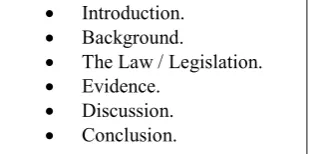
Despite this codification omission that results in a macrostructural fragmentation, we can distinguish some recurrent structures in court judgments, even though they do not appear in the same order in all the documents (table 5):
Table 5. General macrostructure summary in England and Wales judgments
Introduction.
Background.
The Law / Legislation.
Evidence.
Discussion.
Conclusion.
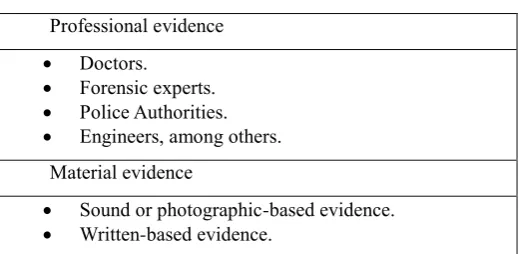
The explanation for those macrostructures lies in the relevance within these judgments. In the first two macrostructures, the Judge establishes the unlawful event and provides the audience with several initial explanations to consider. In the macrostructure named “The Law”, judgments from England and Wales set the legal precedent, a cornerstone of Common Law. The “Evidence” includes the parametres within England and Wales judgments, according to the subsequent considerations (table 6):
11
Table 6. Usual parameters in judgment evidence
Professional evidence
Doctors.
Forensic experts.
Police Authorities.
Engineers, among others.
Material evidence
Sound or photographic-based evidence.
Written-based evidence.
This macrostructure compiles the expert opinions that may establish further points to develop in the last two points of most judgments, Discussion and the Judge’s Conclusion.
Finally, we can state that an omission of a codification on how to write judgments has resulted in a heterogenous macrostructure of English and Welsh judgments. This has a clear and immediate consequence: each Judge-made judgment constitutes an independent court document with its particular internal macrostructure that semantically unifies the whole instrument. Due to this reason, this paper has disclosed their most distinctive macrostructures in order to make it more understandable for both experts and non-expert readers.
References
1. Alanen, R. (1995). Input Enhancement and Rule Presentation in Second Language Acquisition. In R. Schmidt
(Ed), Attention and Awareness in Foreign Language Learning and Teaching (pp. 259- 302). Honolulu: University of Hawaii Press.
2. Alrefaai, I. K. (2013). Suggested Guidelines for Using Translation in Foreign Language Learning and Teaching. Educational Research, 4(1), 12-20.
3. Altman, C., Goldstein, T. and Armon-Lotem, S. (2018). Vocabulary, Metalinguistic Awareness and Language
Dominance Among Bilingual Preschool Children. Frontiers in Psychology, 9, 1953.
https://doi.org/10.3389/fpsyg.2018.01953
4. Appose A. and Karuppali S. (2018). Decoding the Macrostructural Form of Oral Narratives in Typically Developing Children Between 6 – 11 Years of Age: Using Story Grammar Analysis. Online J Health Allied Scs. 17 (1).
5. Atkinson, D. (1987). The Mother Tongue in the Classroom: A Neglected Resources? ELT Journal, 41(4), 241-247. https://doi.org/10.1093/elt/41.4.241
6. Bagheri, M. S., and Fazel, I. (2011). EFL Learners’ Beliefs about Translation and its Use as a Strategy in Writing. The Reading Matrix, 11 (3). 292-301.
7. Bower, G. H. and Cirilo, R. K. (1985). Cognitive Psychology and Text Processing. In T. A. van Dijk, Handbook of Discourse Analysis. Disciplines of Discourse. (pp. 71-105). London: Academic Press.
8. Brooks-Lewis, K. A. (2009). Adult Learners’ Perception of the Incorporation of their L1 in Foreign Language
Teaching and Learning. Applied Linguistics, 30 (2). 216- 235. https://doi.org/10.1093/applin/amn051
9. Carreres, A., and Noriega Sánchez, M. (2011). Translation in Language Teaching: Insights from Professional
Translator Training. The Language Learning Journal, 3 (3), 281-297.
10.https://doi.org/10.1080/09571736.2011.567356
11.Castellotti, V. (2001). La langue maternelle en classe de langue étrangère. Paris: CLE International.
12.Chamot, A.U., and O’Malley, J. M. (1987). The Cognitive Academic Language Approach: A Bridge to the
Mainstream. TESOL Quarterly, 21, 227-249. https://doi.org/10.2307/3586733
13.Ciaflone, E. (2009). L1 Use in English Courses at University Level. ESP World, 8 (22), 1-6.
14.Cook, G. (2010). Translation in Language Teaching, Oxford: Oxford University Press.
15.Cook, V. J. (2001). Using the First Language in the Classroom. Canadian Modern Language Reviews, 57 (3),
184 206. https://doi.org/10.3138/cmlr.57.3.402
16.Cook, V. (2005). Basing Teaching on the L2 User. In E. Llurda (Ed.), Non-Native Language Teachers (pp.
47–61). Boston: Springer. https://doi.org/10.1007/0-387-24565-0_4
17.Cook, V. J. (2007). A Thing of the Future: Translation in the Classroom. International Journal of Applied Linguistics, 17 (3), 396-401. https://doi.org/10.1111/j.1473-4192.2007.00160.x
18.Duff, A. (1989) Translation. Oxford: Oxford University Press.
19.lkova, T. (2010). Learning Strategies in Foreign Language Teaching: Using Translation in English Language
Teaching. Journal of the University of Chemical Technology and Metallurgy, 45(4), 449-452.
20.Ellis, N. (1996). Sequencing in SLA: Phonological Memory, Chunking, and Points of Order. Studies in Second Language Acquisition, 18, 91-126. https://doi.org/10.1017/S0272263100014698
21.Ellis, R. (2008). The Study of Second Language Acquisition. Oxford: Oxford University Press.
22.Fernández-Guerra, A. B. (2014). The Usefulness of Translation in Foreign Language Learning. International
Journal of English Language and Translation Studies, 2 (1), 153-170.
23.Ghaiyoomian, H., & Zarei, Gh. (2015). The Effect of Using Translation on Learning Grammatical Structures: A Case Study of Iranian High School Students. Research in English Language Teaching, 3 (1), 32-39. 24.Hall-Mills, S. (2010). Linguistic Feature Development in Elementary Writing: Analysis of Microstructure
and Macrostructure Features in a Narrative and an Expository Genre. (Thesis). Florida State University. https://doi.org/10.1044/2015_LSHSS-14-0043
25.Hall-Mills, S. and Apel, K. (2015). Linguistic Feature Development Across Grades and Genre in Elementary
Writing. Language, Speech, and Hearing Services in Schools. 46. 242–255.
26.Harmer, J. (2001). The Practice of English Language Teaching. Essex, England: Longman.
27.Holborn, G. (2006). Butterworths Legal Research Guide. London: Butterworths/LexisNexis.
28.Holl, I. (2011). “Die Konstrastive Textsorttenanalyse als Vostufe zur Übersetzung von Rechtstexten: Deutsche und Spanische Scheidungsurteile im Vergleich”. Revista de Lingüística y Lenguas Aplicadas, 6. 195-207. https://doi.org/10.4995/rlyla.2011.903
29.Karimian, Z., & Talebinejad, M. R. (2013). Students’ Use of Translation as a Strategy in EFL Classroom. Journal of Language Teaching and Research, 4(3), 605- 610. https://doi.org/10.4304/jltr.4.3.605-610
30.Kavaliauskienë, G., & Kaminskienë, L. (2007). Translation as a Learning Tool in English for Specific Purposes. Kalbotyra, 57 (3), 132-139.
31.Kavaliauskienë, G. (2009). Role of Mother Tongue in Learning English for Specific Purposes. ESP World,
1-8 (22), 1-12. https://doi.org/10.1531-81-8/Klbt.2007.7566
32.Kintsch, W. and Van Dijk, T. (1978). Toward a Model of Text Comprehension and Production.
In Psychological Review. 85, (5), 363-394. https://doi.org/10.1037/0033-295X.85.5.363
33.Lara Chagoyán, R. (2011). Sobre la estructura de las sentencias en México: una visión crítica y una propuesta factible. Quid Iuris. 12. 63–94.
34.Levine, G. S. (2003). Student and Instructor Beliefs and Attitudes about Target Language Use, First Language Use, and Anxiety: Report of a Questionnaire Study. The Modern Language Journal, 87, 343-364. https://doi.org/10.1111/1540-4781.00194
35.Liao, P. (2006). EFL Learners’ Beliefs about and Strategy Use of Translation in English Learning. RELC. Regional Language Center Journal, 37 (2), 191-215. https://doi.org/10.1177/0033688206067428
13 36.Macaro, E. (2001). Analyzing Student Teachers’ Codeswitching in Foreign Language Classroom: Theories and Decision Making. The Modern Language Journal, 85 (4), 531-548. https://doi.org/10.1111/0026-7902.00124
37.Machida, S. (2011). Translation in Teaching a Foreign (Second) Language: A Methodological Perspective. Journal of Language Teaching and Research, 2(4), 740-746. https://doi.org/10.4304/jltr.2.4.740-746
38.Macris, A. (2018). Macrostructure and Local Schemas in the Practice of Novelistic Narrative. New Writing,
16 (1). 21–37. https://doi.org/10.1080/14790726.2018.1490777
39.Mahmoudi, L., and Yazdi Amirkhis, S. Y. (2011). The Use of Persian in the Classroom: The Case of English
Teaching and Learning at Pre-University Level in Iran. English Language Teaching, 4(1), 135-140. https://doi.org/10.5539/elt.v4n1p135
40.Nwogu, K. N. (1997). The Medical Research Paper: Structure and Functions. English for Specific Purposes.
16 (2). 119–138. https://doi.org/10.1016/S0889-4906(97)85388-4
41.Pan, Y. C. and Pan, Y. C. (2012). The Use of Translation in the EFL Classroom. The Philippine ESL Journal,
9, 4-23.
42.Perkins, C. (1985). Sensitizing Advanced Learners to Problems of L1-L2 Translation. In C. Tiford and A. E.
Hieke (Eds.), Translation in Foreign Language Teaching and Testing (pp.51–72). Tubingen: Narr.
43.Polio, C. and Duff, P. (1994). Teachers’ Language Use in University Foreign Language Classrooms: A Qualitative Analysis of English and Target Language Alternation. The Modern Language Journal, 78, 313– 326. https://doi.org/10.1111/j.1540-4781.1994.tb02045.x
44.Pütz, M. and Sicola, L. (Eds.). (2010). Cognitive Processing in Second Language Acquisition: Inside the Learner’s Mind. Amsterdam and Philadelphia: John Benjamins. https://doi.org/10.1075/celcr.13
45.Sankey, H. (1991). Incommensurability, Translation and Understanding. The Philosophical Quarterly, 41 (165), 414-426. https://doi.org/10.2307/2220077
46.Schmidt, R. (1995). Consciousness and Foreign Language Learning: A Tutorial on the Role of Attention and
Awareness in Learning. In R. Schmidt (Ed.), Attention and Awareness in Foreign Language Learning (pp. 1-63). Honolulu: University Press. https://doi.org/10.1017/CBO9781139524780.003
47.Schmidt, R.W. (2001). Attention. In P. Robinson (Ed.), Cognitive and second language instruction (pp.332).
Cambridge: Cambridge University Press.
48.Schmidt, R.W. (2010). Attention, Awareness and Individual Differences in Language Learning. In W.M. Chan, S. Chi, K.N. Cin, J. Istanto, M. Nagami, J.W. Sew, T. Suthiwan, & I. Walker, Proceedings of CLaIc 2010, Singapore, December 2-4 (pp. 721-737). Singapore: National University of Singapore, Center for Language Studies.
49.Schmidt, R. & Frota, S. (1986). Developing Basic Conversation Ability in a Second Language: A Case Study of an Adult Learner of Portuguese. In R. R. Day (Ed.), Talking to Learn: Conversation in Second Language Acquisition (pp. 237-326). Cambridge, MS: Newbury House.
50.Schweers, C.W.Jr. (1999). Using L1 in L2 Classroom. English Teaching Forum, 37(2), 6-9.
51.Seong, M. H. (2009). Strategies Making Language Features Noticeable in English Language Teaching. Journal of Pan-Pacific Association of Applied Linguistics, 13 (1), 113-126.
52.Shiyab, S., & Abdullateef, M. (2001). Translation and Foreign Language Teaching. J. King Saud Univ. Language and Translation. 13, 1-9.
53.Van Dijk, T.A. (1980a). Macrostructures: An Interdisciplinary Study of Global Structures in Discourse, Interaction, and Cognition. Hillsdale: Lawrence Erlbaum.
54.--- (1980b). Texto y contexto. Madrid: Cátedra.
55.--- (1981). “Episodes as Units of Discourse Analysis”. In D. Tannen (Ed.). Analysing Discourse Text and Talk. (pp. 177-195). Washington: Georgetown University Press.
56.--- (1983). “Strategies of Discourse Comprehension”. London: Academic Press, Inc.
57.--- (1985). Handbook of Discourse Analysis. Disciplines of Discourse. London: Academic Press. 1 (3).
58.--- (1993). Estructuras y funciones del discurso. Madrid: Siglo XXI de España.
59.--- (1995). “On Macrostructures, Mental Models and other Inventions: A Brief Personal History of the Kintsch-van Dijk Theory”. Discourse Comprehension. Essays in Honor of Walter Kintsch. Erlbaum Publishers. University of Amsterdam. 383-410.
60.--- (Ed.) (1997). Discourse as Structure and Process. Discourse Studies. A Multidisciplinary Introduction. London: Sage Publications.
61.--- (2006). De la gramática del texto. Análisis crítico del discurso. Una breve autobiografía académica. Barcelona: Universitat Pompeu Fabra.
62.--- (2009). Discurso y poder. Barcelona: Gedisa.
63.Vázquez y del Árbol, E. (2008). La traducción (inglés-español) de testamentos británicos y documentos relacionados. De la teoría a la práctica. Granada: Universidad.
64.--- (2014). Derecho civil comparado aplicado a la Traducción Jurídico-Judicial (Reino Unido y España). Madrid: Dykinson.
65.--- (2016). Traducción judicial y policial (inglés< >español) y Derecho Comparado. Court and Police Translation (English < > Spanish) and Comparative Law. Madrid: Dykinson.
66.Villalmil Portilla, E. (2004). La estructura de la sentencia judicial. Colombia: Impresa Nacional de Colombia.
67.Widdowson, H. (2003). Defining Issues in English Language Teaching. Oxford: Oxford University Press.
68.Wodak, R. and Meyer, M. (2001). Methods of Critical Discourse Analysis. London: SAGE Publications Ltd.
69.https://doi.org/10.4135/9780857028020