Please cite this article as: M. G. Sobamowo, O. M. Sadiq, S. A. Salawu, Dynamic Analysis of Circular Plates in Contact with Fluid and Resting on Two-Parameter Foundations, International Journal of Engineering (IJE), IJE TRANSACTIONS C: Aspects Vol. 32, No. 12, (December 2019) 1798-1804
International Journal of Engineering
J o u r n a l H o m e p a g e : w w w . i j e . i rDynamic Analysis of Circular Plates in Contact with Fluid and Resting on
Two-Parameter Foundations
M. G. Sobamowoa, O. M. Sadiqb, S. A. Salawu*b
a Department of Mechanical Engineering, University of Lagos, Akoka, Nigeria
b Department of Civil and Environmental Engineering, University of Lagos, Akoka, Nigeria
P A P E R I N F O
Paper history:
Received 10 April 2019
Received in revised form 17 September 2019 Accepted 07 November 2019
Keywords:
Circular Plate Deflection Free Vibration
Winkler and Pasternak Differential Transformation Method
A B S T R A C T
The dynamic behaviour of a circular plate in contact with fluid and resting on two-parameter elastic foundations is of interest in the field of geotechnics, structure, highway, railway, oil and gas and mechanical engineering. In this work, the dynamic behaviour of circular plate in contact with fluid and resting on Winkler and Pasternak foundations is investigated. The coupled differential equation of the system is analysed using differential transformation method. Good agreements are established when the results of the analytical solutions are compared to the results of the experimental investigation as reported in literature. The analytical solutions obtained are used to investigate the effects of elastic foundation parameters on natural frequency, combine foundation parameters on natural frequency, plate in contact with fluid and that of radial and circumferential stress on mode shapes. From the results, it is observed that, increases in elastic foundation parameter increases the natural frequency in all cases. Presence of fluid reduces the natural frequency of the plate. Also, it is established that mode shapes are not altered by the presence of fluid. However, mode shape displacement occurs due to presence of radial and circumferential stresses. Since the study provides a physical insight into the vibration mode of the structure, it is expected that the study will enhance better understanding on the dynamic behaviour of a circular plate in contact with fluid and resting on two-parameters elastic foundation.
doi: 10.5829/ije.2019.32.12c.13
NOMENCLATURE
w Deflection Greek Symbols
h Plate thickness 𝜐 Poisson’s ratio
g Gravity( m/s2) 𝜌 Density (kg/m3)
Aspect ratio 𝜇 Plane wave number
Slender ratio Ω Natural frequency
1. INTRODUCTION1
Recently, research interests into the study of dynamic behaviour of circular plate in contact with fluid have gained more attentions. This is because of the wide acceptable usage in various fields of engineering. Therefore, the studies of the natural frequency and modal behaviour of circular plate are justified. Motaghian et al. [1], used exact method in obtaining the solution for free vibration analysis of plate on elastic foundation. In later
*Corresponding Author Email: [email protected] (S. A. Salawu)
accomplished by connecting the ends of the springs to the plate that only undergoes transverse shear deformation. The load-deflection relationship is obtained by considering the vertical equilibrium of a shear layer. Hence, the pressure–deflection relationship is given by incorporation of shear layer factor to existing Winkler formula. The Pasternak foundation accounts for the deficiency part of the Winkler foundation. The adoption of two-parameters foundation has proven to be more reliable than only Winkler foundation due to the ability to take care of the shear interaction among spring element.
However, Adibi and Adibi [3] worked on forced and free convection in closed domians with emphasis on various fluids. Meanwhile, Benferhat et al. [4] determine porosity effect on free vibration analysis and bending of functionally graded plate resting on two-parameter foundations. In another work, Özdemir [5] employed finite element method in the vibration response of Mindlin plate on Winkler foundation. In a further study, Umair et al. [6] performed numerical analysis on semi-empirical relations. Likewise, Nikbakhat and Behnamfar [7] demonstrated experiment on structures under subway induced vibrations. Recently, researchers have proposed and applied several semi-analytical methods in analysing dynamic behaviour of rectangular plate resting on nonlinear foundations. Bayat et al. [8] applied Homotopy perturbation method (HPM) for nonlinear free vibration of tapered beams. Werfalli and Karoud [9] used Galerkin method for the analysis of rectangular plate. Also, variational iteration method (VIM), is adopted in analytical investigation of rectangular plate resting on two-parameter foundations by Younesian et al. [10]. Eztensive literatures had studied the characteristic of immersed and submerged plate in fluid Lamb [11] carried out an analytical approach into the investigation of fluid-plate coupled system. They determined the natural frequency of clamped circular plate in contact with water using Rayleigh’s method, the results were validated later with experimental results of Gascón-Pérez and García-Fogeda [12]. The reviewed of the past studies showed that the analysis of the dynamic behaviour of circular plates resting on Winkler and Pasternak foundations with the aid of differential transformation method has not been investigated. While the analytical method is considered to be more effective when compared to others like numerical and semi-analytical but the shortcomings of handling nonlinear problem have not been overcome. Differential transformation method (DTM) proposed by Zhou [13], is a reliable method of solution capable of solving linear, nonlinear, coupled and integro-differential equations. The method provides closed form solution with few iterations. The advantages of DTM over other semi-analytical method of solutions justify the application in this study. Therefore, the present study focuses on application of DTM to determine dynamic
analysis of circular plates in contact with fluid and resting on Winkler and Pasternak foundations. The solutions are used for parametric studies.
2. PROBLEM FORMULATION AND MATHEMATICAL ANALYSIS
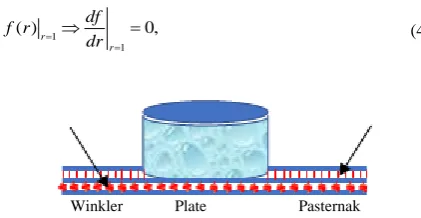
Circular plate resting on Winkler and Pasternak foundations is considered as shown in Figure 1. The diameter of the cylinder filled with water is 2𝑎, height is
Н. The fluid is inviscid and compressible of density ρ. The bottom cavity is at 𝑧 = 𝐻, which is resting on Winkler and Pasternak foundations, the side wall is at 𝑟 = 𝑎 also considered rigid. However, the fluid surface is covered with circular plate at 𝑧 = 0 and at the bottom. The motion of the fluid is presumed to be of small magnitude and irrotational. The governing differential equations of the coupled system can be expressed in dimensionless form as stated in literature [14]:
(
)
4 3 2
4 3 2 2 3 4
2
2 2
2
1
, 0 ; w
s k
d f d f B d f B df A
f k f
dr r dr r dr r dr r
d f df
k f p r z
dr r dr
+ − + + +
− + − = =
(1)
2 2 2
2
2 2 2 2 2
1 1
0; 1
k k k
k k
d p dp m d p
p p
dr +r dr − r + dz +c = (2)
where f is the transverse deflection of the circular plate,
kw is the Winkler foundation parameter, ksis the shear of Pasternak foundation, Ω is the non-dimensioned natural frequency, Pkis the hydrostatic dynamic pressure of fluid.
is the slender ratio andc
is the speed ratio of sound in fluid and circular plate.4 2
4
A=m − m and 2
2 1
B= m + (3)
where
m
is the integer number of nodal diameter. 2. 1. Boundary Conditions Three type of boundary conditions are considered: Clamped, free and simply supported which are presented in dimensionless form according to classical theory of vibration as follows [14]:Clamped edge,
1
1
( )r 0,
r df f r
dr =
=
= (4)
Winkler Plate Pasternak
Figure 1. Circular plate with fluid resting on two-parameter
Simply supported edge,
( )
1 1 22 22 10, r r
r
d f df m
f r M D f
dr r dr r
= =
= − + + =
(5)
Free edge, 1 2 2 2 2 1 0, r r
d f df m
M D f
dr r dr r =
= − + + =
(6)
2
3 2 2 2 2
3
3 2 2
1
2 1
1 3
0, r r
d f d f m df m m
V f
dr r dr r dr r
m = = + + + = − − − (7)
The bending moment is represented as 𝑀𝑟and the radial
shear force per unit length is represented as 𝑉𝑟
.
Thecoupled governing Equations (1) and (2) are fourth order and second order, respectively. Invariably four conditions and two conditions are needed for solving the problem respectively. Two conditions may be obtained from the external condition of the plate while the rest is obtained from the condition at the centre of the plate. For the other equation second-order equation, one at the external as usual. The regularity conditions at the centre are given as follows:
Symmetric case,
3 3 0
0
( 0, )
= 0, = 0, k 0
r r r
df d f
dr d p r r r z V = = = = = (8)
where m=0, 2, 4 ,
Axisymmetric case,
( )
0 0 220
0, rr 0, k( 0, ) 0
r
r d f
f r M p r z
dr = =
=
= = = = = (9)
and m=1, 3, 5
3. METHOD OF SOLUTION
3. 1. Principle of Differential Transformation Method Differential transformation method proposed by Zhou [13] is a very simple, powerful, reliable and very versatile method of solution. DTM involves transformation techniques which are applied to the governing equation along with the boundary conditions to form algebraic recursive expression. The resulting solution of the algebraic equations form the solution of the system in series form. This transformation makes it very simple to manipulate and convergences very fast. The accuracy of the results compared to numerical method and experimental is very high. The basic definitions and operational properties are as follows:
Considering a function 𝑓(𝑟) that is analytic in the domainR, then it will be differential continuously with rest to space r:
(
)
( )
, , k
k d f r
r k r =
for all
r
R
(10)For 𝑟 = 𝑟𝑖, then
𝜑(𝑟, 𝑘) = 𝜑(𝑟
𝑖, 𝑘), where
k belongs tothe set of non-negative integers, denoted as the k-domain. Therefore, Equation (10) is written as follows:
( )
( ) ( ) , i k i k r r d f rF k r k
r = = =
(11)
where 𝐹𝑘 is the spectrum of 𝑓(𝑟) is at 𝑟 = 𝑟𝑖 𝑓(𝑟)
expressed in Taylor’s series, then 𝑓(𝑟) is presented as follows:
(
)
( ) ( ), ! k i k r rF r F k
k − =
(12)Equation (12) is the inverse of 𝐹(𝑘) using the symbol "𝐷"representing the differential transform process and combining Equation (11) and (12), we have:
( )
(
)
1( ) ( ), ! k i k r r
f r F k D F k
k − − = =
(13)3. 2. Application of DTM to the Solution of Nonlinear Equation under Investigation Using the operational properties, the differential transformation of the governing Equations (1) and (2) are transformed along with regularity condition at the centre.
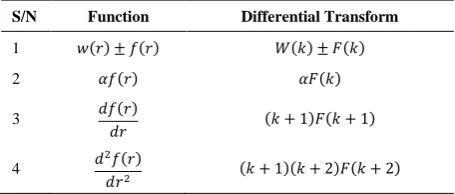
Table 1 shows operational properties of DTM. Applying the operational properties of DTM as stated in Table 1, the coupled governing differential Equations (1) and (2) are transformed as follows:
(
)
(
)
(
)(
) (
)(
)(
)
2 2 2 4 24 6 16
4 2 4 2 3
k w k s k k
k
F k F k k k F P
F
A B k k k k k
+ +
− + + − − +
=
− + + + + + + (14)
(
)
(
)
2
2 2 2 2
2 k k
P P
c k m
+
=
+ − (15)
The boundary conditions stated in Equations (8) and (9) are transformed as follows:
[0] , [1] 0, [2] / 2, [0] , [1]
F =a F = F =b P =d P =e (16)
TABLE 1. Operational properties of differential transformation
method
S/N Function Differential Transform
1 𝑤(𝑟) ± 𝑓(𝑟) 𝑊(𝑘) ± 𝐹(𝑘)
2 𝛼𝑓(𝑟) 𝛼𝐹(𝑘)
3 𝑑𝑓(𝑟)
𝑑𝑟 (𝑘 + 1)𝐹(𝑘 + 1)
4 𝑑
2𝑓(𝑟)
3. 3. Application of DTM to the Conditions Same principle is adopted in transforming other conditions. For the fluid pressure different conditions exist but, this study is investigating the effect of the fluid when in contact with the plate.
To obtain the natural frequency of the coupled equation, the condition Equation (16) is applied along with the coupled Equations (14) and (15) and non-trivial solutions obtained which is resolved to obtain the Eigen value and natural frequency.
3. 4. The Stress-Deflection Expression as [14] To determine the radial and circumferential stress for the circular plate, the following dimensionless expression may be used:
( )
22 2
, z
, 1
rr
E r z d f df dr r dr
= +
− (17)
( )
22 2
, z 1
, 1
E r z df d f r dr dr
= +
− (18)
where 𝐸 is the Young modulus of the circular plate, 𝜈 is the Poison’s ratio and 𝑧 is the mid-plane of the plate. Equations (17) and (18) are the radial and circumferential stress respectively.
4. RESULTS AND DISCUSSION
The analytical solution of coupled governing equation of motion of the circular plate under various boundary conditions with differential transformation method is hereby presented. The material properties for the thin uniform thickness, homogenous circular plate used are: 𝐸 = 207𝐺𝑃𝑎, 𝜌 = 7850 𝑘𝑔 𝑚⁄ 3, ℎ = 10𝑚𝑚,
𝜌 = 1000 𝑘𝑔 𝑚⁄ 3, Young modulus, material density, plate thickness and density of water respectively.
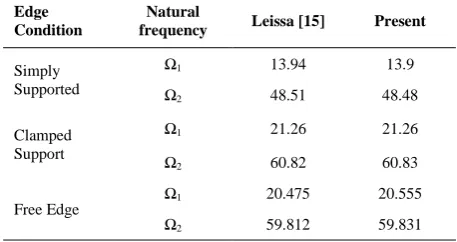
The analytical solution obtained is compared with experimental results reported in literature [15] and presented in Tables 2 and 3.
TABLE 2. Validation of fundamental natural frequency for
symmetric condition
Edge Condition
Natural
frequency Leissa [15] Present
Simply Supported
Ω1 4.977 4.935
Ω2 29.72 29.72
Clamped Support
Ω1 10.2158 10.2158
Ω2 39.7711 39.7711
Free Edge
Ω1 9.003 9.003
Ω2 38.443 38.439
TABLE 3. Validation of fundamental natural frequency for
axisymmetric condition
Edge Condition
Natural
frequency Leissa [15] Present
Simply Supported
Ω1 13.94 13.9
Ω2 48.51 48.48
Clamped Support
Ω1 21.26 21.26
Ω2 60.82 60.83
Free Edge
Ω1 20.475 20.555
Ω2 59.812 59.831
Good agreement is observed along the entire values under different boundary and regularity conditions. Generally, the natural frequency is expressed in dimensionless form Ω. Therefore, the results are valid for all thickness to radius ratio. Table 4 clearly shows that, the number of iterations needed to obtain convergence in relation to natural frequency differs. For instance, fundamental mode requires 10 iterations for DTM while the second requires 15 iterations and third iteration requires more as illustrated in Table 4. This behaviour is attributed to more complex series functions combination. Results shown in Tables 2 and 3 illustrate that, first two natural frequency gives a reasonable prediction of plate behaviour, more iterations are required for higher mode natural frequencies and also increases the fundamental frequency accuracy.
4. 1. Effect of Foundation Parameters of Natural Frequency The analysis is performed on the three boundary conditions as discussed earlier and using regularity conditions at the centre to start the iterations. In this study, consideration is given to;
Elastic Winkler type 𝑘𝑤= 0, 50, 100, 150
Elastic Pasternak type 𝑔𝑠= 10, 50, 100
Two-parameter elastic foundations (𝑘𝑝= 0, 𝑘𝑤= 50,
𝑔𝑠 = 10, 50, 100)
The values are given based on experimental investigations and as used in practice. Although, it a global behaviour of plate to be affected by presence of elastic foundation, comparing Tables 5 to Tables 2 and 3 indicates that for both plate and foundation stiffness to be
TABLE 4. Convergence study
N Mode 1 Mode 2 Mode 3 Mode 4
15 4.9351271 29.158475
25 4.9351358 29.719307 74.054478
30 4.9351222 29.720113 74.194844 135.43725
comparable there is a need to properly study the foundation stiffness to be chosen. As it is expected in all cases, increasing the foundation stiffness results into higher value of natural frequencies. Moreover, it is also observed that, effect of the difference in natural frequencies is more significant for higher mode of the circular plate.
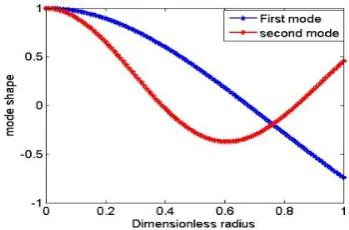
4. 2. Mode Shape According to literature [14], for transient stress investigation, the response is normally based on modal superposition principle and the modal stress which to certain level, will expose the characteristics and content of the whole response of the plate. Based on that, study of the non-dimension radial and circumferential stress is determined using Equations (17) and (18) with results illustrated in Figures 2 and 3. The mode shape for the natural frequencies is shown in Figures 2 and 3, respectively. It is essential to note that, the mode shape obey the classical theory of vibration. For radial and circumferential stresses, location of the vibrating node and antinodes are in-away different due to the vanishing mode of the boundary condition. Figures 4 and 5 show mode shape due to the radial and circumferential stress, it is clearly shown that, the location of node and antinodes of the vibrating plate changes. Figures 4 and 5 when compared to Figures 2 and 3 different in the mode shape is clearly shown. Invariably, the extrema mode shapes location differs based on the boundary conditions. Figure 2 illustrates symmetric case vibration while Figure 3 shows axisymmetric case vibration. There is a clear difference in the shape of the mode shapes due to different modal numbers adopted. The condition at the centre play a major role in the shape modal shapes.
4. 3. Effect of Combine Winkler and Pasternak The combine variation effect of two-parameter foundations on natural frequency as shown in Table 5 illustrate the variation of the two-parameter foundations on the natural frequencies. From the results shown, increasing the combines of the two-foundation stiffness
TABLE 5. Combine Winkler and Pasternak variation effect on
natural frequency
Edge Condition
Natural
frequency (𝒌𝒘= 𝟓𝟎, 𝒎 = 𝟎)
Mode 𝒈𝒔= 𝟏𝟎 𝒈𝒔= 𝟓𝟎 𝒈𝒔= 𝟏𝟎𝟎
Simply Supported
Ω1 9.07 17.71 24.36
Ω2 33.98 48.73 63.24
Clamped Support
Ω1 13.15 20.91 27.61
Ω2 42.41 56.33 69.91
Free Support
Ω1 11.55 18.30 24.16
Ω2 43.23 59.74 75.90
also increases the natural frequency of the plate. The effect is more remarkable with the combined foundation parameter than when compared to only Winkler or Pasternak foundation.
Figure 2. Modes shapes of symmetric free edge
Figure 3. Modes shapes of axisymmetric free edge
Figure 4. Radial stress for simply supported edge
Symmetric case
Figure 5. Circumferential stress for symmetric case first
4. 4. Effect of Fluid on the Plate Based on the analysis, it is observed that, lower natural frequency is attained while plate is in fluid as compared to when on air. The medium act as damper to the natural frequency of vibrating circular plate. This is because, both vibrating plate and fluid possess kinetic energy, when vibrating plate is in contact with fluid, the kinetic energy of both systems increases significantly. This is referred to as added virtual mass incremental factor. It is also observed from the results obtained that, there is no significant change in mode shape of the plate when immersed in fluid.
5. CONCLUSION
The study of vibration of circular plate in contact with fluid and resting on two-parameter foundations is investigated using DTM. The radial and circumferential stress determined. The analytical solutions obtained are used for the parametric study. From the results, it is concluded that, increase elastic foundation increases the natural frequencies, mode shapes are distorted due to radial and circumferential stress. Mode shapes of circular plate are not significantly affected when in contact with fluid. Natural frequencies of plate lower when in contact with fluid. The present study exposes the significant of the controlling parameters in dynamic behaviour of the plate.
6. REFERENCES
1. Motaghian, S., Mofid, M. and Akin, J. E., “On the free vibration response of rectangular plates, partially supported on elastic foundation”, Applied Mathematical Modelling, Vol. 36, No. 9, (2012), 4473–4482.
2. Rezaiefar, A. and Galal, K., “Free vibration of thin rectangular steel plates with geometrically-nonlinear load-displacement behavior”, Thin-Walled Structures, Vol. 129, (2018), 381–390. 3. Adibi, T., Adibi, O. and Razavi, S. E., “A Characteristic-based
Solution of Forced and Free Convection in Closed Domains with Emphasis on Various Fluids”, International Journal of
Engineering-Transactions B: Applications, Vol. 32, No. 11,
(2019), 1689–1695.
4. Benferhat, R., Daouadji, T.H., Mansour, M.S. and Hadji, L., “Effect of porosity on the bending and free vibration response of functionally graded plates resting on Winkler-Pasternak foundations”, Earthquakes and Structures, Vol. 10, No. 6, (2016), 1429–1449.
5. Özdemir, Y. I., “Forced vibration analysis of Mindlin plates resting on Winkler foundation”, Challenge Journal of Structural
Mechanics, Vol. 4, No. 1, (2018), 18–26.
6. Mohd Umair, S., Gulhane, N.P., Al-Robaian, A.R.A. and Khan, S. A., “On Numerical Investigation of Semi-empirical Relations Representing Local Nusselt Number at Lower Nozzle-target Spacing’s”, International Journal of Engineering - Transaction
A: Basics, Vol. 32, No. 1, (2019), 137–145.
7. Nikbakht, R. and Behnamfar, F., “Response Spectra of Structures under Subway Induced Vibrations”, International Journal of
Engineering - Transaction C: Aspects, Vol. 31, No. 12, (2018),
2009–2015.
8. Bayat, M., Pakar, I. and Bayat, M., “Analytical study on the vibration frequencies of tapered beams”, Latin American
Journal of Solids and Structures, Vol. 8, No. 2, (2011), 149–162.
9. Werfalli, N.M. and Karoud, A. A., “Free vibration analysis of rectangular plates using Galerkin-based finite element method”,
International Journal of Mechanical Engineering, Vol. 2, No.
4, (2012), 59–67.
10. Younesian, D., Saadatnia, Z., Askiri, H. and Esmailzadeh, E., “Analytical solution for oscillation of rectangular plate on nonlinear Winkler Pasternak foundation”, In Proceedings of the ASME 2011, International Design Engineering Technical Conferences & Computers and Information in Engineering Conference, USA, (2011), 1–6.
11. Lamb, H., “On the Vibrations of an Elastic Plate in Contact with Water”, Proceedings of the Royal Society of London. Series A,
Containing Papers of a Mathematical and Physical Character,
Vol. 98, No. 690, (1920), 205–216.
12. Gascón-Pérez, M. and García-Fogeda, P., “Induced damping on vibrating circular plates submerged in still fluid”, International
Journal of Applied Mechanics, Vol. 7, No. 6, (2015), 1–18.
13. Zhou, J.K., “Differential transformation and its applications for electrical circuits”, Huazhong University Press, Wuhan, China, (1986).
14. Shariyat, M. and Alipour, M. M., “Differential transform vibration and modal stress analyses of circular plates made of two-directional functionally graded materials resting on elastic foundations”, Archive of Applied Mechanics, Vol. 81, No. 9, (2011), 1289–1306.
Dynamic Analysis of Circular Plates in Contact with Fluid and Resting on
Two-Parameter Foundations
M. G. Sobamowoa, O. M. Sadiqb, S. A. Salawub
a Department of Mechanical Engineering, University of Lagos, Akoka, Nigeria
b Department of Civil and Environmental Engineering, University of Lagos, Akoka, Nigeria
P A P E R I N F O
Paper history:
Received 10 April 2019
Received in revised form 17 September 2019 Accepted 07 November 2019
Keywords:
Circular Plate Deflection Free Vibration
Winkler and Pasternak Differential Transformation Method
هدیکچ
هریاد هحفص یکیمانید راتفر زاگ و تفن نهآ هار ،نابوتا ،کینتوئژ هجوت دروم کیتسلاا ینابم رب نکاس لایس اب سامت رد یا
هریاد هحفص یکیمانید راتفر هلاقم نیا رد .تسا هتفرگ رارق کیناکم یسدنهم و ینابم رب نکاس لایس اب سامت رد یا
ورلکنیو
تسا هتفرگ رارق قیقحت دروم کنرتسپ .تسا هتفرگ رارق زیلانآ دروم مرفسنارت شور زا هدافتسا اب لیسنارفید هلداعم دنچ .
تسدب یلیلحت جیاتن .تسا هدش شرازگ قیقحت هنیشیپ رد هدمآ تسدب یبرجت قیقحت جیاتن و یلیلحت لح نیب یبولطم قابطنا
رف رب یبیکرت یاهرتماراپ ،یعیبط سناکرف رب یکیتسلاا یاهرتماراپ ریثات هدمآ سرتسا ،لایس اب سامت رد هحفص ،یعیبط سناک
لکش لیاتسا رب یطیحم و یعاعش یم ناشن هدمآ تسدب جیاتن .تسا هدومن یسررب ار اه
رتماراپ شیازفا دراوم هیلک رد دهد
یم یعیبط سناکرف شیازفا بجوم ینابم یم هحفص یعیبط سناکرف شهاک بجوم لایس روضح .دوش
روضح نینچمه .ددرگ
بجوم لایس لکش لیاتسا رییغت
لکش لیاتسا ییاجباج بجوم لایس روضح لاح ره هب .دش دهاوخن اه تحت هک هدش اه
سرتسا ریثات یم راظتنا هک دراد هزاس تاشاعترا رب یکیزیف یهاگن رضاح هلاقم .دوب دنهاوخ یطیحم و یعاعش یاه بجوم دور
یارب یرتهب مهف هریاد هحفص یکیمانید راتفر
یس اب سامت رد یا کیتسلاا ینابم رب نکاس لا
.دراد