the best lens shapes that comply with given radiation characteristics. The first technique is a step-wise approach: the first step consists in solving the synthesis problem using Geometrical Optics (GO) principles, and, in the second one, the GO shape is optimized locally to fulfill the target specifications. This approach leads to an ill-posed problem and is only applicable to single-shell configurations. To overcome these limitations, an alternative technique consists of a global optimization of the ILA, using genetic algorithms (GAs) for instance. The capabilities of both design tools are highlighted numerically. Future trends in the shape optimization of lens antennas are also discussed.
R´esum´e. Dans cet article, nous d´ecrivons les deux m´ethodologies principales actuellement utilis´ees pour l’optimisation de forme de dispositifs de focalisation du type antennes lentilles int´egr´ees 3-D. L’objectif principal du processus d’optimisation consiste `a d´efinir une forme optimale de lentille de fa¸con `a satisfaire des propri´et´es en rayonnement pr´ed´efinies. La premi`ere m´ethodologie comporte deux ´etapes successives : elle consiste d’abord en une r´esolution pr´ealable du probl`eme inverse au sens de l’optique g´eom´etrique, puis en une optimisation locale de la forme ainsi pr´ed´etermin´ee. Le probl`eme non lin´eaire `a r´esoudre est mal conditionn´e et cette approche ne s’applique aujourd’hui qu’`a des configurations simple coque. Afin de s’affranchir de ces limitations, une solution alternative consiste `
a effectuer une optimisation globale de l’antenne en couplant un noyau g´en´erique de calcul asymptotique `
a un algorithme d’optimisation globale (du type algorithme g´en´etique par exemple). Les potentialit´es de ces deux techniques sont illustr´ees grˆace `a plusieurs exemples num´eriques. Enfin nous d´efinissons les principaux besoins actuellement exprim´es en optimisation de dispositifs focalisants.
1.
Introduction
Many millimeter-wave front-end modules use quasi-optical devices for power budget or high resolution pur-poses. Among the available antenna technologies, a number of prior works suggest that lens antennas are very promising for shaped-beam or multiple-beam applications [1]. In this paper, we focus our attention on a par-ticular kind of lenses: the so-called integrated lens antennas (ILAs). The latter have been employed in many applications, like point-to-point and point-to-multipoint indoor and outdoor radio links [1][2], ACC (Automo-tive Cruise Control) radars [3], imaging systems and SIS receivers [4], maritime communications in Ku-band, satellite communications in Q- and Ka-bands [5][6]. A recent state of the art is given in Ref. [7].
1Institut d’Electronique et de T´el´ecommunications de Rennes (IETR), www.ietr.org. UMR CNRS 6164, Universit´e de Rennes 1, Campus de Beaulieu, Bˆatiment 11D, Avenue du G´en´eral Leclerc, 35042 Rennes Cedex, France. Email: [email protected]
c
EDP Sciences, SMAI 2007
ESAIM: PROCEEDINGS 89
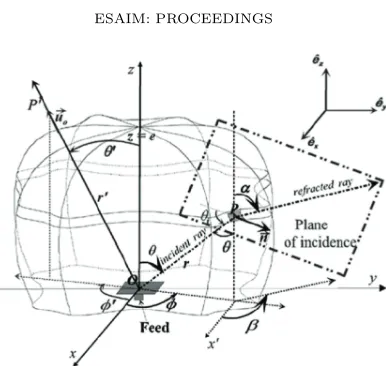
Figure 1. Single-shell integrated lens antenna. Geometry and notations.
In contrast to shaped reflector antennas, the synthesis and optimization of shaped lenses has been con-siderably less studied because lenses have been often considered as heavy and bulky, and the mathematical formulation and numerical computations in dielectric lens shaping may be a delicate task, especially for arbi-trary three-dimensional (3-D) lenses [8]. Specific design methodologies have been proposed for the synthesis of (i) axisymmetric, nearly axisymmetric and arbitrarily-shaped ILAs in single- and double-shell configurations (e.g. [6][8]-[11]), and (ii) non-homogeneous lenses [12].
This paper is organized as follows. We describe recent advances in the local and global optimization of arbitrarily-shaped 3-D ILAs in Sections 2 and 3, respectively. Numerical results are also given to illustrate the capabilities of these techniques. Conclusions and future trends are finally drawn in Section 4.
2.
LOCAL OPTIMIZATION AND NUMERICAL RESULTS
2.1.
Geometry and notations
An ILA is defined as a dielectric lens body (ǫr,d, tanδd) in direct contact with a primary feed. The geometry
of a single-shell arbitrarily-shaped ILA is represented in Fig. 1. In this figure, it is assumed that the feed is a planar antenna radiating towards the z>0 direction (it is assumed that the phase centre coincides with the origin O). The lens profile r(θ, φ) is shaped so that the far-field radiation pattern of the ILA coincides with a desired pattern h(α, β) for a given primary source g(θ, φ). The incident and refracted rays are denoted by (θ, φ) and (α, β), respectively. P’ is an observation point and P denotes any secondary source point located on the lens surface.
2.2.
Formulation and algorithm
This procedure comprises two successive steps. In the first one, a synthesized lens profile, rGO(θ, φ), is
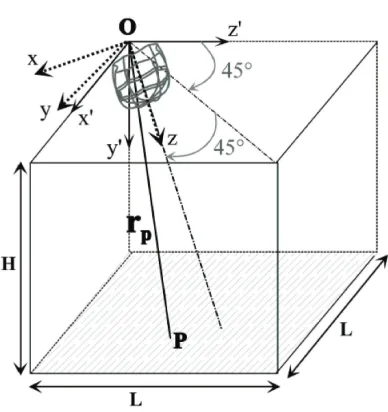
Figure 2. Room geometry. The base station (BST) antenna is located at the origin O and illuminates the floor with a constant flux.
∂r ∂θ =
(sinαcosθcos(β−φ)−cosαsinθ)r
nd−(sinαsinθcos (β−φ) + cosαcosθ) (1)
∂r ∂φ =
sinαsin (β−φ)rsinθ
nd−(sinαsinθcos (β−φ) + cosαcosθ) (2)
∂2 r ∂θ∂φ =
∂2 r
∂φ∂θ (3)
Wherend=√ǫr,d. After some manipulations, Eqns (1)-(3) are transformed into a second-order Monge-Ampere
(M.A.) equation; the latter is solved iteratively after linearization and discretization using first-order centered finite differences [8]. It is noteworthy to mention that the synthesized profile - solution of the M.A. equation - is an approximate solution of the problem since the diffraction effects are not taken into account in the GO formulation. To circumvent these limitations and improve the accuracy of the solution, the synthesized profile is optimized locally using a gradient-type technique (second step) so that its theoretical power pattern GGO−P O
coincides with the target pattern h. GGO−P O is computed with the hybrid GO-PO (GO-Physical Optics)
method [4][8]. This algorithm is described in detail in Ref. [11].
2.3.
Numerical results and discussions
This technique has been applied successfully for the design of shaped ILAs radiating Gaussian, flat-top, conical and exotic beams [13][14]. In particular, ILAs are one relevant antenna technology for 4-G wireless local area networks (WLANs) in the 60-GHz band. In this context, several communication scenarii suggest to fix the base station (BST) antenna at the upper corner of the room (height H, square area L×L). For this configuration
(Fig. 2), in order to compensate for the free-space attenuation and avoid multiple reflections on the walls, the radiation pattern of the BST should comply with the following specification:
h(α, β)∝
r2
p, for 0< x′ < L and 0< z′< L
ESAIM: PROCEEDINGS 91
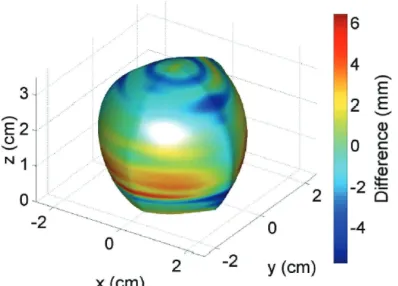
Figure 3. Synthesized and optimized 3-D lenses for WLANs at 60-GHz. The 3-D shape corresponds to the synthe-sized lens and the color scale indicates the difference (in mm) between the op-timized shape and the synthesized one.
Figure 4. Theoretical radiation pat-terns (φ=0˚) computed with the GO-PO method at 60 GHz. Dashed grey line: Radiation pattern ’g’ of the open-ended waveguide. Black dashed line: Power template ’h’. Solid grey line: Be-fore optimization. Solid black line: af-ter optimization.
The corresponding synthesized and optimized lens shapes are represented in Fig. 3. It is assumed that the lens is in Teflon (ǫr,d= 2.1, tanδd= 5×10⁻³) and is illuminated by an open-ended rectangular metallic WR-15
waveguide.
The theoretical co-polarization components of the primary feed, the synthesized ILA and the optimized ILA are compared in Fig. 4 in one principal plane (φ=0˚). The radiation patterns of the synthesized ILA are in strong disagreement with the amplitude template. As expected, this result confirms that the synthesis procedure should be generally followed by an optimization of the lens shape. On the other hand, there is a satisfactory agreement between the target and optimized patterns, despite the -10dB side lobes appearing beyond 55˚. This result is one of the first numerical validations highlighting the possibility to obtain strongly shaped beams using 3D-shaped ILAs [13].
Due to the range of validity of ray tracing techniques, this algorithm is only valid for electrically-large ILAs. In addition, in some cases, it might be delicate to apply because the M.A. problem is ill-posed and the existence of a solution has been established only for single shaped reflectors [15]. Moreover, due to its complexity, the formulation has never been extended to the optimization of multi-shell ILAs. To circumvent these limitations, alternative global optimization procedures have been proposed recently, as described in the next Section.
3.
GLOBAL OPTIMIZATION AND NUMERICAL RESULTS
3.1.
Methodology
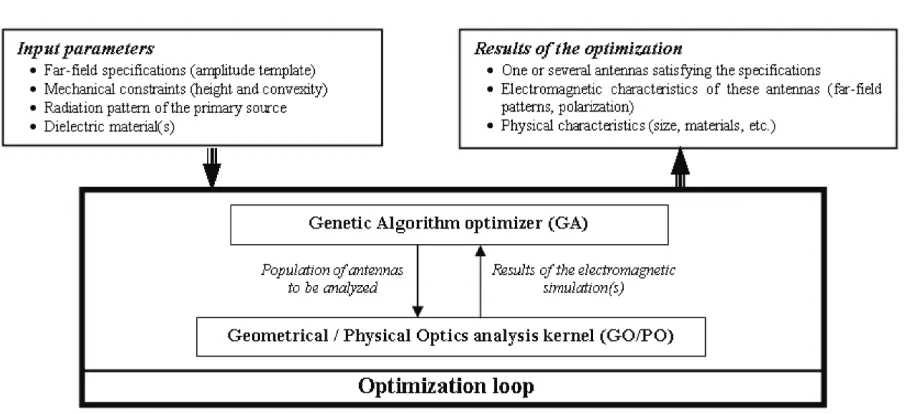
This design procedure (Fig. 5) consists in combining a genetic algorithm (e.g. [16]) with a powerful GO-PO kernel developed for the analysis of multi-shell generic 3-D ILAs.
Figure 5. Flowchart of the optimization tool.
iteration of the optimization loop, the electromagnetic characteristics of an ILA generated by the optimizer are analyzed with the GO-PO tool and its performance is compared to the desired far-field specifications. Further information is available in Refs. [17][18].
3.2.
Numerical results
Two examples are discussed here in order demonstrate the flexibility and capability of this design tool.
3.2.1. Single-shell lens
In this example, the objective is to design a lens antenna radiating a flat-top beam at 28GHz. The lens is in Rexolite (ǫr,d = 2.53, tanδd = 5×10⁻³) and is fed by an aperture-coupled microstrip patch antenna.
Fig. 6 and 7 represent the 3-D optimized ILA and its radiation patterns, respectively. Comparison with the amplitude template shows that the ripples of the sectoral beam (≈3dB) are slightly larger than the target value.
In addition, the roll-off is less rapid than the desired one. These effects are due to the reduced size of the lens. The radiation performance could be improved significantly by optimizing a larger ILA (whose central thickness is roughly 12×λ0, instead of 4×λ0).
3.2.2. Double shell lens
Global Earth observation antennas for low orbit satellites require a shaped beam radiation pattern that provides constant flux coverage of the Earth surface within a Θ<Θmaxsubtended angle measured with respect
to nadir. Taking into account Earth curvature and path loss attenuation dependence with Θ, the constant flux coverage requirement translates approximately into a Sec(kΘ) radiation pattern template, where k is a constant related to the desired Θmax.
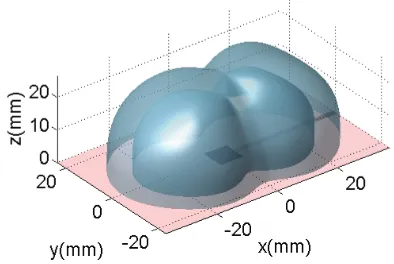
An ILA satisfying these requirements is designed in Ka-band. A double-shell configuration is selected in order to reduce the overall size and weight of the lens. The optimized ILA is represented in Fig. 8; the inner and outer shells are made of Macor (ǫr,d=5.67) and Rexolite in order to enhance the power transfer efficiency and
ESAIM: PROCEEDINGS 93
Figure 6. Optimized shape of the lens for a flat-top illumination.
Figure 7. Computed radiation pat-terns in both principal planes at 28GHz. Solid grey line: power tem-plate. Solid and dotted black lines: co-polarization components in E- and H-planes.
Figure 8. Double-shell optimized ILA.
4.
CONCLUSION AND FUTURE TRENDS
This paper describes two design methodologies for the optimization of shaped Integrated Lens Antennas (ILAs) for shaped beam applications at millimeter waves. The first approach is based on the local optimization of a synthesized lens profile, solution of a Monge-Amp`ere problem. Although powerful, this technique is presently restricted to the design of large and single-shell ILAs. An alternative solution consists in combining a global optimization algorithm (like a Genetic Algorithm) to high-frequency techniques (like the Geometrical Optics - Physical Optics method). Numerical examples have highlighted the main characteristics and limitations of these design tools.
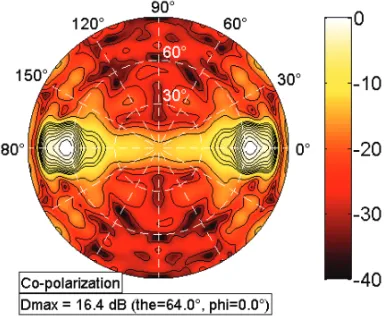
Figure 9. Radiation patterns in both principal planes at resonance (26GHz). Solid orange line: power template. Solid and dotted black lines: co-polarization components in E- and H-planes.
Figure 10. 3-D co-polarization pat-tern at resonance (26GHz).
implemented and validated for the analysis and the global optimization of lens antennas. Among those, the development of fast and accurate full-wave electromagnetic solvers seems to be a very promising approach. A recent contribution has demonstrated its feasibility in 2-D [19]. Extension in 3-D and combination with fast computational techniques (such as the FMM) is an exciting challenge.
References
[1] G. Godi, R. Sauleau, D. Thouroude, ”Performance of reduced size substrate lens antennas for millimetre-wave communications”, IEEE Trans. Antennas Propagat., vol. 53, n˚4, pp. 1278-1286, Apr. 2005.
[2] X. Wu, G. V. Eleftheriades, T. E. van Deventer-Perkins, ”Design and characterization of single- and multiple-beam mm-wave circularly polarized substrate lens antennas for wireless communications”, IEEE Trans. Microwave Theory Tech., vol. 49, n˚3, pp. 431-441, Mar. 2001.
[3] B. Schoenlinner, X. Wu, J. P. Ebling, G. V. Eleftheriades, G. M. Rebeiz, ”Wide-scan spherical-lens antennas for automotive radars”, IEEE Trans. Microwave Theory Tech., vol. 50, n˚9, pp. 2166-2175, Sep. 2002.
[4] D. F. Filipovic, S. S. Gearhart, G. M. Rebeiz, ”Double-slot antennas on extended hemispherical and elliptical silicon dielectric lenses”, IEEE Trans. Microwave Theory Tech., vol. 41, n˚10, pp. 1738-1749, Oct. 1993.
[5] B. Bar`es, R. Sauleau, G. Godi, ”Design of a compact millimeter-wave lens antenna for satellite communications in Q-band”, 26th ESA Antenna Technology Workshop on Satellite Antenna Modelling and Design Tools, ESTEC, Noordwijk, The Nether-lands, pp. 229-236, 12-14 Nov. 2003.
[6] J. R. Costa, C. A. Fernandes, G. Godi, R. Sauleau, H. Legay, ”Benchmark of lens antennas for Ka-band global earth observation from LEO satellites”, European Conf. on Antenna and Propagation, EuCAP 2006, Nice, France, 6-10 Nov. 2006.
[7] R. Sauleau, C. A. Fernandes, J. R. Costa, ”Review of lens antenna design and technologies for mm-wave shaped-beam appli-cations”, 11th International Symposium on Antenna Technology and Applied Electromagnetics, ANTEM 2005, Saint-Malo, France, 15-17 Jun. 2005.
[8] B. Chantraine-Bar`es, R. Sauleau, L. Le Coq, K. Mahdjoubi, ”A new accurate design method for millimeter-wave homogeneous dielectric substrate lens antennas of arbitrary shape”, IEEE Trans. Antennas Propagat., vol. 53, n˚3, pp. 1069-1082, Mar. 2005. [9] C. A. Fernandes, L. M. Anunciada, ”Constant flux illumination of square cells for millimeter-wave wireless communications”,
ESAIM: PROCEEDINGS 95
[10] J. R. Costa, M. Silveirinha, C. A. Fernandes, ”Design and analysis of double-shell axial-symmetric integrated lens antennas for space applications”, 28th ESA Antenna Workshop on Space Antenna Systems and Technologies, Noordwijk, Netherlands, vol. 2, pp. 865-872, Jun., 2005.
[11] R. Sauleau, B. Bar`es, ”A complete procedure for the design and optimization of arbitrarily-shaped integrated lens antennas”, IEEE Trans. Antennas Propagat., vol. 54, n˚4, pp. 1122-1133, Apr. 2006.
[12] O. M. Bucci, I. Catapano, L. Crocco, T. Isernia, ”Synthesis of new variable dielectric profile antennas via inverse scattering techniques: a feasibility study”, IEEE Trans. Antennas Propagat., vol. 53, n˚4, pp. 1287-1297, Apr. 2005.
[13] B. Bar`es, ”Synth`ese et optimisation d’antennes lentilles substrats `a diagramme de rayonnement form´e en ondes millim´etriques”, Ph.D. dissertation, Universit´e de Rennes 1, Nov. 2004.
[14] B. Bar`es, R. Sauleau, ”Design and optimisation of axisymmetric millimetre-wave shaped lens antennas with directive, secant-squared and conical beams”, IEE proc. Microw., Ant. Propag., in press.
[15] L. A. Caffarelli, S. Kochengin, V. I. Oliker, ”On the numerical solution of the problem of reflector design with given far-field scattering data”, Contemp. Math., vol. 226, pp. 13-32, 1999.
[16] D. S. Weile, E. Michielssen, ”Genetic algorithm optimization applied to electromagnetics: a review”, IEEE Trans. Antennas Propagat., vol. 45, n˚ 3, pp. 343-353, Mar. 1997.
[17] G. Godi, ”Conception et optimisation d’antennes lentilles multicouches et de dˆomes di´electriques. Applications en ondes millim´etriques”, Ph.D. dissertation, Universit´e de Rennes 1, Nov. 2006.
[18] G. Godi, R. Sauleau, L. Le Coq, D. Thouroude, ”Design and optimization of three dimensional integrated lens antennas with genetic algorithm”, IEEE Trans. Antennas Propagat., in press.