Please cite this article as: H. Bakhshi, A. Dehghani, S. Jafaripanah, Using the Genetic Algorithm Based on the Riedel Equation to Predict the Vapor Pressure of Organic Compounds, International Journal of Engineering (IJE), IJE TRANSACTIONS C: Aspects Vol. 31, No. 6, (June 2018) 863-869
International Journal of Engineering
J o u r n a l H o m e p a g e : w w w . i j e . i rUsing the Genetic Algorithm Based on the Riedel Equation to Predict the Vapor
Pressure of Organic Compounds
H. Bakhshi*, A. Dehghani, S. Jafaripanah
Faculty of Chemical Engineering, Babol Noshirvani University of Technology, Babol, Iran
P A P E R I N F O
Paper history:
Received 01 November 2017
Received in revised form 02 February 2018 Accepted 08 February 2018
Keywords:
Genetic Algorithm Vapor Pressure Riddle Equation Clapeyron Optimization
A B S T R A C T
In this paper, a genetic algorithm (GA) has been used to predict the vapor pressure of pure organic compounds based on Riedel equation. Initially, the coefficients of Riedel equation were optimized. Then, a new term was added to the original Riedel equation to reduce error of the model in prediction of vapor pressures of pure materials. 110 components at two different pressures (10 and 100 kPa) were chosen to investigate the capability of mentioned models. Absolute average relative deviation percent (AARD %) was reported for 40 components as testing materials to compare the calculated results of two models with experimental data. Results showed that the exerted modification on Riedel equation decreases the errors in prediction of vapor pressures of chemical components.
doi: 10.5829/ije.2018.31.06c.01
1. INTRODUCTION1
Vapor pressure equation represents the relationship between the vapor pressure of a liquid and temperature. When the vapor phase is in equilibrium with the liquid phase. Clapeyron equation can be obtained from the equality of chemical potential, temperature and pressure in both phases [1]. The first equation for prediction of the vapor pressure of pure compounds was presented by integration of Clapeyron equation. Later many equations were suggested by modifying the original equation. Most of these equations are based on the principle of corresponding states and usually are presented as the logarithm of the reduced vapor pressure versus the reduced temperature. Antoine offered a modified simple form of the vapor pressure equation, in 1888 [2]. Cox presented a linear graph that relates the logarithm of the vapor pressure and temperature of few materials. Later this correction was extended for more compounds [3]. Wagner offered an equation to calculate the vapor pressure of nitrogen and argon, over the entire temperature range which the experimental data of vapor
*Corresponding Author Email: [email protected] (H. Bakhshi)
liquid density and the vapor pressure of 20 pure alcohols using an ANN model and statistical associating fluid theory (SAFT) equation of state. They reported the average absolute deviation percent (ADD%) for vapor pressure of pure alcohols for SAFT equation of state and ANN model were 3.378 and 3.593%, respectively [13]. Honarmand et al. [14] presented an accurate artificial neural network (ANN) model for vapor pressures prediction of pure substances. They used more than 12000 vapor pressure data point for testing, training and validation of ANN model. They reported that the ANN model predicted the vapor pressure of 75 pure compounds with average absolute relative deviation of 0.211% [14]. Roganov et al. [15] developed an algorithm based on a set of saturated vapor pressures of substances at various temperatures for calculation of the critical pressures, the critical temperatures, and Riedel coefficients at a critical point. Hogge et al. [16] optimized the final coefficient of Riedel equation (denoted as E) for vapor pressure estimation of seven various families of compounds including n-alkanes, 2-methyl alkanes, 1-alkenes, n-aldehydes, aromatics, ethers and ketones. They found out that the E equal 2 fits these compounds much better than the common E of 6 [16]. Also, they reported that an E of 2-5 fits compounds such as aldehydes, alkanes, alkenes, alkynes, amines, aromatics, esters, ethers, gases, halogenated compounds, ketones, multifunctional compounds, ringed alkanes, silanes, and sulfides much better than the usual E of 6 [17]. Since, GA is a new powerful tool for optimization it can be used to perform modification of Riedel equation.
In this article the Riedel's coefficients were optimized using vapor pressure data of 110 components at two different pressures (10 and 100 kPa) by applying GA. Also, a new equation based on Riedel equation was proposed for estimation of the vapor pressure, specially at low pressure.
2. THEORY
Riedel presented the following equation to calculate the vapor pressure of various compounds:
(1)
where, Pνp and T are the vapor pressure and the temperature, respectively. Parameters A, B, C, and D, are constants that are function of temperature, critical temperature (Tc), normal boiling temperature (Tb), and critical pressure (Pc). Riedel has defined the parameter α to determine the constants of Equation (1):
(2)
Where Pνpr and Tr are reduced vapor pressure and reduced temperature which are equal to P/Pc and T/Tc, respectively.
Respect to available experimental data for vapor pressure, Riedel and Plank have shown that:
At (3)
According to Equation (3) Riddle has suggested the following equations:
35Q
(4)
(5)
Riedel correlated the experimental vapor pressure data of different pure substances and suggested Equation (6) for estimation of empirical parameter Q as follow:
(6)
αc is the parameter α at critical point and could be obtained by the following equations:
(7)
(8)
Where Tbr is the reduced normal boiling temperature which equals to Tb/Tc. Also, Riddle considered the value of K for all compounds, equal to 0.0838. Later, Vetere [8] showed that for calculation of K, more accurate results will be achieved using the following equations for alcohols and acids:
For Acids: (9)
For Alcohols : (10)
(11)
extrapolation of the results of vapor pressure equations at low temperatures is one of the theoretical methods to predict the vapor pressure of compounds at low pressures [9, 23]. Another solution for calculation of the vapor pressure is modification of the main Riedel equation. In this work, initially, 10 fixed parameters in the Riedel equation have been optimized using the genetic algorithm. The modified equation has been used to obtain the temperature at which the vapor pressure of studied component reaches to 10 and 100 kPa. Main equations that should be optimized are:
(12)
(13)
(14)
Q
(15)
(16)
Where, C1 to C10 are the coefficients, which should be optimized. Moreover, a new equation was proposed for achieving to a greater accuracy by adding a new term to the Riedel equation:
(17)
In this case, 11 parameters (C1 to C11) of Equation (17) were calculated by applying the genetic algorithm.
2. 1. Genetic Algorithm Genetic algorithm (GA)
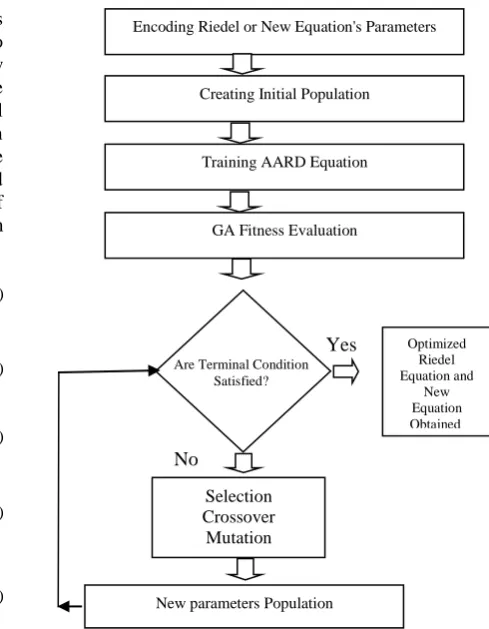
uses the natural evolution and survival of the fittest method with the genetic reproduction for quick search and optimization. The most important aspect of (GA) is that, it can do the search to find the best among the possible answers in the interval that was chosen by the user. It can find the optimal answer after several iterative calculations, according to the survival of the fittest law. Search process consists of artificial mutation, crossover and selection operations [24-27]. Figure 1 shows the steps of genetic algorithm for optimization of coefficients of Equations (12) and (17). Steps of operations can be described as follows:
1. First, C1, C2, C3... C10 for Equations (12-16) and C1, C2, C3... C11 for Equations (12-15) and (17) were coded to form the chromosomes. The chromosome X is expressed in the form of X = {k1, k2 ... k10} for Equations (12-16) and in form of X = {k1, k2 ... k11}
Figure 1. Steps of genetic algorithm to optimize the coefficients of Riedel and new suggested equation
for Equations (12-15) and (17) in which k1, k2... k11 are the same coefficients as C1, C2, C3... C11. The population size and the maximum evolution for generations were considered 50 and 100, respectively. The start of generations was from zero.
2. Evaluation function: In this step, the absolute average relative deviation percent (AARD %) for vapor pressures data was considered as the evaluation function:
(18)
Where Pcal is calculated vapor pressure by the models and Pexp is the experimental value of the vapor pressure for each substance.
3. Choice: the stochastic uniform method was used to decide whether the chromosome must be alive in the next generation or not. The chromosome that stayed alive in the next generation is placed in the Crossover and Mutation operations.
4. Crossover: The intersection occurs between the parents to form a new child with the intersection ability. The possibility of generation for new chromosome in each pair was considered equal to 0.8 and the scattered
Encoding Riedel or New Equation's Parameters
Creating Initial Population
Training AARD Equation
GA Fitness Evaluation
No
Yes
Are Terminal Condition Satisfied?
Optimized Riedel Equation and
New Equation Obtained
Selection Crossover Mutation
function was used for newly constructed chromosomes to make up the next generation.
5. Mutation: The Mutation operation follows the Crossover operation and determines whether a chromosome should be changed in the next generation or not. In this step, Gaussian method and Scale and Shrink was set equal to one.
6. The next generation: prepares a population for the next generation.
7. Stop conditions: The mentioned operations will be repeated until the number of generations reach to 50.
3. RESULTS AND DISCUSSION
It is important to explain that in this work, two general models based on Riedel equation using the genetic algorithm, have been used to estimate the vapor pressure of organic compounds at pressures of 10 and 100 kPa. At first, efforts have been done to optimize the coefficients of the Riedel equation using the genetic algorithm. In the second model, the coefficients of a new proposed equation have been optimized by changing the main Riedel equation. Finally, the results
of new model have been compared with the first model and also the optimized Riedel equation. During the survey in this work, the vapor pressure data of 150 different organic compounds were applied for pressures of 10 and 100 kPa. 110 data were used in the training phase to obtain the coefficients of the optimized Riedel equation and the coefficients of the new equation. Then, vapour pressures data of 40 different organic compounds were obtained for testing and comparison phase of three equations: The Riedel, the optimized Riedel and the new equation. The list and properties of some used compounds in the training and testing phases are summarized in Tables 1 and 2, respectively [28]. Complete set of data will be available as “Supplemental file” for readers. The optimized coefficients of the Riedel equation by the genetic algorithm method and optimized coefficients of the new equation for pressures of 100 and 10 kPa are listed in Tables 3 and 4, respectively. These coefficients were obtained by minimizing the AARD% introduced in Equation (18). The values of AARD% calculated by applying three mentioned models (Riedel, optimized Riedel and new equation) for vapor pressures of 100 and 10 kPa, are shown in Tables 5 and 6, respectively.
TABLE 1. Characteristics of the used compounds in the training phase [28].
kpa Pc (bar)
Tc (K) Tb (K)
Name Mol. form.
NO.
-4.3 -51.8
42.6 426.9
269.2 Bromochlorodifluoromethane
CBrClF2 1
-58.1 -96.6
39.7 340.15
215.41 Bromotrifluoromethane
CBrF3 2
22.5 -30
45.3 471.3
295.94 Dibromodifluoromethane
CBr2F2 3
-81.7 -116
38.73 301.84
191.71 Chlorotrifluoromethane
CClF3 4
-30 -71.3
41.3 385.1
243.45 Dichlorodifluoromethane
CCl2F2 5
TABLE 2. Characteristics of the used compounds in the testing phase [28]
TABLE 3. The coefficients of the optimized Riedel and new equation, for pressure of 100 kPa
11 C 10 C 9 C 8
C 7
C 6
C 5
C 4
C 3
C 2
C 1
C Method
-0.625 0.51
0.94 0.867
0.049 0.612
0.633 0.003
0.443 0.152
Optimized Riedel
0.012 0.485
0.592 2.561
-0.429 0.094
0.31 -1.19 0.264
2.548 0.686
New Equation
T (°C) at 10 T (°C) at 100 kpa
NO. Mol. form. Name Tb (K) Tc (K) Pc (bar) T (°C) at 10 kpa T (°C) at 100 kpa
1 C2H4Br2 1,2-Dibromoethane 404.8 583 71.64 62.2 130.9
2 C2H4O2 Acetic acid 391.04 594.45 57.9 55.9 117.5
3 C2H5F Fluoroethane 235.6 375.31 49.62 -78.7 -37.9
4 C4H6 1,3-Butadiene 268.74 425 42.63 -51.9 -4.7
TABLE 4. The coefficients of the optimized Riedel and new equation, for pressure of 10 kPa
11 C 10 C 9 C 8
C 7
C 6
C 5
C 4
C 3
C 2
C 1
C Method
- 2.405 1.046
0.781 0.794-
0.695 3.435
1.959 0.41
1.091 -0.63
Optimized Riedel
1.192 3.433
1.466 3.526
1.154 1.789
2.304 3.468
0.122 2.961
1.345 New Equation
TABLE 5. Comparison of errors of Riedel, optimized Riedel and new equation for pressure of 100 kPa
Total absolute percentage error
for all substances Total absolute
percentage error testing
phase Total absolute
percentage error training
phase Method
2.8921 3.3555
2.723 Riedel
2.1989 3.2389
1.8451 Optimized
Riedel
1.6217 2.2843
1.3840 New
Equation
TABLE 6. Comparison of errors of Riedel, optimized Riedel and new equation for pressure of 10 kPa
Total absolute percentage error
for all substances Total absolute
percentage error testing
phase Total absolute
percentage error training
phase Method
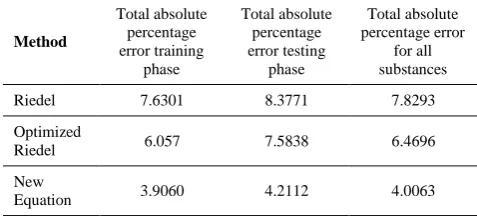
7.8293 8.3771
7.6301 Riedel
6.4696 7.5838
6.057 Optimized
Riedel
4.0063 4.2112
3.9060 New
Equation
As can be seen from the results in Table 5, the average absolute value of the total error decreases by optimizing the Riedel coefficients for prediction of the vapor pressure in both training and testing phases. The errors for pressure of 100 kPa, were reduced from 2.72 to 1.84 percent in training phase and from 3.35 to 3.23 percent in testing phase.
Also, the new suggested equation decreased the average value of the total error to 1.38 and 2.28 percent in the training and testing phase, respectively. But as noted, the fundamental weakness of the Riedel equation is at low pressures and this issue is clearly visible due to the absolute value of the total error for pressure of 10 kPa in the training and testing phase (7.63 and 8.37 percent) and comparing it with the absolute value of the total error for pressure of 100 kPa. According to the results of Table 6 it can be seen that by optimizing the coefficients of the Riedel equation, the training and testing phase errors were reduced to 6.05 and 7.23 percent, respectively. However, a significant decrease of the error was obtained by applying the proposed equation. The training and testing phase errors of
calculations using new model were reduced to 3.90 and 4.21 percent, respectively. Scatter plots of actual versus predicted vapor pressure using optimized Riedel equation and new equation at two pressures (10 and 100 kPa) are shown in Figure 2.
4. CONCLUSION
Figure2. Scatter plots of actual vs. predicted vapor pressure using: (a) optimized Riedel equation at 10 kPa (b) new equation at 10 kPa (c) optimized Riedel equation at 100 kPa (d) new equation at 100 kPa.
5. REFERENCES
1. Smith, J.M., Introduction to chemical engineering
thermodynamics. 1950, ACS Publications.
2. A. Einstein, B. Podolsky, and N. Rosen, "Can Quantum-Mechanical Description of Physical Reality Be Considered Complete?", Physical Review, Vol. 47, No. 10, (1935), doi: 10.1103/PhysRev.47.777.
3. Cox, E.R., "Pressure-temperature chart for hydrocarbon vapors",
Industrial & Engineering Chemistry, Vol. 15, No. 6, (1923),
592-593.
4. Wagner, W., "New vapour pressure measurements for argon and nitrogen and a new method for establishing rational vapour pressure equations", Cryogenics, Vol. 13, No. 8, (1973), 470-482.
5. Ambrose, D. and Ghiassee, N., "Vapour pressures and critical temperatures and critical pressures of some alkanoic acids: C1 to c10", The Journal of Chemical Thermodynamics, Vol. 19, No. 5, (1987), 505-519.
6. Plank, R. and Riedel, L., "A new criterion for the curves of the vapor pressure at the critical point", Ingenieur-Archiv, Vol. 16, (1948), 255-266.
7. Riedel, L., "Eine neue universelle dampfdruckformel untersuchungen über eine erweiterung des theorems der übereinstimmenden zustände. Teil i", Chemie Ingenieur
Technik, Vol. 26, No. 2, (1954), 83-89.
8. Vetere, A., "The riedel equation", Industrial & Engineering
Chemistry Research, Vol. 30, No. 11, (1991), 2487-2492.
9. Vetere, A., "Again the riedel equation", Fluid Phase Equilibria, Vol. 240, No. 2, (2006), 155-160.
10. Olsen, E. and Nielsen, F., "Predicting vapour pressures of organic compounds from their chemical structure for classification according to the vocdirective and risk assessment in general", Molecules, Vol. 6, No. 4, (2001), 370-389. 11. Velasco, S., Roman, F., White, J. and Mulero, A., "A predictive
vapor-pressure equation", The Journal of Chemical
Thermodynamics, Vol. 40, No. 5, (2008), 789-797.
12. Gandhidasan, P. and Mohandes, M.A., "Predictions of vapor pressures of aqueous desiccants for cooling applications by using artificial neural networks", Applied Thermal Engineering, Vol. 28, No. 2-3, (2008), 126-135.
13. Rohani, A.A., Pazuki, G., Najafabadi, H.A., Seyfi, S. and Vossoughi, M., "Comparison between the artificial neural network system and saft equation in obtaining vapor pressure and liquid density of pure alcohols", Expert Systems with
Applications, Vol. 38, No. 3, (2011), 1738-1747.
14. Honarmand, M., Sanjari, E. and Badihi, H., "Prediction of saturated vapor pressures using non-linear equations and artificial neural network approach", Journal of Mathematics
and Computer Science, Vol. 8, (2014), 343-358.
15. Roganov, G., Garist, I., Garist, E. and Stepurko, E., "Calculating the vapor pressure of aliphatic hydrocarbons by additive methods and determining their critical parameters on this basis",
Russian Journal of Physical Chemistry A, Vol. 89, No. 10,
(2015), 1726-1731.
16. Hogge, J.W., Giles, N.F., Knotts, T.A., Rowley, R.L. and Wilding, W.V., "The riedel vapor pressure correlation and multi-property optimization", Fluid Phase Equilibria, Vol. 429, (2016), 149-165.
17. Hogge, J.W., Giles, N.F., Rowley, R.L., Knotts IV, T.A. and Wilding, W.V., "New vapor-pressure prediction with improved thermodynamic consistency using the riedel equation",
Industrial & Engineering Chemistry Research, Vol. 56, No.
49, (2017), 14678-14685.
18. Tillner-Roth, R., "A nonlinear regression analysis for estimating low-temperature vapor pressures and enthalpies of vaporization applied to refrigerants", International Journal of
Thermophysics, Vol. 17, No. 6, (1996), 1365-1385.
(a)
(b)
(c)
19. Ewing, M.B. and Ochoa, J.C.S., "Vapour pressures of n-hexane determined by comparative ebulliometry", The Journal of
Chemical Thermodynamics, Vol. 38, No. 3, (2006), 283-288.
20. King, M. and Al-Najjar, H., "A method for correlating and extending vapour pressure data to lower temperatures using thermal data: Vapour pressure equations for some n-alkanes at temperatures below the normal boiling point", Chemical
Engineering Science, Vol. 29, No. 4, (1974), 1003-1011.
21. Poling, B.E., "Vapor pressure prediction and correlation from the triple point to the critical point", Fluid Phase Equilibria, Vol. 116, No. 1-2, (1996), 102-109.
22. Medeiros, M., Armas-Alemán, C.O., Costas, M. and Cerdeirina, C.A., "Temperature dependence of the heat capacity and vapor pressure of pure self-associated liquids. A new correlation based on a two-state association model", Industrial & Engineering
Chemistry Research, Vol. 45, No. 6, (2006), 2150-2155.
23. Carruth, G.F. and Kobayashi, R., "Extension to low reduced temperatures of three-parameter corresponding states: Vapor pressures, enthalpies and entropies of vaporization, and liquid fugacity coefficients", Industrial & Engineering Chemistry
Fundamentals, Vol. 11, No. 4, (1972), 509-517.
24. Zhang, Y., "An improved qspr study of standard formation enthalpies of acyclic alkanes based on artificial neural networks and genetic algorithm", Chemometrics and Intelligent
Laboratory Systems, Vol. 98, No. 2, (2009), 162-172.
25. Whitley, D., Starkweather, T. and Bogart, C., "Genetic algorithms and neural networks: Optimizing connections and connectivity", Parallel Computing, Vol. 14, No. 3, (1990), 347-361.
26. Gosselin, L., Tye-Gingras, M. and Mathieu-Potvin, F., "Review of utilization of genetic algorithms in heat transfer problems",
International Journal of Heat and Mass Transfer, Vol. 52,
No. 9-10, (2009), 2169-2188.
27. Hwang, S.-F. and He, R.-S., "Improving real-parameter genetic algorithm with simulated annealing for engineering problems",
Advances in Engineering Software, Vol. 37, No. 6, (2006),
406-418.
Using the Genetic Algorithm Based on the Riedel Equation to Predict the Vapor
Pressure of Organic Compounds
H. Bakhshi, A. Dehghani, S. Jafaripanah
Faculty of Chemical Engineering, Babol Noshirvani University of Technology, Babol, Iran
P A P E R I N F O
Paper history:
Received 01 November 2017
Received in revised form 02 February 2018 Accepted 08 February 2018
Keywords: Genetic Algorithm Vapor Pressure Riddle Equation Clapeyron Optimization هديكچ ا رد نی روگلا زا هلاقم متی تنژ کی ارب ی پ شی ب ینی کرت راخب راشف تابی
لآ ی اپ رب صلاخ هی ر هلداعم لدی رد .تسا هدش هدافتسا
ا نی باختنا اب ادتبا راک
110
هب هب فلتخم هدام هنی زاس ی ارض بی ر هلداعم لدی ارب ی اطخ شهاک ی شان ی ا زا نی رد شور پ شی ب ینی ارب راخب راشف ی اهراشف ی 100 و 10 ک لاکساپولی نچمه .تسا هدش هتخادرپ نی
ازفا اب شی کی هلداعم هب مرت
لصا ی لک هلداعم هئارا و ی دج دی اپ رب هی ر شور ،لدی اطخ ی شان ی پ زا شی ب ینی ارب راخب راشف رادقم ی اهراشف ی 100 و 10 ک ،لاکساپولی داعم ندش صخشم زا سپ .تسا هدش هداد شهاک هب هل
هنی دج هلداعم و ،دی تلاداعم تقد اب سررب ی اطخ ی زا لصاح 40 کرت بی جنس فلتخم هدی اتن .دش جی ر هلداعم رب هدش لامعا حلاصا هک داد ناشن ،لدی اهاطخ ی پ شی ب ینی راشف کرت راخب تابی ش ییایمی م شهاک ار ی .دهد
doi: 10.5829/ije.2018.31.06c.01
![TABLE 1. Characteristics of the used compounds in the training phase [28].](https://thumb-us.123doks.com/thumbv2/123dok_us/28592.2003286/4.595.53.545.694.743/table-characteristics-used-compounds-training-phase.webp)