International Journal of Engineering
J o u r n a l H o m e p a g e : w w w . i j e . i rThe Effect of Air Fuel Ratio and Temperature on Syngas Composition and Calorific
Value Produced from Downdraft Gasifier of Rubber Wood-Coal Mixture
b Chemical Engineering Department, Faculty of Engineering, Universitas Sriwijaya, Palembang 30139, Indonesia
P A P E R I N F O
Paper history:
Received 10 November 2017
Received in revised form 23 December 2017 Accepted 04 Januray 2018
Keywords:
Rubber Wood Gasification Downdraft Gasifier Syngas
LHV
A B S T R A C T
Rubber wood (Ficus elastica) is one of the biomass waste that can be used as raw material for gasification process, and has a calorific value of 4069 cal/g. Gasification is a process to convert a solid fuels to syngas (CO, CH4, and H2) through a partially combustion process using limited air between 20% to 40% of air stoichiometry. Depending on the direction of airflow, the gasifier are classified as updraft, downdraft, and cross-flow. The downdraft type of gasifier produces a lower tar content than updraft type.The gasification of rubber wood and rubber wood-coal mixture were carried out in this research. The purpose of the research is to determine the effect of Air Fuel Ratio (AFR) and temperature on calorific value and composition of syngas using a downdraft gasifier.The variations of AFR were 0.64, 0.95, and 1.26. The temperature of gasification was varied between 600-1000ºC. The result showed that the percentage of CO, H2, and CH4 decreased with increasing of AFR and decrease in calorific value. The calorific value of syngas increased along with the temperature.The use of coal in the gasification process can maintain the stable combustion temperatures and increase the syngas produced. The best-operating conditions in this research occurred at AFR of 0.64, temperature of 800ºC and use of coal as a stabilizer.At this condition, the percentage of syngas of 35.95% of CO, 15.95% of H2, 9.38% of CH4, and caloric value of 9.42 MJ/m3 was obtained. The highest gasification yield of 35.75% was also reached.
doi: 10.5829/ije.2018.31.09c.02
*Corresponding Author Email: [email protected] (T. E. Agustina)
Representatives have agreed on National Energy Policy aimed at the management and provision of national energy until 2050. This policy refers to the new renewable energy (EBT), namely solar, wind, water, and biomass that are able to meet national energy needs to 21%.
Biomass is a raw material generated from forests, agriculture and livestock industry that has the potential to reduce emissions on the environment and stabilize energy needs [3]. Biomass is an environmental friendly alternative energy because it contains no sulfur, carbon-neutral, and a plentiful material [1]. These alternative fuels are obtained from resources other than petroleum. The advantage of these fuels is that they emit less air pollutants in comparison with gasoline and most of them are more economically favorable compared to oil [4]. T. Tiaraa, T. E. Agustina*b, M. Faizalb
a Chemical Engineering Magister Program, Faculty of Engineering, Universitas Sriwijaya, Palembang 30139, Indonesia
Please cite this article as: T. Tiara, T. E. Agustina, M. Faizal, The Effect of Air Fuel Ratio and Temperature on Syngas Composition and Calorific Value Produced from Downdraft Gasifier of Rubber Wood-Coal Mixture, International Journal of Engineering (IJE), IJE TRANSACTIONS C: Aspects Vol. 31, No. 9, (September 2018) 1480-1486
1. INTRODUCTION1
Biomass that refers to all biologically produced materials and living matter on earth whose energy is derived from plant sources, such as wood from forests, wastes from the agricultural, forestry and industrial, human or animal wastes. Moreover, biomass is a renewable carbon source that can be converted into solid fuel, liquid or gas [5]. The biomass has the potential to be converted to synthesis gas which in turn can be converted to liqud fuel [6]. Biomass energy can be produced from a variety of thermochemical (combustion, gasification, and pyrolysis) [7], biological (anaerobic digestion and fermentation), or chemical (esterification) processes [8]. Gasification of biomass has attracted the highest interest because it offers higher efficiency compared with the combustion and pyrolysis. Biomass is traditionally burned to supply heat and electricity in industrial processes. Efficiency of electricity generation from biomass direct combustion is very low, ranging between 20% to 40%. Pyrolysis process converts biomass to bio-oil in the absence of oxygen (O2). Limited usefulness and difficulties in the downstream processing of bio-oil has limited the application of biomass pyrolysis technology [9].
The large rubber plantations in Indonesia 2014 reached 3,606,000 hectar with a production value of 585,427 tonnes of dry rubber [10]. Rubber wood cultivated with the main objective to get the sap of rubber as a main material of rubber until now. Rubber trees can grow to a height of 30 meters and will produce latex after 5-6 years. After 25 years, the rubber trees were cut down and replaced with a new tree because it is no longer produce latex [11]. So far, rubber trees only have limited use such as in industrial crafts and furniture. However, it has great potential to be developed as a biomass product.
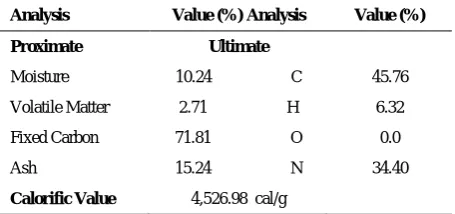
The rubber wood proximate-ultimate analysis results and its heating value can be seen in Table 1. Gasification is a process of converting solid fuels to syngas (CO, CO2, CH4, and H2) through a combustion process using limited air between 20 to 40% of air stoichiometry [11]. In addition it can be used directly as fuel, heat and steam produced syngas which can be used in a gas turbine to produce electricity. The excess of gasification can improve the efficiency of energy utilization of biomass, mainly producing electricity. The combustion of syngas is more easily controlled, and produces a lower harmful emissions, and high efficiency in the gas turbine and steam-gas cycle. In gasification process, heat loss is lower than in biogas combustion process. Also, energy production in gasificaton process is higher than in biogas combustion.
The gasification process occurs in the gasification reactor known as the gasifier. Depending on the direction of airflow, the gasifiers are classified as updraft, downdraft, and cross-flow. Among the types of gasification processes, the most simple and able to produce gas with a fairly good quality is the downdraft
gasification type [12]. The downdraft gasifier type produces a lower tar content than the updraft gasifier type. This is because of the tar content produced along pyrolysis will be oxidized and broken down into lighter compounds [13]. In this research, the downdraft gasifier, combustion air was inserted from the top or side of the combustion zone and the gases discharged from the bottom of the reactor.
The quality of the syngas produced (composition production of CO, H2, CO2 and CH4 and energy content) and the performance of gasification (gas yield) depend on the composition of raw materials, design of the gasifier and operating parameters such as temperature, Air Fuel Ratio (AFR), high static bed, fluidization velocity, equivalence ratio, gasifying agent, catalysts and others [14]. In this research, gasification of biomass was carried out using rubber wood as raw material. The purpose of this research is to determine the effect of AFR and temperature on calorific value and composition of syngas using downdraft gasifier of rubber wood-coal mixture.
2. MATERIALS AND METHODS
Raw materials used in this research was rubber wood. Raw material was obtained from plantations in the area of Ogan Ilir area of South Sumatra Province. The first step of the process was size reduction of raw material with a particle size of 0.5-5 cm (Figure 1). The samples were dried to reduce the moisture content of feedstock by a direct sunlight until reached to a constant weight and then stored for further analysis and experiment. The chemical composition of the wood was determined by proximate and ultimate analysis. A Thermo Gravimetric Analyzer (TGA-701) was used to determine the moisture content, ash content, volatile matter and fixed carbon. A TruSpace CHNS analyzer (Chromatogram Varian 450_GC Lab Instrument) was used to determine the carbon, nitrogen, hydrogen, sulfure, and oxygen contents of the raw material. Analysis of calorific value of the raw materials was also carried out by a bomb calorimeter. The results of proximate-ultimate analysis and heating value of Rubber Wood were indicated in Table 1.
TABLE 1. The proximate-ultimate analysis and heating value
of rubber wood
Analysis Value (%) Analysis Value (%)
Proximate Ultimate
Moisture 10.24 C 45.76
Volatile Matter 2.71 H 6.32
Fixed Carbon 71.81 O 0.0
Ash 15.24 N 34.40
Calorific Value 4,526.98 cal/g
Figure 1. Rubber wood
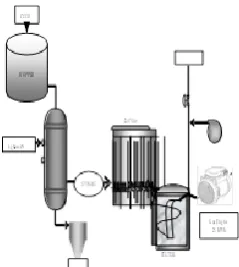
Beside that, a Digital Thermometer Gun, Digital Hygro Meter, and Gas Chromatograpy were also used in this study. The Vulcan Downdraft Gasifier used consist of the following main tools: gasifier reactor, cyclones, coolers, tar filter, blower, gas engine generators and generator control panel. This system is also equipped with temperature and pressure control devices, as well as biomass consumption gauges.
A 10 kg of rubber wood put into a storage, which is integrating with a stirrer and a screw that regulated the flow rate of biomass into a gasification reactor. Gasification reactor consists of four processes, namely drying, pyrolisis, oxidation, and reduction. Gasification of gas called gas producer, mainly consisting of gases that can be burned namely CO, H2 and CH4 and gases that can not be burned in the form of CO2 and N2. The composition of produced gas is highly dependent on biomass composition, particle shape and biomass type as well as the conditions of the gasification process. The cyclone has a function to remove coarse dust containing in the syngas. The dust was discharged from the bottom of the gasifier. Then the syngas was flowed to Tar Filter that has a function to remove the tar before syngas exit through the stack gas. If the valve on the stack gas is closed then the syngas will be supplied to the motor generator unit as driving a gas turbine, and the generator produces electricity. Before entering to the generator, the syngas should be filtered in order to absorb dust/soot in the syngas because it could adversely affect the performance of the gas turbine. Figure 2 shows the schematic diagram of downdraft gasifier equipments.
Figure 2. Scheme of downdraft gasifier equipment
3. RESULTS AND DISCUSSION
3. 1. The Effect of AFR and Temperature on CO Percentage in the Syngas The carbon monoxide (CO) content in the syngas in this research was decreasing as the AFR increasing at temperature range of 700-1000ºC. This phenomena is caused by partial combustion of different gaseous components resulted in a large increase in CO2 concentration [14]. The temperature increase in the gasification process also affects on the CO content of the syngas. The CO content was mainly determined by Bourdard reaction (CO2 + C → 2CO) [15]. Higher temperature was not favorable for CO production; thus, the content of CO decreased and the CO2 content contrary increased [16].
Figures 3 and 4 show the effect of AFR on the CO content of the syngas produced in gasification for rubber wood and rubber wood-coal mixture, resprctively. The CO content was increased, although such increase was not very significant. This is because the use of coal can stabilize the temperature inside the gasifier so that the CO formation reaction in the reduction process was optimally occured.
Figure 3. The Effect of AFR and temperature on CO
percentage in syngas produced from rubber wood gasification
Figure 4. The Effect of AFR and temperature on CO
percentage in syngas produced from rubber wood-coal mixture gasification
20 24 28 32 36
600 700 800 900 1000
CO
P
e
rc
e
nt
a
ge
(%
)
Temperature(oC)
AFR
0.64
0.95
1.26
20 24 28 32 36 40
600 700 800 900 1000
CO
P
e
rc
e
nt
a
ge
(%
)
Temperature (oC)
AFR
0.64
0.95
3. 2. The Effect of AFR and Temperature on CO2
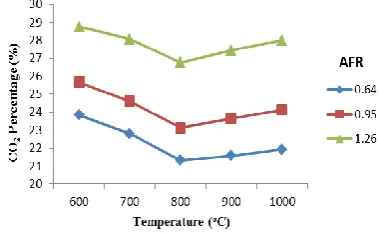
Percentage in the Syngas The concentration of carbon monoxide (CO2) in the syngas was also observed in this study. Figures 5 and 6 represent the effect of AFR and temperature on the concentration of CO2 in syngas produced from gasification of rubber wood and mixed rubber wood-coal, respectively. It can be seen that by increasing AFR, the concentration of CO2 was increased. An increase in AFR of the gasification process, approaching the AFR stoichiometric will increase the CO2 content in the syngas [17]. A decrease in CO2 concentration in the syngas indicated a better gasification efficiency.
These trends occurred because higher temperature, the equilibrium of the endothermic reaction (e.g.CO2 + H2 → CO + H2O) shifted to the exothermic reaction (e.g. CO + H2O → CO2 + H2). Consequently, CO gas was converted to CO2 gas. Figures 5 and 6 depict the effect of AFR on the CO2 content of the syngas produced in gasification for rubber wood and rubber wood-coal mixture, respectively.
3. 3. The Effect of AFR and Temperature on H2
Percentage in the Syngas The hydrogen produced in the syngas from this study was observed. An increase in AFR resulted in H2 concentration increase. Other researchers like [19] have reported a similar trend. Figures 7 and 8 showed that an increase in AFR, the H2 concentration was increased. It was occurred because when AFR approaching at 1.5 (AFR stoichiometric), the H2 was converted into steam (H2O) so the content of H2 in the syngas reduced.
An increasing of gasification temperature stimulated in the steam-carbon reaction (C + H2O → CO + H2). However, H2 gas was also preferentially combusted if the temperature became very high [20]. It was stated that hydrogen was increased with increasing temperature, and then gradually decreased at high temperature when the temperature was higher than 1000ºC [21]. In the study, addition of coal as a stabilizer, the amount of H2 generation was higher than other research without the use of coal. An increase in H2 content reduced the formation of H2O in the syngas, because excess of H2O lead to crack of the hydrocarbons.
Figure 5. The Effect of AFR and temperature on CO2
percentage in syngas produced from rubber wood gasification
Figure 6. The Effect of AFR and temperature on CO2
percentage in syngas produced from rubber wood-coal mixture gasification
Figure 7. The Effect of AFR and temperature on H2
percentage in syngas produced from rubber wood gasification
Figure 8. The Effect of AFR and temperature on H2
percentage in syngas produced from rubber wood-coal mixture gasification
12 13 14 15 16 17
600 700 800 900 1000 H2
P
e
rc
e
nt
a
ge
(%
)
Temperature (oC)
AFR
0.64 0.95 1.26
13 14 15 16 17
600 700 800 900 1000 H2
P
e
rc
e
nt
a
ge
(%
)
Temperature (oC)
AFR
0.64 0.95 1.26
The CO2 concentration was increased if the gasification temperature higher than 800ºC. At gasification temperature between of 500 to 800ºC, the reduction of CO2 into CO was occurred, but when the temperature was higher than 800ºC, the concentration of CO began to decrease, so that the CO2 concentration increased. An increase in temperature resulted in increase in CO2 mole percentage, while CO mole percentage decreased [18].
3. 4. The Effect of AFR and Temperature on CH4
Percentage in the Syngas The effect of AFR on percentage of methane gas (CH4) in the syngas was observed by increasing the AFR, which resulted in decrease of CH4 content. The presentation data for rubber wood and mixture of rubber wood-coal are shown in Figures 9 and 10, respectively. A similar trend was reported by other researchers [19]. Inferred that increasing the AFR results in a decrease in concentrations of methane and other light hydrocarbons, which have relatively high heating values. The model results validate the claim that CH4 concentration decreases with increasing AFR. Additionally, the decreased amount of remaining carbonaceous materials for gasification reactions may result in the decrease of hydrocarbon gases production such as CO, CH4 and C2Hn [20].
Based on Le Chatelier’s principle, it is understood that higher reaction temperatures favor the reactants in exothermic reactions while they favor the products in endothermic reactions. Therefore, the endothermic reactions of methane reforming reaction (C + 2H2 → CH4) were verified this theory. Methane formed in the gasifier at high temperatures underwent endothermic reactions with the already formed water vapor and was converted into CO, CO2 and H2. Hence the yield of CH4 decreased at high temperatures (temperature greater than 800oC). The figure shows that an increase in the temperature resulted in an increase in the proportion of hydrogen and carbon monoxide, and a decrease in the proportion of carbon dioxide and methane. This is due to the decreasing rate of the methanizing reactions, and the probability of water gas reactions (C + H2O → CO + H2). Figure 10 demonstrates the effect of AFR and temperature on CH4 percentage in syngas produced from rubber wood-coal mixture gasification. Although gasification temperature was greater than 800oC, CH
4 generated still increased. This was because due to the use of coal; it can stabilize the temperature inside the gasifier so that the formation reaction of CH4 in the reduction process can optimally occur. Beside, when the particle of coal is exposed to heat sources, it is cracked to gas, liquid and solid phases that are named, respectively gas, tar and char. As a combustable material, the present of coal yield the gaseous fuel, and finally the produced gas burn then consequenty both the flame temperature and burning velocity increase to support the system optimally [22].
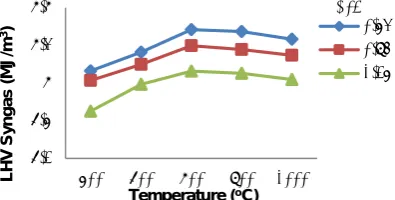
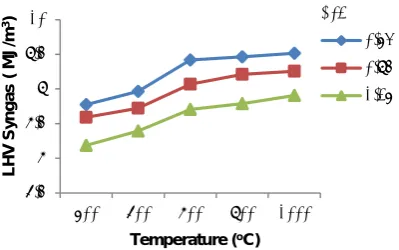
3. 5. The Effect of AFR and Temperature on Syngas Heating Value Figures 11 and 12 show a decrease in the value of LHV syngas along with an increase in AFR. This is because of an increase inair mass flow rate supply into the gasifier which will directly improve AFR; thus, affecting the chemical reaction of syngas formation process. Where the gasification process requires a limited of air supply, the content of syngas (CO, H2, and CH4) will tend to decline. If the mass flow rate of air supply
increase, the CO2, N2, and O2 in the syngas will also increase.
In gasification of rubber wood at temperatures of more than 800ºC, LHV of the syngas decreased, because of the decrease in the concentration of CO and CH4 in the syngas, as illustrated in Figure 11. However, in gasification of rubber wood-coal mixture, the LHV of syngas increased with increasing temperature as illustrated in Figure 12. An increase in LHV syngas gasifier with increase in temperature is due to increase in CO, H2 and CH4 concentration in the syngas. Temperature is considered as the most important factor to reduce the concentration of tar. Because of an increase in temperature will decrease in the tar conversion due to the syngas will be formed much more from the reaction.
Figure 9. The Effect of AFR and temperature on CH4
percentage in syngas produced from rubber wood gasification
Figure 10. The Effect of AFR and temperature on CH4
percentage in syngas produced from rubber wood-coal mixture gasification
Figure 11. The effect of AFR and temperature on LHV of
syngas produced from rubber wood gasification
7.8 8 8.2 8.4 8.6
600 700 800 900 1000
C
H4
P
e
rc
e
nt
a
ge
(%
)
Temperature (oC)
AFR
0.64 0.95 1.26
8.6 8.8 9 9.2 9.4 9.6
600 700 800 900 1000
CH
4
P
e
rc
e
nt
a
ge
(%
)
Temperature (oC)
AFR
0.64 0.95 1.26
7.2 7.6 8 8.4 8.8
600 700 800 900 1000
L
H
V
S
y
ngas
(
M
J
/m
3)
Temperature (oC)
AFR
Figure 12. The Effect of AFR and temperature on LHV of syngas produced from rubber wood-coal mixture gasification
1. Natthaya, P., Chaiyot, T. and Takayuki, T., “Low temperature gasification of coconut shell with CO2 and KOH: effects of temperature, chemical loading, and introduced carbonization step on the properties of syngas and porous carbon product”,
International Journal of Chemical Engineering. Vol. 16,
(2015), 481615.http://dx.doi.org/10.1155/2015/481615
2. Najjar, Y. S. H., “Gaseous pollutants formation and their harmful effects on health and environment”, Ashdin Publishing
Innovative Energy Polices. Vol. 1, (2011), 1-8.
3. Volsky. and Smithart, “Handbook of Clean Energy System”, Wiley, United Kingdom, (2011).
4. Kolur, M. M., Khalilarya, Sh., Jafarmadar, S. And Nemati, A., “Hydrogen and ethanol as potential alternative fuels compared to gasoline under improved exhaust gas resirculation”,
International Journal of Engineering-Transactions C: Aspects,
Vol. 27, No.3, (2014), 449-456.
5. Akhilesh, K. and Ravindra, R.,“Experimental analysis of a producer gas generated by a chir pine needle (leaf) in a downdraft biomass gasifier”, Journal of Engineering Research and
Applications, Vol. 4,(2014), 122-130.
6. Najafpour, G. D., Basu, R., Clausen, E. C. and Gaddy, J. L., “Bioreactor scale-up for water-gas shift reaction”, International
Journal of Engineering, Vol. 9, No. 3, (1996), 121-129.
7. Lahijani, P., Najafpour, G. D., and Mohammadi, M., “Influence of inherent alkali content and surface area of biomass char on its CO2 gasification reactivity”, Iranica Journal of Energy and
Environment”, Vol. 8, No. 1, (2017), 1-5.
8. Tumuluru, J. S., Boardman, R. D., Wright, C. T., and Hess, J. R., “Some chemical composional changes in miscanthus and white oak sawdust sample during torrefaction”, Energies, Vol. 5, No. 10, (2012), 3928-3947
9. Wang, Y., Yoshikawa, K., Namioka, T. And Hashimoto, Y., “Performance optimization of two-staged gasification system for woody biomass”, Fuel Process. Technol. Vol. 88, (2007), 243-250.
10. Directorate General of Plantation, “Indonesian rubber plantation statistic”, Jakarta, (2014).
11. Guswendar, R., “Characteristics of gasification on an updraft double gas outlet gasifier using rubber wood fuels”, Jakarta,
Universitas Indonesia, (2012).
13. Pengmei, Lv., Yuan, Z., Ma L., Wu C., Chen, Y., and Zhu, J.,“Hydrogen-rich gas production from biomass air and oxygen/steam gasification in a downdraft gasifier”, Renewable
Energy, Vol. 32, issue 13, (2007), 2173-2185.
14. Ghani, W.A., Moghadam, Reza, Mohd Salleh, M. A. and Alias, A.B., “Air gasification of agricultural waste in a fluidized bed gasifier”, Hydrogen Production Performance, Vol. 2, (2009), 258-268.
15. Lahijani, P., Zainal, Z. A., Mohammadi, M., and Mohamed, A. R., “Conversion of the greenhouse gas CO2 to the fuel gas CO via the Boudouard reaction: A review”, Renewable and Sustainable
Energy Reviews, Vol. 41, (2015), 615-632.
16. Lahijani, P. and Mohammadi, M., “Catalytic Effect of metal species on enhancement of CO2 gasification reactivity of biomass char”, International Journal of Engineering-Transactions C:
Aspects Vol.28, No.9, (2015), 1251-1256
17. Diaz, M., Ilminnafik, N. and Mulyono, T., “Pengaruh air fuel ratio (AFR) terhadap kualitas syn-gas gasifikasi sekam padi tipe downdraft”, Universitas Jember, (2014).
18. Chen, W., Annamalai, K.,Ansley R. J., and Mirik, M. “Updraft fixed bed gasification of mesquite and juniper wood samples”,
Energy, Vol. 41, (2012), 454-461.
19. Turn, S., Kinoshita, C., Zhang, Z., Ishimura, D. and Zhou, J., “An experimental investigation of hydrogen production from biomass gasification”, International Journal of Hydrogen Energy, Vol. 23, No. 8, (1998), 641-648.
20. Sommas, K. and Suneerat, P., “Gasification of high moisture rubber woodchip with rubber waste in a bubbling fluidized bed”,
Fuel Processing Technology, Vol. 92, (2011), 671 – 677.
22. Bidabadi, M., Mostafavi, S. A., Dizaji, F. F. and Dizaji, B. H., “An analytical model for flame propagation through moist lycopodium particles with non-unity lewis number”,
International Journal of Engineering-Transaction B:
Applications, Vol. 27, No. 5, (2014), 793-802
7.5 8 8.5 9 9.5 10
600 700 800 900 1000
LH
V
S
y
ngas
(
M
J
/m
3)
Temperature (oC)
AFR
0.64 0.95
1.26
4. CONLUSION
The percentage of CO, H2, and CH4 decrease with an increase in AFR, so the calorific value also decrease. In temperature range of 600-800ºC the percentage of CO, H2, and CH4 increase, while in temperature range of 800-1000ºC only the percentage of H2 and CO2 increase. The calorific value of syngas increase a long with temperature. The use of coal in the gasification process can maintain the stable combustion temperatures inside the gasifier and increase the syngas produced. Moreover, the percentage of CO, CH4 and H2 were enhanced. Therefore, results in an increase in the calorific value. The best operating conditions of rubber wood-coal mixture gasification occurred at the air fuel ratio (AFR) of 0.64 and the temperature of 800ºC. The percentages composition of syngas and calorific heating value were 35.95% of CO, 15.95% of H2, 9.38% of CH4, and 9.42 MJ/m3, respectively. In this study, under the stated condition, the highest gasification yield of 35.75% was obtained.
5. REFERENCES
21. Marek, B., Lisy, Martin. and Stelcl, Ota., “The effect of temperature and residance time on the gasification process”, Acta
Polytechnica Vol. 4 , No. 52, (2012), 313-334.
12. Reed, T. B. and Das, A., “Handbook downdraft gasifier engine systems”, Golden, CO : Solar Energy Research Institute, SERI/SP-271-3022, (1998).
The Effect of Air Fuel Ratio and Temperature on Syngas Composition and Calorific
Value Produced from Downdraft Gasifier of Rubber Wood-Coal Mixture
a Chemical Engineering Magister Program, Faculty of Engineering, Universitas Sriwijaya, Palembang 30139, Indonesia b Chemical Engineering Department, Faculty of Engineering, Universitas Sriwijaya, Palembang 30139, Indonesia
P A P E R I N F O
Paper history:
Received 10 November 2017
Received in revised form 23 December 2017 Accepted 04 Januray 2018
Keywords:
Rubber Wood Gasification Downdraft Gasifier Syngas
LHV
هديكچ
( کيتسلا بوچ
Ficus elastica
هلابز زا یكی ) ه
یم هک تسا هدوت تسیز یا نويساكيفیزاگ دنیارف یارب ماخ داوم ناونع هب دناوت
و دريگ رارق هدافتسا دروم نآ یفرصم یرلاک رادقم
4069 کی هليسو هب هک تسا یدنیارف نويساكيفیزاگ .تسا مرگ رب یرلاک
نيب دودحم یاوه زا هدافتسا اب یشخب قارتحا دنیآرف 20
ات 40 یارب دماج تخوس ،اوه یرتمويکوتسا زا دصرد زتنس زاگ
(
CO
،
4 CH
و
2 H
هب جنسزاگ ،اوه نایرج تهج هب هتسب .دراد رايتخا رد ار ) یرج ناونع
نيئاپ یوسب ای و لااب یوسب زاگ نا و ،
هتسد لباقتم نایرج یم یدنب
بوچ نويساكيفیزاگ .دراد نایرج عون هب تبسن یرتمک یاوتحم ديلوت روتارنژ لزید عون .دوش
ییاوه تخوس تبسن ريثأت نييعت ،قيقحت زا فده .دش ماجنا قيقحت نیا رد یكيتسلا بوچ و بوچ طولخم و یكيتسلا
(
AFR
د یزاس زوسزاگ زا هدافتسا اب زتنس زاگ بيکرت و یترارح شزرا رب امد و ) نيئاپ تهج ر
تارييغت .تسا
AFR
، 64 / 0 ،
95 / 0 و 26 / 1 نيب نويسزاگ یامد .دوب 600
ات 1000 یتناس هجرد دصرد هک داد ناشن جیاتن .دوب ريغتم دارگ
CO
،
2 H
و
4 CH
شیازفا اب
AFR
یم شهاک یرلاک شزرا شهاک و زاگ یرلاک رادقم .دبای
زتنس یم شیازفا ترارح هجرد اب هارمه هدافتسا .دبای
زاگ دنیارف رد گنس لاغز زا اكيفی
یم نويس نیرتهب .دهد شیازفا ار زاگ نامزمه ديلوت و ظفح ار رادیاپ قارتحا یامد دناوت
رد قيقحت نیا رد طیارش
AFR
64 / 0 یامد ، 800 یتناس هجرد لاغز زا هدافتسا و دارگ
تيبثت کی ناونع هب گنس ماجنا هدننک
یزاگ زتنس دصرد طیارش نیا رد .دش 95
/ 35 %
CO
، 95 / % 15
2 H
، 28 / % 9
4 CH
یرلاک رادقم و 42
/ 9
3 MJ/m
.دمآ تسدب
زاگ رادقم نیرتلااب اكيفی
نويس 75 / 35 % دمآ تسد هب زين تسا ه
.
doi: 10.5829/ije.2018.31.09c.02