DOI: 10.2478/10004-1254-64-2013-2378 Short communication
FRESH FROZEN PLASMA AS A SUCCESSFUL
ANTIDOTAL SUPPLEMENT IN ACUTE
ORGANOPHOSPHATE POISONING
Slavica VUČINIĆ1, Milica ZLATKOVIĆ1, Biljana ANTONIJEVIĆ2, Marijana ĆURČIĆ2, and
Bogdan BOŠKOVIĆ1
National Poison Control Centre, Medical Faculty, Military Medical Academy, University of Defence1, Department of
Toxicology “Akademik Danilo Soldatović”, Faculty of Pharmacy, University of Belgrade2, Belgrade, Serbia
Received in March 2013 CrossChecked in April 2013
Accepted in April 2013
Despite improvements to intensive care management and specifi c pharmacological treatments (atropine, oxime, diazepam), the mortality associated with organophosphate (OP) poisoning has not substantially decreased. The objective of this examination was to describe the role of fresh frozen plasma (FFP) in acute OP poisoning. After a deliberate ingestion of malathion, a 55-year-old male suffering from miosis, somnolence, bradycardia, muscular fasciculations, rales on auscultation, respiratory insuffi ciency, as well as from an inhibition of red blood cell acetylcholinesterase (AChE) and plasma butyrylcholinesterase (BuChE), was admitted to hospital. Malathion was confi rmed in a concentration of 18.01 mg L-1. Apart
from supportive measures (including mechanical ventilation for four days), antidotal treatment with atropine, oxime - pralidoxime methylsulphate (Contrathion®), and diazepam was administered, along with FFP. The
potentially benefi cial effects of FFP therapy included a prompt increase of BuChE activity (from 926 IU L-1
to 3277 IU L-1; reference range from 7000 IU L-1 to 19000 IU L-1) and a reduction in the malathion
concentration, followed by clinical recovery. Due to BuChE replacement, albumin content, and volume restitution, FFP treatment may be used as an alternative approach in patients with acute OP poisoning, especially when oximes are not available.
KEY WORDS: acetylcholinesterases, albumin, butyrylcholinesterase, malathion, oximes
The conventional approach to organophosphate (OP) poisoning treatment involves efforts to counteract the effects of excessive acetylcholine (ACh) accumulation and the overstimulation of cholinergic neurons caused by irreversible acetylcholinesterase (AChE) inhibition. Atropine effectively reduces muscarinic signs, while oximes reactivate inhibited AChE and directly detoxify unbound OPs (1). Despite the use of these antidotes and improvements to intensive care, the mortality associated with OP poisoning remains high and calls for new alternative treatments (2, 3). Fresh frozen plasma (FFP) or
albumin, acting as a bioscavenger to clean up circulatory OPs, has been evaluated as an alternative treatment modality, but the few studies that have investigated it are controversial and need to be clarifi ed (4, 5).
SUBJECTS AND METHODS
vomiting, and diarrhoea, but his vital signs were normal: blood pressure 140 mm Hg /70 mm Hg, pulse
70 bpm, oxygen saturation (sO2) 96 %. Three hours
earlier, he drank 100 mL of pesticide formula, containing 600 g L-1 of malathion. A gastric lavage was performed, followed by an administration of 50 g of activated charcoal and an evacuation of white coloured solution. After admission to the Intensive Care Unit 4 h after ingestion, he was somnolent, spontaneously breathing, with copious bronchial secretion, pinpoint pupils, muscle fasciculations, hypotension (90 mm Hg /70 mm Hg), pulse 90 bpm,
and had a respiratory rate of 25 min-1. Apart from
supportive measures, he received 12 mg of atropine during the fi rst 30 min, followed by a continuous infusion of atropine. The patient was administered 2 g of pralidoxime methylsulphate as a loading dose, followed by 500 mg h-1 in a continuous infusion and fresh frozen plasma (two bags, from 220 mL to 250 mL every 12 h for 2 days; total of 8 bags). Due to the development of respiratory insufficiency [pH 7.54, pO2 50, s O2 89 %, pCO2 32, actual base excess (ABE) 4.9] and copious bronchial secretion, the patient was intubated and mechanical ventilation was initiated. Routine laboratory tests were within normal limits.
RESULTS
Initially, the number of red blood cell (RBC) AChE
and plasma BuChE showed an activity of 1862 IU L-1
(reference range from 4000 IU L-1 to 8000 IU L-1) and
926 IU L-1 (reference range from 7000 IU L-1 to
19000 IU L-1), respectively, with a significant
reduction of AChE activity to 903 IU L-1 and an
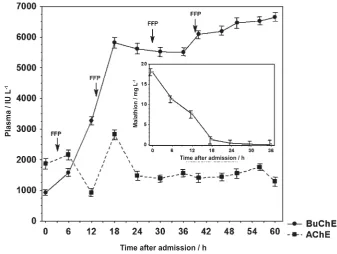
increase of BuChE to 3227 IU L-1 after 6 h (and the first dose of fresh frozen plasma). On day one, malathion was confi rmed in the blood by the liquid chromatography-mass spectrometry method (LC-MS) at a concentration of 18.01 mg L-1. After 5 h, the concentration of malathion was 11.25 mg L-1, and after the second dose of plasma, the level of malathion was 1.21 mg L-1. After the third dose of FFP, malathion concentrations reduced even further (0.07 mg L-1 and
0.02 mg L-1), while on day two, it was no longer
d e t e c t e d . M e a n B u C h E l e v e l o f F F P w a s
(10868±1078) IU L-1, while the total albumin given
amounted to 82 g.
AChE activity continued to decrease, whereas BuChE responded well to FFP therapy (from 926 IU L-1, the level increased to 1576 U L-1 after the fi rst, and from 3227 IU L-1 to 5816 IU L-1 after the second dose) (Figure 1).
Figure 1 BuChE and AChE activity ±SD, with the malathion concentration ±SD in blood
Time after admission / h
Plasma / IU L
-1
Time after admission / h
Malathion / mg L
In order to evaluate the capacity of FFP for binding malathion to albumin (mean value 4.1 g L-1), a water solution of insecticide was incubated in vitro with FFP in a molar ratio 1:1 of its albumin content. The mixture
was kept in a water bath at 37 °C for various time
intervals ranging from 1 h to 24 h. The unbound malathion concentration was determined by the LC-MS method. The results showed that malathion was bound to FFP at a concentration of 200.8 mg L-1, with a t1/2 of 2.1 h.
The clinical recovery was gradual. Mechanical ventilation was no longer necessary from day four, and only small daily doses of atropine were needed. The total atropine dose was 735 mg, and pralidoxime was used for four days. The patient’s condition improved steadily and he was discharged from the hospital on day seven.
DISCUSSION
Butyrylcholinesterase functions as a natural bioscavenger that binds OPs stoichiometrically and thus inactivates them. The advantage of the prophylactic use of purified human BuChE was confirmed in various OPs, including soman, sarin, and tabun. A single dose of BuChE was able to maintain therapeutic concentrations for at least four days, protecting humans from an exposure of 2 x LD50 to 5 x LD50 (3, 6). An experimental study on guinea pigs confi rmed that the nerve agents sarin, soman, cyclosarin, and tabun formed phosphorylated adducts with a tyrosine residue on albumin when incubated with human plasma in vitro. Albumin served as a relatively long-lived biological marker not only for nerve agents (7), but also for dichlorvos (8).
No human trials involving BuChE have been conducted due to the high costs and large quantity needed for the inactivation of OPs. An alternative approach would be to use FFP. In a prospective clinical study, Güven et al. (4) applied FFP with atropine and pralidoxime in 12 patients with OP poisoning, while 22 patients were given atropine and oximes (controls). In the control group, the mortality was 14.3 %, and intermediate syndrome (IMS) was 28.6 %, while neither lethal outcomes nor IMS were registered in the group with FFP. Furthermore, plasmapheresis with FFP was used on a patient with fenitrothion poisoning who developed sepsis. After plasma exchange therapy, ChE levels increased and the patient’s clinical condition resulted in a complete recovery (9).
Contrary to this, the results of an open-labelled pilot randomized trial involving the comparison of FFP, albumin, and saline in sixty patients with acute OP poisoning did not show any favourable effects on the clinical outcomes (5). Despite a signifi cant increase in BuChE levels with FFP, a greater number of IMS cases were observed, and there were no differences in atropine requirement, duration of mechanical ventilation, hospital stay or mortality. Two explanations for the unsuccessful treatment were offered: ageing of OP-ChE and OP-albumin complex dissociation (7).
Fulton (10) attempted to explain the favourable effect of FFP found by Güven et al. (4, 9) through discussing “the secret ingredient” and suggested that aggressive volume resuscitation with BuChE serves as a possible scavenger; however, the author did not comment on the same presumed role of albumin.
Our patient was severely poisoned by malathion, with pronounced muscarinic and nicotinic effects and
a marked inhibition of AChE and BuChE. The
malathion concentration in the patient’s blood was
18.01 mg L-1, which was reduced rapidly by an
administration of FFP. This concentration is close to
the malathion blood level of 23.9 mg L-1 found
antemortem in a suicidal poisoning (11). Malathion is a dimethyl-organophosphate with a low toxicity in humans. However, many fatal human ingestions of malathion have been documented in the literature, with the lethal doses estimated to range from
350 mg kg-1 to 1000 mg kg-1 (12). In addition to
atropine, oximes, and supportive measures, FFP was administered during two days. A prompt increase of BuChE activity and volume restitution containing albumin eliminated the poison. This was followed by a clinical recovery, which was ascribed to the benefi cial effects of FFP therapy, primarily induced by supplemented BuChE and albumin.
CONCLUSION
Acknowledgements
This work was supported by the Ministry of Education, Science and Technological Development of the Republic of Serbia (Projects OI 176018 and III 46009).
REFERENCES
1. Eddleston M, Buckley NA, Eyer P, Dawson AH. Management of acute organophosphorus pesticide poisoning. Lancet 2008;371:597-607. doi: 10.1016/S0140-6736(07)61202-1 2. Rahimi R, Nikfar S, Abdollahi M. Increased morbidity and
mortality in acute human organophosphate-poisoned patients treated by oximes: a meta-analysis of clinical trials. Hum E x p To x i c o l 2 0 0 6 ; 2 5 : 1 5 7 - 6 2 . d o i : 1 0 . 1 1 9 1 / 0960327106ht602oa
3. Doctor BP, Saxena A. Bioscavengers for the protection of humans against organophosphate toxicity. Chem Biol Interact 2005;15:167-71.
4. Güven M, Sungur M, Eser B, Sari Ĭ, Altuntaş F. The effects of fresh frozen plasma on cholinesterase levels and outcomes in patients with organophosphate poisoning. J Toxicol Clin Toxicol 2004;425:613-9.
5. Pichamuthu K, Jerobin J, Nair A, John G, Kamalesh J, Thomas K, Jose A, Fleming JJ, Zachariah A, David SS, Daniel D, Peter JV. Bioscavenger therapy for organophosphate poisoning-an open-labeled pilot randomized trial comparing
fresh frozen plasma or albumin with saline in acute organophosphate poisoning in humans. Clin Toxicol 2010;48:813-9. doi: 10.3109/15563650.2010.518970 6. Doctor BP, Maxwell DM, Ashani Y, Saxena A, Gordon RK.
New approaches to medical protection against chemical warfare agents. In: Somani SM, Romano JA Jr, editors. Chemical warfare agents:toxicity at low levels. New York (NY):CRC Press; 2002. p. 191-214.
7. Li B, Schopfer LM, Hinrich SH, Masson P, Lockridge O. Matrix-assited laser desorption/ionization time-of-fl ight mass spectrometry assay for organophosphorus toxicants bound to human albumin at Tyr411. Anal Biochem 2007;361:263-72. doi: 10.1016/j.ab.2006.11.018
8. Peeples ES, Schopfer LM, Duysen EG, Spaulding R, Voelker T, Thompson CM, Lockridge O. Albumin, a new biomarker of organophosphorus toxicant exposure, identifi ed by mass spectrometry. Toxicol Sci 2005;83:303-12. doi: 10.1093/ toxsci/kfi 023
9. Güven M, Sungur M, Eser B. The effect of plasmapheresis on plasma cholinesterase levels in a patient with organophosphate poisoning. Hum Exp Toxicol 2004;23:365-8. doi: 10.1191/0960327104ht462cr
10. Fulton JA. FFP in organophosphate poisoning:what´s the secret ingredient? Clin Toxicol 2005;43:215. doi: 10.1081/ CLT-200053343
11. Zivot U, Castorena JL, Gariott JC. A case of fatal ingestion of malathion. Am J Forensic Med Pathol 1993;14:51-3. 12. Farago A. Fatal, suicidal malathion poisonings. Arch Toxicol
Sažetak
SVJEŽA SMRZNUTA PLAZMA KAO UČINKOVIT DODATAK ANTIDOTSKOJ TERAPIJI U SLUČAJU AKUTNOG OTROVANJA ORGANOFOSFATOM
Unatoč napretku intenzivnog liječenja i specifi čne farmakološke terapije (atropin, oksim, diazepam), mortalitet u akutnim trovanjima organofosfatima (engl. Organophosphate, OP) nije se značajno smanjio. Cilj je bio upozoriti na ulogu svježe smrznute plazme (engl. Fresh frozen plasma, FFP) u liječenju akutnih otrovanja OP-ima. Nakon namjerne ingestije malationa, u bolnicu je primljen muškarac u dobi od 55 godina s miozom, somnolencijom, bradikardijom, mišićnim fascikulacijama, pukotima pri auskultaciji pluća i respiratornom insufi cijencijom kao karakterističnim znacima trovanja organofosfatom, kao i inihibicijom eritrocitne acetilkolinesteraze (AChE) i plazmatske butirilkolinesteraze (BuChE). U krvi je potvrđena prisutnost malationa u koncentraciji od 18,01 mg L-1. Pored pratećih mjera (uključujući
mehaničku ventilaciju tijekom četiri dana), primijenjena je antidotska terapija atropinom, oksimom pralidoksim-metilsulfatom (Contrathion®) i diazepamom, zajedno s FFP-om. Naglo povećanje aktivnosti
BuChE (od 926 IU L-1 do 3277 IU L-1; referentna vrijednost od 7000 IU L-1 do 19000 IU L-1), eliminacija
otrova s promptnom redukcijom koncentracije malationa, uz klinički oporavak, mogu se pripisati povoljnim učincima terapije FFP-om kao adjuvansom. FFP osigurava BuChE, povećani sadržaj albumina i nadoknadu volumena, zbog čega se može koristiti kao alternativni način liječenja akutnih trovanja OP-ima, posebno kada nam nisu dostupni oksimi.
KLJUČNE RIJEČI: acetilkolinesteraza, albumin, butirilkolinesteraza, malation, oksimi
CORRESPONDING AUTHOR:
Prof. Biljana Antonijević
Department of Toxicology “Akademik Danilo Soldatović”, Faculty of Pharmacy, University of Belgrade
11000 Belgrade, Serbia