IMPACT OF MOBILE PHONE HABIT AND SOCIAL MEDIA IN
KERALA
Anjali P. K.
Research Scholar,Govt. Brennen College, (Kannur University), Kerala. Email: [email protected]
1. INTRODUCTION:
Social networking websites provide tools by which people can communicate, share information, and create new relationships. With the popularity of social networking websites on the rise, people’s social interaction is affected in multiple ways as we adapt to our increasingly technological world. The way web users interact and talk to each other has changed and continues to change. These users now socialize through the internet and it takes away from the person socialization that has been around forever. Social networking websites have affected our social interaction by changing the way we interact face-to-face, how we receive information, and the dynamics of our social groups and friendships (iAsur and Huberman, 2010).
2. REVIEW OF LITERATURE:
ii Abdulabi,et al., (2014) researched the negative effects of social networking sites by conducting a survey of 152
students of the chosen universities. This paper examines the relationship between time spend for using online social networking sites and health threats, poor academic performance, privacy and security issues. They found that there is a negative relationship between dependent variable and independent variable .The excessive use of the internet will lead to average and poor performance by the students which will adversely affect the quality of education. Therefore they recommended that the university should really consider blocking the usage of social network sites.
iiiDas Biswajith and Shankar Sahoo (2013) critically analyzed the impact of social networking sites on personal and
social life. The growing popularity of social networking sites among the internet users demands an introspection of personal and social behaviour of human beings. Social networking sites become a reason for anxiety and makes private life and public life of an individual as a digital document. They suggested the following measures to remain Safe in social networking sites such as; 1) Change the profile privacy, 2) Don’t accept friendship request from strangers. 3) Don’t post very personal information on the profile. 4) Be cautious while posting photos 5) Avoid using social networking sites in working hours.
3. RESEARCH QUESTIONS: The study purports to raise the following research questions:
Does the use of social media sites have any impact on people from different sectors of the economy? What are the benefits they derive from using social media?
What are the benefits of social media on the academic front.?
4. OBJECTIVES:
To analyse the usage of social networking sites and among different age groups and gender.
To evaluate the pros and cons of social networking sites and measuring the money spends and the time spends for using social networking sites.
5. METHODOLOGY:
Descriptive research design was used for conducting this study.The study makes exclusive use of primary data for the analysis.A set of questionnaire was designed to collect information and data from the sample respondents. The
Abstract: The study examined the influence of social media across various age groups in Kerala. And this study enquired time and money spent by various groups and measuring the money and time spend for using social networking sites. The specific objectives of the study were to analyze, the pattern of utilization of services of social media among various age groups It also examined the purpose for which students use these sites and their impact on them. The analysis was based upon primary data collected from 100 respondents.
sample size of the study is 100 respondents. After the collection of data, the results were analyzed with the use of the Statistical tools like ratios and percentages and the result shown in tables with corresponding frequencies and percentage.
6. ANALYSIS AND INTERPRETATION: Usage of Social Media
At the very outset the analysis throws light upon rate of use of social media services among the 100 respondents belonging to different age groups. Social networking sites are playing an important role in the present society. The measurement of rate of utilisation of the services of such social media is depicted in the following table;
Table 1.Usage of Social Media
Age Use social media Not using social media Percentage
Bellow 18 6 (7.69) 3 (13.63) 9 (9)
18-25 30 (38.46) 6 (27.27) 36 (36)
25-35 15 (19.23) 3 (13.63) 18 (18)
35-45 11 (14.10) 2 (9.09) 13 (13)
45-55 10 (12.82) 4 (18.18) 14 (14)
Above 55 6 (7.69) 4 (18.18) 10 (10)
Total 78 (78) 22 (22) 100 (100) Source:survey data ; Note: values in the brackets are percentage.
Table 1 shows that the usage of social networking sites among the 100 respondents. Here there is 78(78%)out of the 100 respondents are using social networking sites. . And 22(22%)are does not use any social networking sites. Under this there are 6(7.69%)are bellow 18 who use the social networking sites.and 3 (13.63%)are never use any social networking sites. 30(38.46%) in the age 18-25are using social networking sites. And 6 persons out of 100 respondents under this same age group is didn’t accept any social networking sites. In the age group 25-35 ,15(19.23%) are accepting social networking sites,and 3(13.63%)are rejecting social networking sites. In the age 35-45, 11(14.10%) are using social networking sites and 2 (9.09%) are avoid it. In the age group 45-55 there are 10(12.82%) are using social networking sites and 4(18.18%) are avoid it. Finally 6(7.69%) in the age group above 55 are using social networking sites. And 4 (18.18%) in the same age group are rejectig the social networking sites. Thus it is clear from the table that there exists a higher rate of access to social media by the respondents of the study. The rate of utilisation of social media is high amon the people belonging to the age group of below 25.
Commonly Used Social Networking Sites
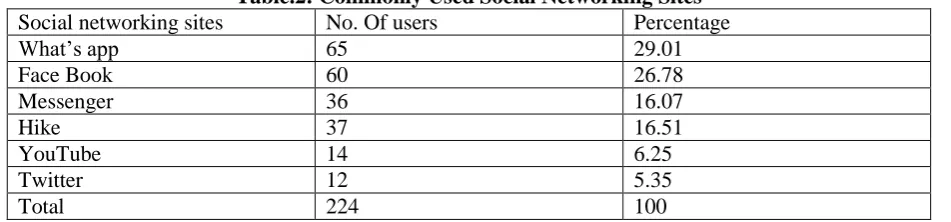
Social media sector is largely growing and new players enter into fields every year offering specific services. Its use is increasing day by day with high rate in all over the world. Hence a brief review of the popular Social Networking sites is very much required. The table below shows commonly used social networking sites.
Table.2: Commonly Used Social Networking Sites
Social networking sites No. Of users Percentage
What’s app 65 29.01
Face Book 60 26.78
Messenger 36 16.07
Hike 37 16.51
YouTube 14 6.25
Twitter 12 5.35
Total 224 100
Source: Sample Survey
It is clear from the table that what’s app is the most commonly used social networking site with 65 persons using the service. Second largest social network used facebook that is 60. Thirty six persons have used messenger. Other common sites which are used by respondents are hike , you tube , twitter 37, 14)and 12 persons respectively.
Purpose of Using the SNS
Table 3. Purpose of Using Social Networking Sites
Purposes No. Of users Percentage
Keeping touch with friends 72 25.80
Planning events 45 16.12
Making new friends 34 12.18
Dating 15 5.37
Local events information 25 8.96
Time wasting 35 12.54
Educational purposes 49 17.56
Others 21 7.52
Total 279 100
Source: Sample survey
It is clear from the table that 72 (25.80%) of the respondents are using social networking sites for keeping touch with friends. 45(16.12%) of the respondents are using these sites for planning events. some peoples are using these sites for making new friends that is 43(12.18%). 15(5.37%) are using SNS for dating. 25(8.96%) are using these sites for getting local events information. 35(12.53%)are using these sites for wasting time.49(17.56%) of the respondents are using social networking sites for educational purposes. And 21(7.52%) of the respondents are used these sites for other personal purposes. Students in this study are used social networking sites for educational purposes.
Time of Usage of Social Networking Sites
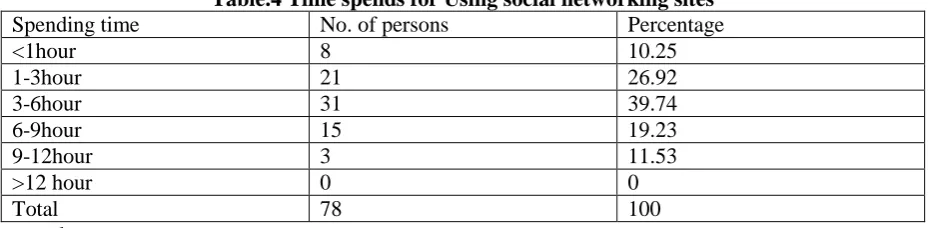
Youth are spending most of their time for using social networking sites. They actively participate in social networking activities. It is shown in the following table;
Table.4 Time spends for Using social networking sites
Spending time No. of persons Percentage
<1hour 8 10.25
1-3hour 21 26.92
3-6hour 31 39.74
6-9hour 15 19.23
9-12hour 3 11.53
>12 hour 0 0
Total 78 100
Source: sample survey
The data in the table shows that the spending time of social media usage among the 100 respondents in a day. 8(10.25%) are using social media less than 1 hour. 21(26.92 %)of the respondents are using social networking sites 1-3 hour per day. 1-31(1-39.74%)of the respondents are using these sites 6- 9 hour per day.15(19.21-3%)of the respondents are using social networking sites in 9-12 hours per day. And no one in the sample survey can use social networking sites more than 12 hour.
Money Spent on SNS/ Monthly Costs for Using Social Networking Sites
For using social networking sites we spend some money when we assess social networking service through smart phone it require internet recharge on mobile. It is very expensive. the monthly cost of using social networking sites among the100respondents are shown in the table
Table; 5 Monthly Cost For Using Social Networking Sites
Cost No .of users Percentage
<100 27 34.61
100-500 47 60.25
>500 4 5.12
Total 78 100
It is clear from the above table.7 shows that 27(34.61%) of the respondents are spending less than rupees per month. 47(60.25%) of the respondents are spending more than 100 rupees per a month for using social networking sites. 4(5.12%) of the respondents are spend more than 500 rupees per month for using social networking sites. it is expressed also in the diagram below;
Method of Assessing Social Networking Sites
The respondents are using social networking sites through various platforms like computer, smart phones, tablets etc.
Table 6: Method of Assessing Social Networking Sites
Method No. of persons Percentage
Pc 8 7.69
Laptop 13 12.25
Smart phone 74 71.15
I pad 9 8.65
Others 0 0
Total 104 100
Source; sample survey
It is clear from the table that most of the 100 respondents are using social networking sites through their smart phones. That is 74(71.15%). 8(7.69%) of the respondents are using those sites through their personal computers. 13(12.25%)are used through laptops. And 9(8.65%) are used these sites through i pads.
Effects of Social Networking Sites
The social networking sites have so many effects on the day to day life of the users both positive and negative. The respondents have different opinion about these effects. That is depicted on the following table.
Table: 7 Effects of social networking sites
Opinion No. Of persons Percentage
Does not effect 25 32.05
Somewhat effect 29 37.17
Replaces effects 24 30.76
Total 78 100
Source: sample survey
The table shows that 25(32.05 %)of the total respondents are opined that the social networking sites does not affect on face to face communication. 29(37.17%)opines that there is somewhat effect on face to face communication. And other 24(30.76%)of the respondents are opines that social networking sites has replaces most face to face communication.
Negative Effects- Victimisation of Online Bullying (offensive comments or e mails)
This study has enquired about whether they have been targets cyber bullying or any type cyber crime. The opinion of respondents are shown in the table 4.20 bellow
Table 8 Victimisation on Social Medias
Victimization No. of persons Percentage
Victims 35 44.87
Non victims 43 55.12
Total 78 100
Source: sample survey
The above table shows that there is 44.87 percent of respondents are the victim of offensive comments or emails. On the other hand 55.12 percent of respondents are not a victim of online crimes.
Role of Awareness Classes in Schools and Colleges
Table 9 Role Of Awareness Classes In Schools And Colleges.
Opinion No. of persons percentage
Agree 40 51.28
Disagree 38 48.71
Total 78 100
Source: sample Survey
The table 13 shows that 40(51.28%) out of 100 respondents are agree with social networking sites is important to aware in schools and colleges. But on the other hand 38(48.71%) of the respondents are disagree with that.
Importance of social networking sites.
Social networking sites are important to communication with each other. The importance given to social networking sites according to this survey is depicted on the table below:
Table.10 ; Importance of Social Networking Sites
Opinion No. of persons Percentage
Strongly agree 42 42
Agree 36 36
Strongly disagree 16 16
Disagree 6 6
Total 100 100
Source: sample survey
The table 4.22 shows that most of the respondents are strongly agree that social networking sites are important in the present scenario. That is 42(42%) of the respondents. And 36% agree with that. 16% of the respondents are strongly disagreeing with the use of social networking sites. And other 6 (6%) are disagree with that.
Students Usage of Social Networking Sites for Academic Purposes
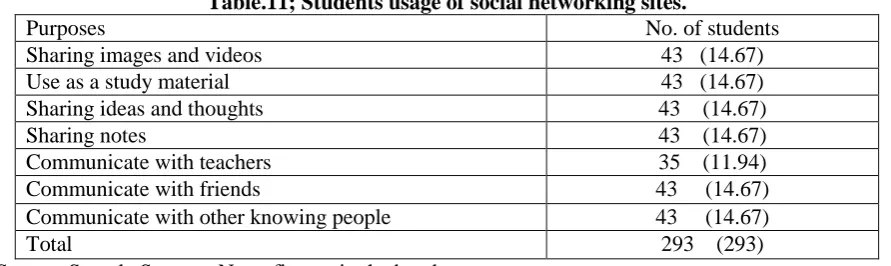
Students are the main users of social networking sites. They use social networking sites mainly for their academic purposes. The detailed information of the student’s usage of social networking sites is given below:
Table.11; Students usage of social networking sites.
Purposes No. of students
Sharing images and videos 43 (14.67) Use as a study material 43 (14.67) Sharing ideas and thoughts 43 (14.67)
Sharing notes 43 (14.67)
Communicate with teachers 35 (11.94) Communicate with friends 43 (14.67) Communicate with other knowing people 43 (14.67)
Total 293 (293)
Source: Sample Survey, Note: figures in the brackets are percentage.
The table 15 shows that the social media usage of students on their academic performance. There are 43 students included in this study. All are using social media for their academic purposes, such as sharing images and videos, ideas and thoughts, notes, and they use it as a study material. 35 students use it for communicating with their teachers for clearing doubts. And they are use it for communication with friends, and other people whom they know.
7. SUMMARY AND CONCLUSION:
With respect of social media usage there are 78 persons out of 100 respondents are using social networking sites. Most of these users are under the age group of 18-25.
This study find out that most commonly used social networking sites are facebook and what’s app.Main purpose of using social networking sites by the users are keeping touch with friends and 49 percent of people are using this for educational purpose.
With respect of social networking group membership majority of respondents are members in social networking for keeping up the relationship.
On the time usage for social networking sites, it is found that majority of respondents use these sites for 3-6 hours in a day. And no one can use more than 1 hour per day.
Majority of the respondents are using social networking sites through their smart phones.
Most of the respondents are using these sites more than a year.
No females in the sample are didn’t accept strangers from the social networking sites, but most of the male respondents are accept strangers.
From the selected sample most of the respondents opines that there is some positive effects on the social networking sites.
45% of persons among the respondents affirmed that sometimes a victim of online bullying (44.87) and others are not a victim any other offensive comments or emails.
59% of the respondents agree with the need for awareness on social networking sites in schools and colleges . But on the other hand 41% of respondents strongly disagreed.
78% respondents in the sample agree with social networking sites are very important and others are strongly disagreeing with this importance.
Students are using social networking sites for their academic purposes.
Thus from the forgone analysis it is found that 78% of the people use the social media for one or other purposes. It is the youth who use it more than other age groups. The respondents have opined that they had experienced some adverse impacts like cyber bullying and other intimidations.
Use of social media has been increasing at a faster rate in recent time period due to the changes that took place in the field of communication. Every three person out of four uses this new media for one other purpose, both good and bad causes. The use of this media is very large in the case of students as three out of every four among them use this media. The study has also found that there instance of respondents becoming prone to cyber bullying through these sites. Hence for a proper use of social media by youth of the society, proper awareness campaign or cyber education must be given to this category of users
REFERENCES:
1. Ghulam Shabir, Yousef Mahmood Yousef Hameed, Ghulam Safdar, Syed Muhammad Farouq Shah Gilani.The Impact of Social Media on Youth: A Case Study of Bahawalpur City (2014) vol. 3(4)
2. Daniel Mcconkey (2012) what influence do the soial networking sites have on our society today. Vol.4 3. Eszter Hagittai (2007). Whose space , Differences among users and non users of social networking sites.
Foot Notes:
iAsur, S. &. Huberman, B.A. (2010) Predicting the Future with Social Media. Social Computing Lab: HP Labs, Palo
Alto, California. pp 1- 8
iiAida abdulabi, Behrang sumadi, Behrooz Gharleghi (2014) a study on the negative effects of Social networking sites
such as facebook among Asia Pascific University scholars in Malesia.vol.(5)
iiiDr. Biswajith Das and Shankar Sahoo (2013). Social networking sites A critical analysis of its impact on personal
and social life. Vol.2