Available Online at www.ijpret.com 1014
INTERNATIONAL JOURNAL OF PURE AND
APPLIED RESEARCH IN ENGINEERING AND
TECHNOLOGY
A PATH FOR HORIZING YOUR INNOVATIVE WORK
ANDROID BASE SMART HOME AUTOMATION
PROF. ANUP V. KALASKAR, UDAY P. WANKHADE, MAHESH P. BISANE, SUDHAN D. AHIR, RUSHIKESH R. DESHMUKH, PRATIK R. DONGARE
IBSS College of Engineering, Amravati. 444603.
Accepted Date: 05/03/2015; Published Date: 01/05/2015
\
Abstract:This paper presents the overall design of Home Automation System (HAS) with low cost and wireless remote control. This system is designed to assist and provide support in order to fulfill the needs of elderly and disabled in home. Also, the smart home concept in the system improves the standard living at home. The main control system implements wireless Bluetooth technology to provide remote access from PC/laptop or smart phone. The design remains the existing electrical switches and provides more safety control on the switches with low voltage activating method. The switches status is synchronized in all the control system whereby every user interface indicates the real time existing switches status. The system intended to control electrical appliances and devices in house with relatively low cost design, user-friendly interface and ease of installation.
Keywords: Home automation, Smart home, home appliances, Bluetooth, Android.
Corresponding Author: PROF. ANUP V. KALASKAR
Access Online On:
www.ijpret.com
How to Cite This Article:
Anup V. Kalaskar, IJPRET, 2015; Volume 3 (9): 1014-1022
Available Online at www.ijpret.com 1015 INTRODUCTION
The “Home Automation” concept has existed for many years. The terms “Smart Home”, “Intelligent Home” followed and has been used to introduce the concept of networking appliances and devices in the house. Home automation Systems (HASs) represents a great research opportunity in creating new fields in engineering, architecture and computing (Huidobro and Millan, 2004). HASs becoming popular nowadays and enter quickly in this emerging market. However, end users, especially the disabled and elderly due to their complexity and cost, do not always accept these systems. Due to the advancement of wireless technology, there are several different of connections are introduced such as GSM, WIFI, ZIGBEE, and Bluetooth. Each of the connection has their own unique specifications and applications. Among the four popular wireless connections that often implemented in HAS project, Bluetooth is being chosen with its suitable capability. Bluetooth with globally available frequencies of 2400Hz is able to provide connectivity up to 100 meters at speed of up to 3Mbps depending on the Bluetooth device class [1]. In addition, a Bluetooth master device is able to connect up to 7 devices in a Piconet [2].
Available Online at www.ijpret.com 1016 their phone application. Meanwhile reference [10] mentioned the phone control is designed in JAVA application but it also did not mention the specific phone‟s OS for the application. From the overall papers reviews, HAS according to [3-10] never mentioned about the existing physical electrical switches in their system. Without the switches on the wall, the designed system limited the control only at the GUI. This issue brings inconvenient to the people in the house. This designed system remains the physical switches with the modified low voltage activating method, in order to provide safer physical control to the user compared to the conventional high voltage switches. The Bluetooth connection in this system is established by Bluetooth module that directly receives/ transmits commands from/to smart phone or laptop/PC. For the GUI, Window OS on laptop/PC and Android OS on Smart Phone are chosen based on the high user distribution in current market. By considering the flexibility, the main control board is designed with wired and wireless connection. USB HID as secondary connection to the control board performs the wired connection. For the wireless connection, the main control board can be connected to either one of the laptop/PC or Smart Phone. Besides, the switches status on the board is synchronized in real time to all the connected GUI controllers. In term of cost, this system implemented low cost microcontroller and Bluetooth module as the system main core. The total cost of one unit of this system hardware is estimated less than RS 2000. With this low budget, this system is still performed with powerful remote functions to make our life in home become easier.
Working Principle:
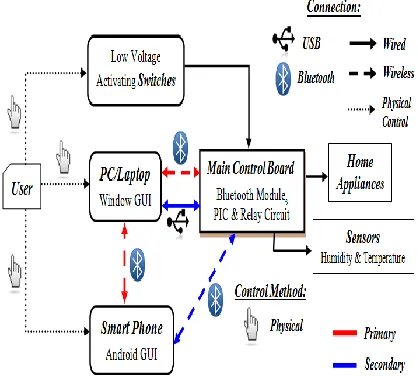
Fig 1 illustrates the overall control function of the system. The system is directly installed beside the conventional electrical switches on the wall. The Bluetooth wireless connection enabled the system communicates with graphical user interface (GUI) on PC/laptop or smart phone without cable. The target home appliances are controlled by the system Main Control Board.
Available Online at www.ijpret.com 1017 portable method is able to assist the disabled people who have problem with locomotion difficulty.
Fig 1. Functional Block Diagram of the System
The sensors that connected to the main control board measure room temperature and humidity level in the house. The indication from the sensor is able to remind the user to switch on/off the heater, fan or air cond. in the house. The home appliance on/off status and temperature or humidity reading are synchronized to the two GUIs on personal computer or laptop or smart phone. The switches status and sensor reading are in real-time monitoring by the main control board. Any changes on the status or reading will be transmitted to the two GUIs. After the smart phones Bluetooth connection is connected to personal computer or laptop, the Window GUI will be act as a server to forward or transmit any data from/to the smart phone and main control board. Some connection parts of the system are designed with two connections (Primary and Secondary) to the system. In case of issue occurs on personal computer or laptop, smart phone can directly connect to main board. While in case of Bluetooth connection issue occurred between personal computer or laptop and control board, personal computer or laptop can connect to board by wired USB connection. The secondary connection is act as the backup solution in the system.
Hardware Design:
Available Online at www.ijpret.com 1018 establish the Bluetooth and USB connection to the GUIs. For the sensor, HSM-20G Sensor Module is chosen because it is the low cost 2- in-1 combination of humidity and temperature modules. For the Bluetooth module, low cost Cytron Bluebee Bluetooth module is chosen to establish the Bluetooth connection between main control board and the GUIs.
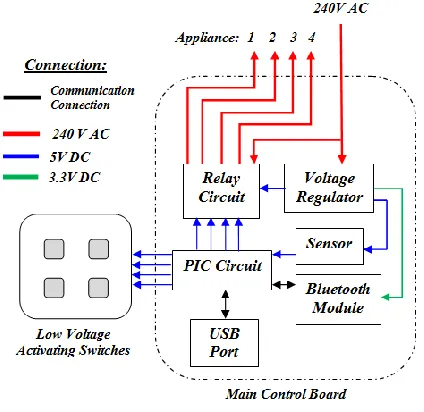
Fig. 2 Main Control Board Hardware Block Diagram
The electrical current is directly connect to the main control board whereby it separates the regulator and relay circuit. The voltage regulator is constructed by common reliable regulator circuit which consists of transformer, rectifier and regulator. 5V and 3.3V DC output is regulated in order to fulfill the voltage needs of the specific components in the main control board. Moreover, the low voltage activating switches will replace the existing switches. The ease of installation is taken into account for this system. The system is designed to directly install beside the electrical switches on the wall. The installation of this system eliminates the complex wiring reinstallation and overhead wiring on the wall. The existing switch connection is connected and controlled by the relay circuit inside main control board. Furthermore, multiple control boards can be installed in home. Bluetooth master device in PC/laptop is mostly able connect up to 7 devices in a Piconet. With these simple and low cost components, the main control board is constructed in pretty small size but still performs the strong functions and features of the system.
Software Design:
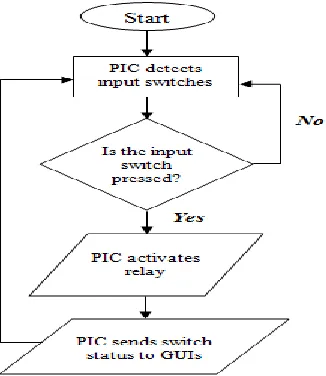
Available Online at www.ijpret.com 1019 process of the Low Activating Switches in the system. The switches detection function is performed by the microcontroller, PIC. The activating switches are designed by push buttons. Any input switch is pressed; it will interrupt the main function loop of the PIC. Then, the PIC will activate the relay and toggle the current appliances switch status. At the moment, PIC also informs the change of switch status to all the GUIs that connected to the main board.
Fig 3. Low Voltage Activating Switches Process
Window GUI is designed by an user-friendly interface. The four bulbs indicated the appliances status that connected to the system. User can simply click on the bulb to turn on/off the appliance. Control board „Connect‟ button is performed to establish connection to main control board by Bluetooth or USB. Phone„ Connect‟ button is performed to establish connection between Window GUI and Android GUI. When the both connections are established, Window GUI acts as the server between main board and phone. All the data received from main board will be forwarded to the phone. Also, the data sent from phone will be forwarded to main board.
Available Online at www.ijpret.com 1020 The application is designed in Android version 2.2 (Froyo) with API level 8. The application is designed in low API level so that the devices with higher version are compatible with it. Fig 5 illustrate the Android GUI tested on smart phone with Version 4.0.4 (Ice Cream Sandwich). The interface is simple to use, user can simply touch on the icon to turn on/off the appliances after connected to the Window GUI or direct to the main control board.
Fig 5. Android Main Control GUI
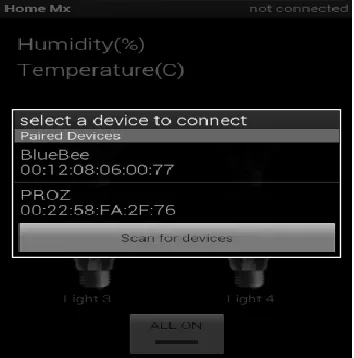
Fig 6 illustrate the interface of Android GUI selecting Bluetooth device. User can connect directly to main control board (BlueBee) or connect to PC/laptop (PROZ) by Bluetooth connection.
Available Online at www.ijpret.com 1021 APPLICATION:
Yet there is an increasing demand for smart homes, where appliances react automatically to changing environmental conditions and can be easily controlled through one common device.
This Technology is very useful for Physically Challenged and Disabled People.
This wireless technology is especially useful in home environment, where there exists hardly any infrastructure to interconnect intelligent appliances.
FUTURE SCOPE:
Home Automation is undeniably a resource which can make a home environment automated. People can control their electrical devices via these Home Automation devices and set up controlling actions through Mobile. In future this product may have high potential for marketing.
CONCLUSION:
In conclusion, this low cost system is designed to improve the standard living in home. The remote control function by smart phone provides help and assistance especially to disabled and elderly. In order to provide safety protection to the user, a low voltage activating switches is replaced current electrical switches. Moreover, implementation of wireless Bluetooth connection in control board allows the system install in more simple way. The control board is directly installed beside the electrical switches whereby the switching connection is controlled by relay. Furthermore, flexible types of connections are designed as backup connections to the system. The connected GUIs are synchronized to the control board. They indicate the real-time switches status. The easy to use interface on Window and Android GUI provides simple control by the elderly and disabled people. For future work, the Window GUI will be implemented with speech recognition voice control. The android GUI will be implemented as a remote Bluetooth microphone to the Window GUI. All the voice signal inputs to the smart phone will be transmitted to the Window GUI for signal processing. Also, the push buttons implemented in low voltage activating switches will be replaced by capacitive sensing switches. All the future work is expected without spend extra cost, even one cent from the current system.
REFERENCES:
1. The official Bluetooth website from Bluetooth SIG: http://www.bluetooth.com
Available Online at www.ijpret.com 1022 3. R. Piyare and M. Tazil, “Bluetooth Based Home Automation System using Cell Phone,” in Consumer Electronics, 2011, pp. 192-195.
4. Kailash Pati Dutta, Pankaj Rai and Vineet Shekher, “Microcontroller Based Voice Activated Wireless Automation System:, VSRD-IJEECE”, Vol. 2(8), 2012, 642-649
5. Baris Yuksekkaya, A. Alper Kayalar, M. Bilgehan Tosun, M. Kaan Ozcan, and Ali Ziya Alkar, “A GSM, Internet and Speech Controlled Wireless Internet Home Automation System”, IEEE Transactions on Consumer Electronics, Vol. 52, No. 3, AUGUST 2006.
6. N. Sriskanthan and Tan Karande, “Bluetooth Based Home Automation Systems,” Journal of Microprocessors and Microsystems, 2002, Vol. 26, pp. 281-289.
7. Kwang Yeol Lee & Jae Weon Choi, “Remote- Controlled Home Automation System via Bluetooth Home Network” in SICE Annual Conference in Fukui, 2003, Vol. 3, pp. 2824- 2829.
8. Wijetunge S.P., Wijetunge U.S., Peiris G.R.V, Aluthgedara C.S. & Samarasinghe A.T.L.K., “Design and Implementation of a Bluetooth based General Purpose Controlling Module”, in IEEE, 2008, pp. 206-211.
9. Sandeep Kumar & Mohammed A Qadeer, “Universal Digital Device Automation and Control”, in IEEE, 2009, pp. 490-494.