Available Online at www.ijpret.com 1526
INTERNATIONAL JOURNAL OF PURE AND
APPLIED RESEARCH IN ENGINEERING AND
TECHNOLOGY
A PATH FOR HORIZING YOUR INNOVATIVE WORK
PHOTONIC NETWORK AND ITS SCOPE
SURAJ DEULGAONKAR1, VISHWAS GAIKWAD2, HARSHAL DATIR1
1.Computer Science and Engineering Department, Sant Gadge Baba Amravati University, Amravati. 2.Information Technology Department, Sant Gadge Baba Amravati University, Amravati.
Accepted Date: 05/03/2015; Published Date: 01/05/2015
Abstract:A photonic network is communication network, where information is transmitted completely in the form of optical or infrared transmission signals. This network is the most appropriate solution to deal with bandwidth requirements in future, especially for internet. With photonic network, it is also possible to make our network “smart”, as it has many features which works during the transmission of data through this network. This paper introduces a review of photonic network and its vision, which provides high capacity network with flexibility, expandability and very high reliability. First, the paper describes the basic concept and current status of photonic network, then gives deployment stages, requirements to form perfect photonic network. Lastly, it describes the base technology like synthetic transport platform, scale free photonics for the photonic networks.
Keywords: Optical Add-drop multiplexer (OADM), Optical cross connect (OXC), Photonic layer, Photonic network processor (P-NP).
Corresponding Author: MR. SURAJ DEULGAONKAR
Access Online On:
www.ijpret.com
How to Cite This Article:
Suraj Deulgaonkar, IJPRET, 2015; Volume 3 (9): 1526-1533
Available Online at www.ijpret.com 1527 INTRODUCTION
Day by day the communication traffic is increasing tremendously due to the internet, high speed access, mobile communications etc. Internet and IP data traffic is increasing rapidly and it is expected mostly that IP based network is used in intranets and virtual private networks (VPNs), hence now a days there is Wavelength Division Multiplexing (WDM) system is used by communication carriers for restricting the communication traffic and due to that reason key system for photonic networks is WDM [1] .These Photonic Networks are used to create cost effective IP centric broadband network.
Also, photonic network having much more scope in the Big Data era , as all the sectors as medical , education , social will relay on the cloud computing . Hence, sorting, accessing and updating that data sets in the Data Centers (DCs) will increase in abundant manner. The data sets that to be proceed in a proper time is limited by the processing capability, bandwidth and latency in the data transfer over network, for which we need higher bandwidth with low latency. The key requirements for Big Data network is ultra large capacity with low power consumption, flexibility, low latency where all these requirements are fulfilled by a smart concept of photonic networks called as photonic cloud [2].
For network operators, the capacity crunch is the crucial issue because of increasing traffic in the network, with that operational capital expenditure (OPEX) is also mentionable. And Current network operation and management (OAM) is labour intensive and hence if we want to upgrade the capacity of transmission link then labours have to send to the site to exchange
The module which will create cost and time constraint. If up gradation is possible from remote site by only updating software which will overcome the problem of OPEX, minimize the delivery time. For which photonic network can be make less labor intensive by synthesizing the desired transmission by software control.
This paper presents the review towards the photonic networks and its vision to provide high capacity during transmission over a network.
PHOTONIC NETWORK’S CONCEPT
Available Online at www.ijpret.com 1528
expandable photonic network which leads to increase in the capacity of network, also all the information is transferred.
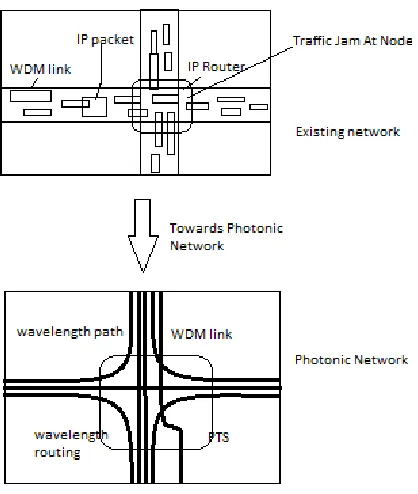
In photonic network, the photonic layer is the important concept which increases expandability, which gives cost-effective increase in transmission capacity as demand is increases. With that the photonic network is providing flexibility factor if network needs to change in routes and transmission capacity. For example, in case of failure in the network. If wavelength count is more, there will be feasible to directly address destinations or to assign one wavelength per virtual path, in next days it is possible that all optical processing will be cost effective processing for all capacity signals.
Fig. 1 Photonic Highway
Available Online at www.ijpret.com 1529
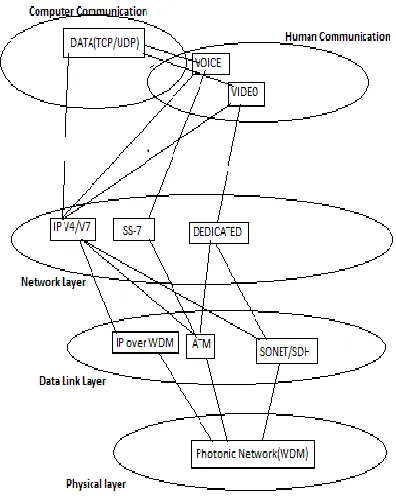
To promote photonic networks which carry huge amount of traffic by making combination of the WDM and IP technologies, it is necessary to develop a simple interface. Recently, the IP information is mapped in SDH/SONET frames and get implemented in WDM systems. The preferable interface is that, which directly transfers IP information into WDM technology as shown in Fig. 2, where simpler interface is shown as all the IP information is transported by using WDM
Technology which is mostly preferable. The optical Internetworking Forum (OIF) was
Established in 1998, which is open forum for discussing on an interface. If there is any new proposal then it is discussed in three phases: physical interface, management and inter-la adjustments.
Fig 2 Network Architecture
CURRENT STATUS OF PHOTONIC NETWORK
Available Online at www.ijpret.com 1530
decade. With this coherent technology, transmitter can generate light signals of any shape with digital signal processors (DSPs) and high speed digital to analogy converters (DAGs).
This make it possible to create ideal filter for NY Quist WDM and to generate M-ray quadrature amplitude modulation signals , where on receiver side the optical signals are converted into the parallel using analogy to digital converter and lastly proceed by DSPs[5].
With packet optical transport technology, it is possible to divide capacity into many flexible paths where electric packet switches get integrated with WDM optical cross connects.
DEPLOYMENT STAGES
The deployment can be done in several stages , where first stage is point to point transmission deployment .This stage relatively having WDM technology that effectively increase transport capability. Multiplexing is the main aim of photonic network and independent characteristics of each wavelength allow assignment of wavelength to the applications.
The next stage of photonic network is optical path network where functions like adding, switching and dropping can be obtained optically and communication path is redefined by incorporating the wavelength. Here, optical add-drop multiplexer (OADM) have great role.
In next stage the optical cross connect (OXC) is required. The OXC is having complex part of processing such as route changing and wavelength exchange.
In the last stage, the IP signals from routers are the main signals where simple interface, standardizations are main concerns. Here IP packets are directly transported by WDM technology. This stages will overlap each other and their development is remain in progress.
REQUIRMENTS NEEDED IN PHOTONIC NETWORK
A. Requirement 1
The photonic network should be free from the limitations of the large capacity routers, means infrastructure should bottleneck free! Where if there is progress in the optical transmission technologies then the capacity can be increased.
B. Requirement 2
Available Online at www.ijpret.com 1531
transmission technology and sub-wavelength path. Also, synthetic photonic nodes supports higher level protocols and user- defined node functions.
BASE TECHNOLOGY FOR PHOTONIC NETWORKS
A. Synthetic Transport Platform
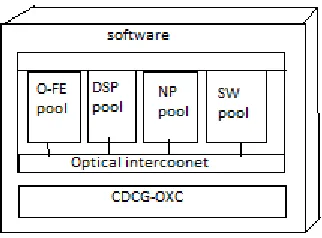
A synthetic transport platform is a technology which is made up of synthetic photonic node. This nodes are transport nodes which integrates next generation optical cross connect and fully programmable P-NP which gives higher level node functions. This photonic have scalability and full flexibility. [2]These characteristics define all node functions by software and with that it incorporates the other base technologies of photonic networks like scale free photonics and smart photonic networking.
The architecture of synthetic photonic network is shown in the Fig. 3 [2], It has optical cross connect and P-NP. This optical cross connect have many features with new Capabilities. For example, it is grid less hence enabling it to handle flexible WDM grids and it also consist of SDM switching, which provides multi-core fibres or multi-mode transmission.
Fig. 3 Architecture of Synthetic Photonic Node
Available Online at www.ijpret.com 1532
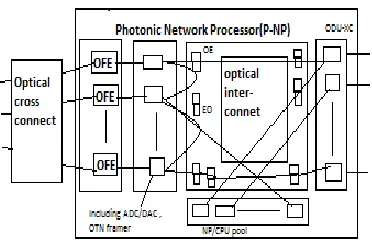
functional module can be configured by programming the optical interconnections pattern that connects the set of components together.
The photonic network operation system manages all the resources of this device pools and manage their configuration.
Fig. 4 Photonic Network processor
B. Scale Free Photonics
This technology drops physical limitations in the optical transmissions in which further expanding of optical transmission capacity limit, slicing the capacity into many channels are included. As concern with capacity limit expansion, the SDM technology which is having multi-mode transmission will enhance the capacity of every fibre.
In coherent transmission system, a frequency stabilized laser is necessary for frequency stabilization.
For noise reduction, an optical amplifier with a low noise figure (NF) is attractive solution. Low-NF of inline optical amplifier improves the signal-to-noise ratio in transmission systems.
The technology that are designed for the reduction of the noise due to correlation among multiple channels becomes important and hence such transmission technologies are used for the transmission of ultra- band data through multiple channels.
CONCLUSION
Available Online at www.ijpret.com 1533
OADM, OXC, and signal processing, we can obtain flexibility, expandability and reliability in the network. Also, it is most probably capable of completing all the future needs of communication area.
This paper is promoting to the photonic network as to make photonic network as the main product of the communication field as this photonic network technology can be a base technology in near future.
REFERENCES
1. Cisco Visual Networking Index: Global mobile data Traffic forecast update, 2012-2017, Cisco systems, Inc., CA, USA, 2014.
2. Ken-ichi-Itayama, Fellow, IEEE, Atsushi Hiramatsu ,Member, IEEE, Masaki Fukoi, Takehiro Tsuritani Naoaki Yamanaka, Fellow, IEEE, Satoru Okamoto, Senior Member, IEEE, Masahiko Jinno, Senior Member, IEEE, Masafumi Koga, Member, IEEE,” Photonic Network Vision
2020-Toward Smart Photonic Cloud”(Invited Tutorial)Journal Of
LightwaveTechnology,vol.32,No.16,Aug.15,2014.
3. Hideo Kuwahara , And Their Forward View” Feb22,1999 Hajime Imai, Takashi Touge ,Koichi Ohta, ”Photonic Networks 1,2003.
4. Ken-ichi-Sato, Satoru Okamoto,”Photonic Network”, NTT Network Innovation Laboratires , Octber