Organized by C.O.E.T, Akola & IWWA, Amravati Center. Available Online at www.ijpret.com296
INTERNATIONAL JOURNAL OF PURE AND
APPLIED RESEARCH IN ENGINEERING AND
TECHNOLOGY
A PATH FOR HORIZING YOUR INNOVATIVE WORK
SPECIAL ISSUE FOR
NATIONAL LEVEL CONFERENCE
"SUSTAINABLE TECHNOLOGIES IN
CIVIL ENGINEERING"
FERROCEMENT: COMPOSITE MATERIAL AND ITS APPLICATIONS
M. B. VARMA1, M. B. HAJARE2
Department of Applied Mechanics, Government College of Engineering, Aurangabad
Accepted Date: 13/03/2015; Published Date: 01/04/2015
Abstract –Ferrocement is a composite material made up of cement mortar and reinforcement in the form of layer of mesh. A composite material is a formed that behaves differently from reinforced concrete. There is some similarity between the reinforced concrete and ferrocement materials; differences are there, indicating that ferrocement requires a separate study to establish its structural performances. Ferrocement, a thin element, is used as a building construction as well as a repair material. This review from the past experience present the results of experimental and analytical studies on ferrocement members and bring out the salient features of construction, material properties and the special techniques of applying cement mortar on to the reinforcing mesh. This study brings out the importance of using ferrocement in swimming pools and water tanks, silos, corrugated roofs, slab panels, shell and dome structures by using available mechanized production methods and proper choice of reinforcements.
Keywords-Cement Mortar, Ferrocement, Wire Mesh
Corresponding Author: MR. M. B. VARMA
Co Author: MR. M. B. HAJARE
Access Online On:
www.ijpret.com
How to Cite This Article:
Organized by C.O.E.T, Akola & IWWA, Amravati Center. Available Online at www.ijpret.com297 INTRODUCTION
Plain concrete has low tensile strength, ductility, and resistance to crack propagation. Flaws or micro cracks exist in the material even before any load is applied, because of its inherent microstructure and volumetric changes during manufacturing. [1] These flaws lead to a brittle failure of the material in tension compare to its compressive strength. In reinforced concert, although the failure of the composite is ductile due to the ductile nature of reinforcement, the concrete suffers an extensive amount of cracking. In the past, working stresses were relatively low. Consequently, the cracks in the reinforced concrete members were small, and therefore insignificant. However, the present trends towards more economical designs, pressed for higher working stresses. Due to excessive crack width and deflection which impair the appearance of the structure, weakening the member due to corrosion of steel and damaging non-structural members. Serviceability criteria become more critical than the strength consideration. The concrete technologist faced with the problem of improving the inherent weak properties of concrete in order to cater for the designer's requirements. A repair good improve the function and performance of structures, restore and increase its strength, provides water tightness and prevent against aggressive environment to steel surface durability. Corrosion of rcc structures takes place in the main reinforcement in slab, beam and the stirrups, where cover is not provided well. To overcome such problem material having good properties has to search out. To encourage the search for new materials to partially replace reinforced concrete. It is under such circumstances that ferrocement, among other materials, has emerged.[1][2]The reinforcement of ferrocement consists of several layers of relatively fine wire mesh packed together with or without steel bars in the middle. Cement mortar is used to fill the gaps between the meshes and provide the cover for the reinforcement.
Organized by C.O.E.T, Akola & IWWA, Amravati Center. Available Online at www.ijpret.com298
ferrocement is receiving extensive attention both in the field of applications and the study of its properties.
II. LITERATURE SURVEY
A brief review of past work carried out by different researchers on ferrocement in construction practices is discussed below.
P. PARAMASIVAM [1] Paper gives idea about benefits of ferrocement and application to real life. Ferrocement is ideally suited for thin wall structures as the uniform distribution and dispersion of reinforcement provide better cracking resistance, higher tensile strength to weight ratio, ductility and impact resistance. By adapting available mechanized production methods and proper choice of reinforcements it can be cost competitive in industrialized countries. Research and development works of ferrocement has resulted in several applications such as sunscreens, secondary roofing slabs, water tanks, and repair material in the building industries. The design, construction, and performance of some of these applications of ferrocement structural elements are highlighted in this paper.
M. JAMAL SHANNAG [2] The main objective of his study was to investigate the effects of combining reinforcing steel meshes with discontinuous fibers as reinforcement in thin mortar specimens. Variables were investigated are number of mesh layers 2 and 4, transverse wire spacing, small, medium and large, and the type of fiber, steel and glass. Everything else being equal, the addition of brass coated steel fibers to the matrix of ferrocement can effectively increases its flexural strength, energy absorption to failure, and significantly reduce the average crack spacing and width, and reduce the mortar cover at ultimate load.
A. SALEEM [3] In his paper gives the idea of the behavior of ferrocement structure under the earthquake. The earthquake resulted in a great loss of life and property. This work is mainly focused on developing a design of small size, low cost and earthquake resistant house. Ferrocement panels are recommended as the main structural elements with lightweight truss roofing system. Earthquake resistance is ensured by analyzing the structure on ETABS for a seismic activity of zone 4. The behavior of structure is found satisfactory under the earthquake loading. An estimate of cost is also presented which shows that it is an economical solution.
Organized by C.O.E.T, Akola & IWWA, Amravati Center. Available Online at www.ijpret.com299
special techniques of applying cement mortar on to the reinforcing mesh. His study brings out the importance of using ferrocement in swimming pools and water tanks, silos, corrugated roofs, shell and dome structures, and also in the repair of old deteriorated RCC structures. Also is discussed in this paper a similar material to ferrocement. The recommendations of his study include addition of fibers in ferrocement to reduce crack-width. Ferrocement is a thin construction element with thickness in the order of 10-25 mm and uses rich cement mortar; no coarse aggregate is used; and the reinforcement consists of one or more layers of continuous, small diameter steel wire, weld mesh netting. It requires no skilled labour for casting, and employs only little or no formwork.
R. THENMOZI [5] In his paper he discusses the details of the flexural behavior of self-compacting concrete (SCC) ferrocement fiber reinforced slab panels. A total of 24 slabs have been tested under flexural loading. The size of the slab is 700 x 300 x 25 mm and 700 x 300 x 30 mm. The parameters studied in this investigation include the fiber content, number of weld mesh layers thickness of ferrocement. From the studies, it is observed that the load carrying capacities, energy absorption, deformation at ultimate load are high in the case of SCC ferrocement hybrid polypropylene fibers. Further, it is observed that there is reduction in crack width and increase in number of cracks in the case of SCC ferrocement hybrid polypropylene fibers indicates delay in crack growth.
A. JAGANNATHAN [6] Researcher in his experimental work has made an attempt to experimentally investigate the ultimate flexural load of ferrocement slabs of size 700 x 200 x 15 mm reinforced with PVC coated steel weld mesh, and compare the results with slabs using GI-coated steel weld mesh, by varying the number of layers from 1-3. Ordinary Portland Cement, locally available river sand and potable water have been used in preparation of cement mortar, and the sand-cement ratio of 2:1 and water-cement ratio of 0.43 have been used in accordance with ACI codes. The flexural strength of ferrocement slabs was determined on four-point loading using a specially fabricated flexure loading frame. The flexural load, maximum deflection, crack-pattern and crack-width of ferrocement slabs reinforced have been analyzed using varying PVC and GI coated weld mesh layers (1-3). Increasing the number of mesh layers from 1-3 caused a substantial increase in flexural load as well as improvement in ductility behavior of ferrocement slabs.
Organized by C.O.E.T, Akola & IWWA, Amravati Center. Available Online at www.ijpret.com300
observed that stress intensity as well as cracking shear strength of plate depends upon volumetric fraction of wires.
V. HALHALLI[8] In his paper he focused on the behavior of ferrocement deep beam. The recent application of Ferro cement includes prefabricated roofs elements, load bearing panels, bridge decks and others. However there have been many structural applications in different parts of the world especially in eastern part considerable efforts have been made by many individuals and research organization around the world to study the engineering of Ferro-cement. This present study deals with the behavior of Ferro cement deep beams under central point load.
R. J. PHALKE [9] The Paper gives the idea of flexural behavior of ferrocement slab panels reinforced with different number of wire mesh layers. The main objective of this work is to study the effect of using different no of wire mesh layers on the flexural strength of flat ferrocement panels and to compare the effect of varying the no of wire mesh layers and use of steel fibers on the ultimate strength and ductility of ferrocement slab panels. The no of layers used are two, three and four. Slab panels of size (550x200) with thickness 25 mm are reinforced with welded square mesh with varying no of layers of mesh. Panels were casted with mortar of mix proportion (1:1.75) and water cement ratio (0.38) including super plasticizer with dosage of 1% of total weight of cement. Some panels were casted with steel fibers (0.5%) of total volume of composite and aspect ratio is 57. Panels were tested under two point loading system in UTM machine after curing period of 28 days. Test result shows that panels with more no of layers exhibits greater flexural strength and less deflection as that compared with panels having less no of layers of mesh.
III. FERROCEMENT INGRADIENTS
A. MATRIX
The matrix of ferrocement is usually cement mortar, consisting of cement, sand, water and additive. The matrix should have some or all of the following requirements, depending on the use of the structure, high compressive strength, impermeability, and hardness, resistance to chemical attack, low shrinkage, and workability. Most of the available specifications concerning the properties of the mortar used in ferrocement depend on observation and practical consideration of the ferrocement uses, with some aid from the knowledge on concrete technology. From a concrete technology point of view, the main factors which affect the properties of the mortar are:
Organized by C.O.E.T, Akola & IWWA, Amravati Center. Available Online at www.ijpret.com301
2. Sand/cement ratio.
3. Gradation, shape, maximum size of aggregates.
4. Quality, age, and type of cement.
5. Admixtures.
6. Curing condition.
7. Mixing, placing and compaction of mortar.
The limits of the above factors are affected by the requirements of the mortar which in turn depend on the use of ferrocement. In marine structures more restrictions are generally required than in civil engineering structures. In most applications, high strength and low shrinkage are required and therefore low water: cement ratio, between 0.35 and 0.55 [5] should be used. Workability should be high and therefore a suitable compromise should be arrived at to increase the water content to take account of the decrease in strength. Rich cement mortar is required to give compressive strength between 35 to 50 N/mm2. [4]
1 .Cement
Ordinary Portland cement is used in making of mortar. Thecementshould fresh and free from lumps.
2. Aggregates
Normal-weight fine aggregate is the most common aggregate used in ferrocement. The aggregate consists of well graded fine aggregate that passes a 2.34 mm sieve; and since salt-free source is recommended, sand should preferably be selected from river-beds and be salt-free from organic or other deleterious matter and relatively free from silt and clay. Good amount of consistency and compaction is achieved by using a well-graded, rounded, natural sand having a maximum top size about one-third of the small opening in the reinforcing mesh to ensure proper penetration (ACI Committee 549R-97). The moisture content of the aggregate should be considered in the calculation of required water. [7]
3. Water
Organized by C.O.E.T, Akola & IWWA, Amravati Center. Available Online at www.ijpret.com302
4. MatrixMix Proportioning
The mix proportion ranges of the mortar for ferrocement application are sand/cement ratio by weight, 1 to 2.5 and Water-cement ratio by weight, 0.30 to 0.5. The amount of water used should be the minimum consistent with compatibility. This is commonly achieved by using a well-graded, rounded, natural sand having a maximum top size about one-third of the smallest opening in the reinforcing system to ensure proper penetration. Sand passing a 1.16 mm sieve has given satisfactory results in many practical applications. The mix should be as stiff as possible, provided it does not prevent full penetration of the mesh. Normally the slump of fresh mortar should not exceed 2 in. (50 mm). For most applications, the 28-day compressive strength of 75 by 150-mm moist-cured cylinders should not be less than 35 MPa.
B. REINFORCEMENT FOR FERROCEMENT
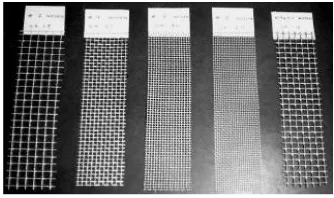
Different types of meshes are available almost in every country in the world. Two important reinforcing parameters are commonly used in characterizing ferrocement and are defined as Volume fraction of reinforcement; it is the total volume of reinforcement per unit volume of ferrocement. Specific surface of the reinforcement, it is the total bonded area of reinforcement per unit volume of composite. The principal types of wire mesh currently being used are given below: Hexagonal wire mesh Welded wire mesh, Woven wire mesh, expanded metal mesh and three dimensional meshes.
1. Hexagonal or Chicken Wire Mesh
This mesh is readily available in most countries and it is known to be the cheapest and easiest to handle. The mesh is fabricated from cold drawn wire which is generally woven into hexagonal patterns. Special patterns may include hexagonal mesh with longitudinal wires.[4]
2. Welded Wire Mesh
Organized by C.O.E.T, Akola & IWWA, Amravati Center. Available Online at www.ijpret.com303 Fig. 1 Hexagonal and Welded Wire Mesh.
3.Woven Wire Mesh
In this mesh, the wires are interwoven to form there required grid and the intersections are not welded. The wires in this type of mesh are not straight. They are bent in the shape of zigzag lines and large angle of bending might cause cracks along the mesh However, the molding performance of this mesh is as good as the hexagonal and the welded wire mesh.
4.Expanded Metal Mesh
This mesh is formed by cutting a thin sheet of expanded metal to produce diamond shape openings. It is not as strong as woven mesh, but on cost to strength ratio, expanded metal has the advantage. This type of mesh reinforcement provides good impact resistance and crack control, but they are difficult to use in construction involving sharps curves.
Fig. 2 Woven Wire Mesh
C. PROPERTIES OF FERROCEMNT COMPOSITE
1. Wire diameter 0.5 to 2 millimeters.
2. Size of mesh opening 6 to 35 millimeters.
3. Maximum 8% volume fraction in both directions.
Organized by C.O.E.T, Akola & IWWA, Amravati Center. Available Online at www.ijpret.com304
5. Mesh covers 1.5 to 5 millimeters.
6. Ultimate tensile strength up to 34 MPa.
7. Allowable tensile strength up to 10 MPa.
8. Modulus of rupture up to 55 MPa.
9. Compressive strength up to 28 to 69 MPa.
Fig. 3 A Typical Ferrocement Section
IV. Construction Methods And Applications:
Construction process is important for ferrocement construction. Since the ferrocement elements are very thin in the order of 10-25 mm, considerable care is to be taken to maintain minimum cover of 3 mm.
A. ARMATURE SYSTEM
The armature system is a framework of tied reinforcing bars to which layers of reinforcing mesh are attached on each side. Mortar is then applied from one side and forced through the mesh layers towards the other side. The skeletal steel can assume any shape. Diameter of the steel bars depends on the size of the structure.[5] Skeletal steel is cut to specified lengths, bent to the proper profile, and tied in proper sequence. The required numbers of layers of mesh are tied to each side of the skeletal steel frame.
B.CLOSED MOLD SYSTEM
Organized by C.O.E.T, Akola & IWWA, Amravati Center. Available Online at www.ijpret.com305
C.PRESS FILLS METHOD
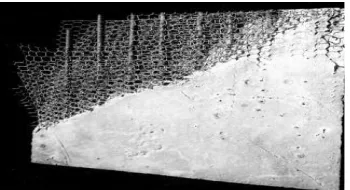
In ferrocement construction, mortar plastering and penetration on to the mesh plays a crucial role. The mortar is usually apply in the mesh reinforcement either by hand or shot through a spray gun device in order to get a homogeneous mixture of ingredients and produce almost a fabric of mesh coated and well packed with mortar.[10]
Fig.4 Press Fill Method
D. LAY- UP TECHNIQUE
Lay-up technique which involves placing the mesh in the mortar rather than the mortar in the mesh; and successive layers of mesh are placed in layers of freshly sprayed, or manually placed, mortar. To assure that mesh layers do not pop out, a thin mortar cover layer is placed first and allowed to set, but not dry completely, prior to application of a second mortar layer and the first mesh layers. [15] This first layer of mortar cover is generally about 3 mm. A major advantage of the lay-up technique is that each layer of mesh is placed under full visual contact any gap in the mortar is immediately apparent and instantly corrected.
Organized by C.O.E.T, Akola & IWWA, Amravati Center. Available Online at www.ijpret.com306
E. APPLICATIONS OF FERROCEMENT
1. Floating marine structures.
2. Secondary roofing slab.
3. Water tank construction.
4. Silos construction.
5. Maintenance and repair of detoriated structures.
6. Used in constructing members, hollow columns, wall, beams.
V. CONCLUSION
This brought out that ferrocement is an innovative material and the ready availability of material and easy construction methods it suitable for housing, water and food storage structures. Ferrocement is found to be suitable material for repairing the defective RCC structural elements to increase their performance. The performance of ferrocement is depend on properties of reinforcing mesh, there is need to specify optimum range of properties of mesh. Considering the unique features, ferrocement is important alternative for RCC and repair material in future.
REFERENCES
1. Joel Bernstein, “Ferrocement: Application in Developing Countries, National Academy of Science, Washington D.C. Feb 1973, pp 40-45.
2. M.Saleem, “Flexural Behavior of Ferrocement Sandwich panels”, Cement Concrete Composites, Jan-1991pp 21-28.
3. A .E. Naaman, “Bending behavior of mortar reinforced with steel meshes and Polymeric fibers”, Cement and Concrete Composites, 1995 pp-327-338.
4. ACI Committee 549, “State-of-the-Art Report on Ferrocement", ACI 549R-97, American Concrete Institute, 1997pp 24.
Organized by C.O.E.T, Akola & IWWA, Amravati Center. Available Online at www.ijpret.com307
6. P.Paramasivam, “ Ferrocement structural applications”, 26th conference on Our World in Concrete and Structures at Singapore, on August 27-28, 2001, pp 99-107.
7. S.Wang “Bending response of hybrid ferrocement plates with meshes and fibers” Journal of Ferrocement, Vol-34, Jan-2004, pp 275-287.
8. M.Jamal Shannag “Flexural response of Ferrocement with fibrous Cementitious Matrices” Construction and Building materials, 2007 pp 1198-1205.
9. A. Saleem, “Low Cost Earthquake Resistant Ferrocement Small House”, Pak. J. Engg. & Appl. Sci. Vol. 2 Jan 2008, pp 59-63.
10. P.B.Sakthivel, “Ferrocement construction technology and its application-A Review”, The International Conference on Structural Engineering ,Construction and Management at Kandy, Sri Lanka on December 15-17,2011, pp 2-12.
11. R.Thenmozi “An Experimental investigation on the flexural behavior of scc ferrocement slabs incorporating fibers” IJEJT, Vol-4 May-2012, pp 2146-2157.
12. A. Jagannathan “Study of flexural behavior of ferrocement slab reinforced with PVC coated weld mesh” IJERD, Vol-1, July-2012, pp 50-57.
13. S. K. Patra, “Ferrocement – A Review’’, IJERT Vol. 2 Issue 10, October – 2013, pp 562-565.
14. V. Halhalli, “Shear and Flexural Behavior of Ferro Cement Deep Beams’’,IJRET Nov- 2013, pp 85-90.