A Study of ICT skills among the Research Scholars of University of Kerala
Bibina C. B. Librarian Grade IV
Marian College of Architecture and Planning, Trivandrum, India Email: [email protected]
1. INTRODUCTION:
Today, information is considered as the key source for the development of scholarly research activities. Acquisition of information gives a power to libraries and the scholars. Information literacy is the ability to find, evaluate and use information effectively and efficiently. Due to the advances in the information and communication technology (ICT), traditional library environment becomes changes into modern library in its collection, organization and services etc. Information and Communications Technology, replacing the older ‘IT’ and the alternative ‘C&IT’ to express the combination of computing hardware and software with the capabilities of communications networks that provides new opportunities for teaching, learning and training through the delivery of digital content (Prytherch, 2005) [1]. Digital collections have now gained a great place in the modern library. Also, library automation softwares are developed for the easy handling of library services. So that, every scholars require skills to access ICT tools and to manage modern libraries. The present study aimed at accessing the ICT skills of research scholars in University of Kerala
.
2. REVIEW OF LITERATURE:
This study has reviewed some literatures and is listed in chronological order.
Digital literacy among the research scholars of social science and arts faculties in University of Kerala was conducted by Bibina and Kabir (2018) [2]. The study results that, social science scholars are more digitally literate than arts. Kumar and Hulamani (2018) [3] examined the ICT literacy among library professionals of professional colleges in Southern Karnataka. ICT literacy levels of the library professionals were depended on the ICT use in the library. Impact of ICT on LIS professionals of Mahatma Gandhi Kashi Vidyapith in Uttar Pradesh was studied by Pandey (2018) [4]. The findings of the study revealed that, most of the library professionals aware about the ICT tools and technologies. Digital literacy of science research scholars of University of Kerala was studied by Bibina and Kabir (2016) [5]. Great majority of the science research scholars were familiar with web portals, online databases, digital library/archives, open access e-books/e-journals search engines. Reddy (2014) [6] examined the ICT skills of library professionals in the engineering college libraries of Warangal, Telangana. The findings reveled that, all librarians are aware of ICT tools and technologies. A study of ICT skills among library professionals in the Kerala University library system was conducted by Seena and Pillai (2014) [7]. Lack of training is the main constraints faced by the librarians. An analytical study regarding the ICT literacy among library professionals in the engineering college libraries of Tamilnadu was conducted by Thanuskodi (2011) [8]. Most of the library professionals possess knowledge in computer fundamentals and internet, but very least number had knowledge of computer programming.
3. OBJECTIVES OF THE STUDY:
To identify the IT skills possessed by the respondents.
To understand the familiarity with digital/computer tools and web 2.0 based services.
To identify the devices used for internet access and purpose of using ICT tools by the research scholars. To find out the opinion of researchers regarding the merits and demerits of ICT tools and web based services.
Abstract: The present study is an attempt to find out the ICT skills among research scholars of University of Kerala. Proportionate stratified sample of 166 research scholars are selected from all faculties and questionnaire was delivered personally to the sample selected, out of which 160 were returned. An analysis to data collected was done by using MS Excel and SPSS package. Chi-square test was used for hypothesis testing. More science scholars were technically qualified than others. Every science and social science researchers knew how to access an internet, but it was comparatively low in arts. Majority of the science, social science and arts researchers possessed skills in MS office and desktop publishing.
4. HYPOTHESIS:
H1: There is no statistically significant association between technical qualifications of respondents and faculties. H2: There is no significant association between the gender and IT skills.
H3: There is a statistically significant association between faculties and IT skills
H4: There is a statistically significant association between familiarity with the digital/computer tools and faculty. H5: There is a significant association between the familiarities with the web 2.0 services and faculties.
H6: There is no significant association between devices used for internet access and faculties.
5. METHODOLOGY:
In order to collect the relevant data, a structured questionnaire is designed and distributed to research scholars of 42 departments of University of Kerala. Proportionate stratified sampling is used for selecting sample. Strata sample sizes are determined by the following equation (Sample size: Stratified random samples, n.d.):
nh = (Nh / N) * n
Where ‘nh’ is the sample size for stratum h, ‘Nh’ is the population size for stratum h. ‘N’ is total population size, and ‘n’ is total sample size. Proportionate stratified sample of 166 (26.35%) out of 630 research scholars is selected and questionnaires were distributed among them.
6. ANALYSIS AND INTERPRETATION:
Faculty-wise Distribution of Respondents
Out of 160 respondents, 47.50% from science, 25.62% from social science and rest (26.89%) belonged to arts. Table 1 represents the faculty wise distribution of the respondents.
Table 1: Faculty-wise Distributions of Respondents
Faculty Number of respondents Percentage
Science 76 47.50
Social science 41 25.62
Arts 43 26.89
Total 160 100.00
Technical Qualification of Respondents
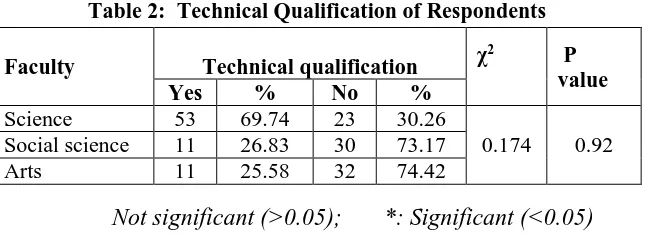
More number (69.74%) of research scholars in science faculty possessed technical qualification than
in social science (26.83%) and arts (25.58%) faculties. Responses are tabulated in table 2. There is no
statistically significant association between technical qualification of respondents and faculties. The null
hypothesis H1 is accepted.
Table 2: Technical Qualification of Respondents
Faculty Technical qualification χ
2 P
value
Yes % No %
Science 53 69.74 23 30.26
0.174 0.92 Social science 11 26.83 30 73.17
Arts 11 25.58 32 74.42
Not significant (>0.05); *: Significant (<0.05)
Association Between Gender and IT Skills
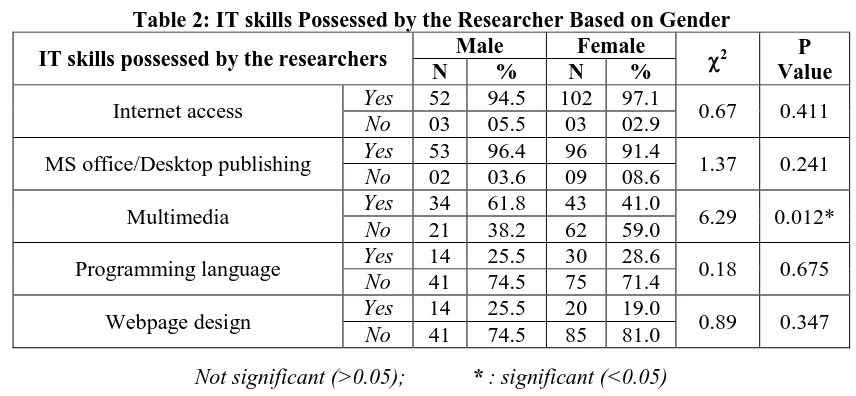
Table 2: IT skills Possessed by the Researcher Based on Gender
IT skills possessed by the researchers Male Female 2 P
Value
N % N %
Internet access Yes 52 94.5 102 97.1 0.67 0.411
No 03 05.5 03 02.9
MS office/Desktop publishing Yes 53 96.4 96 91.4 1.37 0.241
No 02 03.6 09 08.6
Multimedia Yes 34 61.8 43 41.0 6.29 0.012*
No 21 38.2 62 59.0
Programming language Yes 14 25.5 30 28.6 0.18 0.675
No 41 74.5 75 71.4
Webpage design Yes 14 25.5 20 19.0 0.89 0.347
No 41 74.5 85 81.0
Not significant (>0.05); * : significant (<0.05) IT Skills Possessed by the Respondents
Every science and social science researchers know how to access an internet, but it was comparatively low (about 86.05%) in arts. Majority of the science (96.05%) and social science researchers (95.12%) and 88.37% of the arts researchers possessed skill in MS office and desktop publishing. Responses are tabulated in the Table 3. From the table 3, it is clear that, the hypothesis H3 is not fully rejected.
Table 3: IT Skills Possessed by the Respondents
IT Skills
Faculty
χ2 df P
value Science Social
science Arts
N % N % N %
Internet access 76 100.0 41 100.00 37 86.05 16.962 2 0.00*
MS office & Desktop publishing 73 96.05 39 95.12 38 88.37 4.668 2 0.10
Multimedia 55 72.37 30 73.17 16 37.21 13.992 2 0.00*
Programming language 32 42.11 08 19.51 04 9.30 2.695 2 0.26
Web page design 20 26.32 09 21.95 05 11.63 3.557 2 0.17
Not significant (>0.05); *: significant (<0.05)
Familiarity with Digital/Computer Tools
Every science researchers were familiar with CD-Rom and pendrive, and majority of them were familiar with printer (97.37%), digital camera (93.42%), web camera (93.42%), e-book reader (93.42%), and DVD (93.42%). All the social science researchers were familiar with pendrive and majority of them were familiar with CD-Rom (95.12%) and printer (95.12%). All the arts researchers were familiar with pendrive and majority of them were familiar with CD-Rom (95.35%). Responses are tabulated in the Table 4. The Hypothesis H4 is not fully rejected.
Table 4: Familiarity with Digital/Computer Tools
Digital/Computer tool
Faculty
χ2 P
value Science Social science Arts
N % N % N %
CD-Rom 76 100.0 39 95.12 41 95.35 1.048 0.59
Pendrive 76 100.0 41 100.0 43 100.0
Floppy disc 70 92.11 33 80.49 27 62.79 3.604 0.17
Printer 74 97.37 39 95.12 38 88.37 7.835 0.02*
Scanner 68 89.47 38 92.68 39 90.70 1.087 0.58
Digital camera 71 93.42 35 85.37 32 74.42 12.174 0.00*
Web camera 71 93.42 35 85.37 37 86.05 0.228 0.89
E-book reader 71 93.42 32 78.05 27 62.79 2.368 0.31
DVD 71 93.42 37 90.24 33 76.74 3.862 0.15
Magnetic tape 39 51.32 21 51.22 12 27.91 6.942 0.03*
Familiarity with Web 2.0 Based Services
Most of the science researchers, (90.79%) were familiar with web 2.0 based services. It was about 78.05% in social science and 67.44% in arts. There is a significant association between the familiarity with the web 2.0 services and faculties. Thus the hypothesis H5 is accepted. The responses are tabulated in Table 5.
Table 5: Familiarity with Web 2.0 Based Services
Faculty Yes % χ2 P value
Science 69 90.79
10.197 0.01* Social Science 32 78.05
Arts 29 67.44
Devices Used for Internet Access by the Respondents
Most of the science (85.53%) and social science (95.12%) scholars used laptop for internet access, but smartphone (86.05%) in arts. Only a minority of science researchers (9.21%) used notebook and I-pad. Only 7.32% of social science researchers used I-pad, but no respondents used notebook. Laptop was used by 81.40% of the arts scholars,. Only 13.95% of the arts researchers used I-pad. There is no significant association between devices used for internet access and faculties. Thus the hypothesis H6 is not fully accepted. The responses are tabulated in Table 6.
Table 6: Devices Used for Internet Access by the Respondents
Devices used for internet access
Faculty
χ2 P value
Science Social science Arts
N % N % N %
Smartphone 52 68.42 29 70.73 37 86.05 5.174 0.08
Laptop 65 85.53 39 95.12 35 81.40 5.469 0.07
Desktop 60 78.95 27 65.85 30 69.77 2.661 0.26
Notebook 07 09.21 0 0 07 16.28 7.005 0.03*
I-Pad 07 09.21 03 07.32 06 13.95 1.127 0.57
Not significant (>0.05); *: Significant (<0.05)
Purpose of Using ICT Tools by the Respondents
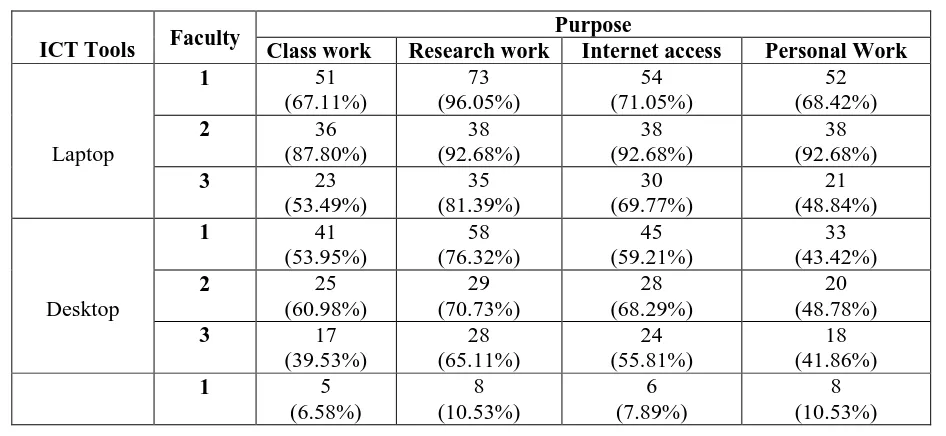
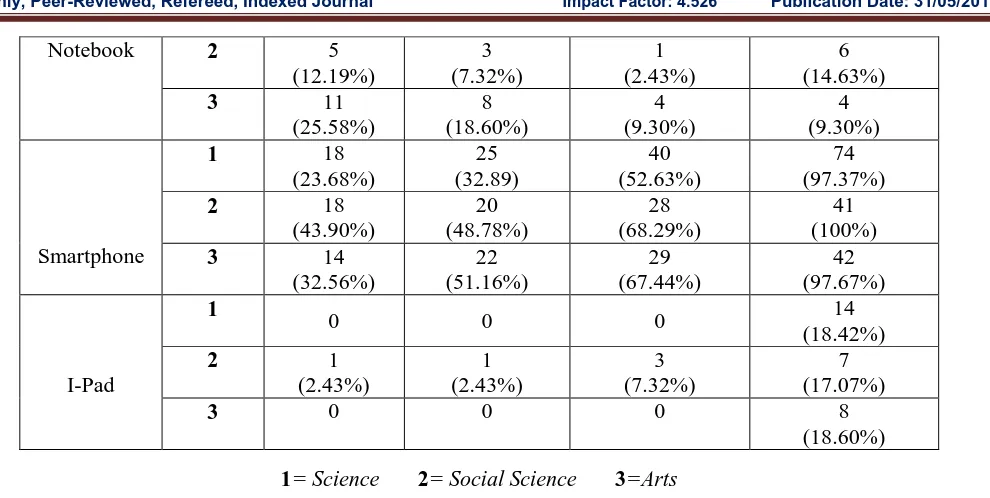
Majority of the science researchers used laptop for research work (96.05%) and smartphone for personal work (97.37%). All social science researchers and majority of the arts researchers used smartphone for personal work (97.67%). None of science and arts researchers used I-pad for class work, research work and internet access. More number of respondents in all faculties used desktop for research work after that internet access.
Table 7: Purpose of Using ICT Tools by the Respondents
ICT Tools Faculty
Purpose
Class work Research work Internet access Personal Work
Laptop
1 51
(67.11%) 73 (96.05%) 54 (71.05%) 52 (68.42%)
2 36
(87.80%) 38 (92.68%) 38 (92.68%) 38 (92.68%)
3 23
(53.49%) 35 (81.39%) 30 (69.77%) 21 (48.84%) Desktop
1 41
(53.95%) 58 (76.32%) 45 (59.21%) 33 (43.42%)
2 25
(60.98%) 29 (70.73%) 28 (68.29%) 20 (48.78%)
3 17
(39.53%) 28 (65.11%) 24 (55.81%) 18 (41.86%)
1 5
1= Science 2= Social Science 3=Arts
Opinion Regarding the Merits and Demerits of ICT Tools and Web-based Services
Opinion of researchers was sought regarding the merits and demerits of ICT tools. The responses are tabulated in the Table 7.1 and Table 7.2.
Opinion Regarding the Merits of ICT Tools and Web-based Services
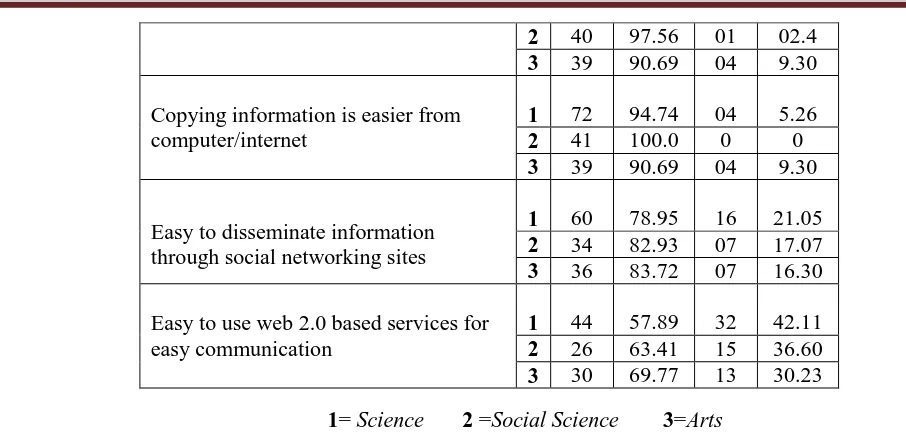
Every science and social science researchers and majority of the arts researchers (95.35%) informed that they used computer and internet for entertainment. All the social science and arts researchers and 89.47% of the science researchers agreed that current information is available on internet. All the arts researchers and majority of the science (98.68%) and social science (97.56%) researchers agreed that internet help in their research work. All the social science researchers, majority of the science researchers (94.74%) and 90.69% of the arts researchers agreed that copying information from internet is easier. Overall, only a minority of respondents disagreed with the almost all statements provided. Responses are tabulated in 7.1.
Table 7.1: Merits of ICT Tools and Web-based Services
Statements
Facult
y
Opinion
Agree Disagree
N % N %
I enjoy using computer & internet 1 76 100.0 0 0
2 41 100.0 0 0
3 41 95.35 02 4.65
Easy to carry my laptop anywhere 1 64 84.21 12 15.79 2 31 75.61 10 24.39 3 35 81.39 08 18.60
Current information is available on internet
1 68 89.47 08 10.53
2 41 100.0 0 0
3 43 100.0 0 0
Internet helps me in my research work 1 75 98.68 01 01.30 2 40 97.56 01 02.40
3 43 100.0 0 0
Information is available in short time
1 74 97.36 02 02.6
Notebook 2 5
(12.19%)
3 (7.32%)
1 (2.43%)
6 (14.63%)
3 11
(25.58%)
8 (18.60%)
4 (9.30%)
4 (9.30%)
Smartphone
1 18
(23.68%)
25 (32.89)
40 (52.63%)
74 (97.37%)
2 18
(43.90%)
20 (48.78%)
28 (68.29%)
41 (100%)
3 14
(32.56%)
22 (51.16%)
29 (67.44%)
42 (97.67%)
I-Pad
1
0 0 0 14
(18.42%)
2 1
(2.43%)
1 (2.43%)
3 (7.32%)
7 (17.07%)
3 0 0 0 8
2 40 97.56 01 02.4
3 39 90.69 04 9.30
Copying information is easier from computer/internet
1 72 94.74 04 5.26
2 41 100.0 0 0
3 39 90.69 04 9.30
Easy to disseminate information through social networking sites
1 60 78.95 16 21.05 2 34 82.93 07 17.07 3 36 83.72 07 16.30
Easy to use web 2.0 based services for easy communication
1 44 57.89 32 42.11 2 26 63.41 15 36.60 3 30 69.77 13 30.23
1= Science 2 =Social Science 3=Arts
Opinion Regarding the Demerits of ICT Tools and Web-based Services:
Opinions regarding demerits of ICT tools are shown in Table 7.2. Majority of the social science researchers (95.12%) informed that people lost their time due to chatting with their friends through social networking sites, but it was comparatively less in science (76.32%) and arts (60.46%). Majority of the arts (95.35%) and social science (95.12%) researchers agreed that studying long time on a computer screen is difficult, but it was comparatively less (76.31%) in science faculty. Most of the respondents in all categories agreed with almost all statements provided.
Table 7.2: Demerits of ICT Tools and Web-based Services
Statements
facul
ty Opinion
Agree Disagree
N % N %
I am not sure of quality of information available on internet
1 42 55.26 34 44.74 2 37 90.24 04 09.76 3 37 86.05 06 13.95
I like traditional system of learning 1 36 47.37 40 52.63 2 20 48.78 21 51.22 3 32 74.42 11 25.58
It is difficult to study for long time on computer screen/e-reader
1 58 76.31 18 23.68 2 39 95.12 02 04.87 3 41 95.35 02 04.65
Copyright violation is more in case of digital information
1 60 79.95 16 21.05 2 34 82.90 07 17.07 3 32 74.42 11 25.58
Students misuse computer and internet based services
1 59 77.63 17 22.37 2 36 87.80 05 12.19 3 32 74.42 11 25.58
Difficulty in finding relevant information due to information overload
1 41 53.95 35 46.05 2 30 73.17 11 26.83 3 25 58.14 18 41.86
People lost their time due to chatting with friends through social networking sites
2 39 95.12 02 04.88 3 26 60.46 17 39.53
1= Science 2 =Social Science 3=Arts
7. CONCLUSION:
This study aimed at finding the ICT skills of research scholars of University of Kerala. The study revealed that most of the science and social science researchers used laptop. Whereas arts scholars used smartphone. Majority of the science research scholars used laptop for research work and smartphone for personal work. All social science researchers and majority of the arts researchers used smartphone for personal work. Compared with other ICT tools, only a least number of respondents in all faculties used notebook and I-pad. Overall, it is found that, science scholars are more technically qualified than others. Also more respondents in the science faculty are familiar with the web 2.0 based services. It is suggested that universities as well as department libraries should use more ICT tools and techniques that are helpful for the scholarly research activities. Higher educational institutions and libraries should conduct regular training programmes, library orientation programmes, seminars and workshop for encouraging the use of ICT tools and techniques not only for the researchers, but also for the research guides.
REFERENCES:
1. Prytherch, R. (2005). Harrod’s librarians’ glossary and reference book: A directory of over 10,200 terms, organizations, projects and acronyms in the areas of information management, library science, publishing and
archive management (10th ed.). England: Ashgate Publishing, 352.
2. Bibina, C. B., & Kabir, S. H. (2018). Digital literacy among research scholars of social science and arts faculties in University of Kerala: A comparative study. KELPRO Bulletin, 22(1), 59-70.
3. Kumar, G. K. & Hulamani, C. B. (2018). ICT literacy among library professional colleges in Southern Karnataka: A survey. International Journal of Information Movement, 2(11), 26-34. Retrieved from http://www.ijim.in/
4. Pandey, Y. N. (2018). Impact of ICT on LIS professionals: A study of Mahatma Gandhi Kashi Vidyapith in Uttar Pradesh. International Journal of Research Culture Society, 2(11), 93-96.
5. Bibina, C. B., & Kabir, S. H. (2016). Understanding the factors related to digital literacy: A survey among science research scholars of University of Kerala. Journal of Knowledge & Communication Management, 6(2), 93-104.
6. Reddy, K. I. (2014). ICT skills of library professionals in the engineering college libraries of Warangal, Telangana: A study. International Journal of Library and Information Studies, 4(4), 131-141. Retrieved From http://www.ijlis.org/
7. Seena, S. T. & Pillai, K. G. S. (2014). A study of ICT skills among library professionals in the Kerala University library system. Annals of Library and Information Studies, 61(2), 132-141.