International Journal of Science Technology
Management and Research
Available online at: www.ijstmr.com
IJSTMR
©
2017 | All Rights Reserved 42Smart Eye
Yeole Akshay A.1
Department of Computer Engg., SNJB’s KBJ College of Engineering
Chandwad ,MH, India
Munot Sandesh P.3 Department of Computer Engg,
SNJB’s KBJ College of Engineering Chandwad,MH, India
Bhavsar Karan D.2 Department of Computer Engg,
SNJB’s KBJ College of Engineering Chandwad, MH, India
Mahale Yogesh P.4 Department of Computer Engg, SNJB’s KBJ College of Engineering
Chandwa,,MH, India
Mr. D. S. Rajnor5
Asst. Prof., Department of computer Engg. SNJB’s KBJ College of Engineering
Chandwad,MH,India
Abstract: In the current generation mobile play huge role in every ones life. Total smart phone using population is people who can see, we also make it useful for blind peoples by using features provided by Android Operating System. In today’s world 75platform for our application. In Application we are trying to increase the usability of mobile phones by making application for blind Object detection is a wide area of development. Detecting object using image processing can be used in multiple industrial as well as social applications. This project is proposing to use object detection for blind people and give them audio/ vocal information about it. We are detecting an object using the mobile camera and giving voice instructions about an object. We need to train the system first about object information. We are then doing feature extraction to search for objects in the camera view. And voice command is the best way of giving output to blind person. The reliability and accuracy of application is very high so that no misjudgment occurs in the application. So the quality of output in the prototype should not affected. Feature matching is at the base of many computer vision problems, such as object recognition or structure from motion. Current methods rely on costly descriptors for detection and matching. In this paper, we propose a very fast binary descriptor based on BRIEF, called ORB, which is rotation invariant and resistant to noise. We demonstrate through experiments how ORB is at two orders of magnitude faster than SIFT, while performing as well in many situations. The efficiency is tested on several real-world applications, including object detection and patch-tracking on a smart phone Keywords : Smartphone; Automated; Wi-Fi; E-menu; Android application; Intelligent; Ordering.
I. INTRODUCTION
IJSTMR
©
2017 | All Rights Reserved 43 obstacles. Sometimes it happens that blind people are lost and their gaurdians are in tension about them. There has been many efforts but now, it is not easy for the blind to move independently from one place to another. The world Health Organization estimate that there are 285 million visually impaired people worldwide, mainly in developing countries. Visually impaired persons are defined as those with reduced visual capacity. They can be blind or partially sighted people. These conditions often limit peopels capabilities to perform common task and affect their quality of life. In this system we are detecting an object using the mobile camera and giving voice instructions about the direction of an object. We need to train the system first about the object information. Then we are doing feature extraction to search objects in the camera view. We are taking help of angle where object is placed to give direction about the object. Smart eye will work as object recognition tool to inform objects in front of end user which are within 2 meters range. It belongs to working area, as we are working on particular environment so far now the scope remains restricted to department.Fig.1. Typical matching result using ORB on real-world images with viewpoint change. Green lines are valid matches; red circles indicate unmatched points.
FAST and Rotated BRIEF). Both these techniques are attractive because of their good performance and low cost. In this paper, we address several limitations of these techniques vis-a-vis SIFT, most notably the lack of rotational invariance in BRIEF. Our main contributions are:
• The addition of a fast and accurate orientation component to FAST. • The efficient computation of oriented BRIEF features.
• Analysis of variance and correlation of oriented BRIEF features.
• A learning method for de-correlating BRIEF features under rotational invariance, leading to better performance in nearest neighbor applications.
II. RELATED WORK
FAST and its variants [23, 24] are the method of choice for finding keypoints in real-time systems that match visual features, for example, Parallel Tracking and Mapping [13]. It is efficient and finds reasonable corner keypoints, although it must be augmented with pyramid 1 schemes for scale [14], and in our case, a Harris corner filter [11] to reject edges and provide a reasonable score. Many keypoint detectors include an orientation operator (SIFT and SURF are two prominent examples), but FAST does not. There are various ways to describe the orientation of a keypoint; many of these involve histograms of gradient computations, for example in SIFT [17] and the approximation by block patterns in SURF [2]. These methods are either computationally demanding, or in the case of SURF, yield poor approximations. The reference paper by Rosin [22] gives an analysis of various ways of measuring orientation of corners, and we borrow from his centroid technique. Unlike the orientation operator in SIFT, which can have multiple value on a single keypoint, the centroid operator gives a single dominant result.
Descriptors BRIEF [6] is a recent feature descriptor that uses simple binary tests between pixels in a smoothed image patch. Its performance is similar to SIFT in many respects, including robustness to lighting, blur, and perspective distortion. However, it is very sensitive to in-plane rotation. BRIEF grew out of research that uses binary tests to train a set of classification trees [4]. Once trained on a set of 500 or so typical keypoints, the trees can be used to return a signature for any arbitrary keypoint [5]. In a similar
IJSTMR
©
2017 | All Rights Reserved 44 use offline clustering to find exemplars that are uncorrelated and can be used in matching. These techniques might also be useful in finding uncorrelated binary tests. The closest system to ORB is [3], which proposes a multi scale Harris key point and oriented patch descriptor. This descriptor is used for image stitching, and shows good rotational and scale invariance. It is not as efficient to compute.III. LITERATURE SURVEY
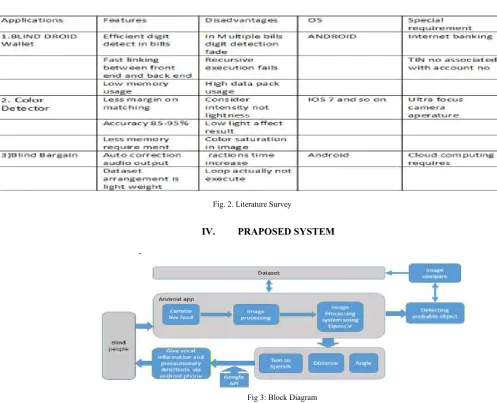
Blind and visually impaired people are at a disadvantage when they travel because they do not receive enough information about their location and orientation with respect to traffic and obstacles on the way and things that can easily be seen by people without visual disabilities. In this survey we mentioned main problem of blind people.
Fig. 2. Literature Survey
IV. PRAPOSED SYSTEM
Fig 3: Block Diagram
Each table in the restaurant will be accompanied with an android tablet or a Smartphone. The device will be loaded with an android supporting application containing food menu details at that restaurant. All the above mentioned digital components such as Smartphone/tablet (containing menu app), an another android phone (we used it for enabling hot-spot to tether the wireless network) and Wi-Fi module are connected wirelessly to create a Wi-Fi network. Some steps are mentioned here to understand the working of the system easily:
Flowchart for understanding the system operation.
Login: Credential details of the customer will be given to the system Selection of menu: Menu will be selected from the order list Wi_ module: Data transmission will be done by wi_ module
SOAP protocol: Simple Object Access Protocol is a messaging protocol that allows programs that run on disparate operating systems.
Generate bill: Automated paperless bill of given order will be generated.
IJSTMR
©
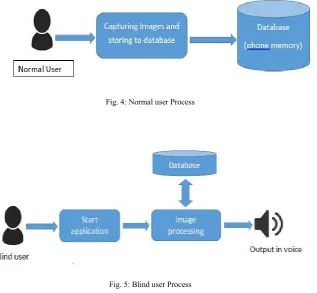
2017 | All Rights Reserved 45 which are coming in their path. So they can get obstacles are coming in their path but they can't get information about which obstacles are coming in their paths. To solve this problem we are building an application which can give obstacles information in voice or in speech to blind peoples. In our project we are using mobile camera, mobile memory i.e. phone memory. When blind people tap on start button this application start mobile camera for obstacles detection in live mode. In this project there are two processes:1. Normal user process: We are calling this process as normal user process because it is used by Normal user 2. Blind User: We are calling this process as blind user process because it is used by Blind user process.
Fig. 4: Normal user Process
Fig. 5: Blind user Process
In this process live camera images and stored images are comparing and if match found it will alert to blind user in voice format.
V. EXPERIMENTAL RESULTS
We evaluate the combination of oFAST and rBRIEF, which we call, ORB, using two datasets: images with synthetic in-plane rotation and added Gaussian noise, and a real-world dataset of textured planar images captured from different viewpoints. For each reference image, we compute the oFAST keypoints and rBRIEF features, targeting 500 keypoints per image. For each test image (synthetic rotation or real-world viewpoint change), we do the same, then perform correspondence brute-force matching to find the best.
a b
Fig. 5. (a)A subset of the binary tests generated by considering high-variance under orientation and (b) by running the learning algorithm to reduce correlation (right).
IJSTMR
©
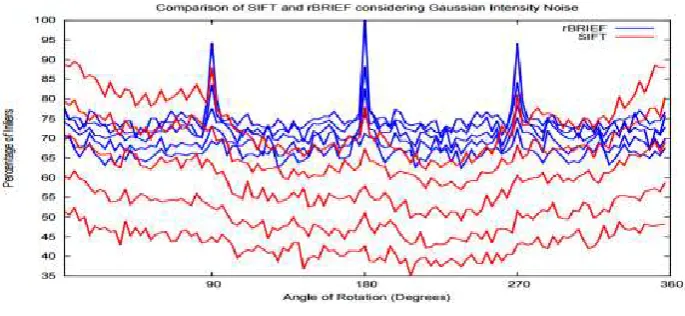
2017 | All Rights Reserved 46 Fig 6. Matching PerformanceFigure 6. Matching performance of SIFT, SURF, BRIEF with FAST, and ORB (oFAST +rBRIEF) under synthetic rotations with Gaussian noise of 10. The results are given in terms of the percentage of correct matches, against the angle of rotation. Figure 6. shows the results for the synthetic test set with added Gaussian noise of 10. Note that the standard BRIEF operator falls off dramatically after about 10 degrees. SIFT outperforms SURF, which shows quantization effects at 45- degree angles due to its Haar-wavelet composition. ORB has the best performance, with over 70% inliers. ORB is relatively immune to Gaussian image noise, unlike SIFT. If we plot the inlier performance vs. noise, SIFT exhibits a steady drop of 10% with each additional noise increment of 5. ORB also drops, but at a much lower rate (Figure 6). To test ORB on real-world images, we took two sets of images, one our own indoor set of highly-textured magazines on a table (Figure 7), the other an outdoor scene. The datasets have scale, viewpoint, and lighting changes.
Fig. 7. Matching behavior under noise
Fig. 7. Matching behavior under noise for SIFT and rBRIEF. The noise levels are 0, 5, 10, 15, 20, and 25. SIFT performance degrades rapidly, while rBRIEF is relatively unaffected.
CONCLUSION AND FUTURE WORK
IJSTMR
©
2017 | All Rights Reserved 47 REFERENCES1. M. Aly, P. Welinder, M. Munich, and P. Perona. Scaling object recognition: Benchmark of current state of the art techniques. In First IEEE Workshop on Emergent Issues in Large Amounts of Visual Data (WS-LAVD), IEEE International Conference on Computer Vision (ICCV), September 2009.
2. H. Bay, T. Tuytelaars, and L. Van Gool. Surf: Speeded up robust features. In European Conference on Computer Vision, May 2006.
3. M. Brown, S. Winder, and R. Szeliski. Multi-image matching using multi-scale oriented patches. In Computer Vision and Pattern Recognition, pages 510–517, 2005. 4. M. Calonder, V. Lepetit, and P. Fua. Keypoint signatures for fast learning and recognition. In European Conference on Computer Vision, 2008.
5 M. Calonder, V. Lepetit, K. Konolige, P. Mihelich, and P. Fua. High-speed keypoint description and matching using dense signatures. In Under review, 2009. 6 M. Calonder, V. Lepetit, C. Strecha, and P. Fua. Brief: Binary robust independent elementary features. In In European Conference on Computer Vision, 2010.
7. O. Chum and J. Matas. Matching with PROSAC – progressive sample consensus. In C. Schmid, S. Soatto, and C. Tomasi, editors, Proc. of Conference on Computer Vision and Pattern Recognition (CVPR), volume 1, pages 220–226, Los Alamitos, USA, June 2005. IEEE Computer Society.
8. M. Everingham. The PASCAL Visual Object Classes Challenge 2006 (VOC2006) Results. http://pascallin.ecs.soton.ac.uk/challenges/VOC/databases.html. 4
9. M. Everingham, L. Van Gool, C. K. I. Williams, J. Winn, nand A. Zisserman. The PASCAL Visual Object Classes Challenge 2009 (VOC2009) Results. http://www.pascalnetwork. org/challenges/VOC/voc2009/workshop/index.html. 6, 7
10. A. Gionis, P. Indyk, and R. Motwani. Similarity search in high dimensions via hashing. In M. P. Atkinson, M. E. Orlowska, P. Valduriez, S. B. Zdonik, andM. L. Brodie, editors, VLDB’99, Proceedings of 25th International Conference on Very Large Data Bases, September 7-10, 1999, Edinburgh, Scotland, UK, pages 518–529. Morgan Kaufmann, 1999. 6
11. C. Harris and M. Stephens. A combined corner and edge detector. In Alvey Vision Conference, pages 147–151, 1988. 2
12 Y. Ke and R. Sukthankar. Pca-sift: A more distinctive representation for local image descriptors. In Computer Vision and Pattern Recognition, pages 506–513, 2004. 13 G. Klein and D. Murray. Parallel tracking and mapping for small AR workspaces. In Proc. Sixth IEEE and ACM International Symposium on Mixed and Augmented
Reality (ISMAR’07), Nara, Japan, November 2007.
14 G. Klein and D. Murray. Improving the agility of keyframebased SLAM. In European Conference on Computer Vision, 2008.
15 G. Klein and D. Murray. Parallel tracking and mapping on a camera phone. In Proc. Eigth IEEE and ACM International Symposium on Mixed and Augmented Reality (ISMAR’09), Orlando, October 2009.
16. V. Lepetit, F.Moreno-Noguer, and P. Fua. EPnP: An accurate O(n) solution to the pnp problem. Int. J. Comput. Vision, 81:155–166, February 2009. 17. D. G. Lowe. Distinctive image features from scale-invariant keypoints. International Journal of Computer Vision, 60(2):91–110, 2004.
18 Q. Lv, W. Josephson, Z. Wang, M. Charikar, and K. Li. Multi-probe LSH: efficient indexing for high-dimensional similarity search. In Proceedings of the 33rd international conference on Very large data bases, VLDB ’07, pages 950– 961. VLDB Endowment, 2007.
19. M. Martinez, A. Collet, and S. S. Srinivasa. MOPED: A Scalable and low Latency Object Recognition and Pose Estimation System. In IEEE International Conference on Robotics and Automation. IEEE, 2010.
20. M. Muja and D. G. Lowe. Fast approximate nearest neighbors with automatic algorithm configuration. VISAPP, 2009. 21. D. Nist´er and H. Stew´enius. Scalable recognition with a vocabulary tree. In CVPR, 2006.
22. P. L. Rosin. Measuring corner properties. Computer Vision and Image Understanding, 73(2):291 – 307, 1999.
23.E. Rosten and T. Drummond. Machine learning for highspeed corner detection. In European Conference on Computer Vision, volume 1, 2006.
24. E. Rosten, R. Porter, and T. Drummond. Faster and better: A machine learning approach to corner detection. IEEE Trans. Pattern Analysis and Machine Intelligence, 32:105– 119, 2010.
25. S. Se, D. Lowe, and J. Little. Mobile robot localization and mapping with uncertainty using scale-invariant visual landmarks. International Journal of Robotic Research, 21:735– 758, August 2002.
26. S. N. Sinha, J. michael Frahm, M. Pollefeys, and Y. Genc. Gpu-based video feature tracking and matching. Technical report, In Workshop on Edge Computing Using New Commodity Architectures, 2006.
27. J. Sivic and A. Zisserman. Video google: A text retrieval approach to object matching in videos. International Conference on Computer Vision, page 1470, 2003. 28. N. Snavely, S. M. Seitz, and R. Szeliski. Skeletal sets for efficient structure from motion. In Proc. Computer Vision and Pattern Recognition, 2008.
29. G.Wang, Y. Zhang, and L. Fei-Fei. Using dependent regions for object categorization in a generative framework, 2006.