Available Online At www.ijpret.com
INTERNATIONAL JOURNAL OF PURE AND
APPLIED RESEARCH IN ENGINEERING AND
TECHNOLOGY
A PATH FOR HORIZING YOUR INNOVATIVE WORK
PREDICTION OF COMPRESSIVE STRENGTH OF CONCRETE USING
ACCELERATED CURING
N.L.SHELKE1, SANGEETA GADVE2
1. Research Scholar, Structural Engineering, Sardar Patel College of Engineering, Andheri (W), Mumbai-400 058
2. Faculty in Applied Mechanics, Visvesvaraya National Institute of Technology, Nagpur-440 010
Accepted Date:
27/02/2013
Publish Date:
01/04/2013
Keywords
Concrete,
Compressive Strength,
Accelerated Compressive Strength,
Ordinary Portland cement,
Curing
Corresponding Author Mr. N. L. Shelke
Abstract
The increase in strength with increased curing temperature is due to the speeding up of the chemical reactions of hydration. This increase affects only the early strengths without affecting ultimate strengths. Hence, curing of concrete and its gain of strength can be expedited by raising the temperature of curing, thereby reducing the curing period. This type of curing called accelerated curing. The proposed work is aimed at
Available Online At www.ijpret.com 1. Introduction
The increase in strength with increased
curing temperature is due to the speeding
up of the chemical reactions of hydration.
This increase affects only the early
strengths without affecting ultimate
strengths. Hence, curing of concrete and its
gain of strength can be expedited by raising
the temperature of curing, thereby
reducing the curing period. This type of
curing called accelerated curing has many
applications in the manufacturing of precast
concrete products. The method is typically
used for pre-cast concrete products called
accelerated curing. The various methods of
accelerated curing are Warm-water
method, Boiling-water method, Autoclave
curing, Steam curing, Electrical curing,
Microwave heating etc. [25].
As per normal curing procedures one has to
wait for 28 days to obtain the strength of
concrete. However under certain
conditions such as shortage of time,
weather conditions, on the spot changes in
project and expedition of construction it
becomes necessary to obtain early strength
rather than waiting for entire period of
curing which proves to be uneconomical.
The answer to this problem is to obtain the
actual strength of the concrete at earlier by
employing accelerated curing methods. The
proposed research focuses on effective
approach by using elevated temperature of
water for curing of concrete to obtain the
expected grade of concrete at earlier
stages.
2. Literature Review
The methods for earlier determination of
concrete strength with satisfactory
reliability had been researched for over 30
years [17]. After a dormant period of about
30 years, systematic efforts on the subject
were made in many research centers [35,
36].
M.V. Krishna Rao et al. (2010) has proved
the parameters of the study include the
curing period [1, 3, 7, 14 and 28 day], curing
method [conventional wet curing,
membrane forming compound curing and
accelerated curing] and the type of cement
[ (OPC) 43 grade, (PPC) 43 grade and (OPC)
43 grade +10% Silica Fume(SF) replacement
for cement[24]. I˙lker Bekir Topcu et al.
Available Online At www.ijpret.com accelerated curing temperature and fine
aggregate on early strength as well as the
relationships between early
strength-28days strength and strength maturity [12].
D.W.S. Ho et al. (2002) this paper explores
the potential benefits of steam-cured
concrete, particularly on mix incorporating
mineral admixtures [4].
M. Hulusi Ozkul (2001) Presented the
relation between 28-day strength of normal
cured concrete and accelerated strength is
investigated by using an ordinary Portland
cement and tars cement under two
different accelerated curing conditions,
warm water and boiling water [20]. Majid
Izzeddin Abdullah Almukhtar (2001)
investigated the development of the
compressive strength for concrete by using
different curing regimes. Accelerated curing
system within 28 hours can be estimate 28
day strength [19]. Thanakorn Pheeraphan et
al. (2001) investigated microwave energy
can accelerate the hydration of cement,
resulting in rapid strength development of
concrete in an early period [34]. M. Tokyay
(1999) investigated relationships between
standard compressive strength at 7, 28, and
90 days and early strength attained by (1)
autogenously curing, (2) warm water curing,
and (3) boiling water curing were obtained
and a regression expression to predict the
strength of concretes containing high-lime
and low-lime fly ashes as partial cement
replacement are proposed [22]. R. Musa
Resheidat et al. (1996) investigated
accelerated strength testing using the
boiling water method. Correlation between
the28-day compressive strength and the
corresponding accelerated strength was
established for prediction of concrete
strength at 28 days [23].
3. Materials and Methods
3.1 Materials used for Experimental Study
a) Cement
b) Aggregates
c) Water
3.2 Experimental Procedure
As per the IS10262:2009, mix designs were
prepared of M40 by using 53 Grade OPC.
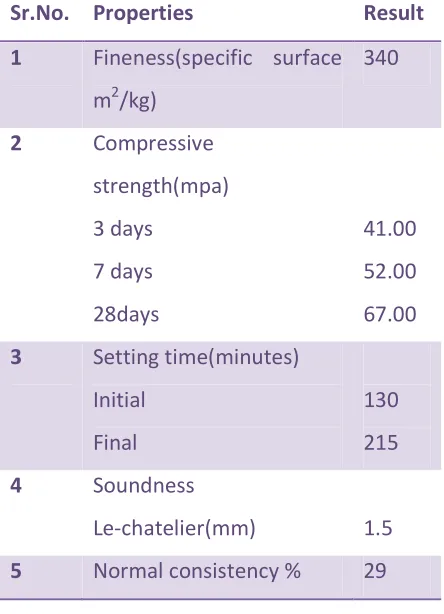
Various physical tests of cement and
properties of aggregates are given in Table1
Available Online At www.ijpret.com Table 1 Physical properties of cement
Sr.No. Properties Result
1 Fineness(specific surface
m2/kg)
340
2 Compressive
strength(mpa)
3 days
7 days
28days
41.00
52.00
67.00
3 Setting time(minutes)
Initial
Final
130
215
4 Soundness
Le-chatelier(mm) 1.5
5 Normal consistency % 29
Table 2 Properties of aggregates
Property Fine
aggregate
Coarse aggregate
M1 M2
Specific
gravity
2.79 2.81 2.82
Fineness
modulus
4.38 6.10 7.01
The experimental program includes testing
of a total 10 trials in which each trial 9 test
specimens were carried out i.e. 90 test
specimens of standard cubes of size
150×150×150mm cast and tested the three
parameters viz., age of curing (7,28 days
compressive strength and accelerated
compressive strength by boiling water
method as per IS 9013-2004).
The procedures of boiling water curing and
Normal water curing methods were
followed.
A) Boiling water curing: After the cube
specimens is prepared, they were left to
stand undisturbed in their moulds in place
free from vibration at a temperature of
27±20C for 23 hrs ±15 minutes from the
time addition of water to the ingredients.
The specimens shall then be gently lowered
into the curing tank and shall remain totally
immersed for a period of 3½ hrs ±5
minutes. The temperature of water in the
curing tank shall be at boiling (1000C) at sea
level. The temperature of water shall not
drop more than 30C after the specimens
were placed and shall return to boiling
within 15 minutes. After curing for 3½hrs ±5
minutes in the curing tank the specimen
Available Online At www.ijpret.com the moulds were cooled by immersing in
cooling tank at 27±20C for 2hr.
Then results were observed.
B) Normal (cooling) water curing: After the
cube specimens were prepared, they left to
stand undisturbed in their moulds in place
free from vibration at a temperature of
27±20C for 1 day from the time of addition
of water to the ingredients. Then remove
from the mould and specimens are lowered
into the curing tank and it is remain totally
immersed for a period of 7 & 28 days. Then
results were observed.
4. Result and Discussion
The results obtained from the experimental
investigations includes various parameters
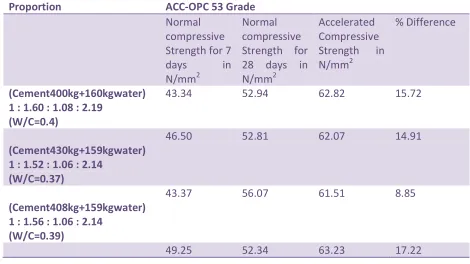
were carefully analyzed. Table 3 shows the
details of compressive strength for 7 &28
days compressive strength and Accelerated
Strength as per IS9013-2004. In case of
accelerated curing, the 28 days strength is
predicted based on equation: 28-days
compressive strength=1.64×(accelerated
concrete strength) + 8.09 Mpa.
Table 3 Trial Results for M40
Proportion ACC-OPC 53 Grade
Normal compressive Strength for 7
days in
N/mm2
Normal compressive Strength for 28 days in
N/mm2
Accelerated Compressive Strength in
N/mm2
% Difference
(Cement400kg+160kgwater) 1 : 1.60 : 1.08 : 2.19
(W/C=0.4)
43.34 52.94 62.82 15.72
(Cement430kg+159kgwater) 1 : 1.52 : 1.06 : 2.14
(W/C=0.37)
46.50 52.81 62.07 14.91
(Cement408kg+159kgwater) 1 : 1.56 : 1.06 : 2.14
(W/C=0.39)
43.37 56.07 61.51 8.85
Available Online At www.ijpret.com * Target strength for M40 =48.25 N/mm2
The percentage variation between the
normal compressive strength and the
accelerated strength one is found to be in
the range of -10.07% & +13.23% which
indicates the satisfactory agreement in the
results. In case of 02 trials, the accelerated
strength is found to underestimate the
actual strength by an average 10.07% and
for the remaining 08 trials overestimate
by13.23% on an average.
4 Conclusions
The results state that both strength i.e. the
normal compressive strength and
accelerated strength achieved the target
strength of M40.The compressive strength
obtained by using accelerated curing
method is higher than normal compressive
strength obtained by using accelerated
curing method is higher than normal
compressive strength.
(Cement450kg+162kgwater) 1 : 1.39 : 0.94: 1.89
(W/C=0.36)
(Cement402kg+157kgwater) 1 : 1.59 : 1.07 : 2.18
(W/C=0.39)
39.65 48.27 46.35 -4.14
(Cement421kg+160kgwater) 1 : 1.50 : 1.01 : 2.06
(W/C=0.38)
42.88 52.72 54.19 2.71
(Cement410kg+160kgwater) 1 : 1.55 : 1.05 : 2.12
(W/C=0.39)
40.47 54.44 46.93 -16.00
(Cement510kg+173.4kgwater) 1 : 1.77 : 0.71 : 1.066
(W/C=0.34)
43.51 50.85 58.16 12.56
(Cement 471kg+160kgwater) 1 : 1.32 : 1.07 : 1.59
(W/C=0.34)
44.31 50.56 66.13 23.54
(Cement 385kg+155kgwater) 1 : 1.68 : 115 : 2.3
(W/C=0.4)
39.00 48.54 54.18 10.40
Available Online At www.ijpret.com Acknowledgement
The authors thanks ACC Ltd. for providing
the 53 grade OPC and Dept of Structural
Engineering, Sardar Patel College of
Engineering, Mumbai for providing the
labortaor facilities
References
1. A.M. Neville, Properties of Concrete,
Halstead Press, New York, 1973
2. Baris, Ozer, M., Hulusi Ozkul,(2004) “The
influence of initial water curing on the
strength development ofordinary portland
and pozzolanic cement concretes.” Cement
and Concrete Research xx (2004) xxx–xxx.
3. Christopher, K.,Y., Leung, Thanakorn,
Pheeraphan,(1995) “Microwave curing of
Portland cement concrete:experimental
results and feasibility for practical
applications.”Construction and Building
Materials, Vol. 9, NO. 2, pp. 67-13, 199.
4. D.,W.,S., Ho, C.,W., Chua, C.,T.,
Tam,(2003) “ Steam-cured concrete
incorporating mineral admixtures” Cement
and Concrete Research 33 (2003) 595–601.
5. Emmanuel, Rozie`re, a., Ahmed, Loukili,
a., Franc, ois, Cussigh, b.,(2009) “A
performance based approach for durability of
concrete exposed to carbonation”
Construction and Building Materials 23
(2009) 190–199.
6. Ekin Altan, Sinan T. Erdog˘an(2011) “
Alkali activation of a slag at ambient and
elevated temperatures.” Cement & Concrete
Composites xxx (2011) xxx–xxx.
7. Fathollah, Sajedi, Hashim, Abdul
Razak,(2011) “Effects of curing regimes and
cement fineness on the compressive strength
of ordinary Portland cement mortars.”
Construction and Building Materials 25
(2011) 2036–2045.
8. Halit, YazVcV., Serdar., AydVn, Hqseyin.,
Yig˘iter., Bqlent Baradan,(2004) “Effect of
steam curing on class C high-volume fly ash
concrete mixtures.’’ Cement and Concrete
Research 35 (2005) 1122–1127.
9. Harun, Tanyildizi, Ahmet, Coskun,(2008) “
The effect of high temperature on
compressive strength and splitting tensile
Available Online At www.ijpret.com containing fly ash.” Construction and Building
Materials 22 (2008) 2269–2275.
10.Heba, A., Mohamed,(2011) “ Effect of fly
ash and silica fume on compressive strength
ofself-compacting concrete under different
curing conditions.”Ain Shams Engineering
Journal (2011) xxx, xxx–xxxg .
11.IS: 9013-1978 "Methods of Making,
Curing and Determining Compressive
strength of Accelerated-Cured Concrete Test
Specimens", Bureau of Indian Standards, New
Delhi
12.Ilker,Bekir,Topc,u., Mehmet, Ug˘ur
,Toprak,(2005) “Fine aggregate and curing
temperature effect on concrete
maturity.’’Cement and Concrete Research 35
(2005) 758– 762.
13.J., PayaÂ, J., MonzoÂ., M.,V., Borrachero,
E., Peris-Mora, F. ,Amahjour(1999) “
Mechanical treatment of fly ashesPart IV.
Strength development of ground fly
ash-cement mortars cured at different
temperatures’’ Cement and Concrete
Research 30 (2000) 543± 551.
14.Jin-Keun, Kima., Sang, Hun, Hanb., Seok,
Kyun, Parkc.,(2002) “ Effect of temperature
and aging on the mechanical properties of
concrete Part II. Prediction model.’’ Cement
and Concrete Research 32 (2002) 1095–
1100.
15.Ktftng Tan* and Odd E. Gjorv**
Performance Of Concrete Under Different
Curing Conditions.” Cement and Concrete
Research, Vol. 26, No. 3, pp. 355-361,1996.
16.Lker,Bekir,Topc,u., Mehmet, Ug˘ur,
Toprak,(2005) “ Fine aggregate and curing
temperature effect on concrete maturity.”
Cement and Concrete Research 35 (2005)
758– 762.
17.M.S. Gerend, Steam cured cylinders give
28-day concrete strength in 48 hours,
Engineering News Record 98 (1927) 282.
18.Maria, Kaszy,_nska,(2002) “ Early age
propertiesof high-strength/high-performance
concrete.” Cement & Concrete Composites
24 (2002) 253–261.
19.Majid, Izzeddin, Abdullah, Almukhtar,
(2001) “How can you estimate 28 day
compressive strength for concrete in 28
Available Online At www.ijpret.com 20.M., Hulusi,Ozkul.,(2001) “Efficiency of
accelerated curing in concrete.’’Cement and
Concrete Research 31 (2001) 1351–1357.
21.M., R., Resheidat, O., N.,
Madanat,(1996) “Accelerated strength and
testing of concrete in Jordan.”Materials and
Structures, 1992, 25, 79-83.
22 .M., Tokyay,(1999) “ Strength prediction
of fly ash concretes by accelerated testing.’’
Cement and Concrete Research 29 (1999)
1737–1741.
23 .Musa, R. ,Resheidat, and Mwafag,S.,
Ghanmat,(1996) “ Accelerated Strength and
Testing of Concrete Using Blended Cement.”
Advn Cem &as Mat1997;5:49-56.
24 .M.,V., Krishna, Rao,P.,Rathish, Kumar,
Azhar, M., Khan,(2010) “A study on the
influence of curing on the strength of a
standard grade concrete mix.” Facta
Universitatis Series: Architecture and Civil
Engineering Vol. 8, No 1, 2010, pp. 23 – 34.
25 .M. L. Gambhir, “Concrete Technology:
Theory and Practice”, Fourth edition, Tata
McGraw Hill Education Private Ltd, New
Delhi, India.
26 .M.S.Shetty, "Concrete Technology:
Theory and Practice", 23rd Revised edition,
S.Chand and Company, New Delhi, India.
27 .Neville. A.M., "Properties of Concrete",
4th Edition, Pitman Publishing Limited,
London 1997.
28 .Omer, Arioz,(2007) “ Effects of elevated
temperatures on properties of concrete.”
Fire Safety Journal 42 (2007) 516–522
29 .P., GarcCs, E., G.,Alcocel, S., Chinchbn, C.,
G.,Andreu, and J., Alcaidet, (1997) “ Effect of
curing temperature in some hydration
characteristics of calcium aluminate cement
compared with those of portland cement.”
cement andConcrete Research, vol 27. No 9.
Pp 1343-1355. 1997.
30 .Q., Yu, S.,Sugita, K.,Sawayama, and Y.,
Isojima,(1998) “ Effect of electron water
curing and electron charging Curing on
concrete strength.” Cement and Concrete
Research, Vol. 28, No. 9, pp. 1201–1208,
1998.
31 .Rafat, Siddique, Deepinder, Kaur,(2011) “
Properties of concrete containing ground
Available Online At www.ijpret.com elevated temperatures.” Journal of Advanced
Research (2011) xxx, xxx–xxx.
32 .Soroka, C.H.Jaegermann and A.Bentur,
"Short-term steam-curing and concrete
later-age strength", Materials and Structures,
Springer Netherlands, March, 1978, Vol.11,
No.2, pp.93-96.
33 .T.,BakharevJ.,G., SanjayanY.,-B.,
Cheng,(1999) “ Effect of elevated
temperature curing on properties of
alkali-activated slag concrete.”Cement and
Concrete Research 29 (1999) 1619–1625.
34 .Thanakorn, Pheeraphana.,
Lilik,Caylianib., Mario, I.,Dumangas ,Jr.,b,
Pichai, Nimityongskul,(2002) “Prediction of
later-age compressive strength of normal
concrete based on the accelerated strength
of concrete cured with microwave energy.”
Cement and Concrete Research 32 (2002)
521–527.
35 .V.M. Malhotra, Accelerated Strength
Testing of Concrete Specimens, Medical and
Technological Publishing Co. Ltd., London,
1973.
36.V. Ramakrishnan, Accelerated strength
testing—Annotated bibliography, ACI SP-56,
1978, p. 285.
37..Y., Maltaisand,J., Marchand,(1997)
“Influence of curing temperature on cement
hydration and mechanical strength
development of fly ash mortars.” Cement and
Concrete Resesmh, Vol. 27, No. 7,
pp.1009-1020,1997.
38..Y., N., Ghan, G., F., Peng, M.,
Anson,(1999) “ Residual strength and pore
structure of high-strength concrete and
normal strength concrete after exposure to
high temperatures.” Cement and Concrete