Available Online at www.ijpret.com 1857
INTERNATIONAL JOURNAL OF PURE AND
APPLIED RESEARCH IN ENGINEERING AND
TECHNOLOGY
A PATH FOR HORIZING YOUR INNOVATIVE WORK
PRIVACY PRESERVATION OF DATA AND FRAUD ENTRY DETECTION BY USING
USER FEEDBACK
MISS. PAYAL P. WASANKAR1, PROF. ARVIND S. KAPSE2
1. Student of M. E. Computer Science and Engineering, P. R. Patil Co E & T, Amravati. 2. Asst. Prof. Computer Science and Engineering, P. R. Patil Co E &T, Amravati.
Accepted Date: 05/03/2015; Published Date: 01/05/2015
Abstract: Privacy and security, particularly maintaining confidentiality of data, have become a challenging issue with advances in information and communication technology. The ability to communicate and share data has many benefits, and the idea of an omniscient data source carries great value to research and building accurate data analysis models. Here we preserve the privacy of data and detect the fraud user by using user feedback. On the basis of user feedback we can do this.
Keywords: Suspicious, Security, Trusted third party, Privacy, Feedback
Corresponding Author: MISS. PAYAL P. WASANKAR
Access Online On:
www.ijpret.com
How to Cite This Article:
Payal P. Wasankar, IJPRET, 2015; Volume 3 (9): 1857-1865
Available Online at www.ijpret.com 1858
INTRODUCTION
Maintaining the Privacy of information from unauthorized disclosure is a long standing concern of computer system design. Privacy is easy to accomplish with centralized solutions Many popular web services require users to sign away their privacy and ownership rights as a condition of service, sites often take advantage of this to collect, store, and share vast amounts of personal data about their users. Most users find this objectionable [1]. All the previous privacy preserving data analysis protocols assume that participating parties are truthful about their private input data. Recently, game theoretical techniques have been used to force parties to submit their true inputs. Assume that each party has an internal device that can verify whether they are telling the truth or not [2]. In our work, we do not assume the existence of such a device. Instead, we try to make sure that providing the true input is the best choice for a participating party and we detect that provided user input is true or false by using cooperative data validating strategy. And this model is the combination of both secure multiparty computation and non cooperative computation model [3][4].
1. PRIVACY PRESERVATION
Many privacy-preserving data analysis protocols have been designed using cryptographic techniques. Data are generally assumed to be either vertically or horizontally partitioned. In the case of horizontally partitioned data, different sites collect the same set of information about different entities. For example, different credit card companies may collect credit card transactions of different individuals. Privacy-preserving distributed protocols have been developed for horizontally partitioned data for building decision trees, [5], mining association rules, [6], and generate k-means clusters [7] and k-nn classifiers. Here we will try to overcome some of the limitation of existing system[8][9] and make one new model that will provide the security of data and also detect the fake data provided by participating party. And for that here we design two algorithms.
2.1 Privacy Preserving Algorithm
Step1: select avg-emp, turnover, profit, clients and purchase for the given start date and end date
Step2: go to each record and check the record which is of the selected company; make this as base company.
Available Online at www.ijpret.com 1859
2.2 Fraud or Suspicious Entry Detection Algorithm
Step1: User buy a product and gives feedback.
Step2: feedback is given in the form of positive and negative.
Step 3: feedback is treated as 0/1 based on negative or positive feedback.
Step 4: fetch all products with negative feedback (pn) and and all products with positive feedback (pp)
Step 5: get company ids for pp and pn
Step 6: add +1 for pp and
-1 for pn in score
Step 7: for each company
if sum>0
Positive
else
Negative
2.3 Working
Systems implementation is the construction of the new system and the delivery of that system into production. The development process has started with the definition of set of system requirements, main functionalities and the analysis of possible development approaches.
2.4 Modules
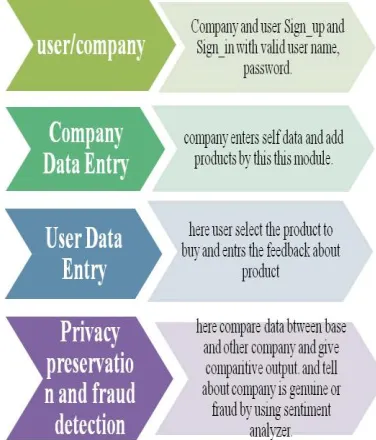
There are mainly two modules which are
Company sign-up/login
User sign-up/login
Available Online at www.ijpret.com 1860
Company sign-up or login Module:
Here company first sign-up or register with some basic information like, name, user name, password and other information. Once register he gets valid user name and password from next time he enter user name and password and login to the system.
User sign-up or login module:
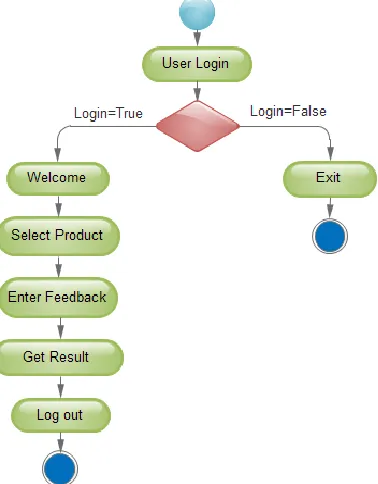
In this module, user first sign-up or register with some basic information like, name, user name, password and other information. Once register he gets valid user name and password from next time he enter user name and password and login to the system. After that user can buy the product. After this he must have to enter the feedback. And this feedback of user sends to the datum box sentiment analyzer. Here checking the positive or negative feedback. And on the basis of this score will be calculated and decided that company is genuine or fraud.
2.5 Flow of System
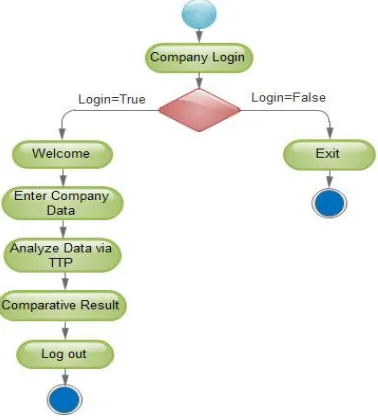
Activity diagrams are one of the five diagrams in the UML for modeling the dynamic aspects of systems. An activity diagram is essentially a flowchart, showing flow of control from activity to activity. Activity diagrams may stand alone to
Available Online at www.ijpret.com 1861 visualize, specify, construct, and document the dynamics of a society of objects, or they may be used to model the flow of control of an operation. Activity diagrams are graphical representations of workflows of stepwise activities and actions with support for choice, iteration and concurrency. In the Unified Modeling Language, activity diagrams can be used to describe the business and operational step-by-step workflows of components in a system. An activity diagram shows the overall flow of control. Activity diagram commonly contain
Activity States and action State
Transitions
Objects
Typical flowchart lacks in expressing concurrency clearly whereas with Activity diagram we can clearly depict the concurrency in the system flow.
Available Online at www.ijpret.com 1862
Figure 3 Activity Diagram for User Login
2. RESULT ANALYSIS
This section shows the performance analysis of the system and the result gathered from our designed system. The application is mainly design for the security of data and to avoid the fraud. This scheme provides a monitoring system for preserving the confidentiality of the data. Confidentiality is preserve through Trusted Third Party (TTP).
When misuse of data increase, our need is the ability to compute the desired beneficial outcome of data sharing for analyzing without having to actually share or disclose data. SMC protocol does not provide fully guarantee. Then by using cooperative strategy for fake entry detection and by using feedback we can preserve the privacy of data and detect the fraud company. And for that purpose we have two algorithms namely privacy preservation algorithm and Fraud or Suspicious Entry Detection Algorithm. In privacy preserving algorithm we got the comparative output. In that we consider one company as a base company and compare the data of base company with all other company data. And we will get the comparative output without disclosing actual data values.
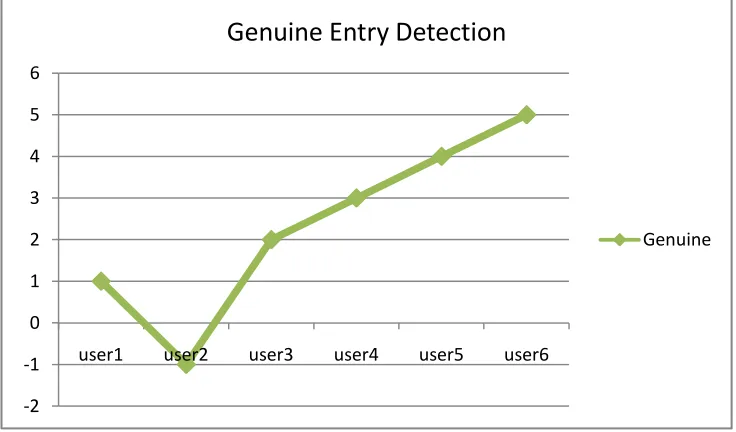
Available Online at www.ijpret.com 1863 the same time score of company is also calculated. and by using this strategy we calculated the positive and negative feedback and give the result in the form of fraud/suspicious or genuine company. For calculating the result adds +1 for positive feedback and -1 for negative feedback in the score. And if score is greater than zero then result is positive else negative.
Add +1 for positive and -1 for negative in score
For each company
If score >0
Positive
Else Negative
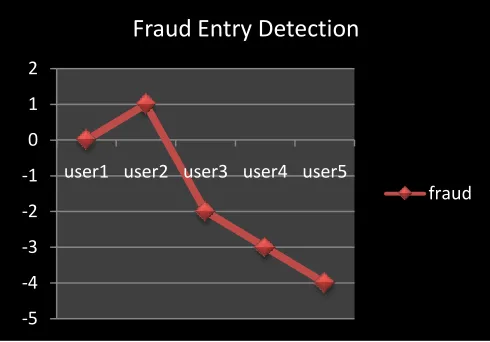
Now we will see by using graphs. Following are the graphs for genuine and fraud entry detection. In first graph there are two sides upper side is for positive feedback. And lower side is for negative feedback. When more positive feedback are present then company is detect genuine.
And in second graph more negative feedback are present then company is detect as fraud.
Figure 4 Genuine Company Detection Graph
-2 -1 0 1 2 3 4 5 6
user1 user2 user3 user4 user5 user6
Genuine Entry Detection
Available Online at www.ijpret.com 1864
Figure 5 Fraud Company Detection Graph.
3. CONCLUSION
The never ending processes of information security that is secure the information from unauthorized parties. Here we see the how information is secure by using different techniques. Even though privacy-preserving data analysis techniques guarantee that nothing other than the final result is disclosed, whether or not participating parties provide truthful input data cannot be verified. And here we also can detect the fraud company by using feedback of users.
Here we combine the SMC and NCC model and make one cooperative strategy for fake entry detection. By using that we can analyze that provided input is wrong or correct. And here we also preserve the privacy of data and user get the result without learning knowledge of data contents.
REFERENCE
1. J. Turow, J. King, C. J. Hoofnagle, A. Bleakley, and M. Hennessy. “Americans Reject Tailored Advertising and Three Activities That Enable It.” SSRN eLibrary, Sept. 2009.
2. Murat Kantarcioglu, Wei Jiang. “Incentive Compatible Privacy-Preserving Data Analysis.” IEEE TRANSACTIONS ON KNOWLEDGE AND DATA ENGINEERING VOL:25 NO:2 YEAR 2013.
3. Lindell Y. & Pinkas B.(2009). “Secure Multiparty Computation for Privacy-Preserving Data Mining.” Journal of Privacy and Confidentiality, Vol 1, No 1, pp.59-98.
4. Kargupta H., Das K.& Liu d K.(2007). “Multi-party, privacy-preserving distributed data mining using a game theoretic framework.” PKDD, Vol.4702, pp.523–531,Springer.
-5 -4 -3 -2 -1 0 1 2
user1 user2 user3 user4 user5
Fraud Entry Detection
Available Online at www.ijpret.com 1865 5. Jiang W., Clifton C. & Kantarcioglu M. (2008). “Transforming semi-honest protocols to ensure accountability.” Data and Knowledge Engineering, Vol.65, pp.57–74, ISSN 0169-023X.
6. Emekci F., Sahin O. D., Agrawal D. & Abbadi A. El. (2007).”Privacy preserving decision tree learning over multiple parties.” Data and Knowledge Engineering, Vol.63, No 2, pp.348–361, ISSN 0169-023X.
7. V. S., Elmagarmid A. K., Bertino E., Saygin Y. & Dasseni E.(2004b) . “Association Rule Hiding.” IEEE Transactions on Knowledge and Data Engineering, Vol 16, Issue 4, pp.434–447, ISSN 1041-4347.
8. R. M. Oliveira and Osmar R. Zaïane. (2004).”Toward standardization in privacy preserving data mining.” ACM SIGKDD 3rd Workshop on Data Mining Standards, pp. 7–17, Seattle, WA, USA.
9. Xinjing Ge and Jianming Zhu (2011). “Privacy Preserving Data Mining, New Fundamental Technologies in Data Mining.” ISBN: 978-953-307-547-1.