ISSN : 2581-7175 ©IJSRED: All Rights are Reserved Page 706
Web Information Seeking Behaviour of Academic
Staff: in case of Assosa University
Genene Abera
1(Assistance Professor)
Abstract:
The purpose of this study is to investigate the web information seeking behavior of Academic Staff Students of Assosa University. To do so, cross-sectional descriptive survey were employed using both quantitative and qualitative approaches. A total of 174 Academic Staff participated in the study. Data were collected using survey questionnaires and semi-structured interview. The data generated through survey questionnaire were analyzed using frequency, percentages, Mean, Chi-square test and independent t-test. The data generated via open ended questions and semi-structured interview were analyzed narrative description. Results showed that even though Most of Academic Staff information need is based on print and electronic sources, majority of them 136(63%) use internet on daily basis. The results show that most Academic Staff seek web information for the purpose of doing class assignment 159(90.2%) and conducting research 124(71.2%), Moreover the findings suggested that Google search engine is the most consulted web channel for academic purpose; however websites and social media also frequently used web channel by and Academic Staff. Most of the respondents are dissatisfied with slow internet connection and lack of information literacy training due to limited internet bandwidth. Moreover, a number of challenges were identified, dominant among them being speed of internet connection, lack of training and information overload. The result of the Chi-square test revealed that there is a statistically significance difference between male and female counterparts in terms of frequency usage of web channel, purpose to use web channel for academic activity. The study recommends comprehensive information literacy program, proper marketing about the importance of scholarly databases and OPAC. Equally, improving technical and physical infrastructures is essential to enable effective utilization of web for Academic Staff.Keywords: information seeking and Web information seeking behaviour
1. INTRODUCTION
1.1 Background of the Study
Information Seeking (IS) has been an important human activity since the evolution. Human seek information to gather, store, interpret and use for various purposes (Afzal, 2009). Information is important to increase the awareness, to change the current state of knowledge, to change attitude, and to solve a problem, and to help for decision making process. They found that a more comprehensive picture of web information seeking has only recently started to emerge through empirical studies that recognise the importance of analysing fundamental differences of users. The study also revealed that 'information seeking'- as opposed to information searching because it
ISSN : 2581-7175 ©IJSRED: All Rights are Reserved Page 707 involves examination of characteristics and differences that relate to users as information seekers rather than simply to the exploration of the information searching activity. However, comprehensive studies of web information seeking are still limited, many of the approaches followed are problematic and a consistent methodological framework vis-à-vis the peculiarities of the web and its users has not yet been developed. The participation in seeking web information is generally poor among the developing countries. The explosion of the internet and the web is a reality some developing nations have not yet fully grasped. However, this is at varying levels; some nations are better positioned than others (Francis, 2008). The papers mostly focused on health information seeking behaviours (Mulusew, 2012). Therefore, study to some extent fill the literature gap related to web information seeking behaviour.
1.2. Statement of Problem
Today, the online web-based resources are one of the main sources of information for Academic Staff which is why web searching has become one of the most active information access tasks in higher education. Kellar and Shepherd`s (2006) declare that although a large body of theoretical research conducted on information seeking behavior in both electronic and non-electronic environments exists, information seeking on the web is a ‘newer’ branch of research that differs from library-based information seeking in the complexity of the resources and the tools used. Web information is a vital resources needed by Academic Staff Students to perform well in their academic pursuit. Academic Staff in Assosa University use the web more hours in the quest of information. However the web information need, channel of web information sought, the purpose of seeking web information, level of satisfaction and problem encountered during web information seeking is unknown.
1.3. Objective of the Study 1.3.1. General Objective
The overall objective of the study is to investigate the web information seeking behavior of the Academic Staffof Assosa University.
1.3.2. Specific Objectives
ISSN : 2581-7175 ©IJSRED: All Rights are Reserved Page 708 To examine whether there is a significant gender difference in the web information seeking behaviour among Academic Staff.
1.4. Scope and Limitations of the Study
The study focused on investigating the web information seeking behaviour Academic Staff of Assosa University. Since the university environment is a diverse group comprising different Academic, management staff & Students and its expensive and time consuming, the study was not including the others staff in the University.
1.5. Conceptual frame work
The conceptual framework mainly derives from the above literature review. The researcher also tries to adapt a general model of information use (Deltor, 2003). The overall process is shown briefly by the following diagram. The conceptual framework shows the relationship among needs, seeking and use of web information seeking. It comprises multivariable independent and
ISSN : 2581-7175 ©IJSRED: All Rights are Reserved Page 709 variables are web information need, web information seeking behaviour, web information use and level of satisfaction.
2. Research Methodology
2.1. Descriptions of the Study Area
Assosa University is located 675 km north west of Addis Ababa at Assosa town which is the capital city of
Benishangul Gumuz Regional State. The University started its function with five faculties and seventeen
departments by admitting the first batch of 1043, regular students which are assigned to these five Faculties.
Namely: - Engineering and Technology, Natural and Computational Sciences, Agriculture and Natural
Resource, Business and Economics, and Social Sciences and Humanity faculties. In 2017/18 Academic
year, the University continued its teaching learning process with7colleges, 3 schools and 36 departments
(ASU Website, 2016).
2.2. Research Design
The methodology employed by the researcher is a cross sectional study design using quantitative and qualitative approaches to achieve the research objectives. In other words, the study employed mixed research methodology. This complementary method of investigation was used to acquire greater insight and more clear and complete picture of the Academic Staff of the Assosa University on web information seeking behaviour.
2.3. Population of the study
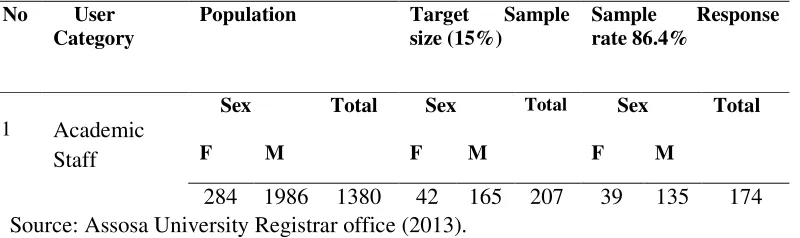
The population of the study will be Academic staff of Assosa University. The target population was 1380 (ASU Registrar Office, 2013).
2.4. Sampling Methods
ISSN : 2581-7175 ©IJSRED: All Rights are Reserved Page 710 on proportional stratified random sampling technique ( y x 15/100= 15%) Y= sub group population.
Table 1: User Categories, Population and Samples of the Study
No User Category
Population Target Sample
size (15%)
Sample Response
rate 86.4%
1 Academic Staff
Sex Total Sex Total Sex Total
F M F M F M
284 1986 1380 42 165 207 39 135 174 Source: Assosa University Registrar office (2013).
2.5. Data Collection
In order to collect the required data for the study, the following three types of data collection tools were used: observations, questionnaires and interviews.
2.6. Data Analysis
The collected quantitative data was processed using SPSS software version 21.0; in that, descriptive statistics was used to put the result in the form of tables. Qualitative data was collected and the result of the finding of qualitative data was displayed in the form of narrations, explanations, concepts, and opinions. The presentation was made using frequency table, percent and mean were used to describe among information seeking behaviour Academic Staff. Significance differences were assessed with Pearson chi-square test, Chi-square and T-test.
3. Result and Discussion
The respondents were from Academic Staff 174 (81.6%). Of the 174 Academic Staff, 39(19.8%) were female and 135 (80.2%) male.
3.1. Preference of Information Source
Table 3: Preference of Information Sources
Information source respondents category
Academic Staff
printed Count 17
ISSN : 2581-7175 ©IJSRED: All Rights are Reserved Page 2
electronic Count 37
% 17.1
Both Count 120
% 55.6%
Count 174
% 80.6
% represents percentage
The majority of students 120(55.6%) preferred both print and electronic sources of information to meet their academic information need. However, most of the respondents relied on electronic information sources because of its convenience, accessibility and source of versatile information.
3.2. Method of Internet Access
Table 4:Method of Internet Access
respondents category
Method of internet access Frequency Percent Chi-square Test
df Ρ
Academic Staff
wired office terminal 1 .6
wired comp lab 73 42.0
wireless comp lab 26 14.9
wired comp lab & wireless comp 69 39.7 wired comp and wireless comp
and wireless home 5 2.9
Sub Total 174 100.0
To meet the web information need, large number of students (95%) use ASU’s wired and wireless internet connection computer labs to access different sources of information. The Chi-square test has proved that there is statistically significant [
χ
2=194.828.df=5 ρ =0.000] difference between those who preferred Internet access through wireless and wired terminal to meet academic information need.3.3. Extent of agreement for availability of adequate information on the web
Table 5: Extent of Agreement to the Adequacy of Web Channel
Web Channel
Strongly
Agree Agree Neutral Disagree
Strongly Disagree
ISSN : 2581-7175 ©IJSRED: All Rights are Reserved Page 711 Search Engine 123 56.9 84 38.9 6 2.8 2 0.9 1 0.5 Websites 53 24.5 102 47.2 46 21.3 13 6 2 0.9 Electronic mail
and social network
61 28.2 90 41.7 48 22.2 12 5.6 5 2.3
Library Online Catalogue (OPAC)
58 26.9 74 34.3 63 29.2 18 8.3 3 1.4
Online Scholarly Database
35 16.2 84 38.9 77 35.6 14 6.5 6 2.8
` F = Frequency, %= Percentage
On the issues of adequate information found from web channel to meet their information need, it was found out that the vast majority of the respondents 123(56.9%) strongly agreed that adequate information can be found from search engine particularly Google. OPAC and scholarly database were the least ranked web channel in terms of adequate information for academic purpose. The Chi-square result showed that there is statistically significant difference between the level of agreement with regard to adequacy in using search engine, website to meet their information need [
χ
2=298.491, df= 4. ρ = 0.000] , [χ
2=142.843, d f= 4. ρ = 0.000] respectively. It was therefore found that the majority Undergraduate Students strongly agree with the idea that adequate information is obtained from search engines mainly Google and websites.In relation to this Nkomo (2009) found that both students mostly rely on search engine, websites and email respectively.3.4. Frequency of Internet Usage
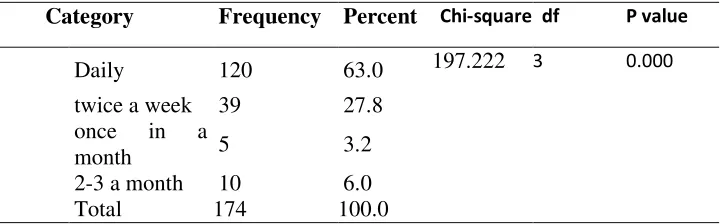
Table 6: Frequency of Internet Usage
Category Frequency Percent Chi-square df P value
Daily 120 63.0 197.222 3 0.000 twice a week 39 27.8
once in a
month 5 3.2
2-3 a month 10 6.0
Total 174 100.0
ISSN : 2581-7175 ©IJSRED: All Rights are Reserved Page 712 statistical significance difference on frequency of usage internet among Undergraduate Students [
χ
2= 197.222, df=3, ρ =0.000]. The result revealed that the majority of Undergraduate Students use internet on daily biases. This result confirms the works of (Milkyas, 2012; Nekom, 2009) who found that large number of faculties and students use internet several times a day. Furthermore, almost all interviewees replied that it is easy to use, easily accessible at remote with no human intervention and can found relevant information based on their need.3.5. Purpose to Seek Web Information and Frequency of Use by Undergraduate students
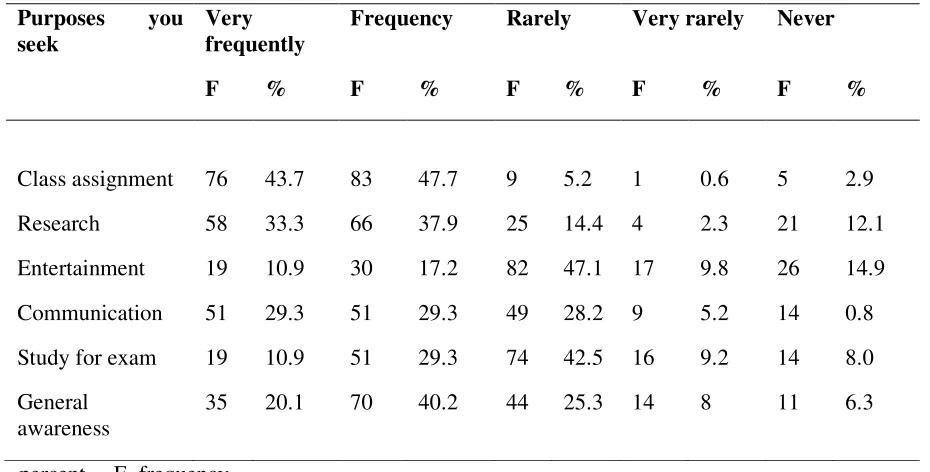
Table 7: Purpose to Seek and Frequency of Use by Undergraduate Students Purposes you
seek
Very frequently
Frequency Rarely Very rarely Never
F % F % F % F % F %
Class assignment 76 43.7 83 47.7 9 5.2 1 0.6 5 2.9 Research 58 33.3 66 37.9 25 14.4 4 2.3 21 12.1 Entertainment 19 10.9 30 17.2 82 47.1 17 9.8 26 14.9 Communication 51 29.3 51 29.3 49 28.2 9 5.2 14 0.8 Study for exam 19 10.9 51 29.3 74 42.5 16 9.2 14 8.0 General
awareness
35 20.1 70 40.2 44 25.3 14 8 11 6.3
%= percent F=frequency
The majority of postgraduate students seek web information frequently for the purpose of doing class assignment 76(43.7%) Communication51 (29.3%) and conducting research 58 (33.3%). The results confirms with the study conducted in South Africa Nkomo et al. (2010) , which reveals that Most of the time students information seeking behaviour involves the need to complete course assignments, prepare for class discussions, seminars, and research.
3.6. Frequency Usage of Web Channel
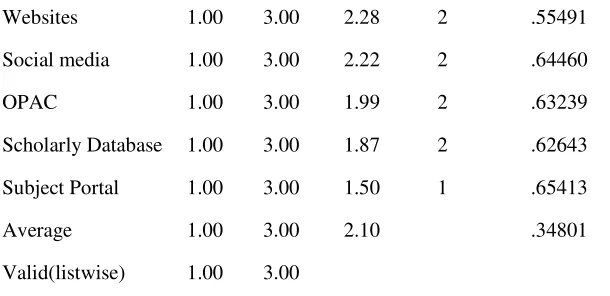
Table 8: Frequency Usage of Web Channel
Web Channel Min Max Mean Mode Std.
Deviation
ISSN : 2581-7175 ©IJSRED: All Rights are Reserved Page 713
Websites 1.00 3.00 2.28 2 .55491
Social media 1.00 3.00 2.22 2 .64460
OPAC 1.00 3.00 1.99 2 .63239
Scholarly Database 1.00 3.00 1.87 2 .62643
Subject Portal 1.00 3.00 1.50 1 .65413
Average 1.00 3.00 2.10 .34801
Valid(listwise) 1.00 3.00
The study showed that Search engine, Websites, and social media were the most frequently used web channel in order. The least frequently used web channel by the respondents was OPAC, Scholarly database and Subject portal. The findings indicated that search engine is the most frequently used web channel. In contrast OPAC, scholarly database and subject portal less frequently used where their Mean value is less than the average (Mean= 2.10) value. The finding is also in agreement with Nkomo (2009) found that student mostly rely on search engine, websites and email.
3.7. Skill of Web Usage
Table 9: Web information usage skill
Respondent N F/ % Very
good
Good Average Poor Very
poor
Undergraduate Students
174 F 35 74 52 10 3
% 20.1 42.5 29.9 5.1 1.7
ISSN : 2581-7175 ©IJSRED: All Rights are Reserved Page 714 3.8. Information Literacy Training
Table 10: Information Literacy Training
respondents category
Frequency Percent
Undergraduate
yes 86 49.4
no 88 50.6
Total 174 100.0
Only more than half of 88 (50.6%) Undergraduate Students didn’t take training on how to use web information channels. Thus, this suggests that majority of Undergraduate Students 84(49.4%) took information literacy training. The researcher as university library staff knows that the library and information centre provides information literacy training every year for new comers (1st year students). As indicated by Adeogun (2006) the purpose of information literacy (IL) education is to help students develop critical thinking and analytical skills which they will need for transforming information into knowledge.
3.9. Usefulness of Information Literacy Training
Figure 3: Usefulness of Information Literacy Training
0.00% 10.00% 20.00% 30.00% 40.00% 50.00%
Very useful useful
useful
to some extent useful
Figure 3 indicated that, Undergraduate Students who confirmed that training has been very useful were (44.2%), useful (44.2%) and to some extent useful (11.6%). Only less than half of the respondents took training on how to use web information channels. Majority of the respondent reported that training has been useful regardless of level of usefulness. Therefore, majority of the respondents found that the training offered by the library was useful, it does not mean that they are complete and satisfied by the information literacy training
3.10. Web information for academic and research work
ISSN : 2581-7175 ©IJSRED: All Rights are Reserved Page 715
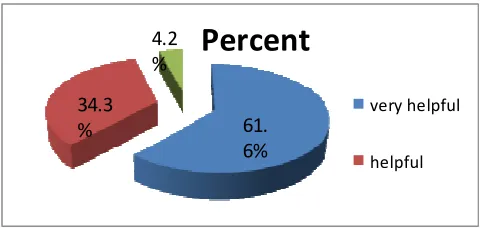
Percent
very helpful
helpful 61.
6% 34.3
%
4.2 %
The study shows majority of undergradaute students considered web infromation were helpful for academic and resarch purpose. The findings of the study was consistent with Nokom (2009) and Milkyas (2012) who noted that most of instructors access internet for searching and retrieved information which is helpful for research. Thus, the intervention of Assosa University library and information technology centre will play pivotal role to build appropriate network infrastructure, subscribe relevant online electronic resources and proper marketing/education to facilitate learning-teaching and research activities of the university.
3.11. Web Information Use Satisfaction
Table 11: Web Information Use Satisfaction
Level of satisfaction
V.S S Neutral DS V.D
F % F % F % F % F %
Information
literacy/ICT training
13 6 41 19 57 26.4 94 43.5 11 5.1
Speed of internet connection
26 12 44 20.4 58 26.9 74 34.3 14 6.5
Resolve problem and meet needs
25 11.6 70 32.4 81 37.5 35 16.2 5 2.3
Use and relevance of online scholarly
25 11.6 71 32.9 73 33.8 37 17.1 10 4.6
User interface are easy to use
21 9.7 66 30.6 89 41.2 29 13.4 11 5.1
Online public access catalogue
11 5.1 36 17.6 106 49.1 55 25.5 6 2.8
ISSN : 2581-7175 ©IJSRED: All Rights are Reserved Page 716 71(33%) satisfied with the relevance of online scholarly database and web information resolve their problem.
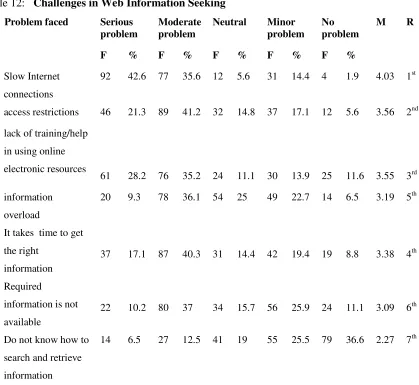
3.12. Challenges in Web Information Seeking Behaviour
Table 12: Challenges in Web Information Seeking
Problem faced Serious
problem
Moderate problem
Neutral Minor
problem No problem
M R
F % F % F % F % F %
Slow Internet
connections
92 42.6 77 35.6 12 5.6 31 14.4 4 1.9 4.03 1st
access restrictions 46 21.3 89 41.2 32 14.8 37 17.1 12 5.6 3.56 2nd
lack of training/help
in using online
electronic resources
61 28.2 76 35.2 24 11.1 30 13.9 25 11.6 3.55 3rd
information
overload
20 9.3 78 36.1 54 25 49 22.7 14 6.5 3.19 5th
It takes time to get
the right
information
37 17.1 87 40.3 31 14.4 42 19.4 19 8.8 3.38 4th
Required
information is not
available
22 10.2 80 37 34 15.7 56 25.9 24 11.1 3.09 6th
Do not know how to
search and retrieve
information
14 6.5 27 12.5 41 19 55 25.5 79 36.6 2.27 7th
NB: F=frequency M= Mean R=Rank
ISSN : 2581-7175 ©IJSRED: All Rights are Reserved Page 717 3.13. Comparison of sex difference with respect to web information seeking behaviour of
Academic staff’s
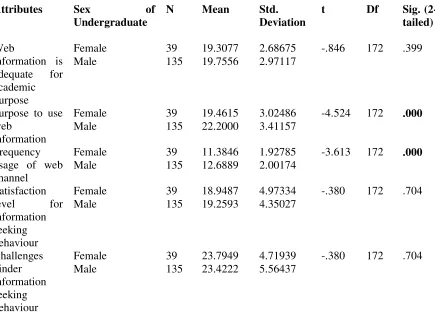
Table 13
15: Gender Difference Web Information Seeking Behaviour for Undergraduate Students
Attributes Sex of
Undergraduate
N Mean Std.
Deviation
t Df Sig.
(2-tailed)
Web
information is adequate for academic purpose
Female 39 19.3077 2.68675 -.846 172 .399
Male 135 19.7556 2.97117
purpose to use web
information
Female 39 19.4615 3.02486 -4.524 172 .000
Male 135 22.2000 3.41157
Frequency usage of web channel
Female 39 11.3846 1.92785 -3.613 172 .000
Male 135 12.6889 2.00174
Satisfaction level for information seeking behaviour
Female 39 18.9487 4.97334 -.380 172 .704
Male 135 19.2593 4.35027
Challenges hinder information seeking behaviour
Female 39 23.7949 4.71939 -.380 172 .704
Male 135 23.4222 5.56437
NB= * Significant at alpha 0.05 level
The researcher has been tested if there is any significance difference between male and female with respect to different attributes of web information seeking activity by using independent T-test. The researcher conclude that there is a statistical significance difference between male and female academic staff respondents [t(40)=2.115, ρ=.041]. Showing that female are strongly agree with adequate information can be found from the web channel (Mean=21.13) than their male counterpart (Mean = 19.18). The finding was consistent with Steinerova and Susol (2007) indicated that men tend to be more satisfied with the result of information seeking.
ISSN : 2581-7175 ©IJSRED: All Rights are Reserved Page 718 Most of Academic staff information need is based on hybrid (print and electronic) sources of information that mainly focused on web based information sources. This effect might be ascribed to ease of electronic resources, accessibility and continuity of service.The main purpose of using web information by Academic staff is for communication and research than teaching and general awareness purpose. Similarly, the main purpose of using web information by Academic staff is for class assignment and research than communication and entertainment. Thus, web information seeking behaviour of Academic staff mostly relied on academic purpose and self-development.
The most visited web in terms relevance and frequency of usage among web channels according to their orders were: - Search engines, Websites, Social media, OPAC and Scholarly database.Most of Academic staff dissatisfied with slow internet connection, lack of information literacy training and use of OPAC. The majority of Academic staff’s (38%) who might be unsure of their opinion about relevance of scholarly database could be in indication of lack of awareness about its importance for academic purpose.
As evidenced by the t-test, a statistical significant differences was observed between genders Academic staff [t (172)=-3.613, ρ=.000], showing that males frequently used web channel (M=12.68)
than their female counterpart respondents (M= 11.3846). Similarly a statistical significant differences was observed between genders of Academic staff [t(40)=2.115, ρ=.041], showing that female are strongly agree with adequate information can be found from the web channel (Mean=21.13) than their male counterpart (Mean = 19.18). Moreover, there are challenges affecting effective web information seeking were revealed by Academic staff. Key among them was slow internet connection, access restriction, lack of training and information overload.
5.
Recommendation
ISSN : 2581-7175 ©IJSRED: All Rights are Reserved Page 719 There is a need to organize user-workshops in educating and training regarding the various web information sources available that includes PERI scholarly databases, OPAC and other relevant open source that would helpful for academic purpose.
Information literacy needs should get special attention by the Assosa University top management to ensure lifelong learning .Therefore; the information literacy program should be incorporate in the university curriculum. More information about all the various web information channels should be provided, about those that remained unpopular (e.g. scholarly databases and OPAC). The study proved that most of Undergraduate Students were untrained and did not properly used university subscribed scholarly databases for teaching and research purpose. Therefore, there should be more workshops on INASP online scholarly databases and other open sources for Academic staff at regular intervals.
The University librarians and institutes should develop information marketing strategy to create awareness among Academic staff on the available online scholarly databases and other useful electronic resources.
6. REFERENCES
Afzal, Waseem, 2009. Web for information seeking: a propositional study. School of Library and Information Management.45(2): (http://www.academic.emporia.edu.)Accessed on July 07, 2013. Deltor, Brain.2003. Internet-based information system use in organizations; an information studies
perspective.Information System Journal.13:113-132.
Francis,H.2008. The Information Seeking Behaviour of Social Science Faculty at University of West Indies. Journal of Academic Librarianship, 31(1),67-72.
Kellar, M.Watters. and Shepherd, M. 2006. Field study characterizing web- based Information seeking tasks. (http://www.cs.dal.ca/research/techreports.) Accessed on October 12, 2013.
Kothari, C.R. 2004. Research methodology: Methods and Technique. 2004. 2nd Edition. New Delhi, India: New Age International Limited Publisher.
ISSN : 2581-7175 ©IJSRED: All Rights are Reserved Page 720
Milkyas Hailu 2012. Internet usage behaviour among agricultural faculties of Harmaya University
(MSc Thesis). Haramaya University, Harmaya, Ethiopia.
Nkomo, Ntando.2009. A comparative analysis of the web information seeking behaviour of Students and staff at the University of Zululand and the Durban University.
Nkomo, Ntando; Ocholla, Dennis and Daisy, Jacobs. 2010. Web Information Seeking Behaviour of Students and Staff in Rural and Urban Based Universities in South Africa: A Comparison Analysis. (610)4:132 -141.
Sandelowski, Margarete.2000.Research methods: mixed method studies. Research in Nursing and Health.23, 246–255. (http://axis.cdrewu.edu/axis_doc/functions/research-design.) Accessed on August 17, 2013.