
71
International Journal of Engineering and Management Research, Volume-3, Issue-3, June 2013
ISSN No.: 2250-0758
Pages: 71-76
www.ijemr.net
Atom Transfer Radical Block Copolymerization of Lauryl methacrylate
and Styrene: Their Structural and Thermal Characterization
Pravin Kumar Srivastava
Department of Chemistry, Sanjay Gandhi (P.G.) College, Meerut, INDIA
ABSTRACT
Block copolymers of lauryl methacrylate and
styrene were synthesized by using polystyrene
(macroinitiator)/ EBiB (initiator) /CuBr/ OPMI(catalyst/ ligand) initiation system. DSC traces shows two Tg’s (-39.36oC and 100.21oC) confirm the complete phase separation or formation of block copolymers. NMR also indicates block synthesis.
Keywords--- ATRP, Block copolymer, Thermal
characterization, DSC
I.
INTRODUCTION
Block copolymers are a combination of two or more macromolecules joined covalently either at one or both ends. When these segments are incompatible, micro-phase separation take place at the polymer interface forming domains and giving rise to useful properties in bulk and in solution. Block copolymers have widely been used as compatibilizers, dispersing agents and thermoplastic elastomers (TPEs) etc.1-5 Anionic polymerization, due to its transfer and termination free nature, has proven to be the best method for preparing block copolymers with controllable chain length of the block and narrow MWD.5-7 Although methacrylates can be polymerized using anionic initiation, the preparation of well-defined polymers is hindered by a number of side reactions. Several approaches have been reported in the literature to overcome this problem. However, because of the starved reaction conditions needed in anionic polymerization and conventional radical polymerization of LMA usually give polymers with wide molecular weight distribution and poorly controlled structure. Therefore, we seek to develop a living polymerization method to prepare well-defined polymers and copolymers of lauryl methacrylate.
Compared to the traditional methods, living/ controlled radical polymerization provides polymers with controlled molecular weight, molecular weight distribution and architectures. It is easier to carry out and have considerably widened the opportunity for the synthesis of copolymers.8, 9, 10, 11-12
Synthesis of block copolymer by ATRP is a two-step process involving the synthesis and isolation of macroinitiator followed by block copolymer synthesis using this macroinitiator. Jerome and coworkers
13
have reported the synthesis of acrylic block copolymers using ATRP. They prepared difunctional poly(n-butyl acrylate) macroinitiator and it was used to initiate the polymerization of MMA. The block copolymers were prepared in the presence of different catalyst complexes and better results were obtained with copper chloride/4,4’-(dinonyl)-2,2’bipyridine (CuCl/dNbpy) complex in the presence of excess deactivator (CuCl2).
Raghunadh et al.14 synthesized block copolymer of LMA and MMA using single pot synthesis by sequential addition of monomer i.e. LMA followed by MMA using ATRP. In such cases, one block consist of one monomer, however the second block may consist of both the monomers. Therefore for the synthesis of block copolymers with two distinct blocks, two step syntheses are preferable. Mandal et al.15 reported the synthesis of tri-block copolymer using difunctional PLMA macroinitiator. This paper describes the synthesis of block copolymer [PS-b-PLMA] ATRP method.
First a polystyrene macroinitiator was prepared using CuBr/ PMDETA/ EBiB (catalyst/ ligand/ initiator) system. Polystyrene macroinitiator thus prepared was used to polymerize LMA using CuBr/ OPMI/ EBiB (catalyst/ ligand/ initiator) initiation system. Choudhary.et.al16
Lauryl methacrylate, LMA (Aldrich, USA, 96%) was purified by washing with 5% aqueous NaOH solution, followed by washing with water till neutral and then dried over anhydrous CaCl
carried out the homogeneous polymerization of LMA using CuBr/ OPMI/ EBiB system. The copolymers thus prepared were characterized using GPC (molecular weight and molecular weight distribution), NMR(structural characterization), TGA (thermal stability) and DSC (glass transition temperature).
II.
EXPERIMENTAL DETAILS
2.1 Materials
2. Finally it was distilled under
72
S. Chemicals, Bombay, 99.5%) was purified by stirring over CaH2 under nitrogen then distilled from it at reduced
pressure before use.
Copper bromide, (Aldrich USA, 98%) was purified by stirring in glacial acetic acid under nitrogen followed by filtration, washing with dry ethanol and dried at 100oC.
Ethyl-2-bromo-isobutyrate (EBiB) (Aldrich USA, 98%), N,N,N’,N’’,N’’-pentamethyldiethylenetriamine (PMDETA) (Aldrich USA, 99%) were used as received. Toluene (Merck) was dried and purified by refluxing with sodium and benzophenone under nitrogen followed by distillation.
2.2 Preparation of Poly(styrene-b-LMA) Copolymer (i) Synthesis of Polystyrene Macroinitiator:
The general procedure was as follows:
A dry schlenk tube was filled with CuBr(0.0975g, 0.68mmol), PMDETA(0.3mL, 1.36mmol) and styrene(7.8mL, 0.68mmol) in that order. The reaction mixture was purged with nitrogen to remove the traces of oxygen. The tube was degassed three times by repeated freeze/ vacuum/ thaw cycles and finally evacuated and back filled with nitrogen. The reaction mixture was placed in a preheated oil bath at 120oC. Now initiator ethyl-2-bromoisobutyrate (0.1mL, 0.68mmol) was added and the reaction mixture used for polymerization contains monomer: initiator: CuBr: ligand in the ratio of 100: 1: 1: 2 . The polymerization was stopped at a desired time by cooling the tube in ice water. The reaction mixture was diluted with THF and passed through a short neutral alumina column to remove the catalyst. The polymer was precipitated with methanol. Then, the polymer was dried under vacuum for 24h at 60o
For the synthesis of block copolymer, polystyrene prepared in step (i) was used as macroinitiator. (Mn=6488, Mw/Mn=1.22). In a general experiment [monomer: initiator: CuBr: ligand 100: 1 : 1: 2.5], a dry schlenk tube was filled with CuBr (0.0097g,0.68mmol), OPMI (0.0445g, 2.04x 10
C.
(ii) Synthesis of PS-b-PLMA Copolymer
-3
mmol) and LMA (2mL, 68mmol) in that order then polystyrene macroinitiator and toluene was added. The reaction mixture was purged with nitrogen to remove traces of oxygen. The tube was degassed three times by repeated freeze/ vacuum/ thaw cycles and finally evacuated and back filled with nitrogen. The reaction mixture was placed in preheated oil bath at 95oC. The polymerization was stopped at a desired time by cooling the tube in ice water. The reaction mixture was diluted
with THF and passed through a short neutral alumina column to remove the catalyst. The polymer was precipitated with methanol, separated by filtration and then dried under vacuum for 24h at 60oC. The polymer yield was determined gravimetrically.
III.
CHARACTERIZATION
3.1 Nuclear Magnetic Resonance Spectroscopy (NMR)
NMR spectra were recorded on a Bruker spectrospin DPX 300 spectro-meter (Fallenden, Switzerland) using CDCl3
3.2 Gel Permeation Chromatography (GPC)
as a solvent and tetramethylsilane (TMS) as an internal standard.
Waters (1525) gel permeation chromatograph (Milford, MA) equipped with styragel (HR-3 and HR-4, 7.8x 300 mm) columns along with Evaporating Light Scattering Detector (ELSD-2420) was used to determine the molecular weight and molecular weight distribution in polymers. For calibration, polystyrene standards (Shodex Standards SL-105, Japan) having molecular weight of 197,000, 51,000, 13,900 and 2100 were used. THF was used as solvent at a flow rate of 1 mL/min.
3.3 Thermal Characterization:
Thermal characterization was done using thermogravimetry and differential scanning calorimetry. TA 2100 thermal analyzer was used for recording TG/DTG traces in nitrogen atmosphere over the temperature range of 20-800oC. A heating rate of 20oC / min and a sample size of 10 ± 5mg were used in each experiment.
Perkin E lmer Pyris 6 differential scanning calorimeter (Walthan, MA) was used for the thermal characterization of polymers. DSC scans were recorded in a static air atmosphere at a heating rate of 10o
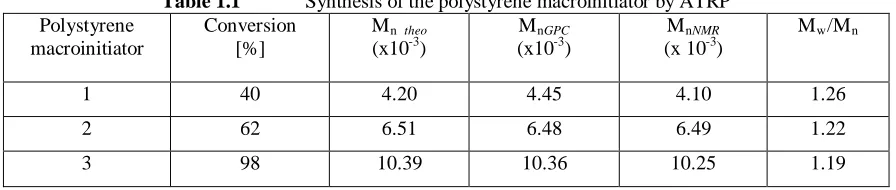
The monofunctional polystyrene macroinitiators were prepared by bulk ATRP of styrene using CuBr/PMDETA as catalyst/ligand and EBiB as the initiator. The experimental molecular weight and molecular weight distribution of the macroinitiators are listed in Table 1.2.
Table 1.1 Synthesis of the polystyrene macroinitiator by ATRP
C /min with 5±1 mg of samples.
IV.
RESULTS AND DISCUSSION
4.1 Synthesis of Polystyrene Macroinitiators:
Polystyrene macroinitiator
Conversion [%]
Mn theo
(x10-3 M ) nGPC (x10-3 M ) nNMR
(x 10-3
M )
w/Mn
1 40 4.20 4.45 4.10 1.26
2 62 6.51 6.48 6.49 1.22
73
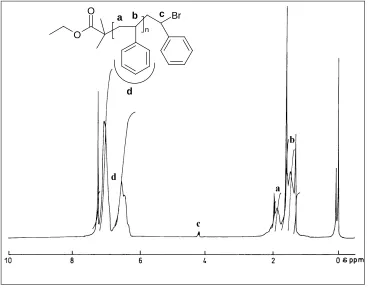
1H-NMR spectra of polystyrene macroinitiators are shown in Figure 1.1. In 1H-NMR spectra the signals at
δ=6.5-7.0 ppm correspond to the presence of aromatic protons of the phenyl ring of styrene and the signals at
δ=1.2-1.97 ppm correspond to the protons of vinyl in the main chain. The signal at δ=4.2 ppm is due to the terminal CH of the polymer chain to which active bromine is
attached. The ratio of the area of terminal CH peaks and peaks of the five proton of phenyl rings were used to calculate MnNMR of polystyrene macroinitiator. The
molecular weight calculated from 1H-NMR is in accordance with the molecular weight determined by GPC and theoretically calculated molecular weight.
Figure 1.1: 1H-NMR spectrum of polystyrene macroinitiator in CDCl3
4.2. Synthesis of PS-b-PLMA Copolymer:
Monofunctional polystyrene macroinitiators prepared above having molecular weight in the range of 4.20 x10³ -10.40 x10³ g/mol were used for the synthesis of block copolymer (PS-b-PLMA) by ATRP of LMA using CuBr/OPMI as catalyst/ligand and toluene as solvent at 95o
Figure 1.2 shows the plot of number average molecular weight (M
C.
n) and polydispersity index (PDI) vs.
conversion (%) for the copolymerization at 95oC. Number average molecular weight (Mn
Mn,theo = Mn, macroinitiator +[M]LMA/[M]macroinitiator x Mol. Wt. of LMA x % Conversion (Eq. 1.1)
) of PS-b-PLMA, determined by GPC, increased with increasing conversion with a little change in polydispersity index (PDI) value i.e. it varied from 1.22 to 1.29. Theoretical molecular weight of the diblock copolymers was also calculated using equation 1.1 and the results are summarized in Table 1.2
Table 1.2 Molecular characterization of PS-b-PLMA copolymers
Sample designation Macroinitiator Mn( 10-3
Conversion [%] )
Mntheo
( 10-3
Mn )
GPC
( 10-3
PDI )
F2
PS-b-PLMA[I] 6.48 28 13.65 14.73 1.25 0.90
O O
n Br
a b c
74
PS-b-PLMA[II] 6.48 81 20.73 29.27 1.29 0.69
PS-b-PLMA[III] 10.36 75 29.56 31.27 1.23 0.80
F2
It was observed that the molecular weight determined using GPC is higher than the theoretical molecular weight calculated using equation 1.1[Table 1.2]. The reason for this difference could be due to the
differences in the hydrodynamic volume of PS-b-PLMA and calibration standards i.e. polystyrene used for the GPC calibration. This behavior has been observed by several researchers in different systems and is well reported in the literature
= mole fraction of LMA in copolymer
14
10 20 30 40 50 60
10000 15000 20000 25000 30000 35000 40000
Mn PDI
conversion (%)
Mn
1.0 1.2 1.4 1.6 1.8 2.0
P
DI
.
Figure1.2 Plot of number average molecular weight (Mn GPC) and PDI vs. conversion (%) for copolymerization of LMA
by ATRP at 95oC using CuBr/ OPMI as catalyst/ligand, toluene as solvent and polystyrene [6.48 x10³ g/mol as macroinitiator .
Figure1.3.: GPC traces of PS macroinitiator and block copolymers: (a) PS macroinitiator (Mn= 6.48 x 10⁻³ gmol-1, (b)PS-b-PLMA [I](Mn=14.77 x 10 3 gmol-1;(c)PS-b-PLMA[II] (Mn=29.27x10³gmol-1
No bimodal distribution was seen in GPC traces. A unimodal distribution with increase in molecular weight without change in polydispersity index with conversion (%) showed that the system is living. There was no trace of unreacted macroinitiator thus indicating a good efficiency of macroinitiator.
)
Figure 1.4 show the NMR spectrum of PS-b-PLMA. In 1H-NMR spectrum of block copolymer, apart from signals for PS, we observed signals at δ = 3.92 ppm which is assigned to –OCH2 of LMA. The intensity of this
signal and the signal due to phenyl protons (δ= 6.6-7.1
ppm) was used to calculate the copolymer composition. The results of copolymer composition determined from
1
H-NMR are given in Table 1.1 The copolymer composition calculated from the 1
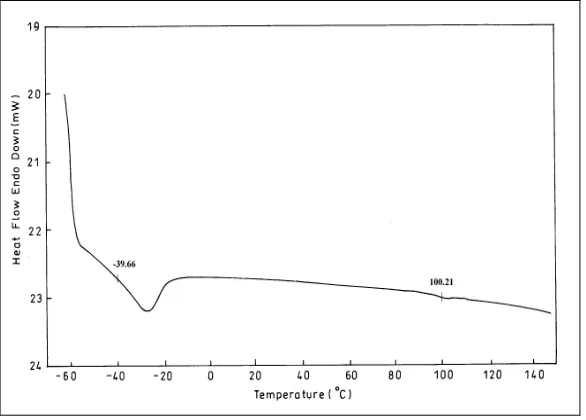
Figure 1.5 and 1.6 shows the DSC traces of PS-b-PLMA copolymer [I] and [II] respectively. In the DSC trace of copolymers PS-b-PLMA [I]and Ps-b-PLMA [II], a shift in base line corresponding to the glass transition
H-NMR was in agreement (with ±5% error) with the feed ratio in each case.
75
temperature of two homopolymers i.e. PLMA [at -39oC] and polystyrene[ at 100oC] was observed. The presence of endothermic shift in the baseline corresponding to the
glass transition of homopolymers confirm the formation of block copolymers.
Figure 1.4 1H-NMR spectrum of PS-b-PLMA copolymer in CDCl3(R=lauryl group)
Figure 1.5 DSC scan of PS-b-PLMA [I] copolymer.
O
O
n m
O O
CH2-(CH2)10-CH3 COOR
Br
76
Figure 1.6 DSC scan of the PS-b-PLMA [II] copolymerV.
CONCLUSION
PS-b-PLMA copolymers were successfully synthesized through ATRP, catalyzed by CuBr/OPMI in toluene. The molecular weight increases with increase in percent conversion. The chain extension polymerization from polystyrene macroinitaitor shows good initiator efficiency of macroinitiator and active chain end. In the DSC traces, two Tg’s (-39.36oC and 100.21o
[16] Srivastava, P. K.; Choudhary, V. J. Appl.Polym Sci. 2012,125, 31-35
C) observed corresponding to the Tg’s of homopolymers confirm the complete phase separation or formation of block copolymers.
REFERENCES
[1] Reiss, G.; Hurtrez, G.; Bhadur, P. Encyclopedia of Polymer Science and engineering, 2nd ed Vol 2 I Kroschwitz Eds Wiley, New York 1985, 324.
[2] Folkes, M. J. Ed Processing, structure and Properties of Block Copolymers, Elsevier, London (1985). [3] Meier, D. J. Ed Block Copolymers Science and Technology, Harwood, New York (1983).
[4] Noshay, A.; McGrath, J. E. Block Copolymers: Overview and Critical Survey, Academic Press, New York (1977).
[5] Quirk, R. P.; Kinning, D. J.; Fetters, L. J Comprehensive Polymer Science Vol 7 Specially Polymers and Polymer Processing S L Agarwal Ed Pergamon, Oxford 1989,1.
[6] Rempp, P.; Franta, E.; Herz, J. E. Adv Polym Sci 1988, 86, 145.
[7] Morton, M. “Anionic Polymerization: Principles and Practice”,Academic Press, New York 1983. [8] Quirk, R. P.; Kim, J. Rubber Chem Technol 1991, 64, 450.
[9] Matyjaszewski, K.; Xia, J. H. Chem Rev 2001, 101, 2921
[10] Percec, V.; Borboiu, B.; Macromolecules 1995, 28, 7970.
[11] Kato, M.; Kamigaito, M.; Sawamoto, M.; Higashimura, T. Macromolecules 1995, 28, 1721. [12] Kato, M.; Ando, T.; Sawamoto, M. Chem Rev 2001, 101, 3689.
[13] Nakagawa, O.; Fujiimoto, N.; Nishiura, T.; Kitayama, T.; Hatada, K. Polym Bull (Berlin) 1992, 29, 579.
[14] Raghunadh, V.; Baskaran, D.; Sivaram, S. Polymer 2004,45,3149.
![Figure 1.5 and 1.6 shows the DSC traces of PS-b-PLMA copolymer [I] and [II] respectively](https://thumb-us.123doks.com/thumbv2/123dok_us/9789115.1964560/4.612.75.540.50.100/figure-shows-dsc-traces-ps-plma-copolymer-respectively.webp)
![Figure 1.6 DSC scan of the PS-b-PLMA [II] copolymer](https://thumb-us.123doks.com/thumbv2/123dok_us/9789115.1964560/6.612.152.458.50.248/figure-dsc-scan-ps-b-plma-ii-copolymer.webp)
