INTERVENTIONS OR PRACTICE-BASED
POSITIVE DEVIATIONS
Arvind Singhal
Peer J Svenkerud
Abstract
S
cholars and practitioners of communication and social change are obsessed withmore efficiently diffusing evidence-based innovations. While, there is value in doing so, it is important to recognise that evidence-based practice subscribes to the tenets of the classical diffusion of innovations paradigm—a reification of outside-in, expert-driven approaches to solving problems, and a tendency to overlook, marginalise, and reject local solutions. In this article, through a detailed case study analysis of a highly effective malnutrition project in Vietnam that employed the Positive Deviance (PD) approach, we argue that communication for development scholars should go beyond evidence-based practice to favour more practice-based evidence—that is, the enablement of communities to discover the wisdom they already have and then to act on it. PD is an assets-based approach that identifies the deviant and variant practices about what is going right in a community to amplify it, rather than focusing on what is going wrong in a community and fixing it from the outside. In the PD approach, internal change agents present social proof to their peers that complex problems can be solved without additional resources. Given the solutions are generated locally, and distilled through concrete action steps, they are more likely to be owned by potential adopters and be sustained.
Keywords: Positive deviance, diffusion of innovations, evidence-based practice, practice-based evidence
Introduction
come from the outside, (2) their efficacy is validated through scientific evidence, (3) they are promoted by a well-meaning change agency, (4) through expert and knowledgeable change agents, (5) using persuasive mass, interpersonal, and digital communication channels, (6) to plug existing knowledge-attitude-practice (KAP) gaps, (7) among a carefully targeted and segmented client audience, (8) by harnessing the social network influence of opinion leaders, (9) who serve as visible peer models for innovation adoption among the non-adopters (Dearing & Cox, 2018; Dearing & Meyer, 2010; Dedehayir et al., 2017; Rogers, 2003, 2004; Rogers, Singhal, & Quinlan, 2009; Singhal, 2011; Singhal & Dearing, 2006).
In this article, we broach an alternative conceptualization of diffusing innovations, which turns the classical diffusion paradigm on its head. This alternative approach to diffusing innovations is known as the Positive Deviance (PD) approach. The PD approach is not touted here as a substitute for the classical diffusion of innovations paradigm; rather, we argue that the PD approach expands the solution space by working with a different set of principles, questions, and mindsets, believing that often the wisdom to solve intractable social problems lies within the community (Singhal, 2011). We argue that while the classic diffusion approach favours the spread of evidence-based “best practice,” the PD approach favours the spread of practice-based evidence—i.e., the amplification of a deviant and variant practice that makes the difference in a given context. That is, PD is an inside-out process in contrast with the classical dominant framework of outside-in diffusion (Singhal & Bjurström, 2015).
The PD approach to diffusing “new ideas and practices” has been employed— over the past 25 years—in over 50 countries to address a wide variety of complex social problems, including solving endemic malnutrition (Pascale & Sternin, 2005; Sternin, 2003; Zeitlin, Ghassemi, & Mansour, 1990), decreasing neo-natal and maternal mortality (Shafique, Sternin, & Singhal, 2010), reintegrating returned child soldiers (Singhal & Dura, 2009), reducing school dropouts (Singhal & Dura, 2012); cutting down the spread of hospital-acquired infections (Singhal, Buscell, & Lindberg, 2010; 2014; Singhal & Dura, 2017); enhancing female entrepreneurship in rural areas (Jain et al., 2017), and reducing female genital cutting, sex trafficking, and other intractable issues (Pascale, Sternin, & Sternin, 2010).
The Positive Deviance Approach: Diffusing Solutions from the
Inside-Out
Positive Deviance is much more radical than even its practitioners imagine. Radical in the best sense, it is joining a new field of inquiry, which might be called communal transformation.
--Peter Block (cited in Singhal, Buscell, & Lindberg, 2010, p. vii)
To understand the Positive Deviance (PD) approach, let us invoke a Sufi tale. In one of his hundreds of guises, the mystical Sufi character Nasirudin appears on earth as a smuggler, arriving at the customs checkpoint each day leading a herd of donkeys. The customs inspector would feverishly turn the baskets hanging on the donkeys upside down to check the contents, hoping to nail Nasirudin in an act of wrongdoing. He, however, never found anything of interest, and hence had little choice but to let the smuggler go free.
Years go by, and Nasirudin’s legend as a smuggler grew while the inspector grew ever more frustrated. One day, after Nasirudin and the inspector had retired from their respective occupations, their paths crossed. The former inspector pleaded, “Tell me, Nasirudin. What were you smuggling?”
“Donkeys,” Nasirudin said.
Nasirudin’s donkey story holds important lessons for social change scholars and practitioners. It shows that often the solutions to highly intractable problems, whether in communities or organizations, stare us in the face, but remain hidden in plain sight. To discover these invisible solutions, we need to reframe our way of thinking, letting go of cherished mindsets of where innovations come from, how we validate their efficacy, and how can they be spread from the inside-out.
Akin to the customs inspector who was trying to solve a problem, and could not see the solution—the donkeys, Positive Deviance (PD) is an approach to problem solving which begins with the premise that often the solution to the most complex social problems stare us in the face, but we as experts are unable to see them (Sternin & Choo, 2000; Pascale & Sternin, 2005; Singhal & Dura, 2017). PD initially gained recognition in the work of Tufts University nutrition professor Marian Zeitlin in the 1980s, when she began focusing on why some children in poor communities were better nourished than others (Zeitlin, Ghassemi, & Mansour, 1990). She called them positive deviants— “positive” because they were well nourished and “deviants” because they were statistical outliers—the true variants. In so doing, Zeitlin’s work privileged an assets-based approach, identifying what is going right in a community to amplify it, as opposed to focusing on what is going wrong in a community and fixing it.
interventions around the world. They institutionalized PD as an inside-out diffusion of innovations approach by showing how it could be operationalised in a community setting (Papa, Singhal, & Papa, 2006).
Identifying and Diffusing Deviant Practices to Combat Malnutrition in Vietnam In December of 1990, Jerry Sternin sat face-to-face with Mr. Nuu, a high-ranking official in the Vietnamese Ministry of Foreign Affairs in Hanoi.
“Sternin, you have six months to show results,” noted Mr. Nuu.
“What? Six months? Six months to demonstrate impact?” Jerry Sternin could not believe his ears.
“Yes, Sternin, six months to show impact, or else I will not be able to extend your visa.”
Jerry Sternin, accompanied by his wife Monique and 10-year old son Sam, had just arrived in Hanoi to open an office for Save the Children, a U.S.-based NGO. His mission: to implement a large-scale program to combat childhood malnutrition in a country where two-thirds of all children under the age of five suffer from malnutrition.
The Vietnamese government had learned from experience that results achieved by traditional supplemental feeding programmes were not sustainable. When the programmes ended, the gains usually tapered off. The Sternins had to come up with an approach that enabled the community, without much outside help, to take control of its nutritional status.
And quickly! Mr. Nuu had given the Sternins six months!
From years of studying Mandarin, Jerry knew that the Chinese characters for “crisis” are represented by two ideograms: danger and opportunity. Perhaps there was an opportunity to try something new in Vietnam.
Necessity is the mother of invention. If old methods of combating malnutrition would not yield quick and sustainable results, the Sternins wondered if the construct of Positive Deviance, coined a few years previously by Tufts University nutrition professor Marian Zeitlin, might hold promise.
Zeitlin broached the notion of positive deviance as she tried to understand why some children in poor households, without access to any special resources, were better nourished than others. What did they know, and what were they doing that others were not? Perhaps combating malnutrition called for an assets-based approach; that is, identifying what’s going right in a community and finding ways to amplify it, as opposed to the more traditional deficit-based approach of focusing on what’s going wrong in a community and fixing it.
Positive deviance sounded good in theory. But no one, to date, had operationalised the construct to design a field-based nutrition intervention. Might it work in a community-setting? How? The Sternins had no roadmaps or blueprints to consult. Where to begin?
snaked through Quong Xuong, and so suspicion of Americans, was palpably high. The Sternins’ first task was to build trust with community members. The rest would follow.
After several days of consultation with local officials, four village communities were selected for a nutrition baseline survey. Armed with six weighing scales and bicycles, health volunteers weighed some 2,000 children under the age of three in four villages in about 3 days. A growth card for each child, with a plot of their age and weight, was compiled. Some 64% of the weighed children were found to be malnourished.
No sooner were the data tallied, with bated breath the Sternins asked:
“Are there any well-nourished children who come from very, very poor families?”
The response: “Yes, yes, there are some children from very, very poor families who are healthy!”
These poor families in Than Hoa that had managed to avoid malnutrition without access to any special resources; these families would represent the Positive Deviants. “Positive” because they were doing things right, and “Deviants” because they engaged in variant behaviours that most others did not.
What behaviours were these PD families engaging in that others were not? To answer this question, community members were tasked to visit six of the poorest families with well-nourished children in each of the four villages. The Sternins believed that if the community self-discovered the solution, they were more likely to implement it.
Palpable excitement bathed the community hall. The self-discovery process yielded the following uncommon (variant) PD practices among poor households with well-nourished children:
• Family members collected tiny shrimps and crabs from paddy fields, adding them to their children’s meals. These foods are rich in protein and minerals. • Family members added greens of sweet potato plants to their children’s meals.
These greens are rich in beta carotene, and other essential micronutrients, e.g. iron and calcium.
Interestingly, these foods were accessible to everyone4, but most community members believed the foods were inappropriate for young children. Further, • PD mothers were feeding their children three to four times a day, rather than the
customary twice a day. But not more food, they were breaking the two big meals into smaller portions.
• PD mothers were actively feeding their children, making sure there was no food wasted.
• PD mothers washed the hands of the children before and after they ate.
the people what to do. Now the “best practices” needed to be diffused so that the non-adopters could adopt them.
Various ideas for “telling” were brainstormed: household visits, attractive posters, educational sessions, and others. Many were implemented in the classical diffusion of innovations approach, trying to persuade people to see the relative advantages of these identified best practices. However, results were disappointing. While a few folks adopted the said best practices, the majority did not.
From their previous field-based experience in other countries, the Sternins knew that old habits die-hard; new ones, even when they hold obvious advantages, are difficult to cultivate. The Sternins’ experience suggested that such “best practice” innovations almost always engendered resistance from the people. The Sternins coined a phrase for it: the “natural human immune” response.
As the brainstorming winded down, a sceptical village elder bellowed: “A thousand hearings isn’t worth one seeing, and a thousand seeing isn’t worth one doing.”
On the car ride back to Hanoi, the Sternins talked about the wisdom inherent in the elder’s remark. Could they help design a nutrition program that emphasized “doing” more than “seeing” or “hearing?”
A two-week nutrition program was designed in each of the four intervention villages. Mothers, whose children were malnourished, were asked to forage for shrimps, crabs, and sweet potato greens. Armed with small nets and containers, mothers waded the paddy fields picking up tiny shrimps and crabs. The focus was on action, picking up the shrimps and crabs, and shoots from sweet potato fields.
In the company of positive deviants, mothers learned how to cook new recipes using the foraged ingredients. Again, the emphasis was on “doing;” on practice.
After the pilot project, which lasted two years, malnutrition had decreased by an amazing 85% in the communities where the PD approach was implemented. Over the next several years, the PD intervention became a nationwide program in
Photo 1: A Cooking Session in Progress in an Intervention Village. Monique Sternin (center) Sitting on the Floor with Vietnamese Mothers as an Equal.
Vietnam, helping over 2.2 million people, including over 500,000 children improve their nutritional status (Pascale, Sternin, & Sternin, 2010; Pascale & Sternin, 2005; Singhal, Sternin, & Dura, 2009; Singhal & Dura, 2009).
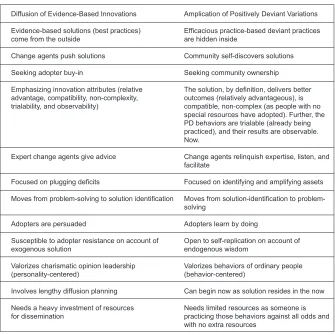
Born out of necessity, this pioneering PD experience in Vietnam turned the fundamental tenets of the classical diffusion of innovations framework on its head (Table 1).
Table 1: Diffusion of Evidence-Based Innovations Contrasted with Amplification of Positively
Deviant Variations
Diffusion of Evidence-Based Innovations Amplication of Positively Deviant Variations
Evidence-based solutions (best practices) Efficacious practice-based deviant practices
come from the outside are hidden inside
Change agents push solutions Community self-discovers solutions
Seeking adopter buy-in Seeking community ownership
Emphasizing innovation attributes (relative The solution, by definition, delivers better
advantage, compatibility, non-complexity, outcomes (relatively advantageous), is trialability, and observability) compatible, non-complex (as people with no special resources have adopted). Further, the PD behaviors are trialable (already being practiced), and their results are observable.
Now.
Expert change agents give advice Change agents relinquish expertise, listen, and
facilitate
Focused on plugging deficits Focused on identifying and amplifying assets
Moves from problem-solving to solution identification Moves from solution-identification to problem-
solving
Adopters are persuaded Adopters learn by doing
Susceptible to adopter resistance on account of Open to self-replication on account of exogenous solution endogenous wisdom
Valorizes charismatic opinion leadership Valorizes behaviors of ordinary people (personality-centered) (behavior-centered)
Involves lengthy diffusion planning Can begin now as solution resides in the now
Needs a heavy investment of resources Needs limited resources as someone is for dissemination practicing those behaviors against all odds and
with no extra resources
Source: Draws upon Pascale & Sternin (2005), Singhal (2011); and Singhal and Bjurström (2015)
inside-out diffusion as noted by the attributes of the PD approach in the above table.
Discussion and Conclusions
“We dance round in a ring and suppose, But the Secret sits in the middle and knows.”
—Robert Frost (1942)
The classical diffusion paradigm has been criticised for reifying expert-driven, top-down approaches to address problems and thus, by default, overlooking and rejecting local solutions and upstream intervention (Papa, Singhal, & Papa, 2006; Singhal & Dearing, 2006; Lundblad, 2003, Traube et al., 2017). Social change scholars and practitioners should increasingly pay attention to the value of local expertise, tacit knowledge, and indigenous wisdom in finding culturally appropriate solutions to community problems (Slettli & Singhal, 2017). One such inside-out approach to innovation diffusion is exemplified by the positive deviance approach.
The PD approach questions the dominant standpoint behind our obsession with the diffusion of outside-in, expert-driven, evidence-based innovations. It shifts our notions of where knowledge and expertise reside, reaffirming the value of distributed and situated innovativeness (Singhal & Bjurström, 2015). The PD approach believes that the wisdom to solve the problem lies inside. While social change experts usually make a living discerning community deficit, and then implementing outside solutions to change them, in the PD approach, the role of experts is framed differently. The expert’s role is to help the community find the positive deviants, identify their uncommon but effective practices, and then to design a community intervention to make them visible and actionable.
In the PD approach, the change is led by internal change agents who, with access to no special resources, present the social behavioural proof to their peers. If they can do it, others can, too. As the PD behaviours are already in practice, the solutions can be implemented without delay or access to outside resources. Further, the benefits can be sustained, since the solution resides locally.
In the PD approach, the dominant “transmission-centred” innovation-decision framework is turned on its head. As opposed to subscribing to the notion that increased knowledge changes attitudes and attitudinal changes change practice, PD believes in changing practice. PD believes that people change when that change is distilled from concrete action steps.
of human agency and situated innovativeness. This practice turn represents a move away from being obsessed with scientific proof, i.e. evidenced-based practice and values social proof, i.e. practice-based evidence (Singhal & Bjurström, 2015).
While the field of economics has insisted on the individual rationality of actors and social theory has emphasized the role of societal structure in determining individual behaviour, our argument to privilege the amplification of practice-based variations strikes a balance between the two, emphasising the importance of context, and the possibility for individuals within that context to make a difference through their agency in adopting a deviant practice (Singhal & Bjurström, 2015). The key challenge, of course, is how to identify and diffuse this variation of practice? The Vietnam PD case shows that by asking questions such as (1) “Are there well-nourished children among the poorest-of-poor?,” and, if so, (2) “What enables them to be well-nourished?” allows us to find positive outliers—that is pinpoint where innovativeness is both distributed and situated, and how it can be amplified within a social system.
In conclusion, a preponderance of evidence—spread across the decades—notes that innovations (or solutions) that are generated locally are more likely to be owned by the potential adopters. When adopters are persuaded to buy into the vision of an outside expert, they tend to demonstrate inertia and resistance, much like the Iowa farmers in the Ryan and Gross (1943) study who for an average of about 10 years resisted the adoption of hybrid seed corn. The positive deviance approach represents a different way of solving problems and deserves greater attention by scholars and practitioners of development and social change.
References
Alvesson, M., & Sköldberg, K. (2009). Reflexive methodology: New vistas for qualitative research (3rd ed.). London: Sage Publishing.
Czarniawska, B. (2004). Narratives in social science research. London: Sage Publishing.
Dearing, J. W., & Cox, J. G. (2018). Diffusion of innovations theory, principles, and practice. Health Affairs,
37(2), 183-190. https://doi.org/10.1377/hlthaff.2017.1104
Dearing, J. W., & Meyer, G. (2010). The active adopter in the diffusion of innovations. In A Vishwanath & G. Barnett (Eds.), Advances in the study of the diffusion of innovations (pp. 29-60). New York: Hampton Press.
Dedehayir, O., Ortt, R. J., Riverola, C., & Miralles, F. (2017). Innovators and early adopters in the diffusion of innovations: A literature review. International Journal of Innovation Management, 21(8), 1–27. https:// doi.org/10.1142/S1363919617400102
Frost, R. (1942). The secret sits [Blog post]. Retrieved from http://wonderingminstrels.blogspot.com/2001/01/ secret-sits-robert-frost.html
Jain, P., Sachdev, A, Singhal, A., Svenkerud, P.J., & Agarwal, S. (2018, May). Voice, imagination, and actionable possibilities: A positive deviance inquiry of women entrepreneurs in Uttar Pradesh, India.
Paper presented at the 68th Annual Conference of the International Communication Association, Prague, The Czech Republic.
Knorr-Cetina, K., Schatzki, T. R., & von Savigny, E. (Eds.) (2000). The practice turn in contemporary theory.
New York: Routledge.
Lundblad, P. P. (2003). A review and critique of Rogers’ diffusion of innovation theory as it applies to organizations. Organizational Development Journal, 21(4), 50-64.
Mack, A., & Rock, I. (1998). Inattentional blindness. Cambridge, MA: The MIT Press. March, J. G., & Simon, H.A. (1958). Organizations. New York: Wiley.
Papa, M. J., Singhal, A., & Papa, W. H. (2006). Organizing for social change: A dialectic journey of theory and praxis. Thousand Oaks, CA: Sage
Pascale, R. T., & Sternin, J. (2005, May). Your company’s secret change agents. Harvard Business Review,
1–11.
Pascale, R. T., Sternin, J., & Sternin, M. (2010). The power of positive deviance: How unlikely innovators solve the world’s toughest problems. Boston, MA: Harvard Business Press.
Rogers, E. M. (2003). Diffusion of innovations (5th ed.). New York: Free Press.
Rogers, E. M. (2004). A prospective and retrospective look at diffusion model. Journal of Health Communication, 9(1), 13–19. https://doi.org/10.1080/10810730490271449
Rogers, E. M., Singhal, A., & Quinlan, M. M. (2009). Diffusion of innovations. In D. W. Stacks & M. B. Salwen (Eds.), An integrated approach to communication theory and research (pp. 418-434) (2nd ed.). New York: Routledge.
Ryan, B., & Gross, N. C. (1943). The diffusion of hybrid seed corn in two Iowa communities. Rural Sociology, 8, 15–24.
Shafique, M., Sternin, M., & Singhal, A. (2010). Will Rahima’s firstborn survive overwhelming odds?: Positive deviance for maternal and newborn care in Pakistan. Boston, MA: Positive Deviance Initiative. Singhal, A. (2011). Turning diffusion of innovations paradigm on its head. In A. Vishwanath & G. Barnett
(Eds.), The diffusion of innovations: A communication science perspective (pp. 193-205). New York: Peter Lang Publishers.
Singhal, A., & Bjurstrom, E. (2015). Reframing the practice of social research: Solving complex problems by valuing positive deviations. International Journal of Communication and Social Research, 3(1), 1-12. Singhal, A., & Dearing, J. W. (Eds.). (2006). Communication of innovations: A journey with Ev Rogers.
Thousand Oaks, CA: Sage.
Singhal, A., Buscell, P., & Lindberg, C. (2010). Inviting everyone: Healing healthcare through positive deviance. Bordentown, New Jersey: Plexus Press.
Singhal, A., Buscell, P., & Lindberg, C. (2014). Inspiring change and saving lives: The positive deviance way.
Bordentown, New Jersey: Plexus Press.
Singhal, A., & Dura, L. (2009). Protecting children from exploitation and trafficking: Using the positive deviance approach in Uganda and Indonesia. Washington D.C.: Save the Children Federation.
Singhal, A., & Dura, L. (2012). Transforming community through self-discovery, dialogue, and action: The rising tide of the positive deviance approach in development communication. In S. R. Melkote (Ed), The role of development communication in directed social change: A reappraisal of theory and practice (pp. 157-168). Singapore: Asian Mass Communication and Information Centre.
Singhal, A., & Dura, L. (2017). Positive deviance: A non-normative approach to health and risk messaging.
Oxford Research Encyclopedia of Communication: Communication Theory, Health and Risk Communication. DOI: 10.1093/acrefore/9780190228613.013.248
Slettli, V., & Singhal, A. (2017). Identification and amplification of tacit knowledge: The positive deviance
approach as knowledge management praxis. Electronic Journal of Knowledge Management, 15(1), 48-58.
Sternin, J. (2003). Practice positive deviance for extraordinary social and organizational change. In D. Ulrich, M. Goldsmith, L. Carter, J. Bolt & N. Smallwood (Eds.), The change champion’s fieldguide (pp. 20–37). New York: Best Practice.
Sternin, J., & Choo, R. (2000, January-February). The power of positive deviancy. Harvard Business Review,
2–3.
Svenkerud, P.J., & Singhal, A. (1998). Enhancing the effectiveness of HIV/AIDS prevention programs targeted to unique population groups in Thailand: Lessons learned from applying concepts of diffusion of innovation and social marketing. Journal of Health Communication, 3, 193-216. DOI:10.1080/108107398127337 Svenkerud, P. J., Singhal, A., & Papa, M. J. (1998). Diffusion of innovations theory and effective targeting
of HIV/AIDS programmes in Thailand. Asian Journal of Communication, 8(1), 1- 30. https://doi. org/10.1080/01292989809364751
Traube, D. E., Begun, S., Okpych, N., & Choy-Brown, M. (2017). Catalyzing innovation in social work practice.
Research on Social Work Practice, 17, 134-138.
Arvind Singhal, Ph.D,. is the Samuel S. and Edna H. Marston Endowed Professor of Communication at The University of Texas at El Paso and appointed Professor 2, Inland School of Business and Social Sciences, Inland University of Applied Sciences, Norway. His teaching and research interests include the diffusion of innovations, the positive deviance approach, the entertainment-education communication strategy, and liberating interactional structures. Emai: [email protected]