MORPHOLOGICAL AND QUALITY CHARACTERIZATION
Sarala Yadav
ICAR-Central Potato Research Station, Patna, Bihar-801506
Abstract
The protection of Plant Varieties and Farmers Right Authority (PPV& FRA) provide guidelines for the conduct of test for distinctiveness, uniformity and stability. In this study characterization of 13 soybean varieties was done as per DUS guidelines (PPV & FRA, 2009). T he varieties were characterized 20 characters, viz. Plant growth type, days to 50% flowering, leaf shape, leaf colour, plant growth habit, flower colour, plant height(cm), pod pubescence, pubescence colour, pod shattering, days to maturity, seed size, seed hilum colour, cotyledon colour, seed oil content and seed protein content. Most of the varieties have medium height except 524 and 2008 were short type and Pusa 16, Pusa 20, Pusa 24 were tall. Green leaf colour was common as compare to dark green colour (eg 750-1, Chatkabhuj). All candidate varieties showed purple flower colour whereas, Pusa 20 and Pusa 24 have white flower colour. All varieties were early maturing type. Most of the varieties have high protein content with medium oil content except variety 2008, which have high oil content (22.7%).
Key words: Soybean, PPV& FRA act, Candidate varieties, Characterization
I. INTRODUCTION
Soybean (Glycine max (L.) Merril.) is a species of legume (2n=40) native to East Asia, widely grown for its edible bean which has numerous uses. The plant is classed as an oil seed rather than a pulse by the UN Food & Agricultural organization (FAO). It is very important oil seed crop in India. Soybean is ranked number one in international market among world’s major oilseed crops (Chung & Singh 2008). Total 104 soybean improved varieties have been notified/ released in India for the cultivation in different agro-ecological zones of the country so far (seed net portal, 2012). The distinctness, uniformity and stability are to be established by the DUS Test. Therefore candidate varieties are to be compared with all the varieties, whose existence is matter of common knowledge and with the most similar varieties. Characterization of varieties is important in order to avoid the duplication varieties are classified on the basis of morphological and seed characters. Qualitative characters are being more stable over generations (Raut 2003) hence are reliable for characterization of varieties. Therefore, the present study was planned to characterize the 13 soybean varieties for 20 different traits.
II. MATERIAL AND METHODS
13 varieties of soybean, 10 obtained from Sipani farms 750-1(V1), 524 (V2), 3003(V3), 2008(V4),
2005(V5), 629(V6), Kuber (V7), Chamatkar(V8), Chatkabhuj(V9) AND JS 335(V10) and three varieties
from I.AR.I. New Delhi was Pusa 16(V11), Pusa 20(V12), Pusa 24 (V13). Characterization of seed was
of crop growth as per DUS test guidelines (PPV& FRA, 2009). Data were recorded on randomly selected fifteen competitive plants. Correlation was studied between the traits like days to 50% flowering, plant height, days to maturity, seed protein and oil content by Pearson’s correlation method.
III. RESULT AND DISCUSSION
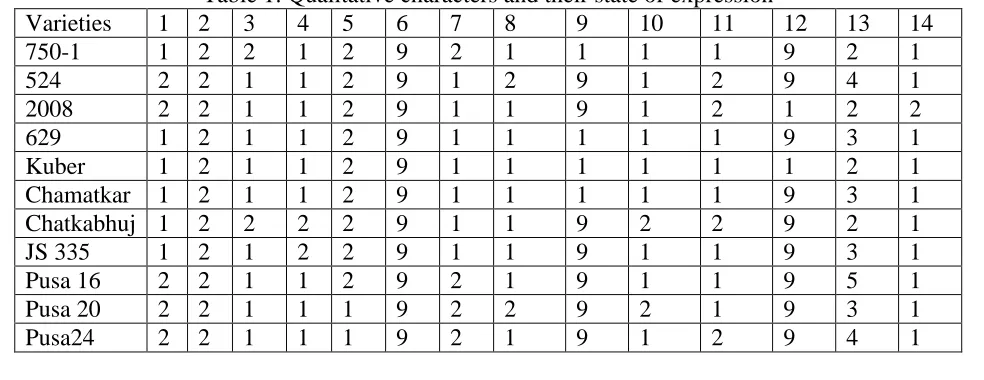
In the present study, 15 qualitative and five quantitative traits were studied for establishing the varietal distinctness. Out of twenty characters four characters viz., leaf shape (pointed ovate), pod pubescence (present), early maturity and high protein content in all genotypes were observed to be monomorphic in nature. Remaining 16 characters were found to be polymorphic in nature (table 1 and 2). Submitted seed samples were characterized for six seed characteristics. Six varieties were with small seed size 3 were with large seed size and rest were with medium seed size. Two varieties (3003, 2005) were not taken in further study due more than 50% off types observed under field conditions. Growth habit was determinate (750-1, 629, Kuber, Chamatkar, Chatkabhuj and JS 335) and semi-determinate (524, 2008, Pusa 16, Pusa 20 and Pusa 24). Leaf color was green in most of the varieties except 750-1 and Chatkabhuj have dark green leaf color. Two groups of flower color, white and purple were observed. All varieties except Pusa 20 and Pusa 24 were purple flower colored. All three groups of plant height i.e. short (524, 2008), medium (750-1, 629, Kuber, Chamatkar, Chatkabhuj and JS 335) and tall (Pusa 16, Pusa 20 and Pusa 24) were observed. It ranged from 81.84 cm (Pusa 24) to 34.67 cm (2008). Grey pod pubescence color was observed in most of the varieties except 750-1, Pusa 16, Pusa 20 and Pusa 24. Pod color was brown in 524 and Pusa 20, rest others were yellow pod colored. All varieties were resistant to pod shattering except 750-1, 629, Kuber and Chamatkar. Prominent seed size was small (6 varieties) as compare to medium and large seed size. Seed shape was generally spherical (in 8 varieties) as compare to elliptical (in 3 varieties).most of the varieties were with dull appearance and yellow to yellow green seed color except 2008 (green seed color). Days to 50% flowering ranged from 40 days (524) to 48 (Pusa 24) days but days to maturity were early ranged from 61 days (524) to 77 (Pusa 24) days (graph 1). All varieties were with high protein content and medium oil content except variety 2008, which have high (22.7%) oil content (table 3 and graph 2). Positive significant correlation was found between days to 50% flowering and plant height (0.672), days to 50% flowering and days to maturity (0.66) and between plant height and days to maturity (0.620). Whereas, highly significant negative correlation was found between seed oil (%) and seed protein content (table 4).
It is concluded that out of 13 soybean varieties two were rejected due more than 50% off types. Remaining 11 were characterized and found distinct to each other. Thus in the present study morphological descriptors proved to be more helpful as the identity of all the cultivar could be established individually.
Table 1: Qualitative characters and their state of expression
Varieties 1 2 3 4 5 6 7 8 9 10 11 12 13 14
750-1 1 2 2 1 2 9 2 1 1 1 1 9 2 1
524 2 2 1 1 2 9 1 2 9 1 2 9 4 1
2008 2 2 1 1 2 9 1 1 9 1 2 1 2 2
629 1 2 1 1 2 9 1 1 1 1 1 9 3 1
Kuber 1 2 1 1 2 9 1 1 1 1 1 1 2 1
Chamatkar 1 2 1 1 2 9 1 1 1 1 1 9 3 1
Chatkabhuj 1 2 2 2 2 9 1 1 9 2 2 9 2 1
JS 335 1 2 1 2 2 9 1 1 9 1 1 9 3 1
Pusa 16 2 2 1 1 2 9 2 1 9 1 1 9 5 1
Pusa 20 2 2 1 1 1 9 2 2 9 2 1 9 3 1
1. Plant: Growth type; Determinate (1), semi-determinate (2), Indeterminate (3) 2. Leaf: Shape; Lanceolate (1), Pointed ovate (2), Rounded ovate (3)
3. Leaf: Colour; Green (1), Dark green (2) 4. Plant growth habit; Erect (1), Semi-erect (2) 5. Flower: Colour; White (1), Purple (2) 6. Pod: pubescence; Absent (1), Present (9) 7. Pod: pubescence colour; Grey (1), Tawny (2) 8. Pod: colour; Yellow (1), Brown (2), Black (3) 9. Pod: shattering; Shattering (1), Non-shattering (9) 10. Seed: shape; Spherical (1), Elliptical (2)
11. Seed colour; Yellow (1), Yellow green (2), Green (3), Black (4) 12. Seed luster; Shiny (1), Dull (9)
13.Seed hilum colour; Yellow(1), Grey(2), Brown(3), Black(4), Variegated (5) 14. Seed cotyledon colour; Yellow (1), Green (2)
Table 2: Quantitative characters and their state of expression
Varieties 1 2 3 4 5 6
750-1 5 5 3 3 5 7
524 5 5 3 3 5 7
2008 5 5 3 3 7 7
629 5 5 3 3 5 7
Kuber 5 5 3 3 5 7
Chamatkar 5 5 3 3 5 7
Chatkabhuj 5 5 3 3 5 7
JS 335 5 5 3 3 5 7
Pusa 16 5 7 3 3 5 7
Pusa 20 7 7 3 3 5 7
Pusa24 7 7 3 3 5 7
1. Plant: days to 50% flowering; Early (3) ≤35 days, Medium (5) 36-45 days, Late (7) >45 days 2. Plant: height; Short (3) ≤40 cm, Medium (5) 41-60 cm, Tall (7) >60 cm.
3. Plant: days to maturity; Early (3) ≤ 95 days, Medium (5) 96-105 days, Late (7) >105 days. 4. Seed: size; Small (3) ≤10 g, Medium (5) 10.1- 13.0 g, Large (7) >13.0g.
5. Seed: oil content (%); Low (3) ≤15, Average (5) 15.1-18.0, High (7) >20.0 6. Seed: protein content (%); Low (3) ≤38, Medium (5) 38.1- 40.0, High (7) >40.0
Table 3. Mean and range of quantitative traits
Mean and Range
Characters Mean Std. Deviation Range
Days to 50% flowering 42.55 2.734 40.00 (524) to 48.00 (Pusa24)
Plant height (cm) 51.36 14.569 34.67 (2008) to 81.84 (Pusa20)
Days to maturity 65.82 4.600 61.00 (524) to 77.00 (Pusa24)
Seed oil (%) 18.91 1.136 18.30 (Pusa24) to 22.70 (2008)
Correlation Matrix
* Correlation is significant at the 0.05 level
** Correlation is significant at the 0.01 level
Days to 50% flowering is positively correlated with Plant height and Days to maturity. Plant height is positively correlated with Days to maturity. Seed oil (%) is negatively correlated with Seed protein (%)
Graph 1: Days to 50% Flowering vis-a-vis Days to Maturity
Days to 50% flowering and days to maturity exhibited a significant Positive correlation (0.661)
Graph2: Comparison of Seed Protein (%) and Seed Oil Content (%)
• 0 20 40 60 80 100
V1 V2 V4 V6 V7 V8 V9 V10 V11 V12 V13
DFP
DM
0 10 20 30 40 50
V1 V2 V4 V6 V7 V8 V9 V10 V11 V12 V13
Oil (%)
Protein (%)
Character Days to 50%
flowering Plant height (cm) Days to maturity Seed oil (%) Seed protein (%)
Days to 50% flowering 1.000 0.672* 0.661* -0.337 0.292
Plant height (cm) 1.000 0.620* -0.282 0.061
Days to maturity 1.000 -0.176 0.157
Seed oil (%) 1.000 -0.848**
• Maximum oil content (%) was observed in V4 (2008) with low protein content among these varieties.
BIBLIOGRAPHY
[1] Anonymous. 2009. Guidelines for the conduct of test for distinctiveness, uniformity and stability on soybean (Glycine
max (L.) Merril). Plant Variety Journal of India 3(10): 13-22.
[2] Gupta A, Mahajan V, Khati P and Srivastava A K. 2010. Distinctness in Indian soybean (glycine max) varieties using
DUS chatracters. Indian Journal of Agricultural Sciences 80 (12): 1081-4
[3] Ramteke R, Kumar V, Murlidharan P and Agarwal DK. 2010. Study on genetic variability and traits interrelationship
among released soybean varieties of India [Glycine max (L) Merril]. Electronic Journal of Plant Breeding 1(6): 1483-7
[4] Ramteke R and Murlidharan P. 2012 Characterization of Soybean (Glycine Max ) varieties as per DUS Guidelines.
Indian Journal of Agricultural Sciences 82(7): 572-7.
[5] Satyavathi CT, Bharadwaj CH, Hussain SM, Karmarkar PG, Tiwari SP, Joshi OP and Mohan Y. 2004. Identification key