http://www.sciencepublishinggroup.com/j/mcs doi: 10.11648/j.mcs.20170206.16
ISSN: 2575-6036 (Print); ISSN: 2575-6028 (Online)
Calculator on Java Using the Method of Raoelina
Andriambololona
Solofonjatovo Evariste Andriamasivelo, Raoelina Andriambololona
Theoretical Physics Department, Institute National des Sciences et Techniques Nucléaires (INSTN-Madagascar), Antananarivo, Madagascar
Email address:
[email protected] (S. E. Andriamasivelo), [email protected] (S. E. Andriamasivelo), [email protected] (R. Andriambololona), [email protected] (R. Andriambololona), [email protected] (R. Andriambololona)
To cite this article:
Solofonjatovo Evariste Andriamasivelo, Raoelina Andriambololona. Calculator on Java Using the Method of Raoelina Andriambololona. Mathematics and Computer Science. Vol. 2, No. 6, 2017, pp. 130-138. doi: 10.11648/j.mcs.20170206.16
Received: November 20, 2017; Accepted: December 4, 2017; Published: January 2, 2018
Abstract:
The method of Raoelina Andriambololona consists to apply tools from matricial calculation and linear algebra in
Arithmetics. This method permits to simplify arithmetic operations and to suppress many existing inconsistencies in writing, in
enunciating, and in the four basic operations of arithmetic: addition, subtraction, multiplication and division. The main
objective of this article is to use this method to design a computer software using java language. We give here the kernel of the
java program corresponding to the calculator, and an overview of the obtained results. This calculator displays the numbers
from the left – hand side (L) to the right – hand side (R) in increasing order (i) and does all the operations in this order i.e. it
performs the display and calculation in the same direction unlike current calculator in which displaying and calculation are
performed in opposite directions. The result is quite consistent with the reading, the writing and all the operations in Malagasy
language.
Keywords: Java, Arithmetic, Linear Algebra, Matrix Calculation
1. Introduction
RAOELINA ANDRIAMBOLOLONA has done research
to improve the Malagasy scientific language instead of doing
a translation from French language. He forged a scientific
approach, starting from the concept itself.
The column - matrix layout of the basic vectors, which
results from a convention, reveals the only four possible
logical and coherent writings of integer and decimal numbers.
The choice adopted, and therefore the convention chosen, must
be consistent with the way of writing: line writing (LR) from
the left-hand side (L) to the right-hand side (R) or line writing
(RL) from the right-hand side (R) to the left-hand side (L).
Thus, the arrangement of numbers is by construction
consistent with writing; it must be the same for the reading,
which must obviously follow the writing [1] [2] [4]
In Malagasy language, we write numbers from the
left-hand side (L) to the right-left-hand side (R), and we read it from
the right-hand side (R) to the left-hand side (L). This
inconsistency between writing and reading in malagasy
language
has
stimulated
RAOELINA
ANDRIAMBOLOLONA to write several articles on this
subject. He designed a rational logical matrix operation
technique consistent with the Malagasy spoken numeration
of numbers (malagasy people write the number of LRi
(increasing order) and read LRd (decreasing order).
In this work, we design a calculator, to understand better
the use of this calculation technique, and to become familiar
with the notation LRi i.e left hand side (L) to right hande side
(R) and increasing (i) order. This calculator does not only
display the LRi numbers, but is designed with the calculation
basis (illustrated in examples of this article). Raoelina
Andriambololona
and
Hanitriarivo
Rakotoson
have
programed it in javaScript [9]. Nirina Gilbert Rasolofoson
and Raoelina Andriambololona have designed an ALU and
code converter using matrix calculation [7]. In this paper, we
apply this method in framework of computer science using
java programming language.
2. Recall of the Method of Raoelina
Andriambololona in Arithmetics
[1 - 7]
example 1101 makes no sense if we do not specify the
number basis, for instance binary or decimal basis.
2.1. Basis, Systems, Writing of Numbers
Let a fixed natural integer numbers called "basis", and
the sequence formed by the powers
( > 0, = 0, <
0)
.
is called the "basis vector" using the language of
linear algebra.
The intrinsic (i.e. independent on the basis) number may
be written on the basis vector as
=
where the , not all of which are zero, are natural integers
strictly less than .
is called the "component" of on the
basis vector .
The uniqueness of
is deduced from the linear
independence of the basis vectors.
We have put the basic vectors in column - matrix or row
- matrix form by following a well - defined order (either in
decreasing (d) order or in increasing (i) order). The row -
matrix or column - matrix formed by the components ranked
in a well-defined order represents the intrinsic number in
the basis
We have four choices corresponding to the conventions
taken (column - matrix or row - matrix, increasing or
decreasing order). We fix our choice, so that the writing of
the number is compatible with the writing used (writing on
row from left-hand side to right-hand side or from right-hand
side to left-hand side).
We mark by a sign (by a comma in French, German,
Malagasy,
or by a dot in English), put after the component
corresponding to
, thus separating the components of
with the positive and negative powers .
The values of , strictly less than the number , are the
system digits.
2.2. Using Matrix Calculation in Arithmetics
2.2.1. Basis
of
ℕ
a.
Theorem.
The set
for
∈
is a linear independent generator
system of
ℕ
, that is to say a basis of
ℕ
.
b.
Result
Theorem.
A natural integer decomposes on the basis
in
= ∑
and the component is unique (1)
2.2.2. Basis Column - Matrix
We introduce the columns - matrix basis vector
=
!
!
!
"
#⋮
%#&
'
'
'
(
(1) maybe written matricially as
= )
#…
%#+
!
!
!
"
#⋮
%#&
'
'
'
(
or
= ,-
( ).
(2)
where the row - matrix
,-
( )
is the writing in increasing
order of the number in the numerical basis
) +
.
2.2.3. Remarks
a.
The choice of the decomposition has been fixed so as
to have the writing of numbers from left-hand side to
the right-hand side in increasing order (LRi).
b.
Let us note that this arrangement (LRi) may be made to
be consistent with the rules of the four operations
(addition, subtraction, multiplication and division).
c.
Theorem
The writing
,-
( )
is unique.
d.
Theorem
All the
of (1) and (2) are strictly less than ,( ∈
)0, 1, … , − 1+)
.
the numbers
= (0, 1, 2, … . , − 1)
are called the digits
of the number in the numerical basis .
e.
We do not need to call upon the Euclidean division of
by and its properties (in particular, the property of
uniqueness and condition
<
) which is already
contained in the decomposition.
f.
Theorem
The column - matrix basis defined in the paragraph 2.2.2 is
a bijection of the row - matrix on (2).
2.3. Rules of Operation
2.3.1. The Rules of Addition
Let
= ∑
#and
5= ∑
6# 5, (2.3.1). we can
assume
7
5> 7
without losing in generality with
5≠ 0
+
5=
( +
5)
"
with
= 0
for
(7 + 1) ≤ ≤ 7′
7 "
is chosen in such a way that
+
5<
for all and
in particular for
= 7′
.
All the elements of all the columns of the row - matrix
,-( + ′)
are zero or strictly less than .
Let
′′ = +
5If
′′ = +
5<
, then
′′
is the
element at the
( + 1)
th column of
,-( + ′)
from the left.
If
′′ >
, we decompose it into
′′ =
+
# #+
… +
5= =
with
<
′′ =
+
# #>+ ⋯ +
= =>#(without
summation over )
The element at the
( + 1)
- Column from the left of
,-( + ′)
is
while
#, @, …are to be "carried over the
( + 2), ( + 3), … , ( + B + 1)
-th column from the left
of
,-( + ′)
respectively.
The addition is thus carried out from left-hand side to
right-hand side in increasing order (LRi).
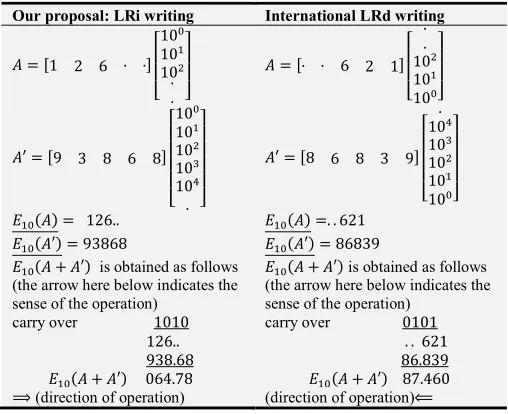
Add in the basis 10 the following intrinsic numbers and
′
Table 1. Addition of 126 (621) by 93868 (86.839).
Our proposal: LRi writing International LRd writing
= )1 2 6 . .+!!"101010#@
. . &'
' (
= ). . 6 2 1+!!" . . 10@
10#
10 &' ' (
′ = )9 3 8 6 8+ ! ! ! ! "1010#
10@
10F
10G
. &' ' ' ' (
′ = )8 6 8 3 9+ ! ! ! "10.G
10F
10@
10#
10 &' ' ' (
,#( ) = 126.. ,#( ) =. . 621
,#( ′) = 93868 ,#( ′) = 86839
,#( + ′) is obtained as follows (the arrow here below indicates the sense of the operation)
,#( + ′) is obtained as follows (the arrow here below indicates the sense of the operation)
carry over 1010 carry over 0101 126.. . . 621 938.68 86.839 ,#( + ′) 064.78 ,#( + ′) 87.460
⟹ (direction of operation) (direction of operation)⟸
Example 2
We suppose that we are in basis 10. The reader will notice
the positions of the carry over that is not indicated.
Table 1. Subtraction of 064 78 (87 460) by126(621).
Our proposal: LRi writing International LRd writing " 064.78
126..
5= " − 938.68
⟹ (direction of operation)
" 87.460 . . 621
5= " − 86.839
(direction of operation)⟸
2.3.2. Rules of Multiplication
Let
and
′
be two integers, defined by the
decompositions (1)
We are getting
×
5=
M
N 5O P
N>O
Q
P"
P
taking into account the multiplication table
N
×
O=
N>Owe have, as for the addition, the condition
0 ≤
N′O
P
N>O
≤
In calculating the components of product
×
5that must
be less than , we must carry over the deductions in the
subtotals
We will illustrate the calculation rules by explaining the
products, subtotals and deductions in
Example 3.
In the basis 10, perform the LRi disposition on
multiplication
Table 2. Multiplication of 518 (815) by 521 6 (6 125).
5 1 8
× 5 2 1 6 Multiplication of 518 by 5216
"2""0""4"
5 7 0 4 carry over Result of 518 × 5518 × 5 "1""0""1"
0 3 6 1 Carry over Result of 518 × 2518 × 2 "0""0"
5 1 8 Carry over Result of 518 × 1518 × 1 "3""0""4"
0 9 8 4 Carry over Result of 518 × 6 518 × 6 5 7 8. 1 9 9. 4
"0""0" "0" "1" "1""0"
final Result Carry over final result ⟹ (direction of operation)
It is easy to check
(5 × 10 + 1 × 10
#+ 8 × 10
@) × (5 × 10 + 2 × 10
#+ 1
× 10
@+ 6 × 10
F)
= 5 × 10 + 7 × 10
#+ 8 × 10
@+ 1
× 10
F+ 9 × 10
G+ 9 × 10
S+ 4 × 10
TWe see that all the operations (writing, adding,
multiplying, and dividing) are done from left-hand side (L) to
the right-hand side (R) in increasing order (i) or LRi.
Example 4: division of 9932 by 4
Table 4. Division of993 2 (2 399) y 4 (4).
Our proposal: LRi writing International LRd writing
9 9 3 2 4 2 3 9 9 4
6 3 9 2 0 5
3 6 3 2 3 9 9
↓ 6 3 + 9 3 6 + 9
↓ 0 0 2 3 9
↓ 0 2 5 3 6 9
3 . . . 9 9 5 . . . 3 5 9 9
⇒ direction of operation ⇒ direction of operation
⇒ direction of writing ⇒ direction of writing
3. Calculator on Java Using the Method
of Raoelina Andriambololona
In this third part, we will use Malagasy words like marika,
isa, fanampiana, fangalana, fampitomboana, fizarana.... to
name the classes of digits, numbers, addition, subtraction,
multiplication and division.
Same overview of the program excerpt is given
3.1. Calculator in Java
3.1.1. Class Marika
Code
:
Marika. java
publicclass Marika {
privateintbase;
privateintcoefficient;
privateintdegre;
publicint getBase() {
returnbase; }
publicvoid setBase(intbase) {
this.base = base; }
publicint getCoefficient() {
returncoefficient; }
publicvoid setCoefficient(int
coefficient) { this.coefficient = coefficient; }
publicint getDegre() {
returndegre; }
publicvoid setDegre(intdegre) {
this.degre = degre; }
publicint getValue() {
return
(int)(getCoefficient()*Math.pow(getBase(), getDegre()));
}
publicvoid printAll() {
System.out.print(getCoefficient()+".(" + getBase() + "^"+getDegre()+")"); }
publicvoid print() {
System.out.print(getCoefficient()); }
public String toString() {
return getCoefficient()+""; }
publicvoid print(String s) {
System.out.print(s+getCoefficient()); }
publicint get() {
return getCoefficient(); }
public Isa toIsa() {
Isa isa = new Isa(); try {
if(getDegre()<0) {
isa.addMarika(new Marika(base,0,0)); inti=1;
for (;i<Math.abs(getDegre());i++) { isa.addMarika(new Marika(base,0,-i)); }
isa.addMarika(this); } else {
for (inti = 0; i < getDegre(); i++) {
isa.addMarika(new Marika(base,0, i)); }
isa.addMarika(this); }
} catch (Exception e) {}
returnisa;
}
public Marika(intbase,intcoeff,intdegre) {
super();
this.base = base;
this.coefficient = coeff;
this.degre = degre; }
}
3.1.2. Class Isa
This is the class for the object Isa.
Isa = . +
… . + .
Code: Isa. class
publicclass Isa {
private String signe = "";
privateintbase;
private List<Marika>list=new ArrayList<Marika>();
private List<Marika> listN = new ArrayList<Marika>();
public List<Marika> getList() {
returnlist;
}
publicvoid setList(List<Marika> list) {
this.list = list; }
publicint getBase() {
returnbase;
}
publicvoid setBase(intbase) {
this.base = base;
}
publicint maxDegreN() {
intmax = 0;
for (inti = 0; i < listN.size(); i++) { max= Math.max(
Math.abs(listN.get(i).getDegre()),max); }
returnmax;
}
public String toString() {
StringBuilder sb = new StringBuilder(); checkList();
sb.append(getSigne());
intinit = maxDegreN()>4?4:maxDegreN();
for(inti = init; i>0; i--){
sb.append(getMarika(-i).getCoefficient()); }
if(listN.size()>0)sb.append(",");
for(inti=0; i<list.size(); i++) {
sb.append(getMarika(i).getCoefficient()); }
if(list.size() == 0)sb.append("0");
returnsb.toString();
}
publicvoid print() {
System.out.println(this); }
publicvoid print(String s) {
System.out.println(s + " " + this); }
publicvoid checkList() {
while(list.size()>1&&getMarika(list.size()-1)
.getCoefficient()==0) {
list.remove(getMarika(list.size()-1)); }
}
public Isa(intmarika, intbase) {
super();
this.base = base;
inti = 0;
if(marika<0)signe = "-";
if(marika == 0) {
list.add(new Marika(base, 0, 0));
return;
}
marika=Math.abs(marika);
List<Marika>listTmp=new ArrayList<Marika>();
while( marika > base) {
reste = marika%base;
listTmp.add(new Marika(base,reste, i++));
marika/=base; }
listTmp.add(new Marika(base, marika, i));
for(i=0; i<listTmp.size(); i++) { Marika n = listTmp.get(i);
n.setDegre((listTmp.size()-1) –
n.getDegre()); list.add(n);
} }
publicvoid addMarika(Marika n)
throws Exception {
if(findMarika(n.getDegre()) != null)
thrownew Exception("Twice exception");
if(n.getDegre()>=0) {
for (inti = 0; i < n.getDegre(); i++) {
if(findMarika(i)==null)
addMarika(new Marika(this.base, 0, i)); }
list.add(n); } else {
listN.add(n); }
}
public Marika findMarika(intdegre) {
if(degre >= 0) {
for (inti = 0; i < getList().size(); i++) { Marika marikaTemp = getList().get(i);
if(degre == marikaTemp.getDegre()) {
returnmarikaTemp;
} } } else {
for (inti = 0; i < getListN().size(); i++) { Marika marikaTemp = getListN().get(i);
if(degre == marikaTemp.getDegre()) {
returnmarikaTemp;
} } }
returnnull;
}
public Isa(String marika, intbase) {
super();
this.base = base;
String[] marikas = marika.split(",");
intentier = marikas.length == 2? 1:0;
charcs[] = marikas[entier].toCharArray();
inti = 0;
if(entier == 0 && cs[0]=='-') { setSigne("-");
i=1; }
for(intj = i; j < cs.length; j++) { try {
addMarika(new Marika(base, Integer.valueOf(cs[j]+""), j-i)); } catch (Exception e) {
e.printStackTrace(); }
}
try {
cs = marikas[entier-1].toCharArray();
i = cs.length;
intfin = 0;
if(cs[0]=='-') { setSigne("-");
fin = 1; }
for(intj=(i-1); j>=fin; j--) {
addMarika(new Marika(base, Integer.valueOf(cs[j]+""), -(i-j)));
}
} catch (Exception e) {
} }
public Marika getMarika(intindex){
Marika marika = findMarika(index);
if(marika != null)
returnmarika;
else
returnnew Marika(10, 0, index);
}
public List<Marika> getListN() {
returnlistN;
}
publicvoid setListN(List<Marika> listN) {
this.listN = listN; }
publicvoid removeMarika(intindex) {
Marika marika = findMarika(index);
if(index<0){
listN.remove(marika); } else {
findMarika(index).setCoefficient(0); }
checkList(); }
publicvoid removeLastMarika() {
if(listN.size()>0) {
listN.remove(findMarika(-listN.size())); } else {
intn = list.size();
if(n==1) {
list.get(0).setCoefficient(0); list.get(0).setDegre(0);
return;
}
list.remove(findMarika(0));
for (inti = 1; i < n; i++) { findMarika(i).setDegre(i-1); }
} }
public Marika getLastMarika() {
Marika n = null;
if(listN.size()>0) {
n = findMarika(-listN.size()); } else {
n = getMarika(0); }
returnnew Marika(n.getBase(), n.getCoefficient(), n.getDegre());
}
publicint size() {
returnlistN.size() + list.size();
}
publicvoid setMarika(Marika n) {
Marika marikaTemp = findMarika(n.getDegre());
if(marikaTemp == null) {
try {
} catch (Exception e) {
e.printStackTrace(); }
} else {
marikaTemp.setCoefficient(n.getCoefficient()); }
}
public String getSigne() {
returnsigne;
}
publicvoid setSigne(String signe) {
this.signe = signe; }
public Isa farany(intisa) {
Isa chiffre = new Isa();
intn = this.getList().size();
intm = this.getListN().size();
for(intj = -m; j < n; j++) {
try {
if(isa-->0) {
chiffre.addMarika(this.getMarika(j));//break; } else {
if(j>0) break;
chiffre.addMarika(new Marika(10, 0, j)); }
} catch (Exception e) {
e.printStackTrace(); }
}
returnchiffre;
}
public Isa getDivise(intisa) {
Isa chiffre = new Isa();
intj = -getListN().size();
try {
for (inti = 0; i < isa && i < size(); i++) {
chiffre.addMarika(new Marika(10, getMarika(j++).getCoefficient(), i));
if(getListN().size() == 0 && getList().size() == 1)return
chiffre;
if(i == isa-1) {
booleannotNull = false;
for (intk = j; k < size(); k++) {
if(getMarika(k).getCoefficient()!=0) {
notNull = true;
break;
} }
if(getMarika(j-1).getCoefficient() == 0 && notNull)
chiffre.addMarika(new Marika(10, 1, i+1)); }
}
} catch (Exception e) {
e.printStackTrace(); }
chiffre.checkList();
returnchiffre;
}
public Isa shift(intn) {
Isa rep = new Isa();
try {
inti = -getListN().size();
for (; i < getList().size(); i++) {
rep.addMarika(new Marika(10, getMarika(i).getCoefficient(), i + n));
}
for (intj = i + n; j <= 0; j++) {
rep.addMarika(new Marika(10, 0, j)); }
} catch (Exception e) {}
returnrep;
}
public Isa() {
super();
}
}
3.2. The Addition and Subtraction Method
Here is a piece of code on addition and subtraction
explained in Part 2.
Code:
publicstatic Isa fanampianaP(final Isa A, final Isa B) {
Isa rep = new Isa();
intn = A.getList().size();
intm = B.getList().size();
intbase = B.getBase();
intk = Math.max(m, n);
intret = 0;
inti = 0;
try {
for(; i < k; i++) {
inta = A.getMarika(i).getCoefficient();
intb = B.getMarika(i).getCoefficient();
intc = a + b + ret;
intd = (int)(c%base);
ret = (int)(c/base);
rep.addMarika(new Marika(10, d, i)); }
if(ret!=0){
rep.addMarika(new Marika(base, ret, i)); }
} catch (Exception e) {}
returnrep;
}
publicstatic Isa fanampianaN(final Isa A, final Isa B) {
Isa rep = new Isa();
intn = A.getListN().size();
intm = B.getListN().size();
intbase = A.getBase();
if(n == 0 && m == 0) returnnew Isa(0, base);
intk = Math.max(m, n);
intret = 0;
try {
for(inti=k; i>0; i--) {
inta = A.getMarika(-i).getCoefficient();
intb = B.getMarika(-i).getCoefficient();
intc = a + b + ret;
intd = (int)(c%base);
ret = (int)(c/base);
rep.addMarika(new Marika(10, d, -i)); }
if(ret!=0){
rep.addMarika(new Marika(base, ret, 0)); } elserep.addMarika(new Marika(base, 0, 0));
} catch (Exception e) {}
returnrep;
}
publicstatic Isa fanampiana(final Isa A, final Isa B) {
Isa sommeP = fanampianaP(A, B); Isa sommeN = fanampianaN(A, B); Isa rep = fanampianaP(sommeN, sommeP);
rep.setListN(sommeN.getListN());
returnrep;
publicstatic Isa fangalanaP(Isa A, Isa B) {
intn = A.getList().size();
intm = B.getList().size();
intk = Math.max(n, m);
intret = 0;
if(inferieur(A, B)) { Isa r = fangalanaP(B, A);
r.setSigne("-");
returnr;
}
Isa rep = new Isa();
for(intiTmp=0; iTmp < k; iTmp++) {
inta = A.getMarika(iTmp).getCoefficient();
intb = B.getMarika(iTmp).getCoefficient();
intc = a - b - ret;
if(c<0) {
ret = 1;
c+=10; } elseret = 0;
try {
rep.addMarika(new Marika(10, c, iTmp));
} catch (Exception e) {
e.printStackTrace(); }
}
returnrep;
}
publicstatic Isa fangalanaN(Isa A, Isa B) {
intbase = A.getBase();
intk = Math.max(A.getListN().size(), B.getListN().size());
intret = 0;
if(inferieur(A, B)) {
returnfangalanaN(B, A);
}
Isa rep = new Isa();
try {
for(intiTmp=k; iTmp>0; iTmp--) {
inta = A.getMarika(-iTmp).getCoefficient();
intb = B.getMarika(-iTmp).getCoefficient();
intc = a - b - ret;
if(c<0) {
ret = 1;
c+=10; } elseret = 0;
rep.addMarika(new Marika(10, c, -iTmp)); }
rep.addMarika(new Marika(10, ret, 0));
}catch (Exception e) {};
returnrep;
}
3.3. The Multiplication Method
Here is a piece of code on multiplication explained before.
Code:
publicstatic Isa fampitomboanaP(Isa A, Isa B) {
intn = A.getList().size();
intm = B.getList().size();
intbase = A.getList().get(0).getBase(); Isa rep = new Isa("0", 10);
Marika ret = null;
for(intjTmp=0; jTmp < m; jTmp++) {
for(intiTmp= 0; iTmp < n; iTmp++) { intdegre = A.getMarika(iTmp).getDegre() + B.getMarika(jTmp).getDegre();
Isa c = fampitomboana(A.getMarika(iTmp), B.getMarika(jTmp));
ret = c.getMarika(1);
if(rep.findMarika(degre) != null) { c.getMarika(0).setDegre(degre);
rep = fanampiana(rep, c.getMarika(degre).toIsa()); } else {
c.getMarika(0).setDegre(degre);
try {
rep.addMarika(c.getMarika(degre));
} catch (Exception e) {
e.printStackTrace(); }
}
if(ret.getCoefficient() != 0) {
ret.setDegre(degre+1);
rep = fanampiana(rep, ret.toIsa()); }
} }
returnrep;
}
publicstatic Isa fampitomboana(Isa A, Isa B) {
intn = A.getList().size();
intm = B.getList().size();
intbase = A.getList().get(0).getBase(); Isa rep = new Isa("0", 10);
Marika ret = null;
for(intjTmp= -B.getListN().size(); jTmp < m; jTmp++) {
for(intiTmp= -A.getListN().size(); iTmp < n; iTmp++) {
int degre = A.getMarika(iTmp).getDegre() +
B.getMarika(jTmp).getDegre();
Isa c = fampitomboana(A.getMarika(iTmp),
B.getMarika(jTmp));
ret = c.getMarika(1);
if(rep.findMarika(degre) != null) {
if(c.findMarika(0).getCoefficient() !=0)
rep = fanampiana(rep, new Marika(base,
c.findMarika(0).getCoefficient(), degre).toIsa()); } else {
try {
rep.addMarika(new Marika(base,
c.findMarika(0).getCoefficient(), degre));
} catch (Exception e) {
e.printStackTrace(); }
}
if(ret.getCoefficient() != 0) {
ret.setDegre(degre+1);
rep = fanampiana(rep, ret.toIsa()); }
} }
returnrep;
}
publicstatic Isa fampitomboana(final Marika n1, final Marika n2) {
Marika n = new Marika(n2.getBase(), n2.getCoefficient(), 0);
if(n1.getCoefficient() == 0 || n2.getCoefficient() == 0)
returnnew Isa(0, n2.getBase());
Isa rep = new Isa();
try {
rep.addMarika(n);
for (inti = 1; i < n1.getCoefficient(); i++) {
rep = fanampiana(rep, n.toIsa()); }
} catch (Exception e) {}
}
public Isa fampitomboana(final Isa n1, Marika n2) {
Isa rep = n1;
for (inti = 1; i < n2.getCoefficient(); i++) {
rep = fanampiana(rep, n1); }
returnrep;
}
3.4. The Division Method
publicstatic Isa fizarana(Isa a, final Isa b) {
List<Isa> restes = new ArrayList<Isa>(); List<Isa> resultats = new ArrayList<Isa>();
intstop = 20;
intiDiv = b.size()+1;
intapresVirgule = -28;
try {
while(!egal(a,new Isa(0, 10)) &&
superieur(a, new Marika(10, 1, apresVirgule -1) .toIsa())) {
Isa reponse = new Isa(0, 10); intreponseDegre = 0;
intdiviseurDegre = apresVirgule; a = fanampiana(a, new Marika(10, 0,
apresVirgule).toIsa()); Isa a_i = new Isa();
while(superieur(a.getDivise(iDiv), b) ||
egal(a.getDivise(iDiv), b)) { if(superieur(a.getDivise(iDiv), b) || egal(a.getDivise(iDiv), b)) {
Isa p = null;
intiReponse = 9;
a.getDivise(iDiv).print();
for (; iReponse >= 0; ) {
p = fampitomboana(new Isa(iReponse,10), b);
if(superieur(a.getDivise(iDiv), p) || egal(a.getDivise(iDiv), p))
break;
iReponse--; }
reponse = fanampiana(reponse, new Marika(10, iReponse, reponseDegre++).toIsa()); p.shift(-a.getListN().size())
a = fangalana(a, p.shift(- a.getListN().size()));
Marika a_iMarika = a.getLastMarika();
a_iMarika.setDegre(diviseurDegre++);
a_i.addMarika(a_iMarika);
a.removeLastMarika(); }
}
//a_i.print("ai_0");
Marika a_iMarika = a.getLastMarika();
if(a_iMarika.getCoefficient() != 0) {
a_iMarika.setDegre(diviseurDegre);
a_i.addMarika(a_iMarika); }
//a_i.print("ai_i"); restes.add(a_i);
resultats.add(reponse.shift(apresVirgule));
a = a_i;
try{
a.addMarika(new Marika(10, 0, 0));
} catch (Exception e) {}
reponse.shift(apresVirgule);
a.print();
b.print(); }
} catch (Exception e) {e.printStackTrace();}
for (inti = 0; i < restes.size(); i++) {
restes.get(i).print(); }
}
3.5. Calculator Interface
The calculator using the LRi disposition and developed
under java is illustrated in this part. In the figures 1, 2, 3 and
4
We put in brackets the numbers in international LRd
writing in the figures 1, 2, 3 and 4
Figure 1. Addition of 756 (657) by 89 (98).
Figure 2. Division of 871 (178) by 35 (53).
Figure 3. Subtraction of 24 (42) by 09 (90).
Figure 4. Multiplication of 4853.3 (3.3584) by 35 (53).
4. Conclusion
inconsistency has led Raoelina Andriambololona to use
matrix calculation in arithmetics. The latter makes clear the
writing and arrangement of operations on numbers. The LRi
disposition is consistent with the rules of operations
(addition, multiplication, subtraction, division), which cannot
be the case of the international LRd writing of numbers with
the usual rules of operations. Enunciating (reading of
numbers) must be consistent with the writing of numbers too.
This fact has encouraged us to write down a program on java,
which is a free software, object-oriented, easy to learn, and
platform-independent. It can be moved easily from one
computer to another and it has the ability to run the same
program on many different systems.
References
[1] Raoelina Andriambololona, “Théorie générale des
numérations écrite et parlée". Bull. Acad. Malg. LXIV./1-2, Antananarivo, Madagascar, 1986.
[2] Raoelina Andriambololona, "Théorie générale des numérations écrite et parlée. II Utilisation du calcul matriciel en arithmétique. Nouvelle proposition d’écriture, d’énoncé des règles d’addition et de multiplication des nombres.". Bull. Acad. Malg LXV/1-2, Antananarivo, Madagascar, 1987.
[3] Raoelina Andriambololona, “Théorie générale des
numérations écrite et parlée. II- Utilisation du calcul matriciel en arithmétique. Application au changement de bases de numération. Bull. Acad. Malg. LXV./1-2, Antananarivo, Madagascar ”, 1987 (1989).
[4] Raoelina Andriambololona, Ravo Tokiniaina Ranaivoson, Wilfrid Chrysante Solofoarisina. Arithmetic and Matricial Calculation. Pure and Applied Mathematics Journal. Vol. 5, No. 3, 2016, pp. 82-86. doi: 10.11648/j.pamj.20160503.14.
[5] Raoelina Andriambololona, Hanitriarivo Rakotoson “Mpikajy elekronika sy siantifika mampiasa ny fomba fanisana Malagasy (Electronic and scientific calculator based on malagasy counting method)”, communication at the Academie Malgache, Antananarivo Madagascar, 05 June 2008.
[6] Raoelina Andriambololona, “Algèbre linéaire et
multilinéaire”, Collection LIRA, INSTN-Madagascar, Antananarivo, Madagascar, 1986.
[7] Nirina Gilbert Rasolofoson, Raoelina Andriambololona. Design of ALU and Code Converter Using Matrix Calculation. Pure and Applied Mathematics Journal. Vol. 6, No. 3, 2017, pp. 89-100. doi: 10.11648/j.pamj.20170603.11
[8] Claude Delannoya Programmer en Java. Édition Eyrolles - 940 pages, 9eédition, 12 juin 2014ISBN10.
[9] Herbert Java: The Complete Schildt Reference, Ninth Edition ISBN-13: 978-0071808552 ISBN-10: 0071808558| 2014.
[10] Herbert Schildt Java: The Complete Reference, Tenth Edition (Complete Reference Series) 10th Edition| New York: McGraw-Hill Education, 2017.| LCCN 2017036734 | ISBN-13: 978-1259589331 (paperback) ISBN-10: 1259589331.
[11] Use of Matrix Calculation in Arithmetics and Numeration Theory for Scientific Calculator Design Raoelina
Andriambololona, R. Hanitriarivo. HEP MAD’07
International Conference, Antananarivo, Madagascar, 10 -15 Septembre 2007.
[12] H. Anton and C. Rorres. Elementary linear Algebra. Applications Version. John Wiley & Sons, Inc. New York, 2000.
[13] D. Danielson. Vectors and Tensors in Engineer and Physics. Addison-Wesley Publishing Company, 1992.