What is Physics?
It is the study of natural world around us
It is commonly divided into major
Physics
Measurement
Physical Quantities and
SI Units
Measurement of Length
What is a
Physical Quantity?
A physical quantity is a quantity that
can be measured.
It consists of a
numerical magnitude
What is a
Physical Quantity?
Example :
The human eyeball is about
24.5 mm
long.
24.5 mm
Numerical
What is a
Physical Quantity?
Example 1:
The length of the room is
10.0 metres
.
Physical Quantity :
Length
Numerical Magnitude :
10.0
What is a
Physical Quantity?
There are
7
basic
physical quantities
(also known as base quantities)
A base quantity is a quantity that
cannot be defined in terms of other
physical quantity.
Base quantities are functionally
Physical Quantity
The
7 base quantities
and
7 base SI units
are shown in the table below.
SI unit is the International Standard of
Derived Quantity
All other physical quantities can be derived from these
seven base quantities. These are called derived quantities.
Common physical quantities such as area, volume and
Derived Quantity
Example
Derive the base unit of (a) area of a square, (b) speed.
(a) [Area of square] = [Length] x [Breadth] = m x m
= m2
Why do we need SI units?
To adopt 1 universal set of units to
Prefixes for SI units
Isn’t it cumbersome to write down very
small numbers such as 0.0000000001 or
very large numbers such as 10000000000 ?
Prefixes are useful for expressing units of
physical quantities that are either very big
or very small. Therefore, we use
prefixes
Prefixes for SI units
Some of the common SI prefixes are listed
below
Example
0.01 μm = 0.01 x 10⁻⁶
Example 2
Express the following values using the
appropriate prefix
(a) 10000 g =
10 kg
(b) 98700000 Hz =
98.7 MHz
(c) 0.000002 m
=
2 x 10
-6m
Standard Form
Recall:
y
x 10
m
Where y is between 1 and 10 Where m is an integer
Example
Test Yourself
The world’s smallest playable guitar is
13
m long. Express the length in
standard form.
Test Yourself
Solution
13 m = 13 10-6 m
= 1.3 10-5 m (in standard form)
Key Idea
A physical quantity has a numerical
magnitude and a unit
The are seven base quantities: length, mass,
time, electric current, temperature,
luminous intensity and amount of substance
The units of these seven base quantities are
known as the SI base units:
m, kg, s, A, K, cd, mole
Prefixes are used to represent very large or
Measurement of Length
Instruments to Measure Length
Metre Rule
Tape Measure
Calipers
Vernier Calipers
Metre Rule and Tape
Measure
Metre Rule
Measure lengths up to
1 m
Tape Measure
Measure lengths up to a
few
metres
Using a metre rule to measure
the depth of a pond
Using a tape measure
Metre Rule
Precision of instrument
The precision of an instrument is the smallest
unit that the instrument can measure
What is the precision of the metre rule?
The smallest unit the metre rule can measure is 0.1
cm or 1 mm
Hence, we say that the metre rule has a precision
Avoiding Reading Errors
Position your eye directly above the markings
to avoid parallax errors.
By taking several readings and taking the
average, you will minimise reading errors
Caliper
Caliper
instrument used for measuring
Caliper
Caliper
Vernier Caliper
Vernier Caliper
a useful instrument used for measuring
both
internal and external diameters
Parts of a Vernier Caliper
Inside Jaws
(measures internal diameter)
Outside Jaws
(measures external diameter)
Main Scale
Vernier Scale
Vernier Caliper
What is the precision of the Vernier Caliper?
The smallest unit the vernier caliper can measure
is 0.01 cm or 0.1 mm
Hence, we say that the vernier caliper has a
Vernier Caliper
Avoid reading errors
Before using the vernier calipers, it is
important to check the instrument for
zero error
Check that the
zero mark on the main
scale
coincides with the
zero mark on
the vernier scale
when not measuring
Outside jaws
(measure outside diameters)
Inside jaws
(measure inside diameters)
Tail
0 5 10 1 2
0 3 4
Step 1 : Take reading on main scale before “0” on vernier scale -- 2.1 cm
Step 3 : Add the readings in Step 1 and Step 2 together -- 2.1 cm + 0.02 cm = 2.12 cm which is the final reading.
Step 2 : Read the vernier number which main scale and vernier scale meet -- 2. This “2” is actually 0.02 cm
No Zero Error
No zero error.
Positive Zero Error
There is zero error.
The zero mark on the vernier is to the right.
Negative Zero Error
There is zero error.
The zero mark on the vernier is to the left.
Micrometer Screw Gauge
Micrometer Screw Gauge
a useful instrument used for measuring
diameters of wires or ball bearings
mainly used to
measure anything less
Parts of a Micrometer Screw Gauge
Anvil Spindle Thimble
Ratchet
Datum Line
Main Scale
Micrometer Screw Gauge
Main scale:
Every division = 0.5 mm
Thimble scale: Every division = 0.01 mm
Since they are 50 markings on the thimble, a
complete turn of the thimble moves the
Micrometer Screw Gauge
What is the precision of the Micrometer Screw Gauge?
The smallest unit the micrometer screw gauge can
measure is 0.001 cm or 0.01 mm
Hence, we say that the micrometer screw gauge has a
Guide to using
0 5
25 20 15 10
Step 1 : Every marking at the top main scale represent 1 mm. Read the marking – 5 mm
Step 2 : Marking at the bottom of main scale represent 0.5 mm. Check if it is there – 0.5 mm
Step 3 : Read the number on the
thimble that is in line with the horizontal line in main scale – 0.17 mm
Step 4 : Add the numbers in Step 1, 2 and 3 together – 5 mm + 0.5 mm + 0.17 mm = 5.67 mm
Guide to using
Zero Errors for
No Zero Error
There is zero error.
Positive Zero Error
There is zero error.
The zero mark on the datum line is to the left.
Negative Zero Error
The zero mark on the datum line is to the right.
Read the thimble scale to obtain the negative zero error reading of -0.03 mm
Key Idea
Instruments with their range and
Key Idea
Test Yourself
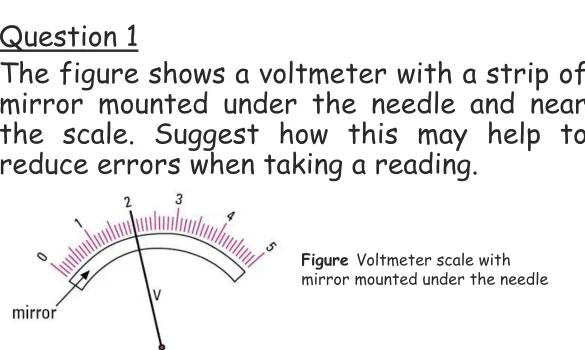
Question 1
The figure shows a voltmeter with a strip of
mirror mounted under the needle and near
the scale. Suggest how this may help to
reduce errors when taking a reading.
Test Yourself
Solution 1
When taking a reading, ensure that
your vision is placed directly above
the needle so that the image of the
needle coincides with the needle.
Test Yourself
Question 2
The diameter of a wire is measured
using a micrometer screw gauge. A
student takes an initial zero reading
and then a reading of the diameter.
What is the corrected diameter of
the wire in mm?
A
3.37
B
3.85
C
3.89
Test Yourself
Solution 2
The zero reading Z = +0.02 mm
The diameter reading D = 3.87 mm
Hence the corrected diameter reading:
D
corrected= D – Z = 3.87 – (+0.02)
=
3.85 mm
Do you know?
How can you tell the time without a
How do we measure time?
By observing events that repeat at
Measurement of Time
Instruments to Measure Time
All instruments use some kind of
periodic motion to tell time, such as
through
Oscillation of springs
Natural vibrations of crystals
Instruments to Measure Time
Mechanical watches or clocks use the
oscillations of springs
Quartz watches use the natural vibrations of
crystals
Stopwatches can measure time to a precision
of
0.1 s
Digital stopwatches can show readings to
two
Human Reaction Time
Human reaction time is about 0.3 s
to 0.5 s for most people.
Therefore, we usually take readings
Measurement of Time
Using a Pendulum to Measure Time
A simple pendulum consists of a bob
attached to a string.
A complete to-and-fro motion from R
to S and back to R is one complete oscillation.
The period T is the time taken for
Experiment 1.1
Objective
To calibrate a simple pendulum to
measure time in seconds
Apparatus
pendulum
stopwatch
metre rule
retort stand
Experiment 1.1
Procedure
Fasten the metre rule vertically Tie the pendulum to the clamp and
measure the length of the string,
l in metres
Measure the time taken t for the
pendulum to make 20 oscillations
Vary the length
l
between 60 cmExperiment 1.1
Procedure (Cont’d)
Complete the table below
Plot a graph of period T/s against
l
/m and find thelength of pendulum with a period of one second.
Plot also a graph of T2/s2 against length
l
/m.To be calculated To be measured
Results
The length of pendulum with a period of 1 second
can be read off the graph
Experiment 1.1
Question 1
Why do we need to take the average
time of 20 oscillations?
Answer 1
We take the average to account for
human reaction time. Human reaction
time is about 0.3 s for most people.
It would not be accurate to stop a
stopwatch to measure the time taken
for just one oscillation.
Question 2
What can you observe about the
graph of
T
/s vs.
l
/m?
Answer 2
The period of the pendulum,
T
,
increases with length
l
, but not
linearly.
Question 3
What does the plot of
T
2/s
2vs.
l
/m tell us?
Answer 3
It tells us that the square of the period, T2
is directly proportional to the length,
l
. This gives rise to the straight line graph
when we plot T2/s2 against
l
/m. By extending the straight line graph, we
can easily predict the period of the
pendulum for lengths that are not included in the graph we have plotted.
Key Idea
Time intervals are measured by observing
events that repeat themselves.
Clocks can be used to measure time
intervals in minutes or hours.
Stopwatches can be used to measure time
intervals to a precision of 0.1 s.
The
period
T
is the
time taken for the
Test Yourself
Question 1
Test Yourself
Solution 1
At the beginning of the week e.g. Monday,record
the time on your watch when you board the bus.
Record the time when you alight the bus.
The difference between the two times is the
time taken for the journey.
Repeat the above steps over the course of the
week until Friday.
Take the average of the time taken during the
Test Yourself
Question 2
Test Yourself
Solution 2
Start the swing in its to-and-fro motion.
When the motion is steady, start the stopwatch
when the swing is at one end of its motion.
Stop the stopwatch after 20 oscillations. Record
the time t1.
Repeat above steps for another set of reading t2.
Take average t =
The period T is given by T =
2
(t1 + t2)
20
Test Yourself
Question 3
The figure shows an oscillating pendulum. If the
Test Yourself
Solution 3
Moving from A to C to B only covers
three-quarters of the oscillation. Hence,
Work’ em Out!