
Work, energy, and power
Specification references
3.3.1 a) b) c) d) e)
3.3.2 a) b) c)
3.3.3 a) b) c)
M0.3
M1.1
M2.2, M2.3
M3.8
M4.5
Introduction
You should already be familiar with many of the equations covered in this chapter from GCSE. However, you may find the problems on work, energy, and power challenging. This worksheet aims to give you more practice and will help you to:
choose the correct equation(s) for each question
use the correct force when calculating work or power (be careful not to use mass instead of weight)
identify when you need to use a suvat equation to find a height or a velocity in a multi-stage question.
Learning outcomes
After completing the worksheet you should be able to:
calculate the kinetic energy of an object
calculate the gravitational potential energy of an object
calculate the work done when an object is acted on by a force applied in the direction of motion, or by a force applied at an angle to the direction of motion
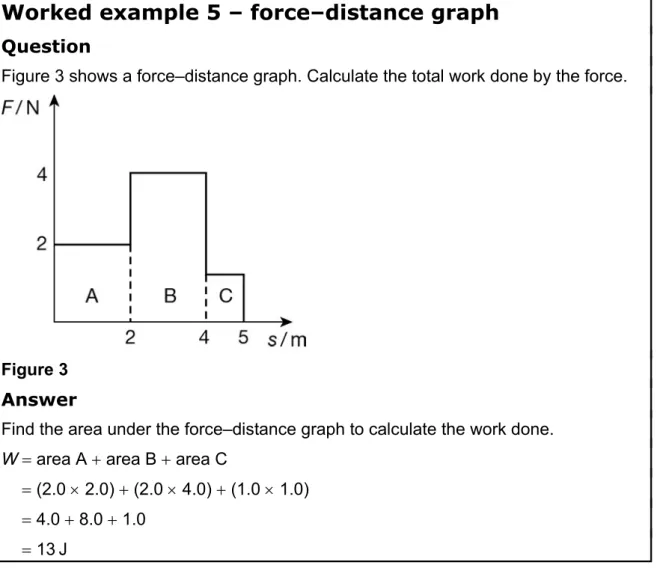
calculate the work done using a force–displacement graph
identify when work has been done against friction and, given the energy or work done, calculate the resistive force
state the law of conservation of energy and use it to explain the energy changes taking place in a particular situation
Background
Kinetic energy is the energy of an object due to its motion. For an object of mass m, moving at velocity v:
kinetic energy mass velocity2
EK m v2
Potential energy is the energy of an object due to its position. If an object of mass m is raised through a vertical height Δh at a steady speed:
change of gravitational
potential energy mass field strengthgravitational change in verticalheight
ΔEP = m g Δh
Work is done on an object when a force acting on the object makes it move. The work done is equal to the energy transferred.
When an object is acted on by a force F, applied in the direction of motion: work done force distance moved in direction of force
W F Δx
When the force is applied at an angle θ to the direction of motion,the work done is equal to the component of force in the direction of motion multiplied by the distance moved:
WF x cos θ
(The force F can be resolved into F sin θ at right angles to the direction of motion and F cos θ in the direction of motion.)
Energy cannot be created or destroyed. Whenever energy is transferred, the total amount of energy after the transfer is always equal to the total amount of energy before the transfer. This is the principle of conservation of energy.
In a problem involving only gravitational potential energy EP and kinetic
energy EK (e.g., a roller coaster ride), if the total energy (EP EK) of the object
changes as it moves, then work must have been done against friction (a resistive force).
Power is the rate of transfer of energy and can be calculated in three different ways:
o power ,
o power ,
Worked example 1 – horizontal motion
Question
An object of mass 3.0 kg is at rest, on a smooth horizontal surface, when a horizontal force of 15 N is applied to the object for 3.0 s. Calculate
a the final velocity of the object
b the distance travelled by the object
c the work done
d the final kinetic energy of the object.
Answer
Step 1
Write down the values given in the question.
m 3.0 kg
F 15 N
t 3.0 s
u 0 m s−1
v ? (the final velocity)
s ? (the distance travelled)
W ? (the work done)
EK ? (the final kinetic energy)
a Step 2
Use Fm a to find the acceleration of the object, a.
Fm a
15 3.0 a a 5.0 m s−2
Step 3
Use the suvat equation vu a t to find the final velocity, v.
v ua t
0 5.0 3.0
b Step 4
Use the suvat equation s (u v) t to find the distance travelled by the object, s.
s (uv) t
(0 15) 3.0
22.5 m
23 m (to two significant figures)
c Step 5
Use the equation W F s to calculate the work done.
WF s
15 22.5
337.5 J
340 J (to two significant figures)
d Step 6
Use the equation EK m v2 to calculate the final kinetic energy of the object.
EK m v2
3.0 152
337.5 J
Worked example 2 – velocity and power
Question
A force of 1.0 104 N acts vertically upwards on a lift, causing the lift to accelerate,
from rest, at 2.0 m s−2 for 5.0 s. Calculate
a the power after 1.0 s
b the average power needed during the 5.0 s.
Answer
Step 1
Write down the values given in the question.
F 1.0 104 N; u 0 m s−1; a 2.0 m s−2
a Step 2
Use the suvat equation vu a t to find the velocity at 1.0 s.
v ua t
0 2.0 1.0
2.0 m s−2
Step 3
Calculate the power at 1.0 s using the equation PF v and your value for velocity at 1.0 s from Step 2.
P F v
(1.0 104) 2.0
2.0 10 4 W
b Step 4
Find the velocity at 5.0 s using the suvat equation vu a t.
v ua t
0 2.0 5.0
10 m s−1
Step 5
Calculate the average velocity of the lift over the 5 seconds.
Since the acceleration is constant, average velocity
Step 6
Calculate the average power using the equation PF v and your value for average velocity from Step 5.
P F v
(1 104) 5.0
5.0 10 4 W
Worked example 3 – force at an angle
Question
A child is pulling a sledge of mass 3.2 kg as shown in Figure 1. The tension in the rope is 55 N and the rope is at an angle of 35° to the horizontal. Calculate the work done when the sledge travels a horizontal distance of 30 m
.
Figure 1 Answer
Step 1
Write down the values given in the question.
m 3.2 kg (we don’t need this value: the weight acts vertically downwards, not in the direction of the force causing the horizontal movement)
F 55 N; θ 35°; Δx 30 m
Step 2
Find the horizontal component of the tension force. horizontal component F cos θ
55 cos 35
Step 3
Use the horizontal component of the force and the horizontal distance to calculate the work done in the horizontal direction.
WF Δx
Worked example 4 – motion down a slope
Question
A skier of mass 60 kg (combined mass of person plus skis) descends a slope at an angle 30° to the horizontal. The skier passes a point P, as shown in Figure 2, at 10 m s−1. At 100 m further down the slope, at point Q, they are travelling at 20 m s−1.
Calculate
a the decrease in the gravitational potential energy of the skier between points P and Q
b the increase in the kinetic energy of the skier between points P and Q
c the average resistive force acting on the skier between points P and Q.
Figure 2
Answer
Step 1
Write down the values given in the question.
m 60 kg
θ 30°
vP 10 m s−1 (velocity at P)
vQ 20 m s−1 (velocity at Q)
Δx 100 m (distance travelled in direction of motion)
a Step 2
Calculate the change in vertical height, Δh, between points P and Q.
Δh 100 sin 30 (rearranging sin θ )
Step 3
Calculate the change in gravitational potential energy corresponding to the change in height Δh.
ΔEP m g Δh
60 9.81 50
29430 J
29 000 J
2.9 10 4 J (to two significant figures)
b Step 4
Calculate the change in kinetic energy between points P and Q. change in kinetic energy kinetic energy at Q − kinetic energy at P
ΔEK ( mvQ2) − ( m vP2)
(vQ2 − vP2)
(202 − 102)
30 (400 − 100)
9000 J
c Step 4
Calculate the work done against resistive forces (friction), W.
W ΔEP − ΔEK
29 430 − 9000
20 430 J
Step 5
Use the equation W F Δx to find the average resistive force.
WF Δx
20 430 F 100
F
204.30 N
Worked example 5 – force–distance graph
Question
Figure 3 shows a force–distance graph. Calculate the total work done by the force.
Figure 3 Answer
Find the area under the force–distance graph to calculate the work done.
W area A area B area C
(2.0 2.0) (2.0 4.0) (1.0 1.0)
4.0 8.0 1.0
13 J
Questions
1 A weightlifter lifts a weight of 2000 N a distance of 2.1 m from the floor in 2.4 s. Calculate their average power. (2 marks)
2 A car of weight 1.5 104 N drives up a slope at a steady speed of 12 m s−1. The
car gains 1.0 m of height for every 10 m travelled in the horizontal direction. Calculate the power of the engine. (2 marks)
3 An object of 10 kg is initially at rest when a horizontal resultant force of 30 N is applied to it for 4.0 s. Assuming frictional forces are negligible, calculate:
a the distance travelled by the object (3 marks)
b the work done on the object (2 marks)
4 A cricket ball of mass 0.16 kg is thrown vertically upwards with an initial velocity of 25 m s−1. If the ball reaches a maximum height of 20 m, calculate the percentage
energy transferred due to air resistance. (4 marks)
Exam-style question
5 A 5.0 kg block of ice is at rest at the top of a smooth inclined plane. The block is released and slides 2.0 m down the plane. Assuming there is no friction between the block and the surface, calculate:
a the gravitational potential energy at the top of the plane (2 marks)
b the component of the weight parallel to the plane (3 marks)
c the acceleration of the block(1 mark)
d the velocity of the block at the bottom of the plane (2 marks)
![Momentum&Energy[1].pptx](data:image/gif;base64,R0lGODlhAQABAIAAAP///wAAACH5BAEAAAAALAAAAAABAAEAAAICRAEAOw==)