Cryptography and Security
Cryptography and Security
Mechanisms
Mechanisms
Nazar Abbas Saqib
[email protected]
Agenda
Agenda
Definitions:
Information Security
Computer, Network , Internet and communication Security
Security Architecture
Security attacks
Security Services
Computer Security
Method of protecting information, computer programs, and other computer system assets while they are connected to the network. Include operating system security, software security, access control & physical security etc.
Network Security
Measures to protect data during their transmission on a computer network, like data protection, data and source authentication etc
Internet Security
:
M
easures to protect data during their transmission over a collection of interconnected networks
Communication Security
Measures and controls taken to deny unauthorized persons information derived from telecommunications and ensure the authenticity of such telecommunications. Communications security includes:
crypto-security, transmission security, emission security, and physical security
Information security Information security Information security
Information security means protecting information and information systems from unauthorized access, use, disclosure, disruption,
modification or destruction.
3 main components of Information system:
• Software
• Hardware
• Communications
3 main Information Security Goals: (3)
• Confidentiality (C)
• Integrity (I) [CIA]
• Availability (A)
3 levels of Information Security:
Security Technologies
Security Technologies
Security technologies help protect systems and information against attacks, detect unusual or suspicious activities, and respond to events that affect security.
There are two core areas:
1.
1.
1.
1. Operational technology
Operational technology
Operational technology
Operational technology
• The purpose of operational technology is to maintain and defend the availability of data resources in a secure manner
• includes firewalls, monitoring tools, Security analysis tools etc
2.
2.
2.
2. Cryptography
Cryptography
Cryptography
Cryptography
Security policy
Security policy
Security policy
Security policy
Security policy
Security policy
A set of rules and practices that specify or regulate
how a system or organization provides security
services to protect sensitive and critical system
resources
1. Restricting physical access to workstations to only authorized personnel.
2. Securing workstations (screen lock or logout) prior to leaving area to prevent unauthorized access. 3. Enabling a password-protected screen saver with a short timeout period to ensure that workstations
that were left unsecured will be protected
4. Complying with all applicable password policies and procedures.
5. Ensuring workstations are used for authorized business purposes only. 6. Never installing unauthorized software on workstations.
7. Storing all sensitivity information, including protected health information (PHI) on network servers 8. Keeping food and drink away from workstations in order to avoid accidental spills.
9. Securing laptops that contain sensitivity information by using cable locks or locking laptops up in drawers or cabinets.
10. Complying with the Portable Workstation Encryption policy 11. Complying with the Anti-Virus policy
12. Ensuring that monitors are positioned away from public view. If necessary, install privacy screen filters or other physical barriers to public viewing.
13. Ensuring workstations are left on but logged off in order to facilitate after-hours updates. Exit running applications and close open documents
14. Ensuring that all workstations use a surge protector (not just a power strip) or a UPS (battery backup). 15. If wireless network access is used, ensure access is secure by following the Wireless Access policy
Workstation Security P
Workstation Security Policy
olicy
Security Attack:
An intelligent act that is a deliberate attempt to evadesecurity services and violate the security policy of a system
Security Mechanism:
A mechanism that is designed to detect,prevent, or recover from a security attack
Security Service:
A processing or communication service that isprovided by a system to give a specific kind of protection to system resources; security services implement security policies and are implemented by security mechanisms
Example: Data Confidentiality is a security service which can be provided through
encipherment- a security mechanism, to avoid data disclosure (security attack)
Security Attacks
Security Attacks
Any action that compromises the security of information owned by
an organization
Often threat & attack used to mean same thing
Threat: a possible danger that might exploit a vulnerability
(RFC2828)
Attack: An intelligent act that is a deliberate attempt to evade
Security attack classification
Security attack classification
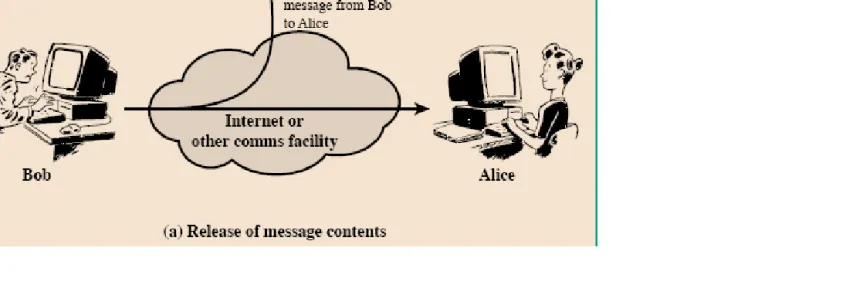
Release of message contents
Traffic analysis
Masquerade
Replay
Modification of message contents
Denial of Service
Passive
Active
Passive Attacks
Passive Attacks
Passive attacks are those attacks where attacker aims to obtain
information that is in transit but does not affect the system resources
The attacker does by eavesdropping or monitoring of data transmission No modification of data - therefore referred to as ‘passive’
Difficult to detect
Passive attacks are further classified into two sub-categories:
Passive attacks
Passive Attacks (Interception)
Passive Attacks (Interception)
Release
Release of
of message
message contents
contents
toto intendedintended receiverreceiver onlyonly..The
The attackattack refersrefers releaserelease ofof messagemessage contentscontents inin transittransit toto aa third
third partyparty (attacker)(attacker) againstagainst thethe wishwish ofof thethe sendersender
ExampleExample:: SendingSending aa confidential mailmail toto aa friendfriend.. ItIt isis desireddesired thatthat
only
only he/shehe/she willwill getget itit
HowHow toto preventprevent it?it?
MessageMessage cancan bebe codedcoded usingusing aa codingcoding languagelanguage
understandable
understandable onlyonly toto bothboth endsends.. TheThe attackerattacker therefore
Passive Attacks (Interception)
Passive Attacks (Interception)
TrafficTraffic analysisTrafficTraffic analysisanalysis attackanalysis attackattackattack:::: attempt to analyze (encoded) messages
to come up with likely patterns that provides some clues regarding the communication that is taking place b/w two parties
What could be observed?
How
How toto preventprevent it?it?
Example: Host and destination addresses, frequency of
the messages, type of messages, etc.
1.
1. Message can be coded Message can be coded 2.
2. Random messages when no Random messages when no message is transmitted
message is transmitted 3.
3. Message padding ( message Message padding ( message length)
Active Attacks
Active Attacks
ActiveActive attacksattacks attemptattempt toto alteralter systemsystem resourcesresources oror affectaffect theirtheir
operation
operation.. TheThe contentscontents ofof thethe originaloriginal messagemessage areare modifiedmodified inin some
some wayway
ItIt cancan bebe inin thethe formform ofof interruption,interruption, modificationmodification andand fabricationfabrication
RelativelyRelatively easiereasier toto detectdetect
Active Attacks
Active Attacks
MasqueradeMasqueradeMasqueradeMasqueradeMasqueradeMasqueradeMasqueradeMasquerade is caused when an unauthorized entity pretends to be
another entity.
Ex. User C might pose to user A, User B might led to believe that
the message indeed come from A
Ex. Capturing user’s authentication sequence (login ID &
Active Attacks
Active Attacks
ModificationModification:::: refer a change in some part of legitimate message,ModificationModification
delay in the message, or reordering the message producing an unauthorized affect
Ex. “Allow John Smith to read confidential file accounts” is modified to
“Allow Fred Brown to read confidential file accounts”
Two sub-categories of Modification attack are Replay attack and Alteration
Active Attacks
Active Attacks
In a ReplayReplayReplayReplayReplayReplayReplayReplay AttackAttackAttackAttackAttack, a user captures a sequence of events or some dataAttackAttackAttack
units and resends them
Ex. User A & User B have accounts in a bank myBank. Users A sends
Active Attacks
Active Attacks
DenialDenialDenialDenialDenialDenialDenial ofDenial ofof Serviceofofofofof Service ((((((((DoSServiceServiceServiceServiceServiceService DoSDoSDoSDoS)))))))) attacks make an attempt to preventDoSDoSDoS
legitimate users from accessing services which they are eligible for
How to launch DoS?
1. Burning up computational resources, such as bandwidth, disk space, or processor time.
2. Disruption of configuration information, such as routing information.
3. Disruption of state information, such as unsolicited resetting of TCP sessions.
4. Disruption of physical network components.
5. Obstructing the communication media between the intended users and the victim so that they can no longer communicate adequately.
RFC 2828, provides the following definitionRFC 2828, provides the following definitionRFC 2828, provides the following definitionRFC 2828, provides the following definition
:
:
:
:
“A processing or communication service that is provided by a system to give a specific kind of protection to system resources; security services implement security policies and are implemented by security mechanisms”
X.800 divides these services into five categories:X.800 divides these services into five categories:X.800 divides these services into five categories:X.800 divides these services into five categories:
1) Authentication 2) Access Control
3) Data Confidentiality 4) Data Integrity
5) Non-repudiation
Data Confidentiality
Protection of data from unauthorized disclosure
Message sent by User A is only exposed to its intended recipient
‘User B’
Security Services
Security Services
Security Services
Security Services
Security Services
Security Services
Security Services
Security Services
Example (Fig)
User A sends an extension plan of his future products to User B – highly confidential
The attacker gets access to data files while transmission w/o the permission or knowledge
Data Integrity
Assurance that data received are exactly as is sent by an authorized
entity
Contain no modification, insertion, deletion, or replay
Can be applied to stream of messages, a single message or selected
fields within a message
Authentication:
Assurance that the communicating entity is the oneclaimed
Peer Entity Authentication: established at the time of connection or a the time
of data transfer (thus associated with a logical connection). It provides confidence that
– Entity is not performing a masquerade or
– Entity is not performing unauthorized replay of a previous connection
Data Origin Authentication (in a connectionless transfer)
– provides confirmation about the source of the data
– Does not provide protection against duplication or modification of data units
Security Services
Security Services
Example (Fig)
The attacker pose User A and sends a funds transfer request to bank (from A to attacker’s
Access Control :
Determines who should be able to access
what
e.g. User A can view the records in database but cannot update Role Based: which user can do what (
User Side
)Rule based: which resource is accessible and under what
circumstances (
Resource Side
)
Access Control List (ACL)
specifies and controls who can accesswhat
Security
Security
Security
Security
Security
Security
Security
Non-repudiation
Protection against denial by one of the parties in a
communication
Sender cannot deny that he has not sent the message
Receiver cannot deny that he has not received the message
Availability
Ensures that a service or information is available to an (authorized)
user upon demand and without delay.
Denial of Service (DoS) attacks
seek to interrupt a service or makesome information unavailable to legitimate users
Security Services
Example (Fig)
Due to the intentional action of attacker, Users A is not able to access
Security Attacks
Security Attacks vs
vs Security Services
Security Services
Process of an attacker getting hold of a message in transit before it reaches the intended recipient. This is attack on confidentiality
Attack on a message where its contents are changed. This is attack on integrity
False message created by Attacker to distort the attention of the authorized users. This is attack on authenticity
Terminologies
Terminologies
Plaintext
The actual text or original data (The input to an encryption function or
the output of a decryption function)
Encryption
The conversion of plaintext or data into unintelligible form by means of
a reversible translation, based on a translation table or algorithm. Also called enciphering
Ciphertext
The output of an encryption algorithm; the encrypted form of a
message or data
Decryption
The translation of encrypted text or data (called ciphertext) into
original text or data (called plaintext). Also called deciphering.
Cipher
An algorithm for encryption and decryption. A cipher replaces a piece
Terminologies
Terminologies
Key
The secret information in a cryptographic operation
Digital Signature
An authentication mechanism that enables the creator of a message to
attach a code that acts as a signature. The signature is formed by taking the hash of the message and encrypting the message with the creator's private key. The signature guarantees the source and
integrity of the message
Hash
Fingerprint of the message. Identifies a message uniquely
Hash function
A function that maps a variable-length data block or message into a
Security Mechanism
Security Mechanism
Security Mechanism
Security Mechanism
Security Mechanism
Security Mechanism
Security Mechanism
Security Mechanism
Encipherment
The use of mathematical algorithms to transform data into a form
that is not readily intelligible. The transformation and subsequent recovery of the data depend on an algorithm and zero or more encryption keys.
Access Control
A variety of mechanisms that enforce access rights to resources. Data Integrity
A variety of mechanisms used to assure the integrity of a data
Security Mechanism
Security Mechanism
Security Mechanism
Security Mechanism
Security Mechanism
Security Mechanism
Security Mechanism
Security Mechanism
Authentication ExchangeA mechanism intended to ensure the identity of an entity by
means of information exchange.
Traffic Padding
The insertion of bits into gaps in a data stream to frustrate
traffic analysis attempts.
Routing Control
Enables selection of particular physically secure routes for
certain data and allows routing changes, especially when a breach of security is suspected.
Notarization
The use of a trusted third party to assure certain properties of a
Relationship b/w
Relationship b/w
Relationship b/w
Relationship b/w
Relationship b/w
Relationship b/w
Relationship b/w
Relationship b/w Security Services &
Security Services &
Security Services &
Security Services &
Security Services &
Security Services &
Security Services &
Security Services &
Mechanisms
Mechanisms
Mechanisms
Mechanisms
Mechanisms
Mechanisms
Mechanisms
Mechanisms
Security Mechanisms
Service Encipherment Digital signatur e Access control Data integrity Authenticatio n exchange Traffic paddin g Routing Control Notarizati on
Model for Network Security
Model for Network Security
Using this model requires to:
1. design a suitable algorithm for the security transformation 2. generate the secret information (keys) used by the algorithm 3. develop methods to distribute and share the secret information 4. specify a protocol enabling the principals to use the
Model for Network
Model for Network Access Security
Access Security
Using this model requires us to:
1. First line of Defence: First line of Defence: First line of Defence: First line of Defence: Select appropriate gatekeeper functions to identify authorized and to stop unauthorized(hackers, intruders, disgruntled employees)
2. Second Line of Defence:Second Line of Defence:Second Line of Defence:Second Line of Defence: Implement security controls to monitor