www.ann-geophys.net/27/2141/2009/
© Author(s) 2009. This work is distributed under the Creative Commons Attribution 3.0 License.
Annales
Geophysicae
Overview and summary of the Spread F Experiment (SpreadFEx)
D. C. Fritts1, M. A. Abdu2, B. R. Batista2, I. S. Batista2, P. P. Batista2, R. Buriti3, B. R. Clemesha2, T. Dautermann4, E. R. de Paula2, B. J. Fechine2, B. G. Fejer5, D. Gobbi2, J. Haase4, F. Kamalabadi6, E. A. Kherani2, B. Laughman1, P. P. Lima3, H.-L. Liu7, A. Medeiros3, P.-D. Pautet5, D. M. Riggin1, F. S. Rodrigues8, F. S˜ao Sabbas2, J. H. A. Sobral2, P. Stamus1, H. Takahashi2, M. J. Taylor5, S. L. Vadas1, F. Vargas9, and C. M. Wrasse10
1NorthWest Research Associates, CoRA Division, Boulder, CO, USA
2Instituto Nacional de Pesquisas Espaciais (INPE), S˜ao Jos´e dos Campos, Brazil 3Universidade Federal de Campina Grande, Campina Grande, Paraiba, Brazil 4Purdue University, West Lafayette, IN, USA
5Utah State University, Logan, UT, USA 6University of Illinois, Urbana, IL, USA
7National Center for Atmospheric Research, Boulder, CO, USA 8Cornell University, Ithaca, NY, USA
9Intelekto Consultancy, S˜ao Paulo, Brazil
10Instituto Nacional de Pesquisas Desenvolvimento, UNIVAP, S˜ao Jos´e dos Campos, Brazil
Received: 21 April 2008 – Revised: 20 October 2008 – Accepted: 4 May 2009 – Published: 11 May 2009
Abstract. We provide here an overview of, and a summary of results arising from, an extensive experimental campaign (the Spread F Experiment, or SpreadFEx) performed from September to November 2005, with primary measurements in Brazil. The motivation was to define the potential role of neutral atmosphere dynamics, specifically gravity wave motions propagating upward from the lower atmosphere, in seeding Rayleigh-Taylor instability (RTI) and plasma bub-bles extending to higher altitudes. Campaign measurements focused on the Brazilian sector and included ground-based optical, radar, digisonde, and GPS measurements at a num-ber of fixed and temporary sites. Related data on convection and plasma bubble structures were also collected by GOES 12, and the GUVI instrument aboard the TIMED satellite.
Initial results of our SpreadFEx analyses are described separately by Fritts et al. (2009). Further analyses of these data provide additional evidence of 1) gravity wave (GW) activity near the mesopause apparently linked to deep con-vection predominantly to the west of our measurement sites, 2) small-scale GWs largely confined to lower altitudes, 3) larger-scale GWs apparently penetrating to much higher al-titudes, 4) substantial GW amplitudes implied by digisonde electron densities, and 5) apparent influences of these per-turbations in the lower F-region on the formation of equa-torial spread F, RTI, and plasma bubbles extending to much
Correspondence to: D. C. Fritts ([email protected])
higher altitudes. Other efforts with SpreadFEx data have also yielded 6) the occurrence, locations, and scales of deep con-vection, 7) the spatial and temporal evolutions of plasma bub-bles, 8) 2-D (height-resolved) structures in electron density fluctuations and equatorial spread F at lower altitudes and plasma bubbles above, and 9) the occurrence of substantial tidal perturbations to the large-scale wind and temperature fields extending to bottomside F-layer and higher altitudes. Collectively, our various SpreadFEx analyses suggest direct links between deep tropical convection and large GW pertur-bations at large spatial scales at the bottomside F-layer and their likely contributions to the excitation of RTI and plasma bubbles extending to much higher altitudes.
Keywords. Ionosphere (Ionosphere-atmosphere interac-tions) – Meteorology and atmospheric dynamics (Thermo-spheric dynamics; Waves and tides)
1 Introduction
is believed to be responsible for these plasma instabilities, and nonlinear RTI growth often causes these plasma bubbles to rise to the topside ionosphere, where well- developed bub-bles may attain apex heights of∼1000–1500 km. Plasma bubbles penetrate to high altitudes on only∼30 to 60% of nights, however. They are also apparently uncorrelated at closely spaced longitudes, but may share seeding conditions, and exhibit seasonal, solar-cycle, geographic, and geomag-netic dependencies suggestive of neutral atmosphere and so-lar influences (McClure et al., 1977; Sobral et al., 1980a, b, 2002; Mendillo and Tyler, 1983; Abdu et al., 1992; Aggson et al., 1992; McClure et al., 1998; Fejer et al., 1999; Sobral et al., 2001; Hysell and Burcham, 2002; Rodrigues et al., 2003; Stolle et al., 2006). In particular, geographic occurrence of ESF appears to be correlated with regions of enhanced equa-torial convection (McClure et al., 1998), while increasing so-lar flux is correlated with greater PREs of plasma drift, earlier ESF seeding and irregularity appearance, and higher initial altitudes (Hysell and Burcham, 2002).
Geographic variability, solar cycle dependence, and the spatial scales at which plasma bubbles arise are all poten-tially indications of the influences of neutral atmosphere dy-namics on plasma instability processes at the bottomside F-layer. Indeed, they all indicate a potential role for gravity waves (GWs) arising from sources in the lower atmosphere or the mesosphere and lower thermosphere (MLT) in provid-ing horizontal and vertical wind, neutral and plasma density, and polarization electric field perturbations contributing to plasma instability growth rates. The potential for GW ef-fects has been recognized for many years, and has provided the motivation for various modeling and theoretical studies (Woodman and LaHoz, 1976; Klostermeyer, 1978; Ander-son et al., 1982; Valladares et al., 1983; Kelley, 1989; Hysell et al., 1990; Huang et al., 1993; Huang and Kelley, 1996a, b, c; Sekar and Kelley, 1998: Taylor et al., 1998). For exam-ple, GW density or velocity perturbations of a few % are a critical seed element in all of the models that have sought to describe RTI and plasma bubble growth and morphology. To date, however, there has been no definitive proof, from ob-servations, modeling, or theory, that GWs do provide a key element in seeding RTI and the plasma bubbles that penetrate to much higher altitudes.
There is compelling evidence, however, that deep convec-tion is a major source of GWs having sufficiently large hor-izontal and vertical wavelengths, horhor-izontal phase speeds, and vertical group velocities to penetrate efficiently to MLT altitudes and above (Taylor and Hapgood, 1988; Piani et al., 2000; Tsuda et al., 2000; Lane et al., 2001; Lane and Clark, 2002; Sentman et al., 2003; Vadas and Fritts, 2003, 2005, 2006, 2009) and that lower atmosphere sources remain competitive with auroral sources even at very high altitudes (Hocke and Schlegel, 1996; Fritts and Vadas, 2008, here-after FV08). There is persuasive evidence that GWs hav-ing large spatial scales and high frequencies routinely con-tribute neutral and plasma perturbations extending to the
bot-tomside F-layer and above (Oliver et al., 1997; Djuth et al., 1997, 2004; Livneh et al., 2007; Earle et al., 2008; Vadas and Nicolls, 2008). There is also evidence that horizontal and vertical wind and neutral and plasma density perturba-tions at bottomside F-layer altitudes may be significant (Earle et al., 2008; Abdu et al., 2009; FV08; Fritts et al., 2008, 2009, hereafter F08 and F09; Kamalabadi et al., 2009). We note that anticipated arrival times at the bottomside F-layer of large-amplitude GWs arising from tropical convection are up to∼1 to 2 h after maximum late afternoon convective ac-tivity (Vadas and Fritts, 2003; FV08) and coincide closely with early evening times of strong ESF and bubble onset (Swartz and Woodman, 1998). But it is also apparent that GWs are unlikely to act alone at the bottomside F-layer, as tidal wind and temperature perturbations may likewise be very significant at bottomside F-layer altitudes, and will have major impacts on GW propagation and refraction at the alti-tudes where they induce large changes in the GW propaga-tion environment. Indeed, several studies suggest that tidal winds normal to the magnetic field may play a role in RTI and plasma bubble initiation (see Meriwether et al., 2008; F08; F09). Here, we generalize these arguments and suggest that GW and tidal perturbations conspire to yield correlations among neutral and plasma perturbations at the bottomside F-layer that potentially enhance all of the perturbation fields expected to increase plasma instability growth rates simulta-neously (F08; Abdu et al., 2009; Kherani et al., 2009).
amplitudes, scales, and propagation directions, 3) GW prop-agation and dissipation theory, 4) plasma perturbations in the F-layer, 5) GW and tidal perturbations at the bottom-side F-layer and their potential influences on plasma instabil-ity growth rates, and 6) observational and modeling studies of mesospheric bores not directly related to our SpreadFEx goals, but enabled by the data obtained during our measure-ment campaign.
2 Overview of the spread F experiment (SpreadFEx)
Our goal in SpreadFEx was to perform observational and modeling studies aimed at quantifying the potential roles of GWs in seeding plasma instabilities and RTI at the bottom-side F-layer and plasma bubbles penetrating to higher alti-tudes. Given the statistical links of plasma bubbles to tropi-cal convection, we designed an experiment aimed at provid-ing sensitivity to both neutral atmosphere responses to deep convection and plasma instabilities and structures at higher altitudes. We chose to perform our experiment in Brazil, where colleagues at Instituto Nacional de Pesquisas Espa-ciais (INPE) have extensive instrumentation for, and experi-ence with, studies of the equatorial neutral atmosphere and ionosphere. The specific role envisioned for GWs was via generation by deep convection, propagation into the thermo-sphere and ionothermo-sphere (TI) (with amplitude growth due to decreasing density and refraction and filtering by large-scale winds), attainment of large GW horizontal and vertical wind, temperature, and neutral and plasma density perturbations at the bottomside F-layer, and GW and tidal modulation of RTI growth rates and potential seeding of plasma bubbles extend-ing to higher altitudes. This scenario is depicted in Fig. 1. Specific questions motivating the design of our measurement campaign and our subsequent analysis, modeling, and theo-retical efforts include
1. Do GWs play a significant role in seeding plasma insta-bilities at the bottomside F-layer and plasma bubbles at greater altitudes?
2. How do GW perturbations to the bottomside F-layer al-ter the seeding conditions conducive to initial plasma instabilities and RTI?
3. If GWs are an important component in plasma instabil-ities and bubble seeding, what are the geophysical pa-rameters controlling their influences?
4. Are GW roles in plasma instability and bubble seeding sufficiently correlated with other measured geophysical parameters to allow their parameterization?
To begin to address these questions, we designed a research program composed of three components: an experimental campaign, a series of analysis efforts, and supporting mod-eling and theoretical studies. The experimental campaign
deep convection
HF GWs, T ~ 10 – 60 min
mesopause GWs (OH) ~ 87 km E/F-layer GWs (5577, 6300)
[image:3.595.311.546.68.197.2]and body forcing ~ 250 km
Fig. 1. Cartoon of GWs arising from deep convection, their
propa-gation to higher altitudes, and their potential contributions to plasma perturbations, instabilities, and plasma bubble seeding. Slanted lines denote GW phase surfaces in a 2-D plane, rings denote air-glow signatures near the mesopause, and the shaded region denotes the bottomside F-layer with plasma density, velocity, and/or polar-ization electric field perturbations accompanying GW neutral per-turbations. The bold arrow indicates the body forcing accompany-ing GW dissipation at high altitudes.
included two measurement sequences during “moon down” conditions from 25 September to 10 October and from 23 October to 8 November 2005. Our initial intent was to co-ordinate these measurements with initial data collection by the C/NOFS satellite, but successive launch delays caused us to go forward as a “stand-alone” campaign. SpreadFEx measurement sequences employed a suite of airglow cam-eras, VHF and meteor radars, digisondes, and GPS receivers at a number of fixed and temporary sites in Brazil. Cor-relative measurements were also performed with the Global UltraViolet Imager (GUVI) instrument aboard the Thermo-sphere, IonoThermo-sphere, MesoThermo-sphere, Energetics and Dynamics (TIMED) satellite. Additional correlative opportunities were made possible through routine data collection by the Jica-marca Radio Observatory (JRO) in Peru and continuous mea-surements by the Geostationary Operational Environmental Satellite (GOES) 12 satellite. GUVI measured electron den-sities via 1356 ˚A emissions extending from∼100 to 600 km on several days coincident with our SpreadFEx ground-based measurements, while GOES 12 yielded continuous data on the locations, scales, and intensities of tropical convection throughout our measurement sequences. JRO data, while potentially useful for correlative studies, have not been em-ployed for SpreadFEx studies to date. The second and third components of the SpreadFEx research program, our various SpreadFEx data analyses and the supporting modeling and theoretical efforts, have provided the basis for the majority of the results reported in this special issue.
Table 1. Instrumentation at the fixed INPE and temporary SpreadFEx measurements sites employed for our experiment. GPS were also
available at∼20 other locations in Brazil.
Site Geogr. Geogr. Magnetic airglow VHF meteor digisonde GPS latitude longitude latitude imager radars radar
S˜ao Luis 2.6 S 44 W 1.5 S × × ×
Fortaleza 3.9 S 38 W 5 S × ×
Cariri 7.4 S 36 W 8 S × × ×
Fazenda Isabel 15 S 47 W 9 S × ×
Cach. Paulista 22.7 S 45 W 17 S × × × ×
São Luis (2 S, 44 W): digisonde
VHF radars (30 & 50 MHz) Fortaleza (4 S, 38 W):
digisonde São João do Cariri (7 S, 36 W):
all-sky imager meteor radar photometer Brazilia (15 S, 47 W): all-sky imager GPS cluster Cachoeira Paulista (23 S, 45 W):
digisonde photometer meteor radar all-sky imager
magnetic equator
30 S BR
optical, radar, digisonde, and GPS measurement sites in Brazil employed for SpreadFEx
geographic equator
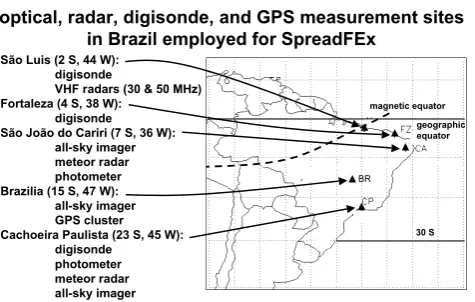
Fig. 2. Measurement sites in Brazil employed for the SpreadFEx
measurement campaigns. GPS receivers were much more widely distributed, with∼25 sites available for SpreadFEx.
was located at several fixed sites, including S˜ao Luis, Fort-aleza, Cariri, and Cachoeira Paulista extending from∼2 to 23◦S geographic latitude and from ∼0 to 17◦S magnetic latitude, with GPS instrumentation more widely distributed. VHF radars at S˜ao Luis defined ESF altitudes and plasma bubble structures at the magnetic equator (de Paula and Hy-sell, 2004), meteor radars defined MLT winds at Cariri and Cachoeira Paulista (Batista et al., 2004; Buriti et al., 2008), digisondes defined electron densities at several dip latitudes (Batista and Abdu, 2004), airglow cameras defined both GW structures at MLT altitudes and plasma bubble structures at higher altitudes in the thermosphere at several locations south of the magnetic equator in order to assess the spa-tial and temporal variability of these processes (Medeiros et al.., 2004), and GPS instrumentation was employed to at-tempt to define the spatial and temporal variations in elec-tron densities (Lanyi and Roth, 1988). Additional optical and GPS instrumentation was placed at several temporary sites at Fazenda Isabel north of Brasilia and several nearby sites. The instrument locations and their relation to the magnetic equa-tor are listed in Table 1 and shown in Fig. 2.
3 Convective activity, locations, and intensities
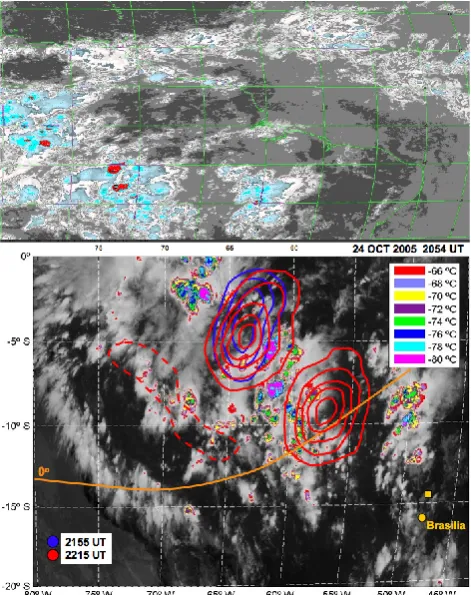
[image:4.595.50.288.218.369.2]10◦S and from ∼30 to 55◦W (upper image in Fig. 3), in
closer proximity to our measurements at S˜ao Luis and Fort-aleza discussed at length in several of the papers in this spe-cial issue. These times are of particular interest, as these days were one of several intervals found to coincide with consid-erable perturbations of the bottomside F-layer and ESF and plasma bubbles penetrating to much higher altitudes seen in radar and digisonde data obtained at S˜ao Luis and Fortaleza (see Abdu et al., 2009; Kherani et al., 2009).
4 GW occurrence, scales, propagation directions, and amplitudes
Our primary SpreadFEx observations of GWs in the neutral atmosphere were performed at Brasilia and Cariri, as these were the sites that had the most favorable viewing condi-tions and were closest (∼10◦) to the dip equator (Taylor et al., 2009; Takahashi et al., 2009). These were also the sites at magnetic latitudes at which we anticipated possible sensitivity to the GWs thought to play a role in ESF and plasma bubble seeding through field- aligned perturbations at lower altitudes off the dip equator. Keograms of OH air-glow brightness in the east-west plane at Brasilia and Cariri, are employed by Takahashi et al. (2009) and F08 to estimate GW propagation directions, wavelengths, and phase speeds. The large majority of the observed GWs were found to have an eastward component of propagation, suggesting that the primary sources of these GWs were likely deep convection occurring preferentially to the west of these sites, but with both northward and southward components, depending on the source location (Takahashi et al., 2009). Typical zonal wavelengths and zonal trace speeds were observed to be∼20 to 150-km and ∼40 ms−1 at Brasilia and ∼50 to 300-km and∼70 ms−1 at Cariri. Some caution is warranted in as-suming these are horizontal wavelengths and phase speeds, however, as propagation directions also often had significant northward or southward components, causing the zonal trace speeds to over-estimate the true horizontal wavelengths and phase speeds to some degree (Taylor et al., 2009). Addition-ally, airglow instrumentation is unable to characterize GW scales, propagation, or the likely convective GW source lo-cations when skies are cloudy, so we expect them to have been insensitive to convection in their immediate proximity. This was the case during the period from 24 to 27 October, when GOES 12 imagery indicated deep convection over east-ern Brazil and extending northward over the Atlantic.
Amplitudes for some of the more prevalent GWs occurring at larger horizontal wavelengths in the MLT airglow layers are estimated by Vadas and Fritts (2009, hereafter VF09). Airglow intensity perturbations for GW horizontal wave-lengths of∼60 to 160 km are found to be in the range∼2 to 7%, implying fractional temperature perturbations of∼1 to 2% (assuming a Krassovsky ratio ofη=(I0/I )/(T0/T)∼3.3). Estimates of horizontal velocity perturbations and
momen-Fig. 3. GOES 12 convection observed in the IR channel at 20:54 UT
on 24 October 2005. Cloud top temperatures are color coded, with solid (dashed) contours showing positive (negative) zonal GW mo-mentum flux magnitudes at 200 km altitude at 21:55 and 22:15 UT (blue and red lines). The dominant GW propagation was eastward at this altitude due to primarily westward and large and variable merid-ional winds filtering of GWs initially propagating more isotropi-cally. Note also that the smaller horizontal wavelength GWs have high-altitude signatures earlier and closer to the convective sources than the larger scales.
[image:5.595.310.546.63.361.2]Fig. 4. Zonal (left) and meridional (center) wind and temperature (right) profiles at (45◦W, 10◦S) used for ray tracing the GWs arising from the deep convective plumes observed in Fig. 3. The profiles were defined by balloon soundings below 30 km, by meteor radar observations between 80 and 110 km, and by a TIME GCM simulation initialized with the NCEP reanalysis data for this same period from 35 to 80 km and from 110 to 350 km. Note the variable wind structure up to∼110 km and the large meridional motions extending to higher altitudes, all of which have significant influences on GW propagation to high altitudes.
5 GW propagation and dissipation theory
Characterization of deep convection during several intervals, together with measured or anticipated winds during the same periods, is employed by V09 to perform ray tracing of GWs assumed to arise from these sources into the MLT. Portions of the initial GW spectrum for each convective source are an-ticipated to have reached altitudes of 200 km and above. Ex-amples of the predicted zonal momentum flux distributions at two times following convective excitation (separated by 20 min) are shown with the blue and red contours in Fig. 3b and exhibit the significant spatial and temporal variability ex-pected in GW responses to transient convection and spatially-variable mean winds. Wind and temperature profiles em-ployed for this study are shown in Fig. 4. While these re-sults are highly idealized, they clearly suggest a tendency for GWs having smaller horizontal wavelengths and higher ver-tical group velocities (corresponding to higher intrinsic fre-quencies) to yield earlier responses closer to the convective source.
The GW wavelength, amplitude, and momentum flux es-timates summarized above, together with reverse ray trac-ing to infer distances from likely convective sources by V09, are employed by VF09 to constrain representative convec-tive GW source spectra for individual convecconvec-tive plumes and small convective complexes arising from our Fourier-Laplace description of these sources. In particular, this ef-fort provides the most defensible link to date between ob-served GW scales and amplitudes and the GW spectra char-acterizing individual convective plumes and small convective complexes. The resulting source spectra allow F08 to antici-pate likely peak GW amplitudes arising from these sources at MLT altitudes and for their extrapolation to higher altitudes for various thermospheric temperature and wind profiles. An evaluation of the refraction, filtering, and dissipation of GWs
6 Plasma perturbations in the F-layer
A major focus of our SpreadFEx measurement campaign and our subsequent data analyses was the characterization of per-turbations to plasma quantities from below the bottomside F-layer to much higher altitudes. This included 1) identi-fication of the amplitudes, spatial and temporal scales, mo-tions, and morphologies of electron densities and gradients at all altitudes where SpreadFEx measurements provided sen-sitivity, 2) determination of the sources of the various per-turbations (i.e., either a manifestation of neutral dynamics inducing plasma signatures or a response to purely plasma processes), and 3) identification of potential links and/or cor-relations between apparently neutral and plasma processes. Plasma perturbations ranged from structures at the bottom-side F-layer having small horizontal scales and limited verti-cal extent to plasma bubbles extending over hundreds of km in altitude and yielding large density perturbations seen with our various SpreadFEx instrumentation.
SpreadFEx measurements in the ionosphere employed ground-based VHF radars, 6300 ˚A airglow imagers, GPS re-ceivers, and digisondes, at various sites in Brazil and the GUVI instrument aboard the TIMED satellite. The higher and deeper perturbations seen at the higher altitudes are con-sidered unambiguous indications of plasma bubbles initiated via initial plasma instabilities and RTI at the bottomside F-layer and extending to the topside. Electron density perturba-tions seen before plasma bubbles are expected to occur, how-ever, are more likely to be plasma signatures of neutral dy-namics arising from tidal and GW perturbations of the iono-sphere. Only at the bottomside F-layer do we expect to see plasma structures that may have an ambiguous interpretation and include perturbations due to neutral and plasma dynam-ics together that may be causally related.
Plasma bubbles extending into the topside F-layer are characterized in this special issue using a 30 MHz VHF radar (beamwidth∼16◦), 6300 ˚A airglow imagers, GPS receivers, and the GUVI instrument by Abdu et al. (2009) and Kamal-abadi et al. (2009), respectively. Range-time intensity (RTI) plots of VHF radar backscatter power are shown in Fig. 5 for two nights during the second SpreadFEx measurement inter-val, 24/25 and 25/26 October 2005, that are of particular in-terest in our analyses. These show plasma bubbles apparently initiated near 250 km and extending to over 600 km with a temporal spacing between 1 and 2 h (see Abdu et al., 2009, for further discussion). Significantly, these responses at the bottomside F-layer coincide with the presence of deep con-vection∼800 km south and northwest of S˜ao Luis and Fort-aleza at this time (see Fig. 3a). There is also significant fine structure in these images suggestive of plasma dynamics on shorter time scales, but the broad radar beam employed for these images precludes definition of features having spatial scales less than the beam width. Additionally, these images provide no information on the spacing of the larger plumes
Fig. 5. Spread F and plasma bubbles observed in the zenith on
24/25 (top) and 25/26 October 2005 (bottom) by the VHF radar at S˜ao Luis during the SpreadFEx measurement campaign. The plume occurrence on both days follows closely the uplifted bottomside F-layer seen in Fig. 8 below and exhibits a similar periodicity.
without knowledge of the plasma drifts at these altitudes, which themselves vary spatially and temporally.
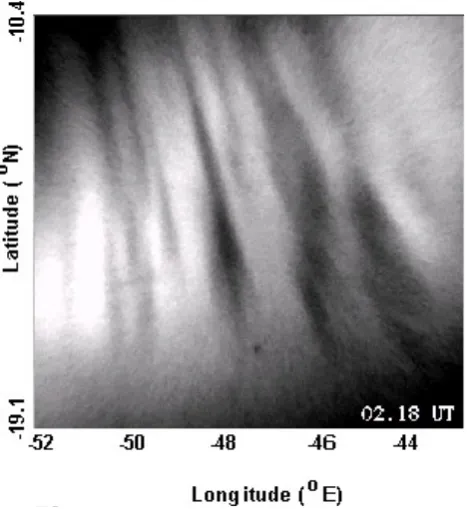
Information on plasma bubble spacing is obtained, how-ever, by employing observations with the 6300 ˚A airglow im-agers located at Brasilia and Cariri during SpreadFEx. An example of these data is shown in Fig. 6 and reveals typical bubble spacings of∼50 to 300 km or larger. Simultaneous MLT and 6300 ˚A airglow measurements also permit correla-tions between apparent neutral atmosphere and plasma struc-tures. A correlation of the spatial scales of GWs in the MLT and plasma bubbles at higher altitudes is performed by Taka-hashi et al. (2009) and provides suggestive and surprising ev-idence of potential direct GW influences extending from the MLT to the bottomside F-layer.
[image:7.595.309.546.61.320.2]Fig. 6. 6300 ˚A airglow image obtained at Cariri on 2 October 2005. Brightness represents integrated emissions along the line of sight and intensities have been mapped to corresponding latitudes and longitudes assuming a peak emission altitude of 350 km. Dark bands indicate depletions in emission intensity within plasma bub-bles, bubbles are aligned along the magnetic field lines, and bubbles are spaced in the normal plane by∼50 to 300 km or more.
GPS measurements likewise shed light on the nature of perturbations near the peak of the F-layer. Examples of the perturbations in the temporal derivative of TEC seen in these data collected at Fortaleza on the evening of 24 October 2005 are shown for reference in Fig. 7. While it is challenging to infer specific scales unambiguously because these data mix variations due to phase motions of the TEC perturbations and motions of the piercing points associated with the various GPS satellites, we nevertheless see periods ranging from∼20 to 60 min prior to∼21:20 UT, which is considered to be on-set time for RTI and plasma bubbles at this location (Swartz and Woodman, 1998). This means that these perturbations cannot be associated with plasma bubbles and that they are almost certainly due to perturbations of the electron densities by large-amplitude GWs having large vertical scales. These observations appear to validate predictions by FV08 in this issue that GWs from sources in the lower atmosphere having just these observed periods will reach the peak of the F-layer under mean solar and nominal Doppler shifting conditions. If so, they clearly also have the potential to impose significant perturbations at the bottomside F-layer that will be further explored elsewhere in the special issue.
Observations of plasma perturbations at and below the bot-tomside F-layer were also possible during SpreadFEx using
GPS d(TEC)/dt fluctuations over Forteleza (~ 350 km)
periods ~ 15 – 60 min
1 hr
18 19 20 21 22
UT Oct. 24 2005
Fig. 7. Time series of d(TEC)/dt for eight GPS satellite traverses
observed from Fortaleza during the evening of 24 October 2005. Note that most oscillations have apparent periods of∼20 min to 1 h and that oscillations are apparent well before spread F and plasma bubble onset, shown approximately by the dashed red line.
[image:8.595.323.522.78.260.2]Fig. 8. Digisonde measurements at S˜ao Luis for 24 to 27 October 2005 (upper panel) showing significant perurbations of the bottomside
F-layer and above (∼200 to 400 km), especially on the first two nights. Kp index (lower panel) during September and October 2005.
Corresponding tabular data yield mean values of 1, 3.5, 2.5, and<2 for 24 to 27 October, respectively, averaged in UT, suggesting only weak to moderate magnetic activity.
bubbles is shown in the right panel of Fig. 9. These orbits have a component of the satellite motion normal to the mag-netic field lines and thus permitted tomographic inversions of these data by Kamalabadi et al. (2009) in this issue, assum-ing that electron density perturbations were aligned along these field lines. These GUVI tomographic inversions indi-cate fractional electron density perturbations at the bottom-side (and topbottom-side) F-layer that are substantially larger than those inferred from digisonde data at the bottomside F-layer (due to smallerHe at the bottomside F-layer, F08). These perturbations also extend to much lower altitudes than can be inferred from the digisonde data and have relatively large spatial scales,∼200 to 500 km (see Kamalabadi et al., 2009; F08). These spatial scales and the downward phase motions noted in the digisonde data (Abdu et al., 2009) suggest possi-ble GW influences on the plasma at these altitudes, but down-ward mapping of plasma bubbles from higher altitudes at the dip equator also cannot be discounted as an explanation.
7 GW and tidal perturbations at the bottomside F-layer
As noted above, VF09 employ the reverse ray tracing re-sults of V09 to infer “best fit” GW source spectra for
rep-resentative individual convective plumes and small convec-tive complexes including three closely spaced plumes. The theoretical study by FV08 uses the same techniques to iden-tify the GW horizontal and vertical wavelengths and periods anticipated to penetrate to the highest altitudes for various thermospheric temperatures and winds, independent of GW sources at lower altitudes. Together, these studies constrain theoretically the GW amplitudes and scales that can influ-ence bottomside F-layer plasma dynamics from sources in the lower atmosphere. FV08 anticipate horizontal and verti-cal wavelengths arising from lower atmosphere sources to be ∼150 to 1000 km and∼150 to 500 km or more at the bottom-side F-layer, respectively, with the larger horizontal scales only becoming important for stronger Doppler-shifting con-ditions. Of these, only the smaller wavelengths, ∼150 to 500 km horizontally and∼150 to 300 km vertically, are ex-pected to propagate efficiently to the highest altitudes with the largest remaining amplitudes.
Fig. 9. Global TIMED/GUVI 1356 ˚A emissions (green) on successive orbits (left) on day 274 (1 October) 2005 during the first SpreadFEx measurement campaign and a closer view (right) over South America exhibiting plasma depletions in 1356 ˚A emissions.
at vertical and horizontal wavelengths of 150 km and∼200 to 400 km, respectively, for a single plume. Amplitudes ∼2 times larger are expected in response to a small con-vective complex. Expected maximum amplitudes for both sources are also∼2 times smaller at vertical wavelengths of ∼200 km. As a result, F08 employ a GW horizontal veloc-ity perturbation 1 ms−1as a conservative upper limit for the purpose of estimating amplitudes at higher altitudes.
The implications of these GW amplitudes at 80 km for per-turbations at the bottomside F-layer are explored in detail by F08. They also consider superposed GW and tidal mo-tions because it is believed that tidal winds largely account for filtering of the spectrum of GWs propagating from lower altitudes and for the eastward winds following sunset that al-low for the neutral-plasma differential velocity contributing to plasma instability growth rates (FV08; F09; Kudeki et al., 2007). F08 infer GW velocity, neutral and electron density, and electron density gradient perturbations that vary as u0h=−(m/ kh)w0∼(m/ kh)(gω/N2)ρ0/ρ= ˆa(g/N )ρ0/ρ, (1) (ρe0/ρe)/(ρ0/ρ)∼ −(2−γ )/2(γ−1)−γ H (γ−1)He, (2) and
(∂ρe0/∂z)/(∂ρe/∂z)=(He/ρe)∂ρe0/∂z∼(1+imHe)(ρe0/ρe), (3) wherekh=2π/λhandm=2π/λzare the horizontal and verti-cal GW wavenumbers,λhandλzare the horizontal and ver-tical GW wavelengths, g is gravity, ω is the GW intrinsic frequency,N is the buoyancy frequency,H andHe are the neutral and electron density scale heights,ρ0/ρ andρe0/ρe are the fractional neutral and electron density perturbations, γ=cp/cv=1.4 andβ∼(1–ω2/N2)1/2∼0.5 to 1 represents the
degree to which the GWs depart from hydrostatic. For mean solar conditions and a GW horizontal velocity perturbation ofuh0∼50 ms−1, these yield
ρ0/ρ∼5 to 10%, (4)
ρe0/ρe∼20 to 40%, (5)
and
(∂ρe0/∂z)/(∂ρe/∂z)∼2 to 5ρe0/ρe, (6) where F08 assumed that the GW propagates vertically with m real, GW dissipation is weak, He≥1/m, λz∼200 km, H∼30 km, and He∼30 to 100 km. These electron den-sity perturbations and their gradients are twice as large for u0h∼100 ms−1, which appears to be very plausible at these al-titudes. They also are in very good agreement with the elec-tron density perturbations (and gradients) that are inferred from the SpreadFEx digisonde and GUVI data summarized above, and which appear to validate the GW amplitudes and spatial scales at these altitudes predicted to arise from con-vective sources. We note, however, that these estimates of electron densities and gradients assume only neutral dynam-ical influences and neglect possible chemdynam-ical and electrody-namical effects that may in fact also be significant.
time of plasma bubble seeding and contributing to 1) refrac-tion and filtering of GWs entering the bottomside F-layer from below, 2) observed predominantly eastward plasma drifts, 3) a neutral wind-plasma drift velocity differential (and shear), 4) temporal variability of plasma drifts that may account for the retrograde drifts observed on occasion at later times, and 5) impacts on thermospheric temperature and plasma density profiles at the bottomside F-layer that may themselves impact plasma instability growth rates. F08 also describe several specific scenarios in which GW and/or tidal structures can combine or align to enhance the field-line-integrated parameters that enhance plasma instability growth rates advocated by previous authors. Their primary conclu-sions are that GW and tidal superpositions can collectively enhance several or all of the parameters impacting plasma instability growth rates, depending on the nature of the GW motions.
8 GW and tidal influences on plasma instability and bubble formation
We summarized above the SpreadFEx studies aimed at defin-ing and quantifydefin-ing GW convective sources at lower alti-tudes, their apparent links and propagation to the MLT and the bottomside F-layer, and the observational and theoreti-cal evidence for specific GW amplitudes, stheoreti-cales, and orienta-tions at the bottomside F-layer. Together, these efforts make a compelling case that GWs arising from deep convection can reach the bottomside F-layer with amplitudes and scales that we might expect to impact plasma instability growth rates and set the stage for specific assessments of the impacts of these perturbations on plasma instability growth rates. Ad-ditional papers in this special issue by Abdu et al. (2009) and Kherani et al. (2009) perform these assessments through lin-ear theory and nonlinlin-ear numerical simulations.
Abdu et al. (2009) employ SpreadFEx measurements at S˜ao Luis and Fortaleza (at dip angles of −3◦ and −12◦, respectively), observational assessments of GW amplitudes and scales at the bottomside F-layer, and linear theoretical calculations of RTI, to investigate the role of GWs in the in-stability initiation at the bottomside F-layer. Several days representative of differing precursor conditions with varying pre-reversal vertical drifts, bottomside F-layer density gradi-ents, and GW density and wind perturbations are considered. The conclusions of this study include the following: 1) ap-parent GW structures at the bottomside F-layer appear to be consistent with observations and theory suggesting that these GWs arise from deep tropical convection, 2) there is con-siderable day-to-day variability in the precursor conditions leading to initial plasma instabilities and of the GW contribu-tions to these condicontribu-tions, 3) GW density perturbacontribu-tions are not required to initiate instability leading to topside plasma bub-bles when vertical drifts exceed∼30 ms−1, but they appear to be a necessary condition when vertical drifts are∼20 ms−1
or less, 4) GW wind perturbations can lead to significant enhancements of polarization electric fields contributing to plasma instability, depending on the F-layer vertical drift, height, and density gradient, 5) GWs likely play a signifi-cant role in plasma instability and plasma bubble initiation, especially when F-layer conditions themselves are marginal for plasma instabilities, and 6) the interplay between F-layer conditions and day-to-day variability in GW perturbations at the bottomside F-layer suggest that GWs may be an impor-tant cause of the day-to-day variability of ESF and plasma bubble occurrence.
Kherani et al. (2009) perform a similar assessment of plasma instability dynamics to that by Abdu et al. (2009), except that they employ a nonlinear numerical model of the influences of bottomside F-layer structure and GW pertur-bations on collisional-interchange instability and nonlinear plasma bubble growth into the topside F-layer. Like Abdu et al. (2009), they employ specific guidance from direct mea-surements of bottomside F-layer structure and apparent GW perturbations of the density and wind fields at these altitudes. They also employ a linear model of GW vertical propagation from an assumed convective source altitude to directly as-sess GW perturbation amplitudes at the bottomside F-layer. Their primary conclusions closely parallel those of Abdu et al. (2009) and include: 1) GW wind perturbations can play a key role in plasma bubble seeding, but they are neither nec-essary nor certain to do so, 2) large GW perturbations can result in deep plasma bubbles when ionospheric conditions are not conducive by themselves, 3) weaker GW perturba-tions can trigger significant bubble events when ionospheric conditions are more favorable, and 4) weak GW perturba-tions in less favorable environments cannot, by themselves, lead to strong plasma bubble responses.
Summarizing, the linear and nonlinear assessments of plasma instability dynamics at the bottomside F-layer by Abdu et al. (2009) and Kherani et al. (2009) appear to be in agreement with each other, with the observational data with which each set of growth rate predictions are compared, and with the expectations of potential impacts based on the as-sessment of GW perturbations at the bottomside F-layer by F08. Together, these studies suggest an important, but not ex-clusive, role for GW perturbations at the bottomside F-layer in 1) modulating plasma instability processes, 2) contribut-ing to initial plasma instability, RTI, plasma bubble initiation, and day-to-day variability in plasma bubble occurrence, and 3) enhancing the potential for plasma instability and plasma bubble initiation when bottomside F-layer conditions are in-sufficient themselves for significant instability development.
9 Observational and modeling studies of mesospheric bores
possible influences at, the bottomside F-layer, the airglow imager and meteor radar data collected during the campaign at Cariri, and in one case supplemented by a coincident ver-tical temperature profile near Cariri obtained by the SABER instrument aboard the TIMED satellite, also enabled obser-vations of several mesospheric bore events and a detailed analysis of one of these. This study by Fechine et al. (2009) provides a detailed assessment of the ducting environment, the responses in two airglow layers, and the bore structure, its apparent altitude, and its evolution in time. They con-clude that the wind profile played a major role in defining the duct at which the observed bore propagated, causing this to be the first clear case of Doppler ducting of a mesospheric bore event in the literature. The key to this ducting environ-ment was a strong and variable wind profile with altitude, despite significant variability also exhibited by the SABER temperature profile.
Motivated by an expectation that MLT wind and temper-ature profiles contribute to complex ducting environments, and the first documentation by Fechine et al. (2009) of a mesospheric bore supported by a Doppler duct, Laughman et al. (2009) explore thermal and Doppler ducting condi-tions enabling bore formation from an initially sinusoidal, long-wave perturbation centered at the ducting level. For both a thermal and a Doppler duct, the result is an undu-lar bore structure in temperature and velocity having suc-cessive peaks emerging with time. The bore oscillations in temperature and velocity also follow a significant reduction in both the temperature and horizontal wind preceding the bore response. Laughman et al. (2009) also explore the im-portance of boundary conditions in properly describing bore responses and the simultaneous occurrence of adjacent ther-mal and Doppler ducts, as might be expected to occur based on the inertia-gravity wave and tidal structures that dominate the MLT variance fields. In this case, an initial bore response at one duct can “tunnel” to the adjacent duct, leading to a nonlinear response at both ducts at later times.
10 Summary and conclusions
This overview of the Spread F Experiment (SpreadFEx) has reviewed the scientific motivation for our measurement and analysis program, described the components of our measure-ment campaign in Brazil, and introduced and summarized the various analyses presented in this special issue. The key results of our collective efforts include the following:
1. deep convection appears to be a significant and viable source of GWs penetrating into the MLT and to the bot-tomside F-layer, depending on GW scales, frequencies, propagation directions, and large-scale winds;
2. GWs spanning a wide range of scales and frequencies reach the MLT, but only GWs having large scales and high frequencies can reach the highest altitudes;
3. GWs arising from convection are strongly influenced by lower atmospheric, MLT, and thermospheric winds. These dictate which GW frequencies, scales, and prop-agation directions penetrate to the bottomside F-layer and above;
4. Digisonde, GUVI, and GPS electron density measure-ments collectively suggest GWs exhibiting downward phase motions (upward propagation), observed peri-ods of∼20 min to 2 h, zonal wavelengths of∼200 to 500 km, and large electron density (and gradient) per-turbations extending from∼100 km to the bottomside F-layer, with implied neutral density and wind pertur-bations of∼2 to 20% and∼10 to 100 ms−1;
5. VHF radar and digisonde data suggest a connection be-tween rising motions, decreasing electron densities, in-creasing electron density gradients, and plasma bubble initiation;
6. tidal winds at the bottomside F-layer appear to play a key role in enabling spread F seeding, given the transi-tion from westward to eastward neutral motransi-tions in the early evening and the influences of these winds on GW propagation;
7. GWs having sufficiently large perturbation amplitudes likely contribute to plasma instabilities at the bottom-side F-layer, particularly when bottombottom-side F-layer con-ditions are not themselves conducive to instability; GWs of smaller amplitudes may also play a role in modu-lating plasma instabilities and determining instability scales when the bottomside F-layer is sufficiently un-stable itelf; and
8. GWs exhibit a variety of other MLT dynamics, includ-ing GW-mean flow and tidal interactions and bore exci-tation indicative of strong nonlinear responses.
Acknowledgements. The SpreadFEx field program and data
anal-ysis were supported by NASA under contracts NNH04CC67C and NAS5-02036. Related modeling and theoretical activities were sup-ported by NSF grants 0314060, 0436703, and ATM-0537311 and AFOSR contract FA9550-06-C-0129. We also thank M. R. Hausman and L. J. Nickisch for their assistance in analyzing GPS data from Fortaleza and V. T. Rampinelli, E. Bataglin, J. Sem-pere, N. D. Cˆandido, and the S˜ao Jo˜ao d’Alianc¸a’s House of Rep-resentatives and Mayor’s House for local support during the cam-paign. CPTEC-INPE provided assistance with the GOES 12 data analysis. Some of the authors also had partial support from Con-selho Nacional de Desenvolvimento Cietifico e Tecnologico CNPq (Abdu, Sobral, de Paula, I. Batista, Takahashi, and Gobbi).
References
Alam Kherani, E., Abdu, M. A., de Paula, E. R., Fritts, D. C., So-bral, J. H. A., and de Meneses Jr., F. C.: The impact of grav-ity waves rising from convection in the lower atmosphere on the generation and nonlinear evolution of equatorial bubble, Ann. Geophys., 27, 1657–1668, 2009,
http://www.ann-geophys.net/27/1657/2009/.
Abdu, M. A.: Outstanding problems in the equatrial ionosphere-thermosphere system relevant to spread F, J. Atmos. Solar Terr. Phys., 63, 869–884, 2001.
Abdu, M., Kherani, E. A., Batista, I. S., de Paula, E. R., and Fritts, D. C.: Gravity wave influences on plasma instability growth rates based on observations during the Spread F Experiment (Spread-FEx), Ann. Geophys., in press, 2009.
Abdu, M. A., Batista, I. S., and Sobral, J. H. A.: A new aspect of magnetic control of equatorial spread F, J. Geophys. Res., 97, 14897–14904, 1992.
Abdu, M. A., Batista, I. S., Takahashi, H., MacDougall, J., So-bral, J. H., Medeiros, A. F., and Trivedi, N. B.: Magnetospheric disturbance induced equatorial plasma bubble development and dynamics: A case study in Brazilian sector, J. Geophys. Res., 108(A12), 1449, doi:10.1029/2002JA009721, 2003.
Aggson, T. L., Maynard, N. C., Hanson, W. B., and Saba Jack, L.: Electric field observations of equatorial bubbles, J. Geophys. Res., 97, 2997–3009, 1992.
Anderson, D. N., Richmond, A. D., Balsley, B. B., Roble, R. G., Biondi, M. A., and Sipler, D. P.: In situ generation of gravity waves as a possible seeding mechanism for equatorial spread-F, Geophys. Res. Lett., 9, 789–792, 1982:.
Batista, I. S. and Abdu, M. A.: Ionospheric variability at Brazilian low and equatorial latitudes: comparison between observations and IRI model, Adv. Space Res., 34, 1894–1900, 2004. Batista, P. P., Clemesha, B. R., Tokumoto, A. S., and Lima, L.
M.: Structure of the mean winds and tides in the meteor region over Cachoeira Paulista, Brazil (22.7◦S, 45◦W) and its compar-ison with models, J. Atmos. Solar-Terr. Phys., 66(6–9), 623–636, 2004.
Buriti, R. A., Hocking, W. K., Batista, P. P., Medeiros, A. F., and Clemesha, B. R.: Observations of equatorial mesospheric winds over Cariri (7.4◦S) by a meteor radar and comparison with ex-isting models, Ann. Geophys., 26, 485–497, 2008,
http://www.ann-geophys.net/26/485/2008/.
de Paula, E. R. and Hysell, D. L.: The S˜ao Luis 30 MHz coherent scatter ionospheric radar: system description and initial results, Radio Sci., 39, RS1014, doi:10.1029/2003RS002914, 2004. Djuth, F. T., Sulzer, M. P., Elder, J. H., and Wickwar, V. B.:
High-resolution studies of atmosphere-ionosphere coupling at Arecibo Observatory, Puerto Rico, Radio Sci., 32, 2321–2344, 1997. Djuth, F. T., Sulzer, M. P., Gonzales, S. A., Mathews, J. D., Elder,
J. H., and Walterscheid, R. L.: A continuum of gravity waves in the Arecibo thermosphere?, Geophys. Res. Lett., 31, L16801, doi:10.1029/2003GL019376, 2004.
Earle, G., Musumba, A. M., and Vadas, S. L.: Satellite-based measurements of gravity wave- induced midlatitude plasma density perturbations, J. Geophys. Res., 113, A3303, doi:10.1029/2007JA012766, 2008.
Fechine, J., Wrasse, C. M., Takahashi, H., Medeiros, A. F., Batista, P. P., Clemesha, B. R., Lima, L. M., Fritts, D., Laughman, B., Taylor, M. J., Pautet, P. D., Mlynczak, M. G., and Russell, J. M.:
First observation of an undular mesospheric bore in a Doppler duct, Ann. Geophys., 27, 1399–1406, 2009,
http://www.ann-geophys.net/27/1399/2009/.
Fejer, B. G., Scherliess, L., and de Paula, E. R.: Effects of the verti-cal plasma drift velocity on the generation and evolution of equa-torial spread F, J. Geophys. Res., 104, 19859–19869, 1999. Fritts, D. C. and Alexander, M. J.: Gravity dynamics and
ef-fects in the middle atmosphere, Rev. Geophys., 41, 1003, doi:10.1029/2001RG000106, 2003.
Fritts, D. C., Abdu, M. A., Batista, B. R., Batista, I. S., Batista, P. P., Buriti, R., Clemesha, B. R., Dautermann, T., de Paula, E., Fechine, B. J., Fejer, B., Gobbi, D., Haase, J., Kamalabadi, F., Laughman, B., Lima, P. P., Liu, H.-L., Medeiros, A., Pautet, D., Riggin, D. M., S˜ao Sabbas, F., Sobral, J. H. A., Stamus, P., Taka-hashi, H., Taylor, M. J., Vadas, S. L., Wrasse, C.: The Spread F Experiment (SpreadFEx): Program overview and first results, Earth, Planets Space, CPEA special issue, in press, 2009. Fritts, D. C., Vadas, S. L., Riggin, D. M., Abdu, M. A., Batista, I. S.,
Takahashi, H., Medeiros, A., Kamalabadi, F., Liu, H.-L., Fejer, B. G., and Taylor, M. J.: Gravity wave and tidal influences on equatorial spread F based on observations during the Spread F Experiment (SpreadFEx), Ann. Geophys., 26, 3235–3252, 2008, http://www.ann-geophys.net/26/3235/2008/.
Fritts, D. C. and Vadas, S. L.: Gravity wave penetration into the thermosphere: sensitivity to solar cycle variations and mean winds, Ann. Geophys., 26, 3841–3861, 2008,
http://www.ann-geophys.net/26/3841/2008/.
Fritts, D. C., Vadas, S. A., and Yamada, Y.: An estimate of strong local gravity wave body forcing based on OH airglow and meteor radar observations, Geophys. Res. Lett., 29(10), doi:10.1029/2001GL013753, 2002.
Fritts, D. C. and Yuan, L.: An analysis of gravity wave ducting in the atmosphere: Eckart’s resonances in thermal and Doppler ducts, J. Geophys. Res., 94(D15), 18455–18466, 1989.
Heelis, R. A., Kendall, P. C., Moffett, R. J., Windel, D. W., and Rishbeth, H.: Electrical coupling of the E and F regions and its effect on F-region drifts and winds, J. Planet. Space Sci., 22, 743–756, 1974.
Hocke, K. and Schlegel, K.: A review of atmospheric gravity waves and travelling ionospheric disturbances: 1982–1995, Ann. Geo-phys., 14, 917–940, 1996,
http://www.ann-geophys.net/14/917/1996/.
Huang, C. S., Foster, J. C., Goncharenko, L. P., Reeves, G. D., Chau, J. L., Yumoto, K., and Kitamura, K.: Variations of low-latitude geomagnetic fiels and Dst index caused by magnetospheric substorms, J. Geophys. Res., 109, A05219, doi:10.1029/2003JA010334, 2004.
Huang. C. S., Kelley, M. C., and Hysell, D. L.: Nonlinear Rayleigh-Taylor instabilities, atmospheric gravity waves, and equatorial spread-F, J. Geophys. Res., 98, 15631–15642, 1993.
Huang, C. S. and Kelley, M. C.: Nonlinear evolution of equatorial spread-F. 1. On the role of plasma instabilities and spatial res-onance associated with gravity wave seeding, J. Geophys. Res., 101, 283–292, 1996a.
Huang, C. S. and Kelley, M. C.: Nonlinear evolution of equatorial spread-F. 2. Gravity wave seeding of Rayleigh-Taylor instability, J. Geophys. Res., 101, 293–302, 1996b.
vari-ability, J. Geophys. Res., 101, 24521–24532, 1996c.
Hysell, D. L.: Radar imaging of equatorial F region irregularities with maximum entropy interferometry, Radio Sci., 31(6), 1567– 1578, 1996.
Hysell. D. L. and Burcham, J. D.: Long term studies of equatorial spread F using the JULIA radar at Jicamarca, J. Atmos. Solar-Teres. Phys., 64, 1531–1543, 2002.
Hysell, D. L., Chun, J., and Chau, J. L.: Bottom-type scattering layers and equatorial spread F, Ann. Geophys., 22, 4061–4069, 2004, http://www.ann-geophys.net/22/4061/2004/.
Hysell, D. L., Kelley, M. C., Swartz, W. E., and Woodman, R. F.: Seeding and layering of equatorial spread-F, J. Geophys. Res., 95, 17253–17260, 1990.
Hysell, D. L. and Kudeki, E.: Collisional shear instability in the equatorial F region ionosphere, J. Geophys. Res., 109, A11301, doi:10.1029/2004JA010636, 2004.
Hysell, D. L., Larsen, M. F., Swenson, C. M., Barjatya, A., Wheeler, T. F., Sarango, M. F., Woodman, R. F., and Chau, J. L.: Onset conditions for equatorial spread Fdetermined during EQUIS II, Geophys. Res. Lett., 32, L24104, doi:10.1029/2005GL024743, 2005.
Kamalabadi, F., Comberiate, J., Taylor, M., and Pautet, D.: Elec-tron densities in the lower thermosphere from GUVI 1356 tomo-graqphic inversions in support of SpreadFEx, Ann. Geophys., in press, 2009.
Kelley, M. C.: The Earth’s Ionosphere, Academic Press, San Diego, 487 pp., 1989.
Kelley, M. C., Makela, J. J., Ledvina, B., and Kintner, P. M.: Ob-servations of equatorial spread- F from Haleakala, Hawaii, Geo-phys. Res. Lett., 29, 2003, doi:10.1029/2002GL015509, 2002. Klostermeyer, J.: Nonlinear investigation of the spatial resonance
effect in the nighttime equatorial F region, J. Geophys. Res., 83, 3753–3760, 1978.
Kudeki, E., Akgiray, A., Milla, M., Chau, J. L., and Hysell, D. L.: Equatorial spread-F initiation: post-sunset vortex, thermo-spheric winds, gravity waves, J. Atmos. Solar-Terr. Phys., 69, 2416–2427, 2007.
Kudeki, E. and Bhattacharyya, S.: Postsunset vortex in equatorial F-region plasma drifts and implications for bottomside spread F, J. Geophys. Res., 104, 28163–28170, 1999.
Lane, T. P., Reeder, M. J., and Clark, T. L.: Numerical modeling of gravity waves generated by deep tropical convection, J. Atmos. Sci., 58, 1249–1274, 2001.
Lane, T. P. and Sharman, R. D.: Gravity wave breaking, secondary wave generation, and mixing above deep convection in a three-dimensional cloud model, Geophys. Res. Lett., 33, L23813, doi:10.1029/2006GL027988, 2006.
Lane, T. P., Sharman, R. D., Clark, T. L., and Hsu, H.-M.: An investigation of turbulence generation mechanisms above deep convection, J. Atmos. Sci., 60, 1297–1321, 2003.
Lanyi, G. E. and Roth, T.: A Comparison Of Mapped And Mea-sured Total Ionospheric Electron-Content Using Global Posi-tioning System And Beacon Satellite-Observations, Radio Sci., 23(4), 483–492, 1988.
Laughman, B., Fritts, D. C., and Werne, J.: Numerical simulation of bore generation and morphology in thermal and Doppler ducts, Ann. Geophys., 27, 511–523, 2009,
http://www.ann-geophys.net/27/511/2009/.
McClure, J. P., Hanson, W. B., and Hoffman, J. F.: Plasma bubble
and irregularities in the equatorial ionosphere, J. Geophys. Res., 82, 2650–2656, 1977.
McClure, J. P., Singh, S., Bamgboye, D. K., Johnson, F. S., and Kil, H.: Occurrence of equatorial F region irregularities: Evidence for tropospheric seeding, J. Geophys. Res., 103, 29119–29135, 1998.
Medeiros, A. F., Buriti, R. A., Machado, E. A., Takahashi, H., Batista, P. P., Gobbi, D., and Taylor, M. J.: Comparison of gravity wave activity observed by airglow imaging at two different lati-tudes in Brazil, J. Atmos. Solar-Terr. Phys., 60, 647–654, 2004. Medeiros, A. F., Fechine, J., Buriti, R. A., Takahashi, H., Wrasse,
C. M., and Gobbi, D.: Response of OH, O2, and OI5577 air-glow emissions to the mesospheric bore in the equatorial region of Brazil, Adv. Space Res., 35, 1971–1975, 2005.
Mendillo, M. and Tyler, A.: The geometry of depleted plasma re-gions in the equatorial ionosphere, J. Geophys. Res., 88, 5778– 5782, 1983.
Meriwether, J., Faivre, M., Fesen, C., Sherwood, P., and Veliz, O.: New results on equatorial thermospheric winds and the midnight temperature maximum, Ann. Geophys., 26, 447–466, 2008, http://www.ann-geophys.net/26/447/2008/.
Oliver, W. L., Otsuka, Y., Sato, M., Takami, T., and Fukao, S.: A climatology of F region gravity wave propagation over the mid-dle and upper atmosphere radar, J. Geophys. Res., 102, 14499– 14512, 1997.
Piani, C., Durran, D., Alexander, M. J., and Holton, J. R.: A numer-ical study of three- dimensional gravity waves triggered by deep tropical convection, J. Atmos. Sci., 57, 3689–3702, 2000. Rodrigues, F. S., de Paula, E. R., Abdu, M. A., Jardim, A. C.,
Iyer, K. N., Kintner, P. M., and Hysell, D. L.: Equatorial spread F irregularity characteristics over S˜ao Lu´Is, Brazil, using VHF radar and GPS scintillation techniques, Radio Sci., 39, RS1S31, doi:10.1029/2002RS002826, 2004.
Rodrigues, F. S., Hysell, D. L., and de Paula, E. R.: Coherent backscatter radar imaging in Brazil: large-scale waves in the bot-tomside F-region at the onset of equatorial spread F, Ann. Geo-phys., 26, 3355–3364, 2008,
http://www.ann-geophys.net/26/3355/2008/.
S˜ao Sabbas, F. T., Rampinelli, V. T., Santiago, J., Stamus, P., Vadas, S. L., Fritts, D. C., Taylor, M. J., Pautet, P. D., Dolif Neto, G., and Pinto, O.: Characteristics of sprite and gravity wave convective sources present in satellite IR images during the SpreadFEx 2005 in Brazil, Ann. Geophys., 27, 1279–1293, 2009,
http://www.ann-geophys.net/27/1279/2009/.
Sekar, R. and Kelley, M. C.: On the combined effects of vertical shear and zonal electric field patterns on nonlinear equatorial spread F evolution, J. Geophys. Res., 103, 20735–20747, 1998. Sekar, R., Suhasini, R., and Raghavarao, R.: Evolution of plasma
bubbles in the equatorial F region with different seeding condi-tions, Geophys. Res. Lett., 22, 885–888, 1995.
Sentman, D. D., Wescott, E. M., Picard, R. H., Winick, J. R., Stenbaek-Nielson, H. C., Dewan, E. M., Moudry, D. R., S˜ao Sabbas, F. T., and Heavner, M. J.: Simultaneous observation of mesospheric gravity waves and sprites generated by a Mid-western thunderstorm, J. Atmos. Solar-Terr. Phys., 65, 537–550, 2003.
Sobral, J. H. A., Abdu, M. A., Batista, I. S., and Zamlutti, C. J.: As-sociation between plasma bubble and airglow disturbances over Brazilian low latitudes, Geophys. Res. Lett., 11(7), 980–982, 1980b.
Sobral, J. H. A., Abdu, M. A., Takahashi, H., Taylor, M. J., de Paula, E. R., Zamlutti, C. J., and Borba, G. L.: A study of the ionospheric plasma bubbles climatology over Brazil, based on 22 years (1977–1998) of OI 630 nm airglow observation, J. Atmos. Terr. Phys., 64(12–14), 1517–1524, 2002.
Sobral, J. A. H., Takahashi, H., Abdu, M. A., Taylor, M. J., Sawant, H., Santana, D. C., Gobbi, D., de Medeiros, A. F., Zamlutti, C. J., Schuch, N. J., and Borba, G. L.: Thermospheric F-region trav-eling disturbances detected at low latitude by an OI(630 nm) im-ager system, Adv. Space Sci., 27, 1201–1206, 2001.
Stolle, C., Luhr, H., Rother, M., and Balasis, G.: Magnetic signa-tures of equatorial spread F as observed by the CHAMP satellite, J. Geophys. Res., 111, A02304, doi:10.1029/2005JA011184, 2006.
Swartz, W. E. and Woodman, R. F.: Same night observations of spread-F by the Jicamarca Radio Observatory in Peru and CUPRI in Alcantara, Brazil, Geophys. Res. Lett., 25, 17–20, 1998. Takahashi, H., Taylor, M. J., Pautet, P.-D., Medeiros, A. F., Gobbi,
D., Wrasse, C. M., Fechine, J., Abdu, M. A., Batista, I. S., Paula, E., Sobral, J. H. A., Arruda, D., Vadas, S. L., Sabbas, F. S., and Fritts, D. C.: Simultaneous observation of ionospheric plasma bubbles and mesospheric gravity waves during the SpreadFEx Campaign, Ann. Geophys., 27, 1477–1487, 2009,
http://www.ann-geophys.net/27/1477/2009/.
Taylor, M. J. and Hapgood, M. A.: Identification of a thunderstorm as a source of short period gravity waves in the upper atmo-spheric nightglow emissions, Planet. Space Sci., 36, 975–985, 1988.
Taylor, M. J., Pautet, P.-D., Medeiros, A. F., Buriti, R., Fechine, J., Fritts, D. C., Vadas, S. L., Takahashi, H., and So Sabbas, F. T.: Characteristics of mesospheric gravity waves near the magnetic equator, Brazil, during the SpreadFEx campaign, Ann. Geophys., 27, 461–472, 2009, http://www.ann-geophys.net/27/461/2009/. Taylor, M. J, Jahn, J.-M., Fukao, S., and Saito, A.: Possible
ev-idence of gravity wave coupling into the mid-latitude F region ionosphere during the SEEK campaign, Geophys. Res. Lett., 25, 1801–1804, 1998.
Tsuda, T., Nishida, M., and Rocken, C.: A global morphology of gravity wave activity in the stratosphere revealed by the GPS oc-cultation data (GPS/MET), J. Geophys. Res., 105, 7257–7274, 2000.
Vadas, S. L. and Fritts, D. C.: Gravity wave radiation and mean responses to local body forces in the atmosphere, J. Atmos. Sci., 58, 2249–2279, 2001.
Vadas, S. L. and Fritts, D. C.: The importance of spa-tial variability in the generation of secondary gravity waves from local body forces, Geophys. Res. Lett., 29(20), 1984, doi:10.1029/2002GL015574, 2002.
Vadas, S. L. and Fritts, D. C.: Thermospheric responses to gravity waves arising from mesoscale convective complexes, J. Atmos. Solar Terr. Phys., 66, 781–804, 2004.
Vadas, S. L. and Fritts, D. C.: Thermospheric responses to gravity waves: Influences of increasing viscosity and thermal diffusiv-ity, J. Geophys. Res., 110, D15103, doi:10.1029/2004JD005574, 2005.
Vadas, S. L. and Fritts, D. C.: The influence of increasing temper-ature and solar variability on gravity wave structure and dissipa-tion in the thermosphere, J. Geophys. Res., TIMED special issue, 111, A10812, doi:10.1029/2005JA011510, 2006.
Vadas, S. L. and Fritts, D. C.: Reconstruction of the gravity wave field from convective plumes via ray tracing, Ann. Geophys., 27, 147–177, 2009, http://www.ann-geophys.net/27/147/2009/. Vadas, S. L., Fritts, D. C., and Alexander, M. J.: Mechanism for
the generation of secondary waves in wave breaking regions, J. Atmos. Sci., 60, 194–214, 2003.
Vadas, S. L. and Nicolls, M. J.: Using PFISR measurements and gravity wave dissipative theory to determine the neutral, back-ground thermospheric winds, Geophys. Res. Lett., 35, L02105, doi:10.1029/2007GL031522, 2008.
Vadas, S. L., Taylor, M. J., Pautet, P.-D., Stamus, P. A., Fritts, D. C., Liu, H.-L., S˜ao Sabbas, F. T., Rampinelli, V. T., Batista, P., and Takahashi, H.: Convection: the likely source of the medium-scale gravity waves observed in the OH airglow layer near Brasilia, Brazil, during the SpreadFEx campaign, Ann. Geo-phys., 27, 231–259, 2009,
http://www.ann-geophys.net/27/231/2009/.
Valladares, C. E., Hanson, W. B., McClure, J. P., and Cragin, B. L.: Bottomside sinusoidal irregularities in the equatorial F region, J. Geophys. Res., 88, 8025–8042, 1983.
Vargas, F., Gobbi, D., and Takahashi, H.: Gravity wave amplitudes and momentum fluxes inferred from OH airglow intensities and meteor radar winds during SpreadFEx, Ann. Geophys., in press, 2009.