Qualitative Market Research: An International Journal
The consumption experience of Tim Hortons’ coffee fansRichelieu André Korai Bernard
Article information:
To cite this document:Richelieu André Korai Bernard , (2014),"The consumption experience of Tim Hortons’ coffee fans", Qualitative Market Research: An International Journal, Vol. 17 Iss 3 pp. 192 - 208
Permanent link to this document:
http://dx.doi.org/10.1108/QMR-06-2012-0032
Downloaded on: 04 March 2015, At: 11:03 (PT)
References: this document contains references to 70 other documents. To copy this document: [email protected]
The fulltext of this document has been downloaded 426 times since 2014*
Users who downloaded this article also downloaded:
Alexandra Vignolles, Paul-Emmanuel Pichon, (2014),"A taste of nostalgia: Links between nostalgia and food consumption", Qualitative Market Research: An International Journal, Vol. 17 Iss 3 pp. 225-238 http:// dx.doi.org/10.1108/QMR-06-2012-0027
Po-Tsang Chen, Hsin-Hui Hu, (2010),"How determinant attributes of service quality influence customer-perceived value: An empirical investigation of the Australian coffee outlet industry", International Journal of Contemporary Hospitality Management, Vol. 22 Iss 4 pp. 535-551 http:// dx.doi.org/10.1108/09596111011042730
Daniela Spanjaard, Louise Young, Lynne Freeman, (2014),"Emotions in supermarket brand choice: A multi-method approach", Qualitative Market Research: An International Journal, Vol. 17 Iss 3 pp. 209-224 http:// dx.doi.org/10.1108/QMR-10-2012-0049
Access to this document was granted through an Emerald subscription provided by 331053 []
For Authors
If you would like to write for this, or any other Emerald publication, then please use our Emerald for Authors service information about how to choose which publication to write for and submission guidelines are available for all. Please visit www.emeraldinsight.com/authors for more information.
About Emerald www.emeraldinsight.com
Emerald is a global publisher linking research and practice to the benefit of society. The company manages a portfolio of more than 290 journals and over 2,350 books and book series volumes, as well as providing an extensive range of online products and additional customer resources and services.
Emerald is both COUNTER 4 and TRANSFER compliant. The organization is a partner of the Committee on Publication Ethics (COPE) and also works with Portico and the LOCKSS initiative for digital archive preservation.
*Related content and download information correct at time of download.
The consumption experience of
Tim Hortons’ coffee fans
André Richelieu and Bernard Korai
Marketing Department, Laval University, Quebec City, Canada
Abstract
Purpose– The purpose of this research is to understand the overall consumer experience, while highlighting the means through which consumers live and take possession of what they consume.
Design/methodology/approach– Holt’s typology serves as the theoretical background. Choosing a netnographic framework, we analyze the coffee experiential universe of 41 Canadian consumers of Tim Hortons’ coffee by studying their personal stories posted on the company’s website.
Findings– Individuals predominantly associate the consumption of coffee with ritual, happiness, joy, travel companion and extended relationship. These categories relate to mystique (ritual); pleasure (happiness and joy); travel (travel companion); and love (family-like relationship).
Research limitations/implications– We acknowledge that there is a danger of bias in our data considering that we used the narratives that recorded the highest hits. However, these narratives represent a socially constructed reality which was validated by Tim Hortons’ fans themselves.
Practical implications– To maintain a strong market position, it is no longer sufficient to understand the associations linked to the overall experience of a product’s consumption. The company must also have ways of accessing or appropriating the consumer experience.
Originality/value– The study shows that it is possible for today’s consumer products to become symbolic representations in the minds of consumers, provided that the consumer has a strong attachment to the brand. It is essential to understand the appropriation practices of consumers’ experiences, as these hold significant theoretical and managerial implications.
Keywords Branding, Experience, Consumption, Coffee, Hockey/Sport, Holt’s typology
Paper typeResearch paper
Introduction
In The Consumer Society, Baudrillard (1970), writes that the utilitarian nature of consumption has steadily morphed into an emotion-and symbol-producing activity,
where the object of consumption is the key to an “economy of experience” (Pine and
Gilmore, 1999). In recent years, there has been a growing interest in “experiential” consumption among academic and business communities. According to some authors (Addis and Holbrook, 2001; Carù and Cova, 2003), this keen interest might well be explained by the emergence of a new type of consumer – one who is more demanding, eager for innovation and always looking for a unique experience. Studies support the idea that customer satisfaction, through a pleasant consumer experience, positively impacts the customer’s judgement (Homburget al., 2006;Leeet al., 2008), enabling the company to increase its profitability and market share (Laiet al., 2009).
Despite its mass appeal, the concept of experience remains a rather unexplored field. In fact, most studies on experience analyze it from the perspective of satisfaction or the
This research has been made possible, in part, thanks to a grant from the Social Sciences and Humanities Research Council of Canada (SSHRC).
The current issue and full text archive of this journal is available at www.emeraldinsight.com/1352-2752.htm
QMR
17,3
192
Received 18 June 2012 Revised 24 January 2013 Accepted 21 March 2013
Qualitative Market Research: An International Journal Vol. 17 No. 3, 2014 pp. 192-208
© Emerald Group Publishing Limited 1352-2752
DOI10.1108/QMR-06-2012-0032
emotions and feelings derived directly from the act of consumption (Ladwein, 2002). Such an approach seems rather reductive when one considers that, today, many consumption activities do not fall in line with traditional definitions of experience. To better understand the consumer experience, one should study it in its entirety, from a perspective that promotes the discovery of new dimensions.
Authors interested in the consumption experience, have, for the most part, been focussed on understanding the perceived expressions or advantages – emotional, sensorial or symbolic. If we know that these experiential consequences or advantages are themselves strongly attributed to the manner in which the consumer captures the
experience (Ladwein, 2002), it may also be interesting to study the mechanisms and
ways that consumers access the consumption experience.
The objective of this study is twofold: to identify the dimensions associated with the entire consumer experience and to outline the different modes of access and appropriation of this experience. In this sense, we have chosen to explore the experiential universe of coffee consumption by analyzing the narratives of 41 Canadian
consumers of Tim Hortons’[1] coffee. Very few studies conducted in the area of food
have been really interested in applying the concept of experience to products of common consumption, whereas “[…] even the less experiential products can have an experiential dimension to them” (Boulaire and Richelieu, 2005, p. 2).
This theoretical limit is also the main point around which gravitate our main contributions. Indeed, from a practical standpoint, this study should help highlight the process by which consumers build their symbolic and emotional attachment towards the brand or product. Through the analysis of different consumer experiences, some strategic perspectives have emerged to help businesses understand how their consumers appropriate themselves the experience of consumption, and also how they should capitalize on it. From a theoretical point of view, the study enables us to update the literature about consumer experience by highlighting other forms of its manifestation, particularly in the food industry.
The article has three major sections. The first takes inventory of the literature on the central concept of experience. The second section applies the concept of experience to the consumption of Tim Hortons’ coffee. The third highlights contributions, limitations and avenues for further research.
Literature review
The concept of experience
The concept of experience is a deciding and unavoidable notion in the mind of the
postmodern consumer. It appears for the first time in the work ofPine and Gilmore
(1999, p. 2), who mention that:
[…] when a person buys a service, he purchases a set of intangible activities carried out on his behalf. But when he buys an experience, he pays to spend time enjoying a series of memorable events that a company stages to engage him in a personal way.
According to these authors, contemporary societies live a profound revolution, characterized by a shift from a service economy to an experience economy. In this era, consumers, through their consumption activities, are increasingly inclined to express their sensual, libertarian and emancipatory demands through a persistent search for
meaning and experiences (Carù and Cova, 2003).
193
Tim Hortons’
coffee fans
The postmodern consumer seems more preoccupied with the search for gratification – eclectic, hedonistic, aesthetic and symbolic – promoted by different
consumption activities in which he/she is involved (Hirschman and Holbrook, 1982).
The supremacy of the experiential element of consumption is illustrated here:
[…] consumer is embedded in a symbolic world […] the individual consumer is constituted differently through direct experience with objects or through the manipulation of symbols that are projected via the goods he or she consumes (Venkatesh and Meamber, 2008, p. 52).
Today, most managers take into account the importance of delivering a good experience to their customers because they are aware that individuals are no longer making a decision solely based on functional attributes (e.g. price and size) (Yuan and Wu, 2008). For over a decade, the concept of experience has become a cornerstone in the design of
modern marketing. As a case in point, in a number of sectors (e.g. tourism [Alistair,
2006]; healthcare [Hill, 2003]; arts [Petkus, 2002]), this concept has become a key element in the marketing strategy implementation. In an increasingly competitive market environment, experiential marketing seems for practitioners an extraordinary strategic weapon for deepening the consumers’ intangible needs or meanings to offer them some products and services that feed their fantasies, dreams and symbolic projections towards the product or brand (McNickel, 2004). As presented byAlistair (2006, p. 485), “Experiential marketing describes marketing initiatives that give consumers in-depth, tangible experiences in order to provide them with sufficient information to make a purchase decision”. Many authors have demonstrated that the experience delivered by a company is very crucial for its success in developing a stronger emotional bond with customers, such as in sports (Blumrodt et al., 2012; Dwyer, 2011; Park et al., 2011;
Richelieu and Pons, 2011). An extraordinary experience can also trigger customer
satisfaction towards the brand or the product. For example,Bearden and Teel (1983)and
Fornell (1992)showed that a higher level of customer loyalty, intention of repetitive purchasing, positive word of mouth and market share were correlated with a higher level of customer satisfaction.
Holt’s typology
With the emergence of the experiential perspective, some authors have highlighted the
increasingly symbolic role that objects of consumption play (McCraken, 1986;
Thompson et al., 1990). Objects are no longer consumed solely for their utilitarian function; objects are also indicators of meaning, enabling individuals to construct their identity and assert their social belonging. From this perspective, the act of consumption could take into account the various relationships that individuals have with the objects
being consumed.Holt (1995)illustrates that individuals continually evolve in a world
made of meaning and symbols, at the heart of which their identity is negotiated, organized and created from the significance attached to the objects of consumption. Holt
outlines a typology that metaphorically describes consuming asexperience,integration,
classificationandplay.
Consuming as experience. ForHirschman and Holbrook (1982), consumption is a personal and subjective experience which leads to a constant search for sensorial and emotional stimulation. The consumer becomes an emotional being in search of experiences that are increasingly spectacular and extravagant. The utilitarian and functional elements of a product are gradually being replaced by more sensual aspects
QMR
17,3
194
that illustrate an individual’s desire for a more vivid and diverse life. Individuals look for gratification experiences through consumption: intense and extraordinary experiences that allow them to momentarily escape the realities of daily life (Maffesoli, 1990).
Consuming as integration.According toCova and Carù (2006), people consume to live, that is to say, to construct their individual and social identities. Numerous authors (Aaker et al., 2001; McCraken, 1986) have emphasized the element of identity by presenting consumption as a group of practices through which individuals acquire, negotiate and interpret meanings associated with objects. By means of semiotic transfer, consumers integrate object and self by negotiating the associated symbolic properties. “They (consumers) look for a symbolic meaning in the products they consume through the image these products give off in order to build, maintain and communicate their identity” (Boulaire and Richelieu, 2005, p. 2).
Consuming as classification. In an attempt to understand the mechanisms and
processes that govern consumption practices, Cova and Cova (2001) came to the
conclusion that the social interaction matters more than the product itself. Objects are not strictly consumed for the experience or for enculturation because, for the most part, they serve to strengthen social connections. Individuals devote themselves to consumption activities to develop social paths, allowing them to express their desires to be connected or to interact with others (Kleineet al., 2006); to assert their belonging to or their dissociation from a group, and to ease their path through various social transitions in life (Curasi, 2011).
Consuming as play.According to Holt’s definition, theplaymetaphor is a set of rules surrounding consumption and awarding the individual the necessary gratification – allowing him/her to enjoy the emotional benefits linked to the experience of
consumption. Other authors (Kleine and Baker, 2004;McCraken, 1986) have suggested
broader definitions applicable to the world of consumption. According to them, the
termplaycan refer to the rituals developed, shared and maintained around an object to
facilitate its consumption. Such rituals can come in different forms, provided they offer the consumer with a memorable and gratifying experience.
Methodology
Data collection
Given that we are looking to explain the inherent and underlying constructions,
meanings and motivations behind different individual consumer experiences (Goulding,
2005), we selected a netnographic approach for data collection. Kozinets, one of the most known and prolific marketing/consumer behaviour researchers in netnography, defined it as:
[…] a process or research methodology that adapts ethnographic research techniques to study the cultures and communities that are emerging through computer-mediated communications […]. It is used to identify and understand the needs and decision influences of relevant online consumer groups (Kozinets, 2002, p. 62).
Netnography is a popular method in qualitative marketing research communities because it fits better with the new realities of consumption: the growth of internet use and proliferation of brand communities that enable consumers to express their lifestyles, attitudes, values and evaluations of products or brands to their peers around
the world (Kozinets, 2002;Sandlin, 2006). In marketing and consumer behaviour fields,
it has been used to investigate some topics such as bride-to-bride planning cross-cultural
195
Tim Hortons’
coffee fans
weddings (Nelson and Otnes, 2005); new social movements of consumer activism about
anti-advertising (Kozinets and Handelman, 2004); online coffee communities (Kozinets,
2002); and co-production and creativity in online communities (Boulaireet al., 2008,
2010). By referring to this research methodology, consumer behaviour researchers can
follow their customers from the physical sphere to the virtual sphere and get closer to
them (Boddy, 2009). Given that the meanings that consumers attribute to possessions
are rapidly evolving in the virtual world, netnography offers a valuable research perspective (that may not be available by using some traditional research approaches) to catch powerful insights from consumers’ virtual discourses, materials (e.g. photographic, images, videos [Brace-Govan, 2007;Martin, 2004;Kozinetset al., 2008];
experiences and meanings towards products/brands [Boddy, 2011; Goulding, 2005;
Mariampolski, 1999]). In this paper, our qualitative analysis, by using a netnography methodology, is based on a selection of 41 narratives from Canadian drinkers of Tim Hortons’ coffee.
Participant selection
For theEvery Cupcampaign, Tim Hortons’ consumers had the opportunity to share
their personal stories about their consumption of Tim Hortons’ coffee. The contributions could be stories, photos or images capturing the memorable rituals of the consumption experience. The selection of a sample group was made on the basis of material (textual
or visual) available on the company’s website (www.timhortons.com/ca/en/index.html).
Two criteria were used for the selection: viewing frequency (100) on the brand’s site and the appreciation rating of each story (an evaluation of consumer appreciation relative to the story describing personal experiences of drinking Tim Hortons’ coffee). Viewing frequency is about the intensity with which a story is seen or read on the brand’s website. We chose the minimal threshold of 100 views because the majority of stories that reach it contain enough textual material about the Tim Hortons’ consumption experience. When a story is among the most viewed on the site and has a high appreciation rating, it is chosen to be part of the sample of stories on which our analysis of Tim Hortons’ consumption experience should be done. These are somewhat all the stories that are eligible (based on our two selection criteria) to express the main meanings that consumers attribute to their Tim Hortons’ coffee experience. Out of the 60 stories preliminarily selected on the aforementioned criteria, we kept 41, basing our decision on the principle of theoretical saturation of the results from the sample group (internal validity;Coyne, 1997;Sandelowski, 1998). In fact, after the 41st story, we noted that subsequent stories did not shed any more light on the understanding of our research question. Nevertheless, to draw theoretically valid conclusions, it was necessary for our sample group to be adequately chosen to get an accurate representation of the reality (external validity). Of the 41 selected stories, 20 were written by Francophone Canadians and 21 by Anglophone Canadians, which means that the sample size of each group did not constitute a potential bias for the interpretation of our data. This equal ratio enables us to give more credibility to our conclusions because many studies showed that English-Canadians differ from French-Canadians on values, attitudes, perceptions and
products/brands’ evaluations (Chéron and Miller, 1993;Michon and Chebat, 2004). With
relatively equal sample sizes, we could avoid interpretation biases and examine similarities and differences between those two groups. In addition, 55 per cent of the selected stories came from women and 45 per cent from men.
QMR
17,3
196
Data analysis
We used a thematic analysis of the content because it was most appropriate to the
objectives of our research (Neuendorf, 2004). To help us in our analysis, we used the
textual analysis software QDA Miner 3.2.3 – much used by qualitative researchers for its ability to easily produce quantitative tables of word and code frequency. We emphasize the literature, notably Holt’s typology, and we incorporate verbatim extracts to lend credibility to the conclusions of our study (Corden and Sainsbury, 2006).
Results
Classification protocol
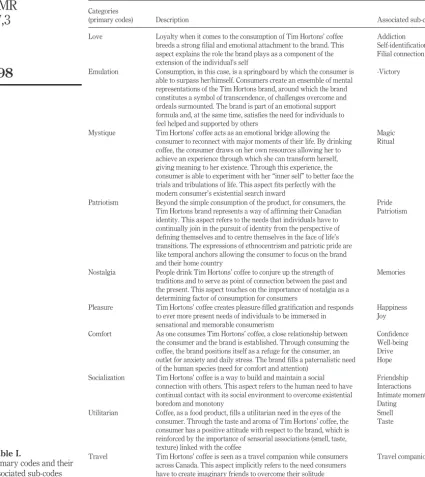
We developed a structured classification protocol. We generated a group of secondary codes or sub-codes that accurately reflected the main ideas of the respondents. After this first exploratory step, 30 sub-codes were identified. Some sub-codes proved redundant and irrelevant. We, therefore, decided to either combine them with similar sub-codes or eliminate them, while being sure to not lose any information relevant to the study. For
example, at the first level of codification, happiness and joy constituted distinct
categories. After our analysis, we noted that they could be integrated under the same
theme calledpleasurebecause of many similarities they convey in their meanings. Also,
we have proceeded in the same way concerning theutilitariantheme. During the first
codification process, we created a category calledtaste experience, which appeared to be
identical in its content with categoriessmellandtaste during our analysis. To avoid
redundancy, those categories have been aggregated in the new suitable category
utilitarian, while the categorytaste experiencewas simply deleted because it did not provide additional information in comparison with the aggregated sub-codes. From this filtering process, 22 sub-codes were retained, which allowed us to reach a more limited set of 10 primary, or first-level codes, representing the underlying aspects of the
consumption experience. Table I captures the primary codes and their associated
sub-codes.
To better interpret the primary codes that emerged from the narrative analysis, we
grouped them according toHolt’s (1995)typology. The new aspects that we identified
supported the thesis that Holt’s typology is not exhaustive with regard to certain activities of consumption
Aspects of the overall consumption experience of Tim Hortons’ coffee
Experience. Inspired by the work of Hirschman and Holbrook (1982), Holt (1995)
demonstrates that the consumption process implies an experiential aspect that manifests in the search for pleasure and emotion. This aspect is primarily translated by the theme of “pleasure” such as illustrated in the code journal. In fact, the consumption
of Tim Hortons’ coffee evokeshappinessandjoyin its consumers. The coffee appears to
evoke moments of pure pleasure, enabling the individual to remain calm in the face of daily challenges (work, school, etc.):
They (Tim Hortons team) made every day better and I thank them for supporting us who are out there fighting.(Woman)
197
Tim Hortons’
coffee fans
Table I.
Primary codes and their associated sub-codes
Categories
(primary codes) Description Associated sub-codes
Love Loyalty when it comes to the consumption of Tim Hortons’ coffee breeds a strong filial and emotional attachment to the brand. This aspect explains the role the brand plays as a component of the extension of the individual’s self
Addiction Self-identification Filial connection
Emulation Consumption, in this case, is a springboard by which the consumer is able to surpass her/himself. Consumers create an ensemble of mental representations of the Tim Hortons brand, around which the brand constitutes a symbol of transcendence, of challenges overcome and ordeals surmounted. The brand is part of an emotional support formula and, at the same time, satisfies the need for individuals to feel helped and supported by others
-Victory
Mystique Tim Hortons’ coffee acts as an emotional bridge allowing the consumer to reconnect with major moments of their life. By drinking coffee, the consumer draws on her own resources allowing her to achieve an experience through which she can transform herself, giving meaning to her existence. Through this experience, the consumer is able to experiment with her “inner self” to better face the trials and tribulations of life. This aspect fits perfectly with the modern consumer’s existential search inward
Magic Ritual
Patriotism Beyond the simple consumption of the product, for consumers, the Tim Hortons brand represents a way of affirming their Canadian identity. This aspect refers to the needs that individuals have to continually join in the pursuit of identity from the perspective of defining themselves and to centre themselves in the face of life’s transitions. The expressions of ethnocentrism and patriotic pride are like temporal anchors allowing the consumer to focus on the brand and their home country
Pride Patriotism
Nostalgia People drink Tim Hortons’ coffee to conjure up the strength of traditions and to serve as point of connection between the past and the present. This aspect touches on the importance of nostalgia as a determining factor of consumption for consumers
Memories
Pleasure Tim Hortons’ coffee creates pleasure-filled gratification and responds to ever more present needs of individuals to be immersed in sensational and memorable consumerism
Happiness Joy
Comfort As one consumes Tim Hortons’ coffee, a close relationship between the consumer and the brand is established. Through consuming the coffee, the brand positions itself as a refuge for the consumer, an outlet for anxiety and daily stress. The brand fills a paternalistic need of the human species (need for comfort and attention)
Confidence Well-being Drive Hope
Socialization Tim Hortons’ coffee is a way to build and maintain a social connection with others. This aspect refers to the human need to have continual contact with its social environment to overcome existential boredom and monotony
Friendship Interactions Intimate moments Dating Utilitarian Coffee, as a food product, fills a utilitarian need in the eyes of the
consumer. Through the taste and aroma of Tim Hortons’ coffee, the consumer has a positive attitude with respect to the brand, which is reinforced by the importance of sensorial associations (smell, taste, texture) linked with the coffee
Smell Taste
Travel Tim Hortons’ coffee is seen as a travel companion while consumers across Canada. This aspect implicitly refers to the need consumers have to create imaginary friends to overcome their solitude
Travel companion
QMR
17,3
198
The consumption narratives associated with experience are not only textual. Numerous consumers used visual content to illustrate the pleasure and happiness felt while drinking Tim Hortons’ coffee. The use of photos and images, in addition to the written stories, might be understood as a way for the consumer to symbolically and emotionally
expand the reach of the consumer experience (Loeffler, 2004).
Integration.Individuals use cultural symbols and meanings attached to objects of
consumption to establish their identity in the social world (Escalas and Bettman, 2005;
McCraken, 1986). The analysis of the narratives highlighted the emergence of a form of animism, accentuated by the effect of habit and consuming Tim Hortons’ coffee. Across
themes ofloveandcomfort, we observed that respondents developed anthropomorphic
representations of Tim Hortons’ coffee.
In their stories, consumers personified Tim Hortons’ coffee as a long-time friend, a
romantic partner and a faithful life partner (filial relationship). Some consumers are
unable to imagine living without the coffee, as it has become an integral part of their personality (self-identification). This coffee love affair sometimes reaches immeasurable
proportions (addiction). Carroll and Ahuvia (2006)stated that the brand – consumer
relationship can be broken down into three component principles: eros (passionate love, visceral attachment to the brand), mania (possessive love, declarations of love for the brand) and agape (altruistic love, positive feelings about the brand). Through consumption, individuals learn not only to share the meanings and symbols associated with the brand but also to develop a semiotic repertory with regard to these symbols that allow them to maintain, define and express their identity (Piacentini and Mailer, 2004):
The other half of our lives is devoted to our love for […] Tim Hortons! (Woman)
Tim Hortons’ coffee is also a source of comfort for consumers. It brings confidence,
well-being, drive and hope. Its consumption seems to give individuals unsuspected strength allowing them to face life’s difficulties. The narratives certainly portray the image of a soothing coffee:
I survived, from day-to-day, by having my Tim Hortons and I can say that without it, I couldn’t have become this cheerful and in shape. I lost 230 pounds in two years. (Woman)
Classification.According to Holt (1995), individuals invest in consumption activities
with the goal of weaving social ties. Tim Hortons’ coffee facilitatesfriendships and
interactionsbetween individuals. Some consumers (in large part, women) reveal that
this coffee allowed them tomeet their soul mate. Tim Hortons’ establishments are also
an ideal place for interpersonal interaction (a mother and her children, a couple, etc.) and provide a place for an individual to be alone:
It was really our secret place, sometimes I was with my two girls, or with one or the other; it gave them each a chance to have their mom to themselves. (Woman)
Beyond the simple beverage, Tim Hortons conveys symbols of identity for Canadian people, notably the passion for hockey. This supports the idea that consumption activities constitute windows of expression of values, rites, standards and practices of a
given culture (Laroche et al., 2002). Usually, associations made to patriotism are
generally evoked in the framework of sports stories (the Olympic Games, curling, hockey, etc.). We should note that patriotic statements are more prevalent among Anglophone participants.
199
Tim Hortons’
coffee fans
Tim Hortons is as much a part of our culture as plaid, dog sleds and poutine. It is a point of pride, something special, and for those of us living outside of our homeland, it’s something not to be taken for granted! (Man)
Play. Consuming is generally organized around a set of rules and rituals that allow individuals to make the consumption experience their own. The rules and rituals that Holt alludes to in his typology are relative to the manner in which consumption acts as a foundation vehicle for interpersonal interactions. For example, for some consumers, drinking Tim Hortons’ coffee is part of a routine that allows them to be in touch with their social environment (friends, colleagues, Tim Hortons’ staff, etc.).
Consumer narratives emphasized the centrality of the Tim Hortons brand during times of national unity, notably hockey games. Their stories also portrayed Tim Hortons’ coffee as a good-luck charm.
And each time, before going to the gym, we went to Tim’s to pick up the famous “Lucky Cup”; it became a family ritual. (Man)
As evidenced in the initial analysis, Holt’s typology can be used to understand the
symbolic meaning attached to today’s products of consumption, like coffee (Filser,
2002). That being said, Holt’s typology is not adequate when used to describe the overall consumption experience insofar, as it is possible to cause new symbolic aspects to emerge. To this effect, the analysis that we undertook with Tim Hortons’ coffee highlighted other important aspects.
Nostalgia.From an experiential perspective,Schindler and Holbrook (2003)show that some consumers demonstrate preferences or positive attitudes towards certain consumer objects that are familiar to them, from their childhood or their youth. This return to the past lets the individual preserve his or her identity in the face of major life
transitions, all while reducing feelings of anxiety or uncertainty (Kessous and Roux,
2008).
Through their stories, several consumers relate their current consumption of Tim Hortons’ coffee to childhood rituals that have stretched into adulthood. For these consumers, the Tim Hortons brand is eternal. This aspect is very interesting, as it could be used by the company to strengthen the feeling of attachment and brand loyalty (Sierra and McQuitty, 2007). Its mention in this study is significant because it constitutes a gold mine that Tim Hortons brand uses in its commercials. For example,
[…] a young father recalls childhood hockey games with his father, then he takes his daughter to Tim Hortons before her Saturday game. Visual imagery can be very powerful when evoking the idea of the power of tradition.[2]
Mystique. According to some authors, religion has lost its sacred power for consumption; an activity that is now a theatre of spiritual expression and the search for
meaning (Yeganehet al., 2010). From this angle,Gallarzaet al.(2009)emphasized the
fact that consumption has become the area where individuals express their desire to have magical and transformational experiences. In this study, this desire is seen via the image of a coffee that shapes individuals. For the most part, Tim Hortons’ coffee has
magicand spiritual virtues and when an individual comes in contact with it, they are filled with happiness and joy. This mystical element seems to create, cultivate and maintain itself through rituals of consumption. Tim Hortons’ coffee appears to be the
QMR
17,3
200
anchor that unites two apparently opposing worlds: the natural and supernatural; the physical and the mystical. This spiritual aspect is illustrated in the following extract:
To this day, on every special occasion, and even not so special times, I will go visit her grave with my coffee, and chat with her as I loved to do before she joined Dad. (Woman)
Spatial. The spatial dimension is associated with travel and exploration. For the respondents, Tim Hortons’ coffee is the ideal travel companion. In a country with a vast geography, the presence of Tim Hortons in-service centres allows Canadians to travel more comfortably and in better humour.
This aspect is very interesting because it makes an important sales argument for the Tim Hortons corporation, which recently undertook the large operation of extending its retail distribution over the entire country. To position itself as the number one coffee brand on the road may give Tim Hortons a distinct advantage, as well as increase its awareness:
I have road tripped coast to coast across Canada 5 times over the last few years. Each time stopping at Timmies at least once a day (often 4-5 times a day). (Man)
Emulation.Emulation refers to Tim Hortons’ social involvement as sponsors of kids’ amateur hockey in Canada. In various narratives, respondents, having demonstrated a patriotic attachment to the brand, associate it with Canadian athletics at all levels. Tim Hortons is perceived as a proud Canadian brand, and through its actions, it encourages young Canadians to surpass themselves, to follow their dreams and to excel. Adopting such an approach can be a lucrative strategy for other companies in this industry, as it allows them to increase their brand communities. This strategy is heavily employed by Tim Hortons, which increased sales using a hockey star, Sydney Crosby, for instance. Being the spokesperson of the “Tim Hortons Timbits” minor hockey program, Sidney Crosby appears in all commercials, public relations and contests related to this Timbits program.
Conclusion
Discussion and contributions
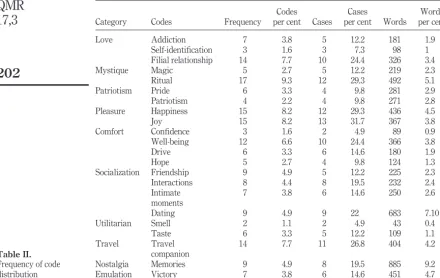
This study investigated the overall consumption experience, and paid particular attention to the process of appropriation and the emotional aspects. Tim Hortons’ coffee, as represented in consumer narratives, was the object of the study. Holt’s typology was used as the theoretical framework to determine the consumer experience. From the narratives, the individuals in the sample group predominantly associated the consumption of coffee with the following: ritual (9.3 per cent, in 17 examples); happiness (8.2 per cent, 15 examples); joy (8.2 per cent, 15 examples); and travel companion and extended relationship (7.7 per cent, 14 examples). These categories relate, respectively, to the following aspects: mystique (ritual); pleasure (happiness and joy); travel (travel companion); and love (family-like relationship) (Table II).
From academic and business standpoints, this study made some interesting contributions. On an academic level, the study showed that it is possible for today’s consumer products to become symbolic representations in the minds of consumers, provided that the consumer has a strong attachment to the brand. In addition, the new aspects that we identified offer interesting avenues that are easily applicable to other consumer activities. Truly, to maintain a strong market position, it is no longer sufficient to know the associations linked to the overall experience of a product’s
201
Tim Hortons’
coffee fans
consumption. In addition to the various associations related to product consumption, the company must also have ways of accessing or appropriating the consumer experience. This forward-thinking process of consumption justifies itself by the very heterogeneity of today’s consumers – shared between multiple “selves”, in the face of their many demands – and ways of satisfying them. The appropriation of the consumption experience can also be predicted, contingent on the intensity with which the experience
is lived and the environmental context that underlies its production (Reed, 2004).
According toGoffman’s (1959)theatric perspective, consumption activities should be
created on the pretence of favouring total appropriation by the consumer. In the scope of this study, pretence is defined as the set of situations and contexts that prevail over the consumption of the experience produced and lived by the Tim Hortons’ coffee consumer. Consumption contexts influence the consumption experiences of Tim Hortons’ coffee drinkers.
Furthermore, in line with the benefits of ethnography described earlier, the methodologically ethnographic (netnographic) approach to this research may be argued to have delivered some rich insights into the attitudes and behaviour of those consumers who were positively engaged with this product – Tim Hortons coffee-shops. Such a methodological approach may therefore be useful for other brand-owners or organizations to help them understand the customers and other stakeholders who are strongly enough engaged in either a positive or negative direction with that brand or
Table II.
Frequency of code distribution
Category Codes Frequency
Codes
per cent Cases
Cases
per cent Words
Words per cent
Love Addiction 7 3.8 5 12.2 181 1.9
Self-identification 3 1.6 3 7.3 98 1
Filial relationship 14 7.7 10 24.4 326 3.4
Mystique Magic 5 2.7 5 12.2 219 2.3
Ritual 17 9.3 12 29.3 492 5.1
Patriotism Pride 6 3.3 4 9.8 281 2.9
Patriotism 4 2.2 4 9.8 271 2.8
Pleasure Happiness 15 8.2 12 29.3 436 4.5
Joy 15 8.2 13 31.7 367 3.8
Comfort Confidence 3 1.6 2 4.9 89 0.9
Well-being 12 6.6 10 24.4 366 3.8
Drive 6 3.3 6 14.6 180 1.9
Hope 5 2.7 4 9.8 124 1.3
Socialization Friendship 9 4.9 5 12.2 225 2.3
Interactions 8 4.4 8 19.5 232 2.4
Intimate moments
7 3.8 6 14.6 250 2.6
Dating 9 4.9 9 22 683 7.10
Utilitarian Smell 2 1.1 2 4.9 43 0.4
Taste 6 3.3 5 12.2 109 1.1
Travel Travel companion
14 7.7 11 26.8 404 4.2
Nostalgia Memories 9 4.9 8 19.5 885 9.2
Emulation Victory 7 3.8 6 14.6 451 4.7
QMR
17,3
202
organization, to comment on it in a public forum such as on a website (Kozinets, 2010;
O’Reilly et al., 2012). The quality and richness of the insights obtained in this study highlight the relevance of the qualitative approach as a method of investigation. Qualitative research has the advantage to favour an in-depth approach to understand some complex consumers’ experiences and extract from them some innovative strategies that can help companies to stand out significantly from their competitors. With the increasingly influence of experiential quest at the heart of contemporary consumption, companies find a great need to examine more closely and qualitatively the relationship that they have with their customers to offer them products and brands that
are closer to their expectations. As asserted by Gendron (2008, p. 130), qualitative
research is:
[…] a relevant and legitimate mode of inquiry. It can provide thick descriptions of new phenomena; it can develop or refine theories about [marketing] in action; and it can sensitize academics to the realities of practitioners and allow meaningful case studies to be developed for teaching purposes. Qualitative research may also help secure academia’s relationships with practitioners because the latter tend to relate to qualitative articles, perhaps in a more meaningful way than quantitative papers.
On a business level and to exploit the experiential aspect throughout the consumption experience, Tim Hortons could include, in its advertising, references to the ambience in its stores or the happiness shared by colleagues drinking Tim Hortons at their workplace. Capitalizing on the nostalgic aspect could be an avenue to exploit to optimize the intensity of the consumer’s experience, for instance through storytelling which refers to the ability of creating myths and legends, of articulating a romanticized story around the club that will be passed on from one generation to another and of crystallizing the emotional bond between the team and its fans (Kollet al., 2010;Megehee and Spake, 2012). In addition, the analysis of contexts revealed two primary modes of consuming Tim Hortons’ coffee: private and public. In the private mode, coffee is consumed as an intimate object easily bringing personal comfort to the consumer or to their closest social circle (family, children and close colleagues). Conversely, the public mode treats the coffee as a collectively shared object that is expected to join the consumer to a larger social world. These different modes could be used in strategic planning by the enterprise. In fact, the advertising strategy could be to capitalize on the public mode when the brand wants to position itself as one of things people will remember from a big event – a hockey game, for example.
Limitations and future research
Although this study made academic and business contributions, it also presented some limitations.
First, we privileged an exploratory approach which seems to have somewhat limited our conclusions. Quantitative approaches could be led in the framework of future research to confirm the conclusions reached in our study.
Second, considering the intensity and highly symbolic degree of the various consumption narratives, there is a good chance that our sample group be composed, for the most part, of passionate consumers who have had a long loyal relationship with the Tim Hortons brand. Collecting data via face-to-face interviews with diverse consumers about the brand (loyal, somewhat loyal, occasional, etc.) may create an avenue of future research with the purpose of validating, on the one hand, the conclusions of the present
203
Tim Hortons’
coffee fans
study, and on the other hand, to proceed with comparisons between groups on the basis of various identified aspects.
Third and in line with the previous point, we acknowledge that there is a danger of bias in our data, considering that we used the narratives that recorded the highest hits. However, by receiving the highest hits, these narratives represent a socially constructed reality which was validated by Tim Hortons’ fans themselves.
One of the important contributions of this study highlighted the example of the strong link that exists between Anglophone consumers and some dimensions of “patriotism”. A future study in this area may prove interesting with a view to empirically validate this conclusion that may, in the case where it could be confirmed, serve to elaborate a brand advertising strategy in English Canada. Similar studies could be undertaken in other countries with national brands which have a strong resonance among local consumers in the private and the public sphere: Starbucks in the USA, Tchibo in Germany, etc. A cross-cultural, comparative analysis could bring some interesting insights on the consumption experience of consumer products and how the respective brands could nurture the loyalty of their “fans”.
Finally, as we have discussed earlier, the netnographic approach used in this research has helped us deliver some rich insights into the attitudes and behaviour of consumers. Consequently, it could be useful for other brand-owners who wish to understand their customers and other stakeholders who are deeply engaged with that respective brand.
Notes
1. The Canadian equivalent of Starbucks.
2. Excerpt from the site: affaires.com, “Les leçons des mini-carottes”, Jordan Lebel, available at:
www.lesaffaires.com/archives/commerce/les-lecons-des-mini-carottes/499148 (accessed 6 June 2011).
References
Aaker, J.L., Benet-Martinez, G. and Garolera, J. (2001), “Consumption symbols as carriers of culture: a study of Japanese and Spanish brands personality constructs”, Journal of Personality and Social Psychology, Vol. 81 No. 3, pp. 492-508.
Addis, M. and Holbrook, M.B. (2001), “On the conceptual link between mass customisation and experiential consumption: an explosion of subjectivity”,Journal of Consumer Behaviour, Vol. 1 No. 1, pp. 50-66.
Alistair, W. (2006), “Tourism and hospitality marketing: fantasy, feeling and fun”,International Journal of Contemporary Hospitality Management, Vol. 18 No. 6, pp. 482-495.
Baudrillard, J. (1970),La société de consommation, Denoël, Paris.
Bearden, W.O. and Teel, J.E. (1983), “Selected determinants of consumer satisfaction and complaint reports”,Journal of Marketing Research, Vol. 20 No. 1, pp. 21-28.
Blumrodt, J., Bryson, D. and Flanagan, J. (2012), “European football teams CSR engagement impacts on customer-based brand equity”,Journal of Consumer Marketing, Vol. 29 No. 7, pp. 482-493.
Boddy, C.R. (2009), “Ethnographic approaches to gathering marketing intelligence”,Australasian Journal of Market and Social Research, Vol. 17 No. 1, pp. 49-56.
QMR
17,3
204
Boddy, C.R. (2011), “Hanging around with people’ ethnography in marketing research and intelligence gathering”,The Marketing Review, Vol. 11 No. 2, pp. 151-163.
Boulaire, C. and Richelieu, A. (2005), “A post-modern conception of the product and its application to professional sport”,International Journal of Sports Marketing & Sponsorship, Vol. 7 No. 1, pp. 23-34.
Boulaire, C., Graf, R. and Guelmani, R. (2008), “Online communities serving the consumer/producer: observations from the study of a fantasy world”,Direct Marketing: An International Journal, Vol. 2 No. 4, pp. 199-220.
Boulaire, C., Hervet, G. and Graf, R. (2010), “Creativity chains and playing in the crossfire on the video-sharing site YouTube”, Journal of Research in Interactive Marketing, Vol. 4 No. 2, pp. 111-141.
Brace-Govan, J. (2007), “Participant photography in visual ethnography”,International Journal of Market Research, Vol. 49 No. 6, pp. 735-750.
Carroll, B.A. and Ahuvia, A.C. (2006), “Some antecedents and outcomes of brand love”,Marketing Letters, Vol. 17 No. 2, pp. 79-89.
Carù, A. and Cova, B. (2003), “Approche empirique de l’immersion dans l’expérience de consommation: les opérations d’appropriation”, Recherche et Applications Marketing, Vol. 18 No. 2, pp. 47-65.
Chéron, E.J. and Muller, T.E. (1993), “Relative importance of values as determinants of ownership patterns: comparisons between the Canadian provinces of ontario and quebec”,Journal of International Consumer Marketing, Vol. 5 No. 3, pp. 37-53.
Corden, A. and Sainsbury, R. (2006), “Exploring ‘Quality’: research participants’ perspectives on verbatim quotations”,International Journal of Social Research Methodology, Vol. 9 No. 2, pp. 97-110.
Cova, B. and Carù, A. (2006), “Expériences de consommation et marketing expérientiel”,Revue Française de Gestion, Vol. 32 No. 162, pp. 99-113.
Cova, B. and Cova, V. (2001), “Tribal aspects of postmodern consumption research: the case of French in-line roller skaters”,Journal of Consumer Behaviour, Vol. 1 No. 1, pp. 67-76. Coyne, I.T. (1997), “Sampling in qualitative research. purposeful and theoretical sampling:
merging or clear boundaries?”,Journal of Advanced Nursing, Vol. 26 No. 3, pp. 623-630. Curasi, C.F. (2011), “Intergenerational possession transfers and identity maintenance”,Journal of
Consumer Behaviour, Vol. 10 No. 2, pp. 111-118.
Dwyer, B. (2011), “Divided loyalty? an analysis of fantasy football involvement and fan loyalty to individual National Football League (NFL) teams”,Journal of Sport Management, Vol. 25 No. 5, pp. 445-457.
Escalas, J.E. and Bettman, J.R. (2005), “Self-construal, reference groups, and brand meaning”,
Journal of Consumer Research, Vol. 32 No. 3, pp. 378-389.
Filser, M. (2002), “Le marketing de la production d’expériences: Statut théorique et implications managériales”,Décisions Marketing, Vol. 28 No. 4, pp. 13-22.
Fornell, C. (1992), “A national customer satisfaction barometer: the Swedish experience”,Journal of Marketing, Vol. 56 No. 1, pp. 6-21.
Gallarza, M.G., Arteaga, F., Floristan, E. and Gil, I. (2009), “Consumer behaviour in a religious event experience: an empirical assessment of value dimensionality among volunteer”,International Journal of Culture, Tourism and Hospitality Research, Vol. 3 No. 2, pp. 165-180.
Gendron, Y. (2008), “Constituting the academic performer: the spectre of superficiality and stagnation in academia”,European Accounting Review, Vol. 17 No. 1, pp. 97-127.
205
Tim Hortons’
coffee fans
Goffman, E. (1959),Presentation of Self in Everyday Life, Doubleday, New York, NY.
Goulding, C. (2005), “Grounded theory, ethnography and phenomenology: a comparative analysis of three qualitative strategies for marketing research”,European Journal of Marketing, Vol. 39 Nos. 3/4, pp. 385-404.
Hill, R. (2003), “Are you being served?”,Health Forum Journal, September, pp. 12-16.
Hirschman, E.C. and Holbrook, M.B. (1982), “The experiential aspects of consumption: consumer fantasies, feelings, fun”,Journal of Consumer Research, Vol. 9 No. 2, pp. 132-140. Holt, D. (1995), “How consumers consume: a typology of consumption practices”,Journal of
Consumer Research, Vol. 22 No. 2, pp. 1-21.
Homburg, C., Koschate, N. and Hoyer, W.D. (2006), “The role of cognition and affect in the formation of customer satisfaction: a dynamic perspective”,Journal of Marketing, Vol. 70 No. 3, pp. 21-31.
Kessous, A. and Roux, E. (2008), “A semiotic analysis of nostalgia as a connection to the past”,
Qualitative Market Research: An International Journal, Vol. 11 No. 2, pp. 192-212. Kleine, S.S. and Baker, S.M. (2004), “An integrative review of material possessions attachment”,
Academy of Marketing Science Review, Vol. 1 No. 1, pp. 1-35.
Kleine, S.S., Kleine, R.E. III and Laverie, D.E. (2006), “Exploring how role-identity development stage moderates person-possessions relations”,Research in Consumer Behavior, Vol. 10 No. 1, pp. 127-163.
Koll, O., Von Wallpach, S. and Kreuzer, M. (2010), “Multi-method research on consumer-brand associations: comparing free associations, storytelling and collages”, Psychology & Marketing, Vol. 27 No. 6, pp. 584-602.
Kozinets, R.V. (2002), “The field behind the screen: using netnography for marketing research in online communities”,Journal of Marketing Research, Vol. 39 No. 1, pp. 61-72.
Kozinets, R.V. (2010), “Netnography: the marketer’s secret weapon: how social media understanding drives innovation”,Netbase Report, March, pp. 1-11.
Kozinets, R.V., Andrea, H. and Hope, J.S. (2008), “The wisdom of consumer crowds: collective innovation in the age of networked marketing”,Journal of Macromarketing, Vol. 28 No. 4, pp. 339-354.
Kozinets, R.V. and Handelman, J.M. (2004), “Adversaries of consumption: consumer movements, activism, ideology”,Journal of Consumer Research, Vol. 31 No. 3, pp. 691-704.
Ladwein, R. (2002), “Les modalités de l’appropriation de l’expérience de consommation: Le cas du tourisme urbain”, Cahier de la recherche, Centre Lillois d’Analyse et de Recherche sur l’Évolution des Entreprises (CLAREE), Lille.
Lai, F., Griffin, M. and Babin, B.J. (2009), “How quality, value, image and satisfaction create loyalty at Chinese telecom”,Journal of Business Research, Vol. 62 No. 10, pp. 980-986.
Laroche, M., Papadopoulos, N. and Heslop, L. (2002), “Effects of subcultural differences on country and product evaluations”,Journal of Consumer Research, Vol. 2 No. 3, pp. 232-247. Lee, Y.-K., Lee, C.-K., Lee, S.-K. and Babin, B.J. (2008), “Festivalscapes and patrons’ emotions,
satisfaction and loyalty”,Journal of Business Research, Vol. 61 No. 1, pp. 56-64.
Loeffler, T.A. (2004), “A photo elicitation of study of the meanings of outdoor adventure experiences”,Journal of Leisure Research, Vol. 36 No. 4, pp. 536-556.
McCraken, G. (1986), “Culture and consumption: a theoretical account of the structure and movement of the cultural meaning of consumer goods”,Journal of Consumer Research, Vol. 13 No. 1, pp. 71-84.
QMR
17,3
206
McNickel, D. (2004), “Hands on brands”, available at: http://fr.scribd.com/doc/12918212/ Experiential-Marketing-2
Maffesoli, M. (1990), Aux Creux des Apparences: Pour une éthique de l’esthétique, Plon, Paris.
Mariampolski, H. (1999), “The power of ethnography”,Journal of the Market Research Society, Vol. 41 No. 1, pp. 75-86.
Martin, T. (2004), “Internal confidentiality: when confidentiality assurances fail relational informants”,Qualitative Sociology, Vol. 27 No. 1, pp. 101-106.
Megehee, C.M. and Spake, D.F. (2012), “Consumer enactments of archetypes using luxury brands”,
Journal of Business Research, Vol. 65 No. 10, pp. 1434-1442.
Michon, R. and Chebat, J.-C. (2004), “Cross-Cultural mall shopping values and habitats: a comparison between English-and French-speaking Canadians”, Journal of Business Research, Vol. 57 No. 8, pp. 883-892.
Nelson, M.R. and Otnes, C.C. (2005), “Exploring cross-cultural ambivalence: a netnography of intercultural wedding message boards”, Journal of Business Research, Vol. 58 No. 1, pp. 89-95.
Neuendorf, K.A. (2004),The Content Analysis Guidebook, Sage Publications, Thousand Oaks, CA. O’Reilly, N., Berger, I.E., Hernandez, T., Parent, M.M. and Seguin, B. (2012), “Understanding adolescent sport participation through online social media”, Sport, Business and Management: An International Journal, Vol. 2 No. 1, pp. 69-81.
Park, S.-H., Mahony, D.F. and Kim, Y.K. (2011), “The role of sport fan curiosity: a new conceptual approach to the understanding of sport fan behavior”, Journal of Sport Management, Vol. 25 No. 1, pp. 46-56.
Petkus, E. (2002), “Enhancing the application of experiential marketing in the arts”,International Journal of Non-profit and Voluntary Sector Marketing, Vol. 9 No. 1, pp. 49-56.
Piacentini, M. and Mailer, G. (2004), “Symbolic consumption in teenagers’ clothing choices”,
Journal of Consumer Behaviour, Vol. 3 No. 3, pp. 251-262.
Pine, B.J. and Gilmore, J. (1999),The Experience Economy, HBS Press, Cambridge, MA. Reed, A. II (2004), “Activating the self-importance of consumer selves: exploring identity salience
effects on judgments”,Journal of Consumer Research, Vol. 31 No. 2, pp. 286-295.
Richelieu, A. and Pons, F. (2011), “How strong is my sports brand? the case of the Montréal Canadiens Hockey Club”,Journal of Sponsorship, Vol. 4 No. 4, pp. 353-365.
Sandelowski, M. (1999), “Focus on qualitative methods: sample size in qualitative research”,
Research in Nursing and Health, Vol. 18 No. 2, pp. 179-183.
Sandlin, J.A. (2006), “Netnography as a consumer education research tool”,International Journal of Consumer Studies, Vol. 31 No. 3, pp. 288-294.
Schindler, R.M. and Holbrook, M.B. (2003), “Nostalgia for early experience as a determinant of consumer preferences”,Psychology and Marketing, Vol. 20 No. 4, pp. 275-302.
Sierra, J.J. and McQuitty, S. (2007), “Attitudes and emotions as determinants of nostalgia purchases: an application of social identity theory”, Journal of Marketing Theory and Practice, Vol. 15 No. 2, pp. 99-112.
Thompson, C.J., Locander, W.B. and Polio, H.R. (1990), “The lived meaning of free choice: an existential-phenomenological description of everyday consumer experiences of contemporary married women”,Journal of Consumer Research, Vol. 17 No. 3, pp. 346-361. Venkatesh, A. and Meamber, A.L. (2008), “The aesthetics of consumption and the consumer as an
aesthetic subject”,Consumption Markets and Culture, Vol. 11 No. 1, pp. 45-70.
207
Tim Hortons’
coffee fans
Yeganeh, H., Marcotte, P. and Bourdeau, L. (2010), “Bridging culture and consumer value: towards an integrative framework”,International Journal of Business and Emerging Markets, Vol. 2 No. 2, pp. 147-162.
Yuan, Y-H. and Wu, C. (2008), “Relationships among experiential marketing, experiential value, and customer satisfaction”,Journal of Hospitality and Tourism Research, Vol. 32 No. 3, pp. 387-410.
Further reading
Mariampolski, H. (1988), “Ethnography makes comeback as a research tool”,Marketing News, Vol. 22 No. 1, p. 32.
About the authors
André Richelieu is specialized in brand management and sports marketing. His research relates to how professional sports teams can leverage their brand equity by capitalizing on the emotional connection they share with their fans; how professional sports teams can internationalise their brand; and how sports teams can improve fans’ experience at the sporting venue and outside the stadium, and increase fans’ attachment to the team. Richelieu is the co-author ofNeo-Sports Marketing(De Boeck Publishers, 2011) andGlobal Sports Marketing(Routledge Publishers, 2012). An overview of his work can be found at www.andrerichelieu-sportsmarketing.com. André Richelieu is the corresponding author and can be contacted at:[email protected]
Bernard Korai is a PhD student in Marketing at Laval University. His research interests focus on consumer behaviour, the role of culture in marketing and brand management. He currently teaches a course in consumer behaviour at the undergraduate level at the Faculty of Business Administration.
To purchase reprints of this article please e-mail:[email protected] Or visit our web site for further details:www.emeraldinsight.com/reprints
QMR
17,3
208