Abstract
Objective: The anthropometrical data of our aging population has significantly changed within the last five decades. Therefore the question arises whether or not the commonly used reference values of the Euro-pean Community (ECCS) for lung function, may still be accepted today. Measured values for elderly are classified by extrapolation beyond the range of refer-ence equations.
Material and methods:Lung function was examined by pneumotachography for recording static lung volumes and flow-volume-curves in 257 asymptomatic non smoking males, aged 20-90 years. Results were com-pared to the reference values of ECCS, SAPALDIA, LuftiBus, and NHANES.
Results:For analysis age and height dependence of in-vestigated respiratory parameters (VC, FVC, FEV1, FEV1 %FVC, PEF, MEF75,50,25) can for simplicity be de scribed by linear functions (y = a . height(H)-b . age (A)+c). The forced expiratory volume in one second, FEV1, was calculated by FEV1 = 0.0432 . H-0.0347 . A -2.114; where H - height, A - age; r = 0.78. Mean FEV1 for younger subjects was found to be 106.1 ± 11.2% of the ECCS reference values and 97.8 ± 11.7% in older subjects. For all parameters investigat-ed linear regressions on age were steeper than de-scribed by the ECCS reference values. The regression of lung function to height largely follows the ECCS prescriptions.
Summary: Bochum lung function values of healthy subjects showed a steeper age descent compared to the reference values of the ECCS. The alternatively discussed reference values of the SAPALDIA-, NHANES- or LuftiBus-Study are higher, but do not cover all necessary parameters and/or the age range. A multi centre study for contemporary reference values is recommended.
Key words: lung function, reference values, elderly males, spirometry, forced expiration
I
NTRODUCTIONThe structure of our aging population has significantly changed along with anthropometrical data in the last five decades. Therefore the question arises whether or not the commonly used reference values of ventilatory lung function, which were suggested by the European
Community for Coal and Steel (ECCS) [1, 2], may still be accepted today, since these values were obtained in the sixties and seventies from subjects with a restricted range of age and body height. Birth cohort effects and improved technology should be considered. Measured values are classified for elderly by extrapolated refer-ence equations which have been obtained from a dif-ferent population beyond the range. Therefore deci-sions in elder and smaller subjects concerning com-pensation due to impaired lung function after industri-al exposure on the basis of ECCS-vindustri-alues are question-able. In the last decades several new reference equa-tions were published, finding higher values for lung function [3-8], which replaced the former recommen-dations [9-13]. Compared to the recently published recommendations, ECCS-values are lower, and the lower limit values or the 5thpercentile may not
repre-sent the cut off point between “normal” and “dis-eased”.
Three models may be discussed for the changes in lung function related to aging. After the age of 65 a normal course of aging could result in a further linear decrease in spirometric parameters with the same slope as observed in middle aged groups [14]. Second-ly, healthy older subjects may have nearly constant val-ues for lung function. Finally, accumulation of dis-eases may result in a steeper decrease in lung function, as observed in patients with COPD or in heavy smok-ers [15-17].
The current reference formulas available from the literature are incomplete concerning spirometric pa-rameters (Hankinson [3], only FVC, FEV1, FEV6, PEF, FEF25-75) the range of age (Brändli et al. [4] 20-60 years, FEV1, FVC, FEV1 %FVC, PEF, MEF75,50,25, MEF25-75), or contain, as e.g., the Luftibus-Study, a se-lection bias, since only subjects were investigated who paid for a lung function test because of their personal request (Kuster et al. [6] FEV1, FVC, FEV1 %FVC, PEF, MEF75,50,25). In order to perform a comprehen-sive diagnosis of lung function, static and dynamic lung volumes from spirometry and residual volume (RV) from Helium dilution or even from body plethys-mography are needed along with PEF and MEF75,50,25 - values from flow-volume-curves. A complete set of parameters is available only from ECCS recommenda-tions [1, 2].
A linear extrapolation of the ECCS reference equa-tions would be the most simple temporary solution;
Eur J Med Res (2009) 14(Suppl. IV): 140-146 © I. Holzapfel Publishers 2009
T
IME FOR
N
EW
R
EFERENCE
V
ALUES FOR
V
ENTILATORY
L
UNG
F
UNCTION
W. Marek1, E. Marek1, K. Mückenhoff2, H-J. Smith3, P. Degens4, N. Kotschy-Lang5, M. Kohlhäufl6 1Institute of Occupational Physiology, Augusta-Kranken-Anstalt, Bochum; 2Institute of Physiology, Ruhr-Universität Bochum; 3Cardinal
Health, Höchberg; 4Forschungsinstitut für Arbeitsmedizin der Deutschen Gesetzlichen Unfallversicherung, Bochum;
5Berufsgenossenschaftliche Klinik für Berufskrankheiten Falkenstein; 6Klinik Schillerhöhe, Center for Pulmonolgy and Thoracic Surgery,
however, an extrapolation is not generally recom-mended. But all manufactures have implemented the extrapolation in their systems and lung function labo-ratories largely use them. This procedure however does not base on a scientific background and raises the question, if one can rely on diagnosis of lung function based on extrapolations.
The European Task Force on standardisation of lung function testing has recently published a series of comprehensive recommendations for lung function testing and interpretation [18-20]. The problems of the lower limit values and the restricted age range however were not solved.
We checked on a small, but carefully chosen group of healthy never smoking males aged 18 to 90 years and 160 to 203 cm body height, if the ECCS reference recommendation still can be accepted in daily routine measurements, if an extrapolation of the ECCS refer-ence values can be performed, or if the deterioration of lung function is different from a linear decline in higher ages. From the results, a ‘Bochum’ set of refer-ence formulas for lung function parameters in healthy non-smoking males were calculated by multiple linear regression analysis for discussion.
M
ATERIAL ANDM
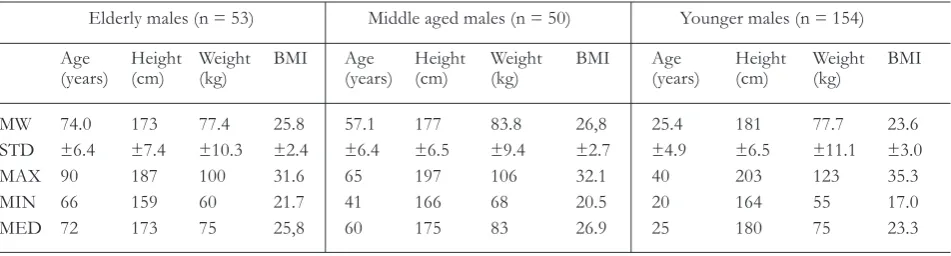
ETHODSLung function was examined using pneumotachogra-phy for recording static lung volumes and flow-vol-ume-curves in 257 asymptomatic non smoking Cau-casian males, aged 20-90 years. Subjects were without diseases of the lung, heart or other organs. The sub-jects were recruited among healthy non-smoking staff members from the hospital, volunteers, and subjects introducing themselves for a health check to enter a life insurance. Competitive athletes or employers per-forming severe physical work were not recruited. The anthropometrical data are presented in Table 1.
ANTHROPOMETRICALDATA
The body height of the males, recruited in the cross sectional study correlated significantly to age, height = -0.173 . age +185 cm (r = 0.49, P <0.01). The mean height of a 25 years old young subject was 181 cm and 173 cm for an 80 years old male. BMI significantly in-creased with age, BMI = 0.056 . age + 22.5 (r=0.37, P<0.01). For the younger group, BMI was 23.6 ± 3.0 and 25.8 ± 2.4 (P<0.005) for the elderly group. BMI
showed a tendency to decrease with height BMI = -0.0723.height + 37.9, (r = 0.37, P<0.05). There was a slight tendency to lower BMI indices with increasing height, BMI = -0.084 .height + 40.2 (r=0.20, P<0.05).
LUNGFUNCTIONMEASUREMENTS
Lung function measurements [21] of static and dy-namic lung volumes and maximal expiratory flows, us-ing MasterLab, or PneumoScreen systems (Cardinal Health, Höchberg) were performed according to the recommendations and reference formulas of the ECCS [2]. According to the manufactures guidelines, calibrations were performed daily. After recording static lung volumes, three flow volume manoeuvres were performed, starting from residual volume (RV) with a forced inspiration. Only measurements were ac-cepted with times for expiration (TE) exceeding four seconds and without cough disturbed expirations.
DATAANALYSIS
From the results multiple linear regression lines were calculated for age (20–90 years) and body height (160-203 cm). The reference formulas for spirometric pa-rameters recorded in the present Bochum study were compared to the reference values of the ECCS, SAPALDIA, LuftiBus and Hankinson studies. The re-sults are presented as means ±SD, along with the medi-an. Using Fisher’s paired t-test, differences of mean val-ues were proofed to be significantly different from ref-erence values of ECCS, SAPALDIA- or LuftiBus- val-ues [22]. P<0.05 was accepted as significantly different.
R
ESULTSCORRELATION OFLUNGFUNCTIONPARAMETERS TOAGE
For healthy subjects, the relationship to age of all res-piratory parameters investigated (VC, FVC, FEV1, FEV1 %FVC, PEF, MEF75,50,25) can be described with linear regressions (y = -m.age+n) for comparison with the ECCS reference equations with extended age range until 90 years of age (P<0.01). Forced expirato-ry volume in one second, FEV1, is represented by FEV1 = -0.043 . age + 5.93; r2 = 0.74 (Fig. 1). The mean FEV1 for younger subjects was 106 ±11.0% of the EGKS reference values, 104 ± 14.1% in middle
Table 1.Anthropometrical data of the elderly, middle aged, and younger subjects included in the study.
Elderly males (n = 53) Middle aged males (n = 50) Younger males (n = 154) Age Height Weight BMI Age Height Weight BMI Age Height Weight BMI (years) (cm) (kg) (years) (cm) (kg) (years) (cm) (kg)
aged group and 98 ±12.5% in the older subjects. Lung function parameters calculated as %predicted also sig-nificantly correlate to age (P<0.01). FEV1 %pred is represented by FEV1 pred = -0.135 . age + 109.68; r2 = 0.06 (Fig. 2).
CORRELATION OFLUNGFUNCTIONPARAMETERS TO
BODYHEIGHT
Lung function parameters, in absolute values and in %predicted are in accordance with ECCS reference
values of body height, indicating a representative match with ECCS reference values. The correspon-dence of FEV1 and body height can be described as FEV1 = 0.091.height–12.12; r2= 0.43, P <0.01, cov-ering the height range 160-202 cm (Fig. 3). Lung function parameters given in %predicted did not show a correlation to body height. These dependen-cies of lung function values are correctly incorpo-rated in the formulas. FEV1 %pred is represented by FEV1 pred = 0.14 . height + 79.34; r2 = 0.009 (Fig. 4).
Fig. 1. Regression of FEV1 on age for healthy non-smoking male adults between 20 and 90 years.
Fig. 2. Regression of FEV1 (in %predicted of
ECCS) on age for healthy non-smoking male adults.
Fig. 3. Regression of FEV1 on body height for
LUNGFUNCTIONPARAMETERSCOMPARED TOECCS
REFERENCEVALUES
The frequently used predicted values of lung function in the group of younger males were up to 10% higher compared to the ECCS reference values. In males old-er than 65 years results wold-ere similar to ECCS predict-ed values or up to 5% smaller. The data confirm the steeper gradual reduction of lung function parameters with age compared to ECCS formulas.
BOCHUMREFERENCEFORMULAS FORLUNGFUNCTION
PARAMETERS OFMALES
VCIN as a static lung volume, the forced expiratory volumes FVC and FEV1, as well as the maximal expi-ratory flows PEF and MEF75,50,25of the healthy males regress linearly to both, age and height (P<0.01). Ex-tending the range of the ECCS-reference functions until 90 years of age (Table 2), the current values, cal-culated in % of the predicted values of ECCS also correlate to age but not to height (as above), indicating
Table 2.Lung function parameters (in %pred of ECCS) in elderly, middle aged and younger males. Parameter Elderly males Middle-aged males Younger males
(n = 53) (n = 50) (n = 148)
VCIN (%pred) 94.6 ± 11.0*** 102.3 ± 12.5 100.1 ± 10.2 FVC (%pred) 96.5 ± 11.8* 105.3 ± 12.7** 104.7 ± 10.7** FEV1(%pred) 97.8 ± 11.7 104.8 ± 12.3** 106.1 ± 11.2***
FEV1 %VCIN 102.5 ± 8.5* 101.2 ± 7.0 100.8 ± 6.48
PEF (%pred) 96.9 ± 14.2 106.1 ± 20.4 106.2 ± 16.4*** MEF50(%pred) 94.8 ± 24.8 94.8 ± 27.4 104.4 ± 23.3
*P<0.05, **P<0.01, ***P<0.001
Table 3.Bochum reference formulas for ventilatory lung function in healthy non-smoking males aged 20 to 90 years (n=251). Parameter Reference formula r2 RSD 1.64.RSD
VC Y = 0.0631.H - 0.0312.A - 4.960 0.73 0.58 0.96 FVC Y = 0.0615.H - 0.0308.A - 4.673 0.74 0.58 0.96 FEV1 Y = 0.0431.H - 0.0346.A - 2.114 0.78 0.49 0.81 FEV1 %FVC Y = -0.1141.H - 0.2001.A + 110 0.32 5.72 9.38 PEF Y = 0.0742.H - 0.0538.A + 1.3032 0.47 1.60 2.63 MEF75 Y = 0.0579.H - 0.0227.A - 1.3032 0.08 1.73 2.85
MEF50 Y = 0.0211.H - 0.0449.A + 3.270 0.41 1.26 2.07 MEF25 Y = 0.0205.H - 0.0400.A - 0.800 0.31 0.68 1.12
H - body height (cm); A - age (years)
a steeper slope of the dependency of the listed lung function parameters on age in the subjects investigat-ed. The residual standard deviation (RSD) of the sub-jects investigated were slightly, but not significantly smaller compared to the ECCS values of RSD, result-ing in slightly higher values for the 5th percentiles.
Bochum function for healthy males demonstrates the steeper slope of the age reduction of 35 ml/year of the compared to 29 ml/year in the ECCS formula. At the age of 25 years FEV1 of a male of 180 cm height, the Bochum values are 300 ml higher com-pared to ECCS values. Near the age of 70 years the re-gression lines cross each other. Since the 5th per-centiles have nearly identical (0.81 and 0.84 l, respec-tively) the lower limit values only differ in the younger ages.
In a 25 year old male of 180 cm height, the 5th
per-centile is 17.8% smaller compared to the predicted val-ue. At 85 years the difference is 30% of the predicted value, or nearly twice as much as for a young adult. The coefficients of variation of the measured values in %predicted of the different lung function parame-ters were minimally smaller in the groups of young and middle aged males compared to the older group. For FEV1 e.g. the coefficient was 11.9 in the older group, 11.7 in the middle aged and 10.6 in the younger group.
D
ISCUSSIONThe commonly distributed and largely accepted refer-ence formulas of the ECCS [1, 2] for ventilatory lung function are limited in fulfilling the current require-ments of lung function testing. The formulas were compiled by the ECCS experts from different investi-gations and subsets of individuals in the seventies. Meanwhile anthropometrical parameters significantly altered, the population is getting older, and technology is largely improved. The stringent definition of the lower limit value by subtracting 1.64.RSD with con-stant RSD wrongs older and smaller subjects effective-ly. The definition of the lower limit value (5th per-centile) is not only important for the discrimination of healthy to diseased, but is also the basis for expert opinions and the amount of compensation for occu-pational lung diseases.
EXTRAPOLATION OFREFERENCEVALUES
Measured lung function values of healthy elderly sub-jects up to 90 years of age can for our purposes be de-scribed by linear regression functions on age and body height. Compared to the ECCS reference formulas, the slopes of the functions were steeper since values for younger subjects were higher than predicted and those of the elderly were slightly lower. The results de-rived from the older group did not deviate too much from extrapolated ECCS values. So, according to the present results on normal lung function an extrapola-tion of the reference equaextrapola-tions beyond common range of age, applying the same limitations as described for subjects in the middle age range, is justified. Our re-sults do not contradict an extrapolation of ECCS-val-ues beyond the range of the reference valECCS-val-ues and can
act as a makeshift for classification of impaired lung function in older subjects. The alternatively discussed reference equations of the SALPADIA-Study, of NHANES and partially of the LuftiBus-Study are higher, but don’t cover all the necessary parameters and/or the age range needed for a comprehensive classification of lung function. A multi centre study for contemporary reference values should be per-formed in order to solve the problems concerning valid reference values.
MULTICENTERSTUDY FORNEWEUROPEANLUNG
FUNCTIONFORMULAS
The demand for a complete set of reference values, replacing the ECCS recommendations due the altered structures of our population can be realized only with a great financial, material and personal engagement in a multi centre European research project. At least a number of 20.000 subjects have to be recruited from local registration offices, smokers and diseased sub-jects excluded and only subsub-jects being qualified are al-lowed to be selected. Selection in higher age groups will be difficult, as we were faced in our study. In a comprehensive reference value project not only static and dynamic lung volumes and maximal flows should be studied, but also parameters of body plethysmogra-phy, diffusion capacities for CO and blood gases should be studied with identical devices.
The study should be designed to follow longitudinal changes in lung function of adults. A 25 years old male of 190 cm height will be several cm smaller at 80 years. Cross sectional studies like ECCS do not inte-grate age into their formulas for TLC. We don’t know if TLC regresses with aging. These open questions can only be answered with a longitudinal study. Recently, the European Respiratory Society established a task force for generation of new reference values of lung function with the aim of compiling current data from early childhood to senescence. A set of recommenda-tions for all ages would be highly convenient, solving the problems of overlaps from adolescence to adults. But for statistical reasons this procedure is highly problematic. In childhood the independent variables for lung function parameters are mainly height and weight, but for young adults these are height, age and sex. So there is a discontinuity in the underlying math-ematical model. Stanovic et al. [23, 24] have published something like reference values spanning from child-hood to senescence .
ECCS REFERENCEVALUESCOMPARED TOLUFTIBUS OR
SALPAPLDIA-RECOMMENDATIONS
1.5 l from 25 to 80 years of age, the difference be-tween the predicted value and the 5th percentile is
nearly constant over the whole range of age. In the original version of the SAPALDIA-Study the lower limit value approximate the predicted values with in-creasing age [4]. Due to a simplified mathematical model, with respect to the small number of older sub-jects, the authors newly computed the lower limit ues [25]. Now the reference values and lower limit val-ues are almost parallel in the SAPALDIA-Study as we know from ECCS formulas. In the Bochum study, based on data of only 257 healthy subjects, coeffi-cients of variation of the values in %predicted did not remarkable differ in the younger and older group as one might expect with respect to the differences in FEV1 of about 2.0 L between a 25 years and an 85 years old male of 180 cm body height.
INDIVIDUALREFERENCEVALUES
For a 50 years old male with 175 cm body height, the difference in between the 5th and 95th percentiles of
FEV1is nearly ±25% of the predicted value. A healthy young adult with a FEV1 of 125%, (95th percentile) developing a COPD after occupational exposure, re-quires a deterioration of his functional lung volume of about 50%, more than his left lung volume, before reaching the lower limit value.
In order to improve the sensitivity of the reference values, a registration of individually well measured lung function parameters as individual reference values of young adults before exposition to hazards should be performed. These values can be taken as individual reference and changes apart from the normal annual decline can be detected much earlier. Treatment and occupational hygiene will be more effective. The idea of individual reference values is supported by the Ger-man Atemwegsliga offering a 'lung passport' with a table for measurements and a diagram representing lung volumes by age. Recording data into the diagram, steeper changes in FEV1compared to the normal de-cline can be detected before a fall below the 5th
per-centile.
S
UMMARY ANDC
ONCLUSIONRegress of static and dynamic lung function parameter of healthy non smoking males investigated in the Bochum study exceeds the limits of ECCS reference values. In the investigated range of 20-90 years and 160-200 cm height, linear regres-sions were computed. Static and dynamic parameters of younger adults were signifi-cantly higher and values of elderly adults were slightly lower compared to ECCS values. Using ECCS references as an interim solution, a linear extrapolation beyond the age limit is acceptable. Considering the in-creasing age and height of our population and the changes in working conditions, a comprehensive multi centre study on lung function of Caucasians should be initiated by the European Community.
Conflicts of interest:No conflicts of interest were reported in relation to this article.
R
EFERENCES[1] Quanjer PH. Standardized lung function testing. Report Working Party Standardization of Lung Function Tests. European Community for Coal and Steel. Bull Eur Phys-iopathol Respir 1983; 19 Suppl 5: 1-95.
[2] Quanjer P, Tammeling GJ, Cotes JE, Pederson OF, Peslin R, Yernault JC. Lung volumes and forced ventilatory flows. Report of the working party standardization of lung functions tests. European Community for Steel and Coal. Eur Respir J 1993; 69 Suppl 16.
[3] Hankinson JL, Odencrantz JR, Fedan KB. Spirometric ref-erence values from a sample of the general U.S. popula-tion. Am J Respir Crit Care Med 1999; 159: 179-187. [4] Brändli O, Schindler N, Künzli R, Keller A, Perruchoud
AP, SAPALDIA Team. Lung function in healthy never smoking adults: reference values and lower limits of nor-mal of a Swiss population. Thorax 1996; 51: 277-282. [5] Roca J, Sanchis J, Agusti-Vidal A, et al. Spirometric
refer-ence values for a Mediterranean population. Bull Eur Physiopathol Respir 1986; 22: 217-224.
[6] Kuster SP, Kuster D, Schindler C, Rochat MK, Braun J, Held L, Brändli O. Reference equations for lung function screening of healthy never-smoking adults aged 18-80 years. Eur Respir J 2008; 31: 860-868.
[7] American Thoracic Society. Lung function testing: selec-tion of reference values and interpretative strategies. Of-ficial statement of the American Thoracic Society. Am Rev Respir Dis 1991; 144: 1202-1218.
[8] American Thoracic Society. Standardization of spirome-try: 1994 Update. Official Statement of the American Thoracic Society. Am Rev Respir Dis 1995; 152: 1107-1136.
[9] Crapo RO, Morris AH, Gardner RM. Reference spiromet-ric values using techniques and equipment that meet ATS recommendations. Am Rev Respir Dis 1981; 123: 659-664.
[10] Knudson RJ, Slatin RC, Lebowitz MD, Burrows B. The maximal expiratory flow-volume curve: normal standards, variability, effects of age. Am Rev Respir Dis 1976; 113: 587-599.
[11] Knudson RJ, Lebowitz MD, Holdberg CJ, Burrows B. Changes in maximal expiratory flow-volume curve with growth and aging. Am Rev Respir Dis 1983; 127: 725-734.
[12] Enright PL, Kronmal RA, Higgins M, et al. Spirometry reference values for women and men 65 to 85 years of age. Am Rev Respir Dis 1993; 147: 125-133.
[13] Enright PL, Beck KC, Sherrill DL. Repeatability of spirometry in 18,000 adult patients. Am J Respir Crit Care Med. 2004; 169: 235-238.
[14] Fletcher C, Peto R. The natural history of chronic air-flow obstruction. BMJ 1977; 1: 1645-1648.
[15] Wise RA. The value of forced expiratory volume in 1 second decline in the assessment of chronic obstructive pulmonary disease progression. Am J Med 2006; 119 Suppl 10: 4-11.
[16] Molfino NA. Genetic predisposition to accelerated de-cline of lung function in COPD. Int J Chron Obstruct Pulmon Dis 2007; 2: 117-119.
[17] Hnizdo E, Sircar K, Yan T, Harber T, Fleming J, Glind-meyer HW. Limits of longitudinal decline for the inter-pretation of annual changes in FEV1in individuals. Oc-cup Environ Med 2007; 64: 701-707.
[18] Miller MR, Hankinson JL, Brusasco V, Burgos F, Casaburi R. Standardisation of Spirometry. Eur Respir J 2005; 26: 319-338.
[20] Pellegrino R, Viegi G, Brusasco V, Crapo RO, Burgos F, et al. Interpretative Strategies for Lung Function Testing. Eur Respir J 2005; 26: 948-968.
[21] Marek W, Marek E, Mückenhoff K, Smith HJ, Kotschy-Lang N, Kohlhäufl M. Lungenfunktion im Alter: Brauchen wir neue Referenzwerte? Pneumologie 2009; 63: 235-243.
[22] Sachs L. Angewandte Statistik, Planung und Auswertung, Methoden und Modelle. Berlin, Heidelberg, New York: Springer Verlag, 1992.
[23] Stanojevic S, Wade A, Stocks J, Hankinson JL, Coates AL, Pan H, Rosenthal M, Corey M, Lebecque P, Cole TJ. Reference Ranges for Spirometry across all ages. a new approach. Am J Respir Crit Care Med 2008; 177: 253-260. [24] Stanojevic S, Wade A, Hankinson JL, Coates AL, Stocks J, Cole TJ. Continuous reference ranges for spirometry from childhood to adulthood. Am J Respir Crit Care Med 2007; 176: A606.
[25] Brändli O, Leuenberger P, Schindler N, Baur X, Degens P, Künzli R, Keller R, Perruchoud AP. Reestimated refer-ence equations for the 5th percentiles of lung function variables in the adults population of Switzerland. (SAPALDIA-Study). Thorax 2000; 55: 173-174.
Author’s address:
Wolfgang Marek, PD Dr. rer. nat. Institute for Occupational Physiology, Augusta-Kranken-Anstalt
Bergstr. 23 44791 Bochum Germany
Phone: +49 234 5172474