R E S E A R C H A R T I C L E
Open Access
HERA-GITRL activates T cells and promotes
anti-tumor efficacy independent of Fc
γ
R-binding functionality
David M. Richards
3, Viola Marschall
1, Katharina Billian-Frey
3, Karl Heinonen
3, Christian Merz
3,
Mauricio Redondo Müller
3, Julian P. Sefrin
3, Matthias Schröder
3, Jaromir Sykora
3, Harald Fricke
2, Oliver Hill
3,
Christian Gieffers
3and Meinolf Thiemann
3*Abstract
Background:Glucocorticoid-induced TNFR-related protein (TNFRSF18, GITR, CD357), expressed by T cells, and its ligand (TNFSF18, GITRL), expressed by myeloid populations, provide co-stimulatory signals that boost T cell activity. Due to the important role that GITR plays in regulating immune functions, agonistic stimulation of GITR is a promising therapeutic concept. Multiple strategies to induce GITR signaling have been investigated. The limited clinical efficacy of antibody-based GITR agonists results from structural and functional characteristics of antibodies that are unsuitable for stimulating the well-defined trimeric members of the TNFRSF.
Methods:To overcome limitations of antibody-based TNFRSF agonists, we have developed HERA-GITRL, a fully humanhexavalent TNFreceptoragonist (HERA) targeting GITR and mimicking the natural signaling concept. HERA-GITRL is composed of a trivalent but single-chain HERA-GITRL-receptor-binding-domain (scHERA-GITRL-RBD) unit fused to an IgG1 derived silenced Fc-domain serving as dimerization scaffold. A specific mouse surrogate, mmHERA-GITRL, was also generated to examine in vivo activity in respective mouse tumor models.
Results:For functional characterization of HERA-GITRL in vitro, human immune cells were isolated from healthy-donor blood and stimulated with anti-CD3 antibody in the presence of HERA-GITRL. Consistently, HERA-GITRL increased the activity of T cells, including proliferation and differentiation, even in the presence of regulatory T cells. In line with these findings, mmHERA-GITRL enhanced antigen-specific clonal expansion of both CD4+ (OT-II) and CD8+ (OT-I) T cells in vivo while having no effect on non-specific T cells. In addition, mmHERA-GITRL showed single-agent anti-tumor activity in two subcutaneous syngeneic colon cancer models (CT26wt and MC38-CEA). Importantly, this activity is independent of its FcγR-binding functionality, as both mmHERA-GITRL with a functional Fc- and a silenced Fc-domain showed similar tumor growth inhibition.
Finally, in a direct in vitro comparison to a bivalent clinical benchmark anti-GITR antibody and a trivalent GITRL, only the hexavalent HERA-GITRL showed full biological activity independent of additional crosslinking.
Conclusion:In this manuscript, we describe the development of HERA-GITRL, a true GITR agonist with a clearly defined mechanism of action. By clustering six receptor chains in a spatially well-defined manner, HERA-GITRL induces potent agonistic activity without being dependent on additional FcγR-mediated crosslinking.
Keywords:Single-chain GITRL, scGITRL-RBD, GITR, Agonist, TNFSF, CD357, HERA
© The Author(s). 2019Open AccessThis article is distributed under the terms of the Creative Commons Attribution 4.0 International License (http://creativecommons.org/licenses/by/4.0/), which permits unrestricted use, distribution, and reproduction in any medium, provided you give appropriate credit to the original author(s) and the source, provide a link to the Creative Commons license, and indicate if changes were made. The Creative Commons Public Domain Dedication waiver (http://creativecommons.org/publicdomain/zero/1.0/) applies to the data made available in this article, unless otherwise stated.
* Correspondence:[email protected]
3Research and Development, Apogenix AG, Im Neuenheimer Feld 584, 69120
Heidelberg, Germany
Background
Strategies to boost anti-tumor immune responses are among the most promising new developments in oncology. This is due to important characteristics of the adaptive immune system; including, antigen-specificity, adaptability and ability to generate long-lasting memory [1]. These functions are orchestrated by a complex and delicately balanced system of stimulatory and inhibitory signals. The tumor necrosis factor superfamily (TNFSF) and their cognate recep-tors, collectively called the TNF receptor superfamily (TNFRSF) play key roles in maintaining this balance [2–4]. The TNFSF consists of 19 ligands, each binding to one or more of the 29 members of the TNFRSF [4, 5]. These TNFSF/TNFRSF proteins are expressed by a wide variety of immune cells including T cells and antigen-presenting cell (APC) populations, as well as by tumor cells themselves [2, 4]. This diverse ex-pression pattern highlights the critical role that they play in the anti-tumor immune response.
Glucocorticoid-induced TNFR-related protein (TNFRSF18, GITR, CD357), is expressed at low levels on resting T cells, natural killer (NK) cells and some myeloid cell populations. It is expressed at high levels by activated T cells and regulatory T (Treg) cells [6, 7]. GITR sig-naling, induced by its ligand (TNFSF18, GITRL), expressed by APC populations, plays an important role in regulating immune responses by providing co-stimulatory signals to boost T cell activation, dif-ferentiation, survival and memory formation [2, 8]. GITR is therefore an especially important target for immunotherapy.
TNFRSF signaling is a structurally well-defined event that requires very specific receptor clustering and trimerization [4, 9–11]. While the ligands natur-ally exist as trivalent functional units, the receptors are separated on the cell surface and need to be orga-nized into functional trimeric assemblies. This precise organization is mediated by the trivalent ligand units upon receptor binding, and necessary for effective sig-naling [12].
TNFRSF members have been key immunotherapeutic targets for over 20 years. Multiple strategies to induce GITR signaling are currently being investigated and they can be broadly grouped into GITRL-based (natural ligand mimetics) or agonistic antibody-based ap-proaches [3,9]. The limited clinical efficacy of agonistic anti-GITR antibodies results from structural and func-tional characteristics of antibodies, including the pres-ence of only two target-binding sites per molecule, that are unsuitable for stimulating the TNFRSF [9–11]. We have previously described the construction and bio-logical activity of hexavalent TNF receptor agonists (HERA) targeting TRAIL receptors [13], CD27 [14] and
CD40 [15]. The unique molecular layout and binding mode of HERA-TRAIL/APG350, HERA-CD27L and HERA-CD40L conferred potent biological activity that was superior to conventional agonistic antibodies and independent of additional crosslinking via Fcγreceptors (FcγR) [9,13–15].
Here, we describe the development of a novel agonistic HERA molecule targeting GITR. The under-lying HERA-GITRL structure overcomes significant limitations of bivalent antibody-based approaches because it mimics the natural trimeric ligand, thus inducing optimal trimeric assembly of the GITR receptors.
Methods
Detailed methods and statistical tests can be found in Additional file1: Supplementary Methods.
Results
Structure, design and production of a novel hexavalent GITR agonist (HERA-GITRL)
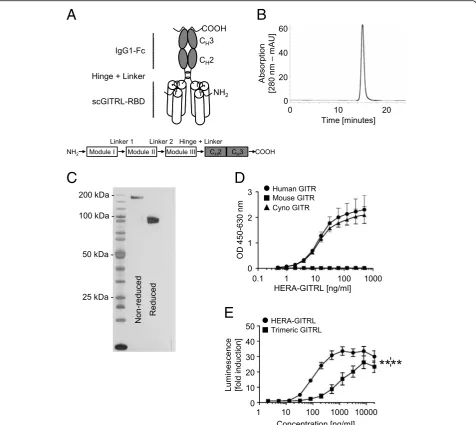
To engineer the hexavalent human GITR agonist, HERA-GITRL, we designed a single-polypeptide chain with three copies of a GITRL (TNFSF18) protomer sub-sequence (the construction principles are outlined in Fig. 1a). Specifically, three copies from the human
GITRL comprising amino acids E56-S177 are
interconnected with two glycine-serine based linkers 8 amino acids in length. The resulting trivalent single chain-GITRL-receptor-binding-domain (scGITRL-RBD) is fused to the Fc-part of a human IgG1-mutein, which is deficient for FcγR binding. For the mouse surrogate GITRL con-structs (mmHERA-GITRL), S43-S177 of the mouse GITRL and the mouse IgG2a-Fc domain were used. The mouse surrogates were engineered in two variants with ei-ther a FcγR-binding deficient or FcγR-binding competent (labeled“Fc+”) IgG2a-Fc domain. All preclinical HERA li-gands included a C-terminal Strep-Tag II for purification of the proteins. Secretory pathway-based expression was achieved by adding an appropriate signal-peptide to the N-terminus.
receptor binding (ELISA), SDS-PAGE, analytical SEC and a thermal shift stability assay, was tested under a variety of different storage and pH conditions in addition to heat
stress and freeze/thaw stability. It was found to be very stable and suitable for standard large-scale production processes (Additional file2: Table S1).
A
C
D
B
E
Fig. 1Structure, production and activity of HERA-GITRL.aSchematic depiction of the structure of the hexavalent HERA-GITRL. Three copies of a GITRL protomer sub-sequence (called the GITRL-receptor binding domain or GITRL-RBD) were combined into one single chain (sc) polypeptide. This generated a trivalent scGITRL-RBD, which was fused to the Fc part of a human IgG1-mutein to create a hexavalent scGITRL-RBD dimer.b, cPurification was accomplished by a two-step process combining AFC followed by preparative SEC. bFor analytical SEC; purified HERA-GITRL was detected by online measurement of absorption at 280 nm. Content of monomer and aggregates was calculated as the AUC from the elution profile of the SEC. HERA-GITRL eluted as a single peak and showed no detectable
Target binding properties and cellular activity of HERA-GITRL
In order to demonstrate functional assembly, purified HERA-GITRL was tested for binding to recombinant hu-man, mouse and cynomolgus monkey GITR-Fc by ELISA (Fig.1d). HERA-GITRL was able to bind to immobilized human and cynomolgus monkey, but not mouse, GITR-Fc demonstrating functional assembly of the respective re-ceptor binding domains and confirming that cynomolgus monkey is a relevant species for further studies. Binding to and dissociation from these receptors were measured in real time, and the respective equilibrium binding con-stants (KD) were calculated (Additional file 2: Table S2).
These species-specific results are consistent with previ-ously published data and confirmed that a specific mouse surrogate mmHERA-GITRL needed to be developed [5]. Binding of mmHERA-GITRL to a panel of GITR-Fc pro-teins demonstrated functional assembly of mmHERA-GITRL and species-specific binding (Additional file2: Fig-ure S1C and Fig. S2A).
Next, functional binding of HERA-GITRL was evalu-ated using a reporter cell assay. NFκB-luc2/GITR-ex-pressing Jurkat cells were incubated with various concentrations of HERA-GITRL or a recombinant tri-meric human GITRL and after six hours of culture, lu-minescence was measured. HERA-GITRL showed a strong agonistic activity that was significantly higher than trimeric GITRL over a broad range of concentra-tions (Fig.1e).
HERA-GITRL enhances human T cell activation following stimulation in vitro
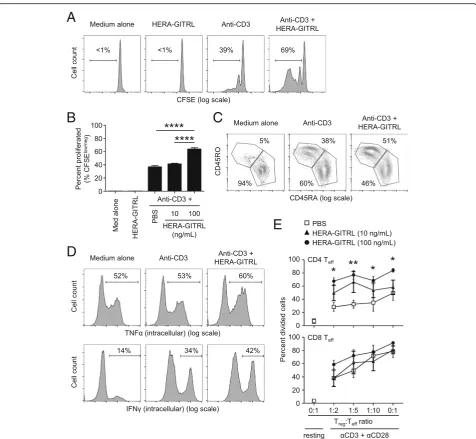
To examine the biological activity of HERA-GITRL, we isolated naïve CD4+ T cells from the peripheral blood of healthy volunteers and stimulated them in the presence of various concentrations of HERA-GITRL. Naïve T cells require a specific T cell receptor (TCR)-mediated signal as well as a second set of “ co-stimulatory” signals in order to achieve full activation and differentiation. Here, naïve CD4+ T cells were stimulated with plate-bound anti-CD3 antibody (1μg/mL) (“signal one”) in the presence of HERA-GITRL (10 or 100 ng/mL). Addition of HERA-GITRL significantly increased the proliferative response of CD4+ T cells stimulated by anti-CD3 antibody (Fig.2a, b). Corresponding changes in the expression of the classic differentiation markers, CD45RA and CD45RO, were also observed following treatment with HERA-GITRL in combination with anti-CD3 antibody (Fig.2c). In addition, CD4+ T cells activated in the presence of HERA-GITRL also increased intracellu-lar accumulation of the inflammatory cytokines IFNγand TNFα(Fig.2d).
Because regulatory T (Treg) cells play an important role in suppressing immune responses and express high
levels of GITR, we decided to investigate the effects of HERA-GITRL treatment on Treg cell activity. Treat-ment of Treg cells isolated from peripheral blood with various doses of HERA-GITRL did not influence Treg cell survival or proliferation (data not shown). However, an indirect effect on Treg cell function was observed fol-lowing HERA-GITRL treatment of standard Treg cell suppression assays. (Fig. 2e). Suppression of effector CD4+ T cell proliferation was significantly inhibited by HERA-GITRL treatment. Effector CD8+ T cells also showed an increase in proliferation in the presence of GITRL. Importantly, treatment with HERA-GITRL alone did not produce any response in unstimu-lated T cells, suggesting that an antigen-specific and TCR-mediated signal is required for the GITR-mediated enhancement of T cell activity (Fig. 2a, b and data not shown).
Pharmacokinetics of HERA-GITRL in mouse and cynomolgus monkey
We assessed in vivo stability and pharmacokinetic (PK) parameters of HERA-GITRL. Female CD-1 mice were treated with 1 or 10 mg/kg body weight (b.w.) HERA-GITRL as a single intravenous (i.v.) bolus injection (Additional file2: Figure S3A). The terminal serum half-life of HERA-GITRL in mice was calculated to be 86 to 97 h (Additional file 2: Table S3). Since human HERA-GITRL binds to cynomolgus monkey GITR, we also per-formed a PK study in this relevant species (Additional file 2: Figure S3B). The terminal serum half-life of HERA-GITRL in cynomolgus monkeys was calculated to be 37 h after a single i.v. injection of 1 mg/kg b.w. (Add-itional file 2: Table S3). In addition, no toxicological signs related to the administration of HERA-GITRL were observed during the in-life phase of this PK study (data not shown). PK parameters of the mouse surro-gates, mmHERA-GITRL and mmHERA-GITRL (Fc+), were also examined in CD-1 mice (Additional file2: Fig-ure S2B, C). For mmHERA-GITRL, the terminal serum half-life was calculated to be 7.4 h after a single i.v. injec-tion of 1 mg/kg b.w. (Addiinjec-tional file 2: Table S4). The FcγR-binding competent mmHERA-GITRL (Fc+) had a half-life of 18.3 h.
mmHERA-GITRL significantly boosts the antigen-specific CD4+ and CD8+ T cell response in vivo
of non-specific T cells to examine for non-antigen-specific effects. Since many T cells express GITR, there is potential for non-specific and bystander T cell activation. These po-tential side effects were examined by comparing chicken
ovalbumin (OVA)-specific and non-specific CD4+ and CD8+ T cells in the same environment. Since the OVA-specific T cell frequency in wildtype C57Bl/6 mice is very low (on average, less than 1000 cells per mouse [17]), we
A
B
D
C
E
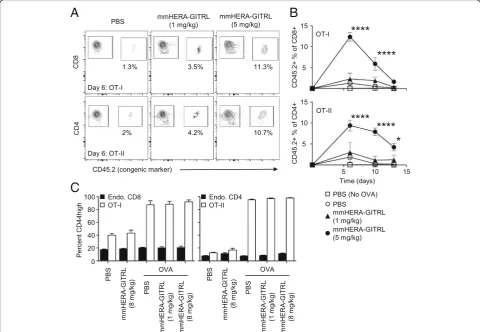
adoptively transferred 2 × 10⁶ OVA-specific CD8+ “OT-I” and CD4+“OT-II”T cells to increase the resolution. Naïve Ly5.1 (CD45.1+) recipient mice were adoptively transferred and challenged with OVA protein plus a single injection of mmHERA-GITRL (1 or 5 mg/kg b.w. and 1 or 8 mg/kg b.w.). Serial blood samples were obtained and representa-tive examples of OT-I and OT-II T cell clonal expansion are shown (Fig.3a). As shown in Fig.3b, both CD8+ and CD4+ antigen-specific T cells underwent significant clonal expansion during the first week following antigen challenge and treatment with the higher dose of mmHERA-GITRL. Treatment with PBS or 1 mg/kg b.w. mmHERA-GITRL
resulted in only a minimal T cell response compared to transfer alone.
In order to examine the specificity of mmHERA-GITRL, expression of CD44, a differentiation/maturation marker, was measured following treatment with HERA-GITRL (Fig. 3c). In the presence of OVA, the antigen-specific CD8+ and CD4+ T cells upregulated surface expression of CD44. In contrast, the endogenous CD8+ and CD4+ T cells did not respond in any of the conditions tested, even when 10 to 15% of the neighbor-ing T cells were vigorously respondneighbor-ing to OVA plus mmHERA-GITRL. Importantly, the antigen-specific T
A
C
B
Fig. 3mmHERA-GITRL significantly boosts the antigen-specific T cell response in vivo without affecting endogenous T cells.a, bC57Bl/6 mice were adoptively transferred with 2 × 10⁶(each) CD8+ OT-I T cells and CD4+ OT-II T cells, challenged with OVA protein (or PBS) and treated with a
cells did not respond to treatment with HERA-GITRL in the absence of their cognate antigen (i.e., OVA) (Fig.3c).
mmHERA-GITRL demonstrates significant in vivo efficacy in syngeneic mouse tumor models independent of Fcγ R-binding functionality
T cell activation assays are well suited for proof of con-cept and mechanism of actions studies, however, it is important for anti-cancer compounds to show in vivo ef-ficacy in syngeneic mouse tumor models. The standard colon carcinoma model CT26wt, known to be highly im-munogenic and generally responsive to immunotherapy, was used to investigate the potency of mmHERA-GITRL treatment.
This model was also used to compare true agonistic ac-tivity to the mixed mode of action, agonistic plus FcγR-mediated activity, seen with therapeutic antibodies. The Fc domain of therapeutic antibodies is responsible for me-diating a range of antibody effector functions such as antibody-dependent cell-mediated cytotoxicity (ADCC) and phagocytosis (ADCP). In fact, the anti-tumor activity of anti-GITR antibodies of the IgG sub-class has been re-ported to be dependent on such functions mediated by FcγR [18]. In contrast, HERA-GITRL has been designed to be effective in the absence of FcγR-binding functional-ity. In order to study the dependence of anti-tumor activ-ity on FcγR binding, we compared the standard mmHERA-GITRL to mmHERA-GITRL (Fc+), which con-tains a functional Fcγ-receptor-binding domain.
CT26wt tumor cells were implanted (subcutaneous, s.c.) and mice were randomized into groups 11 days later with a mean primary tumor volume of approximately 100 mm3. All mice were treated (i.v.) with mmHERA-GITRL, mmHERA-GITRL (Fc+) (both at 1 or 10 mg/kg b.w.) or vehicle control (PBS) on days 11, 14, 18 and 21. Treatment with both GITRL and mmHERA-GITRL (Fc+) resulted in similar dose-dependent tumor-growth inhibition (TGI) compared to the control group, 58% TGI and 66% TGI, respectively, at 10 mg/kg b.w. (Fig.4a, b and Additional file2: Figure S4A).
In addition to TGI, significant changes were also ob-served in the tumor-infiltrating T cell compartment fol-lowing treatment with GITRL and mmHERA-GITRL (Fc+). There was a significant and similar increase in the number of tumor-infiltrating T cells following treat-ment at 10 mg/kg b.w. for both compounds (Fig.4c). This increase was predominantly mediated by an increase in CD8+ T cell enrichment, which is highlighted by the sig-nificant change in the CD4/CD8 ratio as well as a three-fold increase in CD8+ T cell number (Fig.4d, e).
In addition to these quantitative changes in T cell num-bers, there was a significant increase in activation marker expression, including PD1, on tumor-infiltrating CD8+ T cells (Fig. 4f ). There were no significant
treatment-mediated effects on tumor infiltrating CD4+ T cells or T cells isolated from the spleen (Additional file 2: Figure S4B and data not shown). Importantly, no significant dif-ferences between GITRL and mmHERA-GITRL (Fc+) treated mice were observed in anti-tumor ef-ficacy or immune cell quantity or quality.
The single-agent anti-tumor activity of mmHERA-GITRL was also tested in the CEA model. MC38-CEA (C57Bl/6), like CT26wt (BALB/c), is a common colon carcinoma model, however syngeneic tumor stud-ies are performed in a different mouse strain. The two distinct genetic backgrounds gave an opportunity to ad-dress tumor efficacy in the context of their propensities towards different immune polarization, for example, type 1 versus type 2 immunity. MC38-CEA tumor cells were implanted (s.c.) and mice were randomized into groups 5 days later with a mean primary tumor volume of ap-proximately 65 mm3. All mice were treated (i.v.) with mmHERA-GITRL (1 mg/kg b.w.) or vehicle control (PBS) on days 5, 8, 12, 15 and 19. Treatment with mmHERA-GITRL resulted in 42% TGI compared to the control group (Additional file2: Figure S5A, B).
HERA-GITRL demonstrates significantly enhanced activity compared to a clinical benchmark agonistic anti-GITR antibody
Due to the role that many TNFRSF receptors play in en-hancing anti-tumor immunity, multiple approaches have been developed to create TNFRSF receptor agonists. The most common approach has been to generate anti-receptor antibodies. Although antibodies have been shown to be effective at blocking receptor-ligand inter-actions, they have mixed results as TNFRSF receptor ag-onists due to having only two target-binding sites (i.e., GITR-binding sites) and an inability to recreate the 3D organization of the natural trimeric ligand/receptor as-sembly complex.
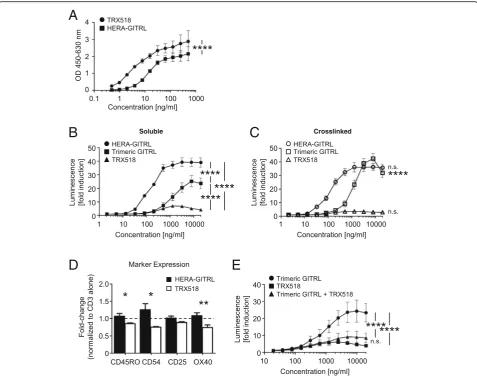
As we have shown in Fig. 1e, the hexavalent HERA-GITRL induces significantly higher receptor signaling activity compared to the trivalent GITRL. To test the hy-pothesis that a bivalent antibody would have even more trouble clustering a sufficient number of receptors to transmit a productive signal, the clinical benchmark anti-human GITR antibody (TRX518) was purchased to perform in vitro comparison studies. HERA-GITRL and the anti-human GITR antibody (TRX518) were tested for binding to recombinant human GITR-Fc by ELISA (Fig. 5a). The anti-GITR antibody demonstrated signifi-cantly stronger binding than HERA-GITRL, which is consistent with the known binding characteristics of antibodies and TNFSF ligands.
A
B
C
D
E
F
reporter cell assay. NFκB-luc2/GITR-expressing Jurkat cells were incubated with various concentrations of HERA-GITRL, GITRL or anti-GITR antibody and after six hours of culture, luminescence was measured. As shown in Fig.5b, treatment with HERA-GITRL resulted in significantly higher reporter activity compared to the anti-GITR antibody across a wide range of concentra-tions. Even the trimeric GITRL showed significantly
higher activity than the benchmark antibody. Since it has been demonstrated that the biological activity of many therapeutic antibodies relies on secondary cross-linking via FcγR interactions, the GITR reporter cell assay was also performed with crosslinked HERA-GITRL, GITRL and anti-GITR antibody. In this assay, multiple “secondary” anti-human Ig antibodies were used to crosslink the benchmark anti-GITR antibody. In
A
B
D
E
C
Fig. 5HERA-GITRL demonstrates significantly enhanced agonistic activity compared to a clinical benchmark antibody.aELISA showing binding of hexavalent HERA-GITRL and bivalent anti-GITR antibody (TRX518) to immobilized human GITR-Fc. TRX518 bound to human GITR-Fc was detected by goat anti-human IgG-Peroxidase. Values are mean OD (n= 3) ± S.D. Representative data from at least three independent experiments are shown. The p value represents a comparison between samples using a two-way ANOVA. ****p < 0.0001.b, cNFκB-luc2/GITR-expressing Jurkat cells were incubated with the indicated concentrations of HERA-GITRL, trimeric GITRL or anti-GITR antibody, without (b) or with (c) crosslinking, at 37 °C for six hours. Data are shown as mean values (± S.D.) from three independent experiments.bThe p values represent a comparison between samples using a two-way ANOVA. ****p < 0.0001.cThe p values represent a comparison between soluble (b) and crosslinked (c) samples using a two-way ANOVA. ****p < 0.0001. n.s. not significant.dNaïve CD4+ T cells were isolated from the peripheral blood of healthy volunteers and stimulated with anti-CD3 antibody (1μg/mL) in the presence of HERA-GITRL or anti-GITR antibody (both 1000 ng/mL). On day five, T cells were harvested and examined by FCM. Due to high donor variability observed when comparing PBS to anti-CD3 antibody treatment, all values have been normalized to the anti-CD3 antibody alone group. The dashed line indicates the 1.0 value. The p values represent a comparison between samples using a one-way ANOVA. *p < 0.05, **p < 0.01.eNFκB-luc2/GITR-expressing Jurkat cells were incubated with the indicated concentrations of trimeric GITRL and/or anti-GITR antibody at 37 °C for six hours. A constant ratio by mass (1:1) was maintained in the
all cases, crosslinking did not increase the activity of the anti-GITR antibody (Fig.5c and data not shown). Cross-linking also failed to increase the activity of HERA-GITRL. The hexavalent layout of HERA-GITRL appears to result in optimal biological activity of this molecule while a potential risk for detrimental hyper-activation of GITR seems to be negligible. In contrast, crosslinking significantly increased the activity of the trimeric GITRL.
In order to compare biological activity of the hexava-lent HERA-GITRL to the bivahexava-lent anti-GITR antibody, naïve CD4+ T cells were stimulated with plate-bound anti-CD3 antibody (1μg/mL) in the presence of HERA-GITRL or anti-GITR antibody (both 1000 ng/mL). On day five, T cells were examined for evidence of activation and differentiation. Treatment with HERA-GITRL re-sulted in a significantly higher percentage of T cells ex-pressing CD45RO, CD54 and OX40 compared to treatment with the anti-GITR antibody (Fig. 5d). Inter-estingly, while HERA-GITRL consistently increased T cell activity compared to anti-CD3 antibody alone, the anti-GITR antibody consistently reduced the T cell re-sponse. In order to understand how treatment with a supposedly agonistic clinical benchmark antibody could result in decreased T cell activation, the GITR reporter assay was used to examine signaling when the natural ligand (represented by the trimeric GITRL) was co-incubated with the anti-GITR antibody. GITR-reporter cells were incubated with various concentrations of tri-meric GITRL plus anti-GITR antibody (maintaining a constant mass ratio). As shown in Fig. 5e, the presence of the anti-GITR antibody significantly inhibits the activ-ity of the trimeric GITRL across a wide range of concen-trations, indicating a blockade of the GITR-ligand binding site by the antibody.
Discussion
GITR has been a key immunotherapeutic target for al-most 20 years and multiple strategies to induce GITR signaling have been investigated. The limited clinical ef-ficacy of GITR agonists results from structural and func-tional characteristics of antibodies, including the presence of only two target-binding domains per mol-ecule, that are unsuitable for stimulating the TNFRSF. Here we describe the engineering and production of a novel hexavalent agonist of human GITR. The lab-scale HERA-GITRL production process yielded defined and stable products devoid of contaminating proteins and product related aggregates. In addition, the stability of HERA-GITRL was tested under a variety of different conditions and found to be suitable for standard large-scale production processes. Binding studies confirmed previously published reports that the purified human
HERA-GITRL binds to human, and cynomolgus
monkey, GITR but not mouse GITR [5]. These species-specific results confirmed that cynomolgus monkey is a relevant species for further studies and indicated the need for a specific mouse surrogate (mmHERA-GITRL).
To examine the biological activity of human HERA-GITRL, we isolated naïve CD4+ T cells and stimulated them in vitro. Consistently, treatment with the hexava-lent HERA-GITRL significantly boosted proliferation and differentiation of stimulated T cells. Critically, these studies also demonstrated that treatment with HERA-GITRL alone did not produce any response in unstimu-lated T cells, suggesting that an antigen-specific and TCR-mediated signal is required for the GITR-mediated enhancement of T cell activity. This is a clear advantage over non-specific strategies, such as checkpoint inhib-ition or cell depletion-based therapies, that lead to ser-ious immune-related adverse events (irAE) due to their broad mechanisms of action [19–21]. Because Treg cells play an important role in maintaining immune homeo-stasis and they express high levels of GITR we decided to investigate the effects of HERA-GITRL treatment on Treg cell activity. Previously published data have shown that, depending on the specific context, GITR signaling can have both inhibitory and stimulatory effects on Treg cell activity [22]. For example, “short-term” exposure to GITR stimulation leads to inhibition of Treg cell activity while “long-term”exposure stimulates their proliferation [22]. Treatment of Treg cells with HERA-GITRL did not influence Treg cell survival or proliferation. However, HERA-GITRL inhibited Treg cell-mediated suppression of effector T cells.
In order to assess pharmacokinetic and safety proper-ties of HERA-GITRL, small-scale studies were con-ducted in healthy cynomolgus monkeys and mice (mmGITRL). These studies showed that HERA-GITRL had a terminal serum half-life of 1.5 days in cy-nomolgus monkeys and 7 h in mice (mmHERA-GITRL). Critically, no toxicological signs related to the adminis-tration of HERA-GITRL were observed during the in-life phase of these studies.
HERA-GITRL makes it the ideal candidate for exploring this area.
The activity and safety of the hexavalent mmHERA-GITRL was also demonstrated in vivo using an antigen-specific adoptive transfer model. The hexavalent mmHERA-GITRL significantly boosted clonal expansion and differentiation of antigen-specific CD4+ and CD8+ T cells. Due to the potential for activation of non-specific and/or bystander T cells (such as, self-antigen-specific T cells), OVA-self-antigen-specific and non-self-antigen-specific T cells were examined. Even in the shared environment, where over 10% of CD4+ and CD8+ T cells were vigorously responding to their specific antigen, the non-specific (endogenous) T cells did not show any signs of activa-tion. This system, which mimics a more realistic T cell response compared to in vitro stimulation with anti-CD3 antibodies, further demonstrated the specificity of HERA-GITRL. Having a requirement for an antigen-specific signal as well as having a clearly defined agonis-tic forward-signaling mechanism of action means that HERA-GITRL could have a superior safety profile com-pared to other approaches.
The single-agent activity of the hexavalent mmHERA-GITRL was demonstrated with the syngeneic mouse tumor models CT26wt and MC38-CEA. While the pre-vious experiments showed antigen-specific T cell activa-tion, it was important to demonstrate efficacy in tumor models. Treatment with mmHERA-GITRL resulted in dose-dependent tumor-growth inhibition and significant changes in the tumor-infiltrating T cell compartment. Specifically, there was an increase in the number and ac-tivation status of T cells found in the tumor tissue. HERA-GITRL has been designed to be a true agonist and, therefore, effective in the absence of FcγR-binding functionality. The CT26wt tumor model was also used to determine if FcγR binding, a common prerequisite for
“agonistic” antibody activity, could increase the anti-tumor effects of HERA-GITRL. Importantly, no
signifi-cant differences between mmHERA-GITRL and
mmHERA-GITRL (Fc+) treated mice were observed in anti-tumor efficacy or immune cell activity underlining that efficacy of mmHERA-GITRL is independent from FcγR-binding functionality.
Due to the role that TNFRSF receptors play in enhancing anti-tumor immunity, multiple approaches have been de-veloped to create TNFRSF receptor agonists. While anti-bodies are effective at blocking receptor-ligand interactions and stimulating the dimeric receptors of the immunoglobu-lin (B7/CD28) superfamily, they have mixed results as TNFRSF receptor agonists [9]. The limited clinical efficacy of GITR agonists results from structural and functional characteristics of antibodies, including the presence of only two target (GITR)-binding sites per molecule, that are un-suitable for stimulating the TNFRSF. To test the hypothesis
that an antibody would have even more trouble clustering a sufficient number of receptors to transmit a productive sig-nal, the activity of the hexavalent HERA-GITRL, a trivalent GITRL and a bivalent clinical benchmark anti-human GITR antibody was compared. In a GITR-signaling-based reporter assay as well as a primary T cell activation assay, treatment with HERA-GITRL resulted in significantly higher activity compared to the anti-GITR antibody. Even the trimeric GITRL showed significantly higher signaling activity than the benchmark antibody. Since secondary crosslinking has been shown to influence the activity of ag-onistic antibodies [10,23,24], the GITR signaling assay was also performed in the presence of crosslinking. Predictably, the crosslinked trimeric GITRL showed higher signaling ac-tivity. In contrast, crosslinking did not increase the activity of the anti-GITR antibody.
These results support the concept that bivalent compounds, like antibodies, do not have the correct structural and functional characteristics to generate a productive signal [10, 13, 14, 19]. The data also sup-port our previous published findings with HERA-TRAIL, HERA-CD40L and HERA-CD27L suggesting
that proper TNFRSF receptor clustering, best
achieved by higher order structures based on the nat-ural ligand, is required for full induction of down-stream signaling and function [13–15]. It is important to mention that while these conclusions are true for human TNFRSF signaling, comparisons between triva-lent ligand-based concepts and bivatriva-lent antibodies are more complicated in mice. Specifically, crystal struc-ture data has shown that murine GITRL can exist and function as a dimer, highlighting important differ-ences between human and mouse [12, 25, 26]. Since murine GITR can signal as a trimer or a dimer, a bi-valent antibody should be able function as a GITR agonist. As an additional complication, the benchmark anti-mouse GITR antibody (clone DTA-1) is a rat IgG2b that causes severe anaphylaxis when repeatedly injected into mice [27]. Unfortunately, even “ muri-nized” DTA-1 antibodies can cause anaphylaxis due to mouse strain differences in IgG2 expression [28].
TNFRSF signaling pathways [14]. In fact, it has been demonstrated that this clinical benchmark antibody blocks binding of the natural ligand to GITR [22].
In addition to blocking the activity of natural ligand, the structural and functional characteristics of antibodies can lead to a series of unnecessary complications. For example, the majority of antibodies targeting the TNFRSF are fully dependent on additional crosslinking, generally via the Fc domain of the antibodies, for activity [10,23,24]. While these interactions provide some activ-ity, there are serious side effects associated with the functional FcγR-binding domain. This includes depletion of target-expressing cells via ADCC and ADCP as well as antibody-dependent cytokine release (ADCR) and cytokine release syndrome (CRS) [19,24,29–31]. In fact, Fc/FcγR interactions have been shown to be responsible for many of the irAEs associated with antibody-based immunotherapy.
Conclusions
For many years, various strategies have been employed targeting GITR signaling for cancer therapy. In fact, the first GITR-targeting clinical trial began almost 10 years ago. The limited clinical efficacy of GITR agonists is pri-marily due to the structural and functional characteris-tics of antibodies, including the presence of only two target-binding domains per molecule, that are unsuitable for stimulating the TNFRSF. Here, we describe the de-velopment of HERA-GITRL, a true GITR agonist with a clear forward-signaling mechanism of action. HERA-GITRL shows single agent anti-tumor activity both in vitro and in vivo. The hexavalent HERA-GITRL has su-perior activity compared to a bivalent clinical benchmark antibody. Importantly, this agonistic activity is not dependent on FcγR-based mechanisms.
Cancer immunotherapy is currently being dominated by immune checkpoint inhibitors and over 1500 clinical trials are registered targeting PD-1, PD-L1 or CTLA-4. The effectiveness of these approaches is dependent on the presence of previously primed anti-tumor T cells.
Immune-stimulatory compounds, such as
HERA-GITRL, are able to boost T cell priming and, therefore, generate effective anti-tumor immunity that should also work well in combination with immune checkpoint inhibitors.
Additional files
Additional file 1:Supplementary Methods. (DOCX 45 kb)
Additional file 2:Figure S1Purification and biochemical features of mmHERA-GITRL.Figure S2Binding and pharmacokinetic comparison of mmHERA-GITRL and mmHERA-GITRL (Fc+).Figure S3Pharmacokinetics of HERA-GITRL in mouse and cynomolgus monkey.Figure S4 mmHERA-GITRL demonstrates single-agent in vivo efficacy that is independent of
Fcγ-receptor binding.Figure S5mmHERA-GITRL demonstrates significant in vivo efficacy in mice as a single agent in the MC38-CEA tumor model.
Table S1Summary of HERA-GITRL stability under various conditions.
Table S2Summary of the binding constants of HERA-GITRL to human, mouse and cynomolgus monkey GITR-Fc.Table S3Summary of the pharmacokinetic properties of HERA-GITRL in mouse and cynomolgus monkey.Table S4Summary of the pharmacokinetic properties of mmHERA-GITRL and mmHERA-GITRL (Fc+) in mouse. (PDF 866 kb)
Abbreviations
ADCC:dependent cell-mediated cytotoxicity; ADCP: Antibody-dependent cell-mediated phagocytosis; ADCR: Antibody-Antibody-dependent cytokine release; AFC: Affinity purification; APC: Antigen-presenting cell; ATRA: All-trans retinoic acid; b.w.: Body weight; CFSE: Carboxyfluorescein succinimidyl ester; CHO-S: Chinese Hamster Ovary cell, suspension liquid culture; CRS: Cytokine release syndrome; CTV: Cell trace violet; FCM: Flow cytometry; FcγR: Fcγ receptor; HERA: Hexavalent TNF receptor agonist; HMWS: High molecular weight species; i.p.: Intraperitoneal; i.v.: Intravenous; irAE: Immune-related adverse event; KD: Equilibrium binding constant; LMWS: Low molecular
weight species; LN: Lymph node; mmGITRL: Mouse surrogate HERA-GITRL; OVA: Chicken ovalbumin; PBMC: Peripheral blood mononuclear cells; PK: Pharmacokinetic; RBD: Receptor-binding domain; s.c.: Subcutaneous; sc: Single chain; scGITRL-RBD: Single-chain GITRL-receptor-binding-domain; SEC: Size-exclusion chromatography; TCR: T cell receptor; TGI: Tumor-growth inhibition; TNFRSF: Tumor necrosis factor receptor superfamily; TNFRSF18, GITR, CD357: Glucocorticoid-induced TNFR-related protein; TNFSF: Tumor necrosis factor superfamily; TNFSF18, GITRL: GITR ligand; Treg: Regulatory T cell
Acknowledgements
None.
Authors’contributions
All authors were involved in the conception, design and development of all methodology described for this study. Acquisition, analysis and interpretation of data was also accomplished by all authors. MT, VMA and DR were responsible for writing the manuscript. All authors contributed to drafting, revising, and approving the final article.
Funding
This work was conducted at Apogenix AG.
Availability of data and materials
Data are available in the main text and supplementary materials, raw data available upon request.
Ethics approval and consent to participate
All experimental animal protocols were approved by the Ethics Committee for Animal Experimentation.
Consent for publication
Not applicable.
Competing interests
All authors are current or former employees of Apogenix AG.
Author details
1Present address: Biotest AG, Dreieich, Germany.2Present address: SOTIO,
Prague, Czech Republic.3Research and Development, Apogenix AG, Im Neuenheimer Feld 584, 69120 Heidelberg, Germany.
Received: 6 May 2019 Accepted: 8 July 2019
References
1. Sharma P, Allison JP. The future of immune checkpoint therapy. Science. 2015;348(6230):56–61.
3. Sanmamed MF, Pastor F, Rodriguez A, Perez-Gracia JL, Rodriguez-Ruiz ME, Jure-Kunkel M, et al. Agonists of co-stimulation in Cancer immunotherapy directed against Cd137, Ox40, Gitr, Cd27, Cd28, and Icos. Semin Oncol. 2015;42(4):640–55.
4. Watts TH. Tnf/Tnfr family members in Costimulation of T cell responses. Annu Rev Immunol. 2005;23:23–68.
5. Bossen C, Ingold K, Tardivel A, Bodmer JL, Gaide O, Hertig S, et al. Interactions of tumor necrosis factor (Tnf) and Tnf receptor family members in the mouse and human. J Biol Chem. 2006;281(20):13964–71.
6. Nocentini G, Giunchi L, Ronchetti S, Krausz LT, Bartoli A, Moraca R, et al. A new member of the tumor necrosis factor/nerve growth factor receptor family inhibits T cell receptor-induced apoptosis. Proc Natl Acad Sci U S A. 1997;94(12):6216–21.
7. Schaer DA, Hirschhorn-Cymerman D, Wolchok JD. Targeting tumor-necrosis factor receptor pathways for tumor immunotherapy. J Immunother Cancer. 2014;2:7.
8. Riccardi C, Ronchetti S, Nocentini G. Glucocorticoid-induced Tnfr-related gene (Gitr) as a therapeutic target for immunotherapy. Expert Opin Ther Targets. 2018;22(9):783–97.
9. Mayes PA, Hance KW, Hoos A. The promise and challenges of immune agonist antibody development in Cancer. Nat Rev Drug Discov. 2018;17(7): 509–27.
10. Wajant H. Principles of antibody-mediated Tnf receptor activation. Cell Death Differ. 2015;22(11):1727–41.
11. Wyzgol A, Muller N, Fick A, Munkel S, Grigoleit GU, Pfizenmaier K, et al. Trimer stabilization, oligomerization, and antibody-mediated cell surface immobilization improve the activity of soluble trimers of Cd27l, Cd40l, 41bbl, and glucocorticoid-induced Tnf receptor ligand. J Immunol. 2009; 183(3):1851–61.
12. Chattopadhyay K, Ramagopal UA, Mukhopadhaya A, Malashkevich VN, Dilorenzo TP, Brenowitz M, et al. Assembly and structural properties of glucocorticoid-induced Tnf receptor ligand: implications for function. Proc Natl Acad Sci U S A. 2007;104(49):19452–7.
13. Gieffers C, Kluge M, Merz C, Sykora J, Thiemann M, Schaal R, et al. Apg350 induces superior clustering of Trail receptors and shows therapeutic antitumor efficacy independent of cross-linking via Fcgamma receptors. Mol Cancer Ther. 2013;12(12):2735–47.
14. Thiemann M, Richards DM, Heinonen K, Kluge M, Marschall V, Merz C, et al. A single-chain-based hexavalent Cd27 agonist enhances T cell activation and induces anti-tumor immunity. Front Oncol. 2018;8:387.
15. Merz C, Sykora J, Marschall V, Richards DM, Heinonen K, Redondo Muller M, et al. The hexavalent Cd40 agonist Hera-Cd40l induces T-cell-mediated antitumor immune response through activation of antigen-presenting cells. J Immunother. 2018;41(9):385–98.
16. Kearney ER, Pape KA, Loh DY, Jenkins MK. Visualization of peptide-specific T cell immunity and peripheral tolerance induction in vivo. Immunity. 1994; 1(4):327–39.
17. Jenkins MK, Moon JJ. The role of naive T cell precursor frequency and recruitment in dictating immune response magnitude. J Immunol. 2012; 188(9):4135–40.
18. Bulliard Y, Jolicoeur R, Windman M, Rue SM, Ettenberg S, Knee DA, et al. Activating fc gamma receptors contribute to the antitumor activities of Immunoregulatory receptor-targeting antibodies. J Exp Med. 2013;210(9): 1685–93.
19. Ryan JM, Wasser JS, Adler AJ, Vella AT. Enhancing the safety of antibody-based immunomodulatory Cancer therapy without compromising therapeutic benefit: can we have our cake and eat it too? Expert Opin Biol Ther. 2016;16(5):655–74.
20. Kong YC, Flynn JC. Opportunistic autoimmune disorders potentiated by immune-checkpoint inhibitors anti-Ctla-4 and anti-Pd-1. Front Immunol. 2014;5:206.
21. June CH, Warshauer JT, Bluestone JA. Is autoimmunity the Achilles' heel of Cancer immunotherapy? Nat Med. 2017;23(5):540–7.
22. Nocentini G, Ronchetti S, Petrillo MG, Riccardi C. Pharmacological modulation of Gitrl/Gitr system: therapeutic perspectives. Br J Pharmacol. 2012;165(7):2089–99.
23. Li F, Ravetch JV. A general requirement for Fcgammariib co-engagement of agonistic anti-Tnfr antibodies. Cell Cycle. 2012;11(18):3343–4.
24. Li F, Ravetch JV. Antitumor activities of agonistic anti-Tnfr antibodies require differential Fcgammariib Coengagement in vivo. Proc Natl Acad Sci U S A. 2013;110(48):19501–6.
25. Chattopadhyay K, Ramagopal UA, Brenowitz M, Nathenson SG, Almo SC. Evolution of Gitrl immune function: murine Gitrl exhibits unique structural and biochemical properties within the Tnf superfamily. Proc Natl Acad Sci U S A. 2008;105(2):635–40.
26. Zhou Z, Tone Y, Song X, Furuuchi K, Lear JD, Waldmann H, et al. Structural basis for ligand-mediated mouse Gitr activation. Proc Natl Acad Sci U S A. 2008;105(2):641–5.
27. Murphy JT, Burey AP, Beebe AM, Gu D, Presta LG, Merghoub T, et al. Anaphylaxis caused by repetitive doses of a Gitr agonist monoclonal antibody in mice. Blood. 2014;123(14):2172–80.
28. Belmar NA, Chan SW, Fox MI, Samayoa JA, Stickler MM, Tran NN, et al. Murinization and H chain isotype matching of the anti-Gitr antibody Dta-1 reduces immunogenicity-mediated anaphylaxis in C57bl/6 mice. J Immunol. 2017;198(11):4502–12.
29. DiLillo DJ, Ravetch JV. Fc-receptor interactions regulate both cytotoxic and immunomodulatory therapeutic antibody effector functions. Cancer Immunol Res. 2015;3(7):704–13.
30. Nimmerjahn F, Gordan S, Lux A. Fcgammar dependent mechanisms of cytotoxic, agonistic, and neutralizing antibody activities. Trends Immunol. 2015;36(6):325–36.
31. Vogelpoel LT, Baeten DL, de Jong EC, den Dunnen J. Control of cytokine production by human fc gamma receptors: implications for pathogen defense and autoimmunity. Front Immunol. 2015;6:79.
Publisher’s Note