Open Access
Methodology
Instrumentation enabling study of plant physiological response to
elevated night temperature
Abdul R Mohammed and Lee Tarpley*
Address: Texas AgriLife Research and Extension Center, 1509 Aggie Drive, Beaumont, Texas-77713, USA
Email: Abdul R Mohammed - [email protected]; Lee Tarpley* - [email protected] * Corresponding author
Abstract
Background: Global climate warming can affect functioning of crops and plants in the natural environment. In order to study the effects of global warming, a method for applying a controlled heating treatment to plant canopies in the open field or in the greenhouse is needed that can accept either square wave application of elevated temperature or a complex prescribed diurnal or seasonal temperature regime. The current options are limited in their accuracy, precision, reliability, mobility or cost and scalability.
Results: The described system uses overhead infrared heaters that are relatively inexpensive and are accurate and precise in rapidly controlling the temperature. Remote computer-based data acquisition and control via the internet provides the ability to use complex temperature regimes and real-time monitoring. Due to its easy mobility, the heating system can randomly be allotted in the open field or in the greenhouse within the experimental setup. The apparatus has been successfully applied to study the response of rice to high night temperatures. Air temperatures were maintained within the set points ± 0.5°C. The incorporation of the combination of air-situated thermocouples, autotuned proportional integrative derivative temperature controllers and phase angled fired silicon controlled rectifier power controllers provides very fast proportional heating action (i.e. 9 ms time base), which avoids prolonged or intense heating of the plant material.
Conclusion: The described infrared heating system meets the utilitarian requirements of a heating system for plant physiology studies in that the elevated temperature can be accurately, precisely, and reliably controlled with minimal perturbation of other environmental factors.
Background
Global climate warming can affect functioning of crops and of plants in the natural environment. Increased night temperatures have been implicated in decreased crop yields throughout the world and are predicted to warm more than the daytime temperatures in the future [1]. The effects of high night temperatures are diverse, including, for example, increased coincidence of intervals of unusu-ally high night temperature with sensitive reproductive
stages eventually resulting in poor seed set and a decline in vegetative reserves due to increased respiration and alteration in phenology, or, in the case of natural popula-tions, altered quantity and seasonal distribution of repro-ductive units.
Precise and accurate control of the temperatures of and immediately surrounding small populations of plants is a primary purpose of an apparatus for control of high night
Published: 11 June 2009
Plant Methods 2009, 5:7 doi:10.1186/1746-4811-5-7
Received: 27 February 2009 Accepted: 11 June 2009
This article is available from: http://www.plantmethods.com/content/5/1/7
© 2009 Mohammed and Tarpley; licensee BioMed Central Ltd.
temperature, but reliability is also needed to avoid short-term deviations of the tissue temperatures beyond physi-ologically normal ranges. Short-term deviations of tissue temperature have often been shown to affect plant func-tion, often with effects carried beyond the period of expo-sure. For example, sublethal heat shock, with short-term tissue temperature increases in the range observed in oth-erwise well-controlled infrared (IR) heating studies, can induce the synthesis of heat shock proteins and other physiological changes that are important for thermotoler-ance [2]. Another plant-physiological feature that is easy to inadvertently alter during a plant population warming study is vapor pressure deficit, which can lead to decreased leaf water potential for plants under some growing conditions. Decreased leaf water potential can trigger alterations to plants similar to those observed in sublethal heat shock, for example the synthesis of heat shock proteins and other physiological changes that are important for abiotic stress tolerance [2]. One means to alter the vapor pressure deficit (VPD) is to alter the abso-lute humidity [3]. Global climactic change models predict that absolute humidity will change with global warming [1] indicating that the ability to maintain absolute humid-ities while altering temperature would be an additional prerequisite for a heating system designed for study of var-ious plant physiological responses to elevated tempera-ture.
Plant physiological experimentation employs both square-wave manipulation of environmental variables as well as ambient +/- some proportion or degree of the quantity of an environmental factor, e.g. average seasonal temperature + x°C (e.g., [4]) depending on the study objectives, thus the inclusion of computer-based data acquisition and control via the internet is highly desirable to facilitate the study of plant physiological responses to various aspects of high night temperature. The responses by plants and plant populations are multiple, so demand the ability to clearly separate these responses via well-rep-licated studies, often of fairly subtle temperature changes, thus cost and scalability warrant consideration. The appa-ratus should avoid unintended effects on the local envi-ronment.
Current apparatuses used to study the effects of high night temperatures are limited in ability to carefully control the elevated temperature, conduct replicated study of popula-tions of plants, or minimize perturbation of other envi-ronmental factors. Greenhouses, growth chambers, phytotrons, open-top chambers (OTC), and naturally-lit plant growth chambers (known as Soil-Plant-Atmos-phere-Research (SPAR) units) are usually used in control-led environmental studies. Greenhouses generally have higher humidity, lower wind speed, and lower light inten-sity compared to outside. Moreover, greenhouse coverings
typically transmit two-thirds to three-fourths of the avail-able sunlight [5]. In artificially lit growth chambers, the temperature is well controlled, however plants are sub-jected to an artificial light environment. The phytotron has similar light conditions as that of artificially lit growth chambers and also has smaller rooting volumes, which might restrict the partitioning of carbohydrates to roots [6]. The OTC requires a high flow rate of air in and out of the OTC to control the temperature and the humidity [5]. However, many studies have reported higher daytime and night temperatures in OTCs compared to neighboring unenclosed areas [7,8]. The SPAR units are one of the best in controlling the environmental factors [4], however the cost and lack of mobility of the units makes them site-spe-cific. In most of the above-mentioned facilities, the cli-matic conditions are unrealistic and fail to couple changes in light, temperature and other factors resulting in poor simulation of natural environmental conditions [9]. In contrast, the use of an IR heating system can be employed in ways that do not alter other natural environmental con-ditions such as light intensity, humidity, and wind speed, while precisely controlling temperature.
successful application of the apparatus in study of plant physiological response to high night temperature.
Results and discussion
Trade names and company names are included for the benefit of the reader and do not imply any endorsement or preferential treatment by the authors or Texas AgriLife Research.
Infrared (IR) heaters
The IR heaters, purchased from Omega (RAD 3113 BV/ 208, OMEGA Engineering, Inc. Stamford, Connecticut, USA) are housed in a rigid aluminum housing which is 77.8 cm in length and 9.4 cm in width. The aluminum housing is equipped with interlocking connectors, mounting clamp, conduit connector, polished aluminum reflector, and single radiant (RAD) elements. The single RAD element is a rod-shaped heating element (1 cm diameter and 57.8 cm long) mounted at the focal point of the polished aluminum reflector. The working voltage of the heating element is 120 volts and has a power of 1100 watts. The Incoloy (an iron-nickel alloy) sheath is 9.5 mm diameter. The operating wavelengths of the IR heaters are >1200 nm, and the IR heater output is negligible <1200 nm [18]. Hence, there is no significant emission of photo-morphogenic wavelengths. Stranded, insulated, nickel-plated copper wire is used for connecting the heaters to the power controllers. For protection of the IR heaters and personnel, a grill (GR-3, OMEGA Engineering, Inc.) is provided for each IR heater. A detailed description of IR heaters is provided in 'The Electric Heaters Handbook' [18]. Previous studies have described ways to weather-proof similar IR heaters [17].
Power semi-conductor controllers
A silicon controlled rectifier (SCR) power controller is an output device used for fast heat switching, to control vari-able resistance heaters and to switch higher amperage electric heaters. In the setup, the IR heaters are controlled using power semi-conductor controllers (SCR71P-208-030-S60, OMEGA Engineering, Inc.) to enable propor-tioning heating action instead of on/off action. These power controllers are single-phase models, phase-angle firing, 208 volt, 30 amp with a 60-s soft-start option. These power controllers use 'phase-angled fired' propor-tional control, which eliminates thermal shock and extends the working life of the heating elements. The 'phase-angled fired' proportional SCR control also pro-vides a smooth, rapid (in milliseconds) and controlled heating process. This is potentially advantageous for vege-tation warming studies because it provides a nearly con-tinuous adjustment of the heater output thus minimizing the risk of prolonged or intense heating of the plant mate-rial with unexpected deviations away from the set point. The power controller receives a 4 – 20 mA process output
signal from a temperature controller. This signal is proc-essed by the electronics in the power controller to switch the heaters at sub-cycle intervals, resulting in a smooth radiation output. A detailed description of power semi-conductor controllers is provided in 'The Electric Heaters Handbook' [18].
i-Series temperature controllers
The basic function of a temperature controller is to com-pare the actual temperature with the set point temperature and produce an output which will maintain that set point temperature. The i-Series temperature controllers (CNi16D53-C24, OMEGA Engineering, Inc.) used in the present setup include digital panel meters and single loop autotuned proportional integral derivative (PID) control mode controllers that are simple to configure and use, while providing tremendous options including direct con-nectivity to an Ethernet network with the ability to serve web pages over a Local Area Network (LAN) or the Inter-net. The i-Series temperature controllers are Deutsche Industrial Norm (DIN) compatible for easy incorporation into industrial mounting and control systems. The instru-ment utilizes Chip On Board (COB) and Surface Mount Technology (SMT) assembly techniques and automation and provides the ability to program and set the tempera-tures and alarms. The presented system uses 1/16 DIN Omega-series controllers with dual display, analog out-put, 0 to 10 Vdc or 0–20 mA, at 500 ohm max, and relay. The embedded internet and serial communication inter-face allows remote Data Acquisition and Control (DAC) and flexibility in programming via OLE for Process Con-trol (OPC) software on remote PCs. The i-Series tempera-ture controller has both RS-232 and RS-485 serial communication interface, which allows multiple temper-ature controllers to be connected through a single indus-trial server. A detailed description and applications of i-Series temperature controllers are provided in 'The Electric Heaters Handbook' [18].
i-Server
point-to-point serial connection between a serial device and a PC. The serial devices will function over the Ethernet net-work or the Internet as if they were connected directly to a PC. The COM port on the i-Server simulates a local COM port on the PC. The Series temperature controllers and i-Servers connected to an Ethernet network or Internet makes it possible to monitor and control a process from any remote place. A detailed description of the i-Server and its applications are provided in 'The Electric Heaters Handbook' [18].
OLE for process control (OPC) server software
The OPC servers are hardware drivers that are written to a common standard, OPC. The OPC compliant programs (OPC Clients) are available for Distributed Control Sys-tem (DCS), Supervisory Control and Data Acquisition (SCADA) and Human Machine Interface (HMI). Previ-ously each software or application developer was required to write a custom interface to exchange data with hard-ware field devices. The OPC eliminates this requirement by defining a common, high performance interface. The OPC specification is a non-proprietary technical specifica-tion that defines a set of standard interfaces based upon Microsoft's OLE/COM technology. A complete descrip-tion and specificadescrip-tions of OPC servers and OPC clients are available at the OPC Website [20].
Thermocouples
The temperature input can be provided through thermo-couple, Resistance Temperature Detector (RTD), or proc-ess voltage/current. Thermocouples were used in the presented system to provide flexibility in the system, i.e., use of IR (non-contact) thermocouples, rapid response air temperature thermocouples, or hypodermic needle-type (internal temperature of desired plant part) thermocou-ples as desired. In the presented system, the temperature controllers receive input from the rapid response air ther-mocouples (GTMQSS-040E-12, OMEGA Engineering, Inc.), which were attached to the temperature controllers by thermocouple wire (304-T-MO-032, OMEGA Engi-neering, Inc.). The thermocouples are low noise thermo-couple probes with type 'T' grounded-junction probe with a Teflon-insulated extension wire and subminiature male connector termination. The thermocouple wire is also a type 'T' wire, MgO insulation, 0.076 cm cable and the sheath material of the wire is 304 stainless steel (Omega-clad thermocouple wire, The Electric Heaters Handbook, Omega, 2008).
Setup and working of IR heating system
The thermocouple is attached to the i-Series temperature controller by thermocouple wire, which is a type 'T' grounded-junction probe with a Teflon-insulated exten-sion. The i-Series temperature controller also communi-cates with the power controller and i-Server. The i-Series
temperature controller communicates with the power controller by electrical wire connections and with the i-Server through an RS-485 interface via a RJ45 serial port. The power controllers are connected to the IR heaters by stranded, insulated, nickel-plated copper wire. The i-Server communicates with the Ethernet/Internet via a RJ45 serial port. The OLE software is installed on a PC connected via the Ethernet/Internet. The temperature can be set at predetermined set points using i-Series tempera-ture controllers, which can be accessed from a remote dis-tance through a PC via the internet and i-Server. Sophisticated temperature regimes can be applied through use of the OLE software, as can data acquisition. The model of the setup and the actual setup are shown in Fig. 1.
Air temperatures can be set at predetermined set points using i-Series temperature controllers. When the tempera-ture is below the set point as determined by the readings from the thermocouples, a signal from an i-Series temper-ature controller is sent to a power controller, which in turn controls the heater output to maintain the tempera-ture very near the set point.
Plant culture and temperature treatments
Three experiments were conducted in the greenhouse at the Texas AgriLife Research and Extension Center at Beau-mont, Texas, USA. 'Cocodrie', a common U.S. rice (Oryza sativa L.) cultivar of tropical japonica background, was used in all the experiments. The average ambient night temperature during the reproductive period of the rice growing season at the location varied between 26 to 28°C [21]. Hence, the ambient and elevated night temperatures were set at 27 and 32°C (ambient plus 5°C), respectively. This is a large temperature difference relative to most veg-etation warming studies and is also a square-wave treat-ment requiring the maintenance of constant temperature over long periods of time, thus challenged the heating sys-tem's ability for accurate, precise, reliable heating without causing plant physiological artifacts.
Plants were grown in 3-L pots that were placed in a square box (0.84 m2), 10 pots per box. The boxes were lined with
the form of P205. At planting, urea-N was applied at the rate of 113.5 kg ha-1 along with 45.4 kg ha-1 phosphorus
(P205). The second and third nitrogen fertilizations (both 79.5 kg ha-1 nitrogen in the form of ammonium sulfate)
were applied 20 DAE and at the panicle-differentiation stage.
Plants were subjected to elevated night temperature through the use of the nearly continuously controlled IR heaters, which were positioned 1.0 m above the topmost part of the plants. This involved controlled heating of small unenclosed areas of the greenhouse. Air tempera-tures were controlled at predetermined set points (27°C and 32°C). The night temperatures were imposed from 2000 h until 0600 h starting from 20 days after emergence until harvest. There were three experiments presented in the present study. The assignment of heat treatments to greenhouse location was random within each experiment. The greenhouse was maintained at 27°C nighttime tem-perature and within this, plants of the HNT treatment
were subjected to elevated nighttime temperature through the use of nearly continuously controlled (sub-second response) IR heaters. In each experiment, there were four sets (replications) of IR heaters, two IR heaters in each set. The night temperature and humidity were independently monitored using standalone sensor/loggers (HOBOs, Onset Computer Corporation, Bourne, Massachusetts, USA) in both the ambient and the HNT regimes. In each temperature regime, 1 m below the IR heaters, there were four HOBOs, one HOBO per replication. In addition, under the HNT regime, there were two additional HOBOs per replication placed at 0.75 m and 1.25 m below the IR heaters to measure the temperature at different levels below the heaters. The HOBOs were set to record temper-ature and humidity at 15-minutes interval. Hence, the value for a temperature or humidity for a night (2000– 0600) is an average of 40 data points. In experiment-I, plants grown under two sets of IR heaters (randomly selected) were exposed to a wind velocity of 2.2 m s-1
using industrial fans with speed controls (Super Fan,
Picture showing cartoon and actual setup of IR heating system
Figure 1
Mobile Air Circulator, Air Vent Inc., Dallas, Texas, USA). The wind speed was measured using a wind speed meter (ADC™•WIND™, The Brunton Company, Riverton, Wyo-ming, USA). In addition to this main study (consisting of three experiments), a preliminary study (one experiment) was done wherein the HNT was maintained at 32°C using greenhouse heaters. In the preliminary study, temperature and humidity were recorded using HOBOs. The data for humidity under IR vs. greenhouse heating was analyzed using a paired t-test.
Performance of infrared heating system
There was no difference between the experiments (loca-tions within the greenhouse) for ambient as well as ele-vated night temperatures measured using the HOBOs.
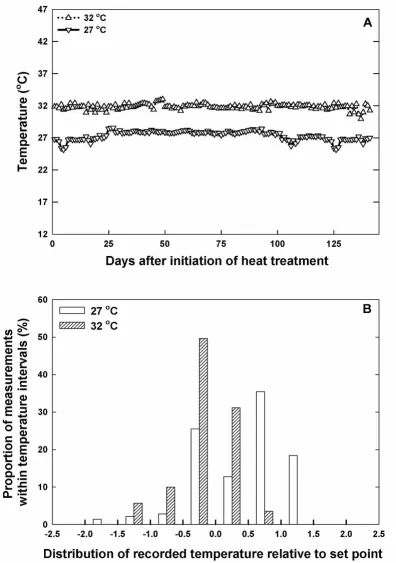
The IR heaters provided accurate night (2000–0600 h) temperatures during the cropping season (emergence to harvest). The average night temperatures were 27.3 and 31.8°C for the ambient (27°C) and ambient + 5°C (32°C) temperature treatments, respectively (Fig. 2A), indicating the ability of the described apparatus to main-tain a large temperature differential for an unenclosed space. For most of the time of heat exposure (82%), night temperature was held within 0.5°C for 32°C treatment (precision) and the minimum and maximum recorded temperatures at any point during the 32°C treatment were 30.0 and 32.9°C (reliability) (Fig. 2B). Similar results of accurate control of temperatures as imposed by the usage of IR heaters are reported in previous studies [12,17]. However, a previous study reported short episodes of tis-sue temperature increases up to 14 °C above set point [17]. We have not observed any "thermal shock" type rise in tissue temperature using the optimized conditions described here. The stability of the tissue temperature in the present study can be attributed to the combination of two factors: (1) the smooth, very rapid modulation of heater output provided through the combined use of the phase-angled fired SCR power controllers with the auto-tuned PID temperature controllers; which prevented ther-mal shock not only of the heating elements, but also of the target vegetation; and (2) the use of the fast response, low noise air-sensing thermocouples, which were subject to very little temperature buffering of the target and sys-tem heating response. A previous study had reported very little change in the surrounding air temperature, although canopy temperature differences were achieved [24]. A dif-ference between the above mentioned study and other reported IR vegetation warming studies compared to the present study is our use of air temperature, instead of can-opy temperature for controlling system response.
The IR heating system had more precision, accuracy and reliability in maintaining set point temperature compared to greenhouse heating (Fig. 3A, B, C). The paired t-test
results indicated no differences between absolute humid-ity under IR and greenhouse heating (Fig. 3A, B). Moreo-ver, the humidity during the cropping season was 14.3 and 14.4 gm m-3 under the high night and ambient night
temperature treatments, respectively, suggesting that the VPD was not altered to any unnatural extent through a change in absolute humidity during the IR heating. The ability to maintain the same absolute humidity in the pre-sented study will provide flexibility in studying plant physiological response to elevated temperature in various ways, and was possibly due to the heating of unenclosed areas with light, but nearly constant, wind providing some mixing of the air.
The accuracy of the IR heater in maintaining the set point temperature greatly decreased with a wind velocity of 2.2 m s-1 (Fig. 4A). At 2.2 m s-1, the IR heaters were off by 3°C.
Similar results of decreased IR heater thermal radiation efficiency with increase in wind speed have been reported in previous studies [3,17]. However, the decrease in effi-ciency with wind speed can be adequately estimated [3]. In the presented setup, the IR heaters were able to main-tain the set point temperatures when mounted 1 m above the canopy (Fig. 4B), however, further increasing the mounting distance above the canopy also decreased the ability of the IR heaters to maintain the set point temper-atures. Similar results of decrease in the ability to main-tain the set point temperatures with increase in mounting distance were reported by Kimball (2005) [3].
Conclusion
The described IR heating system with the phase-angled-fired SCR power controller, autotuned PID temperature controllers, and fast response, low noise, air temperature thermocouples meets the utilitarian requirements of a heating system for plant physiology studies in that the ele-vated temperature can be accurately, precisely, and relia-bly controlled, and can be scaled in replicated study of populations of plants with minimal perturbation of other environmental factors. Changes to the physiology that can alter plant tolerance to abiotic stresses, such as "thermal shock" events or unusual alteration to the VPD due to change in the canopy to air temperature difference or change in the absolute humidity, are avoided. The combi-nation of the lack of effect on other environmental factors and lack of unintended effects on the plant physiology indicate that the presented apparatus is specifically suita-ble for study of plant physiological response to high night temperature. The described IR heating system was able to maintain constant set point temperature, provided the heaters were not too high above the vegetation. Further-more, wind speeds of or above 2.2 m s-1 decreased the
Ability of IR heating system to maintain temperatures at set points
Figure 2
Temperature and humidity under IR heating system and greenhouse conditions
Figure 3
Temperatures as affected by wind velocity and mounting height of the IR heaters
Figure 4
Publish with BioMed Central and every scientist can read your work free of charge
"BioMed Central will be the most significant development for disseminating the results of biomedical researc h in our lifetime."
Sir Paul Nurse, Cancer Research UK
Your research papers will be:
available free of charge to the entire biomedical community
peer reviewed and published immediately upon acceptance
cited in PubMed and archived on PubMed Central
yours — you keep the copyright
Submit your manuscript here:
http://www.biomedcentral.com/info/publishing_adv.asp
BioMedcentral
Competing interests
The authors declare that they have no competing interests.
Authors' contributions
AM and LT conceived the project, designed experiments, and prepared the manuscript.
AM conducted the experiments and developed modifica-tions to the instrumentation. LT designed the instrumen-tation and acquired funding. AM and LT read and approved the final manuscript.
Acknowledgements
The authors thank the Texas Rice Belt Warehouse for providing a graduate fellowship to AM during his studies for the Ph.D. degree, as well as the Texas Rice Research Foundation for partial financial support during the term of this project. We would also like to thank Mr. Robert Freeman for his help with electrical setup and power connections of the IR heating sys-tem.
References
1. Houghton JT, Ding Y, Griggs DJ, Noguer M, Linden PJ van der, Dai X, Maskell K, Johnson CA: Climate Change: the scientific basis. Contribution of Working Group I of the Third Assessment Report of the Intergovernmental Panel on Climate Change.
Edited by: Change IPCC. New York: Cambridge University Press; 2001:555.
2. Sun W, Van Montagu M, Verbruggen N: Small heat shock proteins and stress tolerance in plants. Biochim Biophys Acta. 2002,
1577(1):1-9.
3. Kimball BA: Theory and performance of an infrared heater for ecosystem warming. Global Change Biology 2005, 11:2041-2056. 4. Reddy KR, Hodges HF, Read JJ, McKinion JM, Baker JT, Tarpley L,
Reddy VR: Soil-Plant-Atmosphere-Research (SPAR) facility: A tool for plant research and modeling. Biotronics 2001,
30:27-50.
5. Allen LH, Drake BG, Rogers HH, Shinn JH: Field techniques for exposure of plants and ecosystem to elevated CO2 and other
trace gases. Critical Reveiws in Plant Science 1992, 11:85-119. 6. Thomas RB, Strain BR: Root restriction as a factor in
photosyn-thetic acclimation of cotton seedlings growing in elevated carbon dioxide. Plant Physiology 1991, 96:627-634.
7. Fangmeier A, Gnittke J, Steubing L: Transportable open-tops for discontinuous fumigations. In Microclimate and plant growth in open-top chambers, Air Pollution Research Report 5 Freiburg: Commis-sion of the European Communities, Directorate-general for Science, Research and Development, Environment Research Programme; 1986:102-112.
8. Adros G, Weigel H-J, Jager H-J: Environment in open-top cham-bers and its effect on growth and yield of plants II. Plant responses. European Journal of Horticultural Science 1989,
54:252-256.
9. Tingey DT, McVeety BD, Waschmann R, Johnson MG, Phillips DL, Rygiewicz PT, Oiszyk DM: A versatile sun-lit controlled-envi-ronment facility for studying plant and soil processes. Journal of Environmental Quality 1996:614-625.
10. Harte J, Shaw R: Shifting dominance within a montane vegeta-tion community: results of a climate-warming experiment. Science 1995, 267:876-880.
11. Harte J, Torn MS, Chang F-R, Feifarek B, Kinzig A, Shaw R, Shen K:
Global warming and soil microclimate results from a meadow-warming experiment. Ecological Applications 1995,
5:132-150.
12. Nijs I, Kockelbergh F, Teughels H, Blum H, Hendrey G, Impens I:
Free air temperature increase (FATI): a new tool to study global warming effects on plants in the field. Plant Cell and Envi-ronment 1996, 19:495-502.
13. Luo Y, Wan S, Hui D, Wallace LL: Acclimatization of soil respi-ration to warming in tallgrass prairie. Nature 2001,
413:622-625.
14. Shaw MR, Zavaleta ES, Chiariello NR, Cleland EE, Mooney HA, Field CB: Grassland responses to global environmental changes. Science 2002, 298:1987-1990.
15. Wan S, Luo Y, Wallace LL: Changes in microclimate induced by experimental warming and clipping in tallgrass prairie. Global Change Biology 2002, 8:754-768.
16. Noormets A, Chen J, Bridgham SD, Weltzin JF, Pastor J, Dewey B, LeMoine J: The effects of infrared loading and water table on soil energy fluxes in northern peatlands. Ecosystems 2004,
7:573-582.
17. Kimball BA, Conley MM, Wang S, Lin X, Luo C, Morgan J, Smith D:
Infrared heater arrays for warming ecosystem field plots. Global Change Biology 2008, 14:309-320.
18. Omega: Radiant process heaters. In The Electric Heaters Handbook
21st edition. Omega Engineering Inc., Stamford, Connecticut, USA: Omega Publishers; 2008:z72-z77.
19. Park J, Mackay S, Wright E: Practical Data Communications for Instrumentation and Control. Oxford, UK: Newnes-Elsevier; 2003.
20. OPC Foundation [http://opcfoundation.org]
21. Mohammed AR, Tarpley L: Impact of high nighttime tempera-ture on respiration, membrane stability, antioxidant capac-ity, and yield of rice plants. Crop Science 2009, 49:313-322. 22. Chen CC, Turner FT, Dixon JB: Ammonium fixation by charge
smectite in selected Texas gulf coast soils. Soil Science Society of America Journal 1989, 53:1035-1040.
23. Mohammed AR, Rounds EW, Tarpley L: Response of rice (Oryza sativa L.) tillering to sub-ambient levels of ultraviolet-B radi-ation. Journal of Agronomy and Crop Science 2007, 193:324-335. 24. Nijs I, Ferris R, Blum H, Hendrey G, Impens I: Stomatal regulation
in a changing climate: a field study using Free Air Tempera-ture Increase (FATI) and Free Air CO2 Enrichment (FACE).