A DISTRIBUTED DATA SHARING SYSTEM FOR
IN-NETWORK PROCESSING
by
Joshua C. Kiepert
A dissertation
submitted in partial fulfillment
of the requirements for the degree of
Doctor of Philosophy in Electrical and Computer Engineering
Boise State University
DEFENSE COMMITTEE AND FINAL READING APPROVALS
of the dissertation submitted by
Joshua C. Kiepert
Dissertation Title: WSNFS: A Distributed Data Sharing System for In-Network Processing
Date of Final Oral Examination: 09 April 2014
The following individuals read and discussed the dissertation submitted by student Joshua C. Kiepert, and they evaluated his presentation and response to questions during the final oral examination. They found that the student passed the final oral examination.
Sin Ming Loo, Ph.D. Chair, Supervisory Committee
Amit Jain, Ph.D. Member, Supervisory Committee
Hao Chen, Ph.D. Member, Supervisory Committee
Kenneth G. Ricks, Ph.D. External Examiner
I would like to thank my advisor, Dr. Sin Ming Loo, for both his council and
support during this research and in my general academic pursuits. As this research
has been greatly enhanced by their input and support, I would also like to express
my appreciation for everyone I’ve had the pleasure of working with during my time
in the Hartman Systems Integration Laboratory, in particular: Jim Hall, Michael
Pook, Vikram Patel, Nicolas Terrel, Andy Landoch, Ali Ibrahim, Corey Warner, and
Arlen Planting.
For their continual encouragement and support, I would like to thank my family,
and most especially, I would like to thank my wife Araya, for her constant love,
support, and encouragement, through this work and always.
Wireless sensor networks (WSNs) have emerged as versatile platforms for a wide
range of scientific data acquisition applications. Wireless sensor network systems are
used in many applications including: surveillance, environmental monitoring, target
tracking, wildlife tracking, personal health monitoring, machinery monitoring, and
many others. Current research efforts in WSN system designs are moving toward
approaches that enable direct in-network processing of acquired sensor data to avoid
the high energy costs associated with the bulk transmission of data to outside systems
for processing. Implementation of collaborative in-network processing algorithms is
a non-trivial issue for WSN system development. Design complexity for in-network
processing algorithms is compounded by the fact that there are few frameworks
available to enable general purpose, energy-aware, data sharing within WSN
envi-ronments. This dissertation presents a novel WSN communications and data sharing
framework called WSNFS (Wireless Sensor Network File System), which is designed
to enable general purpose collaborative in-network sensor data processing. WSNFS
presents a common symbolic distributed file system that provides virtual views that
uniquely display sensor data, node characteristics, and network topology to each
sensor node in the network. These features significantly simplify the development
and implementation of in-network collaborative processing algorithms in WSNs.
ABSTRACT . . . v
LIST OF TABLES . . . xii
LIST OF FIGURES . . . xiii
LIST OF ABBREVIATIONS . . . xv
LIST OF SYMBOLS . . . .xviii
1 Introduction . . . 1
1.1 Wireless Sensor Networks . . . 3
1.1.1 Hardware . . . 3
1.1.2 Firmware . . . 5
1.1.3 Computer System Interfacing Software . . . 6
1.2 WSN Data Processing . . . 6
1.2.1 Stream Processing . . . 8
1.2.2 In-Network Query . . . 9
1.2.3 In-Network Processing . . . 10
1.3 Related Work . . . 12
1.3.1 WSN Routing Protocols and Network Abstraction . . . 12
1.3.3 WSN Distributed File Systems . . . 17
1.4 Thesis Statement and Dissertation Contribution . . . 18
1.5 Dissertation Outline . . . 18
2 Wireless Sensor Network File System . . . 20
2.1 Introduction to WSNFS . . . 20
2.2 WSNFS Services . . . 23
2.2.1 Routing and Data Sharing . . . 24
2.2.2 Support for External Data Sinks . . . 28
2.2.3 Physical Data Storage . . . 28
2.2.4 Summary . . . 29
2.3 WSNFS Novelty . . . 29
2.3.1 Networking . . . 30
2.3.2 Data Storage and Access . . . 31
2.3.3 Data Context Assignment . . . 32
2.3.4 Summary . . . 33
2.4 Protocol Definitions . . . 34
2.4.1 Network Management . . . 34
2.4.2 Data Management and Consistency . . . 39
2.4.3 Data Context Assignment . . . 41
2.5 Packet Definitions . . . 42
2.5.1 WSNFS Packet Header . . . 42
2.5.2 Routed Packet . . . 44
2.5.4 Heartbeat Packet . . . 45
2.5.5 Map Packet . . . 46
2.5.6 Remote Operation Packet . . . 47
2.5.7 Remote Data Packet . . . 47
2.5.8 Remote File System Tree Packet . . . 48
2.6 WSNFS API . . . 50
2.6.1 Network Manager . . . 50
2.6.2 Storage Manager . . . 50
2.6.3 View Manager . . . 51
2.6.4 Cache Manager . . . 51
2.6.5 WSNFS I/O . . . 52
3 WSNFS Implementation . . . 54
3.1 Overview . . . 54
3.2 Simulation Manager . . . 57
3.3 Storage Manager . . . 61
3.3.1 Local Data . . . 62
3.3.2 Remote Data . . . 63
3.3.3 Devices . . . 63
3.3.4 Virtual . . . 63
3.4 Network Manager . . . 64
3.4.1 Transceiver . . . 64
3.4.2 Packet Sequencer . . . 65
3.5 Cache Manager . . . 68
3.6 Views Manager . . . 69
3.7 Application . . . 70
3.8 Summary . . . 70
4 A Development Platform for WSNFS . . . 71
4.1 Cluster Nodes . . . 71
4.2 System Architecture . . . 72
4.3 Cluster Node Software . . . 73
4.4 Cluster Hardware Design . . . 74
4.5 Configuration . . . 79
4.6 Summary . . . 79
5 Results . . . 80
5.1 Simulation of Wireless Communication . . . 81
5.2 WSNFS Network Formation . . . 91
5.3 WSNFS Network Routing . . . 100
5.4 Simulation of Peripheral Devices . . . 105
5.5 WSNFS Data Storage and Recall . . . 108
5.6 WSNFS Data Views . . . 111
5.7 WSNFS Data Sharing . . . 121
5.8 Summary . . . 132
6 Analysis . . . .134
6.2 WSNFS Constraints . . . 138
6.2.1 Routing Memory Requirements . . . 138
6.2.2 Data Views Memory Requirements . . . 143
6.2.3 Data Views Communications Requirements . . . 154
6.2.4 WSN Hardware Feasibility . . . 156
6.3 Case Studies . . . 157
6.3.1 On-Demand Data Aggregation with WSNFS . . . 157
6.3.2 Continuous Data Aggregation with WSNFS . . . 169
6.3.3 In-Network Processing Comparison . . . 171
6.4 Framework Comparison . . . 175
6.5 Summary . . . 176
7 Future Work . . . .178
7.1 Embedded Implementation . . . 179
7.2 Network Mapping Enhancements . . . 180
7.2.1 Network Map Optimization . . . 180
7.2.2 Network Localization . . . 182
7.3 Routing Enhancements . . . 183
7.3.1 Static Route Packets . . . 183
7.3.2 Alternate Routes . . . 184
7.3.3 Link Quality Assessment . . . 185
7.4 Summary . . . 186
REFERENCES . . . .192
1.1 WSN Data Management Approaches . . . 8
2.1 WSNFS Definition of Terms . . . 25
3.1 Simulation Parameters . . . 58
3.1 Simulation Parameters . . . 59
3.1 Simulation Parameters . . . 60
5.1 Neighborhood Discovery Results . . . 95
5.2 Mapping Completion Time . . . 98
6.1 WSNFS Routing Memory Requirements . . . 143
6.2 fs object t Memory Requirements . . . 150
6.3 WSNFS Data View Memory Requirements: 9 Node Network . . . 153
6.4 WSNFS Data View Memory Requirements: 64 Node Network . . . 153
1.1 WSN General Architecture . . . 4
1.2 WSN Data Processing Methods . . . 11
2.1 WSNFS Node . . . 24
2.2 Example Views . . . 27
2.3 Mapping Message Propagation (WSNFS Broadcasts) . . . 37
2.4 WSNFS Packet Header Format . . . 44
2.5 WSNFS Routed Packet Format . . . 44
2.6 WSNFS Discovery Packet Format . . . 45
2.7 WSNFS Heartbeat Packet Format . . . 45
2.8 WSNFS Map Packet Format . . . 46
2.9 WSNFS Remote Operation Packet Format . . . 47
2.10 WSNFS Remote Data Packet Format . . . 48
2.11 Remote File System Tree Packet Format . . . 49
3.1 Simulated Transceiver Radius . . . 56
3.2 WSNFS Implementation Architecture . . . 56
3.3 Storage Manager Virtual File System Tree . . . 62
4.1 Raspberry Pi Layout and Specifications . . . 72
4.3 Prototype RPiCluster Stack . . . 75
4.4 Power/LED PCB Design . . . 76
4.5 RPiCluster . . . 78
5.1 Low-Level Communications Experimental Setup . . . 84
5.2 Low-Level Communications Packets Generated . . . 89
5.3 Packet Reception Counts . . . 90
5.4 Packet Reception Distribution . . . 91
5.5 Neighborhood Discovery Time . . . 95
5.6 Network Mapping Time . . . 99
6.1 WSNFS Virtual File System Data Structures . . . 150
6.2 64 Node Network: WSNFS Hops Categories . . . 160
6.3 256 Node Network: WSNFS Hops Categories . . . 162
6.4 64 Node Non-Symmetric Network . . . 165
6.5 WSNFS Hops View Category Distribution: Uniform/Symmetric . . . 166
6.6 WSNFS Hops View Category Distribution: Non-Uniform/Symmetric . 167 6.7 Data Aggregation though WSNFS Metadata . . . 170
7.1 Alternate WSNFS Network Architecture . . . 180
ADC – Analog-to-Digital Converter
API– Application Programming Interface
ASCII– American Standard Code for Information Interchange
CLI – Command Line Interface
CPU– Central Processing Unit
DAC – Digital-to-Analog Converter
DFS – Distributed File System
DNS – Dynamic Name System
GPU – Graphics Processing Unit
HDMI– High-Definition Multimedia Interface
IC – Integrated Circuit
I2C – Inter-Integrated Circuit
I/O– Input/Output
ISP– In-System Programmer
JTAG – Joint Test Action Group
JVM– Java Virtual Machine
LED– Light Emitting Diode
LQI– Link Quality Indicator
MPI – Message Passing Interface
NAT – Network Address Translation
NFS– Network File System
NID– Node Identifier
PCB– Printed Circuit Board
RGB– Red Green Blue
RISC – Reduced Instruction Set Computing
RPC – Remote Procedure Call
RSS – Received Signal Strength
RTC – Real-Time Clock
SBC – Single Board Computer
SD– Secure Digital
SDRAM – Synchronous Dynamic Random Access Memory
SPI– Serial Peripheral Interface
SRAM– Static Random Access Memory
SSH – Secure Shell
TCP/IP– Transmission Control Protocol/Internet Protocol
UART – Universal Asynchronous Receiver/Transmitter
UDP– User Datagram Protocol
UNID – Unique Node Identifier
USB – Universal Serial Bus
WSN– Wireless Sensor Network
WSNFS– Wireless Sensor Network File System
N
Wireless sensor network node count
NN eighbors
Average number of 1-hop neighbors per network node
UNID
Unique network identifier
NNZ
Number of non-zero entries in a routing adjacency table
Dvar
Measure of distance in network hops
NRoutes
Number of alternate routes supported
NNeighbors
Average number of 1-hop neighbors per node within a network
fName
WSNFS file object name
FSODD
WSNFS file system object with dynamic dispatch support disabled and dy-namic file name memory allocation
FSODS
WSNFS file system object with dynamic dispatch support disabled and static file name memory allocation
file name memory allocation
FSOES
WSNFS file system object with dynamic dispatch support enabled and static file name memory allocation
DSize
Memory required for WSNFS directory objects (bytes)
RSize
Memory required for WSNFS remote file objects (bytes)
LSize
Memory required for WSNFS local file objects (bytes)
FSNSize
WSNFS file system node object size (bytes)
FSOSize
WSNFS file system object size (may be referencing FSODD, FSODS, FSOED, orFSOES)
LLSize
Linked list data structure size (bytes)
RExtra
Additional memory space required in addition to FSOSize for a WSNFS file system remote file object
LExtra
Additional memory space required in addition to FSOSize for a WSNFS file system local file object
MTotal
Total memory required to represent a WSNFS data view (bytes)
RN
Average number of remote files in a WSNFS data view
NSharing
Number of nodes sharing data within a WSNFS network system
RShared
Average number of shared files per node in a WSNFS network system
DShared
Average number of shared directories per node in a WSNFS network system
CN
Average number of WSNFS data view categories for each node in a WSNFS network system
nRX
Request receiver node within the network during in-network processing
nC
A centrally located node within the network during in-network processing
nD
A distant edge node within the network during in-network processing
hC
Number of hop categories in a WSNFS network data view during in-network processing
hCC
Number of hop categories in a WSNFS network data view fornC nodes during in-network processing
cC(u)
The centrality index of a vertex within a graph
r(G)
The radius of a graph
d(u,v)
The distance between two vertices,u and v, for a graph
C(G)
The set of center vertices for a graphG
CHAPTER 1
INTRODUCTION
Wireless sensor networks (WSNs) have emerged as versatile platforms for a wide
range of scientific data acquisition applications. Wireless sensor networks are
com-posed of many individual “sensor nodes,” each of which has (at a minimum) a small
microprocessor, a radio system, and some collection of sensors. The capabilities
of the hardware and software present in WSN systems vary greatly depending on
the application. Wireless sensor network systems are also used in a wide range of
applications such as surveillance [1], environmental monitoring [2, 3], target tracking
[4, 5, 6], wildlife tracking [7], personal health monitoring [8, 9], machinery monitoring
[10, 11], and many others.
Significant research is being done in nearly every area of WSN design
includ-ing: hardware platforms, network topology, programming abstractions, and data
processing. While complete consensus is unlikely, much of the research community
is convinced that sensor data processing is best done, at least in part, within the
sensor network itself (e.g., in-network processing or collaborative data processing),
since the data is collected in a distributed fashion. In-network processing systems
treat the WSN as a distributed, parallel processing system. This approach solves the
for processing, particularly in applications where the data needs to be processed in
real-time (e.g., target tracking).
We present a network and data management system for wireless sensor networks
called WSNFS (Wireless Sensor Network File System). WSNFS provides a means
for WSN nodes to more effectively share data while participating in collaborative
data processing. The presented system provides a common distributed file system
(DFS) that supports any number of virtual dataviews. WSNFS dataviews uniquely
present sensor data or node characteristics to each sensor node in the network. Each
sensor node may, for example, be presented with a file structure that gives access to
all data within the network while also explicitly providing a relative hierarchy that
is representative of the network topology from each node’s point of view. As such,
collaborative processing algorithms can make intelligent decisions as to what data
should be utilized based on the cost of data access (power, communications, access
time, etc.). For example, nodes may choose to directly utilize only data that is at
most one network hop away. As the file system may have virtual elements, many other
views may be implemented. As an example, the file system may represent aspects
of the sensor nodes within the network such as sensor configurations or internal
node parameters. The file system may also enable basic aggregation of sensor data
by providing sensor data representations at variable resolution. Beyond its unique
characteristics, the presented system may also be used as a traditional distributed
network file system suitable for storage of raw and processed sensor data. WSNFS is
also capable of supporting data replication, storage load leveling, and data expiration
In the following sections, we outline some background on the general nature of
WSNs and the current direction of research as applied to data management within
WSN systems.
1.1
Wireless Sensor Networks
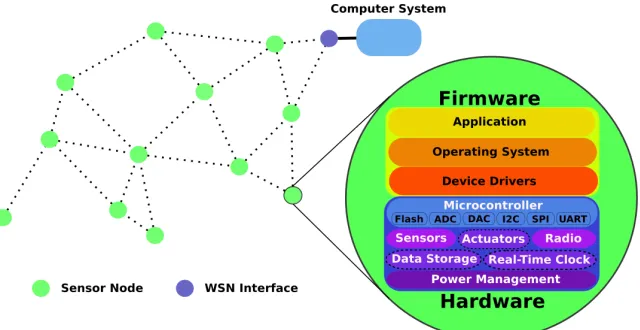
Wireless sensor networks are composed of many components. As with most complex
systems, WSNs generally have a hierarchical design. Wireless sensor networks are an
arrangement of many nodes, each with a means to communicate with other nodes in
the network. At the lowest level of the design, the sensor node hardware is composed
of digital and analog circuitry. Such hardware includes microprocessors,
communi-cations systems, power management systems, sensors, actuators, memory devices,
etc. Next, we have the firmware level, which contains the operating instructions for
the microprocessor(s) on a sensor node. The firmware is itself composed of several
logical layers including the device drivers, an operating system, and applications.
The final component is a means of interacting with the WSN. This is typically
implemented as a traditional computer system with a WSN hardware interface to
enable communication with the WSN. However, with the emergence of highly capable
mobile devices, this may also include smart phones or tablet devices. Figure 1.1 shows
an overview of general WSN architecture.
1.1.1 Hardware
The hardware of each sensor node dictates what fundamental capabilities are
hard-Figure 1.1: WSN General Architecture
ware architecture is essentially composed of a microcontroller, a wireless transceiver
(radio), sensors, and a power management system. Systems may also include the
hardware shown as dotted ovaloids in the hardware diagram. The optional hardware
can include actuators, data storage (e.g., serial flash or Secure Digital (SD) cards),
and real-time clocks (RTCs).
Microcontrollers provide an energy efficient CPU connected to many physical
in-terfaces for managing external hardware including analog-to-digital converters (ADCs),
digital-to-analog converters (DACs), and serial communications interfaces such as
I2C, SPI, and UART. Microcontrollers also include both non-volatile flash for
pro-grams (storage and execution) and volatile SRAM for use as dynamic data storage
during program execution. Many microcontrollers also have special regions of flash
memory, which may be configured as a boot loader. The boot loader area is protected
from being unintentionally overwritten while also enabling firmware residing in the
of the majority of a microcontroller’s flash without the need for a programmer such
as a JTAG or ISP device. Recently, many microcontrollers have been designed
with support for external memory interfaces that enable the addition of external
flash, SDRAM, or SRAM. The on-chip memory capacities within microcontrollers
has been steadily increasing as memory becomes cheaper and more compact. At
the time of this writing, microcontrollers are available with flash capacities ranging
from 512 bytes to 2 megabytes and SRAM capacities from 32 bytes to 512 kilobytes.
Microcontrollers typically used within WSN systems have greater than 32 kilobytes
of flash and greater than 2 kilobytes of SRAM. Of course, platforms that support
external memories are not constrained to these limitations, however the cost, in terms
of the additional energy needed to power external memories, can be significant.
1.1.2 Firmware
The code and data that is loaded to the non-volatile flash memory of a microcontroller
is generally referred to as firmware. This contrasts with software, which is compiled
to a hardware executable form, stored on a secondary non-volatile medium (e.g., hard
drive), and only dynamically loaded into RAM for execution. As is seen in Figure
1.1, the firmware executing on a given sensor node is hierarchical in nature. At the
lowest level, the device drivers interact directly with the underlying hardware. Device
drivers provide an abstracted interface to the upper levels of the firmware stack. This
abstraction allows the upper levels to interact with the hardware without needing
any knowledge of the underlying hardware implementation. The next layer is the
that there is some type of management program executing that controls the device
drivers and responds to other layers of the firmware. The operating firmware may
be as simple as a finite state machine or as advanced as a fully fledged preemptive
multitasking operating system. Finally, we have the application level of the firmware.
This is the layer that is responsible for the global behavior of the sensor node, and
in turn, the global behavior of the WSN as a whole.
1.1.3 Computer System Interfacing Software
The software within WSN systems is found in the interfacing computer systems. As
shown in Figure 1.1, computer systems may be linked to the WSN using some type
of wireless interface. The purpose of this computer system varies greatly with the
WSN system application. In some systems, the computer is responsible for collecting
all of the data gathered by the WSN, storing the data, and processing the results.
In other systems, the computer system serves only to enable a means to configure
the WSN as needed and receive messages from the network on a limited basis.
1.2
WSN Data Processing
Perhaps one of the most significant issues facing WSN systems is how to manage the
vast amount of data that is available from sensor networks. Sensor networks range in
size from just a few to hundreds of nodes. However, there are basically three schools
of thought (although hybrid designs exist, e.g. [12]) as to how the sensor data should
1. Stream Processing: Stream data to high-performance machines outside the
sensor network to subsequently be processed [13].
2. In-Network Query: Treat the WSN like a distributed database and require the
WSN to send out only the data required to answer specific structure query
language (SQL) database type queries [14].
3. In-Network Processing: The WSN itself processes the data in-network, sending
out only relevant information or alerts as needed [15].
Table 1.1 summarizes some of the primary differences between these data
manage-ment approaches. As seen in Table 1.1, each approach to WSN data managemanage-ment
is compared across several characteristics: the average amount of network traffic,
sensor data access latency, the ability to do computations on sensor data, and network
scalability. The network traffic characteristic is based on what level of network traffic
must occur for sensor data, or the results of sensor data processing, to be made
available outside the WSN. Similarly, the data access latency characteristic refers
to the time it takes for sensor data, or sensor data processing results, to be made
available outside the WSN. The computation characteristic compares the relative
ability to apply complex algorithms to sensor data by the WSN itself. Finally, the
scalability characteristic provides a comparison of how effectively the network may
be expanded to an arbitrary number of sensor nodes.
From Table 1.1, we see that in-network processing inherently provides much more
control of characteristic behavior as compared with the other methods of sensor
Table 1.1: WSN Data Management Approaches
WSN Data Management Approaches
Characteristic Stream Processing In-Network Query In-Network Processing
Average Network Traffic High Moderate Application Dependent
Data Access Latency Low Moderate Application Dependent
Computation on Sensor Data None Limited Hardware Dependent
Scalability Limited High Application Dependent
controlled by the WSN application. The computation capabilities are limited only
by the available computational resources on the WSN hardware platform, and as
with in-network query, in-network processing can be highly scalable. However, other
issues need to be considered. In the following sections we will briefly analyze each
data management approach and identify issues involved with each methodology.
1.2.1 Stream Processing
Initially, WSN systems were designed to stream data collected out-of-network for
col-lection and processing. Many WSN systems still utilize this model. Primary benefits
to stream processing include its relatively simple implementation and effectiveness
in small networks with a limited number of sensors. “Smart” control of the wireless
channel can reduce the inherent network congestion. However, an upper limit to
the scalability of a network implementing direct streaming still exists. This limit is
determined by the bandwidth of the receiver and the bandwidth requirements of each
sensor node. Other issues include packet loss due to network congestion, inefficiencies
both in terms of transmit power and data duplication, and finally, the throughput
may be too slow to be processed and acted upon from outside the network. Processing
streaming system by the WSN itself. Instead, an outside system must aggregate
data, perform analysis, and finally, act upon the results. These delays may be
significant depending on the WSN system, and as such, a limited number of systems
can effectively operate in this mode.
1.2.2 In-Network Query
In-network query processing provides a high-level abstraction for interaction with a
sensor network. As discussed above, this system treats the WSN as a database that
responds to SQL-type queries. When a query is injected into the network (typically
one node is responsible for receiving such queries), the query is propagated through
the network so that each node may supply its part of the result. To make this
more efficient, the network internally keeps tables/indexes updated (even when no
active queries are being processed). This makes it unnecessary for all sensor nodes
to be involved in response to each individual query. The primary benefit of this type
of communication is that it can allow the natural application of data aggregation
algorithms such as min, max, avg, etc. In-network query also has the means to
potentially reduce overall network traffic as compared to stream processing since
most of the communication only takes place to answer an injected query. As we have
previously alluded to, one area where in-network query falters is that, depending on
implementation, it may still require significant continued communication outside of
queries to maintain up-to-date indexes and tables. Additionally, there is significant
software overhead required for implementation. Furthermore, in-network query has
analysis of sensor data beyond the simple, database-like, aggregation algorithms.
1.2.3 In-Network Processing
In-network processing effectively applies both the concepts of parallel processing
and distributed systems to the WSN domain. It requires that each sensor node be
capable of both responding with data directly when requested, as well as accepting
computation jobs that must be completed and returned. The benefits of this type of
framework are many: duplicate data can easily be silenced, data can be aggregated
before sending it out of the network, network communication can be directly
con-trolled (and thus reduced), advanced algorithms can be applied to the sensor data,
and high-level abstractions such as in-network query can be supported. Moreover,
this type of management system can support nearly all common uses of WSN systems
as it provides a low-level control of each sensor node that can easily be abstracted
to provide simple high-level management of the network as a whole. As with the
other methods, in-network processing has some disadvantages. With sensor nodes
participating in computation, there are several side effects. Namely, the sensor nodes
must have greater computational performance, and the power requirements may be
increased since computation must be done in addition to normal sensor management.
Additionally, since the programming interface is flexible, it can be inherently more
complicated to develop programs in such an environment.
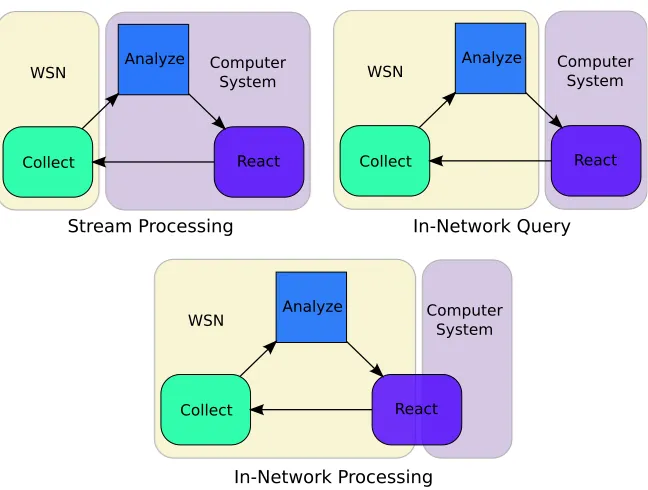
Figure 1.2 provides a graphical representation of how the WSN responsibilities
are allocated. As seen in Figure 1.2, stream processing reduces WSN responsibilities
Collect
Analyze
React
WSN ComputerSystem
Collect
Analyze
React
WSN ComputerSystem
Collect
Analyze
React
WSN ComputerSystem
In-Network Processing
Stream Processing In-Network Query
Figure 1.2: WSN Data Processing Methods
react to collected data. On the other hand, in-network query systems move some
analysis capabilities into the WSN. Finally, in-network processing provides a flexible
WSN system that may process and react to the data collected as well as forward
data and results to external computer systems.
As a whole, in-network processing provides the necessary characteristics for
im-plementation of a general purpose method of WSN data management. However, we
believe there is a need for an inter-node data sharing mechanism to efficiently carry
out in-network processing. While there is much research being applied to in-network
collaborative processing, there is a lack of general purpose data-sharing facilities
within in-network processing frameworks. In-network processing frameworks are
utilizing data local to each sensor node, or they are limited to very specific application
domains.
1.3
Related Work
As discussed in the previous section, a central problem of WSN systems is managing
the vast quantities of data acquired by sensors. Several research areas are being
pur-sued to address this problem including: optimal data routing through the network,
data abstraction methods such as file systems, and data context assignment to allow
better use of collected data. In the following, we discuss work in the aforementioned
categories as they apply to the development of WSNFS. Some of this material will
be revisited in Section 2.3 when discussing some of the finer points of the WSNFS
approach to WSN system management.
1.3.1 WSN Routing Protocols and Network Abstraction
Many approaches to WSN data routing have been considered over the years. Villaba
et al. provided a review of many common approaches while also presenting their
own “Simple Hierarchical Routing Protocol” (SHRP)[16]. Villaba et al. identify four
classes of routing protocols typically applied to WSN systems:
attribute-based/data-centric, geographic, multipath, and hierarchical.
Attribute-based routing protocols route information from the sensor network
according to data attributes that are supplied by the entity making the data request.
Only data that has the specified attribute will be returned to the requesting party.
routing. Geographic protocols make routing decisions based on the physical or
virtual location of the information requested. Multipath routing algorithms maintain
many possible routes, which allows data requests to be fulfilled by any number of
independent paths. Multipath algorithms can improve quality of service (QoS) by
maintaining alternate routes and thus allow data to be routed through the alternate
paths when an active route fails. Finally, hierarchical routing algorithms partition
the network into distinct groups (clusters). This approach helps scale networks to
very large sizes. However, the algorithm must then maintain cluster membership
information as well as negotiate links between clusters. This overhead may be
considered undesirable in smaller networks.
SHRP was designed to optimize routing based on energy stores, link quality, and
number of hops. Furthermore, SHRP was built as an extension to the Sensornet
Protocol (SP) developed by Polastre et al. [17], and it provides features of both
multipath and hierarchical routing. Sensornet Protocol attempts to provide some
transparency between the link layer and the network layer in an effort to provide
a communications framework that can reliably route messages in WSNs while also
allowing the WSN application to participate in routing decisions. Sensornet Protocol
operates by acting as a intermediary to the link layer of the communications stack,
and it provides applications with information about the link layer by maintaining a
table of immediate neighbors to each node within the network. Sensornet Protocol
is also responsible for managing data transmission and reception to and from the
application, allowing link information to be incorporated into application decisions
trans-parency) are important to effective data sharing within sensor networks, particularly
for in-network processing. SHRP itself utilizes SP to implement a system that
attempts to optimize routing and network hierarchy based on link quality (LQI),
network distance (hops), and battery availability. SHRP also attempts to reduce
energy consumption through data aggregation, e.g. avoiding transmission of sensor
data when it has not changed.
SPIN (Sensor Protocols for Information via Negotiation) was developed by Kulik
et al. to investigate adaptive routing protocols in energy constrained networks
[18]. The key premise of SPIN is that a significant number of data exchanges may
be avoided by utilizing descriptors (metadata) that uniquely identify data when
deciding what needs to be transmitted. Beyond the use of metadata to negotiate
data transmissions, SPIN seeks to provide WSN application level control of how
data is routed through the network. As with SHRP/SP, we see a system that
provides some link information to the application, but in this case we also see the
concept of providing a framework that helps WSN systems avoid unnecessary network
communications by utilizing metadata to make communications decisions.
Finally, an important routing protocol strongly related to our work is the
Opti-mized Link-State Routing (OLSR) protocol [19]. Unlike traditional network routing
schemes, OLSR proactively establishes the network topology to allow immediate
and optimized routing when needed. OLSR networks have two node types. The
first node type is the multi-point relay (MPR), which is responsible for all network
control traffic. Any messages that need to be broadcast are forwarded to MPR nodes
on a distributed election process, and once elected each MPR identifies all of its
2-hop neighbors in the network. One significant distinction for OLSR as compared
to the routing protocols discussed above is that OLSR does not actually manage
routing directly. OLSR only maintains possible route information and enables other
services to use the information for routing. Additionally, the process of identifying
an optimal set of MPR nodes is an NP-complete problem, and as such must be solved
heuristically. OLSR will be discussed further in Section 2.3.
1.3.2 File System Abstraction and Data Context Assignment
Data abstraction is studied in many domains. Perhaps the most analogous
sys-tem to our work is that of Picco et al. in which a set of programming language
constructs were developed for describing what they termed “distributed abstract
data types” or DADT [20]. Picco et al. proposed the concept of abstracting
distributed data by representative views as part of a programming language construct
to facilitate distributed programming. While our concept of dataviews is similar to
the DADT model for abstracting distributed data, we will be applying the concept
to an application-level interaction within a file system abstraction rather than in
programming language constructs.
File abstraction for sensor networks is not a new idea. A wide range of file system
abstraction concepts have been applied to sensor networks. Some systems abstract
all aspects of WSN systems using a virtual file system [21, 22]. Other WSN systems
employ a UNIX-like architecture in which tasks and system features are represented
WSN rather than inter-node data sharing.
Aside from general file system abstractions, many traditional WSN optimized file
systems exist for use with on-board flash memory [24, 25, 26]. Such file systems focus
on storing data local to each sensor node, utilizing the storage medium physically
attached to the sensor node. As part of the proposed research, flash-based file systems
of some type will be incorporated to provide management of local data to each sensor
node.
Other file system related concepts in WSNs are those that deal with
organiz-ing and controllorganiz-ing data access. One such concept is a file system optimized for
multi-resolution storage and access of sensor data [27]. Multi-resolution data access
provides many benefits. However, our system differs from other approaches in that
it is providing multi-resolution access as one interface to stored data rather than
as the primary mechanism of data storage. The WSNFS approach extends the
multi-resolution data concept into a distributed model.
Finally, systems built around file system abstractions exist that attempt to
pro-vide a measure of real-time access to sensor data while also providing data access
based on the network hierarchy [28]. This type of system is perhaps the most closely
related to our proposal in that such systems have some similar goals. It differs,
however, in that the file system is again used primarily as a mechanism for externally
controlling and receiving data from the sensor network rather than providing a means
1.3.3 WSN Distributed File Systems
Outside the WSN domain, a large body of research has been applied to the
develop-ment of generic network file systems for mobile platforms (e.g., data sharing between
cell phones, tablets, etc.) [29]. These systems typically try to extend traditional
network file systems (e.g., NFS or similar) to the mobile domain by addressing the
issues associated with unreliable network connectivity in mobile networks. While
many principles can be leveraged from this work, much of the transport layer is
not applicable to WSN systems, because traditional network file systems rely on
transmission control protocol/Internet protocol (TCP/IP) and/or remote procedure
call (RPC) support, which is not present or easily implemented in WSNs.
Other related work includes approaches to data handling within a sensor network
such as general multi-resolution storage [30], data aging [31], and data replication
[32]. We see these concepts as “plug-ins” to our overall architecture, that is, these
features may be added to or removed from a particular implementation. WSNFS
is expected to provide a general purpose mechanism to support many different data
views based on the requirements of specific applications while still maintaining a
consistent interface to sensor nodes participating in collaborative processing.
A wide range of collaborative storage systems have been developed for sensor
networks [33]. Typical collaborative storage systems seek only to store data in the
network without the need for real-time access. Collaborative storage systems in
WSNs arose as an alternative to streaming sensor data out-of-network. In
applica-tions that do not require active processing of sensor data, the system continuously
is it recovered from the network. These systems require storage load leveling as
a result of potential non-uniform data generation rates and the limited storage
space available on individual sensor nodes. Additionally, these systems often have
data replication mechanisms to provide redundancy throughout the network. Data
redundancy ensures data availability despite a few individual sensor node failures.
While systems of this class implicitly provide node-to-node data sharing, it is done
with different goals than our proposed system, and as such is not well suited to
in-network processing applications.
1.4
Thesis Statement and Dissertation Contribution
WSNFS provides a novel approach to WSN data sharing that can improve the energy
efficiency of in-network processing and simplify development of WSN applications
that require collaborative in-network processing.
1.5
Dissertation Outline
This dissertation is organized as follows. Chapter 2 presents the general WSNFS
concept, protocols, and definitions. Chapter 3 presents the framework in which
WSNFS concepts and protocols were implemented for experimentation. Chapter
4 discusses a hardware platform that was developed as part of this work, to test
WSNFS. In Chapter 5, we present the experimental results from testing each of the
primary services provided by WSNFS. Chapter 6 provides an analysis of WSNFS
general discussion of the results from Chapter 5 and through several case studies.
Chapter 7 presents some discussion of possible directions to take the work presented
in this dissertation. Finally, Chapter 8 provides some closing thoughts and
CHAPTER 2
WIRELESS SENSOR NETWORK FILE SYSTEM
2.1
Introduction to WSNFS
WSNFS is a distributed file system like communications framework that greatly
simplifies data sharing between sensor nodes at the application level, while also
providing more efficient access to sensor data for out-of-network devices. A number
of features are important for a general purpose WSN framework. The feature of
primary importance is a close coupling between the WSN application data interface
and the network routing framework. Wireless sensor network applications have
difficulty making effective, energy conscious decisions regarding data use when the
network routing and application layers are completely decoupled. Beyond energy
awareness, WSNFS supports multi-resolution data storage/access, data replication,
data expiration, and virtual file representations. Furthermore, WSNFS provides a
common application programming interface (API) on which to base a wide variety
of WSN in-network processing applications. In effect, WSNFS hides much of the
complex details that make in-network processing difficult to achieve in the WSN
environment, while also providing a rich set of tools to address in-network processing
As discussed in Section 1.2, advanced in-network processing for collaborative data
processing requires efficient data sharing. At its simplest, collaborative processing
may be implemented by only considering data local to each sensor node. However,
for advanced data processing algorithms, sensor nodes need to share much of the
data available. The difficulty with sharing large quantities of data inside a WSN is
the costly nature of data transmission (i.e., the power required to transmit). Thus,
collaborative processing algorithms need to make intelligent decisions as to what
data is transferred for processing. We propose the concept of data views to help
collaborative processing algorithms make well-informed data-use decisions. WSNFS
data views provide a virtual file system abstraction representing the underlying
data, which gives the WSN nodes explicit data context. As an example, one such
view could represent the data in the context of its geographical location within the
monitored area. This would allow sensor nodes to leverage the context of the data
for target tracking. Another such view could be defined as the location of data
in terms of the relative number of network hops required for access. Such context
enables collaborative processing algorithms to limit access to distant nodes while
enabling quick access to data from sensor nodes logically near (according to network
hierarchy).
One important application of data views is the possibility for multi-resolution
storage/access of sensor data. Multi-resolution data views of sensor data would
provide an efficient way to manage the large quantities of sensor data generated in
WSNs. A multi-resolution view can enable data-processing algorithms to be applied
higher resolution data can be utilized for final analysis. Multi-resolution data access
can greatly reduce the volume of data transferred across the network, which directly
reduces energy requirements.
As WSNs often rely on battery power, it is critical that WSN applications be
energy aware. The energy use in WSN systems falls into a few distinct categories:
computation, sensors, and communications. Energy requirements for sensors are
pri-marily controlled by duty-cycling and sensor design, thus there are few opportunities
for significant optimization. However, in contrast to sensors, much can be done to
manage computation and communications. WSNFS seeks to address the trade off
between computation and communications by taking a different approach to data
management.
Beyond data abstraction, we believe there are several other important features
that are important to a distributed WSN file system. These include data replication,
data aging, and virtual file representations. Data replication is the process of enabling
redundant storage of data in the network. This ensures that a few sensor node failures
do not necessarily make data unavailable to remaining nodes. Data aging is the
process of assigning an expiration date to acquired data. Once the expiration date
has been exceeded, the data is deemed no longer relevant and may be overwritten.
The data expiration concept is important, particularly for dynamic applications in
which data acquisition is occurring at a high rate and becomes stale quickly. In such
applications, generally it is desirable to avoid filling limited storage resources by
keeping irrelevant data. Finally, virtual file support enables sensor nodes to export
can naturally make this class of internal configuration and status properties available
efficiently due to their static nature.
The final piece of a complete file system is the physical storage interface. The
underlying storage medium greatly affects the architecture of the file system that
manages its storage. As such, this system will be optimized to take advantage of
typical flash-based storage mediums used in WSN systems.
2.2
WSNFS Services
WSNFS provides a novel method for improving the effectiveness of collaborative
processing in WSN systems. The primary services provided by WSNFS include
peer-to-peer network routing, data context assignment, general data sharing, and
data storage. In the following, each of these services, as well as some of the benefits
to the overall approach to managing sensor networks with WSNFS will be discussed.
Figure 2.1 shows a high-level block diagram of an individual WSNFS node. As seen
in Figure 2.1, the primary components of a WSNFS node are the WSNFS services,
which utilize on-board storage for managing global routing, data views (metadata),
and global shared data. The WSNFS API provides a standard interface for the
services to WSN applications. WSNFS is a completely peer-to-peer system such
that all nodes are logically equivalent. This architecture fits well with the typical
nature of WSNs and provides the additional benefits that the network is more easily
scaled and more robust to individual node failures. The WSNFS routing service is
responsible for maintaining a global routing table as well as forwarding messages
WSNFS Node
WSNFS
Services
WSNFS
API
Local Storage
Routing Table
Data Cache
Meta Data Cache
Shared Data Store
WSN
Application
Figure 2.1: WSNFS Node
may be globally synchronized within the WSN. This may be done to ensure the
system can continue to function when individual nodes fail or leave the network and
to provide an efficient way for new nodes to become aware of the existing network
architecture.
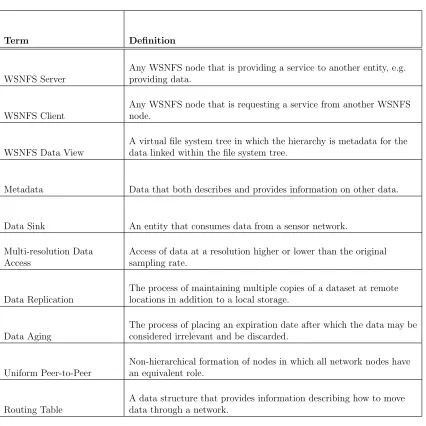
In order to set the stage for the following discussion, it may be useful to define
some of the terms that will be used to describe WSNFS. Table 2.1 identifies some
key conceptual terms.
2.2.1 Routing and Data Sharing
Network routing and data sharing are closely related. To effectively share data
among nodes in a network, the data must be efficiently routed through the network
to the desired recipients. Network routing issues are complicated by the fact that
WSNs typically utilize multi-hop networking architecture to allow use of low-power
transceivers.
pro-Table 2.1: WSNFS Definition of Terms
Term Definition
WSNFS Server
Any WSNFS node that is providing a service to another entity, e.g. providing data.
WSNFS Client
Any WSNFS node that is requesting a service from another WSNFS node.
WSNFS Data View
A virtual file system tree in which the hierarchy is metadata for the data linked within the file system tree.
Metadata Data that both describes and provides information on other data.
Data Sink An entity that consumes data from a sensor network.
Multi-resolution Data Access
Access of data at a resolution higher or lower than the original sampling rate.
Data Replication
The process of maintaining multiple copies of a dataset at remote locations in addition to a local storage.
Data Aging
The process of placing an expiration date after which the data may be considered irrelevant and be discarded.
Uniform Peer-to-Peer
Non-hierarchical formation of nodes in which all network nodes have an equivalent role.
Routing Table
cessed is easily accessible by all participating parties. In WSN collaborative
pro-cessing, a mechanism is needed for identifying the most efficient use of available
data. WSNFS seeks to accomplish this by maintaining a distributed sensor network
routing table. While there is overhead in synchronizing routing information for an
entire WSN, we believe much energy may be saved by enabling WSN applications
to optimally route data through the network. Utilizing the global view of the
network, WSNFS can directly provide the WSN application with the energy context
of accessing the available data. Efficient routing lookups are based on use of a table
data structure. The table index is the desired recipient, and the returned value is the
next node in the routing chain. The WSNFS nodes independently and collaboratively
manage routing tables and modify them as nodes join or leave the network. Any
node in the network may determine participating nodes by simply reading an active
node table. From the perspective of the WSN application, most of the routing details
are actually transparent as they are handled in the transport layer provided by the
WSNFS routing service.
Data views are based on network routing data or other characteristics of nodes
in the network such as energy stores. This metadata is cached locally and updated
based on changes in network characteristics. WSNFS abstracts such information
as a file system tree, and modifies the tree to reflect the perspective of each node
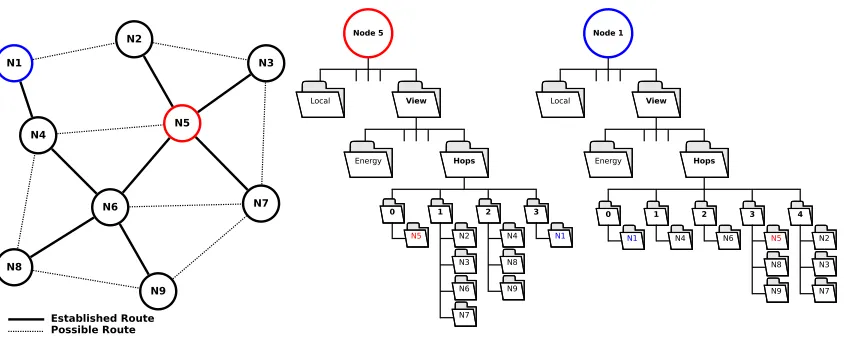
as it relates to global information. Figure 2.2 shows a theoretical example of such
a file system tree from the perspective of two nodes in a corresponding example
network. As seen in Figure 2.2, the “hops” view would be adjusted by WSNFS
Figure 2.2: Example Views
neighbors. WSNFS dataview information is cached in the local metadata cache and
incrementally updated as changes occur in the network.
As discussed earlier, multi-resolution data access enables collaborative processing
algorithms to reduce network traffic by utilizing data at the coarsest data resolution
possible. Similar to other context-based data organization (e.g., network hops, or
energy stores), WSNFS enables multi-resolution access through its dataviews system
and a specialized time-series data file format.
Generic data sharing services (such as data replication) can be achieved by
providing a region of memory on each node dedicated to shared data storage. The
shared data area requires more energy overhead to synchronize, since changes to the
shared area involve actual data transfers, as opposed to the metadata synchronization
2.2.2 Support for External Data Sinks
One of the many benefits of a peer-to-peer architecture is that it becomes far easier for
external monitors to connect to the sensor network system to utilize sensor data and
services provided by the sensor network. This advantage is brought about through
network uniformity. Many existing WSN topologies require the use of special nodes
that act as coordinators. In such systems, it is necessary to connect to a coordinator
to gain access to the sensor network facilities. The peer-to-peer architecture ensures
network uniformity, thus an outside device may connect with the network at any
physical location in the network, gaining access to the same information. This is an
important feature for many networks, as mobile devices gain greater utility in active
monitoring and control of sensor network systems.
2.2.3 Physical Data Storage
Sensor data may be generally thought to fall into two categories: time-series and
events. WSNFS will store both types of data in a space efficient manner, while
also providing a simple means for the data to be accessed through the WSNFSview
interface. WSNFS is essentially symbolically linking remote data into the dataview
path structure dynamically.
As usual, time-series data in WSNFS is represented as ordered pairs of time and
value (t, v). Physical storage space is saved, when possible, by storing the starting
time, interval, and number of values of each time-series. The ordered pairs can be
reconstructed as needed with this information. In storage constrained systems, a
encoding.
Events in WSNFS are defined as data that meet specific criteria. An event
may be as simple as a binary value indicating a signal has occurred, or it may be a
complex relation based on historical time-series data. In practice, event data is simply
time-series data that meets a set of criteria. WSNFS stores only the event criteria
and links to the time-series data range that forms the event to avoid duplication of
stored data.
2.2.4 Summary
Overall, WSNFS is unique in that it merges file system abstraction with a WSN
communications framework. We believe this framework provides a uniform method
for abstracting and leveraging the context of data that is collected in WSNs for
efficient in-network collaborative processing.
2.3
WSNFS Novelty
As discussed in Section 2.2, the key components of WSNFS are the network
discov-ery/routing framework, the data context abstraction (data views) system, and the
DFS. These components work together to allow WSN applications to make informed
decisions when accessing non-local sensor data. We believe WSNFS provides a novel
approach to WSN data management, and as such, the following discussion will focus
2.3.1 Networking
As discussed briefly in Section 1.3.1, a wide range of existing systems support
route management within WSNs. However, a few existing systems are particularly
relevant to the WSNFS approach. We briefly discussed the Sensornet Protocol (SP)
abstraction, as related to its role in the WSN framework, such as providing a way for
link layer information to be utilized directly in applications. We also discussed the
SHRP system for managing data and network routing based on a fixed set of criteria,
e.g. battery availability, link quality, and network distance. The WSNFS routing
service is partially analogous to the abstraction provided by SP for enabling WSN
applications to be aware of underlying network states at a deeper level. SP works as
an intermediary between the network level and the link level of the WSN system, with
its primary role being the maintenance of neighbor tables and message queues. While
the WSNFS network service has a similar purpose, it goes beyond the functionality
of SP by not only maintaining neighbor information but also identifying the network
topology as a whole. WSNFS provides both the network level management as well
as link layer abstraction. WSNFS goes beyond SHRP by providing a framework
that allows data access/management to be controlled by the application, using any
criteria desired, i.e. not only battery, link quality or distance. WSNFS does this by
providing each sensor node with a complete picture of the network topology, which is
built from a node’s relative position in the network. Additionally, WSNFS provides
a generic abstraction to represent system criteria or sensor criteria in a generic way,
which can be directly utilized by the application level of the system, to make data
to network management and routing within WSN systems.
While the network discovery and formation protocols of WSNFS were developed
independently, some similarities to the OLSR protocol exist, which we briefly
dis-cussed in Section 1.3.1. WSNFS may be considered a link-state routing protocol
belonging to the same family as OLSR. One of the more significant differences
between OLSR and WSNFS network architecture is the use of multi-point relays
(MPR) in OLSR. WSNFS was designed to provide a uniform network architecture,
and as such, all nodes within WSNFS have the same responsibilities. This avoids the
distributed election process needed in OLSR to select MPRs, as well as the issues
associated with the network trying to determine the optimum nodes to function as
MPRs. One of the primary benefits of having MPRs is for broadcast management.
OLSR can reduce repeated broadcasting by requiring all nodes wishing to broadcast
a message to notify its nearest MPR, which then executes the broadcast by notifying
other MPR nodes, which in turn notify their neighbors. WSNFS manages the
broadcasting issue by establishing a set of broadcast rules that mitigate problems
with message flooding without MPR nodes. Section 2.4 will revisit WSNFS routing
in further detail.
2.3.2 Data Storage and Access
We briefly touched on some DFS concepts related to WSNFS in Section 1.3.3. While
WSNFS may appear to be a typical DFS on the surface, it does not operate like a
traditional DFS. WSNFS is a DFS in the sense that it presents a file system tree that
remote data as though it is available locally (e.g., linked into the local file system),
the WSN application is fully aware of the fact that certain data sets are remote based
on where the data resides in the file system (data views). As WSNFS is targeted
specifically to the use cases of WSNs, DFS operations are limited to those necessary
for in-network collaborative processing, i.e. primarily read access. Additionally,
WSNFS data files utilize a fixed format, optimized for time-series sensor data, which
greatly simplifies access semantics for time-interval access, record-interval access,
and multi-resolution access of sensor data. Local WSNFS data file access is limited
to append-only writes (single writer) and stateless reads (many readers). In this
context, stateless read operations are defined as read operations that do not depend
on any previous read operation (e.g., last file cursor position). Access to remote data
is generally limited to read-only in WSNFS to avoid write concurrency complexity
issues such as consistency maintenance, file locking, etc.
2.3.3 Data Context Assignment
As briefly visited in Section 1.3.1, the SPIN protocol utilizes metadata to make
routing decisions, controlling how information is transferred. WSNFS extends the
use of metadata as applied in SPIN to a virtual file system environment. In contrast
to SPIN, the file system approach provides a common interface for WSN applications
to work with while also providing other useful services to the WSN system. The
file system trees in WSNFS (data views) describe not only what data is available
on remote nodes, it also provides data context based on the data view in which
trees. In general, only the metadata is synchronized throughout the network in
WSNFS by default. General sensor data may be shared and synchronized in the
network, but may be regarded as only an application-specific function of WSNFS.
As discussed in Section 1.3.2, the WSNFS approach to data context management is
unique. However, data context management in WSNFS is influenced by the work of
Picco et al. in their discussion of abstract data types (ADT) and distributed abstract
data types (DADT). ADTs define interfaces for data objects that enable individual
and collective (distributed) operations to be applied to them. This is accomplished
by creating new programming language constructs such asdistributes,bind,on,local,
andwithin, etc. These programming constructs provide the basis for the language to
express relationships and operate on distributed sensor data explicitly. WSNFS seeks
to provide some of these benefits without redefining the language. As described in
Section 2.2.1, WSNFS provides context for distributed data by expressing metadata
with virtual file system trees. Data classification in WSNFS is represented by the
file system hierarchy, and as such, individual operations are accomplished by directly
accessing resources within the file tree. Collective operations are grouped based
on the file system hierarchy. The classifications imposed on data in WSNFS are
determined by the active set of dataviews, and are thus application specific.
2.3.4 Summary
WSNFS builds on a number of concepts to address the problem of sharing data
within WSNs. It provides a novel approach to providing network information to the
collected by the WSN system. Additionally, WSNFS provides a reduced complexity
(and reduced functionality) DFS to give WSN applications simple data discovery
and data access semantics.
2.4
Protocol Definitions
WSNFS system operation is governed by many distinct protocols. Each of these
protocols can be arranged into just a few distinct categories: network management,
data management, and data context assignment. Network management includes
network formation, topology detection, routing, and maintenance. Data management
encompasses the way sensor data is stored within WSNFS, such as the data file
formats. Data context assignment includes management of WSNFS dataviews.
2.4.1 Network Management
WSNFS provides a link-state protocol type network. It continuously maintains
network topology at each node to facilitate minimal-hop routing from any source
to any destination within the network. As discussed in Section 2.3.1, WSNFS avoids
use of “special” nodes to enable network uniformity. All nodes within a WSNFS
network have the same knowledge of the network topology to ensure redundancy
against failure and allow external data sinks to connect to the network at any
location. WSNFS network formation and management is defined by four states:
Discovery
The discovery state is responsible for identifying 1-hop neighbors. This is
accom-plished by broadcasting a discovery message on a random interval. The random
interval is in place to reduce the likelihood of communication collisions between
neighboring nodes (also possibly in the discovery state). Any node that receives
a discovery message responds by generating a discovery response. Nodes in the
discovery state that receive a discovery response message add the corresponding
responder to a their local neighbor list. The WSNFS discovery protocol rules are
summarized as follows:
1. Discovery messages are broadcast at random intervals without retransmission.
2. Discovery response messages are sent in reply to all received discovery messages.
3. When a discovery message reply is received, the originating node is added to
the 1-hop neighbor list.
4. The discovery state is concluded when the neighbor list no longer changes.
Mapping
The mapping state allows each node in the network to identify the network topology.
Each node broadcasts a mapping message that includes the originating 1-hop
neigh-bor list. Additionally, as each mapping message is forwarded through the network,
each relay node appends its identification data to form a route list for each mapping
which is used for determining the shortest path between any two known nodes in the
network. The WSNFS mapping protocol rules are summarized as follows:
1. Mapping messages includes a unique (to generating node) packet identifier,
origin of packet, associated 1-hop neighbor list, and network path traversed.
2. Mapping messages are broadcast at random intervals with retransmission
lim-ited to desired network maximum hop size.
3. Mapping messages are not forwarded if a message with the same ID and origin
have been previously received. (This rule applies to broadcasts in general.)
4. Mapping messages are not forwarded if the retransmission limit is exceeded.
5. The mapping message path field is appended with the receiving node identifier
before being relayed.
6. The mapping state is concluded when the adjacency table no longer changes.
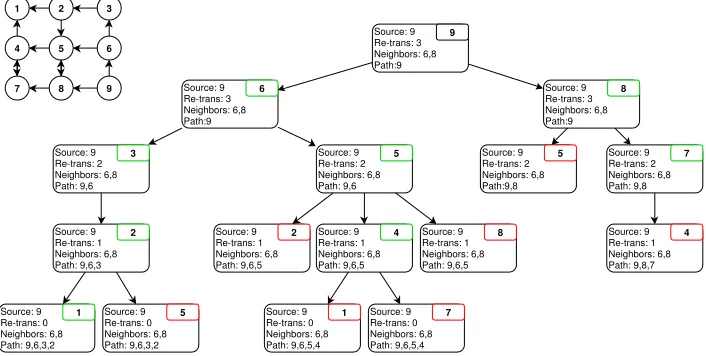
Figure 2.3 shows an example of mapping message propagation through a
representa-tive 3Ö3 network, in which Node 9 broadcasts a mapping message to the network. For
this example, the mapping message is represented by a rectangular box showing the
message’s internal state, and the top-right corner of the box indicates the message’s
current location in the network. The color of the location box indicates whether the
message should be rebroadcast: green indicating retransmission and red indicating
no rebroadcast.
As seen in Figure 2.3, Node 9 broadcasts its 1-hop neighbor table, which in this