M E T H O D O L O G Y
Open Access
An optimised method for the proteomic
profiling of full thickness human skin
Emily Bliss
1*, Wendy E. Heywood
1, Malika Benatti
2, Neil J. Sebire
2and Kevin Mills
1Abstract
Background:The skin is the largest organ of the human body and is the first line barrier defence against trauma, microbial infiltration and radiation. Skin diseases can be a result of multi-systemic disease or an isolated condition. Due to its proteolysis resistant properties there are relatively few human skin proteomic datasets published compared with other human organs or body fluids. Skin is a challenging tissue to analyse using traditional proteomic techniques due to its high lipid content, insolubility and extensive cross-linking of proteins. This can complicate the isolation and digestion of proteins for analysis using mass spectrometry techniques.
Results:We have optimised a sample preparation procedure to improve solubilisation and mass spectral compatibility of full thickness skin samples. Using this technique, we were able to obtain data for the proteome profile of full thickness human skin using on-line two-dimensional liquid chromatography, followed by ultra-high definition label-free mass spectrometry analysis (UDMSE). We were able to identify in excess of 2000 proteins from a full thickness skin sample.
Conclusions:The adoption of on-line fractionation and optimised acquisition protocols utilising ion mobility separation (IMS) technology has significantly increased the scope for protein identifications ten-fold.
Keywords:Proteomics, Skin profiling, Mass spectrometry, Solubilisation
Background
The skin, being the largest organ of our bodies is of paramount importance for barrier protection and first line defence against trauma, microbial infiltration and radiation. However when this barrier is damaged or dis-eased numerous dermatological conditions can arise. These diseases by their nature are superficial, visible and can look unpleasant, which can contribute to a signifi-cant psychological and social burden [1].
To understand more about diseases affecting the skin and the skin barrier in particular, it is important that we understand the complex composition of proteins, metab-olites and lipids that make up the skin and how they play a functional role in its overall structure. The skin consists of three major distinct layers; the epidermis, dermis and the subcutaneous fat layer. The purpose of the subcutaneous fat layer is largely for insulation, the dermis is predominantly made up of collagens, elastin
and fibrillin as well as nerve endings, sweat glands, se-baceous glands, hair follicles and major blood vessels providing nutrients for the epidermal layer [2]. The epi-dermis is the most superficial layer of the skin and comprises the skin barrier; despite being the thinnest of all three layers it is arguably the most complex [3].
Despite the importance of the skin there are relatively few human skin proteomic studies and datasets cur-rently available in the literature [4] compared with other human organs or body fluids. A human-specific PubMed search shows that there are three times as many publica-tions for“liver AND proteomics”[5] and twelve times as many publications for“blood AND proteomics”[6] com-pared with publications for “skin AND proteomics” [7]. Skin is a challenging tissue to analyse using traditional proteomic techniques due to its high lipid content, in-solubility and extensive cross-linking of proteins. This can complicate the isolation and digestion of proteins for analysis using mass spectrometry techniques. Tech-niques used by research groups in the current selection of * Correspondence:[email protected]
1Centre for Translational Omics, UCL Institute of Child Health, 30 Guilford
Street, London WC1N 1EH, UK
Full list of author information is available at the end of the article
available publications about skin proteomics [7] include gel-based protein fractionation [8, 9], heavy isotope labelled assays to identify phosphorylated proteins [10] and studying the proteins secreted by the skin, rather than the skin tissue itself [11]. The latter two techniques are specific to a par-ticular aspect of the skin proteome and do not represent the composition of the skin tissue as a whole. Gel-based protein isolation or fractionation techniques is a viable method for preparing samples prior to mass spectrometry analysis and one which we explored whilst developing the method presented in this paper. When comparing a gel-based fractionation technique and the on-line fractionation technique described here we found a 50 % increase in the number of proteins detected (data not shown).
Here we describe an optimised method of fractionat-ing, chromatographically separating and detecting pro-teins from a trypsin digested sample of human skin. This method is relatively quick, consists of less sample preparation steps and less protein (3μg) compared with similar gel-based methods.
Results
Previously in our laboratory we have been able to iden-tify 100–200 proteins from a full thickness skin biopsy [12], however with an upgraded system and modified
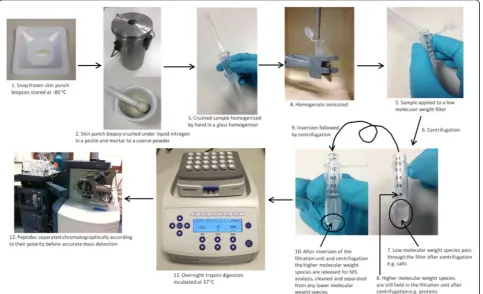
methods we have improved this protocol and achieved a ten-fold increase in the number of identified proteins. In order to be a fair comparison the results presented in this section are from the same sample of skin tissue and are representative of the number of proteins detected by these methods from other samples of skin (data not shown). In the first instance the skin preparation method comprised of powdering the frozen tissue using a pestle and mortar, further homogenisation using a glass homogeniser, sonication, filtration of interfering low molecular weight compounds. This was a method adapted from other published proteomics methods for other tissues [13–15]. Peptides would then be separated using reverse phase chromatography a nanoAcquity li-quid chromatography system coupled to a quadrupole time-of-flight mass spectrometer (QToF Premier, Waters, Manchester) [12] (Fig. 1). Using this workflow 218 pro-teins were identified from the skin samples as detailed in Additional file 1: Table S1.
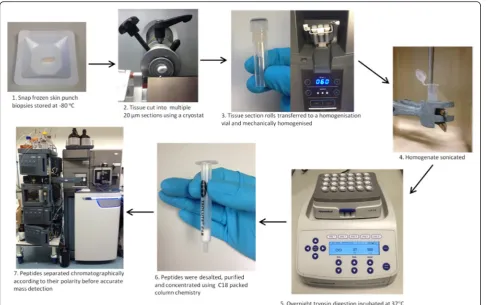
Modifying the initial preparation method (Fig. 2) im-proved the number of detected proteins, to 2237 proteins, from the same sample of skin, those proteins are detailed in Additional file 2: Table S2.
Improved chromatographic separation was achieved using on-line fractionation technology [16] integrated with a nanoAcquity ultra-high performance liquid
chromatography (UPLC) system (Fig. 3) rather that the shotgun approach of the initial method (Fig. 1).
One-dimensional (1D) separation is when the sample is injected onto the trapping column then the analytical column, the peptides are chromatographically separated according to polarity by an increasing concentration of acetonitrile over a 1 h gradient. Two-dimensional (2D) separation reduces the complexity of the sample by dividing it into multiple fractions, in this case eight on an additional fractionation column. Those fractions were then individually applied to the trapping column, then analytical column for chromatographic separation for the same 1 h acetonitrile gradient as the 1D sam-ples and this was repeated for each individual fraction, totalling 8 hs of chromatographic separation for the 2D samples.
Further improvement in peptide quantitation and identification is achieved an optimised acquisition on a quadrupole time-of-flight mass spectrometer to include an additional ion mobility dimension of separation (SYNAPT G2-Si, Waters, Manchester) and capabilities of tailoring the collision energy ramp to the characteris-tic signature of peptides from this matrix (UDMSE).
Discussion
In the first instance in our laboratory we analysed full thickness skin samples using the standard laboratory protocol, as shown in Fig. 1. That method allowed us to identify 218 proteins (Additional file 2: Table S1). We believed that this method could be altered to in-crease coverage of the skin proteome (Figs. 2 and 3). Two noticeably inefficient steps were the powdering and homogenisation. This was time consuming, not reproducible and inefficient (data not shown). Instead we chose to slice the skin using a cryostat into 20μm sections and apply mechanical homogenisation using a ceramic bead homogeniser. We found this method to be quicker, more reproducible and efficient (data not shown). Another modification is the removal of the fil-tration step with a low molecular weight cut off filter. Instead to remove the majority of salts and hydropho-bic compound such as lipids we used reverse phase carbon-18 (C18) pre-packed cartridges. C18 cartridges were selected because this is the same chemistry used in the solid phase of the on-line chromatographic sep-aration thereby the samples are purified appropriately for the system.
Finally the liquid chromatography system was modi-fied to include an additional binary solvent manager which allows the samples to be fractionated on-line using high pH/low pH fractionation (Fig. 3) [17, 18]. One-dimensional separation is quicker as it involved 1 h or chromatographic separation, whereas 2D separation reduced the complexity of the sample into eight separate fractions for analysis, totalling 8 hs of chromatographic separation and greater proteome coverage. The applica-tion of IMS to the mass spectral analysis also greatly improved this method. IMS in this case uses travelling-waves of helium gas against the flow of ions in order to separate co-eluting compounds based on shape and size giving each ion an unique ‘drift time’ measure thereby introducing an additional degree of separation of the ions [19, 20].
Having introduced these changes we have been able to identify 2237 proteins from a single skin sample (Additional file 2: Table S2), ten-fold greater than previously achieved in our group (Additional file 1: Table S1).
This method could equally be applied to other chal-lenging or insoluble tissues such as formalin-fixed paraffin-embedded archived samples. Having developed this technique we will now be able to use the method to further study the skin in health and disease. We hope to be able to shed light on disease mechanisms and underlying biochemical changes that increase sus-ceptibility to certain skin diseases. Further functional characterisation could also be achieved by physical sep-aration of the skin layers. This is currently only achiev-able using laser capture technology that uses a very fine laser beam to cut out and collect sections of tissue from a microscope slide.
Conclusions
In conclusion by modifying the sample preparation method, using a more complex liquid chromatography setup (2D-fractionation) and more recent mass spectrometry separ-ation techniques (IMS) we have successfully been able to modify our original protocol in order to increase ten-fold the proteome coverage for skin samples.
Methods
Experiment design
We aimed to create a mass spectrometry-based method and workflow that would allow us to use proteomics to profile full thickness human skin. Using skin from surgi-cally removed accessory digits, nanoflow UPLC online fractionation and separation before label-free UDMSE raw data acquisition we were able to profile over 2000 proteins.
Materials
All reagents and materials were purchased from Sigma-Aldrich, Poole, UK, unless stated otherwise. All solvents were of UPLC or higher grade specification.
Human skin sample collection
The skin sample was obtained from the surface of an accessory digit surgically removed at Great Ormond Street Hospital, London. The skin was separated from the underlying tissue using a clean scalpel blade.
Solubilisation of tissue and determination of protein concentration of the sample
Skin tissue was washed with a 1x phosphate buffer solution before being snap frozen in liquid nitrogen, embedded in
optimum cutting temperature (Cell Path, Fisher Scientific), cryosectioned into 10 μm rolled tissue sections (Leica CM1860) and collected in a clean tube. The curls were sus-pended in 500μL of 50 mmol/L ammonium bicarbonate containing 2 % w/v amidosulphobetanine-14. Curls and so-lution were transferred to a homogenisation vial (Precellys 0.5 mL tube containing 1.4 mm diameter ceramic beads, peqlab, VWR) and mechanically homogenised for 20 s at high power (Minilys®, Bertin Technologies). The solution was then transferred to ice for 1 min to stop thermal deg-radation. This was repeated a further two times. The vial was then incubated on ice for 1 h before a further three cy-cles of homogenisation. The homogenate was transferred to a clean tube and sonicated for 10 s using a Soniprep 150 sonicator (MSE UK). The sample was spun at 16,000 g for 10 min and the supernatant removed to a clean tube. A modified Lowry (Pierce™, ThermoFisher Scientific) protein assay was used to calculate the protein content of the sample.
In-solution digestion of the homogenised sample
The equivalent of 50 μg of protein solution was taken and lyophilised using a freeze-drier. The pellet was reconstituted in 20 μL of 100 mmol/L trisma base, pH 7.8, containing 2 % w/v amidosulphobetanine-14, 6 mol/L urea and 2 mol/L thoiurea. To this solution 1.5μL of a 1.94 mol/L dithioerythritol solution made up in 100 mmol/L trisma base, pH 7.8 was added, the sample vortexed, centrifuged briefly and incubated on a platform shaker at room temperature for 1 h. Three microlitres of a 1.94 mol/L2-iodoacetamide solution made up in 100 mol/L trisma base, pH 7.8 was added, the sample vortexed, centrifuged briefly and incubated at room temperature on a platform shaker for 45 min. The reaction volume was made up to 190 μL with Milli-Q water (Merck Millipore, Merck KGaA, Germany). Ten microlitres of 0.1 mg/mL Sequencing Grade Modified Trypsin (Promega, Madison, USA) was added, the sample vortexed briefly and incubated overnight at 37 °C.
Purification of the digested sample peptides reverse phase C-18 chromatography
In order to remove the salt and lipid content of the sam-ple, 100μL of the digest solution was taken for a clean-up step using ISOLUTE® C18 columns (Biotage) was used.
Two dimensional high pH fractionation of sample peptides, followed by low pH chromatographic separation using an online nanoAcquity ultra high performance liquid chromatography system
The lypholised sample was reconstituted in 25 μL of 3 % v/v acetonitrile containing 0.1 % v/v trifluoroacetic acid and 50 pmol/μL enolase peptides standard (MassPREP™, Waters) solution, centrifuged at 16,000 g for 10 mins and
the supernatant transferred to a vial (TruView™LCMS Cer-tified, Total Recovery Vial, Waters). The nanoACQUITY UPLC (Waters, Manchester) system was configured in 2D with dilution set-up to allow for the first dimension to online fractionate the sample using high pH mobile phases directly before individual fractions entered the second dimension of chromatographic separation using low pH mobile phases. The first dimension was performed at 2μL/min flow on an XBridge Peptide ethylene bridged hybrid C18 NanoEase Column (130 Å, 5 μm, 300μm X 50 mm, 1/pkg (PN: 186003682), Waters, Manchester) mo-bile phase A was a 20 mmol/L ammonium formate, pH 9 solution and mobile phase B was 100 % acetonitrile. At the beginning of the first dimension 2.4μL of the sample solution was loaded onto the XBridge Peptide column in 3 % mobile phase B for 1 min before a 4 min gradient up to 8.7 %, 11.8 %, 13.6 %, 15.3 %, 17.1 %, 19.3 %, 22.5 % and 50 % mobile phase B respectively for the 8 sequential frac-tions, after which the XBridge Peptide column was re-equilibrated at 3 % mobile phase B. After a fraction has been eluted from the XBridge Peptide column it enters the second dimension constituting low pH reverse phase chromatographic separation at 400 nL/min flow on an ACQUITY UPLC Peptide ethylene bridged hybrid C18 nanoACQUITY Column (10 Kpsi, 130 Å, 1.7 μm, 75 μm X 150 mm (PN: 186003543), Waters, Manchester) main-tained at 35 °C, mobile phase A was 0.1 % v/v formic acid with 5 % v/v dimethyl sulphoxide and mobile phase B was 0.1 % v/v formic acid in 100 % acetonitrile with 5 % v/v dimethyl sulphoxide. Before the peptides from the first dimension are chromatographically separated they were diluted 1:10 during trapping with mobile phase A from the second dimension (20μL/min 0.1 % formic acid with 5 % v/v dimethyl sulphoxide), concentrated and further desalted onto a nanoACQUITY UPLC Symmetry C18 Trap Column (100 Å, 5μm, 180 μm x 20 mm, 2G, V/M (PN:186006527), Waters, Manchester). The second di-mension gradient starts 20.5 min after the start of the first dimension at 3 % mobile phase B and increases to 40 % over 40 min, a further increase to 85 % mobile phase B oc-curs over the next 2 min and is held there for 2 min fur-ther, before returning to the starting conditions for 15 min of re-equilibration.
Label-free UDMSEmass spectrometry data acquisition
wave velocity of 650 m/s and a wave height of 40 V in order to separate similar precursor ions. The low energy scans were performed at a collision energy of 0 V and the high energy scans were performed on a gradient designed to use an optimised collision energy depending on the ion mobility bin, from 0–20 ion mobility bins the collision en-ergy was 13.6 V increasing linearly to 49.1 V at 120 mobil-ity bins, followed by another linear gradient to 54.1 V at 200 mobility bins. At a frequency of every 60 s lock mass of [glutamic acid1]-fibrinopeptide B is delivered via an auxiliary pump at 300 nL/min.
Analysis and quantification of raw mass spectrometry files
Raw data were imported into Waters ProteinLynx Global-Server version 3.0.1 in order to identify peptide masses corresponding to the fragmentation ion data. Mass correc-tions was applied based on the [glutamic acid1 ]-fibrino-peptide B mass delivered via an auxiliary pump. The processed spectra were merged prior to searching the UniProt reviewed human proteome. Database searching parameters were set to two fragment ions matched per peptide, four fragment ions per protein and two pep-tides per protein and one missed cleavage, fixed modifi-cations were set to carbamidomethylation of cysteines and dynamic modifications of hydroxylation of aspartic acid, lysine, asparagine and proline and oxidation of methionine and the false discovery rate set to 4 %.
Additional files
Additional file 1:Table detailing the proteins identifed in the original method (Fig. 1). (XLSX 19 kb)
Additional file 2:Table detailing the proteins identified in the final method (Fig. 2). (XLSX 120 kb)
Abbreviations
C18, carbon-18; IMS, ion mobility separation; QToF, quadrupole time of flight; UDMSE, ultra-high definition label-free mass spectrometry; UPLC ultra-high performance liquid chromatography
Acknowledgements
This research was carried out with funding from a National Institute for Health Research, Biomedical Research Centre Great Ormond Street Hospital and UCL Institute of Child Health PhD Studentship Grant. We also wish to thank the Parents and Children of Great Ormond Street Hospital and also the donations from the Szeban Peto Foundation.
Funding
This research was carried out with funding from a National Institute for Health Research, Biomedical Research Centre Great Ormond Street Hospital and UCL Institute of Child Health PhD Studentship Grant also with kind donations from the Szeban Peto Foundation. The funding bodies had no role in the design of the study, collection, analysis, interpretation of the data or in writing of the manuscript. This report is independent research by the National Institute for Health Research Biomedical Research Centre Funding Scheme. The views expressed in this publication are those of the authors and not necessarily those of the NHS, the National Institute for Health Research or the Department of Health.
Availability of data and material
Protein list data available as supplementary material. Additional file 1: Table S1 details the proteins identified in the original method (Fig. 1) and Additional file 2: Table 2 details the proteins identified in the final method (Fig. 2).
Authors’contributions
EB wrote the manuscript, performed the acquisition, analysis and
interpretation of the data and was involved with the conception and design of the study, WH critically revised the manuscript and was involved with the conception and design of the study, MB provided samples and training for histopathology techniques, NS provided samples and histopathology supervision, KM critically revised the manuscript and was involved with the conception, financing and design of the study. All authors read and approved the final manuscript.
Competing interests
The authors EB, WH, MB, NS and KM have no conflicts of interest to declare.
Ethics approval and consent to participate
The skin samples were samples of excess tissue surgically removed for disposal with no linked clinical information, as stated in the ethics statement thus consent was not required. The research was carried out in accordance with the ethical agreement REC reference: 12/LO/0905, approved by the London–Bloomsbury NRES Committee.
Author details
1Centre for Translational Omics, UCL Institute of Child Health, 30 Guilford
Street, London WC1N 1EH, UK.2Histopathology Department, Great Ormond
Street Hospital, London WC1N 3JH, UK.
Received: 16 March 2016 Accepted: 24 June 2016
References
1. Basra MK, Shahrukh M. Burden of skin diseases. Expert Rev Pharmacoecon Outcomes Res. 2009;9(3):271–83. ISSN 1744–8379. Disponível em: http://www.ncbi.nlm.nih.gov/pubmed/19527100.
2. Macneal, R. J. Structure and Function of the Skin. p. http://www.msdmanuals. com/en-gb/home/skin-disorders/biology-of-the-skin/structure-and-function-of-the-skin, Disponível em: http://www.msdmanuals.com/en-gb/home/skin-disorders/biology-of-the-skin/structure-and-function-of-the-skin. Acesso em: 09/10/2015
3. Proksch E, Brandner JM, Jensen JM. The skin: an indispensable barrier. Exp Dermatol. 2008;17(12):1063–72. ISSN 0906–6705.
4. De Veer SJ et al. Proteases and proteomics: cutting to the core of human skin pathologies. Proteomics Clin Appl. 2014;8(5–6):389–402. ISSN 1862–8354. Disponível em: http://www.ncbi.nlm.nih.gov/pubmed/24677727.
5. National Center for Biotechnology Information, U.S. National Library of Medicine. PubMed Search for“liver AND proteomics”. 2016. Disponível em: http://www.ncbi.nlm.nih.gov/pubmed/?term=liver+AND+proteomics+AND +(Humans%5BMesh%5D). Acesso em: 27/04/2016.
6. National Center for Biotechnology Information, U.S. National Library of Medicine. PubMed Search for“blood AND proteomics”. 2016. Disponível em: http://www.ncbi.nlm.nih.gov/pubmed/?term=blood+AND+proteomics +AND+(Humans%5BMesh%5D). Acesso em: 27/04/2016.
7. National Center for Biotechnology Information, U.S. National Library of Medicine. PubMed Search for“skin AND proteomics”. 2016. Disponível em: http://www.ncbi.nlm.nih.gov/pubmed?term=skin+AND+proteomics+AND +(Humans%5BMesh%5D)&cmd=DetailsSearch. Acesso em: 27/04/2016 8. Lundberg KC et al. Proteomics of skin proteins in psoriasis: from discovery
and verification in a mouse model to confirmation in humans. Mol Cell Proteomics. 2015;14(1):109–19. ISSN 1535–9484. Disponível em: http://www. ncbi.nlm.nih.gov/pubmed/25351201.
9. Schnell G et al. Discovery and targeted proteomics on cutaneous biopsies infected by borrelia to investigate lyme disease. Mol Cell Proteomics. 2015; 14(5):1254–64. ISSN 1535–9484. Disponível em: http://www.ncbi.nlm.nih. gov/pubmed/25713121.
11. Burian M et al. Quantitative proteomics of the human skin secretome reveal a reduction in immune defense mediators in ectodermal dysplasia patients. J Invest Dermatol. 2015;135(3):759–67. ISSN 1523–1747. Disponível em: http://www.ncbi.nlm.nih.gov/pubmed/25347115.
12. Bennett K et al. New role for LEKTI in skin barrier formation: label-free quantitative proteomic identification of caspase 14 as a novel target for the protease inhibitor LEKTI. J Proteome Res. 2010;9(8):4289–94. ISSN 1535–3907 (Electronic) 1535–3893 (Linking). Disponível em: http://www.ncbi.nlm.nih. gov/pubmed/20533828.
13. Aroor AR et al. A proteomic analysis of liver after ethanol binge in chronically ethanol treated rats. Proteome Sci. 2012;10(1):29. ISSN 1477–5956. Disponível em: http://www.ncbi.nlm.nih.gov/pubmed/22545783.
14. Amin NM et al. Proteomic profiling of cardiac tissue by isolation of nuclei tagged in specific cell types (INTACT). Development. 2014;141(4):962–73. ISSN 1477–9129. Disponível em: http://www.ncbi.nlm.nih.gov/pubmed/24496632. 15. Sahu A et al. Host response profile of human brain proteome in toxoplasma
encephalitis co-infected with HIV. Clin Proteomics. 2014;11(1):39. ISSN 1542– 6416. Disponível em: http://www.ncbi.nlm.nih.gov/pubmed/25404878. 16. Rogeberg M et al. On-line solid phase extraction-liquid chromatography,
with emphasis on modern bioanalysis and miniaturized systems. J Pharm Biomed Anal. 2014;87:120–9. ISSN 1873-264X. Disponível em: http://www. ncbi.nlm.nih.gov/pubmed/23746991.
17. DWIVEDI RC et al. Practical implementation of 2D HPLC scheme with accurate peptide retention prediction in both dimensions for high-throughput bottom-up proteomics. Anal Chem. 2008;80(18):7036–42. ISSN 1520–6882. Disponível em: http://www.ncbi.nlm.nih.gov/pubmed/18686972. 18. Wang Y et al. Reversed-phase chromatography with multiple fraction
concatenation strategy for proteome profiling of human MCF10A cells. Proteomics. 2011;11(10):2019–26. ISSN 1615–9861. Disponível em: http://www.ncbi.nlm.nih.gov/pubmed/21500348.
19. May JC, MClean JA. Ion mobility-mass spectrometry: time-dispersive instrumentation. Anal Chem. 2015;87(3):1422–36. ISSN 1520–6882. Disponível em: http://www.ncbi.nlm.nih.gov/pubmed/25526595.
20. Lanucara F et al. The power of ion mobility-mass spectrometry for structural characterization and the study of conformational dynamics. Nat Chem. 2014;6(4):281–94. ISSN 1755–4349. Disponível em: http://www.ncbi.nlm.nih. gov/pubmed/24651194.
21. Distler U et al. Drift time-specific collision energies enable deep-coverage data-independent acquisition proteomics. Nat Methods. 2014;11(2):167–70. ISSN 1548–7105. Disponível em: http://www.ncbi.nlm.nih.gov/pubmed/24336358.
• We accept pre-submission inquiries
• Our selector tool helps you to find the most relevant journal • We provide round the clock customer support
• Convenient online submission • Thorough peer review
• Inclusion in PubMed and all major indexing services • Maximum visibility for your research
Submit your manuscript at www.biomedcentral.com/submit