World Maritime University
The Maritime Commons: Digital Repository of the World
Maritime University
World Maritime University Dissertations Dissertations
2000
A model MET institute for the East African region :
creating an effective infrastructure for outreach and
improved standards
Musa Hassan Musa
World Maritime University
Follow this and additional works at:http://commons.wmu.se/all_dissertations Part of theInfrastructure Commons
Recommended Citation
Musa, Musa Hassan, "A model MET institute for the East African region : creating an effective infrastructure for outreach and improved standards" (2000).World Maritime University Dissertations. 446.
WORLD MARITIME UNIVERSITY
Malmö, Sweden
A MODEL-MET INSTITUTE IN KENYA FOR THE
EAST AFRICA REGION:
Creating an Effective Infrastructure for Outreach and Improved
Standards.
By
MUSA HASSAN MUSA
Kenya
A dissertation submitted to the World Maritime University in partial fulfilment of the requirements for the award of the degree of
MASTER OF SCIENCE
In
Maritime Education and training
(Engineering)
2000
DECLARATION
I certify that all the material in this dissertation that is not my own work has been identified, and that no material is included for which a degree has previously been conferred on me.
The contents of this dissertation reflect my own personal views, and are not necessarily endorsed by the University.
Musa Hassan Musa ...
Date ...
Supervised by: Prof. Peter Muirhead
Course Professor, Maritime Education and Training World Maritime University.
Assessor:
Ass Prof. Toshio Hikima
Associate Professor, Maritime Education and Training (Engineering) World Maritime University
Co-assessor:
Capt. George Angas
DEDICATION
ACKNOWLEDGEMENTS
I would like to express sincere appreciation to my sponsor, the Tokyo Foundation, for providing me with the scholarship to successfully complete my study at WMU. I would like to thank my employer, Kenya Ports Authority for nominating me, in particular, Mr. A. O. Ogwambo.
No achievement would be possible without the kind understanding, criticism and professional assistance of the professors at WMU, visiting professors/specialists, the library staff and all other staff for support. I would especially like to acknowledge the support and generous assistance of my supervisor Prof. Peter Muirhead. I would like to express my appreciation to my assessors Prof. Toshio Hikima and Capt. George Angas for assessing this dissertation.
My thanks go to all those who provided me with valuable information and advice, in particular, Susan Wangeci-Eklow and colleagues both in WMU and KPA. I am indebted for their contribution and help.
ABSTRACT
Title of dissertation: A model-MET institute in Kenya for the East Africa
region: Creating an Effective Infrastructure for Outreach and Improved Standards.
Degree: MSc
This dissertation is a study on the necessary requirements for a model-Maritime Education and Training institute in Kenya for the East Africa region. The revised STCW, the demands for trained maritime professionals and other developments in the maritime industry have all had great impact on the MET systems and institutions in developing countries. Hence, the current MET situation is examined and the available resources in the region identified.
The justification for having a model-MET established in Kenya is assessed. Reports on the analysis of seafarers in the world and the region are examined and discussed, identifying and highlighting both direct and indirect benefits. Other reports and documents on maritime education and training in the region are examined, stakeholders interviewed and data collected. Particular interest is paid towards the creation of employment opportunities and careers for Kenyans.
In order to create an effective infrastructure for outreach and improved standards, a strategic planning of the existing Bandari College is conducted emphasising the requirements for a model-MET institution.
The concluding chapters examine the possible programs to be offered and discuss how the institution should be linked and funded.
TABLE OF CONTENTS
Declaration ii
Dedication iii
Acknowledgements iv
Abstract v
Table of Contents vi
List of Tables viii
List of Figures viii
List of Abbreviations ix
1 INTRODUCTION
1.1 Objectives 1
1.2 Methodology 2
1.3 Limitations 3
2 CURRENT MET SYSTEMS AND INSTITUTIONS IN EAST AFRICA REGION
2.1 Kenya 5
2.1.1 Background
2.1.2 Current MET and Certification System 5
2.1.3 Institutions for MET 7
2.2 Tanzania 9
2.2.1 Examination and Certification system 9
2.2.2 Dar es Salaam Maritime Institute 10
2.3 Mozambique 11
3 NEED FOR MARITIME TRAINING IN KENYA
3.1 Analysis of Seafarers in the World 13
3.2 Seafarers in Kenya and East Africa Region 19
3.3 Benefits of having Maritime Training in Kenya 21
3.4 Difficulties and Limitations 25
4.1.1 Mission Statement and Goals 27 4.1.2 Strengths, Weaknesses, Opportunities and Threats
(SWOT) Analysis 28
4.1.3 Strategic Objectives based on the mission and
SWOT Analysis 32
4.2 Administration and Organisation 33
4.3 Academic Curriculum 34
4.4 Personnel 40
4.5 Facilities and Technology 43
4.6 Quality Standards 46
5. PROGRAMMES AND FUNDING OF THE INSTITUTION
5.1 Programmes 50
5.1.1 Programme Portfolio 50
5.2 Funding 54
5.2.1 Capital and Initial Funding 55
5.2.2 Recurrent Expenditure 56
5.2.3 Sources of Revenue 57
6 EXTERNAL LINKAGES AND CO-OPERATION
6.1 Ministries 59
6.2 Maritime Industry 60
6.3 Port Authority 61
6.4 Colleges and Other Institutions 61
6.4.1 Kenya 61
6.4.2 Regional 62
6.5 MET System Harmonisation and Co-operation
In the Region 63
7. CONCLUSIONS AND RECOMMENDATIONS
7.1 Conclusions 66
7.2 Recommendations 68
REFERENCES 70
APPENDICES
Appendix A IMO Circular TC/Circ.52 76
Appendix B IMO Circular TC 34/INF.2 77
LIST OF TABLES
Table 3.1 Supply and Demand for Seafarers in 2000 16
Table 3.2 Supply and Demand Balances for Seafarers 17
Table 3.3 Officers in Kenya (1999) 20
Table 3.4 Ratings in Kenya (1999) 20
Table 4.1 Maritime Transport and Engineering student/staff ratios 41
Table 4.2 Port and Shipping Operation student/staff ratios 41
Table 4.3 Management and Administration student/staff ratios 42
Table 4.4 Number of contact hours for lecturers per week 42
Table 5.1 Maritime Transport and Engineering programme portfolio 51
Table 5.2 Port and Shipping Operation programme portfolio 53
Table 5.3 Management and Administration programme portfolio 54
LIST OF FIGURES
Figure 1.1 Map of the East African region 4
Figure 1.2 Bandari College organisational structure showing the KPA
linkage 8
Figure 3.1 Distribution of officers of dominant nationalities by region 18 Figure 3.2 Distribution of ratings of dominant nationalities by region 18
Figure 4.1 Strategic planning leading to the model requirements 27
Figure 4.2 SWOT analysis: Internal Environment 29
Figure 4.3 SWOT analysis: External Environment 30
Figure 4.4 Summary of the factors having the most direct and significant
LIST OF ABBREVIATIONS
BIMCO Baltic International Maritime Council
BoG Board of Governors
COMESA Common Market for East and Southern Africa
DCWF Diploma in Clearing, Warehouse and Freight Forward
DIT Directory of Industrial Training
DMI Dar es Salaam Maritime Institute
DMTU Dar es Salaam Maritime Training Unit
EAC East African Co-operation
FCMS Foundation Certificate in Maritime Studies
FDS Foundation Diploma in Shipping
ICS Institute of Chartered Shipbrokers
IMO International Maritime Organisation
JAB Joint Admission Board
JKUCAT Jomo Kenyatta University College of Agriculture and Technology
JICA Japan International Co-operation Agency
KCSE Kenya Certificate of Secondary Education
KIE Kenya Institute of Education
KPA Kenya Ports Authority
KCWFA Kenya Clearing, Warehousing and Forwarding Association
MET Maritime Education and Training
NORAD Norwegian Agency for International Development
OECD Organisation for Economic Co-operation and Development
PDP Portworkers’ Development Programme
PMAESA Port Management Association of Eastern and Southern Africa
STCW International Convention on Standards of Training, Certification and Watchkeeping for Seafarers
SWOT Strengths, Weaknesses, Opportunities and Threats
TACOSHILI Tanzania Coastal Shipping Line
TASU Tanzania Seamen’s Union
TCD Technical Co-operation Division
UK P&I United Kingdom Protection and Indemnity
UNCTAD United Nation Conference on Trade and Development
UoN University of Nairobi
CHAPTER 1
INTRODUCTION
When people talk about maritime education and training in the world, the perspective normally connected with this is that of training mariners for shipboard operations. This is not really true in the sense that, the current maritime industry involves professions other than the seafaring. In essence, this should be reflected in the so-called professional studies in the maritime education and training sector.
In this thesis therefore, the author looks at an ideal maritime education and training model, which could be adapted in Kenya. In the framework, policies related to MET institutions as affected by the revised STCW 78, needs for maritime training and the effects of new developments in the maritime industry are taken into account. This is done in order to create an effective infrastructure for outreach and improve the training standards of the developing nations such as in the East African region.
By description, an institute’s (school’s) policy is a statement of purpose and one or more guidelines as to how that purpose is to be achieved. Taken together, it should provide a framework for the operation of the institute, school or programs. Bearing this in mind, it has led the author to identify the necessary requirements for a MET institution in Kenya, indeed a model for the region, which would strengthen co-operation and harmonize the MET systems in the region.
1.1 OBJECTIVES
In creating this model-MET, the author had the following objectives in order to achieve the overall aim:
• To survey the need of maritime training as a way of creating employment and careers for Kenyans and East Africans.
• To survey and identify available resources by conducting a strategic planning through SWOT analysis, creation of a mission statement and setting strategic objectives.
• To identify the requirements for the model-MET institute in Kenya for the East Africa region.
• To draw conclusions for a future pathway for the model-MET and harmonizing the system in the East Africa region and make suitable recommendations based on the findings of the study.
1.2 METHODOLOGY
The developed strategic planning which is based on the observation of the current situation of the MET systems and resources is used to prescribe the necessary requirements of the institute in Kenya.
The sources of information used in this study include interviews conducted by the writer during his vacation in December 1999, and observation and discussions held during field trips to the various MET institutions. Utilization of concepts and materials from lectures that the author attended at the World Maritime University and other training institutions.
1.3 LIMITATIONS
Basically, the main limitations in this thesis are:
• It covers only the analysis of seafarers in the world and the region and has not looked at other professions related to the maritime industry in surveying, maritime law, classification, ports and shipping.
CHAPTER 2
CURRENT MET SYSTEMS AND INSTITUTIONS IN EAST AFRICA REGION
Most of the countries in the East African region have not put in place the revised STCW 78. In order to understand what is in existence, it is important to look at each country’s current MET system and the state of progress. The countries that comprise the East Africa region for the purpose of this paper are Kenya and Tanzania while a brief description is given for Mozambique. Figure 1.1 shows a map of the region.
Fig 1.1 Map of the East African region.
2.1 KENYA
2.1.1 Background
Although Kenya has one of the leading ports in the region, it does not have a well-defined maritime policy and as a result has not established a sound Maritime Education and Training system of its own. This does not mean that, as a country, it has not been involved in the matters related to MET. For a long period, most of the Kenyan maritime officers were trained in United Kingdom. This is derived from the fact that Kenya is a former British colony.
Looking briefly at the short history of the Kenyan maritime sector, with respect to training, the first trainees were sent to Britain in the early 1960s. This was during the East African Community (which broke up in 1975) and the main purpose was to get qualified officers who were to man the joint common services, lakes and harbours shared by Kenya, Uganda and Tanzania. However, most of these officers did not return home as expected, and this may be due to lack of proper policies, guidelines, incentives and limited opportunities on return.
The formation of the common lake services led to the establishment of the first Seamanship Centre, Marine Training School in Kisumu on the shores of Lake Victoria in 1957. The 3 East African colonies were aiming at training the African seaman. The centre was not a success and it shut its doors pretty soon.
2.1.2 Current MET and Certification System
cases the training aspect was affected, that is the inclusion of STCW 78 and the revised STCW 78 (STCW 95). Kenya ratified the STCW 78 in 1993.
The Merchant Shipping Office where MET and certification is governed, falls under the Ministry of Transport and Communication, but relies and depends on Kenya Ports Authority for conducting its activities. For instance, after candidates have successfully passed their examinations, which are conducted by the Harbour Master for Deck officers and the Senior Marine Engineer, for Engineering Officers, the Merchant Shipping Superintendent issues the certificates of competency. The Minister who also can apply whatever may be found expedient for the good operation of exam regulates these examinations.
The revised act, Merchant Shipping Act of 1983 has not mentioned the examination subjects for any of the certificates, or the periods of sea service required before sitting for these examinations. These issues are included in the unpublished amended act of 1999, which has taken into account STCW 95.
The certificates of competency to be granted in accordance with the existing act include:
Deck Officers’ Certificates
• Foreign Going Ships; Master, Chief, Second and Third mate.
• Near Coastal Ships not exceeding 500 grt; Master and Mate. • Near Coastal Ships not exceeding 100 grt; Master.
Engineer Officers’ Certificates
• First, Second and Third Class Engineer
2.1.3 Institutions for MET
Currently there are no dedicated MET institutions for seafarers in Kenya. The only institution, which offers maritime training activities, is Bandari College. It was basically established to offer training to Kenya Ports Authority (KPA) staff in cargo handling, management and administration, operation and maintenance of equipment and marine craft (tugs, pilot and mooring boats).
Figure 1.2 shows the organisational structure indicating a long linkage chain to the KPA management. One may ask if it is effective to have this long executive chain of command influencing the running of an educational institution, or if the college should be autonomous. These are some of the issues, which need to be looked into.
Some pre-sea training for KPA’s cadet officers, preparing to become marine pilots, is also conducted in this college. Other courses offered are for external port users. These include a Diploma in Clearing and Freight Forwarding, Institute of Chartered Shipbrokers (ICS) course, ferry coxswains and other short courses like basic fire-fighting, first aid and survival craft.
In terms of training facilities, the Bandari College has teaching facilities available to train skills both deck and engine room ratings. However, there could be some further improvements in training facilities, such as:
(a) survival training – the construction of a swimming pool
(b) fire-fighting complex – the construction of a fire simulation complex
(c) seamanship/waterside facilities – equipping the current seamanship
workshop.
BANDARI COLLEGE ORGANISATIONAL STRUCTURE
BANDARI COLLEGE ORGANISATIONAL STRUCTURE
BANDARI COLLEGE ORGANISATIONAL STRUCTURE
BANDARI COLLEGE ORGANISATIONAL STRUCTURE
Deputy MD
OPERATION DIVISION
BOARD OF GOVERNORS
ELECTRICAL & ELECTRONICS
MECHANICAL (Incl. Marine Eng.)
CIVIL Engineering TECHNICAL UNIT Course Director MARINE OPERATION DOCUMENTATION CARGO HANDLING OPERATIONS UNIT Course Director MANAGEMENT & SUPERVISORY
FINANCE & COMPUTER MANAGEMENT &
ADMINISTRATION Course Director Head of Studies & Curriculum
Other facilities available include workshops (mechanical, electrical installation, and civil engineering), a modern amphitheatre, conference rooms, audio-visual equipment, computer room (20 PCs), hostel (for 70 students) and a mock hatch with derricks.
The Bandari College library forms one of the most impressive teaching resource and educational facilities in the college. It caters a wide range of users and has a comprehensive range of text and reference books on its shelves together with a liberal supply of regular periodicals with a broad coverage of specialised subjects. The major problem faced by this magnificent library is the issue of upgrading the stock with newly published books. For the past five years, the rate at which new library materials have been purchased has decreased tremendously, according to the librarian. This has basically been blamed or attributed to the long purchasing process through the long chain pointed out.
2.2 TANZANIA
Tanzania has its own Maritime Education and Training system, which has stemmed from the STCW 78 Convection. The MET system is under the Ministry of Communications and Transport. As with many other former British colonies, the legal instrument, which organises the issuance of certificates of Competency, is the Merchant Shipping Act of November 6th 1981 (Act No. 43 of 1967).
2.2.1 Examination and Certification system
Shipping Act, 1967 and the Merchant Shipping (Certificates of Marine Officers) Regulations, 1981.
2.2.2 Dar es Salaam Maritime Institute
The Dar es Salaam Maritime Institute (DMI) is a parastatal institution under the Ministry of Communication and Transport as stipulated by an Act of the Tanzanian parliament of 1991.
DMI started as Dar es Salaam Maritime Training Unit (DMTU) with the technical and financial support from NORAD in 1980. DMTU was initially developed out of the training needs perceived by the Tanzania Coastal Shipping Line (TACOSHILI) in 1978. Its original mission was that of training marine engineers and navigators for the merchant marine up to Class III level of competency. The name later changed to Dar as Salaam Maritime Institute with the realisation that it had sufficiently developed into an institution capable of serving the whole of the shipping industry in Tanzania.
The institute offers both short and long courses for the maritime industry. The summary of the main/long courses offered by the navigation and engineering departments include:
Navigation Department
• Class 3 Deck Officer
• Class 4 Deck Officer
• Class 5 Deck Officer certificate
Engineering Department
• Engine room assistants
• Pre-course class 3 Marine Engineer
• Class 3 Marine Engineering Officer
• Chief Engineers Endorsement
DMI is currently faced with the big challenge of responding to the revised international (IMO) conventions.
Other maritime related training institutes in Tanzania are Bandari College, Dar es Salaam and National Institute of Transport.
Bandari College is a port institute, which conducts the Tanzania Harbour Authority’s tailor-made training programmes.
The National Institute of Transport, which was established in 1975 offers Diplomas and Certificates in Transport Management, Professional Freight Clearing and Forwarding and Automobile Engineering.
2.3 MOZAMBIQUE
CHAPTER 3
NEED FOR MARITIME TRAINING IN KENYA
In order to survey the needs of training seafarers and other maritime personnel as a way of creating employment and career opportunities in Kenya, the author analyses the trends of seafarers in the world, and the potentiality in Kenya and East Africa as a region. This chapter puts in place whether there is justification for establishing a model maritime education and training institution, the benefits of it and the difficulties and limitations expected.
3.1 ANALYSIS OF SEAFA RERS IN THE WORLD
In analysing the world’s seafarers in terms of supply and demand, it will be in order to indicate whether there is need for training and the implications or impacts it would have in Kenya and the maritime world in general. This issue of manning will be achieved by looking at the various reports published such as the BIMCO/ISF 1995 and 2000 (released in April 2000) Manpower Updates which provide a global scrutiny of the seagoing workforce, and the UK P&I Club reports.
The BIMCO/ISF world supply of seafarer statistics/report of 1995 provided several conclusions. It was observed that there would exist an imbalance between the labour supply areas against the particular region’s demand.
Apart from the above, other conclusions of the BIMCO 1995 update report are as follows:
• Numbers of seafarers from the OECD countries have continued to
the major supply centre with almost 20% of the world’s seafarers and an increasing international demand for Chinese seafarers is expected.
• The emergence of substantial numbers of officers and ratings from
Eastern Europe has not had a major global impact.
• The shore-based sectors, which often fill these vacancies with seagoing
staff drawing on limited resources, are an important feature. These sectors also have a responsibility for the recruitment and training of seafarers. This issue has yet to be properly addressed.
• The age profile of OECD officers is higher than other regions and, as is generally known, the majority of senior officers are currently from OECD countries. The industry needs to discern from where the next generation of officers will be recruited. 10% of OECD nationals under officer training and 15% of Eastern Europe ratings fail to complete their training courses and leave the industry.
• The quality of the labour supply continues to be an area of concern.
Recruitment levels peaked in 1993 when, on average, just under 12% of officer employees were trainees. This can be compared to 6% in 1990 and 10% in 1995. (BIMCO, 2000).
http://www.bimco.dk/html/issues%5F3.htm (3/30/00)
As a matter of fact, the study was not only to produce world seafaring statistics for the period 1995 to 2005 but equally important, to identify manpower trends and comment on any relevant issues emerging from the research.
Asian, Latin American, Caribbean and African states would play an
increasingly important role in maritime affairs. Half the top 12 contributors to
IMO’s annual £18 million budget were developing countries ‘due to the
migration of ships to their flags and, in some cases, the build-up of their
national fleets.
(The Sea, (141))
It is obvious that a tremendous gap exists between the developing and the developed countries in the MET training and yet the latter requires more labour force.
The forecasting of the future supply of seafarers by the 1995 BIMCO report concentrated on the effects of inflows and outflows of the Far Eastern group and the OECD group. It was expected that there would be an increase in the number of Chinese seafarers as the long-term alternative to the Philippines (currently the major source of labour supply) although the scale of increase is now being questioned. According to Dr. Minghua Zhoa (Seaways, February 2000) of the Seafarers’ International Research Centre (SIRC) in Wales, the Chinese seafarers’ predictions could have been greatly overestimated. The current situation is due to some significant problems in difficulties in learning English and lack of an adequate social security system, otherwise they would be a significant force in the seafaring labour market in the future.
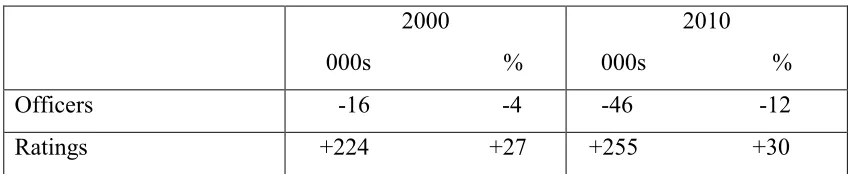
Following the analysis of data of the current estimates of worldwide demand and supply for seafarers, Table 3.1 below indicates the balance of officers and ratings.
Table 3.1 Supply and Demand for Seafarers in 2000 (000s)
Supply Demand Balance
Officers 404 420 -16
Ratings 823 599 +224
Source: BIMCO/ISF 2000 Manpower Update
This data translates into a modest theoretical shortfall of 4% of officers required while ratings continue to have a significant overall surplus of 27%. There exist some doubts about the extent to which large numbers of these ratings are qualified for international service.
It is interesting to note that this overall supply/demand imbalance for seafarers is very similar to the situation in the 1995 BIMCO report. In the case of the officers, the same obstacles are experienced with barriers such as cultural and language differences, lack of international experience and the nationality restrictions that apply to many flags.
Table 3.2 Supply – Demand Balances for Seafarers (000s)
2000
000s %
2010 000s %
Officers -16 -4 -46 -12
Ratings +224 +27 +255 +30
Source: BIMCO/ISF 2000 Manpower Update
This forecast definitely calls for corrective action by increasing the manning levels through education and training. This is where countries such as Kenya should capitalise in the provision of manpower in the industry. The imbalance also extends to the other job categories in the maritime industry like ship surveyors, Coast Guard, Port State Control and examiners/lecturers, which entirely depend on seafarers.
Source: UK P&I CLUB (1996).
Fig.3.1 Officer nationality by region (dominant nationality)
Source: UK P&I CLUB (1996).
Fig 3.2 Ratings nationality by region (dominant nationality)
From the graphs and the report in general, it is understandable that officers mainly come from Europe where most of the shipowners are and ratings from developing countries because they are cheaper. Out of which only 3% of the ratings are from Africa. Can it be improved? The answer is only yes if the region develops its MET
Africa 1%
Rest of Asia 6% Far East 14% North America 1% Eastern Europe 30% European Community 32% Mixed 1% Australia 1% South East Asia
12%
S & C America 2% Eastern Europe 28% North America 1% Far East 12% Australia 1%
South East Asia 32%
Rest of Asia 7% Mixed
1%
S & C America 3%
European Community
system and infrastructure to educate and train the required manpower to a higher standard surpassing the current main players such as the South East Asia.
The current trend by the developed nations is to urge shipowners to try and boost the supply:
NUMAST is urging British shipowners to follow the example of a £600,000
Norwegian scheme to boost officer training.
Telegraph Vol. 32 No.10, Oct. 1999.
The scheme involves funding of training in developing countries, such as the Philippines, whereby, the shipowners’ association assists in the provision of facilities such simulators in exchange of supply of seafarers from these institutions.
3.2 SEAFARERS IN KENY A AND EAST AFRICA REGION
The number of seafarers has been decreasing in the East African region as compared to the 1970s during the time of the East Africa Community (EAC). Then, EAC had its own fleet of ships and the region’s economy was also on the rise.
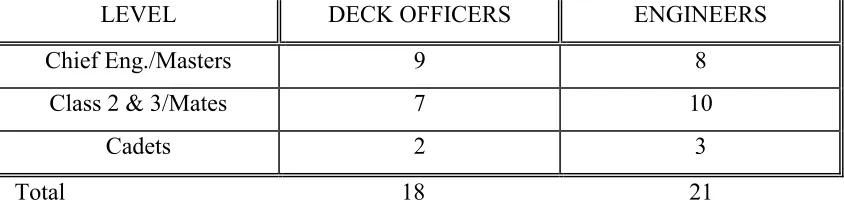
Table 3.3 Officers in Kenya (1999)
LEVEL DECK OFFICERS ENGINEERS
Chief Eng./Masters 9 8
Class 2 & 3/Mates 7 10
Cadets 2 3
Total 18 21
Table 3.4 Ratings in Kenya (1999)
AT SEA JOBLESS
Foreign going Coastal
<20 <400 More than 3000
In neighbouring Tanzania the situation is not so much different in terms of number of seafarers, although they have a registered fleet and the fact that there exists a maritime college. In numbers, there are approximately 4,000 ratings registered by the union, Tanzania Association of Seamen Union (TASU), while the number of officers is around 300.
This region has a number of lakes, such as L. Victoria, L. Tanganyika, L. Turkana, among others. These lakes are mainly used for transport and fishing purposes. For example, Lake Victoria is very important for transportation and trade among the three countries, Kenya, Uganda and Tanzania. The lake has long been known to have quite a number of mariners due to the fact that a number of ships (ferries) and fishing vessels operate here. It is also important to note that the first, although unsuccessful, maritime training centre in the region was established at this lake, in Kisumu. Currently the seafarers in the lake do not attend any formal training but follow a kind of an informal apprenticeship through family backgrounds. Although STCW 95 is not applicable legally in this lake, it is still desirable to raise the standards of safety.
3.3 BENEFITS OF HAVIN G MARITIME TRAINING IN KENYA
From the analysis of the seafarers in the world, Kenya and the region, there is justification for a greater number of trained qualified manpower in the market to curb the shortfalls seen. In addition, there are other reasons, which are of direct benefit to Kenya as a developing country if maritime education and training were to be implemented.
The unemployment rate in the country has been on the rise. There are no job opportunities because there are no vacancies in the already exhausted traditional career fields or the unemployed lack qualifications. With the introduction of a properly defined maritime education and training system in Kenya, it means more career paths and therefore opportunity for graduates from schools.
the universities’ Joint Admission Board (JAB) Prof. Raphael Munavu (Daily Nation, 2000), only 35,480 out of 169,357 or 21 per cent of the students who sat the 1998 Kenya Certificate of Secondary Education (KCSE) applied for university admission. Of these, 30,243 qualified but due to lack of places in the public universities, only 8,150 or 4.8 per cent of the total number of graduates were admitted. The remaining are to look for alternatives in either private and foreign institutions or local middle-level colleges which for sure are not enough. In this case new focus will be in order, such as the maritime education and training.
The local levels of maritime services will be boosted, as it is evident that there are reasons to address the manpower needs and requirements to take care of the rapid growth and development. In some areas the need to train a workforce that meets international standards such as the revised International Convention on Standards of Training, Certification and Watchkeeping for Seafarers (STCW Convention) is important. Safety standards and competency levels would also be raised. Disasters like the Mtongwe Ferry in Mombasa, where over 300 people died in 1994, marine (environmental) pollution and other safety considerations would easily be taken care of.
One of the vital roles of education is of economic benefit to a society. According to the Education Minister, Kalonzo Musyoka (Daily Nation, 2000), education is now a major foreign exchange earner. Foreign students enrolled in Kenyan schools and universities have earned the country some Ksh. 1 billion (US$ 13.5 million) in 1999. It is generally believed that:
Kenya still has some of the best educational infrastructure in East and Central
Africa. Only South Africa has better and more institutions than Kenya in the
where universities and training institutions have collapsed due to civil
wars….
The result is that Kenya has become the centre of higher education in the
region, a role that was enhanced by the establishment of the Commission for
Higher Education in 1985. .
(DailyNation, March 2000)
The above information definitely encourages the establishment of a model maritime training institution. It will obviously cater for the region just like the other already existing institutions.
The other issue, which has been realised, is that the government is losing millions of dollars through students who travel abroad for higher education. In fact, it is estimated that some US$ 200 million is spent annually by parents and organisations to train Kenyans abroad. This money could be utilised locally if the local universities and colleges had more places and career paths. Taking an example of Kenya Ports Authority (KPA) whereby it spends a lot of foreign exchange to train its pilots and marine engineers.
As already indicated above, saving costs and readily available opportunities for the people in the region will be of benefit. For instance, in early September 1999, fourteen Tanzanian seafarers were to take part in a six-month training programme in Durban, South Africa from October the same year. The training was a pilot project of the International Transport Workers’ Federation, which aims at improving employment prospects for African seafarers by upgrading their skills. The offer to the Tanzania Seamen’s Union was as a result of having 4,000 Union members who have not taken part in the newly STCW 95 courses. This is because Tanzania’s only training school, the Dar Es Salaam Maritime Institute (DMI) has been unable to adequately comply with the Convention, according to the Union Chairman, Mr Said el-Mazrui, as reported in The EastAfrican weekly newspaper of 8th September 1999. This programme could have as well been conducted in the region, if a proper and suitable maritime training establishment was available.
The Philippines and other countries from the Far East are considered as the major world suppliers of seafarers. This does not mean that Kenya is denied the opportunity to be among these top suppliers of manpower. To be a supplier of seafarers means international job opportunity for Kenyans and therefore foreign earnings so long as proper legislation is enacted. This could be achieved of course by setting a high standard maritime training for seafarers at the various levels, that is both officers and ratings.
Other areas of benefit could be in the fields of shipping agency and clearing and forwarding disciplines, which are currently conducted in an unacceptable and unrecognised system. Establishing this maritime training system means a proper curriculum and therefore a standardised way of certification and validity of the courses offered.
as port, shipping and seafaring. This would of course lead to Kenya’s vision of becoming a newly industrialised country by the year 2020.
3.4DIFFICULTIES AND L IMITATIONS
The difficulties and limitations for Kenya will be the financial aspect or funding, human resource (qualified personnel), and sea-training or practice as evidenced in the request for assistance from IMO by KPA. (Copies of IMO correspondence and IMO TC Circ.5 dated 9 May, 1991 are attached in Appendix A).
The other difficulties and limitations include the deployment of trained persons, policies, type of curriculum and facilities among others. These are some of the issues expected while coming up with the requirements for model Maritime Education and Training in Kenya for the East Africa region.
CHAPTER 4
REQUIREMENTS FOR A MODEL MET INSTITUTE IN KENYA FOR EAST AFRICA
A model is an abstraction of reality that, if it is good enough, allows us to
understand (and sometimes to predict) some of the dynamics of the system
that it represents. Models are seldom right or wrong; they are just more or
less useful for examining different aspects of organisational functioning.
Birnbaum, Robert (1988), pg.83
From the previous chapters it was observed that there is need to establish Maritime Education and Training in Kenya which could serve as a model for East Africa. Therefore, the author looks at the requirements for this institution, which could be used as guidelines.
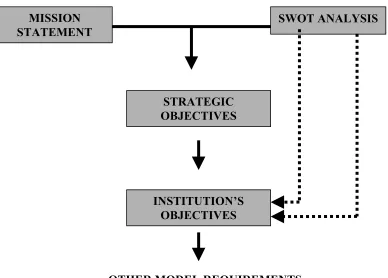
4.1 STRATEGIC PLANNING
OTHER MODEL REQUIREMENTS
Fig 4.1 Strategic Planning leading to the model requirements.
(Source: Muirhead (2000).
4.1.1 Mission Statement and Goals
With respect to the identified needs of the MET institution in Kenya, the mission statement should be broad enough to reflect the trend of events and provide the vision of the future. This statement becomes a control document that aids to achieve the other requirements. The statement should be:
MISSION STATEMENT
SWOT ANALYSIS
STRATEGIC OBJECTIVES
As a model for maritime education and training in the region, the institution is to play an effective role in the development, research and expansion of opportunities and promote the highest practical standards for Kenyans and the international community in careers in the maritime industry.
In particular, the institution should:
• Provide advanced education and training aimed at producing mature and
conscientious graduates with the ability and desire to contribute to the well-being, advancement and development of fellow citizens and the country on the basis of a national philosophy of mutual social responsibility.
• Respond to, and fulfil the needs of, the Kenyan community, and continuously
serve as a model in the region in maritime education, training, research and development.
• Collaborate with other maritime education and training institutions and the
maritime industry in the region and the world.
4.1.2 Strengths, Weaknesses, Opportunities and Threats (SWOT) Analysis.
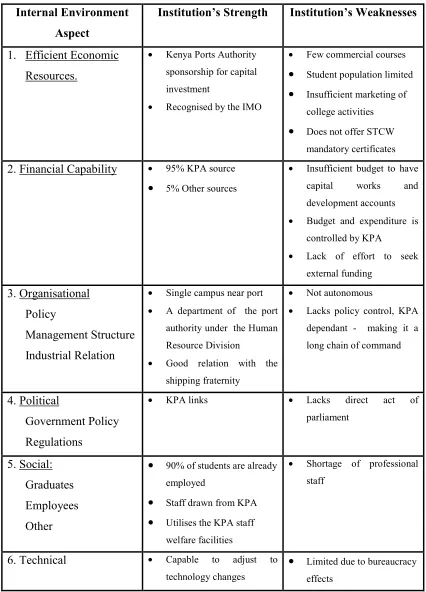
In undertaking this SWOT analysis, the author has selected the existing maritime institution, Bandari College (Kenya Ports Authority’s College), in order to scan the existing and possible competitive environment. This type of analysis focuses on two essential aspects:
• An institution’s strengths and weaknesses, which determine its ability to compete in its area of operation. This makes up the internal environment.
• Opportunities and threats in the marketplace that are of relevance to the
institution’s operations. This is the external environment.
Internal Environment Aspect
Institution’s Strength Institution’s Weaknesses
1. Efficient Economic Resources.
• Kenya Ports Authority sponsorship for capital investment
• Recognised by the IMO
• Few commercial courses
• Student population limited
• Insufficient marketing of college activities
• Does not offer STCW mandatory certificates
2. Financial Capability • 95% KPA source
• 5% Other sources
• Insufficient budget to have capital works and development accounts • Budget and expenditure is
controlled by KPA
• Lack of effort to seek external funding
3. Organisational Policy
Management Structure Industrial Relation
• Single campus near port • A department of the port
authority under the Human Resource Division
• Good relation with the shipping fraternity
• Not autonomous
• Lacks policy control, KPA dependant - making it a long chain of command
4. Political
Government Policy Regulations
• KPA links • Lacks direct act of
parliament
5. Social: Graduates Employees Other
• 90% of students are already employed
• Staff drawn from KPA
• Utilises the KPA staff welfare facilities
• Shortage of professional staff
6. Technical • Capable to adjust to
technology changes
• Limited due to bureaucracy effects
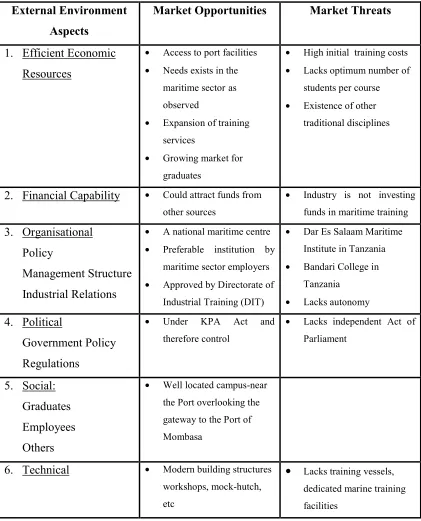
External Environment Aspects
Market Opportunities Market Threats
1. Efficient Economic Resources
• Access to port facilities • Needs exists in the
maritime sectoras observed
• Expansion of training services
• Growing market for graduates
• High initial training costs • Lacks optimum number of
students per course • Existence of other
traditional disciplines
2. Financial Capability • Could attract funds from other sources
• Industry is not investing funds in maritime training
3. Organisational Policy
Management Structure Industrial Relations
• A national maritime centre • Preferable institution by
maritime sector employers • Approved by Directorate of
Industrial Training (DIT)
• Dar Es Salaam Maritime Institute in Tanzania • Bandari College in
Tanzania • Lacks autonomy
4. Political
Government Policy Regulations
• Under KPA Act and therefore control
• Lacks independent Act of Parliament
5. Social: Graduates Employees Others
• Well located campus-near the Port overlooking the gateway to the Port of Mombasa
6. Technical • Modern building structures
workshops, mock-hutch, etc
• Lacks training vessels, dedicated marine training facilities
Fig 4.3 SWOT Analysis: External Environment.
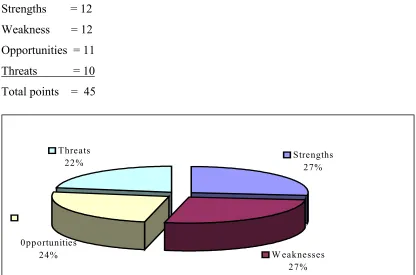
From figures 4.2 and 4.3, the author has assumed each element equal to one point, then a summary of the strengths, weaknesses, opportunities and threats could be shown in the form of a pie chart in figure 4.4. From this, can be seen the factors which will have direct and significant impact on the strategic objectives and therefore the model institute.
Strengths = 12 Weakness = 12 Opportunities = 11 Threats = 10 Total points = 45
Fig. 4.4 Summary of the factors having the most direct and significant impact on Bandari College to be considered in the model institution.
From the summary of the SWOT analysis, it can be observed that the institution has a balanced internal environment of strengths and weaknesses. This is interpreted by the writer that there is need to look at strengthening through the reduction of these weaknesses. By doing so, the college’s ability to compete will rise.
The marketability seems to be favouring the college, having more opportunities than threats. There is still need to look into the possibilities of creating more opportunities
0pportunities 24%
Threats
22% Strengths27%
and handling the threats accordingly. This could be done by having a wider scope in the programmes (portfolio).
4.1.3 Strategic Objectives based on the mission and SWOT analysis
In order to produce a more efficient and effective organisation, specific strategic objectives are required to generate measurable outcomes that the institution intends to achieve. From the mission statement created and the current environment within which it should operate, the author sees the following objectives to be essential:
• To provide internationally recognised maritime education and training
programmes, including short courses and award certificates, diplomas and degrees.
• To establish a set up which would be a yardstick as a model maritime centre in the region.
• To create an establishment having its own policies for administration, finance, recruitment of staff and set quality standards as an autonomous corporate body. • To create a close liaison with the maritime industries enabling the college to
respond readily on demand.
• To continuously develop courses and have a dynamic curriculum development
set up which could adapt to the challenges of changing technology.
• To flexibly structure its courses to be equally suitable for school leavers and experienced mature entrants willing to upgrade their qualifications.
4.2 ADMINISTRATION AND ORGANISATION
The development of the character of any college or institution depends on its organisation and administrative structure as well as the foundations laid down in the first years by both staff and students. The author gave consideration to various types of physical design for an institution, other MET programmes in relation to the philosophical framework, national and international ethos, educational objectives and models of administration and management that would enable the college to develop its own unique character.
Administration is a service process. It has no right to exist for its own sake; therefore, this model administration ensures maximum development of every trainee enrolled. A good administration is very often described in terms of efficiency, whereby leading authorities hold that the most important aspects of the administration process are decision-making, communicating, morale-building and initiating change.
Therefore, the question is how this can be achieved in the model MET.
Before answering this question, there is need to look at the reasons for having the administration in the first place.
In the college, there would exist students, lecturers or instructors, the library and other facilities, which are considered the nucleus of any institution. This means a large complex structure to support the central activities of teaching and learning, this being the justification for the existence of administration of the college.
In addition, administration aids in the planning. Data must be collected, digested, developed and updated to ensure the institution will run at maximum efficiency to enhance the academic program by utilising economy of operations. In order to take care of the above, the model administration organisation of this MET institute should constitute the following four elements:
• Academic affairs – handling institutional and academic programs. • Student personnel service – health and welfare of students.
• Business affairs – financial, plant and personnel management.
• Development and public relations – fund raising, external affairs,
alumni affairs.
To handle these major areas of decision-making, communicating, build morale and initiate necessary changes, there is need to understand the extent to which one can identify the relevant variables, and the looseness or tightness of their relative importance in the organisation structure.
`
Departmental Designation
Course Directors
Chain of command
Horizontal co-ordination (Division of labour)
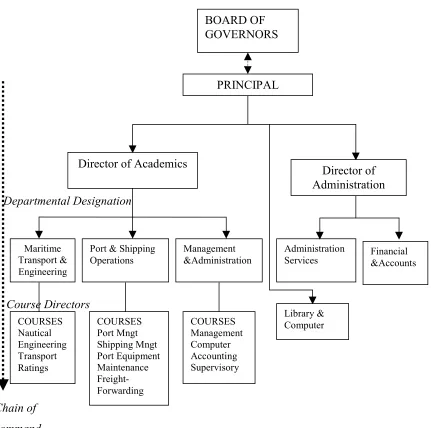
Fig. 4.5 An Organisational Structure for the model MET in Kenya
This organisational structure only illustrates the essential functions in the model, which will form the foundation.
The Board of Governors (BoG) forms the institute’s governing authority. The board’s main functions include supervisory, regulatory, control and monitoring of
PRINCIPAL
Director of Academics Director of
Administration
Maritime Transport & Engineering
Port & Shipping Operations
Management &Administration
Administration
Services Financial&Accounts
finances and responsibility in formulation of policies. The members should include representatives from the Ministry of Transport and Communication, Ministry of Education, maritime industry, Port Authority, Clearing and Forwarding Association, Directorate of Industrial Training, while the Principal is an ex-officio to the board.
From this organisational structure, the four elements constituting the model administration organisation mentioned earlier are taken care of from the Principal’s span of management.
The Director of Academics handles the Academic Affairs through the Heads of Department, while the Director of Administration takes care of the students’ personnel services, business affairs and development and public relations through the Heads of Department. The non-academic administration and the academic community should be integrated through the horizontal co-ordination as indicated in the organisational chart in figure 4.5.
Several committees at different levels are to be established dealing with curriculum development, examination board, student affairs, and staff among others to facilitate the running of the institution.
As compared to the current Bandari College organisational structure, this allows an easy and faster decision making process by officers who are directly involved in the running of the institution.
4.3 ACADEMIC CURRICULUM
the following is the best compromise as adapted from Print (1993, 9): That curriculum means:
All the planned learning opportunities offered to the learners by the
institution, and the experiences learners encounter when the curriculum is
implemented. This includes those activities that educators have devised for
learners as represented in a written document.
From the definition, it can be seen that a curriculum contains the following key elements:
• Planned learning experiences;
• Structured educational institution/programs;
• Documented processes and procedures; and
• Outcomes resulting from implementation.
Aims, goals and objectives
Content
Situational Analysis
Learning Activities
Instructional
evaluation
Phase 1 Phase 2 Phase 3 Organisation Development Application
Source: Print, M (1993) Pg.84. Fig 4.6 Model of curriculum development to be adapted.
From the model, there are three sequential phases – organisation, development and application, which are considered to form the basis for curriculum development.
The organisation phase involves a formularised procedure of curriculum presage whereby participants (curriculum committees or developers) will look at:
• Who will be responsible for developing it;
• their backgrounds
• and the forces that have shaped their thinking.
Implementation & modification
Monitoring & feedback (curriculum evaluation) Curriculum
This is important as the selected committee will influence the shape of the curriculum outcomes and therefore affect the nature of the curriculum. The group here will comprise the school staff, course department, and professionals from the industry among others.
In the development phase, the group follows the cyclical procedures of the curriculum elements in the model (figure 4.6) beginning with situational analysis; aims, goals and objectives; content; learning activities; evaluation and then continuing on to situational analysis again.
The third phase, application incorporates three sets of activities, which include implementation; monitoring and feedback; and the provision of feedback data to the presage group.
In following the above generic curriculum design and development procedure, all the training activities should be presented in the following layout:
• Title of the curriculum unit;
• Context;
• Aim, goals and objectives;
• Content;
• Learning activities; and
• Mode of assessment of learners.
4. 4 PERSONNEL
The effectiveness of an institution essentially depends on the efficiency and quality of its staff and especially the academic staff. This is also highlighted in the STCW Convention Regulation 1/6 requiring parties to ensure that instructors and assessors are appropriately qualified and experienced.
This Human Resource domain also embraces staff planning, recruitment, selection, retention, appraisal, control and staff development. Appropriate policies need to be in place for an independent and effective control of personnel in any successful institution.
In ensuring growth and proper policies for the academic staff, an Academic Staff Development Committee should be established as part of the institute’s management and organisation. This committee will be headed by the Principal, and the members being the directors, both the academic and administration, all the heads of academic departments and at least one senior lecturer from each department. The committee will be responsible in establishing, maintaining and continuously reviewing upcoming issues concerning the academic staff for an effective maintenance of the learning process in the model institute.
of students, while table 4.4 indicates the number of hours per week depending on the level, that is a senior lecturer, lecturer or an assistant lecturer. The heads of departments should be responsible for overseeing that these demands are met. This should be in a manner consistent with their conditions of employment, and maintaining a reasonable balance for lecturers between work carried out in school or elsewhere.
Table 4.1 Required ratios and number of lecturers and students for Maritime Transport and Engineering Department.
Section/unit No. of
lecturers No. of Requiredratio Initial No.of Initial No.of students staff: student students lecturers Nautical Snr Lect. 2 90 01:10 15 1
Lecturers 4 1
Asst.Lect. 2 2
Engineering Snr Lect. 2 90 01:10 15 1
Lecturers 4 1
Asst.Lect. 2 2
Ratings Snr Lect. 1 60 01:12 20 1
Lecturers 2 1
Asst.Lect. 2 1
TOTALS 21 240 01:10.6 50 11
Table 4.2 Required ratios and number of lecturers and students for Port and Shipping Department
Section/Unit No. of lecturers No. of students Required ratio Initial No. of
Initial No. of lecturers staff: student students
Port Operation Snr Lect. 2 120 01:20 75 1
Lecturers 2 2
Asst.Lect. 2 2
Shipping Operation
Snr Lect. 2 90 01:18 60 1
Lecturers 2 2
Asst.Lect. 2 2
Table 4.3 Required ratios and number of lecturers and students for Management and Administration Department
Section/unit No. of lecturers
No. of students
Required ratio Initial No. of
Initial No. of Lecturers staff/student Students
Management Snr Lect. 1 180(+60) 01:50 180(+60) 1
& Supervisory Lecturers 1 1
Asst.Lect. 2 2
Finance Snr Lect. 1 15(+60) 01:40 15(+60) 1
Lecturers 1 1
Asst.Lect. 0 0
Computer & Snr Lect. 1 45(+90) 01:15 45(+90) 1
Information Lecturers 1 1
Asst.Lect. 0 1
TOTALS 9 240(+210) 01:35 240(+210) 9
Table 4.4 Number of lecturer contact hours per week
Level Hrs per week Snr. Lecturer. 12 – 15 Lecturers 15 – 18 Assistant. Lecturer. 18 - 24
KEY
15(+60) The number in brackets indicates the additional number of students from other departments. This means they are already accounted for in the figures provided in the other programmes.
Staff Development Committee or a special committee comprising senior staff should participate in the selection and recruitment of the new appointees.
As the institution is to continuously develop courses and have a dynamic curriculum development set up, it leads to an intellectually demanding and onerous task which calls into play all the lecturers’ competency and skills. Its success depends on the ability of the lecturers to handle the curriculum development processes, as well as having pedagogic skills and other relevant professional experiences. This needs to be enhanced through a clearly established staff development programme as a matter of top priority. This will lead to a continuous increase in the efficiency and effectiveness of the staff already serving as well as newly appointed.
Proper supervision and participation within an agreed framework for the appraisal of the performance of staff who teach at the institute should be observed. The staff should have access to advice and training appropriate to their needs, in accordance with laid down policies of the government or responsible authority for the development of staff.
To encourage retention of staff in this field where there are highly lucrative alternatives, attractive terms of service would be ideal. The terms of service should not only include competitive salary scales, procedures for promotion, job security and adequate academic facilities, but also the more important aspects of staff welfare. For this reason, there should be an attractive housing policy, comprehensive medical care for staff and immediate family among others. The facilities at the institution should cater for proper academic activities and growth of the staff.
4.5 FACILITIES AND TECHNOLOGY
The author has chosen Bandari College as the basis for identifying the requirements for facilities and technology. The question to be asked is what training facilities and technology are required for an effective infrastructure for outreach and improved standards.
In this model, the author looks at the policies, which should be used in providing or establishing the type of facilities and the relevant technology. The buildings for a maritime education and training institution must be adequate and appropriate for the type of activities. They should be furnished and serviced according to their specialised activities. Effects like weight of equipment, vibrations and transmission of power should be taken into consideration and proper strengthening and reinforcements of the workshops.
Training facilities are ever a nightmare in any institution’s budget, often costing a fortune to developing countries. This means under utilised facilities should be avoided. Therefore, it is important for all the acquired equipment in the institute to be used fully and appropriately. In order to do this, the equipment to be bought needs to be prioritised according to several conditions as laid down by a committee. These conditions could be curriculum requirements, regulations in place for example STCW, funding, frequency of use, expertise available in handling the facilities among others.
The other perspective referred to is pedagogic technology. This is the technology in use in order to transfer knowledge and skill from those who have it to those who want/need it. It includes the environment within which it could take place such as the classrooms, bridges, machinery spaces and simulators.
These two perspectives should enable the concerned to come up with the necessary principles in identifying facilities that would demonstrate functional competence such as the control of a piece of equipment or a ‘full mission’ process. This will lead to building appropriate facilities for developing more methods of transferring knowledge and skills.
One other important facility is the library. As the heart of any training institution, this library should be the centre of maritime information. The catalogue should be computerised as any other modern library, supported by a qualified library staff to handle the information technology.
Apart from maritime books, relevant and important subscriptions should be available, which could cater for the type and level of curriculum offered. Being a maritime institution, IMO publications and model courses should be available. In order to support the objectives of the curriculum of the various courses, there should be a clear policy indicating the liaising between each user and the librarian for regular upgrading of the library stock.
4. 6 QUALITY STANDARDS
One of the main tasks facing maritime education and training institutions as a result of the revised STCW Convention is to establish a quality standards system. This involves undertaking a self-evaluation of the procedures and processes in place in the institution that contribute to the education, training and assessment activities.
In this model, the author uses the guidelines as provided in Guidelines on Quality Assurance, by Higher Education Quality Council, 1994 and selectively adapts some aspects from lecture notes on Quality Standards Systems (Muirhead, 2000). These guidelines are to provide the framework for quality assurance and control as a requirement for the model institution and are used, elaborated and adapted accordingly.
These essential quality standards will be applied to policies and to management and control functions and activities. The mission statement, goals and objectives already set should be clearly understood by the management, teaching and administration personnel. This is to provide direction to the curriculum, functions and activities, and assemble and organise the necessary resources to achieve, and continue to achieve the defined objectives. As an example, the policy towards the achievement of the objectives of the institute as derived from the strategic planning should be:
The institute is committed to a policy of providing recognised MET programmes of the highest standards and quality training through meeting obligations and requirements of the industrial and international standards such as the revised STCW 1978 Convention.
The first function relates to the quality system coverage of academic and administrative structures. This involves an establishment of clear management, organisation, lines of responsibility and the procedures and processes for an institute. The other structures are the staff and facilities resources. For the case of this model, these structures have been defined on the requirements in this chapter. These structures are to be enhanced by establishing respectively, policy making committees.
The second function relates to the quality control functions of teaching, training examination and assessment activities. These activities are to be clearly stated in the developed curriculum for each course. In the developed curriculum, issues on:
• Learning and performance objectives;
• Policy and procedures for student admission;
• Curriculum content: knowledge, understanding and skills; • Assessment and examinations and skills acquisition tests; • Resource availability and allocation;
need to be identified and incorporated in the courses accordingly.
The third function relates to the internal review process. This monitors how the institute achieves the set objectives and how effective are its quality control procedures. In this process, the periodic external quality evaluations are arranged through:
• Planning, design, presentation and evaluation of programs; • Teaching, learning and communication activities;
• Selection and approval of teaching staff, examiners and assessors, including qualifications and experience criteria;
Finally, an independent external evaluation (audit) could be undertaken in a systematic and independent examination of all the quality activities, but not the validity of the defined objectives.
The external evaluators could come from the Directorate of Industrial Training (D.I.T) or the Kenya Institute of Education (K.I.E) as chosen or identified by the Ministry of Transport and Communication. This is to encourage or have impartial and independent status of the evaluation process.
CHAPTER 5
PROGRAMMES AND FUNDING OF THE INSTITUTION
From the strategic planning, the author concluded that there is need to strengthen the marketing of the Bandari College through creating opportunities. This is possible through satisfying the public preferences and needs which could lead to greater social and economic benefits for Kenya. With attractive Maritime Education and Training programmes in the model institution, it means opportunities for both Kenyans and potential employers. This could be achieved by having what is known as ‘program diversity’ in academic systems, which has become an important goal of higher education recently.
According to Dill (2000), the term diversity has been emphasised with regard to varieties in the organisation or products of higher education: differences among the programs or services provided by academic institutions, and differences among the type of institutions themselves. (Goedegebuure, Meek, Kivinen & Rinne, 1996). Having created an institution with departments covering both onshore and offshore maritime disciplines, the model will have both institutional and program diversity. The major distinction between the two (institutional and program diversity) as described by Dill (2000) being;
• Institutional diversity: in size; in type or mission; in program profiles; in type of control (public versus private); in location.
• Program diversity: in orientation (theoretical/applied; research/vocational); in quality; in forms of program delivery.
5.1 PROGRAMMES
The administration and organisational structure developed as a requirement of the model institution, provides some guide to the type of programmes or courses which could be run. The academic departments include Maritime Transport and Engineering, Port and Shipping Operation and Administration and Management. This does not mean that there are no linkages between the departments as the horizontal co-ordination strength of the institution’s organisational structure set ensures the possibilities. The author will briefly look at the proposed programme portfolios from each department accordingly.
5.1.1 Programme Portfolio
In this programme portfolio, the author describes the range of courses the institution is to conduct with respect to the outcomes from the previous chapters and considering the effects of diversity. The outcomes include needs of training, objectives and goals and overcoming the weaknesses and threats from the SWOT analysis while encouraging the strengths and opportunities observed.
Maritime Transport and Engineering Department
Table 5.1 Maritime Transport and Engineering Department programme portfolio.
Course/programme Duration Certificate of Remarks
Competency Nautical
Diploma in Nautical
Studies 3 years officer of watch timeplus18 months guided
sea-Certificate in Pre-sea Training (Deck)
1 year safety
certificate(Deck)
plus 6 months sea-time prepares for Diploma in Nautical Studies.
Coxswain Certificate 1 year ferry operator plus 6 months sea-time
Engineering
Diploma in Marine Eng. 3 years officer of watch plus 12 months guided
sea-time Certificate in pre-sea
Training (Engine)
1 year safety certificate plus 6 months sea-time
prepares for Dip. in Marine Eng.
Cert. in marine fitting 1 year plus practical in a
dockyard and plant maintenance
Ratings
General purpose seaman 1 year certificate plus 12 months sea service
for general operation in ship
Basic Seamanship (Deck) 1 year certificate plus 12 months sea service
Ship mechanic (Engine) 1 year certificate plus 12 months sea service
Short/Other Courses
Advanced fire prevention 1 week certificate mandatory for second
-and control mate
First Aid at sea 1 week certificate
Proficiency in survival craft
1 week certificate
GMDSS 3 weeks certificate
adequate levels of hands-on training. The academic and theoretical contents of the courses should be kept to an absolute minimum, taking into consideration the applicability of the knowledge and skills gained.
PORT AND SHIPPING OPERATION
The Port and Shipping Operation Department should focus on the offshore training activities for both the port and shipping industry. For administrative purposes, the department could be divided into two, Port Operations and Shipping Operation.
This is the department, which holds some of the marketable courses such as the Diploma in Clearing, Warehousing and Freight Forwarding (DCWF). The course targets in-serving managers, supervisors from the industry and university graduates interested in joining the industry.
Table 5.2 Port and Shipping Operation Department Programme portfolio.
Course/programme Duration
Remarks
Port Operations
Diploma in Port Mgt. 3 years school leavers and port operators
Certificate in Port
Operation 1 year structured for port operation assistance
Container Terminal 6 months
Operations Cert.
Portworkers Development 6 months covers port supervisory and dockworkers Programmes (PDP)
Cert. in Port Equipment 2 months for port technicians in engineering Depts.
Maintenance e.g. mechanical, electrical & marine
Ship Operations
Diploma in Shipping Mgt. 3 years incl. foundation diploma in shipping
(FDS)
Cert. Shipping Operations 1 year incl. FDS, school leavers (KCSE)
Others
Diploma in Clearing, Ware-housing & Freight
1 year must have a diploma or FCMS and
working experience.
Forwarding. (DCWF) offered in conjunction with KCFWA.
Foundation Certificate in 1 year school leavers
Maritime Studies (FCMS)
MANAGEMENT AND ADMINISTRATION