World Maritime University
The Maritime Commons: Digital Repository of the World
Maritime University
World Maritime University Dissertations Dissertations
2000
Maritime safety and environmental protection :
enhancement through quality and safety
management systems : IMO and EU approaches
and their adoption in Poland
Katarzyna Monika Jedral
World Maritime University
Follow this and additional works at:http://commons.wmu.se/all_dissertations Part of theEnvironmental Policy Commons
This Dissertation is brought to you courtesy of Maritime Commons. Open Access items may be downloaded for non-commercial, fair use academic purposes. No items may be hosted on another server or web site without express written permission from the World Maritime University. For more information, please [email protected].
Recommended Citation
Jedral, Katarzyna Monika, "Maritime safety and environmental protection : enhancement through quality and safety management systems : IMO and EU approaches and their adoption in Poland" (2000).World Maritime University Dissertations. 417.
WORLD MARITIME UNIVERSITY
Malmö, SwedenMARITIME SAFETY
AND ENVIRONMENTAL PROTECTION:
ENHANCEMENT THROUGH QUALITY
AND SAFETY MANAGEMENT SYSTEMS
IMO and EU approaches
and their adoption in Poland
By
KATARZYNA MONIKA JEDRAL
The Republic of Poland
A dissertation submitted to the World Maritime University in partial
fulfilment of the requirements for the award of the degree of
MASTER OF SCIENCE
inMARITIME ADMINISTRATION AND ENVIRONMENTAL PROTECTION
2000
DECLARATION
I certify that all the material in this dissertation that is not my own work has been identified, and that no material is included for which a degree has previously been conferred on me.
The contents of this dissertation reflect my own personal views, and are not necessarily endorsed by the Polish Maritime Authority or the World Maritime University.
(Signature) ...
(Date) ...
Supervised by:
Name: Associated Professor Jan-Åke Jönsson
Office: Maritime Safety and Environmental Protection Institution/organization: World Maritime University
Assessor:
Name: Professor Proshanto Mukherjee
Office: Maritime Administration and Environmental Protection Institution/organization: World Maritime University
Co-assessor:
Name: Captain Hemming Hindborg Office: Quality Co-ordinator
ACKNOWLEDGEMENTS
I would like to express my sincere gratitude and appreciation to the IMO Liaison Team of the United Kingdom Department of the Environment, Transport and the Region Zone 2/34 for awarding me the scholarship to pursue this course of study at The World Maritime University (WMU). I am also grateful to the Ministry of Transport and Maritime Economy of the Republic of Poland for nominating me to attend the studies at the WMU.
I wish to express my profound gratitude to all those who has encouraged me to undertake this demanding study at WMU, especially to Mr. Jerzy Vonau, the Director of the International Mobile Satellite Organization and Mr. Wojciech Szulczynski the Head of the CIS/Eastern European Section of the International Maritime Organization for their inspiring advice. I also thank Professor Kazimierz Dendura who encouraged me to choose this topic.
I hereby give my sincere appreciation to Associated Professor Jan-Åke Jönsson, my supervisor for zealous supervision and guidance throughout the preparation of this dissertation.
I also owe gratitude to Professor Proshanto Mukherjee, my Course Professor, for his valuable advice on my study and to all the staff of WMU, in particular to the library staff, for their kind help and assistance during this research.
Special thanks to my colleagues at the Department of Maritime Administration of the Ministry of Transport and Maritime Economy whose support, understanding and encouragement have been beneficial if finalizing this dissertation.
ABSTRACT
Title of Dissertation : Maritime safety and environmental protection:
enhancement through quality and safety management systems.
IMO and EU approaches and their adoption in Poland.
Degree: MSc
The dissertation is a study of existing quality and safety management systems in the maritime industry adopted either on a voluntary or mandatory basis. Special attention is given to the roles and obligations of maritime administrations in the process of their implementation.
A brief look is taken at the ISO 9002 system, which is being implemented voluntarily by shipping companies but moreover it is a basic scheme for the mandatory safety management system developed by the IMO. It is also presented as the main scheme used by maritime administrations and classification societies to monitor the quality of their performance.
including Port State Control issues and the minimum criteria for recognised organizations acting on behalf of maritime administrations.
Chapter Five evaluates existing requirements for Polish flag vessels in respect of safety management. As well it presents information about the new draft of the ‘Maritime Safety Act’ that is being considered by the Parliament at the time of writing of this dissertation. This part of the paper also includes recommendations regarding further harmonisation of the above standards with those of the IMO and the EU.
The concluding chapter examines the overall results of the study. General conclusions and recommendations as to the possibility of improving maritime safety through better management are presented.
TABLE OF CONTENTS
Declaration ii
Acknowledgements iii
Abstract iv
Table of Contents vi
List of Figures xi
List of Abbreviations xii
1. Introduction 1
2. Management quality standards in maritime industry 5
2.1. Concept of quality 5 2.2. ISO quality standards 6 2.2.1. What does ISO stand for? 6 2.2.2. ISO 9002 requirements 7 2.2.3. Ten steps of ISO 9002 implementation 11 2.2.4. ISO 9002 Certification 12 2.2.5. Role of a State in ISO standards implementation 13 2.2.6. Quality system in accordance to ISO 9002 - an advantage or additional cost for shipping companies 14 2.3. Mandatory implementation of the quality management systems 16 2.3.1. IMO Resolution A. 739(18) 16 2.3.2. Regulation I/8 of STCW’95 17
3. The International Safety Management Code 19
3.1. ISM Code in general 19 3.2. Aspects of the ISM Code 21
3.2.1. Management 21
3.2.2. Personnel 22
3.2.3. Ship and equipment 22
3.2.4. Procedures 23
3.3. ISM Code Requirements 23 3.3.1 Safety and environmental-protection policy 23 3.3.2. Company responsibility and authority 24 3.3.3. Designated person(s) 24 3.3.4. Master’s responsibility and authority 25 3.3.5. Resources and personnel 25 3.3.6. Plans for shipboard operations 26 3.3.7. Emergency preparedness 26 3.3.8. Reports on non-conformities, accidents and hazardous
occurrences 26
3.3.9. Maintenance of the ship and its equipment 27
3.3.10. Documentation 27
3.3.11. Company verification, review and evaluation 28 3.4. Implementation of the ISM Code in 10 steps 28
3.5. Certification 31
3.6.2. IMO requirements for the organization performing
ISM Code certification 38 3.7. ISM Code – does it meet the expectations? 40
4. Quality and safety management in European Union 45
4.1. Quality management systems in European Quality House 45 4.1.1. Standardisation 46 4.1.2. Quality Management 47
4.1.3. Metrology 47
4.1.4. Testing & Certification 48
4.1.5. Accreditation 48
3.1.6. European Quality Policy 49 4.2. Quality and safety in shipping 50 4.2.1. Maritime Safety and Quality Policy 50 4.3. Implementation of the ISM Code 52 4.3.1. Special provisions for ro-ro passenger ferries 52
4.3.1.1. General differences between the Regulation
3051/95/EC and the ISM Code 53 4.3.1.2. Issuance of DOC and SMC 54 4.3.1.3. Suspension of operation 56 4.3.1.4. Grace periods 56 4.3.2.Other types of vessels 57 4.4. Rules and standards for inspection 57 4.5. Port State Control 60
4.6. Conclusion 63
5. Quality and safety management standards in Poland
- present situation and future recommendations 65
5.1.2. The Polish Centre for Testing and Certification 66 5.2. Implementation of requirements established by the IMO 66 5.2.1. Mandatory establishment of quality management systems 67
5.2.1.1. Adoption of the IMO recommendation for
Recognised Organization 68 5.2.1.1. Implementation of Regulation I/8 of STCW’95 68 5.2.2. Implementation of the ISM Code 69
5.2.2.1. Certification
5.3. Harmonisation of Polish law with EU requirements 70 5.3.1. Implementation of Council Regulation 3051/95EC 71 5.3.2. Implementation of Council Directive 94/57/EC 72 5.3.2.1. Implementation recommendation 73 5.4.2.2. Recognition of PRS 74 5.3.3. Implementation of the Council Directive 95/21/EC 75
5.4. Conclusion 76
6. Conclusion 78
References 81
Appendices
Appendix A Implementation of the ISO 9002 87
Appendix B Implementation of the ISM Code 88
Appendix C The International Ship Management Association
(ISMA) Code of ship management 89
Appendix D Management of Safety and Environmental Protection
Appendix E Summary of differences and common features
of the ISM, ISO 9002, ISMA and SEP requirements 92
Appendix F List of legislative texts adopted within EU in the matter of maritime safety and protection
of the marine environment 95
Appendix G Minimum criteria for Recognised Organizations
as per Directive 94/57 (as amended) . 98
Appendix H List of the classification societies acting on behalf
LIST OF FIGURES
Figure.1. Main causes of major maritime claims. 22
Figure 2. Internal programme for preventive maintenance of ship and its
equipment. 27
Figure 3. Structure of the Safety Management System. 30
Figure 4. ISM Code Certification Scheme. 35
Figure 5. Structure of the European Quality House 45
Figure 6. Relation between IMO and ISO Quality Standards and their
LIST OF ABBREVIATIONS
CEN European Committee for Standardisation,
CENELEC European Committee for Electrotechnical Standardisation.
CUM (Centralny Urząd Miar) Central Office of Measures in Poland
CS classification societies
DG Directorate General ( body of European Commission)
Dir. Directive of the European Commission
DMO Director of Maritime Office
DOC Document of Compliance (as per ISM Code)
EA European Co-operation for Accreditation
EN European Norm
ETSL European Telecommunications Standards Institute
EQP European Quality Policy
EU European Union
FS Flag State
IAF International Accreditation Forum
IEC International Electrotechnical Commission
ILAC International Laboratories Accreditation Cooperation
ISM Code International Management Code for the Safe Operation of Ships
and for Pollution Prevention adopted by the Organization by resolution A.741(18).
MA Maritime Administration
Paris MoU Paris Memorandum of Understanding on Port State Control
PCBC (Polskie Centrum Badań i Certyfikacji) Polish Center for Testing
and Certification
PKN (Polski Komitet Normalizacyjny) Polish Committee for
Standardization
PMA Polish Maritime Administration
PN (Polska Norma) Polish Standards
PSC Port State Control
QMS Quality Management System
RO Recognized Organization
SEPP Safety and Environmental Protection Policy
SMC Safety Management Certificate
SMS Safety Management System
STCW International Convention on Standards of Training, Certification
and Watchkeeping for Seafarers
CHAPTER 1
INTRODUCTION
Ever since man first went to sea he was concerned with the safety of his life, his ship, the cargo and later the marine environment. On the other hand the shipping industry has always been one of the most competitive markets due to its unlimited international character. Thus the shipowner has to find a right balance between safety and competitiveness. One of the very popular means of competition is a certificate proving that a company has implemented a quality management system.
At present there are several different quality management systems used by the industry. The basic one, suitable for a shipping company is provided in the ISO 9002 Standard which can be implemented voluntarily in its pure version. Often shipping managers choose its modified variant that better satisfies the company’s needs, an example being the International Ship Management Association Code of Ship Management.
In shipping safety and quality are correlated. They cannot exist separately, because there cannot be shipping operations of high quality that are not safe. Yet, for many years everybody was mostly concerned about the technical aspects of ship safety. The International Maritime Organization (IMO), which came into existence in 1959, has adopted many standards and conventions. All these measures were quite successful resulting in a decrease of the marine casualty rate but disasters still continue to happen. An average of 230 vessels with gross registered tonnage of 1.1 million GRT are lost world-wide every year, with over 1,000 lives lost. (Directorate General Transport-D3 of the European Commission, 1999).
Presently the international trend is that quality of any product or service is a result of the management’s quality. Many companies, which introduced a quality management system, report that it improved the quality of final products meaning reduced employees mistakes and increased customer satisfaction. But can a better, modernised management system in a shipping company also improve the vessel’s
safety and prevent loss of life at sea? The dissertation is inter alia an attempt to
answer this question.
The adopted ISM Code is believed to reduce the number of maritime disasters by integrating existing technical requirements with operational provisions existing in the industry. It is also considered to be the missing link between the ship, her crew and the company ashore. Although for some it was controversial that, the IMO decided to interfere in the relationship between the owner and crewmembers on his vessels the ISM Code became one of the greatest IMO successes in terms of implementation. On 1 July 1998, which was the adoption deadline for 13,000 ships, about 87 per cent of them had certificates required by the Code in order and on time.
The title of the research is ‘Maritime safety and environmental protection:
enhancement through quality and safety management systems’. There is no transparent definition of ‘quality shipping’ or ‘quality management in shipping’. In
aiming at the production of goods or services that will satisfy the needs of the
customers. Thus in this dissertation ‘quality management’ will be related to ISO
standards while ‘safety management’ shall be understood as a management system aiming at increasing safety in shipping and reduction of marine pollution. Therefore ‘quality shipping’, a term very popular nowadays, can be defined as shipping service that meets all criteria and requirements established by the customer or public including safety requirements. The ‘Quality Shipping Seminar 2000’ agreed on a
similar definition, that a ‘quality ship’ is one that is 'in accordance with the
applicable international standards of the day, as well as any related or additional standards set and adopted by others’ (Summary Conclusions, 2000). The author has chosen this subject for the following reasons.
Firstly, because the issue of improving safety at sea through quality and safety management is still a new one and needs to be further developed and improved.
Secondly the ISM Code has only passed through its first phase of implementation and for many vessels will not be mandatory until the year 2002. There are opinions that it needs to be improved, but the IMO has decided that the Code will not be amended until it is binding for all conventional vessels. It is then worth studying the subject in more detail and be able to participate in the discussions when revision time comes.
Thirdly the European Union1 (EU) is strongly involved in the implementation of
IMO standards. The Member States legislated to turn most of the IMO measures into EU law to ensure there would be a harmonised and uniform application of IMO standards in this region of the world. The requirements are in some cases higher than those adopted by the IMO. Since the Republic of Poland is already an Associated Member of the EU and one of the main principles of Polish maritime policy is the achievement of broad harmonisation with EU requirements, it is necessary to scrutinise and compare standards of the IMO and the EU.
The primary goal of this research is to establish what is the role of the Flag State Administration in the establishment of a quality and safety management system in a shipping company and whether safety onboard can be enhanced through changes in the company’s management system.
Also the dissertation is an attempt to provide the Polish Maritime Administration with additional data as to the level of harmonization of Polish law with those of the EU and IMO in respect to maritime quality and safety management assurance. Thus, the existing voluntary and mandatory management standards that are being implemented in the maritime industry are scrutinized. For this purpose the ISO 9000 standards will be described, as they are the fundamental basis of the mandatory IMO and EU requirements. The analysis is also focused on common points and differences of these two regimes.
Particular attention is given to the EU policy on safety and quality management in shipping and methods of its implementation by Member States. For this reason an analysis of EU legislation implementing the ISM Code, as well as the Directive on common rules and standards for ship inspection and the Directive concerning enforcement of international standards for ship safety, pollution prevention and shipboard living and working conditions is provided.
This dissertation gives particular attention to the responsibilities of national Maritime Administrations in respect to the implementation of safety and quality management standards. For this reason the analysis is also focused on the means of enforcement of international standards onboard ships that are available to the flag and port States.
CHAPTER 2
QUALITY MANAGEMENT STANDARDS IN MARITIME INDUSTRY
2.1. Concept of quality
The concept of quality was born during ancient times when the product became marked with the initials or name of their designer. For centuries the quality was related to the trademark as no international, general standards were developed.
Today, quality concepts are embracing not only product and service quality but organizational and managerial aspects as well. They are associated with all of the activities connected to quality management, quality assurance and quality control, certification and accreditation, quality marks and labels, standardisation, metrology, tests and so on.
Quality also represents a strategic discipline in company management, based on the overall commitment of managers and employees towards continuous improvement. This commitment seeks, as its ultimate objective, customer satisfaction in all the phases of a product’s life cycle and in all the sectors of a company.
the production process. In the 1950’s the concept of quality assurance was introduced with a focus on the quality of the organization. These trends in the evolution of quality management depict the proactive attitude, over the years, of companies continuously looking for the tools of a competition.
Nowadays, Total Quality Management refers to a management approach of an organization, which is focused on quality, concerned with managing the entire system, and not only subsystems, isolated processes or functional departments. Quality is thus an essential element of the global management strategy of an organization, based on the overall commitment of managers and employees in continuously improving value for their customers, for the organization itself, its members and society as a whole. As the international Standard ISO 8402 (1994) defines quality as ‘the totality of characteristics of an entity (product, service, process, activity, system, organization, person…) that bear on its ability to satisfy stated and implied needs’.
While considering improvement of maritime safety through better management it’s necessary to talk about the Quality Management System (QMS), which already is one of the management standards adopted by the maritime industry. The QMS became so important that not only shipping companies have implemented it but also the IMO requires in many cases a quality assurance model as mandatory, as it is for example in the case of certification of maritime training and examination centres. Moreover, the idea of the ISM Code is based on ISO 9002 standards and there are a lot of similarities between these two systems, which will be explained in the following chapters.
2.2. ISO quality standards
2.2.1. What does ISO stand for?
normalisation organizations from approximately 100 countries. Its name (ISO) derived from the Greek ‘isos’ which means equal. Developed by Technical Committee, the ISO 9000 series standards concern quality management within the framework of contractual relations between a company and its client, and have been internationally implemented since their first publication in 1987.
At present, the standards related to quality management assurance are:
ISO 9001 - a quality assurance model that is basically used by companies that design, produce, inspect, test, install and service items. (For example, a shipyard that not only builds but also designs vessels)
ISO 9002 - a quality assurance model that is basically used by companies that produce, inspect, test, install and service items. (For example, a shipping company)
ISO 9003 - a quality assurance model that is basically used by companies that must inspect and test items. (For example, an importer or distributor.)
In December 2000 the ISO 9001 and ISO 9002 models are going to be replaced by single model ISO 9001:2000. Unlike the existing standards, which focus on procedures, the new ISO 9001:2000 focuses rather on process. This change, together with a new vocabulary replacing the manufacturing terminology used up to date, will make the standard applicable to all sizes and kind of organizations.
2.2.2. ISO 9002 requirements.
There are 18 ISO 9002 general requirements, which are related to: 1. Management responsibility
2. Quality system 3. Contact review
4. Document and data control 5. Purchasing
6. Control of customer supplied product 7. Product identification and tractability 8. Process control
10.Control of inspection measuring and test equipment 11.Inspection and test status
12.Control of non-conforming product 13.Corrective and preventive action
14.Handling, storage, packaging, preservation and delivery 15.Control of quality records
16.Internal quality audit 17.Training
18.Statistical techniques
Management is primarily responsible for preparing a quality policy for the company and ensuring that it is understood, implemented and maintained at all levels - on shore and onboard. The quality policy is the main goal of the company that the management wants to achieve. Establishment of such a policy shall be preceded by an initial audit that will indicate the present situation of the company and the financial burden related to the launching of a new policy. For this reason one of the top managers should be appointed mainly to carry out duties related to implementation and maintenance of the quality and safety system. It should be frequently reviewed to ensure its continuing suitability and effectiveness. The management ought to present its interest and continuous participation in quality assurance, which shall be its main concern.
In accordance with this standard, a company should establish and maintain procedures for contract2 reviews and for co-ordination of all its activities. First of all it should be assured that the company is able to fulfil the client’s requirements and that those are absolutely clear. Evidence of all arrangements and their changes should be documented.
To enable the continuous control of service quality, the necessary documents and data prescribing all kinds of activities that might be undertaken by the company must be collected. Responsible persons should be provided with the necessary data to perform their duties. These documents might include government and company regulations, quality and safety manuals, operational procedures, planned
maintenance, quality plans, checklists and so on. In the case of a shipping company the procedures might, for example, prescribe:
- a procedure for cleaning of tanks; - control of computer systems;
- control of non-conformities and corrective actions; - the special operation on board, for example emergency; - the loading and unloading of products.
In the process of production/servicing control special attention must be paid to the evaluation of subcontractors, since the company is responsible for services and goods provided by subcontractors to the final customer. Then the purchasing documents must be kept in order and bought product should be evaluated. The next step is to control service performance and assure that all operations carried out on behalf of the client are under controlled condition to safeguard the quality of the product supplied to him. Here the written procedures might be grouped as follows:
- general
- the ship in port - preparing for the sea - preparing for arrival in port
All activities undertaken by the company to satisfy its customer should then be prescribed in quality manuals as presented in the 'Implementation of the ISO 9002 Chart'3. These should also include shore based and shipboard contingency plans, established to describe how to deal with emergency situations related to damage, fire, pollution, personnel, security and cargo. Procedures establishing and maintaining contact between the ship and management ashore should fulfil IMO Assembly Resolution A.648(16): General principles for Ship Reporting Systems and Ship Reporting Requirements for future guidance. Also emergency drills, apart form the SOLAS Convention requirements, are necessary.
The following step is to scrutinise the work that has been done. Each department manager shall be able to present the results in the aspect of usefulness of those quality manuals and procedures and suggest adjustments if necessary.
Personnel training is required for all staff in relation to the established quality system. In the author’s view the information, and probably the training process, should start as soon as the managers decide to implement QMS. Depending on the company’s size, scope of activity and so on, it might require from one to a couple of years. People will not only have to familiarise themselves, but also get used to the new procedures and manuals. For this reason all employees should be informed of a management plan to implement ISO Standards and they should start training right after the procedures and manuals are ready.
As soon as the system is launched, the implementation progress should begin to be measured and continuously reported to the managers. Statistical techniques are most suitable because figures usually speak for themselves and do not require future explanation. It is the most efficient way to convince company management that QMS, although costly, results in real gains for the company in terms of increased production, the more cargo shipped or more satisfied customers which indeed means increased income, if not at present then in the near future.
From the above it might be said that, shipping companies can evidence their capability of providing the required service by focusing mainly on four points:
• management commitment and responsibility,
• contract review
• production/servicing process control
• methods of inspection and prevention of quality deficiencies (Chauvel, 1997, Ch.9)
2.2.3. Ten steps of ISO 9002 implementation.
Implementation of ISO 9002 might be prescribed as ten-step program4, that is:
1. Initial audit - assessment of the existing company practice in relation to all company operations and identifying deviations for the 18 sections of ISO 9002. 2. Strategic planning – identification of available resources and preparing realistic
timetables and goals to be achieved. At this point the quality policy should be drafted as well as responsibilities of the teams, quality manuals and procedures 3. Quality policy – clarification of management’s attitude towards the system and
their commitment to the program.
4. Responsibilities & authority – definition of obligations of each employee in accordance with company policy, to assure the realisation of this policy. This also includes establishment of various links between onshore and onboard teams as well as between each particular member of the team.
5. Quality team – establishment of a group of people concerned only about quality assurance in a company and the actions necessary to obtain certificate of the company’s quality system. It’s important that the head of this group reports directly to top management.
6. Quality manual – rules for applying the quality policy within a company. It basically consists of all documents that were prepared under steps 1-5, and
should be available in each department onboard as well as ashore. Also all clients should be allowed to have access to this manual.
7. Quality procedures – description of all possible actions that are necessary to maintain the quality policy. They should be prepared by the heads of each department onshore and onboard and be used when verifying the quality system. 8. Measurement & reporting – observation of progress made by the company in
respect to the quality system implementation. It includes identifying discrepancies and their causes as well as taking the necessary corrective actions. 9. Personnel training – development of understanding of the quality system among
company employees, both onshore and onboard. This is a continuous process and special repetitive training programs have to be established.
10.Pre-qualification audit – the final, internal check of the quality system’s implementation. This is considered the culmination of the project, and should give a clear idea of the company’s preparedness for external quality certification. It is the last step before the external audit and certification process can start.
2.2.4. ISO 9002 Certification.
‘Certification is a procedure by which a third party gives written assurance that a product, process or service conforms to specified requirements’. (Definition: ISO/IEC Guide 2:1996). Certification is based on the results of tests, surveys, inspections and audits, thus gives confidence to the customer on account of the systematic intervention of a competent third body.
members carry out conformity assessments, either on behalf of their respective governments, or as a business. That means that all ISO 9000 audits and certifications are carried out independently of ISO by certification bodies under those bodies’ individual responsibilities.
Following this it has to be stressed that it is false to describe a company as ‘ ISO-certified’, ‘ISO-registered’, or to use phrases such as ‘ISO certification’, ‘ISO certificates’ and ‘ISO registration’. ISO operates no system for assessing the conformance of organizations’ management systems with standards in the ISO 9000 family. There is no such thing as an ‘ISO certification’, or ‘ISO registration’, whether in relation to ISO 9000, ISO 14000, or any other ISO standard.
In the certification process an independent qualified auditor who represents a certification body authorised by ISO assesses the QMS implemented by the company. Thus, the certificate issued to the company shall be called the 'Certificate of compliance with ISO 9002'.
ISO registration and certificates are not valid for a lifetime, but are dependent on periodic follow-up audits. Consequently, a company must always maintain its quality system compliant with ISO standards if it wishes to remain registered as being compliant. The 'Certificate of compliance with ISO 9002’ can be withheld at any time upon complaint of an unsatisfied client to the registrar.
2.2.5. Role of a State in ISO standards implementation.
Since, in the ISO system standards are developed by national delegations of experts from business, government and other relevant organizations, the best way for a State Administration to enable itself in creation of the standards is to become a member of ISO. Usually the national standards institute is appointed to participate in the technical committees, and obliged to present a consensus position based on the views of stakeholders in their country.
Each national standards body manages its own collection of standards and has access to the collections of other institutes. It places this collection at the disposal of the economic players and proposes a range of services. These may include:
- free information tools or services for identifying standards or for announcing new standards: catalogues, newsletters, web servers, etc.;
- chargeable services for access to the normative texts in different forms such as: subscription, hardcopy form, CD.
- notification or subscription services for regular information; - technical assistance in standards implementation.
2.2.6. Quality system in accordance to ISO 9002 - an advantage or additional cost for shipping companies.
The ISO 9002 is still not very common among shipping companies. In 1996 there were 300-400 shipping companies which voluntarily adopted a combination of the IS 9002 Standard and the ISM Code. They paid a $50,000 certification fee in addition to the cost of using their internal resources (Sagen, 2000.b). After 1997 there were more companies concerned about obtaining the certificate of compliance with ISO 9002 but at a much lower cost and nowadays the tendency is changing again to be more similar to what was in the year 1996.
- it makes good business sense, especially from a marketing point of view;
- it gives possibility to gain a certain advantage over competitors who haven't got the certificate;
- it is a competition tool, since the evidence of compliance is becoming increasingly visible and most companies are displaying the fact that they are ISO certified on their building and on their business letterheads;
- it attracts customers, who generally perceive ISO registered firms as being successful, competent and industry leaders.
- It improves quality, and by doing so increases customer satisfaction ( ISO web page, 1999).
Although the reasons for implementing ISO 9002 Standards in a company are mostly the same, the results differ. For some companies it is an advantage while for others it is only an additional cost. The outcome depends on management and personnel attitude, as well as on the company’s status in the shipping market. A company with no major financial problems, well managed will gain a dominance over its concurrence and attract customers. If the system is implemented properly the following benefits are usually observed:
- error reduction resulting from better systematic inspection and testing as well as from increased employee participation, involvement, awareness and systematic employee training,
- improved productivity resulting from planning and teamwork, - reduction in costs associated with failures,
- resolution of non-conformance and adoption of corrective and preventive action in a systematic way,
- improved communications both internally and externally which usually improve quality,
From the author’s point of view, the ISO 9002 has only a minor influence on safety onboard vessels. The reasons for such a opinion are that first of all this is not the goal of the QMS, and if the safety improvement can be observed it is only as an additional result. Secondly, establishment of the quality management system in accordance with the ISO 9002 does not prove compliance with any established standard in the shipping industry. The certificate only proves that the company is able to provide a customer with a service that has been promised by the management in the company’s policy. Each company establishes its own rules and standards and this means that even if two shipping companies obtained the Certificate of compliance with ISO 9002 the service provided by them can be of a different quality.
To summarise, it must be said that introduction of the QMS in a company does not guarantee safety onboard although it might fulfil the company’s expectations.
2.3. Mandatory implementation of the quality management systems.
As stated previously, implementation of management quality standards is voluntary for shipping companies. Speaking of quality in shipping one cannot forget Maritime Administrations and classification societies (CS) that set up mandatory regulations for those companies. MA and CS are obliged by IMO to implement the QMS at least in relation to some of their activities.
2.3.1. IMO Resolution A. 739(18).
In practice, performance of surveys and certification on behalf of the Administration under the provisions of Reg. I/6 of SOLAS 74, Art. 13 of Load Lines 66, Reg. 4 Annex I and Reg. 10 Annex II of MARPOL 73/78 as well as Art. 6 of the Tonnage’69 Convention is being done on the basis of written agreements between the Flag State (FS) and classification societies (CS). Under such an agreement all responsibilities, procedures of communication between FS and CS and procedures for reporting are included. In many cases, administrations satisfy themselves with QMS introduced by and mandatory for all members of the International Association of classification societies (IACS). Since the IACS quality system did not include certification of all activities ABS as well as LR in 1994 implemented ISO 9001 and attained ISO certificates ABS from Switzerland’s SGS and Lloyds Register from BS/QA5.
2.3.2. Regulation I/8 of STCW’95
Under Regulation I/8 of STCW’95 Convention, the implementation of quality management standards is obligatory for Administrations in relation to maritime education, training, and competence assessment, certification, endorsement and revalidation activities whether in respect to STCW’78 or STCW’95 certificates. The Maritime Administration of a State shall ensure that all the above activities carried out by itself or on its behalf, including those conducted on board ship or in training institutions located in other countries, are monitored through quality standard systems.
As per this Regulation, each Party to the Convention must also ensure that its own Administration and training centres engaged in training and certification are covered by QMS. The system should be focussed especially on the administration’s policy, systems of control and internal quality assurance reviews.
Parties are free to choose the quality standards they apply as well as the certification body for external audits. They can even establish their own quality systems. Usually Administrations take into account existing and internationally recognised standards like ISO 9000 Series.
The recognition of quality management system implemented by MA is very important in the scope of recognition of certificates and training of a particular State. It can be crucial especially for evaluation of the initial report on implementation of the STCW’95 Convention and subsequent periodic reports on external evaluations by competent persons appointed by the IMO.
2.4. Conclusion
The existence of QMS in shipping and its influence on safety cannot be overemphasised. The most significant meaning has the family of ISO 9000 Series, particularly the ISO 9002, which basic requirements were used to development of other systems like the ISM Code. The Certificate of compliance with ISO 9002 is very important for the external relations of shipping companies, since they're able to improve confidence among customers although, as said before, the certificate itself does not prove compliance with any safety or other international standard.
CHAPTER 3
THE INTERNATIONAL SAFETY MANAGEMENT CODE
3.1. ISM Code in general
The International Safety Management Code came into existence in 1993 with IMO Assembly Resolutions A.647(16) and A.680(17). The present version was adopted by IMO in November 1993 in Resolution A741(18). In 1994, Chapter IX of the SOLAS Convention was designed to make the ISM Code mandatory. It finally entered into force under tacit acceptance on 1 July 1998.
As with most of the IMO Conventions, the Code was a result of a few maritime disasters like the Exxon Valdez, Herald of Free Enterprise, Scandinavian Star and
Estonia. In all cases the investigations proved that the major cause of the accidents was human not technical error. When in March 1989, the Exxon Valdez ran aground on Bligh Reef, the National Transportation Safety Board described the probable cause of it as ‘… the failure of the third mate to properly maneuver the vessel because of fatigue and excessive workload…’ and as ‘…the failure of Exxon Shipping Company to provide a fit master and a rested and sufficient crew for the Exxon Valdez…’ (ISM Code and Safety Management Systems lecture notes, 1999).
develop a safety management system appropriate to their operation, thereby imposing a degree of self-regulation' as Capt. Hill said later.
The ISM Code is mandatory for the type of vessels, for which the SOLAS Convention is applicable. This means that the Code does not apply to fishing vessels. The timetable requires certification of Safety Management System (SMS) onboard :
• passenger ships - not later than 1 July 1998
• oil tankers, chemical tankers, gas carriers, bulk carriers and cargo high-speed craft of 500 gross tonnage and upwards - not later than 1 July 1998.
• other cargo ships and mobile offshore drilling units of 500 gross tonnage and upwards, not later than 1 July 2002.
The objectives of the ISM Code are expressed in its Chapter 1.2. They are ‘to ensure safety at sea, prevention of human injury or loss of life and avoidance of damage to the environment, in particular to the marine environment and to property.'
It might be said that the adoption of the ISM Code was the IMO response to a growing interest in improving quality and safety, especially after the ISO 9000 management quality series were introduced and implemented by some companies. But first of all it was designed as a remedy for the growing number of casualties caused by human error6. Thus, the Code established clear links between operations onshore and onboard as well as between all divisions in the company and by integrating ship operations (especially deck and engine).
The shipping industry, including IACS, considers the ISM Code as a vital instrument to improve safety standards onboard and onshore7.
6 For figures on cause of maritime disasters see Figure 1 in Chapter 3.2.2.
7 Studies conducted by the Swedish Club show, that since introduction of the ISM Code (1995/96)
To comply with the requirements of this unique instrument, by the end of year 2002 about 8,000 shipping companies will have to implement and maintain SMS.
3.2. Aspects of the ISM Code
'The ISM Code covers the organization and provisions taken by the company to control safety and to prevent pollution risks' (Chauvel, 1997, Ch.2)
All aspects of the Code can be grouped as follows: 1. Management
2. Personnel (onboard and onshore). 3. Ship and equipment
4. Procedures
3.2.1. Management
In accordance with the Code a company management is responsible for development of the company safety and environmental protection policy (SEPP) and for definition of responsibilities and authority of each person to assure the fulfilment of their policy. Also this group is obligated to prepare, distribute and periodically update a documentary system, which is a tool to assure the effectiveness of the whole system. In many shipping companies it might be sufficient to write down the existing and already used procedures, in some cases it might be necessary to establish new procedures and prescribe them. Generally the idea of the ISM Code can be summarised as 'write what you do and do what your write' (Oleszek, 1997)8.
The management is also responsible for the establishment of necessary control procedures for periodic review of operation of the system. This should enable undertaking of corrective actions for elimination of identified non-conformities in order to maintain the system at the required level.
8 Many other authors of publications on implementation of the ISM Code, including Chauvel and
3.2.2. Personnel
‘People are the key to the system’ (Duda, 1995, pp. 24-26). The ISM Code focuses on several aspects related to human resources in the company. First of them are the crew qualifications, especially nowadays, when the crew number is minimised and one person has several responsibilities.
The second issue is communication between crew members. Understanding of orders without involuntary omissions is crucial when talking about safety. Based on this, a company must assure that all employees have a working knowledge of the language in which information is being provided. As established by the P&I Clubs human mistakes are mentioned in 96 per cent of marine casualties (including operations onshore as well as inaccuracy in design, construction and operational errors (see Figure.1.)
3.2.3. Ship and equipment
In reference to a ship and its equipment, the ISM Code requires proper maintenance through preparation and use of written manuals which enable seafarers to minimise
27% 4% 13% 6%9%7% 13%12% 5%6% 0% 5% 10% 15% 20% 25% 30% Deck Off icer erro r Engin eer Of
ficer erro r Crew err or Pilot erro r Equi pmen
t failu re
Mech anica
l failur e Shor e err or Stru ctura
l failu re
Under in vestiga
tion Other
the number of operational errors. Also systematic and periodical inspections (internal and external) together with materials that provide information on the operational condition of the ship is required. The Code does not include any technical provisions in this aspect.
3.2.4. Procedures
Procedures are 'means of transmitting the expertise necessary in order to make progress' (Chauvel, 1997, Ch.2). Procedures are general description of the company operations. They should not contain detailed information that is of concern only to a few people in the company. This detailed information should be contained in a group of work instructions, which support the procedures and need only be issued to those concerned, whereas the procedures are of importance to all personnel. Procedures are also used to record data essential for proper functioning of the vessel, which is used to avoid repetition of errors in future.
3.3. ISM Code Requirements
As stated above, to fulfil the requirements of the Code, the Safety Management System (SMS) must be established in the company. In general it should be a part of an individual company’s management structure and address company safety objectives, instructions and procedures to be implemented onboard and ashore. Management is responsible for providing operational practices in a safe working environment as well as for establishing safety measures against all identified risks. The Code defines each of the requirements in separate chapters as presented below.
3.3.1 Safety and environmental-protection policy
describing how the company’s objectives will be realised. These objectives must be realistic and measurable and for this purpose must not extend beyond one year. The SEPP, signed by the top manager, must be displayed and become the governing principle of all activities and functions performed by the company.
3.3.2. Company responsibility and authority
The company responsibility and authority must be defined and documented. By doing so it can be assured that all policy goals will be achieved. Each person must be responsible for performing specific tasks, and also have the authority to do so. As someone once has said “Responsibility without authority is like a nail without a hammer” and this principle must always be remembered.
3.3.3. Designated person(s)
Designated person(s) must be appointed to guarantee the application of the company’s safety and environmental protection policy. As per the ISM Code, there can be one or more designated persons, who have direct access to the top management. It’s a good idea towards a reduction of misunderstanding and establishing closer links between onshore and onboard operations, but it seems not to be very practicable. It is not only the author’s opinion9, that only one person for a ship shall be appointed to enable contact between onshore management and the crew on board. This is important to eliminate questions like who should be informed first and whose responsibility will it be to report to the management a particular problem that might arise onboard.
Another person, to whom all problems will be reported from vessels, needs to be appointed onshore. This person is to assure appropriate communication between the vessel’s crew and managers, thus he/she should be adequately qualified and
9 This opinion has been expressed also by the masters during several meeting is the Maritime
experienced in the safety and pollution control aspects as well as have both independence and authority to report deficiencies observed to the highest level of management.
3.3.4. Master’s responsibility and authority
Special attention in the Code is paid to a master’s responsibility and authority. It is recommended that a master shall have a precise written definition of his responsibilities and authority in respect to implementation of the company’s policy onboard. He should be able to give appropriate orders and instructions, verify that the crew respects them and finally review the SMS onboard his ship and indicate the results to onshore managers.
3.3.5. Resources and personnel
Resources and personnel are another very important issue closely linked to the observation of all other IMO conventions and requirements. To be capable of performing their tasks the crew must demonstrate the necessary qualifications, adequate for each position. It is crucial that members of a team working on one ship can rely on each other. This is necessary in order to minimise already very high level of stress that the crewmembers are exposed to 24 hours a day and to ensure the minimum rest time.
While the STCW’95 established basic requirements for training, a company should provide additional exercises that fit it’s particular needs, like familiarisation training, and issue written procedures, with which crewmembers should be familiar before sailing.
could have been prevented or at least minimised to a large extent if only the management had made the right and timely decisions.
3.3.6. Plans for shipboard operations
Plans for shipboard operations should be developed in such a way that they answer the following questions (Dendura, 1996b):
what?, who?, when?, where?, how?, why?
They should prescribe main the operations onboard related to safety of the vessel and pollution prevention, for example, an emergency plan, a training plan, a loading plan and so on. A plan10 usually consists of instructions that describe in detail what particular person or workstation must do to ensure maintenance of the effective operation of the system.
3.3.7. Emergency preparedness
Emergency preparedness is based on risk identification. The code requires safeguards to be established against all identified risks (para.1.2.2.2. ISM Code) so that the company can respond at any time to hazardous accidents and emergency situations involving the ship (para.1.4.5). Emergency preparedness is the result of the correct implementation of the ISM Code. It might be said that the SMS is first of all the risk management system thus the 'company shall identify risks and establish barriers, escalating factors and means of their control' (Trbojevic, 1999). Implementation of written emergency procedures must be done through extensive training and emergency drills onboard.
3.3.8. Reports on non-conformities, accidents and hazardous occurrences
Reports on non-conformities, accidents and hazardous occurrences should be prepared by the shipmaster and sent to onshore management. This requirement is
10 A plan is the document that sets out the operational methods, the resources and the sequence of
very important and useful in theory but very difficult in practice. Usually, people don’t want to talk about their own, or their crew’s, mistakes. Such reports are often understood as self-blaming and proving insufficient professional qualifications. In accordance with the ISM Code, the objective of these reports is not to identify who made a mistake but to understand why the implemented system didn’t work, and why a failure occurred.
3.3.9. Maintenance of the ship and its equipment
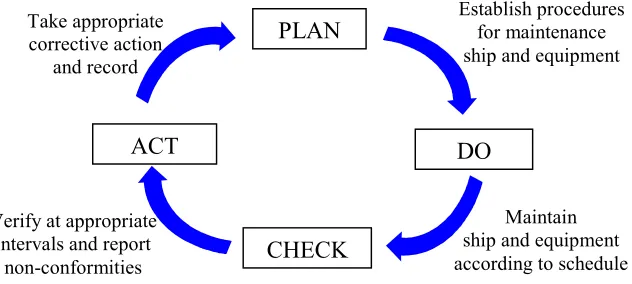
Maintenance of a ship and its equipmentis also curtailed when speaking of SMS. As someone once said ‘a good worker without good tools cannot do a good job’. To fulfil the requirements of the ISM Code, an internal program of onboard maintenance must be established. It should consist of four steps, which are: plan, do, check and act (see Figure 2). External classification and port State controls (PSC) will never be sufficient to assure good technical and safe conditions of a ship, and they are not designed for that. It is the shipping company and its staff who must take care of the equipment they use.
3.3.10. Documentation
The documentation of duties related to ship operations is required by the Code. Almost everything should be in writing: the policy, plans, procedures, instructions
PLAN
CHECK
ACT DO
Establish procedures for maintenance ship and equipment
Maintain ship and equipment according to schedule Take appropriate
corrective action and record
Verify at appropriate intervals and report
non-conformities
and checklists. This is like a revolution in shipping, since this industry for centuries has had an oral tradition. People usually don’t like written procedures, but in reality they are very helpful for training and understanding one’s duties.
3.3.11. Company verification, review and evaluation
Company verification, review and evaluation mean internal systematic reviews at all management levels as well as external audits. It must be clear for personnel that an internal audit is not designed to control employees but to control the operation of the safety management system. The audit shouldn’t be a surprise for the audited sector and it would be better if the personnel is informed of its purpose. Employees should never be afraid of showing non-conformities or hazardous occurrences. If they do so, the company will never be able to verify the efficiency of SMS and more over will not be able to undertake corrective actions.
3.4. Implementation of the ISM Code in 10 steps
There is no doubt that implementation of the ISM Code in a company is a long process. It is for the company’s benefit to understand the purpose and principles of the Code before undertaking any actions. The whole process consists of ten steps which are as follows11:
1. Initial assessment – evaluation of existing practices in a company in reference to the ISM Code and the definition of discovered deviations. This relates to all operational procedures onshore and onboard all operated ships and requires the participation of each company manager.
2. Strategic planning – preparation of action plans for ISM Code implementation onshore and onboard, based on findings of an initial assessment. At this point the timetable should also be prepared, identifying the resources needed for achieving
this goal. This is also the latest stage where management seminars on understanding the Code should be conducted.
3. Safety and environmental protection policy – legitimisation of the prepared plan.
The policy must be clear and be understood by each employee. This also requires an explanation of SEPP and the necessary training of personnel. It’s the author’s view that all employees should be informed that the Code is intended to be implemented as soon as the decision is made by the company management and that this should be an ongoing process including training at later stages. By doing so, management will express its trust to their personnel as well as avoid misunderstandings. An example being personnel’s questions regarding the collection of strange data from employees by the management or possible employment reduction.
4. Responsibilities and authority – definition of the role of each staff member in implementation and maintenance of the policy. It’s very important that everyone knows his exact place in the whole system, his own duties and responsibilities. At this stage operational links between departments must be clarified, especially between onshore and onboard staff. For this reason also the designated person must be appointed as presented in Chapter 3.3.3.
5. Project team – appointment of company employees responsible for carrying on the project’s permanent monitoring and implementation. This group of people should consist of personnel, who already have management responsibilities and one of the managers should be appointed as project manager. Short-term goals should be established and obtaining the SMS certification should be the first one.
documentary systems should be adjusted to the requirements of the Code as well as omitted procedures should be established. This step includes writing of quality manuals and also working instructions which should be contained in a short document reflecting established company quality policy in relation to particular tasks performed by particular divisions or employees.
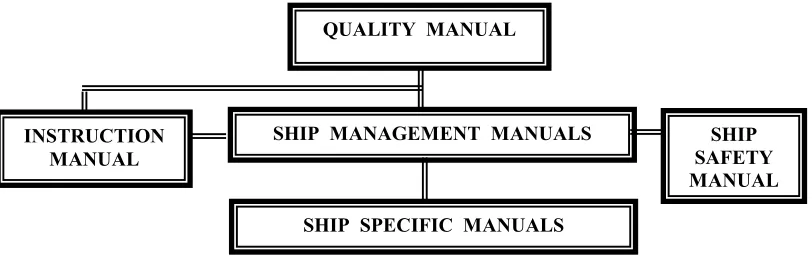
7. Shipboard procedures12 – description of all necessary actions to be undertaken on board ship to implement the policy. This step is similar to the establishment of onshore procedures, keeping in mind that the company has only one policy, which is the same for onshore and onboard activities. Shipboard procedures include drafting of instructions by the master and officers for all crewmembers on each ship. Instructions are important as an aid to procedures, especially for a multilingual crew. Together they constitute manuals as presented below.
The ISM Code para.6.3 to 12.12 requires procedures to “be established for training, information, onboard operations, emergency situations, notification and analysis on non-conformities, accidents and hazardous occurrences, maintenance of the ship and its equipment, identification of equipment, documents and internal audits”.
12 A procedure is a description of a specific activity and definition of responsibilities and methods to
attain an expected result, while an instruction is more detailed and describes a particular task to be accomplished inside a system in order for a specific requirement to be met (“Chauvel, 1997, Ch.3).
QUALITY MANUAL
SHIP MANAGEMENT MANUALS
SHIP SPECIFIC MANUALS INSTRUCTION
MANUAL
SHIP SAFETY MANUAL
Figure 3. Structure of the Safety Management System.
8. Measurement and reporting – review of the progress made by a company up to this point. It might take several months before this stage can be achieved but it is necessary to inform the top manager of the progress made and of future necessary actions. From that time it ought to be an ongoing process, with regular management and project team meetings.
9. Personnel training – development and improvement of personnel skills. Training should be based on already drafted procedures for each group of employees. The creation of a training cycle for all those, who are responsible for implementation and maintenance of the new system should mainly be aimed at familiarisation with the ISM Code, drafting procedures, internal audits, problem solving and so on.
10.Final assessment and certification – prove that the company has achieved its goal and has successfully implemented the new SMS. The last necessary adjustments can be made at this stage and an initial certification started. Although obtaining Safety Management Certificates (SMC) for all operated ships might seem as an achievement of the final goal it should be remembered that this is only a point of passage. The real goal of the company is to improve safety on board and by doing so reduce the unnecessary cost of a ship’s maintenance caused by crew negligence.
3.5. Certification
The certification process, under the ISM Code, is one of the Administration’s major responsibilities. From all of the Flag States, around 40 have delegated all ISM certification to classification societies and a similar number of States have given limited authorisations to the societies act on their behalf in this respect.
be issued only if a Company has a DOC. They can be issued either by the Administration itself, by an Organization Recognised by the Administration (RO) or by the Government of another country acting on the request of the Flag State. In this case copies of all DOCs and SMCs should also be sent to the Administration on behalf of which they have been issued.
Although the issuance of DOCs and SMCs is very important for a company and, sometimes it is considered as a prize for efforts and working hours dedicated to the implementation of the SMS, it is very important to keep in mind that this is not an end but one of the steps in implementing a safety management system in a company. A new working culture must be implemented and the SMC proves only that a company is on the right track, that it is able to describe activities undertaken by it’s personnel and that employees are able to do what has been written. Besides, both the DOC and the SMC are valid only for 5 years and can be withdrawn at any time if non-compliance with the International Safety Management Code is observed.
The Safety Management Certification process consists of three stages, which are: - initial certification,
- maintenance of certification, - re-certification.
3.5.1. Initial certification
An audit for initial certification is carried out only upon a company’s request to the appropriate body (which is either the Administration or the classification society, depending on the State’s decision).
The next step of the audit is to scrutinise the documentary system onshore and if it complies with the ISM Code requirements the auditors proceed to the next stage, which is to check if observed procedures in the company correspond to the written procedures and instructions. The DOC can be issued if the audit witnesses a match between company policy, its written procedures and the situation observed.
The initial audit of the system on board all operated ships concerned should start as soon as the onshore company has been audited. In the beginning, documents are checked. A ship has to have a valid classification certificate, proving that it conforms to Resolution A.739(18) and the statutory certificates required by the Flag State, the statutory inspection and classification files including the observations and comments of the inspectors as well as the DOC issued to the onshore company. If all of the above are available on board and in order, this audit is concerned as a continuation of the onshore evaluation. Often to facilitate the process, audits in the company and onboard begin at the same time, which is not exactly in accordance to the ISM Code, but can be accepted provided that an SMC is not issued before the DOC.
If deviations are observed, corrective actions must be undertaken by the company. If the initial check onboard is successful the auditors proceed to the next step, which is verification of the implemented SMS onboard; how it corresponds to what has been written in the onboard plans and procedures. Finally the SMC can be issued.
3.5.2. Maintenance of the Safety Management System
and liquidation of observed deviations in due course, as well as external audits by the certification body.
3.5.2.1. Internal audit
An internal audit must be performed by groups of internal auditors, consisting of personnel that did not implement an SMS in that audited area. The goal of permanent internal auditing is to assess the effectiveness of the SMS, whether ashore or on board, and to continuously monitor to ensure that it meets the required standards.
The conclusions drawn after each audit are input into the SMS for corrective actions. They should be presented in a form of Shipboard/Ashore Internal Audit Reports.
3.5.2.2. External Audits
IMO recommends that external audits of DOCs be done annually, while SMC’s be audited by external auditors between the second and third year after issuance of the certificate. Since this is only the minimum obligation, the FS is empowered to change the frequency of audits, especially during the first year of compliance.
Even after the DOC and SMC are issued, a company has the right and even more, is obliged to make changes and undertake corrective actions. The purpose of an intermediate audit is to verify that the SMS still corresponds to the requirements of the ISM Code. If modifications made in due course do not meet the Code requirements, the company has three months to undertake corrective actions. This is crucial because the DOC can only be revalidated if an audit confirms that the procedures match the situation observed.
3.5.2.3.Re-certification
The Safety Management System onshore and onboard must be re-certified every five years. The process is in general the same as during the initial certification, except for documentation control. It relates to onshore operations (for renewal of DOC) and to onboard operations (for renewal of SMC).
3.6. Administrations’ responsibilities for implementing the ISM Code.
Chapter IX of SOLAS’74, and the ISM Code, clearly define the role and responsibility of the Flag State Administration or recognised organization as well as the company itself in relation to Code implementation.
The Administration is defined in the ISM Code as 'the Government of the state whose flag the ship is entitled to fly' (para.1.13 ISM Code). It has the major
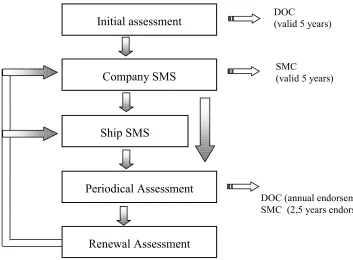
DOC (annual endorsement) SMC (2,5 years endorsement)
Initial assessment
Ship SMS Company SMS
DOC
(valid 5 years)
SMC
(valid 5 years)
Renewal Assessment Periodical Assessment
Figure 4. ISM Code Certification Scheme.
responsibility to ensure that each company will develop and implement a documented SMS. The most important part of this responsibility is certification of the system, which is performed by the Flag States as presented in Chapter 3.5.
3.6.1. Legislative duties
The ISM Code is a special piece of IMO regulation because it cannot be implemented separately, without the implementation of other international maritime safety and environment protection conventions. Para.1.2.3. of the ISM Code requires that the SMS ensure compliance with all mandatory rules and regulations.
The IMO conventions are not mandatory for a particular shipowner until they enter into force by being ratified and properly implemented by the Flag State. This means that to implement the ISM Code, the State should be first of all a party to and enforce Conventions such SOLAS, MARPOL, STCW and LOAD LINES, naming only a few.
The implementation of the SMS should ensure not only compliance with IMO conventions but also with applicable codes and guidelines, as recommended by the IMO, FS, CS and the maritime industry. This is not only a task for the company that implements an SMS, but also a tremendous task for the Administration itself. Because international conventions define only the minimum requirements necessary for safe operation of a ship, Administrations have the right and are encouraged to implement other, more detailed norms.
The ISM Code para.1.2.3, mentioned above, does not make related conventions and IMO standards mandatory, since the Organization does not have the enforcement power and it is only the States themselves, who can make any rules mandatory and binding. On the other hand, under the United Nations Convention on the Law of the Sea (UNCLOS) Art. 94.3, every State Party to the Convention is obliged to take such measures for ships flying its flag as are necessary to ensure safety at sea with regard