Review of alternatives to root cause
analysis: developing a robust system for
incident report analysis
Gregory Hagley,1,2 Peter D Mills,3,4 Bradley V Watts,4,5 Albert W Wu6
To cite: Hagley G, Mills PD,
Watts BV, et al. Review of alternatives to root cause analysis: developing a robust system for incident report analysis. BMJ Open Quality 2019;8:e000646. doi:10.1136/ bmjoq-2019-000646
►Additional material is published online only. To view please visit the journal online (http:// dx. doi. org/ 10. 1136/ bmjoq- 2019- 000646).
Received 29 January 2019 Revised 24 May 2019 Accepted 28 June 2019
For numbered affiliations see end of article.
Correspondence to Dr Gregory Hagley; gl. hagley@ gmail. com © Author(s) (or their employer(s)) 2019. Re-use permitted under CC BY-NC. No commercial re-use. See rights and permissions. Published by BMJ.
Medical errors and other system failures lead to patient injury and significant costs— estimates of potential societal costs range
from $393 to $958 billion.1 2 To improve
safety, the healthcare system has looked to industries with impressive safety records in high-risk contexts, often referred to as high
reliability organisations (HRO), for ideas.3
In the 1990’s the Veterans Health Adminis-tration (VHA) adopted root cause analysis (RCA) from HROs to learn from the most
serious incident reports (IRs).4 Over the
ensuing decades, other healthcare organisa-tions followed developing distinct, yet similar
approaches.5–12
Systematic learning from IRs is a central component of reliable healthcare delivery systems. Methods to learn from IRs work best when they highlight areas of risk, which can
lead to improved performance.12–19
Investi-gating IRs with RCA is consistent with the core characteristics of HROs. The structured feed-back process on a defect in care provides the environment for organisational mindfulness. RCA ‘enables simultaneous adaptive learning
and reliable performance’20 and promotes
mindfulness by acting as ‘a window on the
system’.21 However, it is neither feasible nor
desirable to complete an RCA following every IR. For example, one 600-bed private hospital generates 15 000 IRs annually—an impossible number to investigate with RCA given that the process takes more than 20 person-hours
and over $8000 to complete.22–24
There-fore, the RCA process is typically reserved for medical errors that lead to the greatest harm. Unfortunately, in the remainder of the cases, incident reporting alone does not
improve safety.13 21 Thus, healthcare
organisa-tions need additional strategies to learn from no-harm and low-harm IRs that are rarely the
subject of RCA.25 26
One example of a harmful IR that would lead to an RCA is a medication error that contributed to a patient death. On the other hand, if a nurse administering the medication
noticed the error and alerted the prescribing provider a resulting IR would not indicate patient harm. No RCA or systemic organisa-tional learning would result.
The current RCA process seeks to improve patient care through organisational learning and identifying specific actions to improve performance. Several similar RCA tools are
in wide use in healthcare.6–8 10 12 In an RCA
a multidisciplinary team asks three questions: ‘What happened? Why did it happen?’ and
‘How to prevent it from happening again?’27
They seek to analyse safety events through ‘a human factors engineering approach— entailing a search for system vulnerabilities rather than individual human errors and
other less actionable root causes’.28 RCA has
been shown to improve safety and
compli-ance with clinical processes.29–45 Studies have
also identified problems with the methods by which RCAs are conducted and actions
enacted.12 23 25 46–56 While imperfections in
RCA methods occur, they do not characterise all RCAs.
The feasibility of RCA remains a problem. A single RCA can take 20–90 person-hours
or more to complete.23 The workload means
that few, if any IRs of low-harm and no-harm events are addressed. If some of these events are particularly worrisome to front-line staff, this can lead to staff questioning the relevance of reporting safety events and
contribute to a poor safety culture.57
Addi-tional tools are needed to investigate IRs of no-harm and low-harm IRs. Ideally, the level of harm and potential frequency of the risk should match the depth of the
investi-gation following an IR.6 8 The ideal analytic
tool for otherwise unexamined, less-harmful events should consume fewer resources than RCA to allow more investigations and more
opportunities for organisational learning.58
The aim of this paper was to identify and describe the range of tools used to investi-gate and analyse no-harm and low-harm IRs
copyright.
on September 12, 2020 by guest. Protected by
with a specific focus on alternatives to the conventional RCA process.
MeThods
This narrative review searched PubMed and Embase. There were no search limits (language, study types) used. The search strategy initiated with several concise analyt-ical tools known to the authors and was further devel-oped with a Medical Librarian. Each database’s search is described in online supplementary appendix 1.
The reviewer looked at each citation, and selected items for inclusion if the source described a tool that could be used for investigating and analysing IRs that consumed fewer person-hours than RCA. Studies were excluded if they did not describe or analyse such a tool or if they were not in English. Reference lists for relevant articles were also scanned for additional studies.
ResulTs
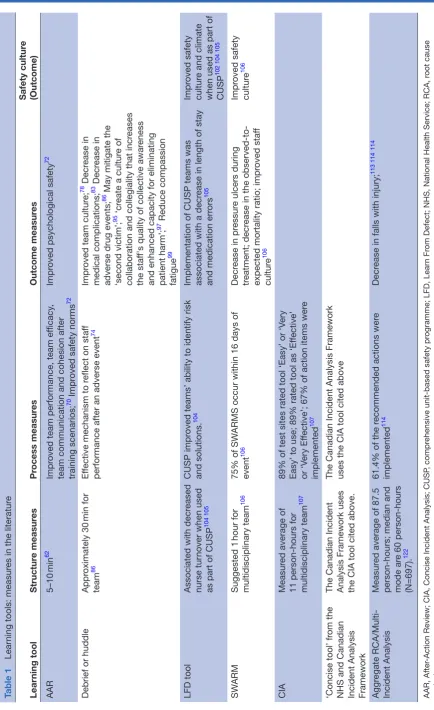
Seven tools were identified in the literature to inves-tigate IRs of medical errors that appear to be less
resource-intense than RCA (table 1). We began with
the least structured and progress to those that are more resource-intensive.
After-Action Review (AAR)
After-Action Review (AAR) originated in the US mili-tary to extract lessons from training and missions but has been adapted to healthcare. Its original purpose was ‘to help Army leaders adapt quickly in the dynamic,
unpredictable situations they were sure to face’.59 60
Several investigators have modified the military's
10-step AAR for healthcare.61–63 Each investigator
suggests at least four questions: ‘What was expected to happen? What actually happened? What is the
differ-ence between these? What has been learnt?’63 A trained
facilitator improves the quality of reflection and resul-tant strong, measurable actions. The AAR takes place in the team's work environment. This method of AAR can
be a means to reflect on training, a work shift or IR.63 64
There are also examples of variations of AAR used after
public health crises and mass casualty events.65–69 Sawyer
et al suggest that AAR provides a structure to enhance
team reflection, learning and enlightened action.61
Available research demonstrates improved team
perfor-mance after AAR in training scenarios,70–72 but does
not specifically address evaluating IRs in healthcare organisations.
Adverse event Debriefing and Huddles
Debriefing, including after event huddles, assume varying structures but share the core characteristic of process-oriented, ‘rigorous reflection’ to find
action-able solutions.73 The literature uses the terms huddle
and debriefing interchangeably.74 75 They frequently
occur as part of a clinical workflow. A team may debrief after a procedure such as surgery. Checklist driven
postoperative debriefings are recommended by the
VHA and WHO.76–78 Debriefings and huddles may also
take place after a safety event, such as a fall.74 75 79–89
When a debrief or huddle retrospectively assesses a safety event, several recommend three stages. These are the (1) reaction phase, (2) understanding or analysis
phase and (3) summary phase.73 90 One study provided
a checklist.74 All formats initiate group reflection soon
after the incident.74 77 91 Often a trained facilitator
guides a team. Several actionable items are generated
to mitigate similar future incidents.74 92 93 One paper
suggests that a postadverse event debriefing could act
as a precursor to a more in-depth RCA.74
Literature suggests numerous benefits for debriefing in healthcare. They have been linked to improved safety,
team culture and clinical performance.74 75 77 85 94–96 Team
members report feeling supported by colleagues after
an adverse event debriefing.74 97 They can also reduce
provider stress and burnout associated with second-victim syndrome, where a caregiver is deeply stressed by
his/her association with an adverse event.95 98 99
Learn From Defect (LFD) tool
Johns Hopkins Medicine developed the Learn From Defect (LFD) tool to systematically guide clinical teams to improve clinical performance in the comprehensive
unit-based safety programme (CUSP).100 101 CUSP teams
use the LFD tool to analyse one defect per month. All staff who were directly or indirectly involved in the defect participate in the investigation. After describing the event, the format guides the team to reflect on various potential contributing factors and whether the factors positively or negatively contributed to the defect. Last, the team creates measurable interventions
to prevent future, similar harm.101
The LFD tool has been evaluated as part of CUSP
in various healthcare settings.102–105 The CUSP
programme, which includes other quality improvement tools, was associated with an improved safety culture
and improved clinical performance.102 105 Furthermore,
CUSP equips staff with improved ability to identify risks
and create meaningful interventions.104
sWARM
The University of Kentucky HealthCare Lexington introduced the ‘SWARMing’ process to improve on their RCA system building on the idea of ‘swarming
intelligence’.106 An IR is reviewed by a department
administrator who initiates a preliminary investigation. If it merits a brief review, a multidisciplinary team is
chartered including individuals involved in the event.106
The team progresses through five phases within an hour. The first two phases train team members on the purpose of the SWARM and review ground rules. The known facts of the incident are reviewed in the third phase. A root cause is determined in the fourth. In the fifth phase, the team develops actions to prevent a similar incident from recurring. An assigned action
copyright.
on September 12, 2020 by guest. Protected by
Table 1
Lear
ning tools: measur
es in the literatur
e
Lear
ning tool
Structur
e measur
es
Pr
ocess measur
es
Outcome measur
es
Safety cultur
e
(Outcome)
AAR
5–10
min
62
Impr
oved team performance, team ef
ficacy
,
team communication and cohesion after training scenarios; 70 Impr
oved safety norms
72
Impr
oved psychological safety
72
Debrief or huddle
Appr
oximately 30
min for
team
86
Ef
fective mechanism to r
eflect on staf
f
performance after an adverse event
74
Impr
oved team cultur
e;
78 Decr
ease in
medical complications;
83 Decr
ease in
adverse drug events;
86 May mitigate the
‘second victim’;
95 ‘cr
eate a cultur
e of
collaboration and collegiality that incr
eases
the staf
f's quality of collective awar
eness
and enhanced capacity for eliminating patient harm’; 97 Reduce compassion
fatigue
99
LFD tool
Associated with decr
eased
nurse tur
nover when used
as part of CUSP
104 105
CUSP impr
oved teams’ ability to identify risk
and solutions.
104
Implementation of CUSP teams was associated with a decr
ease in length of stay
and medication err
ors
105
Impr
oved safety
cultur
e and climate
when used as part of CUSP
102 104 105
SW
ARM
Suggested 1
hour for
multidisciplinary team
106
75% of SW
ARMS occur within 16 days of
event
106
Decr
ease in pr
essur
e ulcers during
tr
eatment; decr
ease in the
observed-to-expected mortality ratio; impr
oved staf
f
cultur
e
106
Impr
oved safety
cultur
e
106
CIA
Measur
ed average of
11 person-hours for multidisciplinary team
107
89% of test sites rated tool ‘Easy’ or ‘V
ery
Easy’ to use; 89% rated tool as ‘Ef
fective’
or ‘V
ery Ef
fective’; 67% of action items wer
e
implemented
107
‘Concise tool’ fr
om the
NHS and Canadian Incident Analysis Framework The Canadian Incident Analysis Framework uses the CIA tool cited above. The Canadian Incident Analysis Framework uses the CIA tool cited above
Aggr
egate
RCA/Multi-Incident Analysis
Measur
ed average of 87.5
person-hours; median and mode ar
e 60 person-hours
(N=697).
122
61.4% of the r
ecommended actions wer
e
implemented
114
Decr
ease in falls with injury;
113 114
114
AAR, After
-Action Review; CIA, Concise Incident Analysis; CUSP
, compr
ehensive unit-based safety pr
ogramme; LFD, Lear
n Fr
om Defect; NHS, National Health Service; RCA, r
oot cause
analysis.
copyright.
on September 12, 2020 by guest. Protected by
owner has 60 days to ensure that the task leaders fulfil their duties. Finally, a report is distributed among organisational leaders highlighting the incident, root
causes and remedial actions.106
After over 1200 SWARMs, UK HealthCare Lexington studied the effectiveness of its tool. The number of IRs increased by 52%. Across the healthcare system, there was a ‘37% decrease in the observed-to-expected
mortality ratio’.106 While preliminary evidence suggests
an improved patient safety and safety culture, UK HealthCare Lexington wants to improve the
implemen-tation and sustainment of the action plans.106
Concise Incident Analysis (CIA)
The Concise Incident Analysis (CIA) was developed in 2013 under the guidance of an advisory group from the WHO Reporting and Learning Systems Community with several objectives. One was to develop an efficient tool to analyse more IRs than the RCA process. It was also aimed to analyse no-harm and low-harm incidents at the unit-level to empower caregivers and strengthen
safety culture at the front line.107 CIA is administered
by a trained facilitator in a small group. A checklist guides the investigation. Like others, it questions what happened and why it occurred. Further, it leads the
team to develop measurable actions.107
The CIA development team surveyed the pilot sites. Among the study sites, most groups (59%) found it helpful when implementing actions and 95% learnt from the analysis. While 94% shared their lessons within the organisation, only 6% shared their lessons
outside the organisation.107 Yet, limitations exist. One
is that it may be prone to bias since those involved in the incident are also among the group analysing the
IR.107 Second, the quality of analysis likely rests in the
capability of the facilitator. Last, while the tool will allow more IR investigations, the CIA tool was not designed to study sentinel events, which should be analysed by a
more robust tool such as RCA.107
Comprehensive frameworks for incident report investigation and analysis
Both the National Health Service (NHS) in the UK and the Canadian healthcare system developed multiple learning tools to investigate IRs. NHS analyses IRs in one of three levels. The Concise Investigation is used for Level 1, which are no-harm, low-harm and
moder-ate-harm events.108 Serious incidents and ‘never events’
fall under Level 2 or 3 and are investigated using the Comprehensive or Independent Investigation Reports, which are similar in scope to RCAs required by VHA
and The Joint Commission.6 8 109 110 The Canadian
dent Analysis Framework adopted the Concise Inci-dent Analysis (CIA) described in the previous section for no-harm and low-harm events. More serious events are investigated with a Comprehensive Analysis, which also mirrors RCAs required by the VHA, and The Joint
Commission.6
There are few differences between NHS’s and the Canadian framework’s concise tools. Each is led by a trained facilitator and seeks to determine the root cause of the incident. The Canadian tool forms a team only
of those proximal to the adverse event.6 Similarly, NHS
tool has a local investigation team, but also encourages patients and or relatives to be involved in the investiga-tion if they were directly affected. Both systems develop a report and encourage lessons to be shared in the work unit, with organisational leadership, or nationally, if
appropriate.6 8 107 Each tool encourages evaluation of
the resulting actions from the analysis. While there are no studies evaluating the NHS’s Concise Investigation, a 2015 ombudsman report was critical of the entire frame-work’s function. Investigations, analyses and actions
were not consistently executed as designed.111 112 The
feasibility and effectiveness of the Canadian concise
tool matches that of the CIA tool (table 1).107
Aggregate RCAs and the multi-incident analysis
Aggregate RCAs are different than the other forms of investigation discussed. Here, multiple IRs can be analysed in one RCA. This is practiced both within the VHA and the Canadian Incident Analysis
Frame-work.6 113 114 The Canadian framework offers guidance
for the use of their Multi-Incident Analysis. Scenarios where it can be used include: (1) a series of low-harm and no-harm events, (2) a group of events similar in origin or composition, (3) a group of patients inhibited by similar factors such as patients receiving care in an emergency department who do not receive the septic bundle within an acceptable time frame and (4) an
analysis of a group of completed safety investigations.6
There has been little evaluation of aggregate RCAs. In one study, investigators interviewed 97 VA medical centres teams, who had completed 176 aggregate RCAs on falls. These teams reported a reduced rate of falls in 34.4% of the locations. 43.8% reported no change and
20.8% stated that it was too soon to tell.114 The rates of
falls with injuries similarly improved at some facilities,
but did not at others.114 Aggregate RCA has also been
recommended as a method to improve the ‘bird's eye view of incidents’ across an organisation. Trends can
be identified to determine systemic root causes.51 The
primary limitation of aggregate RCA is the significant person-hours required.
discussion
In this structured narrative literature review, we iden-tified and described seven tools to analyse IRs, which have a lower time investment and less depth of anal-ysis than traditional RCA. Several of these tools have already been incorporated into tiered frameworks that guide investigative teams to the appropriate tool in large health systems. In these frameworks, IRs resulting in greater harm or perceived potential for future harm receive more resource-intense investigations.
copyright.
on September 12, 2020 by guest. Protected by
The brief tools differ from RCA in several
characteris-tics (table 1). One, staff involved in the IR are members
of the multidisciplinary investigation team. This should speed up the fact-finding process. Yet, it may bias the investigation and analysis. RCA seeks greater objectivity by requiring a third-party investigation. The tools also diverge from RCA on their method to share lessons from the analysis. AAR does not mention sharing lessons
beyond the work group. Campbell et al suggest that
their debrief tool may act as an initial screen prior to a
RCA.74 The SWARM reports the analysis to leadership
like RCA. Leadership shares the lessons as needed.106 A
similarity among all concise tools and RCA is the recom-mendation for a trained facilitator. In evaluating the
CIA tool, Pham et al remarked that the quality of
inves-tigation likely rests on the ability of the facilitator.107
This observation is likely true of all the analytical tools discussed.
The literature describing and evaluating the tools is not complete. The organisational context for each tool
should be clear.115 An investigative tool may function
better in a specific work environment. For example, the LFD tool was evaluated as part of the CUSP team
approach in multiple settings.102–105 This tool is
effec-tive in a small clinical team environment. It may not function well if practiced in a multidisciplinary team recruited from diverse areas of a medical centre to address a system-wide problem. Second, each tool should be validated to promote safety and a safety
culture, which several have done.36 76 77 105 106 114 Some
studies on huddles and debriefs have also analysed their
effects on team functioning,101 102 105 106 which influences
both safety culture and potentially clinical outcomes. Third, tools should demonstrate improved clinical processes or outcomes. RCAs have been critiqued on the strength and implementation percentage of their
actions.28 32–36 56 116 Better outcomes can include a
decrease in the observed-to-expected mortality ratio as
in the SWARM study.27 28 106
Our study had limitations. Some suggest that morbidity and mortality (M&M) rounds are a method
to learn from adverse events.117–121 Yet, this review did
not feature M&M rounds. They retrospectively present
on the resolution of a defect in care.118 It does not
actively guide a group to systematically discern root causes and remedial actions for an IR. Second, there was limited literature evaluating the brief analysis tools. The reports were often descriptive and lacked performance metrics. Divergent methods were used to evaluate each tool. The evaluation of the CIA tool described the safety event characteristics and then surveyed the investigation teams on their perceptions
of the ease of use and effectiveness of the tool.107 Other
studies described their tool’s effects on safety and safety
culture.36 76 77 105 106 114 Still others studied its influence
on standardised outcome measures like
observed-to-ex-pected mortality.106 Emotional and social aspects of the
tools were also measured differently. Some assessed the
tool’s effects on staff stress and compassion fatigue.98 99
The LFD tool noted a decrease in nurse turnover.104 105
Each tool is measured against different criteria making comparisons challenging. The diverse measures high-light the difficulty of defining effectiveness in safety investigations. Third, we may not have found all rele-vant articles due to the non-standardised titles of the tools and search terms. Additional tools exist that have not been evaluated in the literature. Our review falls into the wider emerging literature that has pointed out limitations of the commonly occurring RCA
system.23 25 48 50–52 57 Most of that literature has focused
on the short comings of RCA as an investigative tool. We have examined alternative approaches.
It is clear that healthcare organisations need
system-atic frameworks to learn from error.48 50 51 Each medical
error potentially provides new knowledge to improve the reliability of a healthcare system. Yet, the best method to investigate is unclear. Each tool has trade-offs. A huddle benefits from its proximity to a medical error but lacks the objectivity of a resource-intense third-party inves-tigation. Aggregate analysis tools can potentially opti-mise feasibility and effectiveness by studying multiple
no-harm and low-harm medical error at once.21 48 Thus,
several tools can be uniquely combined into a coherent
system like the British and Canadian frameworks.6 8
The appropriate investigative framework may vary on the context of the healthcare organisation. An organ-isation’s chosen tools should enable it to improve the reliability, safety and quality of care provided to their local community.
Author affiliations
1National Center for Patient Safety, Veterans Affairs Medical Center, White River
Junction, Vermont, USA
2Rehabilitation Department, Dartmouth-Hitchcock Medical Center, Lebanon, New
Hampshire, USA
3National Center for Patient Safety, White River Junction VA Medical Center, White
River Junction, Vermont, USA
4Geisel School of Medicine, Dartmouth College, Hanover, New Hampshire, USA 5National Center for Patient Safety, White River Junction VA Medical Center, White
River Junction, Vermont, USA
6Center for Health Services and Outcomes Research, Johns Hopkins Bloomberg
School of Public Health, Baltimore, Maryland, USA
Acknowledgements Brian Shiner, MD, MPH, Staff Psychiatrist, White River Junction VA Medical Center, White River Junction, Vermont; Geisel School of Medicine at Dartmouth, Hanover, New Hampshire. Loretta Grikis, MLS AHIP, Medical Librarian, White River Junction VA Medical Center, White River Junction, Vermont. Collaborators Loretta Grikis; Brian Shiner.
Contributors GH was the first author who completed the research, coordinated the edits and took advice from contributing authors. BVW, PDM and AWW provided guidance and direction on the manuscript in addition to providing significant edits. B Shiner provided edits and guidance. L Grikis is a medical librarian who assisted with the literature search.
Funding The authors have not declared a specific grant for this research from any funding agency in the public, commercial or not-for-profit sectors.
Disclaimer This material is the result of work supported with resources and the use of facilities at the Department of Veterans Affairs National Center for Patient Safety at the Veterans Affairs Medical Centers, White River Junction, Vermont. The views expressed in this article do not necessarily represent the views of the Department of Veterans Affairs or of the US government. We are submitting this as
copyright.
on September 12, 2020 by guest. Protected by
Original Research; we have not reported these data in any other forum and none of the authors has any conflict of interest regarding this report.There are no outside funding for this manuscript.
Competing interests This work was supported by the Department of Veterans Affairs and as a government product we do not hold the copyright.
Patient consent for publication Not required.
Provenance and peer review Not commissioned; externally peer reviewed. Open access This is an open access article distributed in accordance with the Creative Commons Attribution Non Commercial (CC BY-NC 4.0) license, which permits others to distribute, remix, adapt, build upon this work non-commercially, and license their derivative works on different terms, provided the original work is properly cited, appropriate credit is given, any changes made indicated, and the use is non-commercial. See: http:// creativecommons. org/ licenses/ by- nc/ 4. 0/.
RefeRences
1. David G, Gunnarsson CL, Waters HC, et al. Economic measurement of medical errors using a hospital claims database. Value Health 2013;16:305–10.
2. Goodman JC, Villarreal P, Jones B. The social cost of adverse medical events, and what we can do about it. Health Aff 2011;30:590–5.
3. Stalhandske E, Bagian JP, Gosbee J. Department of Veterans Affairs patient safety program. Am J Infect Control 2002;30:296–302. 4. Bagian JP, Lee C, Gosbee J, et al. Developing and deploying a
patient safety program in a large health care delivery system: you can't fix what you don't know about. Jt Comm J Qual Improv 2001;27:522–32.
5. Weeks WB, Bagian JP. Developing a culture of safety in the Veterans health administration. Eff Clin Pract 2000;3:270–6. 6. Canadian Patient Safety Institute. Canadian Incident Analysis
Framework. Edmonton, AB, Canada: Canadian Patient Safety Institute, 2012.
7. Root cause analysis in healthcare: tools and techniques. The joint Commission, 2018. Available: https://www. jcrinc. com/ assets/ 1/ 14/ EBRCA15Sample. pdf
8. Root cause analysis investigation tools: guide to investigation report writing following root cause analysis of patient safety events. in: agency NNPS, ED.
9. InDepartment of Health Expert Group (Chairman C. An organisation with a memory: report of an expert group on learning from adverse events in the NHS chaired by the chief medical officer. Health Do: ed2000.
10. National Patient Safety Foundation. RCA2: Improving Root Cause Analyses and Actions to Prevent Harm. Boston, MA: National Patient Safety Foundation, 2015.
11. Ruiz-Lopez P, Rodriguez-Salinas CG, Alcalde-Escribano J. Root cause analysis. A useful tool for error prevention. Revista de Calidad Asistencial 2005;20:71–8.
12. Taylor-Adams S, Vincent C. Systems analysis of clinical Incidencts: London protocol. Available: https://www. imperial. ac. uk/ media/ imperial- college/ medicine/ surgery- cancer/ pstrc/ londonprotocol_ e. pdf [Accessed 18 Jan 2019].
13. Macrae C. The problem with incident reporting. BMJ Qual Saf 2016;25:71–5.
14. Chassin MR, Loeb JM. High-reliability health care: getting there from here. Milbank Q 2013;91:459–90.
15. Dore M, Lovato E, Papalia R, et al. Incident reporting: a new tool to reduce risk of errors and to improve the quality of services in internal medicine. Italian Journal of Medicine 2012;6.
16. Pronovost PJ, Morlock LL, Sexton JB, et al. Advances in Patient Safety Improving the Value of Patient Safety Reporting Systems. In: Henriksen K, Battles JB, Keyes MA, et al, eds. Advances in patient safety: new directions and alternative approaches (Vol. 1: assessment. Rockville (MD: Agency for Healthcare Research and Quality, 2008.
17. Staender S. [Incident reporting as a tool for error analysis in medicine]. Z Arztl Fortbild Qualitatssich 2001;95:479–84.
18. Wrenn AJ. The incident report as a risk management tool. Nursing Management 1981;12:34???35–5.
19. Hart PF. THE INCIDENT REPORT--A USEFUL ADMINISTRATIVE TOOL. Can Hosp 1965;42:34–7.
20. Weick KE SK, Obstfield D. Organizing for high reliability: Processes of collective mindfulness. In: ESJ P, ed. Reserach in organizational behavior. , 1999: 21, 81–123.
21. Vincent CA. Analysis of clinical incidents: a window on the system not a search for root causes. Qual Saf Health Care 2004;13:242–3. 22. Wachter R. Understanding patient safety. 2nd edn. San Francisco:
McGraw Hill, Lange, 2007.
23. Wu AW, Lipshutz AKM, Pronovost PJ. Effectiveness and efficiency of root cause analysis in medicine. JAMA 2008;299:685–7. 24. Blanchfield BB, Acharya B, Mort E. The hidden cost of regulation:
the administrative cost of reporting serious reportable events. The Joint Commission Journal on Quality and Patient Safety 2018;44:212–8.
25. Kellogg KM, Hettinger Z, Shah M, et al. Our current approach to root cause analysis: is it contributing to our failure to improve patient safety? BMJ Qual Saf 2017;26:381–7.
26. The value of close calls in improving patient safety: learning how to avoid and mitigate patient harm2010Oak Brook, IL
27. Veteran Health Administration. VHA National Center for Patient Safety Handbook. Washington D.C: Veteran Health Administration, 2011.
28. Bagian JP, Gosbee J, Lee CZ, et al. The Veterans Affairs root cause analysis system in action. Jt Comm J Qual Improv 2002;28:531–45. 29. McGinn T, Conte JG, Jarrett MP, et al. Decreasing mortality
for patients undergoing hip fracture repair surgery. The Joint Commission Journal on Quality and Patient Safety 2005;31:304–7. 30. Perkins JD, Levy AE, Duncan JB, et al. Using root cause analysis
to improve survival in a liver transplant program. J Surg Res 2005;129:6–16.
31. Rex JH, Turnbull JE, Allen SJ, et al. Systematic root cause analysis of adverse drug events in a tertiary referral hospital. Jt Comm J Qual Improv 2000;26:563–75.
32. Choksi VR, Marn CS, Bell Y, et al. Efficiency of a semiautomated coding and review process for notification of critical findings in diagnostic imaging. AJR Am J Roentgenol 2006;186:933–6. 33. Piotrowski MM, Bessette RL, Chensue S, et al. Learning to improve
safety: false-positive pathology report results in wrongful surgery. Jt Comm J Qual Patient Saf 2005;31:123–31.
34. Plews-Ogan ML, Nadkarni MM, Forren S, et al. Patient safety in the ambulatory setting. A clinician-based approach. Journal of general internal medicine 2004;19:719–25.
35. Mills PD, Neily J, Luan D, et al. Actions and implementation strategies to reduce suicidal events in the Veterans health administration. The Joint Commission Journal on Quality and Patient Safety 2006;32:130–41.
36. Percarpio KB, Watts BV, Weeks WB. The effectiveness of root cause analysis: what does the literature tell us? The Joint Commission Journal on Quality and Patient Safety 2008;34:391–8.
37. Cropper DP, Harb NH, Said PA, et al. Implementation of a patient safety program at a tertiary health system: a longitudinal analysis of interventions and serious safety events. Journal of Healthcare Risk Management 2018;37:17–24.
38. Chen KH, Chen LR, Su S. Applying root cause analysis to improve patient safety: decreasing falls in postpartum women. Quality and Safety in Health Care 2010;19:138–43.
39. Bolton-Maggs PHB. Root cause analysis. A valuable tool for improving practice. Blood Transfusion 2013;11(SUPPL. 1):s18–19. 40. Cerniglia-Lowensen J. Learning from mistakes and near mistakes:
using root cause analysis as a risk management tool. J Radiol Nurs 2015;34:4–7.
41. Cicero-Oneto C, Zapata-Tarres M, Velasco FOR, et al. Root cause analysis as a tool to identify problems in the medical care of pediatric patients with acute lymphoblastic leukemia. Boletin Medico del Hospital Infantil de Mexico 2012;69:255–62. 42. Lo D, Mabile R, Crowley KM, et al. Root cause analysis as
a problem solving tool in transfusion medicine. Transfusion
2011;51(SUPPL. 3):245A.
43. Owen L. Improving compliance with the C. difficile root cause analysis tool to reduce incidence. Nursing times 2009;105:14–16. 44. Ramadan G, Rawlani R, Brady-Murphy N, et al. Development of a
root cause analysis tool to investigate catheter associated blood stream infections (CABSI) in a tertiary neonatal unit. Archives of Disease in Childhood 2017;102:A10.
45. Ruddick P, Hannah K, Schade CP, et al. Advances in Patient Safety Using Root Cause Analysis to Reduce Falls in Rural Health Care Facilities. In: Henriksen K, Battles JB, Keyes MA, et al, eds. Advances in patient safety: new directions and alternative approaches (Vol. 1: assessment. Rockville MD: Agency for Healthcare Research and Quality, 2008.
46. Henriksen K, Kaplan H. Hindsight bias, outcome knowledge and adaptive learning. Quality and Safety in Health Care 2003;12:46ii–50.
47. Hettinger AZ, Fairbanks RJ, Hegde S, et al. An evidence-based toolkit for the development of effective and sustainable root
copyright.
on September 12, 2020 by guest. Protected by
cause analysis system safety solutions. J Healthc Risk Manag 2013;33:11–20.
48. Trbovich P, Shojania KG. Root-cause analysis: swatting at mosquitoes versus draining the swamp. BMJ Qual Saf 2017;299:bmjqs-2016-006229–353.
49. Boyd M. A method for prioritizing interventions following root cause analysis (RCA): lessons from philosophy. J Eval Clin Pract 2015;21:461–9.
50. Card AJ, Ward J, Clarkson PJ. Successful risk assessment may not always lead to successful risk control: a systematic literature review of risk control after root cause analysis. J Healthc Risk Manag 2012;31:6–12.
51. Peerally MF, Carr S, Waring J, et al. The problem with root cause analysis. BMJ Qual Saf 2017;26:417–22.
52. Dixon-Woods M, Pronovost PJ. Patient safety and the problem of many hands. BMJ Qual Saf 2016;25:485–8.
53. Hibbert PD, Thomas MJW, Deakin A, et al. Are root cause analyses recommendations effective and sustainable? an observational study. International Journal for Quality in Health Care 2018;30:124–31. 54. Vrklevski LP, McKechnie L, OʼConnor N. The causes of their death
appear (unto our shame perpetual): why root cause analysis is not the best model for error investigation in mental health services. J Patient Saf 2018;14:41–8.
55. Zulkowski K. Root cause analysis: an effective Qi tool. World Council of Enterostomal Therapists Journal 2018;38:35–9.
56. Middleton S, Walker C, Chester R. Implementing root cause analysis in an area health service: views of the participants. Aust. Health Review 2005;29:422–8.
57. Shojania KG. The frustrating case of incident-reporting systems. Quality and Safety in Health Care 2008;17:400–2.
58. Leistikow I, Mulder S, Vesseur J, et al. Learning from incidents in healthcare: the journey, not the arrival, matters. BMJ Qual Saf 2017;26:252–6.10.1136/bmjqs-2015-004853
59. Darling M, Parry C, Moore J. Learning in the thick of it. Harvard business review 2005;83:84-92,–192.
60. Training circular 25-20. A Leader's Guide to the After-Action Review
1993.
61. Sawyer TL, Deering S. Adaptation of the US Army’s After-Action Review for Simulation Debriefing in Healthcare. Simulation in Healthcare: The Journal of the Society for Simulation in Healthcare 2013;8:388–97.
62. Cook JA, Kautz DD. After action reviews in the emergency department: the positives of real-time feedback. J Emerg Nurs 2016;42:146–9.
63. Cronin G, Andrews S. After action reviews: a new model for learning. Emergency Nurse 2009;17:32–5.
64. Penwell V. After action review: a guide for midwifery students and Preceptors. Midwifery today with international midwife
2016;118:18–20.
65. Boston Trauma Center Chiefs’ Collaborative. Boston marathon bombings: an after-action review. J Trauma Acute Care Surg 2014;77:501–3.
66. Mase WA, Bickford B, Thomas CL, et al. After-action review of the 2009-10 H1N1 influenza outbreak response: Ohio's public health system's performance. J Emerg Manag 2017;15:325–34. 67. Goralnick E, Halpern P, Loo S, et al. Leadership during the Boston
marathon Bombings: a qualitative After-Action review. Disaster Med Public Health Prep 2015;9:489–95.
68. Bolster F, Linnau K, Mitchell S, et al. Emergency radiology and mass casualty incidents—report of a mass casualty incident at a level 1 trauma center. Emerg Radiol 2017;24:47–53.
69. Tami G, Bruria A, Fabiana E, et al. An after-action review tool for EDS: learning from mass casualty incidents. Am J Emerg Med 2013;31:798–802.
70. Villado AJ, Arthur W. The comparative effect of subjective and objective after-action reviews on team performance on a complex task. J Appl Psychol 2013;98:514–28.
71. Ellis S, Mendel R, Nir M. Learning from successful and failed experience: the moderating role of kind of after-event review. Journal of Applied Psychology 2006;91:669–80.
72. Dunn AM, Scott C, Allen JA, et al. Quantity and quality: increasing safety norms through after action reviews. Human Relations 2016;69:1209–32.
73. Rudolph JW, Simon R, Raemer DB, et al. Debriefing as formative assessment: closing performance gaps in medical education. Academic Emergency Medicine 2008;15:1010–6.
74. Campbell M, Miller K, McNicholas KW. Post event Debriefs: a commitment to learning how to better care for patients and staff. Jt Comm J Qual Patient Saf 2016;42:41–AP2.
75. Reiter-Palmon R, Kennel V, Allen JA, et al. Naturalistic decision making in after-action review meetings: the implementation of
and learning from post-fall huddles. J Occup Organ Psychol 2015;88:322–40.
76. West P, Neily J, Warner L, et al. Surgical programs in the Veterans health administration maintain briefing and Debriefing following medical team training. Jt Comm J Qual Patient Saf 2014;40:235–9. 77. Haynes AB, Weiser TG, Berry WR, et al. A surgical safety checklist to reduce morbidity and mortality in a global population. N Engl J Med Overseas Ed 2009;360:491–9.
78. Bethune R, Sasirekha G, Sahu A, et al. Use of briefings and debriefings as a tool in improving team work, efficiency, and communication in the operating theatre. Postgrad Med J 2011;87:331–4.
79. Adams J, Conn R, Gohil R. G238 “safety huddles”: multidisciplinary views regarding the purpose and effectiveness of a novel paediatric situational awareness tool. Arch Dis Child 2015;100(Suppl 3):A100.1–A100.
80. Brass SD, Olney G, Glimp R, et al. Using the patient safety Huddle as a tool for high reliability. Jt Comm J Qual Patient Saf 2018;44:219–26.
81. van Melle MA, van Stel HF, Poldervaart JM, et al. Measurement tools and outcome measures used in transitional patient safety; a systematic review. PLoS One 2018;13:e0197312.
82. Conn R, Adams J, Gohil R. G309(P) “safety huddles”:
multidisciplinary views regarding the purpose and effectiveness of a novel paediatric situational awareness tool. Arch Dis Child 2015;100(Suppl 3):A131.2–A131.
83. Corbett N, Hurko P, Vallee JT. Debriefing as a strategic tool for performance improvement. Journal of Obstetric, Gynecologic & Neonatal Nursing 2012;41:572–9.
84. Grant VJ, Robinson T, Catena H, et al. Difficult Debriefing situations: a toolbox for simulation educators. Med Teach 2018;40:703–12. 85. Ladner DP, Ross O, Skaro A, et al. Issues in living donor kidney transplant (LDKT) identified by the NUTORC proactive transplant safety Debriefing tool. American Journal of Transplantation
2011;11(SUPPL. 2):314–5.
86. Morvay S, Lewe D, Stewart B, et al. Medication event huddles: a tool for reducing adverse drug events. Jt Comm J Qual Patient Saf 2014;40:39–AP1.
87. Poore JA, Dawson JC, Dunbar DM, et al. Debriefing Interprofessionally: a tool for recognition and reflection. Nurse educator 2018.
88. Puttha R, Yuen S, Thalava R, et al. The rapid debrief: a tool that transforms learning and system change. Archives of Disease in Childhood 2015;100:A60.
89. Runnacles J, Thomas L, Sevdalis N, et al. Development of a tool to improve performance Debriefing and learning: the paediatric objective structured assessment of Debriefing (OSAD) tool. Postgrad Med J 2014;90:613–21.
90. Hunter LA. Debriefing and feedback in the current healthcare environment. J Perinat Neonatal Nurs 2016;30:174–8.
91. Bajaj K, Meguerdichian M, Thoma B, et al. The pearls healthcare Debriefing tool. Academic Medicine 2018;93.
92. Salas E, Klein C, King H, et al. Debriefing medical teams: 12 evidence-based best practices and tips. The Joint Commission Journal on Quality and Patient Safety 2008;34:518–27.
93. Thompson R, Sullivan S, Campbell K, et al. Does a written tool to guide structured Debriefing improve discourse? implications for interprofessional team simulation. J Surg Educ 2018;75:e240–5. 94. Paull DE, Mazzia LM, Wood SD, et al. Briefing guide study:
preoperative briefing and postoperative Debriefing checklists in the Veterans health administration medical team training program. The American Journal of Surgery 2010;200:620–3.
95. McQuaid-Hanson E, Pian-Smith MCM, Huddles P-SMC. Huddles and Debriefings: improving communication on labor and delivery. Anesthesiol Clin 2017;35:59–67.
96. Gururaja RP, Yang T, Paige JT, et al. Advances in Patient Safety Examining the Effectiveness of Debriefing at the Point of Care in Simulation-Based Operating Room Team Training. In: Henriksen K, Battles JB, Keyes MA, et al, eds. Advances in patient safety: new directions and alternative approaches (Vol. 3: performance and tools. Rockville MD: Agency for Healthcare Research and Quality (US), 2008.
97. Goldenhar LM, Brady PW, Sutcliffe KM, et al. Huddling for high reliability and situation awareness. BMJ Qual Saf 2013;22:899–906. 98. Kentel S. Debriefing tool can relieve stress. Nurs Manage
2011;18:10.
99. Nerovich C, Thime K, Manzardo J, et al. 1267. Crit Care Med 2016;44:392.
100. Cusp tools and resources. Armstrong Institute for patient safety and quality. Available: https://www. hopkinsmedicine. org/ armstrong_ institute/ training_ services/ workshops/ cusp_
copyright.
on September 12, 2020 by guest. Protected by
implementation_ training/ cusp_ guidance. html [Accessed 10 Sep 2018].
101. Pronovost PJ, Holzmueller CG, Martinez E, et al. A practical tool to learn from defects in patient care. The Joint Commission Journal on Quality and Patient Safety 2006;32:102–8.
102. Pitts SI, Maruthur NM, Luu N-P, et al. Implementing the comprehensive Unit-Based safety program (cusp) to improve patient safety in an academic primary care practice. Jt Comm J Qual Patient Saf 2017;43:591–7.
103. Smith LE, Flanders SA. Application of a comprehensive Unit-Based safety program in critical care. Crit Care Nurs Clin North Am 2014;26:447–60.
104. Timmel J, Kent PS, Holzmueller CG, et al. Impact of the
comprehensive Unit-based safety program (cusp) on safety culture in a surgical inpatient unit. The Joint Commission Journal on Quality and Patient Safety 2010;36:252–60.
105. Pronovost P, Weast B, Rosenstein B, Sexton JB, et al. Implementing and validating a comprehensive unit-based safety program. J Patient Saf 2005;1:33–40.
106. Li J, Boulanger B, Norton J, et al. “SWARMing” to Improve Patient Care: A Novel Approach to Root Cause Analysis. The Joint Commission Journal on Quality and Patient Safety 2015;41:494–AP3.
107. Pham JC, Hoffman C, Popescu I, et al. A tool for the Concise analysis of patient safety incidents. The Joint Commission Journal on Quality and Patient Safety 2016;42:26–AP3.
108. Root Cause Analysis Investigation Tools: Three levels of RCA Investigation - Guidance. NHS 2008.
109. Root cause analysis (RCA) investigation report writing templates. National health service. Available: http://www. nrls. npsa. nhs. uk/ resources/? entryid45= 75419 [Accessed 18 Dec 2017].
110. Root cause analysis investigation tools: Concise RCA investigation report examples. in: agency NNPS, ED.
111. A review into the quality of NHS complaints investigations where serious or avoidable harm has been alleged. parliamentary and health service Ombudsman web site. Available: www. ombudsman. org. uk/ publications/ review- quality- nhs- complaints- investigations- where- serious- or- avoidable- harm- has
112. Briefing. learning from serious incidents in NHS acute hospitals: a review of the quality of investigations reports. care quality Commission. Available: www. cqc. org. uk/ sites/ defalut/ files/ 201608_ learning_ from_ harm_ briefing_ paper. pdf [Accessed Updated June 2016. Accessed.].
113. Neily J, Ogrinc G, Mills P, et al. Using aggregate root cause analysis to improve patient safety. The Joint Commission Journal on Quality and Safety 2003;29:434–9.
114. Mills PD, Neily J, Luan D, et al. Using aggregate root cause analysis to reduce falls. Jt Comm J Qual Patient Saf 2005;31:21–31.
115. Pawson RTN. Realist evaluation 1997.
116. Vacher A, El Mhamdi S, dʼHollander A, et al. Impact of an original methodological tool on the identification of corrective and preventive actions after root cause analysis of adverse events in health care facilities. J Patient Saf 2017:1.
117. Wachter RM, Shojania KG, Minichiello T, et al. Advances in Patient Safety AHRQ WebM&M-Online Medical Error Reporting and Analysis. In: Henriksen K, Battles JB, Marks ES, et al, eds.
Advances in patient safety: from research to implementation (volume 4: programs, tools, and products. Rockville MD: Agency for Healthcare Research and Quality (US), 2005.
118. Abdulrasheed I, Zira DI, Eneye AM. Modification of the surgical morbidity and mortality meetings as a tool to improve patient safety. Oman Med J 2011;26:290–2.
119. Bal G, David S, Sellier E, et al. Assessment of morbidity and mortality conferences as a tool for physician education and improvement of quality of care and patient safety: a literature review. Presse Medicale 2010;39:161–8.
120. Cifra C, Jones K, Ascenzi J, et al. 566. Crit Care Med 2013;41(12 SUPPL. 1):A138.
121. Cifra CL, Jones KL, Ascenzi J, et al. The morbidity and mortality conference as an adverse event surveillance tool in a paediatric intensive care unit. BMJ Qual Saf 2014;23:930–8.
122. Neily J. Repsonse from vha national center for patient safety inbox to query on the amount of time to complete an aggregated root cause analysis ED: vha national center for patient safety 2019.
copyright.
on September 12, 2020 by guest. Protected by