Http://www.ijetmr.com©International Journal of Engineering Technologies and Management Research [123]
PRODUCTIVITY OF CONSTRUCTION PROJECT FROM
CONTRACTOR POINT OF VIEW
Taufik Dwi Laksono 1, Dwi Sri Wiyanti *2, dan Pingit Broto Atmadi 3
1, *2, 3 Civil Engineering, Faculty of Engineering, Wijayakusuma University Purwokerto, Jl.Beji
Karangsalam, Purwokerto, 53152, Indonesia Abstract:
Construction project is a continuous activity that link to one another. If there is a delay in one activity it can make delay to the other activity. One of the factors that affect the project completion time is the productivity of each activity. Research of Contractor point of view on the productivity of construction project is expected to give more actual description of Contractor point of view on work productivity and identifying factors that strongly affect productivity so that it can be used as guidance to take steps to improve productivity in construction project. The method that this research use is questionnaire distribution. This method is chosen because it makes easier for researcher to collect data, saving time, and shorten research time. The research result shows that according to contractor, productivity needs to be increase so that construction project quality also improve. According to contractor poit of view, technology can be used as a solution to increase productivity in construction project.
Keywords: Contractor; Productivity; Completion Time; Construction Project.
Cite This Article:Taufik Dwi Laksono, Dwi Sri Wiyanti, and dan Pingit Broto Atmadi. (2018). “PRODUCTIVITY OF CONSTRUCTION PROJECT FROM CONTRACTOR POINT OF VIEW.” International Journal of Engineering Technologies and Management Research, 5(12), 123-133. DOI: https://doi.org/10.29121/ijetmr.v5.i12.2018.334.
1. Introduction
Background
Construction Project implementation is limited by executing time that must be obeyed by the contractor. Contractor ability to fulfill the time requirement to finish the project is an important indicator for the contractor credibility. Contractor inability to fulfill the time requirement can harm the contractor, the project owner, and the community (if the project build public facility). This condition can prompt cost compensation and time extension claim. The constructor.org stated that a delay in construction project can give negative impact on client, contractor, and consultant in terms can prompt distrust and cash flow problem.
Http://www.ijetmr.com©International Journal of Engineering Technologies and Management Research [124] Idzuraida (2013) concluded that there are several factors that cause delays in building construction projects, they are inappropriate method of operating tools, making changes to the design, lack of expertise to change design and specifications, unskilled workers and inadequate materials.
One of the factors that affects project completion time is the productivity of each activity that carried out. According to Moselhi and Khan (2010), productivity in the implementation of construction is important because it affects the time and costs that has been required. This shows that productivity affects the achievement of overall project objectives. In fact, until now, there are construction projects that suffered completion delay that caused by productivity.
Based on the research conducted by Soepardi et al (2017), there is a correlation between work productivity and completion delay, the higher the productivity the lower the delay. Delays in the implementation of construction projects can be reduced by paying attention to education, expertise, working time, age and salary of workers, and project location.
Based on the above researches, one of the causes of delay in the construction projects completion is the inability of the workers to generate high productivity. Referring to above matter, in this research we will examine the contractor's point of view on work productivity in a construction project so that it can be used as a complement for the previous researches.
The conducted research which title is Review of Contractor’s Point of view on the Productivity of Construction Project is expected to provide a result in the form of a more actual description of the contractor's point of view about work productivity so that it can be used as a reference for taking steps to increase productivity in construction projects.
Formulation of the Problem
Based on the existed background, the formulation of the problem of the conducted research which title is Review of Contractor’s Point of view on the Productivity of Construction Project are:
1) What is the contractor's point of view on work productivity in construction project? 2) What are the factors that have a strong influence on productivity based on the point of view
of the contractor?
Research Objectives
Based on the formulation of the problem that has been made, the objectives to be achieved from the research which title is Review of Contractor’s Point of View on the Productivity of Construction Project are:
1) Find out the contractor's point of view on productivity in construction project.
2) Identify factors that have a strong influence on work productivity based on the point of view of the contractor.
Benefits of the Research
Http://www.ijetmr.com©International Journal of Engineering Technologies and Management Research [125] The expected benefits of this research are to give positive contributions in the form of input to several parties, including:
1) Practically
It is expected that this research can be used as a basis for construction project practitioners, especially contractors to evaluate productivity in construction projects to improve their work productivity.
2) Theoretically
This research is expected to give contribution to the development of science, especially matters relating to work productivity so that it can increase the comprehension of all parties about productivity in construction projects.
Research Boundaries
Based on the background of the problem, the formulation of the problem, and the objectives, the boundaries of this research are determined as follows:
1) The contractor in question is a contractor who has carried out a building project. 2) The building project in question is a building project with unlimited number of floors. 3) Research will be conducted in the Banyumas, Purbalingga, Banjarnegara, Cilacap,
Kebumen and Tegal regency.
2. Materials and Methods
Data Collection
In this reseach, data collection was carried out as follows:
1) Indirect activities include collecting data and information on matters relating to the research to people / companies / institutions that related to building projects.
2) Taking notes that relates to the data that needed for research.
Data Source
The data source in this reseach is the answers collected from the contractor on the questions that systematically asked.
Types of Research Data
Data is a number of information that can provide an overview of a situation, or a problem in the form of numbers or in the form of categories or information (Supardi, 2013). In this reseach, the data that collected is quantitative data because the data will be used for research in the form of numbers and is a primary data because the data collected is directly carried by the researcher.
Data Collection Technique
According to Wibisono (2013), based on methods or techniques, data collection can be carried out by sampling, surveying, observation or experimentation.
1) Sampling
Http://www.ijetmr.com©International Journal of Engineering Technologies and Management Research [126] 2) Survey
The survey consists of several ways, namely interviews and questionnaires. Interviews can be carried out structurally or unstructured and can be carried out through face to face or telephone, while the questionnaire is a technique of data collection conducted by giving a set of questions or written statements for the respondent to answer.
3) Observation
Observations are carried out on research regarding human behavior, work processes, natural phenomenon, and when the number of respondents are not too much.
4) Experiments
Experiments are basically a series of activities for manipulating variables in a reseach by keeping some other variables remain constant. The basic elements of an experiment consists of manipulating independent variables, selecting and measuring non-independent variables, selection and assignment of test units and controling irrelevant variables.
Based on the above explanation, in this reseach, sampling methods will be used with sampling procedures and probability sampling techniques where all elements of the population have the same opportunity to be used as research samples and data collection techniques by using questionnaires for time and research costs efficiency.
The method used to conduct this research is the method of distributing questionnaires. This method was chosen because it makes easier for researchers to collect research data, saving time and shorten the period of research.
Population and Samples
Population
The population in this reseach is all contractors in the Purbalingga, Banyumas, Cilacap, Banjarnegara, Kebumen and Tegal Regency.
Sample
This reseach uses research samples that represent the population. Roscoe (1975) in Sekaran and Bougie (2010) gave suggestions about the sample size for the reseach as follows:
1) The appropriate sample size in the reseach is between 30 and 500.
2) If the sample is divided into categories (for example: male-female, public-private employees and others) then the number of members of the sample for each category is at least 30.
3) If the reseach will conduct a multivariate analysis (multiple correlation or regression for example), then the number of sample members is at least 10 times the number of variables studied.
4) For simple experimental research, which uses the experimental group and the control group, the number of sample members is between 10 and 20 each.
Http://www.ijetmr.com©International Journal of Engineering Technologies and Management Research [127] Data Analysis Method
Data processing is carried out to obtain summary data from raw data using univariate analysis, which is to explain or describe the characteristics of each research variable (Saryono, 2010). The summary data obtained can be in the form of total amount, average, percentage, etc. in the form of frequency distribution tables. Contractor point of views of work productivity in construction project and any factors that influence work productivity on construction projects based on the point of views of contractors can be find out by using frequency distribution analysis. The analysis presents data in a table or graph that displays the frequency of each data category. In addition, it also generalizes the observed variables (Nasution, 2017). In analyzing this data, SPSS 21 software is used.
3. Results and Discussions
Research Result
Based on the questioner given to the respondent and the number of respondents needed in this research, the number of respondents obtained is 40 respondents who gave answers to the questions posed in the questionnaire. The following are the results of the respondents' answers based on the questions asked:
1) The age of respondents who returned questionnaire that between 21-30 years old are 28 contractors, between 31-40 years old are 9 contractors and over 41 years old are 3 contractors.
2) The experience of respondents in carrying out construction projects for 1-5 years are 28 contractors, for 6-10 years are 7 contractors, for 11-15 years is 0 contractors, for 16-20 years are 2 contractors and over 20 years are 3 contractors.
3) The value of the construction project contract that ever handled by the respondent with the details of the value of 100 million - 1 are 3 contractors, 1.01 - 5 billion are 23 contractors, 5.01 - 10 billion as are 5 contractors, 10, 01-15 billion are 4 contractors, and over 15 billion are 5 contractors
4) In viewing a construction projects Respondents' answers are: • a Facilities to gain profits and employment, 5 contractors.
• a Facilities gain profits and to demonstrate competencies while still observing the quality of work results, 29 contractors.
• a way for gain profits by paying attention to the quality and the desires of the project owner, 6 contractors.
5) About the need for improving productivity in construction project, all 40 respondents answered that they need an effort to improve the productivity of construction project. The factors that underlie respondent’s answers are:
• So that the budget or project costs do not increase,1 contractor • For time efficiency,4 contractors
• To obtain more effective and efficient work methods,14 contractors • To improve the quality of construction projects,21 contractors
6) About the obstacles that encountered when implementing construction projects : • Manpower, 17 contractors
• Material availability, 23 contractors • Fund availability, 16 contractors
Http://www.ijetmr.com©International Journal of Engineering Technologies and Management Research [128]
• The availability of tools, 16 contractors • Government policies, 5 contractors
• Mismatch between workplan and actual conditions in the field as many as 26 contractors • The lack of consultant capability, 10 contractors
• The lack of cooperation from the project owner, 5 contractors • Weather factors, 7 contractors
• Project neighbourhood, 4 contractors
7) According to respondents there are important things to do to improve the productivity of construction projects, they are:
• Analyze the project in detail • Careful planning
• Regular Meetings
• Plan of health and safety work • Regular employee training • The Use of technology
• Applying strict standard operational procedures • Creating innovative business strategies and models • Make project organization
• Industrial sector collaboration
• Cooperation among industrial marketings • Clear government policies and regulations
• Bidding process that can be participated by wider community • Comprehension on construction methods
• Recruiting experienced and reliable employees • Increasing the use of manufacturing materials • Improving ability to comprehend contracts • Improving communication skills
• Involving other parties in project implementation • Applying fines for consultant’s late planning
• Using material that is easily to found and worked on
• Improving easier funding acces from project owners and banks
Based on the data collected from the results of the questionnaire answered by the respondents, the data is analysed using frequency distribution analysis so that an description of the contractor's point of view on construction project and the strongest factors that influencing the productivity of the construction project based on the point of view of the contractor.
Analysis of Research Results
Analysis of research results based on respondents' answers are as follows:
1) Distribution of Respondent’s Age
Http://www.ijetmr.com©International Journal of Engineering Technologies and Management Research [129] Table 1. Distribution of Respondent’s Age Frequency
Frequency Percent Valid Percent Cumulative Percent
21-30 years old 28 70,0 70,0 70,0
31-40 years old 9 22,5 22,5 92,5
41-50 years old 3 7,5 7,5 100,0
Total 40 100,0 100,0
Based on table 1, it can be seen that the majority of respondents in this reseach are contractors aged between 21-30 years old that is 70%. Followed by contractors aged between 31-40 years old that is 22.5% and aged above 41 years old that is 7.5%.
2) Distribution of Respondents' Experience
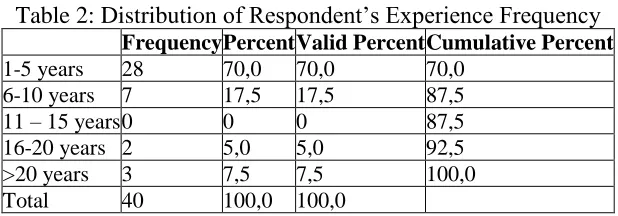
The distribution of experience of respondents in working on a construction project is shown in table 2 below:
Table 2: Distribution of Respondent’s Experience Frequency
Frequency Percent Valid Percent Cumulative Percent
1-5 years 28 70,0 70,0 70,0
6-10 years 7 17,5 17,5 87,5
11 – 15 years 0 0 0 87,5
16-20 years 2 5,0 5,0 92,5
>20 years 3 7,5 7,5 100,0
Total 40 100,0 100,0
Based on table 2, it can be seen that the majority of respondents are contractors who have work experience between 1-5 years that is 70 %. Followed by contractors who have work experience between 6-10 years, over 20 years, and between 16-20 years that are 17.5 %, 7.5 % and 5 %. Meanwhile, no contractors who have work experience between 11-15 years becomes a respondent.
3) Distribution of Construction Project Contract Value
The value of the construction project contract shows the value of the construction project that has been handled by the respondent as a contractor. The distribution of the construction project contract value shown in table 3 below:
Table 3: Distribution of Construction Project Contract Value Frequency
Frequency Percent Valid Percent Cumulative Percent
100 Million - 1 Billion 3 7,5 7,5 7,5
1,01 - 5 Billion 23 57,5 57,5 65,0
5,01 - 10 Billion 5 12,5 12,5 67,5
10,01 - 15 Billion 4 10,0 10,0 77,5
>15 Billion 5 12,5 12,5 100,0
Total 40 100,0 100,0
Http://www.ijetmr.com©International Journal of Engineering Technologies and Management Research [130] percentage as shown in table 3, 1.01 billion - 5 billion is 57.5 %, 5.01 - 10 billion and over 5 billion each 12.5 %, 10.01 - 15 billion is10 % and 100 million to 1 billion is 7.5 %.
4) Distribution of Respondents' Views on Construction Projects
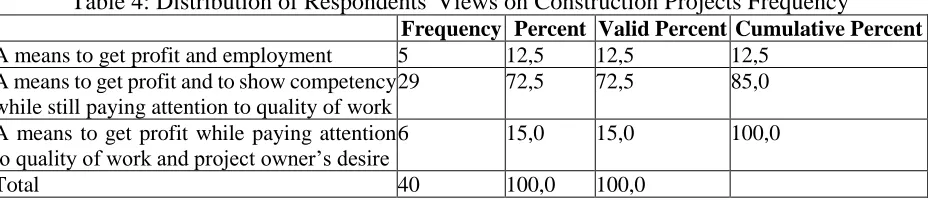
The respondents' view of the construction project shows the contractor's point of view on a construction project. Table 4 below shows the distribution of respondents' views on construction projects:
Table 4: Distribution of Respondents' Views on Construction Projects Frequency
Frequency Percent Valid Percent Cumulative Percent
A means to get profit and employment 5 12,5 12,5 12,5
A means to get profit and to show competency while still paying attention to quality of work
29 72,5 72,5 85,0
A means to get profit while paying attention to quality of work and project owner’s desire
6 15,0 15,0 100,0
Total 40 100,0 100,0
Based on table 4, it can be seen that the respondent in this case the contractor views the construction project in 3 (three) point of views, they are as a means to get profit and employment with a percentage of 12.5%, means of means to get profit and to show competency while still paying attention to quality of work with a percentage of 72.5%, and the A means to get profit while paying attention to quality of work and project owner’s desire with a percentage of 15%. Based on those percentage, the majority of contractors perceive that construction projects are a means to gain profits and show competency while still paying attention to the quality of work.
5) Distribution of the Reasons why the Productivity of Construction Projects Need to be Enhanced
Based on the collected data, all of 40 respondents stated that the productivity of the construction project still needs to be improved. The underlying reasons can be seen in table 5 below:
Table 5: Distribution of the Reasons why the Productivity of Construction Projects Need to be Enhanced Frequency
Frequency Percent Valid Percent Cumulative Percent
Budget does not increase 1 2,5 2,5 2,5
Time Efficiency 4 10,0 10,0 12,5
More effective and efficient work method 14 35,0 35,0 47,5 Improving the quality of construction project 21 52,5 52,5 100,0
Total 40 100,0 100,0
Http://www.ijetmr.com©International Journal of Engineering Technologies and Management Research [131] 6) Obstacles that Faced by Respondents When Implementing Construction Projects
Respondents have a view that in implementing a construction projects there will be obstacles that would have to be faced until the construction project completed. Some of the obstacles that occurred can be seen in table 6 as follows:
Table 6: Obstacle in Impleneting Construction Project
Obstacle in Implementing Construction Project Yes No Qty
Manpower 17 23 40
Material Availability 23 17 40
Availability of Funds 16 24 40
lack of comprehension on the work methods that will be used 11 29 40
The availability of tools 16 24 40
Government policies 5 35 40
Mismatch between workplan and actual conditions in the field 26 14 40
The lack of consultant capability 10 30 40
The lack of cooperation from the project owner 5 35 40
Weather factor 7 33 40
Project neighborhood 4 36 40
From table 6, it can be seen that there are 11 obstacles faced by contractors when implementing construction projects. Among the 11 obstacles it can be stated that the most common obstacle experienced by contractors in implementing construction projects is the mismatch of workplan with actual conditions in the field, that is 65.0% of respondents (contractors). Furthermore, the obstacles that often experienced are the availability of material that is 57.5%, manpower that is 47.5%, and availability of tools and availability of funds each is 40.0%. Other obstacles do not mean that they do not appear, but only a few contractors experience these obstacles (less than one third of respondents).
7) The Most Important Things To Do To Increase The Productivity Of Construction Projects In order to increase the productivity of a construction project, the respondent sets out some of the most important things to do, namely:
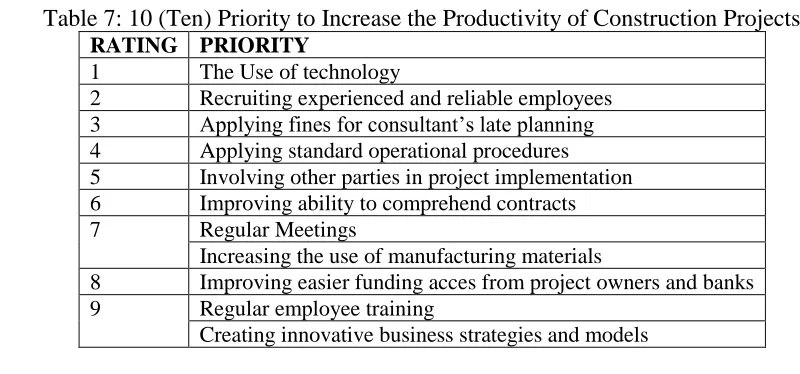
Based on the distribution of respondents' priority selection frequency scores there are 10 (ten) priority groups in an effort to increase the productivity of construction projects in table 7, namely:
Table 7: 10 (Ten) Priority to Increase the Productivity of Construction Projects
RATING PRIORITY
1 The Use of technology
2 Recruiting experienced and reliable employees 3 Applying fines for consultant’s late planning 4 Applying standard operational procedures 5 Involving other parties in project implementation 6 Improving ability to comprehend contracts
7 Regular Meetings
Increasing the use of manufacturing materials
8 Improving easier funding acces from project owners and banks 9 Regular employee training
Http://www.ijetmr.com©International Journal of Engineering Technologies and Management Research [132]
Make project organization Industrial sector collaboration
Cooperation among industrial marketings Comprehension on construction methods 10 Analyze the project in detail
Careful planning
Plan of health and safety work
Clear government policies and regulations
Bidding process that can be participated by wider community Improving communication skills
Using material that is easily to found and worked on
Based on the of the research’s data results and analysis, in general, it can be concluded that: 1) Most of the contractors who become respondents ages from 21 to 30 years old. 2) The majority of contractor work experience is from 1 to 5 years.
3) The value of the construction project contract carried out by the majority contractors (23 contractors) is between 1.01 billion and 5 billion.
4) The contractors consider that construction project is a means to get profits and to show competencies while still paying attention to the quality of the work.
5) The contractor believes that increasing the productivity of construction projects is carried out to improve the quality of construction projects.
6) The contractor considers that mismatches between workplan with actual conditions in the field and the availability of materials are the most common obstacles in implementing construction projects.
7) The use of technology is the most powerful choice used to increase productivity in construction projects.
4. Conclusions and Recommendations
The conclusions that can be drawn taken from the results of the research are:
1) Contractor's point of view on the productivity of a construction project is that productivity needs to be increased because increasing productivity of construction projects can improve the quality of construction projects.
2) The contractor's point of view of the factors that have a strong influence on the productivity of construction projects is mismatches between workplan and actual conditions in the field and material availability. This is based on the choice of these two factors that exceed 50% of the total respondents.
3) The contractor considers that the use of technology is a solution that can be done to increase work productivity on construction projects.
References
[1] Ambar, T. S., Rosidah. Manajemen Sumber Daya Manusia. Graha Ilmu. Yogyakarta. 2009 [2] Bogdan, R., Talyor, J. Introduction to qualitative research methods : a phenomenological approach
to the social science. New York: Willey-interscience publication. 1992
Http://www.ijetmr.com©International Journal of Engineering Technologies and Management Research [133]
[4] Danang, S. Teori, Kuesioner, dan Analisis Data Sumber Daya Manusia (Praktik Penelitian), Yogyakarta. CAPS
[5] Dwi, T., Sri Murni, D., Sugeng, P.B. Faktor-faktor yang Mempengaruhi Produktivitas Pekerja Pada Pekerjaan Atap Baja Ringan di Perumahan Green Hills Malang. Jurnal Rekayasa Sipil, Vol 6, No.1, 2012
[6] Hamdan, D., Kadar, N. Manajemen Proyek. Pustaka Setia. Bandung, 2014
[7] Idzuraida, I. Keterlambatan Proyek Konstruksi Gedung, Faktor Penyebab dan Tindakan Pencegahannya, Jurnal Momentum, Vol.14 (1), Feb, 2013.
[8] Ilyas, Yaslis. Kinerja Teori Penilaian dan Penelitian. Fekom UI, Jakarta. 1999
[9] Issac, A., O., Godwin, I., I. Influence of Labour-Related Factors on Construction Labour Productivity in The South-South Geo-Political Zone of Nigeria. Journal of Construction in Developing Countries, 19(1), pp 93-109, 2014
[10] Jan, T, Pingkan A.K. P, Walangitan, D.R.O. Analisis Tenaga Kerja Terhadap Produktivitas Pada Proyek Konstruksi (Studi Kasus: Rehabilitasi dan perluasan Rumah Dinas Rektor Unsrat), Tekno, Vol. 14, No. 65. April, 2016
[11] Mahamid, I. Contractors Perspective Toward Factors Affecting Labor Productivity in Building Construction. Engineering, Construction and Architectural Management, Vol 20, Issue 5, pp 446-460, 2013
[12] Mohammed, A.H., Montaser A. H., Ghaleb, J.S. Factors Affecting Construction Labour Productivity: A Case Reseach of Jordan. International Journal of Construction Management, Vol. 16, Issue 2, pp 138-149, 2016
[13] Moselhi, O., Khan, Z. Analysis of Labour Productivity of Formwork Operations in Building Construction. Construction Innovation, 2010. 10(3), 286-303
[14] Muchdarsyah, S. Produktivitas, Apa dan bagaimana. Bumi Aksara. Jakarta. 1997 Nasution, Leni Masnidar. Statistik Deskriptif. Jurnal Hikmah, 2017. 14 (1), 49-55
[15] Saryono. Metode Penelitian Kualitatif, Alfabeta. Bandung. 2010
[16] Sedarmayanti. Tata kerja dan Produktivitas kerja. Tinjauan dari aspek ergonomi atau kaitan antara manusia dengan lingkungan kerjanya. Mandar Maju. 2011.
[17] Sekaran, U., Bougie, R. Research methods for business. New York: John Wiley & Sons. 2010 [18] Selviana. Pentingnya K3(Keselamatan dan Kesehatan Kerja) dalam Meningkatkan Produktivitas
kerja. Buletin KPIN, Vol 3, No. 10, Oktober 2017
[19] Soepardi, H., Bambang, P.A., Arief, N. W. Pengaruh Produktivitas Kerja Terhadap Keterlambatan Pelaksanaan Proyek Konstruksi Bangunan. Prosiding Temu Ilmiah IPLBI, 2017, C043-C052 [20] Sunyoto, D. Teori, Kuesioner, dan Analisis Data Sumber Daya Manusia (Praktik Penelitian),
Yogyakarta. CAPS
[21] Supardi. Aplikasi Statistika dalam Penelitian, Change Publication, Jakarta.2013 The Constructor.org. Delays in Construction Projects, Its Types, Effects and Management
[22] Trijono, R. Metode Penelitian Kauntitatif. Papas Sinar Sinanti, Jakarta. 2015 [23] Undang-undang RI No. 28 Tahun 2002 tentang Bangunan Gedung
[24] ibisono, D. PanduanPenyusunan Skripsi, Tesis dan Disertasi. Andi. Yogyakarta. 2013 www.id.m.wikipedia.org. Kontraktor
[25] Yunita, A.M., Theodorus, W., Marisya, L. A. Kajian Penyebab Keterlambatan Pelaksanaan Proyek Konstruksi Gedung di Kota Kupang. Jurnal Teknik Sipil, Vol 11, No.2, September 2013
*Corresponding author.