Printed in The Islamic Republic of Iran, 2015 © Shiraz University
Bending and Free Vibration Analyses of Rectangular Laminated Composite Plates Resting
on Elastic Foundation Using a Refined Shear Deformation Theory
A.R. Setoodeh
*and A. Azizi
Faculty of Mechanical & Aerospace Engineering, Shiraz University of Technology, Shiraz, Iran
Abstract: In this paper, a closed form solution for bending and free vibration analyses of simply supported rectangular laminated composite plates is presented. The static and free vibration behavior of symmetric and antisymmetric laminates is investigated using a refined first-order shear deformation theory. The Winkler–Pasternak two-parameter model is employed to express the interaction between the laminated plates and the elastic foundation. The Hamilton’s principle is used to derive the governing equations of motion. The accuracy and efficiency of the theory are verified by comparing the developed results with those obtained using different laminate theories. The laminate theories including the classical plate theory, the classical first-order shear deformation theory, the higher order shear deformation theory and a three-dimensional layerwise theory are selected in order to perform a comprehensive comparison. The effects of the elastic foundation parameters, orthotropy ratio and width-to-thickness ratio on the bending deflection and fundamental frequency of laminates are investigated.
Keywords: Bending analysis, Free vibration, Refined shear deformation theory, Two-parameter elastic foundation 1. Introduction
Laminated composites are widely used in aerospace, automotive, and marine industries due to their high strength-to-weight ratio. The static, dynamic and buckling analyses of such structures have been the focus of attention for mechanical and structural engineers. Meanwhile, different theories have been developed to predict the behavior of laminated plates. The most popular theory is equivalent to single-layer (ESL) theory according to the literature. The ESL theories are usually categorized in three main categories of the classical plate theory (CPT), first-order shear deformation theory (FSDT), and higher-order shear deformation theories (HSDTs).
In this regard, Shojaee et al. [1] developed a free vibration and buckling analyses of symmetrically thin composites based on the classical plate theory. Reissner [2] developed the FSDT which takes into account the shear deformation effects. Unlike the FSDT, the HSDT satisfies the equilibrium conditions on the top and bottom surfaces without using shear correction factor. Also, Reddy [3] developed a third-order shear deformation theory (TSDT) using polynomial functions for displacement fields. However, most of the HSDTs are computationally expensive due to the additional unknowns which are introduced in the context of the theory. Recently, employing the refined form of the shear deformation theories has been the subject of many researches. Meanwhile, different forms of polynomial, trigonometric and exponential functions are implemented to investigate the mechanical behavior of one- and two-dimensional structures. For instance, Ferreira et al. [4] used sinusoidal functions for displacement fields. Soldatos [5] used hyperbolic functions to express the distribution of displacement components. Karama et al. [6] adopted exponential functions to study mechanical behavior of laminated composite beams. On the other hand, the FSDT may be inaccurate enough to predict the mechanical behavior of thick and moderately thick
Received by the editors March 17, 2015; Revised May 27, 2015 and Accepted June 23, 2015.
laminated composites. Unlike the classical FSDTs, Thai and Choi [7-9] presented a refined theory which contains four unknowns. They exhibited that this refined FSDT can develop accurate results for static and vibration analyses of composite plates.
The subject of plate and beam modeling resting on elastic foundations is important in analyzing structural problems. The two models of Winkler and Pasternak elastic foundations have been widely used in different studies. Although the Winkler model is simple and widely necessary, it is unable to takes into account the nonlinear behavior. Katsikadelis et al. [10] carried out the bending analysis of plates resting on elastic foundation using singular boundary integral equations. Dinev [11] obtained analytical solutions for beams on elastic foundations by singularity functions and using Pasternak foundation. An exact three-dimensional solution of simply supported rectangular plates on Pasternak foundation was developed by Dehghany and Farajpour [12]. Akavci [13] analyzed the laminated composite plates on elastic foundation employing various plate theories. Lal et al. [14] presented an investigation of the stochastic bending static response of laminated composite plates resting on elastic foundation with uncertain system parameters subjected to the static distributed loading. Akavci et al. [15] studied bending deformation of symmetrically laminated plates resting on elastic foundation based on FSDT. Also, Akavci [16] examined buckling and free vibration analyses of simply supported symmetric and antisymmetric cross-ply thick composite plates on elastic foundation by a hyperbolic displacement model. Nedri et al. [17] presented free vibration analysis of laminated composite on elastic foundation using a refined hyperbolic shear deformation theory. A comprehensive static, free vibration and buckling analyses of laminated composite plates on distributed and point elastic supports using a three-dimensional layer-wise finite element method was developed by Setoodeh and Karami [18].
In this paper, a simple refined first-order shear deformation theory is implemented to predict the bending and free vibration behavior of simply supported rectangular laminated composites on elastic foundations. To the best of the authors’ knowledge, the influence of the Winkler-Pasternak two-parameter model on the bending deformation and natural frequencies of any laminate stacking sequence is investigated for the first time in the context of the refined FSDT. Furthermore, similar solutions are presented by reducing the refined theory to the CPT. The closed form solutions of cross-ply and angle-ply laminates on elastic foundation are developed and the results are successfully compared with the existing solutions.
2. Theoretical Formulation
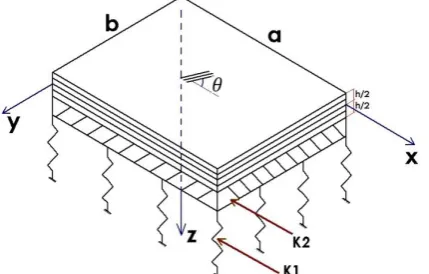
Consider a rectangular composite plate with in-plane dimensions a and b in the x and y directions, respectively, and thickness h in the z direction as shown in Fig. 1. The reference Cartesian coordinate system (x, y, z) is located on the middle-plane of the plate. The plate is consisted of northotropic layers resting on elastic foundation.
The displacement field of the refined FSDT is given by:
1 2 3 , , , , , , , , , , b b b s w u x y z u x y zx w u x y z v x y z
y u x y z w x y w x y
(1)
where (u1, u2, u3) are respectively the components of the displacement vector and (u, v) denote the in-plane displacement components of the middle-plane in the x and y directions, respectively. Unlike the classical FSDT, the transverse displacement u3 is divided into the bending (wb) and shear (ws) parts.
The nonzero in-plane strains (x, y, xy) and the transverse shear strains (xz, yz) are associated with the displacement field in Eq. (1) as:
2 2 2
2 , 2 , 2
,
b b b
x y xy
s s
xz yz
w w w
u v u v
z z z
x x y y y x x y
w w x y
(2)Under the assumption that each layer possesses a plane of elastic symmetry parallel to the x–y plane, the constitutive equations for a layer can be written as:
11 12 12 22
66 44
55
0
0
0
0
0
0
0
0
0
0
0
0
0
0
0
0
0
0
x x y y xy xy yz yz xz xz
Q
Q
Q
Q
Q
Q
Q
(3)Again, (x, y, xy) and (xz, yz) denote the in-plane and the transverse shear stresses, respectively. Here, for each layer Qij is given in terms of the Young’s modulus (E), the Poisson’s ratio () and the shear modulus (G) in different orthotropic directions as below:
1 2
11 22 12 12 22 66 12 44 23 55 13
12 21 12 21
, , , , ,
1 1
E E
Q Q Q
Q Q G Q G Q G
(4)
The stress–strain relations in the laminate coordinates of the kth layer are given as:
(k)
(k) (k)
11 12 16
12 22 26
16 26 66
44 45 45 55
0
0
0
0
0
0
0
0
0
0
0
0
x x
y y
xy xy
yz yz
xz xz
Q
Q
Q
Q
Q
Q
Q
Q
Q
Q
Q
Q
Q
(5)
4 2 2 4
11 11 12 66 22
2 2 4 4
12 11 22 66 12
4 2 2 4
22 11 12 66 22
3 3
16 11 12 66 12 22 66
3
26 11 12 66 12
2 2
4
2 2
2 2
2
Q Q cos Q Q sin cos Q sin
Q Q Q Q sin cos Q sin cos
Q Q sin Q Q sin cos Q cos
Q Q Q Q sin cos Q Q Q sin cos Q Q Q Q sin cos Q
3 22 66
2 2 4 4
66 11 22 12 66 66
2 2
44 44 55
45 55 44
2 2
55 55 44
2
2 2
Q Q sin cos
Q Q Q Q Q sin cos Q sin cos
Q Q cos Q sin Q Q Q sin cos Q Q cos Q sin
(6)
where
is the angle between the global x-axis and the longitudinal direction of fibers of each lamina. The Hamilton’s principle is used to derive the governing equations of motion as:
2
1
0 t
F t
U U V T dt
(7)where U and T are respectively the strain energy and kinetic energy of the plate, UF denotes the strain energy of the elastic foundation, and V is the work done by external forces. The variation form of the strain energy is expressed as:
2 2
2 2 2
2 2
[ 2
] h
x x y y xy xy xz xz yz yz
h A
b b b
x x y y xy xy
A
s s
x y
U dzdA
w w w
u v u v
N M N M N M
x x y y y x x y
w w
Q Q dA
x y
(8)where the stress resultants are defined by:
2 2
2 2
2 2
,
,
,
,
,
,
,
,
,
,
,
h h
x y xy x y xy x y xy x y xy
h h
h
x y xz yz
h
N
N
N
dz
M
M
M
zdz
Q Q
dz
(9)
2 2
11 12 16 11 12 16 2
12 22 26 12 22 26 2
16 26 66 16 26 66 2
2
b x b y xy bw
u
x
x
N
A
A
A
B
B
B
w
v
N
A
A
A
B
B
B
y
y
N
A
A
A
B
B
B
u
v
w
y
x
x y
2 211 12 16 11 12 16 2
12 22 26 12 22 26 2
16 26 66 16 26 66 2
2
b x b y xy bw
u
x
x
M
B
B
B
D
D
D
w
v
M
B
B
B
D
D
D
y
y
M
B
B
B
D
D
D
u
v
w
y
x
x y
44 45 45 55 s x s yw
Q
A
A
x
k
w
Q
A
A
y
(10)where k is the shear correction factor. Also, the elements of the stiffness matrices A, B, D are defined as follows:
/2
2 /2
, , 1, ,
h
ij ij ij ij h
A B D Q z z dz
(11)The variation of the work done by the transverse load q and the kinetic energy are calculated respectively by Eqs. (12) and (13).
b s
AV q w w dA
(12)
1 1 2 2 3 3
0 2
V
b b b b
b s b s
A
K u u u u u u dAdz
w w w w
I u u v v w w w w I
x x y y
(13)The point above a variable denotes, as usual, a time derivative. The various inertias I0 and I2are defined as:
/ 2
2 0 2/ 2
, 1,
h
h
I I z
dz
(14)The variation of UF can be written as:
F e b s
A
U f w w dA
where fe is the density of reaction force of the foundation and is expressed as follows.
2
0 1
e
f k w k w (16) The coefficients k0 and k1 show the elastic stiffness of the Winkler and Pasternak foundations, respectively.
By substituting Eqs. (8), (12), (13) and (15) into Eq. (7), doing some manipulations and collecting the coefficients of
u, v, wband
ws, the governing equations are obtained as below:
0 0 2 2 2 2 20 1 0 2
2 2
2
0 1 0
:
:
: 2
: xy x xy y xy y x
b b s b s b s b
y x
s b s b s b s
N N u I x y N N v I x y M M M
w q k w w k w w I w w I w
x x y y
Q Q
w q k w w k w w I w w
u y v x
(17)By using the stress resultants from Eq. (10), the governing equations can be expressed in terms of displacement components
u v w w
, ,
b,
s
as:
2 2 2 2 2 2
11 2 16 66 2 16 2 12 66 26 2
3 3 3 3
11 3 16 2 12 66 2 26 3 0
2 2 2 2 2 2
16 2 12 66 26 2 66 2 26 22 2
3 16
2
3 2
2
b b b b
u u u v v v
A A A A A A A
x x y y x x y y
w w w w
B B B B B I
x x y x y y
u u u v v v
A A A A A A A
x x y y x x y y
w u B
3 3 3
12 66 26 22 0
3 2 2 3
3 3 3 3 3 3
11 3 16 2 12 66 2 26 3 16 3 12 66 2
4 4 4
3 3
26 2 22 3 11 4 12 66 2 2 16 3
2 3
3 2 2
3 [ 2 2 4
b b b b
b b b
w w w
B B B B I v
x x y x y y
u u u v v
B B B B B B B B
x x y x y y x y x
w w w
v v
B B D D D D
x y y x x y
u y x
4 4 2 226 3 22 4 0 1 0 2
2 2 2
2
55 2 45 44 2 0 1 0
4 ]
2
b b
b s b s b s b
s s s
b s b s b s
w w
D D q k w w k w w I I
x y y
w w w
kA kA kA
w
q k w w k w w I
x x y y w
w w w
3. Analytical Solution for Cross-Ply and Angle-Ply Laminates
We can assume the solutions based on Navier approach, as below:
(18a)
(18b)
1 1 1 1 1 1 1 1 1 1, , sin sin
, , sin sin
, , cos sin
, , sin cos
, , sin cos
i t s smn m n i t b bmn m n i t mn m n i t mn m n i t mn m n
w x y t W e x y
w x y t W e x y
u x y t U e x y
antisymmetric cross ply
v x y t V e x y
u x y t U e x
, ,
1 1 mn i t cos sin
m n
y
antisymmetric angle ply
v x y t V e x y
(19)where i 1,
m
/ ,a
n
/b. Also
U
mn,
V
mn,
W
bmn,
W
smn
are the coefficients, and
is the frequency of the free vibration. The transverse load q is defined using the double Fourier sinusoidal series expansions as:
1 1
, mnsin sin
m n
q x y Q
x
y
(20)The coefficient
Q
mn for some typical loads is obtained as follows:
0 00 0 2
4
, sin sin 16
a b
mn
q for sinusoidal load
Q q x y x ydxdx q
ab for uniformload
mn
(21)Finally, the matrices related to the analytical solutions are obtained by substituting Eqs. (19) and (20) into Eq. (18):
0 11 12 13
0
12 22 23 2
0
13 23 33 34 0
34 44 0 0
0 0 0
0 0
0 0 0
0 0
0 0
0 0 0 0
mn
mn
bmn mn
smn mn
I
s s s U
I
s s s V
s s s s I I W Q
s s I I W Q
(22) where,
2 2 2 2
11 11 66 12 12 66 22 66 22
4 2 2 4 2 2
33 11 12 66 22 0 1
2 2 2 2 2 2
44 55 44 0 1 34 0 1
3 2
13 11 12 66
3 2
23 22 12 66
, , 2 2 , 2 2
s A A s A A s A A
s D D D D k k
s k A A k k s k k
s B B B
for antisymmetric
s B B B
3 213 26 16
3 2
23 16 26
2 2
0 0 2
3
3
cross ply
s B B
for antisymmetric angle ply
s B B
I I I
(23)11 12 13 12 22 23 13 23 33 34
34 44
0
0
0
0
0
0
mn
mn
bmn mn
smn mn
s
s
s
U
s
s
s
V
s
s
s
s
W
Q
s
s
W
Q
(24)
4. Numerical Results
In this section, different examples are demonstrated to indicate the accuracy and efficiency of the present formulation. The results are successfully compared with available solutions and those predicted by various laminate theories. To perform a comprehensive comparison, a separate computer code is prepared based on FSDT theory of Reddy [19] and an analytical solution is developed to generate comparable results. Similarly, the results based on the CPT are provided by setting
w
s
0
in the present theory. Afterwards, the influences of elastic foundation parameters and laminate stacking sequence on the bending behavior and natural frequencies are illustrated. The symmetric and antisymmetric arrangements of laminated composites are considered which exhibit the efficacy of the model. In static analysis, the plate is subjected to sinusoidal loading. The shear correction factor is considered to bek
5 / 6
. Also, the following material properties are assumed in the solutions.Material 1: E1 25E G2, 12G130.5E G2, 230.2E2,
120.25 (25) Material 2: E1/E2 variable, G12G130.6E2, G230.5E2,
120.25 (26) The following non-dimensional parameters are defined throughout the paper:
4 2 3
0 1 2
0 3 1 3 4
2 2 0
2 2
2 2
0
2
0
2
,
,
100
,
,
2 2
,
,
,
0,
,
2 2
2
x x xz xz
a
h
k b
k b
E h
a b
K
K
w
w
E h
E h
q a
h
a b
h
b
z
z
z
z
q a
q a
E
4. 1. Bending analysis
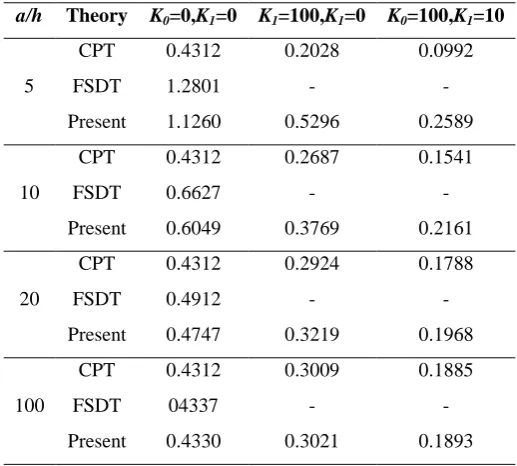
Problem 1. Tables 1 and 2 demonstrate respectively the effects of the elastic foundation parameters on the dimensionless central deflections w for (0,90,0,90) and (0,90,90,0) laminated plates. The results are presented for thin and thick plates with different width-to-thickness ratios (a/h). The present solutions are compared with those obtained using the HSDT [14], FSDT and CPT. It is found that the calculated analytical results agree well with the results of HSDT. It is also seen that the CPT provides acceptable results for the laminated plates with a/h≥ 20. As expected, the value of w decreases with increasing the stiffness of the elastic foundation. By comparing the results reported in Tables 1 and 2, it can be concluded that the dimensionless transverse central deflection of symmetric laminates is smaller than those of antisymmetric laminates. This trend is clarified in Fig. 2. It is seen that the difference in bending deformation of the aforementioned laminates is decreased when the elastic foundation parameters are significantly increased.
Table 1. Dimensionless transverse central deflection w of (0,90,0,90) laminated square plates (material 1).
a/h Theory K0=0,K1=0 K1=100,K1=0 K0=100,K1=10
5
CPT 0.5065 0.2301 0.1108
FSDT 1.2013 - -
Present 1.2013 0.5457 0.2627 HSDT [14] 1.2455 0.4920 0.2561
10
CPT 0.5065 0.3015 0.1676
FSDT 0.6802 - -
Present 0.6802 0.4048 0.2250 HSDT [14] 0.7551 0.4001 0.2559
20
CPT 0.5065 0.3268 0.1922
FSDT 0.5500 - -
Present 0.5500 0.3548 0.2087 100
CPT 0.5065 0.3358 0.2017
FSDT 0.5083 - -
Present 0.5083 0.3370 0.2023
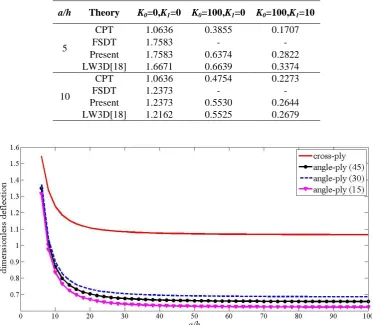
Problem 3. The static analysis of a square two-layer angle-ply
,
laminate is firstly studied and then the resulted bending deformations are compared with those of similar cross-ply laminate as depicted in Fig. 3. Three different ply-orientation angles of (15,-15), (30,-30), and (45,-45) are considered for angle-ply laminates. The variations of the dimensionless central transverse deflection with respect to (a/h) ratio are presented. It is observed that the values of w for all of the angle-ply laminates under consideration are smaller than the corresponding deflections predicted for the cross-ply arrangement.Table 2. Dimensionless transverse central deflection w of (0,90,90,0) symmetric square laminates (material 1).
a/h Theory K0=0,K1=0 K1=100,K1=0 K0=100,K1=10
5
CPT 0.4312 0.2028 0.0992
FSDT 1.2801 - -
Present 1.1260 0.5296 0.2589 10
CPT 0.4312 0.2687 0.1541
FSDT 0.6627 - -
Present 0.6049 0.3769 0.2161 20
CPT 0.4312 0.2924 0.1788
FSDT 0.4912 - -
Present 0.4747 0.3219 0.1968 100
CPT 0.4312 0.3009 0.1885
FSDT 04337 - -
Fig. 2. Variation of dimensionless central deflection w of (0,90,90,0) symmetric (dash lines) and (0,90,0,90) antisymmetric (solid lines) laminates versus (a/h) ratio for different elastic foundation parameters (material 1).
Table 3. Dimensionless transverse central deflectionwof a two-layer cross-ply square laminate (material 1).
a/h Theory K0=0,K1=0 K0=100,K1=0 K0=100,K1=10
5
CPT 1.0636 0.3855 0.1707
FSDT 1.7583 - -
Present 1.7583 0.6374 0.2822 LW3D[18] 1.6671 0.6639 0.3374 10
CPT 1.0636 0.4754 0.2273
FSDT 1.2373 - -
Present 1.2373 0.5530 0.2644 LW3D[18] 1.2162 0.5525 0.2679
Fig. 3. Variations of dimensionless central deflection of two-layer cross-ply (0,90) and angle-ply
,
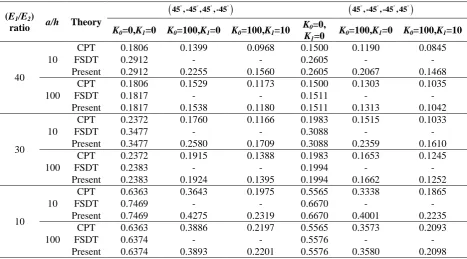
laminates with three different ply-orientation angles versus (a/h) ratio (material 1).Problem 4. This problem is performed for bending analysis of four-layer angle-ply (45,-45,-45,45) symmetric and (45,-45,45,-45) antisymmetric square laminates with different (a/h) and
E
1/
E
2
elastic parameters as listed in Table 4. As mentioned before, similar solutions are developed employing the CPT and classical first-order shear deformation theory. The good agreement between the results of the present theory and those obtained by the classical FSDT is obvious. Furthermore, The CPT exhibits acceptable results only for thin laminatedcomposite plates due to neglect of the shear deformation effect. Also, it is seen that the value of w increases with decreasing the degree of orthotropy.
Problem 5. In the next problem, a stress analysis is carried out for a square four-layer angle-ply laminate arranged as (0,90)2 with various
E
1/
E
2
ratios. The variations of the dimensionless normal andtransverse stress components in the x-direction with respect to different values of the elastic foundation parameters are illustrated in Table 5. It is observed that
x decreases with increasing the elastic foundation stiffness or with decreasing the
E
1/
E
2
ratio.4.2.Free vibration analysis
Problem 6. In this problem, free vibration analysis of square antisymmetric cross-ply laminated plates is investigated using Eq. (22) in the absence of external load. In Table 6, the dimensionless natural frequencies of laminates obtained by using different theories are shown for various values of
E
1/
E
2
ratios. The present results are compared with those reported in Ref. [17] using the HSDT, and the three-dimensional elasticity (3D) solutions given in Ref. [20]. It is observed that the present approach can provide accurate results in comparison with the three-dimensional elasticity solutions. It is found that the dimensionless fundamental frequency increases with increasing the orthotropy
E
1/
E
2
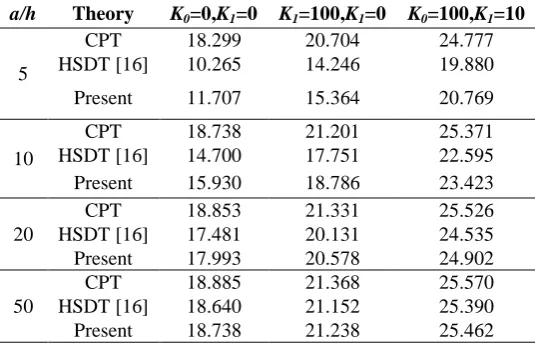
ratio.Problem 7. In the next problem, a square three-layer cross-ply laminate is considered. The obtained dimensionless fundamental frequencies for different elastic foundation parameters and width-to-thickness ratios (a/h) are demonstrated in Table 7. The present results are compared with those predicted using the HSDT [14], FSDT and CPT. It is observed that the present solution is in close agreement with the results reported in Ref. [16]. It can be also concluded that the frequencies of laminates increase with increasing the stiffness of the elastic foundation.
Table 4. Dimensionless transverse central deflection w of square four-layer angle-ply laminates with various orientations (material 2).
(E1/E2)
ratio a/h Theory
° ° ° °
45 , -45 , 45 , -45
° ° ° °
45 , -45 , -45 , 45
K0=0,K1=0 K0=100,K1=0 K0=100,K1=10
K0=0, K1=0
K0=100,K1=0 K0=100,K1=10
40 10
CPT 0.1806 0.1399 0.0968 0.1500 0.1190 0.0845
FSDT 0.2912 - - 0.2605 - -
Present 0.2912 0.2255 0.1560 0.2605 0.2067 0.1468 100
CPT 0.1806 0.1529 0.1173 0.1500 0.1303 0.1035
FSDT 0.1817 - - 0.1511 - -
Present 0.1817 0.1538 0.1180 0.1511 0.1313 0.1042
30 10
CPT 0.2372 0.1760 0.1166 0.1983 0.1515 0.1033
FSDT 0.3477 - - 0.3088 - -
Present 0.3477 0.2580 0.1709 0.3088 0.2359 0.1610 100
CPT 0.2372 0.1915 0.1388 0.1983 0.1653 0.1245
FSDT 0.2383 - - 0.1994 - -
Present 0.2383 0.1924 0.1395 0.1994 0.1662 0.1252
10 10
CPT 0.6363 0.3643 0.1975 0.5565 0.3338 0.1865
FSDT 0.7469 - - 0.6670 - -
Present 0.7469 0.4275 0.2319 0.6670 0.4001 0.2235 100
CPT 0.6363 0.3886 0.2197 0.5565 0.3573 0.2093
FSDT 0.6374 - - 0.5576 - -
Table 5. Dimensionless stress components of a square four-layer angle-ply laminate arranged as (0,90)2 with various
E1/E2
ratios (material 2).Table 6. Dimensionless fundamental frequency
of square antisymmetric cross-ply laminates (material 2, a/h=5).lamination Theory E1/E2=10 E1/E2=20 E1/E2=40
(0/90)1
3D [20] 6.9845 7.6745 8.5625 HSDT [17] 6.9839 7.8095 9.0610 Present 6.9392 7.7060 8.8333
(0/90)2
3D [20] 8.1445 9.4055 10.6790 HSDT [17] 8.1999 9.6353 11.1853 Present 8.2246 9.6885 11.2708
(0/90)3
3D [20] 8.4143 9.8398 11.2720 HSDT [17] 8.4069 9.9205 11.5019 Present 8.4183 9.9427 11.5264
(0/90)5
3D [20] 8.5625 10.0843 11.6245 HSDT [17] 8.5131 10.0670 11.6682 Present 8.5132 10.0638 11.6444
Table 7. Dimensionless fundamental frequency
of a square three-layer cross-ply laminate resting on elastic foundation (material 2, E1/E2=40).a/h Theory K0=0,K1=0 K1=100,K1=0 K0=100,K1=10
5
CPT 18.299 20.704 24.777 HSDT [16] 10.265 14.246 19.880 Present 11.707 15.364 20.769 10
CPT 18.738 21.201 25.371 HSDT [16] 14.700 17.751 22.595 Present 15.930 18.786 23.423 20
CPT 18.853 21.331 25.526 HSDT [16] 17.481 20.131 24.535 Present 17.993 20.578 24.902 50
CPT 18.885 21.368 25.570 HSDT [16] 18.640 21.152 25.390 Present 18.738 21.238 25.462
5. Conclusion
In this article, a refined shear deformation theory is employed for bending and free vibration analyses of simply supported rectangular laminated composite plates resting on elastic foundation. The Winkler– Pasternak two-parameter foundation model is considered in the analysis and a closed form solution is developed. The effects of laminate stacking sequence, width-to-thickness ratio, elastic foundation parameters and orthotropy ratio on the bending deformation and natural frequencies of plates are investigated. Comparison studies are performed to verify the validity and efficacy of the present model. It is exhibited that the theory is capable of predicting reliable results for thick and moderately thick laminated composites with reducing the computational cost.
(E1/E2)
ratio
x
xz
K0=0, K1=0 K1=100,K1=0 K0=100,K1=10 K0=0, K1=0 K0=100,K1=0 K0=100,K1=10
6. References
[1] S. Shojaee, N. Valizadeh, E. Izadpanah, T. Bui and T. V. Vu, Free vibration and buckling analysis of laminated composite plates using the NURBS-based isogeometric finite element method, Journal ofComposite Structure,
94(2012) 1677–1693.
[2] E. Reissner, The effect of transverse shear deformation on the bending of elastic plates, Journal of Composite
materials, 12(1945) 69–72.
[3] J.N. Reddy, A simple higher-order theory for laminated composite plates, Journal of Applied Mechanics, 51(1984) 745–752.
[4] A.J.M. Ferreira, C.M.C. Roque and R.M.N. Jorge, Analysis of composite plates by trigonometric shear deformation theory and multiquadrics, Journal ofComposite Structure, 83 (2005)2225–2237.
[5] K.P.Soldatos, A transverse shear deformation theory for homogeneous monoclinic plates, Journal of Acta
Mechanica, 94(1992) 195–220.
[6] M. Karam, K.S. Afaq and S. Mistou, Mechanical behaviour of laminated composite beam by the new multi-layered laminated composite structures model with transverse shear stress continuity, Journal of Solids and
Structures, 40(2003) 1525–1546.
[7] H.T. Thai and D.H. Choi, A simple first-order shear deformation theory for the bending and free vibration analysis of functionally graded plates, Journal ofComposite Structure, 101 (2013) 332–340.
[8] H.T. Thai, D.H. Choi, Finite element formulation of various four unknown shear deformation theories for functionally graded plates, Journal ofFinite Elements in Analysis and Design, 75(2013) 50–61.
[9] H.T. Thai and D.H. Choi, A simple first-order shear deformation theory for laminated composite plates, Journal
ofComposite Structure, 106(2013) 754–763.
[10]T. Katsikadelis and A. E. Armenakas, Plates on elastic foundation by BIE method, Journal of Engineering
Mechanics, 110(1984) 1086-1105.
[11]D. Dinev, analytical solution of beam on elastic foundation by singularity functions,Journal of Engineering
Mechanics, 19(2012) 381–392.
[12]M. Dehghany and A. Farajpour, Free vibration of simply supported rectangular plates on Pasternak foundation: An exact and three-dimensional solution, Journal of Engineering Solid Mechanics, 2(2013) 29-42.
[13]S.S. Akavci, Analysis of thick laminated composite plates on an elastic foundation with the use of varius plate theories,Journal of Mechanics of Composite Materials, 41(2005) 663-682.
[14]A. Lal, B. N. Singh and R. Kumar, Static Response of Laminated Composite Plates Resting on Elastic Foundation with Uncertain System Properties, Journal of Reinforced Plastics and Composites, 26(2007) 807– 823.
[15]S.S. Akavci, H.R. Yerli and A. Dogan, The first order shear deformation theory for symmetrically laminated composite plates on elastic foundation, The Arabian Journal for Science and Engineering, 32(2007) 341-348. [16]S.S. Akavci, Buckling and free vibration analysis of symmetric and antisymmetric laminated composite plates
on an elastic foundation, Journal of Reinforced Plastics and Composites, 26(2007) 1907–1913.
[17]K. Nedri, N. El Meiche and A. Tounsi, Free vibration analysis of laminated composite plates resting on elastic foundation by using a refined hyperbolic shear deformation theory, Journal of Mechanics of Composite
Materials, 49(2013)943–958.
[18]A.R. Setoodeh and G. Karami, Static, free vibration and buckling analysis of anisotropic thick laminated composite plates on distributed and point elastic supports using a 3-D layer-wise FEM, Journal of Engineering
Structures, 26(2003) 211–220.
[19]J.N. Reddy, Mechanics of laminated composite plates and shells: theory and analysis, CRC Press, Boca Raton, (2004).