Shiraz University
Effect of Different Fertilization Systems on Yield and Seed
Mineral Elements of Pumpkin
A. HABIBI
1*,
G. HEIDARI
1**,
Y. SOHRABI
1*and H.
BADAKHSHAN
1*1
Department of Agronomy and Plant Breeding, College of Agriculture, University of Kurdistan, Sanandaj, I. R. Iran.
Received28 August 2014, Accepted 14 January 2015, Available Online 3 March 2015
ABSTRACT- To investigate the effects of bio-chemical and organic fertilizers on yield and seeds NPK contents of pumpkin (Cucurbita pepo var. styriaca), an experiment was conducted at the Research Farm of Kurdistan University in 2009 growing season. Treatments were included 1) control, 2) seeds inoculated with free-living N fixing bacteria (NFB), 3) seeds inoculated with phosphate-solubilizing bacteria (PSB), 4) chemical fertilizer (C), 5) organic fertilizer (O) , 6) NFB + PSB, 7) NFB+ 50% O, 8) NFB+ 50% C, 9) PSB + 50% O, 10) PSB + 50% C, 11) 50% O + 50% C, 12) NFB+ PSB + 50% O, 13) NFB+ PSB + 50% C, 14) NFB+ PSB + 50% O + 50%. The highest value of nitrogen concentration was observed in the NFB+ 50% C and NFB+ PSB+ 50%C treatments. The highest potassium concentration was found in the NFB+ 50% C treatment. The maximum phosphorous concentration was observed in PSB+ 50%C. The maximum seed yield was obtained from the treatment that pumpkin seeds inoculated with free-living N (NFB) and phosphate-solubilizing bacteria (PSB) + 50% organic fertilizer. The highest fruit yield was obtained from NFB+ PSB+ 50%C+ 50%O. It was concluded that application of biofertilizers in combination with 50% chemical and organic fertilizers, reduced the use of chemical fertilizers and produced higher seed and fruit yield.
Keywords: Bio Fertilizer, Compost, Medicinal Pumpkin, Nitrogen, Potassium, Yield
INTRODUCTION
Medicinal pumpkin, called Styrian oil pumpkin or Cucurbita pepo, has been formed by an accidental natural mutation that led to tremendous morphological changes of the seed architecture (9). Nitrogen (N) and phosphorus (P) are the most important nutrients for
plant growth (4). Large quantities of chemical fertilizers are used to replenish soil N and P, resulting in high costs and severe environmental contamination (29). Biofertilizers contain a variety of beneficial microorganisms and enzymes which accelerates and improves plant growth and protects plants from pests and diseases (8). P bio-fertilizers in the form of microorganisms, especially phosphate-solubilizing bacteria in rhizosphere, can help increase the availability of accumulated phosphates for plant growth by solubilization (18). Important genera of phosphate solubilizing bacteria are Bacillus and Pseudomonas (22). Phosphate solubilizing microorganisms secrete organic acids and phosphatase enzyme that act on insoluble phosphate and convert it into plant available form (20, 28). This process not only reduces higher cost of manufacturing fertilizers but also mobilizes the fertilizers added to soil (27). Biological nitrogen fixation by free-living nitrogen fixing microorganisms occurs in soils by several aerobic (Azotobacter, Beijerinickia) or microaerobic (Azospirilum) prokaryotes (12). These bacteria contain nitrogenase enzyme responsible for fixing atmospheric di-nitrogen into soil, thus improving the soil fertility (11). The addition of organic material of various origins to soil has been one of the most common practices to improve soil properties (7). Compost enhances the environmental sustainability of agriculture by decreasing chemical inputs and increasing soil organic matter (16). The benefits of animal manure application to soil organic matter quality, nutrient availability, soil aggregation and other soil functions are well known (14). Application of organic manure combined with chemical fertilizer is an important approach to maintaining and improving the soil fertility, and increasing fertilizer use efficiency (15). Therefore, the present investigation was undertaken to study the effects of N-fixing and P-solubilizing bacteria in the presence of chemical and organic fertilizers on yield, mineral elements of pumpkin seeds.
MATERIALS AND METHODS
ha-1) and organic fertilizers (10 t ha-1) were applied before sowing. It was applied 100 kg ha-1 potassium sulfate based on soil analyses for all treatments. Organic fertilizers were analyzed for chemical and nutrients properties (Table 2). Urea fertilizer (nitrogen source containing 46% nitrogen) was added to plants at the early flowering stage (120 kg ha-1). Two kinds of phosphate -solubilizing bacteria (Pseudomonas putida strain p 13, Bacillus lentusstrain p 5) and two kinds of nitrogen fixing bacteria (Azotobacter, Azospirillum) were used as the biofertilizers. These bacteria strains were originally isolated from farm soils in Iran and were obtained from Iranian Soil and Water Research Institute. For seed inoculation, 100 g PSB and 1 lit NFB for 8 kg seed per hectare were used before being immediately planted.
Table 1. Some physicochemical characteristics of soil in research field Soil
texture Clay
% Sand
% Silt
% pH
EC (dSm-1)
OC (%)
N %
K (mg kg-1)
Zn (mg kg-1)
Fe (mg kg-1)
Cu (mg kg-1)
P (mg kg-1) Sandy
loam 16 58 26 7.9 0.61 1.46 0.21 82.95 5.56 12.19 2.3 5.14
Table 2. Chemical characteristics of organic fertilizers applied in the soil
characteristics pH N (%)
P (%)
K (%)
Ca (mg kg-1)
Mg (mg kg-1)
Zn (mg kg-1)
Cu (mg kg-1)
Animal manure 7.51 0.52 0.45 0.32 832 1205 3 28
Compost 7.18 0.72 1.21 0.55 1871 1951 14 302
Fruit and seed yield
Fruits were harvested from three central rows of each plot on September 2009. Ripe fruits were harvested, weighted and then the seeds of each fruit were manually extracted and dried in shade and room temperature. All dried seeds were weighted separately. Grain harvest index was calculated by the following Eq.
Grain harvest index= Seed yield/ Fruit yield
Chemical composition of pumpkin seed
The seed N content was measured by the micro-kjeldahl method as described by Peach and Tracey(19).
Potassium (K) and P were determined using a flame photometer and spectro photometric method, respectively, as described by Skroch et al. (26). P and K uptake per unit area were determined by the following Eq. (24):
P or K Uptake = seed yield × P or K concentration
Statistical analysis
RESULTS AND DISCUSSION
significantly affected by the treatments The results indicated that all the measured traits, except for the harvest index were (p<0.01) (Tables 3 and 4).
Table 3. Analysis of variance for different fertilizer treatments on fruit and seed yield and harvest index of pumpkin
Mean square
SOV df Fruit yield Seed yield Harvest index
Block 2 600880.07* 645.23ns 0.097ns
Treatment 13 511288.42** 1447.22** 0.064ns
Error 26 143778.45 185.61 0.042
CV 8.57 17.21 12.01
ns: not significant,*Significant at P < 0.05,**Significant at P < 0.01
Table 4. Analysis of variance for different fertilizer treatments on chemical composition of pumpkin seed
Mean square
SOV df N K K uptake P P uptake
Block 2 35.45** 71446.41** 88.63ns 12139.93ns 282.05ns Treatment 13 0.718** 51987.49** 1545.53** 113551.37** 3534.77**
Error 26 0.205 5274.04 343.74 27153.18 490.18
CV 8.22 7.62 26.02 13.34 24.08
ns: not significant,*Significant at P < 0.05,**Significant at P < 0.01
Fruit and seed yield
growth promoting substances (23). These results were in agreement with those of Al-Harbi and Wahb-Allah (1). They found that in summer squash, the highest fruit yield was obtained by applying 72 kg N fertilizer with biofertilizer (Azotobacter, Azospirillium and Klebsiella) inoculation.
Table 5. The effect of fertilizer treatments on fruit yield, seed yield and harvest index of pumpkin (Cucurbita pepo var. styriaca).
Treatments N-fixing
Bacteria (NFB)
Phosphate-solubilizing Bacteria (PSB)
Chemical fertilizer
(C)
Organic fertilizer (O)
Fruit yield (g m-2)
Seed yield (g m-2)
Harvest index (%)
- - - - 1933.7 e 31.26 e 1.89 a
+ - - - 3874.9 cd 66.03 cd 1.70 a
- + - - 3674.6 cd 64.77 cd 1.89 a
+ + - - 4010.4 cd 67.27 cd 1.67 a
- - + - 3823.8 cd 66.5 cd 1.73 a
- - - + 3673.3 cd 61.88 cd 1.77 a
- - + + 3400.6 d 58.22 cd 1.31 a
+ - + - 5790.5 b 74.09 c 1.67 a
+ - - + 4321.4 c 70.69 cd 1.75 a
- + + - 4213.5 c 69.14 cd 1.74 a
- + - + 4239.1 c 73.41 c 1.72 a
+ + + - 6272.2 ab 97.97 b 1.59 a
+ + - + 6056.2 ab 118.5 a 1.60 a
+ + + + 6640.4 a 105.49 ab 1.89 a
LSD%5 636.39 19.68 0.37
Means with a common letter are not significantly different using LSD Test at 5% probability level. Amount used for the treatments: NFB 1 lit ha-1; PSB 100 g ha-1; C Single super phosphate (150 kg ha-1) + Urea (120 kg ha-1) when applied alone and Single super phosphate (75 kg ha-1) + Urea (60 kg ha-1) when combined with other treatments; O 10 ton ha-1when applied alone and 5 ton ha-1when combined with other treatments.
Mineral elements
The highest nitrogen concentration (6.23%) was observed in NFB+ 50% C but it was not significantly different from the NFB+ PSB+ 50%C (6.16%) treatment (Table 6). Increased seed N content after applying nitrogen fixing bacteria might be due to the direct effects of these bacteria in N-fixation, hormone production or to more efficient N assimilation aided by the bacterial nitrate reductase (25).
treatment and NFB+ PSB+ 50% C and NFB+ PSB+ 50% O treatments (Table 7). Sahravat (23) reported that significant linear relationships were observed between grain yield and total P uptake in upland rice.
Table 6. The effect of fertilizer treatments on seed N and K contents and K uptake composition of pumpkin (Cucurbita pepo var. styriaca).
Treatments N-fixing
Bacteria (NFB)
Phosphate-solubilizing Bacteria (PSB)
Chemical fertilizer
(C)
Organic fertilizer (O)
N (%) K
(mg/100g )
K uptake (g m-2)
- - - - 4.36 d 615.3 d 19.61 e
+ - - - 5.45 bc 1004.8 bc 66.77 cd
- + - - 5.59 abc 978.5 c 64.96 cd
+ + - - 5.43 bc 1034.3 b 73.28 bcd
- - + - 5.57 abc 946.2 c 62.96 d
- - - + 5.21 c 864 c 53.57d
- - + + 5.73 abc 871.8 c 50.92d
+ - + - 6.23 a 1218 a 94.54 abc
+ - - + 5.36 bc 1056.2 b 75.23 abcd
- + + - 5.91 abc 930 c 63.6 cd
- + - + 5.62 abc 995.8 bc 72.99 bcd
+ + + - 6.16 a 961 c 94.17 abc
+ + - + 5.65 abc 897 c 104.72 a
+ + + + 6.01 ab 970.7 c 101.28 ab
LSD%5 0.75 121.9 31.12
Means with a common letter are not significantly different using LSD Test at 5% probability level. Amount used for the treatments: NFB 1 lit ha- 1; PSB 100 g ha-1; C Single super phosphate (150 kg ha-1) + Urea (120 kg ha-1) when applied alone and Single super phosphate (75 kg ha-1) + Urea (60 kg ha -1) when combined with other treatments; O 10 ton ha-1 when applied alone and 5 ton ha-1 when combined with other treatments.
The highest seed K concentration (1218 mg/100g) was observed with the application of nitrogen fixing bacteria combined with 50% chemical fertilizer. The effect of these microorganisms (Azotobacter and Azospirillum) on K uptake might be attributed to their more efficiency in supplying biologically fixed nitrogen and enhancing plant growth by producing phytohormones, which stimulate nutrients absorption (6). According to Table 6, applying organic fertilizer alone or in combination with other fertilizers increased the K uptake, compared with the control treatment. This may be due to the positive effects of organic fertilizers on soil structure that lead to increasing the area of the roots per unit of soil volume, increasing the nutrient uptake, slowing the release of nutrients and enhancing fertilizer use efficiency (17).
Despite the maximum K uptake per unit area related to NFB+ PSB+ 50%O treatment, this treatment had the lowest content of K in seeds (Table 6). Therefore, we can conclude that K content of seeds decreased because of high seed yield production and dilution of K concentration in the NFB+ PSB+ 50%O treatment.
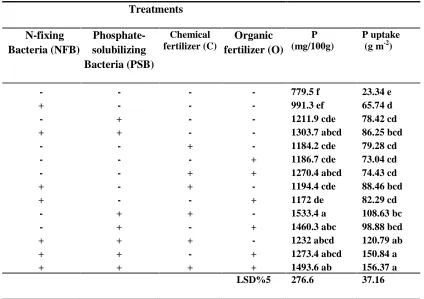
phosphate-dissolving bacteria can increase the availability of phosphorous. These bacteria secrete organic acids, which lead to a transfer of fixed phosphate to available phosphate (13). Also applying nitrogen fixing bacteria, compared with other treatments, increased P absorption (Table 7).
Table 7. The effect of fertilizer treatments on seed P content and P uptake composition of pumpkin seed (Cucurbita pepo var. styriaca).
Treatments N-fixing
Bacteria (NFB)
Phosphate-solubilizing Bacteria (PSB)
Chemical fertilizer (C)
Organic fertilizer (O)
P (mg/100g)
P uptake (g m-2)
- - - - 779.5 f 23.34 e
+ - - - 991.3 ef 65.74 d
- + - - 1211.9 cde 78.42 cd
+ + - - 1303.7 abcd 86.25 bcd
- - + - 1184.2 cde 79.28 cd
- - - + 1186.7 cde 73.04 cd
- - + + 1270.4 abcd 74.43 cd
+ - + - 1194.4 cde 88.46 bcd
+ - - + 1172 de 82.29 cd
- + + - 1533.4 a 108.63 bc
- + - + 1460.3 abc 98.88 bcd
+ + + - 1232 abcd 120.79 ab
+ + - + 1273.4 abcd 150.84 a
+ + + + 1493.6 ab 156.37 a
LSD%5 276.6 37.16
Means with a common letter are not significantly different using LSD Test at 5% probability level. Amount used for the treatments: NFB 1 lit ha- 1; PSB 100 g ha-1; C Single super phosphate (150 kg ha-1) + Urea (120 kg ha-1) when applied alone and Single super phosphate (75 kg ha-1) + Urea (60 kg ha -1) when combined with other treatments; O 10 ton ha-1 when applied alone and 5 ton ha-1 when combined with other treatments.
This could be due to the direct effect of bacteria on root growth and greater mineral uptake (10). Using organic fertilizers combined with phosphate- dissolving bacteria increased P content of pumpkin seeds (Table 7). The organic fertilizers release nutrients slowly and the application of organic fertilizers alone cannot provide essential P for plant completely (5). Therefore, the application of phosphate-dissolving bacteria can increase the available P by hydrolysis P from organic and inorganic compounds due to acidification of soil or secretion of phosphatase enzymes (21).
CONCLUSIONS
It was concluded that the application of biofertilizers in combination with 50% chemical and 50% organic fertilizers had a great potential to increase yield of pumpkin seeds, and improved the use efficiency of chemical fertilizers. Also, compared with conventional chemical fertilizers, integrated plant nutrition systems could ensure agricultural production and safeguard the environment. Developing a suitable nutrient management system that integrates the use of bio, organic and chemical fertilizers may be a surefire way to reach the goal of sustainable agriculture.
ACKNOWLEDGMENTS
Financial support from University of Kurdistan Research Council in Iran is gratefully acknowledged.
REFERENCES
1. Al-Harbi, A. R. and M. A. Wahb-Allah. 2006. Effect of biofertilization under different nitrogen levels on growth, yield and quality of summer squash. J. Saudi Soc. Agric. Sci. 5(1): 42-54.
2. Ayoola, O. T. 2010. Yield performance of crops and soil chemical changes under fertilizer treatments in a mixed cropping system. Afr. J. Biotechnol. 9(26): 4018-4021.
3. Chang, C. H. and S. S. Yang. 2009. Thermo-tolerant phosphate-solubilizing microbes for multi-functional biofertilizer preparation. Bioresource Technol. 100: 1648-1658.
4. Chen, J. 2006. The combined use of chemical and organic fertilizer and or biofertilizer for crop growth and soil fertility. Taipei Food Fert. Technol. Bull. 17: 1-9.
5. El-Assiouty, F. M. M. and S. A. Abo-Sedera. 2005. Effect of bio and chemical fertilizers on seed production and quality of spinach (Spinacia oleracea L.). Int. J. Agric. Biol. 7(6): 947-952.
6. Efthimiadou, A., D. Bilalis, A. Karkanis and B. Froud-Williams. 2010. Combined organic/inorganic fertilization enhances soil quality and increased yield, photosynthesis and sustainability of sweet maize crop. Aust. J. Crop Sci. 4(9): 722-729.
8. Fruhwirth, G. O. and A. Hermetter. 2007. Seed and oil of the styrian oil pumpkin: components and biological activities. Eur. J. Lipid Sci. Technol. 109: 1128-1140. 9. Gharib, F., L. A. Moussa and O. N. Massoud. 2008. Effect of compost and bio-fertilizers on growth, yield and essential oil of sweet marjoram (Majorana hortensis) plant. Int. J. Agric. Biol. 10(4): 381-382.
10. Gothwal, R. K., V. K. Nigam, M. K. Mohan, D. Sasmal and P. Ghosh 2007. Screening of nitrogen fixers from rhizospheric bacterial isolates associated with important desert plants. Appl. Ecol. Environ. Res. 6(2): 101-109.
11. Kavadia, A., D. V. Vayenas, S. Pavlou and G. Aggelis. 2007. Dynamics of free-living nitrogen-fixing bacterial population in antagonistic conditions. Ecol. Model. 200: 243-253.
12. Mahfouz, S. A. and M. A. Sharaf-Eldin. 2007. Effect of mineral vs. biofertilizer on growth, yield, and essential oil content of fennel (Foeniculum vulgare Mill.). Int. Agrophys. 21: 361-366.
13. Mao, J., D. C. Olk, X. Fang and Z. He, K. Schmidt-Rohr. 2008. Influence of animal manure application on the chemical structures of soil organic matter as investigated by advanced solid-state NMR and FT-IR spectroscopy. Geoderma. 146: 353-362.
14. Min-gang, X., L. Dong-chu, L. Ju-mei, Q. Dao-zhu, K. Yagi and Y. Hosen. 2008. Effect of organic manure application with chemical fertilizers on nutrient absorption and yield of rice in Hunan southern china. Chin. J. Agric. Sci. 7(10): 1245-1252.
15. Mohamed, M. A. H. and M. Abdu. 2004. Growth and oil production of fennel (Foeniculum vulgare Mill): effect of irrigation and organic fertilization.
Biol. Agric. Hort. 22: 31-39.
16. Naveed, M., M. Khalid, D. L. Jones, R. Ahmad and Z. A. Zahir. 2008. Reletive efficacy of pseudomonas spp., containing ACC -deaminase for improving growth and yield of maize (Zea mays L.) in the presence of organic fertilizer. Pak. J. Bot. 40(3): 1243-1251.
17.Ngoc-Son, T. T., C. Ngoc-Diep and T. T. Minh Giang. 2006. Effect of Bradyrhizobia and phosphate solubilizing bacteria application on soybean in rotational system in the Mekong delta. Omonrice. 14: 48-57.
18. Peach, K. and M. V. Tracey. 1956. Modern methods of plant analysis. Springer-Verlag, Berlin. 735 p.
19. Ponmurugan, P. and G. Gopi. 2006. Distribution pattern and screening of phosphate solubilizing bacteria isolated from different food and forage crops. J. Agron. 5(4): 600-604.
20. Pouryousef, M., M. R. Chaichi, D. Mazaheri, M. Fakhretabatabaii and A. Jafari. 2007. Effect of different soil fertilizing system on seed and
mucilage yield and seed P content of Isabgol (Plantago ovate Forsk). Asian J. Plant Sci. (7): 1088-1092.
and phosphate solubilization by phosphate solubilizing microorganisms (PSM) under in vitro conditions. Pak. J. Biol. Sci. 7(2): 187-196.
22. Rokhzadi, A., A. Asgharzadeh, F. Darvish, G. Nour-mohammadi and E. Majidi. 2008. Influence of plant growth-promoting rhizobacteria on dry matter accumulation and yield of chickpea (Cicer arietinum L.) under field condition. Am. Eurasian J. Agric. Environ. Sci. 3(2): 253-257.
23. Sahrawat, K. L. 2008. Direct and residual phosphorus effects on grain yield phosphorus uptake relationships in upland rice on an ultsol in West Africa. Int. J. Plant Prod. 2(4): 281-287.
24. SAS Institute 2002. The SAS System for Microsoft Windows. Release 8.2. Cary, NC.
25. Shehata, M. M. and S. A. El-khawas. 2003. Effect of biofertilizers on growth parameters, yield characters, nitrogenous components, nucleic acids content, minerals, oil content, protein profiles and DNA banding pattern of sunflower (Helianthus annus L. cv. Vedock) yield. Pak. J. Biol. Sci. 6(14): 1257-1268. 26. Skroch, K., C. Hoffman, L. Mundt and R. Gelderman. 1999. Plant analysis
procedures. South Dakota State University Agricultural Experiment Station. pp: 44.
27. Turan, M., N. Ataoglu and F. Sahin. 2007. Effect of Bacillus FS-3 on growth of tomato (Lycopersicon esculentum L.) plants and availability of phosphorus in soil. Plant Soil Environ. 53(2): 58-64.
28. Vessey, J. K. 2003. Plant growth promoting rhizobacteria as biofertilizers. Plant Soil. 255: 571-586.