1Sangeeta Ghosh
2Bhatri Pratim Dowarah *3Abhijit Dutta
CORRESPONDING AUTHOR
*3Abhijit Dutta
Associate Professor, HOD, Dept. of Physiotherapy,
Assam Down Town University,
Chandrapur Road, Sankar Madhab Path, Gandhi Nagar, Panikhaiti,
Guwahati, Assam 781026, India. www.ijphy.org
Int J Physiother. Vol 2(6), 1103-1109, December (2015) ISSN: 2348 - 8336
DOI: 10.15621/ijphy/2015/v2i6/80775
ABSTRACT
Background: Stroke-related balance and gait deficits contribute to the large number of falls in these patients. This may be due to inappropriate reaction to external forces. Hence, one has to be able to react to external forces with appropriately timed and scaled responses to maintain balance. Therefore it is important to identify which patients have risk of falling and would benefit from fall prevention measures. To accomplish this, valid and reliable clinical scales those are easy to administer are needed. Assessment scales that predict falls have been tested in different populations. The present prospective study compares two simple scales viz. Timed Up and Go test (TUG) and Performance Oriented Mobility Test (POMA) in fall prediction among patients with sub acute and chronic stroke. Methodos: 50 stroke subjects were asked to perform both the tests viz. TUG and POMA one after another on the date of evaluation or Day 0 and from Day 1 falls are recorded per month up to six months. Both test results were compared for their accuracy.
Results: It was found that t = -4.496 which is highly significant at (p=0.00) which proves that there is remarkable difference in means of TUG and POMA. TUG covers 0.970 and POMA covers 0.135 area in the curve and is an established fact that higher area indicates excellent accuracy. The sensitivity and specificity of TUG is 78% and 94% respectively and that of POMA is 90% and 60% respectively. Conclusion: To conclude, we can say that there is significant difference between the Timed Up and Go test and Tinetti‘s Performance Oriented Mobility Assessment score on prediction of fall in Hemiparetic Stroke patients.
Keywords: Fall prediction in stroke, Timed up & go test, Tinetti performance oriented mobility assessment.
1Physiotherapist,
Mahatma Gandhi Model Hospital, Bagribari, Dhubri, Assam.
2 EX-Assoc. Professor, Dept. of
Physiotherapy,
Assam Down Town University,
Chandrapur Road, Sankar Madhab Path, Gandhi Nagar, Panikhaiti,
Guwahati, Assam 781026, India.
INTRODUCTION
Stroke is defined as a clinical syndrome typified by rapidly developing signs of focal or global disturbance of cerebral functions, lasting more than twenty four hours or leading to death, with no apparent cause other than of vascular origin (WHO, 1978). Depending on the location of vascular defect(s), different functions are disturbed leading to temporary or permanent impairment, activity limitations and participation restrictions.1,2,3
Stroke or Cerebro vascular accident (CVA) occurs when blood supply to a part of the brain is disrupted, causing brain cells unable to produce energy, particularly Adenosine tri-phosphate (ATP). This is followed by pump failure of neuronal membrane and calcium ion influx. This influx results in formation of free radicals and release of Nitric oxide and Cytokines. Both mechanisms cause brain cell death.
Stroke-related balance and gait deficits contribute to the large number of falls in these patients. With respect to maintenance of upright balance, three domains of balance abilities should be considered. First, one has to be able to stand quietly, without losing balance. The COM (vertical projection) of the body needs to be maintained well within the limits of the BOS. Second, one has to be able to voluntarily move the body (parts) to execute ADL without falling. When performing tasks in a stationary position (such as reaching or weight shifting), a person must reposition the COM within the BOS. In a task in which the BOS changes position or size (such as a sit-to-stand STS movement or a step), the COM has to be adequately repositioned with the new BOS to not fall. Third, an external perturbation (e.g. movement of the support surface or a push) can move the COM toward the limits of the BOS (or beyond). Hence, one has to be able to react to these external forces with appropriately timed and scaled responses to maintain balance. With respect to gait, safe and independent ambulation in everyday life includes the ability to walk over even surfaces as well as over challenging terrain (e.g., obstacles in the travel path). Walking over even terrain relies on a coordinated and rhythmic pattern of muscle activation, generating sufficient mechanical energy to produce progression of gait. During the swing phase of gait, one has to achieve sufficient clearance of the foot to prevent stumbling. Furthermore, postural stability during walking requires sufficient stance stability of the weight bearing lower limb and adequate pre-positioning of the swinging leg and foot for weight acceptance. In addition, to walk safely over
uneven terrain, one should be able to adapt the gait pattern in response to various environmental obstacles and constraints. All these contribute to fall.4,5,6 Fall incidence rates between 23% and 50%
have been reported in studies of people with chronic stroke.7,8,9 Therefore it is important to
identify which patients have risk of falling and would benefit from fall prevention measures. To accomplish this, valid and reliable clinical scales those are easy to administer are needed. Assessment scales that predict falls have been tested in different populations. The present prospective study compares two simple scales viz. Timed Up and Go test (TUG) and Performance Oriented Mobility Test (POMA) in fall prediction among patients with sub acute and chronic stroke. Reliability and validity of the two scales has been found out in prediction of fall in geriatric population, Parkinson‘s disease, Stroke10,11 and
many other diseases. Identification of high risk patients and fall prevention should be given much more importance in the present world where any person hardly have time to care for their old disabled parents or family members. The reliability and validity of Timed Up and Go test (TUG) and Performance Oriented Mobility Assessment (POMA) have been tested in prediction of fall in Stroke patients and it was found to be excellent.12,13 The tests have been done separately.
But no study has been done yet to compare the two scales in fall prediction of hemiparetic (stroke) patients and to find out which one is better.
METHODOLOGY
This is a comparative study design. A sample of 50 subjects was collected by convenient sampling method. All subjects diagnosed as hemiparetic stroke and referred by consultant Neurologists and Neurosurgeons were included in the study. All the subjects were required to sign written informed consent form prior to participation in the study. 50 subjects were to perform both the tests viz. TUG and POMA one after another on the date of evaluation or Day 0 and from Day 1 falls are recorded per month up to six months.
visual impairments, Subjects with unstable cardiovascular problem, Subjects with cognitive impairments, Subject with frequent history of fall prior to stroke were excluded from this study. The total duration of the study was six months. The duration of the test program for each subject was 30 minutes (approx) with proper rest period in between (if required). After recording the scores for each test, a follow up was done for six months within which numbers of falls were recorded.
Figure 1: Chair used Figure 2: Chair used in TUG in POMA
PROCEDURE AND PROTOCOL
PROCEDURE
Baseline assessment of each subject was done on the basis of primary assessment Performa. The Subject‘s cognitive status was assessed with the help of Mini Mental State Examination Scale and the lower limb Spasticity was assessed with the help of Modified Ashworth Scale. A written informed consent was taken from each of the subject fulfilling the inclusion and exclusion criteria and then allowed to participate in the study.
All the subjects were explained about what, how and why to do the tests. TUG test was conducted at first where the patient had to walk for a total distance of 6 meters. The distance was marked with a red marker so that it was well visible by the subjects. As per procedure of the test the subject was made to sit on an armed chair with proper back rest and on the command “go”, the subject got up and walked till he/she reached the red marked line. On reaching the line, the subject turned, walked the same way till he/she reached the chair and sat down. Time taken was recorded with the help of a Stopwatch. After performing TUG, POMA was to be performed by each subject. Accordingly the two components of POMA viz. Balance and Gait test was performed sequentially. For the test to perform, the subject was first made to sit on a hard armless chair and at first the balance components were checked and then the gait. After the tests were done and the scores were recorded, a log book was given to each
subject for reporting the number of falls for each month up to 6 consecutive months. The number of falls for each subject was correlated with TUG test & POMA separately and statistically analyzed. This correlation explained which test is better for prediction of falls.
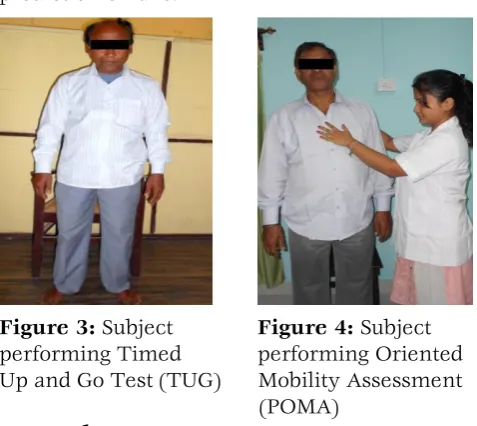
Figure 3: Subject Figure 4: Subject performing Timed performing Oriented Up and Go Test (TUG) Mobility Assessment (POMA)
Protocol:
Timed Up & Go test was performed as 1 practice and 3 trials for average score. After the test had been administered, the prediction of falls would be judged with TUG test as:-
Less than 8.5 sec is independent
More than 14 in such Hemiparetic patients are at high fall risk
20-29 sec is normal for frail elderly or disabled person
More than 30 is dependent in mobility skills and activities of daily living.
The total score of POMA is 28 scores, 16 for balance and 12 for gait. The fall prediction would be judged with this test as-
Less than 19 are considered at high risk of falls
Between 19-24 are at moderate risk.
Between 24-28 are at low risk of falls.
Time allotted for completing the two tests was 30 minutes for each subject with proper rest time as needed between tests or portion of test. After recording the scores for each test, a follow up was done for 6 months.
The accuracy of a test using AUC of ROC is interpreted as follows-
Values Accuracy
0.90-1.00 Excellent
0.80-0.90 Good
0.70-0.80 Fair
0.60-0.70 Poor
All analysis was carried out in SPSS windows Version 20.0.Demographic data including age and genders were descriptively summarized. An alpha-level of 0.05 was used to determine statistical significance. Statistical techniques used for analysis include both univariate and multivariate Tests. To determine the significance, t-test had been used and to determine the sensitivity and specificity of the tools, Receiver Operating Characteristic had been used. For prediction of fall of the subjects, (ROC) is the best method to be used.
Demographic Representation of Data
Demographic information of the study population is outlined in the table below:
Gender (Male : Female) 9 :16
Age ( Mean + SD) 56.52 + 4.97
Table 2: Demographic data Age and gender distribution is tabulated below:
Age Group Gender Total
Female Male
46 - 50 Years 6 5 11
51 - 55 Years 5 6 11
56 - 60 Years 5 13 18
61 - 65 Years 2 8 10
Total 18 32 50
Table 3: Age and Gender Distribution of the subjects
In this study, 50 subjects were selected with convenient sampling method. Out of 50 subjects, there were 32 males and 18 females with mean age of 56.52 years ranging from 48 years to 65 years.
Graph 1: Mean age of the subjects
Graph 2: Gender distribution of the subjects Analysis and Interpretation
In this study the data‘s are obtained using TUG and POMA and judgments were done on the basis of the pre-established cut off scores. For TUG, the cut off score is 14 seconds. Subjects taking more than 14 seconds are prone to fall. Determination of TUG scores in predicting falls in hemiparetic patients on the basis of pre-determined cut off value is given below:
Table 4: TUG score analysis
The above table shows that 94% of the total hemiparetic patients took more than 14 seconds in performing Timed Up and Go test. This implies that 94% of the patients were at high risk of fall and only 6% were not at risk of fall.
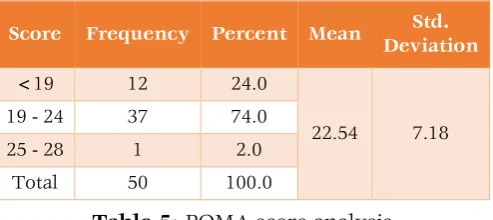
For POMA, according to the pre established cut off scores, subjects scoring less than 19 are at high risk, between 19 to 24 are at moderate risk and in between 24 to 28 are at low risk of falls. Determination of POMA scores in predicting falls in hemiparetic patients is given below:
Score Frequency Percent Mean Std.
Deviation
<19 12 24.0
22.54 7.18
19 - 24 37 74.0
25 - 28 1 2.0
Total 50 100.0
Table 5: POMA score analysis.
Table 5 reveals that 24% of the total patients scored less than 19 in POMA imply that 24% hemiparetic patients were at high fall risk, 74% of
Time Frequency Percent Mean Std.
Deviation
>14
sec 47 94.0
18.22 6.85 <14
sec 3 6.0
the patients had moderate risk of fall and only 2% had low risk of fall.
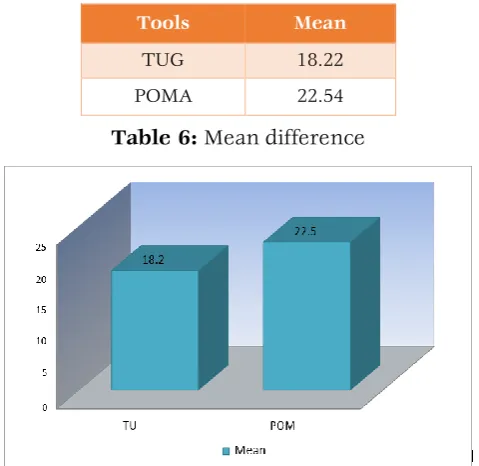
Tools Mean
TUG 18.22
POMA 22.54
Table 6: Mean difference
Graph 3: Display of mean difference between TUG and POMA
Graph 4: Receiver Operating Characteristic (ROC) Curve
Test Result Variable(s) Area
TUG 0.970
POMA 0.135
Table 7: ROC curve interpretation
Table 7 shows that area of TUG under ROC is 0.97 which is much higher than area of POMA which is 0.135. And the pre-established interpretation of the Area under Curve (AUC) reveals that the higher the AUC, the better the overall performance of the tool and area ranging from 0.90-1.00 represents excellent accuracy. Thus it can be inferred that TUG is more effective in predicting fall in patients than POMA.
From the Data collected, it is clear that the subjects taking 19.33 seconds or more in TUG and the
subjects scoring less than 23 in POMA are more prone to fall. Therefore sensitivity and specificity of the tools are calculated on the basis of these two scores or cut-off points.
Sensitivity, Specificity and Predictive value of TUG (>19.33) and POMA (< 23) in determining the falls of the patients are tabulated below:
TUG Fall No
Fall
Sensitivity Specificity
≥19.33 (26case)
25 1
78% 94%
<19.33 (24case)
7 17
Table 8: Sensitivity and Specificity of TUG Observation: - Out of 50 cases, 26 subjects scoring ≥ 19.33 undergone 25 number of falls i.e. 96.15%, whereas only 29.17 % i.e. 7 out of the 50 patients scoring <19.33 undergone falls. Thus TUG ≥ 19.33 had the sensitivity of 78% and specificity 94%.
POMA Fall No
Fall
Sensitivity Specificity
< 23 (35case)
27 8
90% 60%
≥ 23 (15case)
3 12
Table 9: Sensitivity and Specificity of POMA Observation: - Out of 50 cases, 35 patients scoring <23 in POMA undergone 27 number of falls i.e. 77.1%, whereas only 3 (13 %) out of 50 patients scoring ≥ 23 undergone falls. Thus POMA <23 had the sensitivity of 90% and specificity 60%.
RESULTS
The present study was undertaken to determine the efficiency of the two tools viz. Timed Up and Go Test (TUG) and Performance Oriented Mobility Assessment (POMA) in predicting falls in hemiparetic Stroke Patients and to compare between the two in order to find out which one is better in predicting falls.
Analysis of the data collected through the study of six months had shown that TUG is much better in predicting falls in such patients. One of the objectives of the study was to record the efficiency of TUG in predicting falls in Hemiparetic Stroke patients. The subjects were made to perform this test and the numbers of falls were recorded each month. After 6 months of recording, when an average of falls was calculated and correlated with the pre-established cut-off scores, results were found to be good.
The calculated statistical values are obtained with the help of univariate and multivariate tests. In order to find out whether there is any significant difference in TUG and POMA scores in prediction of fall of the same subjects, independent sample t- test was done. The mean values of each tools is compared in this test. It was found that t = -4.496 which is highly significant at (p=0.00) which proves that there is remarkable difference in means of TUG and POMA. To prove which tool is better in predicting fall, mean difference and t-test are not enough and reliable. Whenever two tools are to be compared for prediction of an event, the best and reliable method of analysis is Receiver Operating Characteristics (ROC) curve. In this curve of sensitivity and 1-specificity the values o f both TUG and POMA are plotted and the Area Under Curve (AUC) was calculated. TUG covers 0.970 and POMA covers 0.135 area in the curve and is an established fact that higher area indicates excellent accuracy. This implies TUG is much more efficient and better predictor of fall than POMA. Again, the data collected and recorded in the master chart reveals that subjects taking 19.33 seconds or more in TUG are more prone to falls and subjects scoring 23 or less in POMA are more prone to fall. Graphical representation of the statistical data‘s in ROC also depicts the same. Therefore these two values ≥19.33s and <23 are the cut-off points for TUG and POMA respectively. Using these cuts- off points, the sensitivity and specificity of the two tools were calculated. The sensitivity and specificity of TUG is 78% and 94% respectively and that of POMA is 90% and 60% respectively.
Thus TUG and POMA both have potential to predict falls in Hemiparetic Stroke patients but TUG is better and much more efficient predictor of fall in such patients.
DISCUSSION
The purpose of this study was to conduct a comparison between Timed Up and Go (TUG) test and Performance Oriented Mobility Assessment (POMA) in predicting falls in hemiparetic stroke patients.
Statistical analysis shows that there is significant difference between TUG and POMA in predicting falls in hemiparetic patients. And Receiver Operating Curve (ROC) revealed that TUG is much better predictor than POMA in such patients. Also its sensitivity and specificity shows the same. Although reliability and validity of TUG14,15,16 and
POMA 17,18are very good in stroke patients as
established in previous studies, their comparison shows significant difference. In TUG, the time
taken to get up from a chair and complete a lap of 3 meter is counted. The task includes both balance and gait but gives more importance to gait factors. Whereas POMA consists of two sub-tests viz. Balance and Gait tests in which there is 16 scores for Balance and 12 scores for Gait test summing up to total of 28. Thus it gives more score or points on balance. Studies have proved that balance is less related to fall i n chronic stroke patients.19 Also
while performing the study, more precisely while collecting data‘s it was found that many of the patients scoring 15 out of 16 in Balance tests of POMA scored 5 or 6 out of 12 in Gait test. The same patient gave a record of frequent falls almost falls of average 2.17 within 6 months. This proves that a stroke patient having fair balance has a significant gait disturbance leading to fall. Gait disturbances mainly include inadequate ground clearance possibly due to extensor synergy or Dorsi flexor weakness. At times there may be effects of other extrinsic factors on falls. As a trial to eliminate error due to such risk of fall, a single fall within 6 months is neglected.
The result of this study again showed that a patient taking 19.33seconds or more in TUG test and less than 23 in POMA is prone to fall. This gives the new cut-off p o i n t of the tools. But POMA could not predict falls accurately in such hemiparetic patients.
Thus on the basis of our results, we found out that TUG is a better predictor of falls in hemiparetic stroke patients.
CONCLUSION
To conclude, we can say that there is significant difference between the Timed Up and Go test and Tinetti‘s Performance Oriented Mobility Assessment score on prediction of fall in Hemiparetic Stroke patients.
REFERENCES
1. Darcy A Umphred‘s. Neurological Rehabili-tation.5th edition; 2007.
2. Susan B, O‘ Sullivan and Thomas J. Schmitz‘s. Physical Rehabilitation Assessment and Treat-ment. 4th edition; 2001.
3. Michael Donaghy‘s. Brains Diseases of Nervous System. 11th edition;2001.
4. Vivian Weerdesteyn, Mark De Niet, Hanneke J.R, Van Duijnhoven, Alexender C.H. Falls in Individuals with Stroke. Journal of Rehabili-tation Research and Development. 2008;45: 1195-1214.
an accumulated impairments model. J Rehabil Res Dev. 2002;39(3):385– 94.
6. Hamdy RC, Moore SW, Cancellaro VA, Harvill LM. Long-term effects of strokes on bone mass. Am J Phys Med Rehabil. 1995;74(5):351–56. 7. Jørgensen L, Engstad T, Jacobsen BK. Higher
incidence of falls in long-term stroke survivors than in population controls: depressive symptoms predict falls after stroke. Stroke 2002; 33: 542 - 547.
8. Hyndman D, Ashburn A. People with stroke living in the community: attention deficits, balance, ADL ability, and falls. Disabil Rehabil. 2003;25:817–822.
9. Lamb SE, Ferrucci L, Volapto S, et al. Risk factors for falling in home-dwelling older women with stroke: the women's health and aging study. Stroke.2003;34:494–501.
10.Ng SS, Hu Chan CW et al. the TUG: its reliability and association with lower limb impairment and locomotor capacity in people with chronic stroke. Archives of Physical medicine and Rehabilitation. 2005;86 (8):1641-1647
11.Jennifer Canbek, George D. Fulk, Leah Nof, John L. Echternach. Test-retest reliability and concurrent validity of the tinetti performance-oriented mobility assessment in patients undergoing inpatient physical therapy after stroke. Journal of American Physiotherapy Association 2011.
12.Hyndman D, Ashburn A, Stack E. Fall events among people with stroke living in the community: circumstances of falls and
characteristics of fallers. Arch Phys Med Rehabil. 2002; 83: 165–70.
13.Tinetti, M. (1986). Performance - oriented assessment of mobility problems in elderly patients. Journal of the American Geriatrics Society, 34, 119-126.
14.Talia Herman, Nir Giladi, Jeffrey M. Hausdorff. Properties of the ‘Timed Up and Go’ Test: More than Meets the Eye. Gerontology. 2011 Apr; 57(3): 203–210.
15.Ellinor Nordin, Nina Lindelof, Erik Rosendahl, Jane Jensen, Lillemor Lundin - olsson. Prognostic validity of the Timed Up-and-Go test, a modified Get-Up-and-Go test, staff‘s global judgement and fall history in evaluating fall risk in residential care facilities. Age and Ageing. 2008; 37: 442–448. 16.Shumway-Cook A, Brauer S, Woollacott M.
Predicting the probability for falls in community-dwelling older adults using the Timed Up & Go Test. Phys Ther. 2000; 80: 896-903.
17.Carole Lewis, Keiba Shaw. Performance-Oriented Mobility Assessment. Phys therapy and Rehab Medicine. Geriatric Function. 2005; 16(23):1-6.
18.Deeks JJ. Systematic reviews of evaluations of diagnostic and screening tests. BMJ 2001;323: 157-62.
19.Harris JE, Eng JJ, Marigold DS, Tokuno CD, Louis CL.Relationship of balance and mobility to fall incidence in people with chronic stroke. Physical therapy. 2005;85(2):150-8.
Citation