
Management Strategy for Smart Grid
–
A Cluster System Analysis Method
Paramet Wirasanti
A thesis submitted in partial fulfillment of the
requirements of the
University of Bolton
for the degree of
Doctor of Philosophy
This research work was carried out
in collaboration with
The South Westphalia University of Applied Sciences
Division of Electrical Engineering
Soest, Germany
Dedicated to
my family
my professors
Abstract
Recently, Distributed Generation (DG) technologies become more potential in electricity supply contributors to electric utilities. It leads to increase the grid integration ratio of DG. Thus, the trend of decentralized power systems has been considered as a future of energy supply systems. According to this fact, the distribution systems must be changed from a passive control area to be an active control area. To overcome and realize this issue, the clustering power systems approach is developed. The main idea of this concept is to coexist the DG with the conventional power systems. Therefore, the system structure and the control approach are introduced and developed based on the conventional system. The cluster network structure keeps the main idea of conventional interconnected grid. Consequently, the clustering power systems concept intends to cluster the power systems into several areas, called cluster area. As a direct result, the cluster network structure can be described like the interconnected grids.
In order to empower and turn the ordinary passive distribution system to be the active system, the clustering approach announces the distribution management system (DMS) for the cluster automation application. The DMS application is the cluster controller and management, which applies in each cluster area. To accomplish the DMS functionality, control functions based on cluster concept have been developed continuously, e.g. the multi-level clusters control approach. Besides the development of cluster control approach, a cluster analysis strategy is cautiously considered as well, since it is a key to complete a cluster management and an optimization process. A hybrid calculation technique is consequently proposed to be a solution for cluster analysis, because it offers a possibility to integrate a character of interconnected clusters into the analysis. Hence, the cluster analysis can be employed in a decoupling way. To evolve the cluster analysis, a character of distribution network has to be taken into account. The character of distribution network is dominated by the unbalanced condition e.g. multi-phase feeder system. Moreover, the penetration of DG units can cause unbalanced condition as well, e.g. single phase feed in of home PV systems. To deal with unbalanced condition, an asymmetrical sequence hybrid and asymmetrical three-phase four-wire hybrid analysis method is rolled out, both are developed based on a difference issue of load flow studies.
Acknowledgements
This research study was carried out through the department of Power Systems and Power Economics of the University of Applied Science South Westphalia, Soest, (Germany), in partial fulfillment of the requirements of the University of Bolton (UK) for the Doctor of Philosophy degree from January 2010 until December 2013. The research was financially supported by the Federal Ministry of Education and Research in Germany.
I would like to acknowledge my supervisor, Prof. Dr.-Ing. Egon Ortjohann from the South Westphalia University of Applied Sciences, for his distinguished supervision and excellent guidance, which contributed the successful research study.
I would like to thank my supervisor and director of the study, Prof. Dr. Danny Morton from the University of Bolton, for his great advice and support in the entire research period.
I would be remiss if I didn’t acknowledge my colleagues in the Power Systems and Power
Economics laboratory. I would like to particularly thank Mr. Andreas Schmelter (Dipl.-Ing), Mr. Manfred Wilczek (Dipl.-Ing.), and Mr. Carsten Mauer (Dipl.-Ing) for their great constructive discussions, cooperation, and technical support. My appreciations also go to Mr. Marius Hoppe (M.Sc.), Mr. Hakam Saffour (M.Sc.), and Mr. Sasiphong Leksawat (M.Sc.) for their unlimited assistance and time.
Many thanks also go to all postgraduate and undergraduate students who worked in the laboratory through this study period.
Declaration
“No portion of the work presented in this dissertation has been submitted in support of another award or qualification either at this institution or elsewhere.”
Keywords:
Active Distribution Network Smart Grids
Clustering Power Systems Philosophy Multi-Level Cluster Control Application Hybrid Calculation Technique
Table of Contents
List of Figures ... I List of Tables ... V List of Abbreviations ... VII List of Variables ... IX
1. Introduction ... 1
1.1 Evolution of Electrical Power Systems... 1
1.1.1 Conventional Power Systems ... 2
1.1.2 Decentralized Power Systems ... 3
1.1.3 Key to Successful Future Power Systems ... 5
1.2 Problem Statements ... 7
1.3 Motivation ... 8
1.4 Research Aim and Objective ... 10
1.5 Research Contribution ... 12
1.6 Dissertation Structure ... 12
2. State of the Art ... 15
2.1 Electrical Energy Transition ... 15
2.2 Smart Grid and Smart Market ... 17
2.3 Smart Grid Research Projects ... 21
2.3.1 FENIX ... 22
2.3.2 ADDRESS ... 24
2.3.3 Digital GRID ... 26
2.3.4 ADINE ... 28
2.3.5 Web2Energy ... 30
2.3.6 E-Energy ... 32
2.4 Discussion ... 34
3.1 Interconnected Transmission Grids ... 39
3.2 Clustering Power Systems Approach ... 42
3.3 Interconnected Clusters Network ... 44
3.4 Benefits of Clustering Power Systems ... 46
4. Cluster Control Strategy... 49
4.1 Recycling of Hierarchical Conventional Control Functions ... 49
4.2 Control Strategy for Clustering Power Systems... 53
4.2.1 Distribution Generation Unit Control Application ... 54
4.2.2 Horizontal Cluster Control Application ... 55
4.2.3 Vertical Cluster Control Application ... 59
4.3 Verification of Cluster Control Applications ... 62
4.3.1 Simulation Platform - dynamic RMS Model ... 63
4.3.1.1 Dynamic model of frequency generation part ... 64
4.3.1.2 Dynamic model of voltage generation part ... 65
4.3.1.3 Frequency Equalizer Model ... 66
4.3.1.4 RMS Power Systems Network Model ... 66
4.3.2 Case Study1 - Horizontal Control Application ... 67
4.3.3 Case Study2 – Vertical and Horizontal Control Application ... 74
4.4 Summary ... 79
5. Cluster System Analysis Method ... 81
5.1 Cluster System Analysis Strategy ... 81
5.2 Conventional Load Flow Analysis Methods ... 83
5.2.1 Current Injection Method ... 83
5.2.2 Newton-Raphson Method ... 85
5.3 Hybrid Calculation Method ... 86
5.3.1 Preparation Process for Hybrid Matrix Calculation ... 88
5.3.2 Impedance Hybrid Matrix ... 90
5.3.3 Admittance Hybrid Matrix ... 91
5.5 Verification of Decoupling Cluster Systems Analysis ... 95
5.6 Summary ... 101
6. Cluster System Analysis Algorithm for Asymmetrical Grid Conditions ... 103
6.1 Asymmetrical Network Conditions ... 103
6.2 Asymmetrical Bus Types Specifications ... 106
6.2.1 Slack Bus and Imported Interconnected Clusters Voltage Bus ... 106
6.2.2 Voltage Controlled Bus and Distribution Generation Bus ... 108
6.2.3 Load Bus and Generation Bus ... 110
6.3 Conventional Asymmetrical Load Flow Analysis Methods ... 112
6.4 Asymmetrical Sequence Hybrid Load Flow Calculation Method for Three-Phase Cluster System ... 115
6.4.1 Asymmetrical Element Compensation Technique ... 116
6.4.2 Sequence Hybrid Load Flow Algorithm ... 119
6.5 Asymmetrical Hybrid Load Flow Calculation Method for Three-Phase Four-Wire Cluster System ... 123
6.5.1 Three-Phase Four-Wire Hybrid Load Flow Algorithm ... 124
6.6 Summary ... 126
7. Validation of Asymmetrical Hybrid Load Flow Algorithm ... 129
7.1 Case Study 1: Low Voltage Network ... 130
7.2 Case Study 2: IEEE 123 nodes Test Feeder ... 134
7.3 Case Study 3: Interconnected Clusters System ... 138
7.4 Summary ... 141
8. Conclusions and Future Works ... 143
8.1 Conclusion ... 143
8.2 Future Works ... 147
List of Publications ... 149
List of Equations ... 151
References ... 161
List of Figures
Fig. 1.1: Overview of conventional power systems ... 2
Fig. 1.2: Overview of decentralized power systems ... 4
Fig. 1.3: Overview of clustering power systems approach ... 8
Fig. 1.4: Structure overview of TSO grid operation ... 10
Fig. 1.5: Dissertation structure ... 14
Fig. 2.1: Share of renewable energy in gross final consumption in the EU27, Norway and Croatia in 2011 ... 16
Fig. 2.2: Action matrix of smart gird ... 19
Fig. 2.3: Evolution of electricity grid ... 21
Fig. 2.4: FENIX VPP concept ... 23
Fig. 2.5: CVPP and TVPP in system and market concept ... 24
Fig. 2.6: ADDRESS system architecture ... 25
Fig. 2.7: An example of power routing ... 27
Fig. 2.8: Overview of ADINE concept ... 29
Fig. 2.9: System Architecture of W2E control center ... 32
Fig. 2.10: Cellular system structure ... 33
Fig. 2.11: a) BEMI concept , b) moma project concept ... 34
Fig. 3.1: Overview of ENTSO-E interconnected grids ... 40
Fig. 3.2: 50hertz High-voltage grid map, December 2012 ... 41
Fig. 3.3: Cluster network using bottom-up concept ... 43
Fig. 3.4: Overview of interconnected clusters network ... 45
Fig. 4.1: Overview of hierarchical control strategy based TSO ... 50
Fig. 4.2: Operation time of hierarchical control strategy ... 51
Fig. 4.3: Inverter feeding modes ... 54
Fig. 4.4: Interaction overview of conventional interconnected grids ... 56
Fig. 4.5: Control scheme of conventional interconnected grids ... 57
Fig. 4.7: Vertical and horizontal control scheme of interconnected clusters ... 60
Fig. 4.8: Empowering interconnected clusters system with cluster controller ... 61
Fig. 4.9: A general idea of dynamic-RMS model ... 64
Fig. 4.10: Frequency generation model with frequency droop control function ... 65
Fig. 4.11: Voltage generation model with voltage droop control function ... 65
Fig. 4.12: Equivalent circuit of inverter model ... 67
Fig. 4.13: Examined interconnected cluster systems ... 68
Fig. 4.14: Active power of each generating unit ... 70
Fig. 4.15: Active power exchange between clusters system ... 71
Fig. 4.16: Zoom active power exchange between clusters during the first simulation event .. 72
Fig. 4.17: Power systems frequency ... 73
Fig. 4.18: Zoom on power systems frequency during the first simulation event ... 73
Fig. 4.19: Examined cluster system ... 74
Fig. 4.20: Active power of each generating unit ... 76
Fig. 4.21: Active power exchange between clusters system ... 77
Fig. 4.22: Power systems frequency ... 78
Fig. 4.23: Zoom on power systems frequency during the first simulation event ... 78
Fig. 4.24: Multi-level cluster management strategy based on bottom-up approach ... 80
Fig. 5.1: Cluster operation and management strategy ... 82
Fig. 5.2: Current source network ... 84
Fig. 5.3: Iteration process of Newton-Raphson load flow analysis ... 85
Fig. 5.4: Mixing of voltage- and current source network ... 87
Fig. 5.5: Examined five buses system for sorted bus admittance matrix ... 89
Fig. 5.6: A simple three interconnected clusters network ... 93
Fig. 5.7: Decoupling analysis approach of interconnected clusters ... 94
Fig. 5.8: Specifying decoupling position of the power systems ... 96
Fig. 5.9: Decoupling cluster systems process ... 97
Fig. 5.10: Decoupling cluster system analysis in dynamic-RMS simulation platform ... 98
Fig. 5.12: Comparison of simulation results at bus11 ... 100
Fig. 6.1: Example of three-phase impedance network ... 104
Fig. 6.2: Equivalent three-phase model of ideal voltage source ... 107
Fig. 6.3: Sequence components equivalent model of symmetrical voltage source ... 107
Fig. 6.4: Sequence components equivalent model of asymmetrical voltage source ... 108
Fig. 6.5: Equivalent three-phase model of ideal generator ... 108
Fig. 6.6: Sequence components equivalent model of symmetrical generator ... 109
Fig. 6.7: Sequence components equivalent model of asymmetrical generator ... 110
Fig. 6.8: A model of constant power bus type ... 110
Fig. 6.9: A model of constant current bus type ... 111
Fig. 6.10: A model of constant impedance bus type ... 112
Fig. 6.11: Asymmetrical Newton-Raphson load flow analysis algorithm ... 113
Fig. 6.12: Sequence component π-equivalent model of asymmetrical cable ... 115
Fig. 6.13: Decoupling π-equivalent model of asymmetrical cable based on sequence components ... 119
Fig. 6.14: Sequence hybrid load flow calculation flow chart ... 121
Fig. 6.15: Example of three-phase four-wire network... 123
Fig. 6.16: Three-phase four-wire hybrid load flow calculation flow chart ... 125
Fig. 7.1: Examined low voltage network ... 131
Fig. 7.2: Uan voltage difference between DIgSilent and sequence hybrid algorithm ... 133
Fig. 7.3: Ua difference between DIgSilent and three-phase four-wire hybrid algorithm ... 134
Fig. 7.4: Modified IEEE 123 nodes test feeder ... 135
Fig. 7.5: Algorithm performance comparison ... 137
Fig. 7.6: Modified IEEE 37 nodes test feeder to interconnected clusters network ... 139
Father Fig. A.1: Positive sequence transformer T-equivalent circuit ... 176
Fig. A.2: Zero sequence transformer equivalent circuit – YNyn ... 177
Fig. A.3: Zero sequence transformer T-equivalent circuit – YNyn... 178
Fig. A.4: Zero sequence transformer equivalent circuit – YNd ... 178
Fig. A.6: Zero sequence transformer equivalent circuit – YNzn ... 180
Fig. A.7: Dyn transformer without neutral connection at star point ... 181
Fig. A.8: Dyn transformer with neutral connection at star point ... 182
Fig. A.9: (a) Solid-earthed neutral configuration, (b) Unearthed neutral configuration ... 184
Fig. A.10: Transformer equivalent circuit in pu. ... 185
List of Tables
Table 4.1: Reference value of generator, inverter and load... 69
Table 4.2: Overview of simulation events ... 69
Table 4.3: Reference value of generator, inverter and load... 75
Table 4.4: Overview of simulation events ... 75
Table 5.1: Reference value of generator, inverter and load... 99
Table 7.1: Comparative load flow results of selected nodes ... 132
Table 7.2: Comparative load flow results of selected nodes ... 133
Table 7.3: Comparative load flow results of selected nodes ... 136
Table 7.4: Selected nodes three-phase load flow results ... 137
Table 7.5: Applied voltage of cluster node ... 140
Table 7.6: Back calculated injection power of cluster node ... 140
Table 7.7: Comparative load flow results of selected nodes ... 141
Mother Table A.1: Identification letter for transformer vector group ... 177
Table A.2: Transformer parameter description ... 186
Table A.3: 2MVA 10/0.4kV Dyn5 transformer parameters ... 189
Table A.4: NAYY 4x50SE three-phase four-wire cable parameters ... 189
Table A.5: Cable length of each connection... 189
Table A.6: Applied load and generation power ... 190
Table A.7: Reactive power injection profile ... 191
Table A.8: Modified substation model ... 191
List of Abbreviations
Abbreviations Description
AC Alternating Current
AD Active Demand
ADN Active Distribution Network
ANM Active Network Management
AVR Automatic Voltage Regulator
BEMI Bidirectional Energy Management Interface
BPL Broadband Powerline
CIM Common Information Model
DC Direct Current
DERs Distributed Energy Resources
DG Distributed Generation
DGC Digital Grid Controller
DMS Distribution Management System
DSO Distribution Systems Operator
ECS Energy Conversion System
ENTSO-E European Network of Transmission System Operators for Electricity
EU European Union
GF Grid Forming
GP Grid Parallel
GS Grid Supporting
HMI Human Machine Interface
HV High Voltage
ICT Information and Communication Technology
IED Intelligent Electronic Device
MV Medium Voltage
NEV Neutral to Earth Voltage
NIS Network Information System
PC Primary Control
PLC Power Line Communication
PV Photovoltaic
RESs Renewable Energy Sources
RMS Root Mean Square
SC Secondary Control
SVC Static VAR Compensator
TC Tertiary Control
TSO Transmission Systems Operator
UCTE The Union for the Co-ordination of Transmission of Electricity
VPP Virtual Power Plant
List of Variables
Variables Description
H Hybrid matrix
I Complex Current
S Complex Apparent power
T Sequence Component to Phase Component Transform Matrix
U Complex Voltage
X Complex Value
Y Complex Admittance
Z Complex Impedance
P Active Power
Q Reactive Power
0,1,2 Lower suffix for Sequence Components
a,b,c,n Lower suffix for Phase Components and Neutral
c Lower suffix for Compensation element
d Lower suffix for Decoupling element
k Lower suffix for Known element
1.
Introduction
Global power systems are currently in the transition to move from conventional power generation to sustainable power generation based on renewable energy sources (RESs). An improvement of grid operation and reliability is subsequently taken into account in the term
of “Smart Grid”. Meeting the challenges of future electrical power systems enables a research and an innovation. Dealing with the changes in the power supply process e.g. technical, economic and regulation, are required a good lesson from historical cases. Thus, it is worth to mention that a background of existing power systems is important to keep in mind as a principle for future power systems. Hence, the thesis introduces an evolution of electrical power systems in order to point out a stepwise development direction including requirements of future power systems. This general discussion is a key to success next generation of electrical power systems.
1.1 Evolution of Electrical Power Systems
Presently, electrical power supply systems are facing significant change due to the high penetration of distributed generation (DG) in last twenty year [1], and [2]. Obviously, there are plenty of new aspects about future power process e.g. an active distribution network (ADN), a revision of power flow and a liberalization of electrical energy trade. To accomplish those expected characteristics, a decision must soon be made to close the gap between a bulk transmission network and a future network. However, the development track must be clarified that
“The future power system is an evolution not a revolution.(1)”
1.1.1 Conventional Power Systems
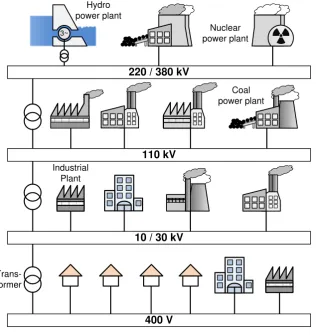
Traditionally, the conventional power supply systems can be mainly defined by large centralized power plants, transmission lines, transformers and loads. This results in a clear structure of electrical systems, which is described by transmission network and distribution network. The main component on transmission network is generation units e.g. coal, hydro and nuclear power plants. From generation units, the power is injected into transmission systems in order to deliver to consumption units. This transmission level is operated under the high voltage level (110 kV) or extra high voltage (200/380kV). The delivered power enters into distribution network through substations. Based on traditional systems, the substation is a passive power exchange unit. It is used for controlling and transferring the power to consumption units, which can be everything from a big industry plant to small equipment in a house, and they are normally located at medium voltage level (10/30kV) and low voltage level (0.4kV), respectively. An overview of conventional power systems is portrayed in Fig. 1.1. According to the system structure, it is obvious that the power flow process is delivered from centralized power plants down to consumption units in distribution network. This character of conventional systems describes the power flow process as a unidirectional.
Trans-former
Industrial Plant
400 V 10 / 30 kV
Nuclear power plant
Coal power plant Hydro
power plant
3~
110 kV 220 / 380 kV
Regarding the unidirectional power flow process, it is obvious that the system operators and the system controls are functioned and managed as a centralized operation. This can be also referred to the controlling and stabilization of power systems state variables, frequency and voltage. Those variables are controlled and stabilized by central power plants on transmission network. According to those facts, the transmission network is named as an active control area. On the other hand, the distribution network can be implied as a passive area, because there are only consumption units on this area.
Having a look on the market system based on conventional power systems, commonly, the target of electric power system is to satisfy the customer demands in financial. Thus, the electricity markets come to take a part of electrical energy trading. The trading participants have the possibility to balance their purchase and sale obligations in order to provide low transaction costs and a neutral price for the wholesale power. It is obvious that the persons, who manage the market mechanism, are the electrical energy trader companies, capacity holders, and power generation companies. Hence, the current market system is similarly operated as centralized market system because the market participants are basically located on transmission level. The discussion on this section is aimed to illustrate the conventional system, which is still dominant. Further discussion of the conventional supply systems, the transmission code regulations and standard can be found in [3], [4], [5], [6], [7], and [8]. Nevertheless, the central power plants e.g. coal power plant and nuclear power plants are presently considered to be reduced or removed from the power systems, since they cause the global environment problems. For example, the recent 2011 Fukushima accident [9], this issue alerts the people around the world to realize the danger of nuclear power and refuse this kind of power. Moreover, the centralized power systems structure can cause the electricity black out. The major black out in the Midwest and Northeast United States and Ontario, Canada on 2003 may illustrate a good example. Around 50 million people stayed without electricity for 4 days. The event contributed to at least 11 deaths, and damage cost are estimated around 6 billion US dollar [10]. Due to those reasons, a trend of decentralized power systems based on RESs has been intensively taken into account as sustainable power systems. This is another chapter of the power systems evolution. The follow section is donated to illustrate and clarify the concept of decentralized system as well as the expected change based on technical and economical approaches.
1.1.2 Decentralized Power Systems
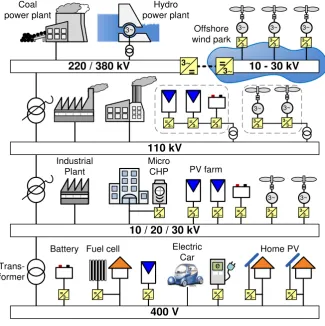
European Union. Currently, Sweden has already reached 46.8% of renewable energy share in total electrical energy consumption, Latvia (33.1%), Finland (31.8%) and Austria (30.9%) [11]. Another country, which is worthy to point out, is Germany. The renewable energy share in total electricity consumption has been dramatically increased from 4.8% in 2004 to 23.6% in 2012 [12]. The most vivid growing systems are the photovoltaic systems and wind energy systems, which 90% and 95%of install capacity is located in distribution network [1], respectively. Those mentioned situations are an obvious evidence to show that the DG units based RESs has been considered as the sustainable power supply systems. Furthermore, the DG technologies become more potential contributors of electricity supplied to electric utilities. Thus, it can be foreseen that the grid integration ratio of DG will continuously increase. In order to figure out the characteristic of decentralized power systems, the system structure is firstly considered. An overview of decentralized power system is shown in Fig. 1.2.
Trans-former
Industrial Plant
Offshore wind park
3~
3~ 3~
3~
3~ 3~
3~
3~ 3~
10 - 30 kV =
3~
Micro
CHP PV farm
Fuel cell
3~
3~ 3~
3~
3~ 3~ 3~
3~
3~
=
NISSAN
3~
= e
Electric Car
3~
=
3~
=
3~
=
Home PV
3~
=
Battery
3~
=
3~
=
3~
=
10 / 20 / 30 kV
400 V
3~
=
3~
=
3~
=
3~
3~ 3~
3~
3~ 3~
110 kV 3~
Hydro power plant
220 / 380 kV Coal
power plant
3~
=
Fig. 1.2: Overview of decentralized power systems
network. Moreover, advance control functions can be implemented into inverter. Regards that fact the approach of ADN has been launch and widely discussed. In [13], the definition of AND is clarified. It can be briefly summarized that the passive character of distribution network will be changed to active character in an automated way. This means that the local consumption units can be turned to production units. This is a birth of “Prosumer” definition, [14].
Since the DG units have more potential in electrical energy producing and they are expected to participate in grid control application in order to establish the active character in the entire power systems. It can be predicted that the power flow process can be reversed from the distribution level to the transmission level. This means that the traditional unidirectional power flow will be changed to bidirectional process. However, this approach requires a rearrangement of technical control concept based on power systems state variable because it can cause power systems stability problems. Moreover, many electrical infrastructures are also needed to be replaced by a new component, which can support the bidirectional power flow process. Due to those reasons, this bidirectional approach is still under the development process.
Considering the view of electricity market system, it can be implied that the decentralized market system will be more competitive, since the electrical power generation is growing in decentralized systems. Consequently, a liberalization and privatization of electricity market has been presently discussed. Plenty of development models have been lately developed and introduced. Nevertheless, the implementation in a real system still needs more investigation. Those mentioned changes in power systems, the penetrating of DG units based RESs and the liberalization of electricity, can ruin the reliability of convention power systems [15]. Thus, to move toward the decentralized power systems or future power systems, cautious study is required in order to provide a good strategy for the technical change and economical change. As mentioned that the future power systems is the evolution not revolution, therefore, the development outlines for the future power systems based on this statement are summarized in the next section. Further discussion of the decentralized power systems can be found in [16], [17], [18], [19], [20], and [21].
1.1.3 Key to Successful Future Power Systems
“the smart grid is an electricity network, which can intelligently integrate the actions of all users connected to it - generators, consumers and those that do both in order to efficiently
deliver sustainable, economic and secure electricity supplies” [22].
Regards that point of view, the intelligent infrastructures have to be integrated into network in order to establish the interaction between all units in network. Based on this issue, the term of
“Smart Market” is also started to discuss, since the interaction between generation units and
consumption units are active [23]. According to those mentioned issues of electricity grid, it is needed to state that those are recent concepts of this moment. Due to this point, the evolution of electricity grid can be also changed in another aspect in the future. Therefore, this thesis is going to point out and emphasize the key concept for sustainable development.
Before start the discussion for sustainable development strategy, it is noteworthy to state that the conventional power supply system still serves main consumptions of electricity demand with reliability. However, with a variety of problems e.g. its cost and sustainability, it challenges the approach of RESs in the long term system. The RESs can be considered as small generation units, which are penetrating in distribution network. On the other hand, the RESs can be also considered as huge power plant in transmission network e.g. offshore wind park. Thus, it is impossible to cut the conventional process. Furthermore, this must be taken into account as the first priority. Consequently, this thesis emphasizes that any novel development must be coexisted with conventional systems. The technical issues, especially power systems state variables control, have to be cautiously studied, since the current manner of distribution network is still passive. Since the generation units grow and penetrate in distribution network, it opens more competition in electricity market. The liberalization and privatization of electricity market have been recently discussed. Similarly, any new market mechanism must not ruin the traditional system.
Another key point to accomplish the transition in sustainable way is a standard communication between all grid participating components. The standard communication is needed because DGs can belong to different owners and utilize various software/hardware systems. Therefore, international standards such as IEC and IEEE standards are important as a development guideline for the commutation system of future power systems.
directly implied in distribution system. The feed in power of DG unit can be operated as single phase systems. Those are different points from conventional power plant, which have to be taken into account in order to achieve the successful future decentralized power systems.
1.2 Problem Statements
The trend to move toward sustainable electrical power supply systems is decentralized systems based on RESs. As emphasized, any novel strategy for future power systems is necessary to consider about the coexistence between new integration of DG units and existing convention grid. Thus, a downsizing of conventional management and control process has been lately studied and promoted in [24], [25], [26], [27], and [28], where the power systems state variables control is the key point of those researches. Since the power systems stability issue is assured through state variable control, which allows further advance application e.g. the reversion of power flow process and the smart energy trading function.
However, there are differences between transmission network and distribution network, which are usually not considered. The most different point is a symmetrical condition of network. The network construction is worthy to point out that the transmission systems can be considered as a symmetrical network, which cannot be completely implied in distribution network. Moreover, there are different distribution network characters in some country. For example, the distribution network in Europe can be described by the symmetrical network [29], but the distribution network in other countries e.g. Thailand is totally asymmetrical system. This is obvious due to network construction, since the multi-phase systems are utilized in power distribution and the overhead power lines are untranspose [30], and [31]. Furthermore, the load characteristic, star- and delta connection can also cause the unbalanced condition. Regards those mentioned issues, the asymmetrical problem becomes more obvious in distribution power systems.
or three storage systems are required and separately connected to each phase [37]. Those mentioned solutions could be solved. Nevertheless, the solution of future power systems requires the flexibility and adaptability. Therefore, the unbalanced or asymmetrical condition problem is worth researching in order to deliver the sustainable solution.
In summary, the asymmetrical character of distribution network and the high share of DG units based on RESs can be the most important problem in future power systems stability. Furthermore, the liberalization of energy trading, which is expected in the future systems, can lead to asymmetrical problem as well. Consequently, the solution for future power systems e.g. power systems management and power systems control must be able to handle with asymmetrical problem, and it must coexist with the conventional process as well.
1.3 Motivation
To move toward sustainable electrical power supply systems, this express a large field of research. Plenty of research projects have been established. The clustering power systems approach is also included; this approach has been introduced and successfully promoted by the department of Power Systems and Power Economics, at South Westphalia University of Applied Sciences, Soest, Germany [38]. The main idea of this approach is to structure power systems network and to implement control application down to local network area. Furthermore, the coexistence between DG units and conventional power systems is also the target of the development.
...
...
DMSDMS DMS
DMS DMS
3~
The cluster network structure kept the main idea of European Network of Transmission System Operators for Electricity (ENTSO-E) interconnected grids [39], and [40]. To illustrate the cluster system network, an overview of clustering power systems concept is displayed in Fig. 1.3. The clustering power systems concept is to cluster the power systems into several areas, called cluster area. This means that each cluster network structure, which links to another cluster area, can be described like interconnected grids. It can be noticed that the local area or prosumer unit is grouped and considered as the lowest cluster level. Consequently, the local area is a part of another cluster level and this process is repeated upward to conventional plants. This network structure process is called bottom-up approach. Further information about clustering power systems network structure is clarified in Chapter3.
Considering on proposed cluster network structure, it can simplify the complexity of the future power systems and provides the opportunity to classify network construction. Thus, the asymmetrical condition due to different network constructions e.g. multi-phase power systems can be managed in order to solve asymmetrical problem in an easier way. According to good network organization, it gives also an opportunity to structure and standardize the communication strategy for future grid [41]. Additionally, the approach of energy trading linearization can be more obvious. Each cluster area can be considered as economic cooperative, and hence the association of future electricity market can be clarified through clustering power systems approach as well.
However, all expected process of future power supply systems can be realized, when the distribution system is able to participate in grid control as conventional way. In order to turn the ordinary passive distribution system to be the active systems, the clustering approach announces the distribution management system (DMS) for a cluster automation application. In fact, the DMS approach is already promoted and utilized as a service platform to empower distribution systems [42], [43], [44], and [45]. Nonetheless, the application of DMS based on cluster concept is a cluster controller, which is in charge for cluster control and management and aimed to operate based on each cluster area. This controller is a media to downsize the conventional process to local area e.g. control scheme and management strategy. Further information about DMS applications are given in Chapter4.
1.4 Research Aim and Objective
One of the main challenges in future power systems associated with Smart Grid is the evolution process of the distribution network from passive system to active system according to grid control. This means that the distribution systems operator (DSO) level has to be integrated into the active grid control. Consequently, many research projects are currently conducted and investigated in order to complete this target. The outstanding projects are further discussed in section 2.3. The clustering power systems philosophy is developed for this purpose as well. In the point of view of clustering philosophy, the active grid control in DSO level must be related to the grid code from transmission systems operator (TSO) [38]. The aim of clustering power systems philosophy is to extend operational functions in TSO level down to DSO level, [38]. Therefore, it is worthy to portray the grid operation functions based on TSO level, as shown in Fig. 1.4, [46]. It can be noticed in this figure that the grid operation is divided into three parts to simplify an explanation. Part1 is related to the dynamic power systems control. The control function is responsible for the control of state variables, frequency and voltage. Part2 contains the offline grid operation algorithms. The main functions are the optimization tools for the power dispatch and the grid voltage observation. Those functions determine the reference values for the dynamic grid control in Part1. Regarding the active power dispatch under the actual weather and load condition, the historical data is compulsory as a reference. Hence, the information of weather data, load data, etc., is indicated in the third part of grid operation system, where those are stalled in a database system, as observed in Part3.
Optimal power
flow Generator database
Topological database
Lastdatenbank
Grid1
Load database
Trans-former
Grid2
PReg.
PL
QL
PL,max,PL,min
QL,max,QL,min
∆Pm
ax
,
∆Pm
in
∆Q
m
ax
,
∆Q
m
in
Pmax,Pmin
Qmax,Qmin
PReg._∆
PL
QL Qset_SPset_S
QSet_s
DroopSec.
PSet_s
DroopPr.
Tap set
PSet
Qset/Uset
∆Pse
t
∆Q
se
t
Forecasts
Secondary control Weather database
Calculation of reserve
power
Application and resource planning
Generator Primary
control
Generator Primary
control
Part1 Part2
Part3
For the coordination of all different grid operation functions, the load flow calculation is essential. It is needed for observation and management of the line power flow in relationship with the grid voltage distribution. According to those functionalities, it can be pointed out that the load flow analysis is a fundamental function in the grid operation. Further detail of TSO grid operation system and exchanged variables between functions can be found in [46]. Considering the clustering philosophy with the aim of transferring the grid operation functions of TSO level down to DSO level, the approach of downsized grid control unit according to Part1 in Fig. 1.4 was already investigated. [47] and [25] show that the dynamic grid control functions, i.e. primary control (PC) and secondary control (SC), can be transferred in a cluster orientated way. The research works in [47] and [25] carry the remarkable results that the clustering philosophy give the fundamental structure for the application of PC and SC in the DSO level.
To reach the target regarding the transfer of the complete TSO grid operation functions to the DSO level, the functions from Part2 in Fig. 1.4 must be developed under the clustering structure conditions. As mentioned the load flow calculation is necessary for observation and investigation of the power grid status, therefore a cluster orientated load flow calculation method is required. This method has to fulfill the classical requirements of the load flow analysis under steady state condition. On the other hand, the load flow calculation has to satisfy the requirements of the clustering philosophy [38]. To accomplish the requirements of the clustering grid structure, the load flow calculation has to be provided for each cluster, in which the calculation has to be performed independently. In summation of all individual load flow calculations for each cluster area, the whole grid status concerning load flow and grid voltage distribution must be exactly represented.
The main aim of this thesis is to adapt the load flow calculation to the clustering philosophy, especially for the DSO level. Therefore, the special conditions of the DSO level, asymmetrical load flow, four-wire network, etc., have to be considered together with the independent system management strategy of each cluster area. As a result, this thesis is targeted to clarify the load flow calculation analysis strategy related to the clustering concept. A new approach for the cluster orientated load flow calculation is developed and introduced for special conditions in DSO level. Furthermore, the mathematical calculation algorithm should be simply implementable in decentralized Smart Grid management system. All those mentioned requirements have to be taken into account in the development process for the load flow algorithm, which can be done by minimizing the data exchange between the cluster areas.
analysis method has to be separately calculated based on each cluster area. Particularly, the asymmetrical condition in distribution grid must be taken into account for the development of the cluster load flow method. Finally, the asymmetrical analysis method together with the clustering power systems philosophy will become a major application for enabling active power control and grid management in distribution network.
1.5 Research Contribution
To provide the sustainable solution of future grid, the clustering power systems approach has been developed and recently delivered as a sustainable strategy. It provides an intelligent network organization. The entire power systems are considered as the interconnected clusters. Regarding this concept, the interconnection points are only concerned for the cooperation between cluster areas. As a consequence, the downsized conventional control strategy can be implemented into cluster area. This leads each cluster to be operated based on each area and its process is identical with conventional system. To take this advantage, this research is studied based on this concept.
To operate the cluster control unit in an automatic way, the power flow analysis is necessary, as noticed in Fig. 1.4, [46]. Nevertheless, the clustering power systems approach can cause in the complexity of systems analysis, since the cluster network can be constituted by many interconnected grids. To overcome those issues, the main contribution of this research is to propose the power flow analysis method based on clustering power systems approach. The method has to be simple and robust. The analysis method including mathematical description are presented in Chapter5.
Moreover, the proposed power flow analysis method is aimed to solve asymmetrical network condition and unbalance feed in of DG units. Thus, the cluster system analysis under asymmetrical issue is one of contributions in this research as well. The power flow calculation technique and algorithm are stated in Chapter6.
In summary, the proposed cluster system analysis method is not only a key feature to realize the automated function of cluster control units but also the main function of the optimization, management and economic process, which are expected to apply into the decentralized system.
1.6 Dissertation Structure
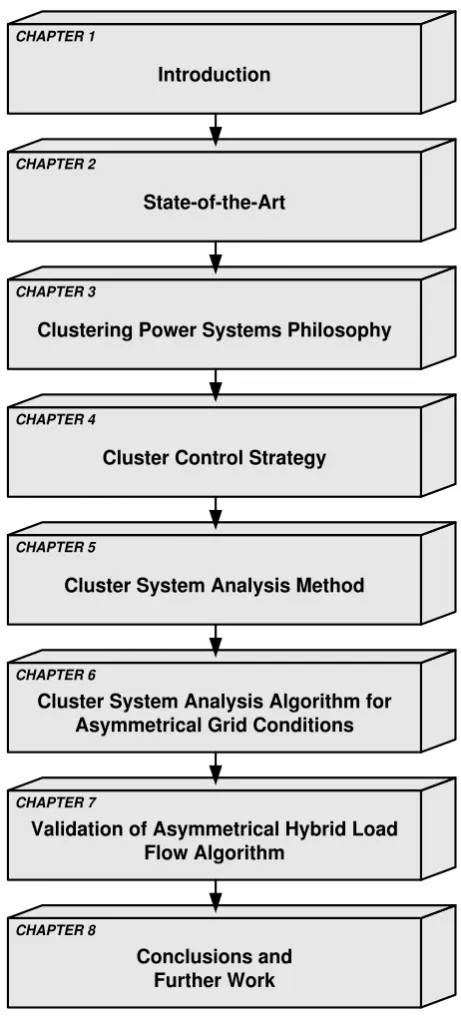
of building and operating future smart power systems. To have an overview of this thesis, a dissertation structure is portrayed in Fig. 1.5, and a brief explanation of all chapters is shown as following:
Chapter 1 introduces the technical background of this research. The evolution of electrical power supply systems, key to successful future power systems, problem statement, motivation, research aims, research contribution and the dissertation structure are described.
Chapter 2 presents the state of the art of this research. To illustrate a vision of future power system, this provides an overview of recent definition and scientific research projects. The discussion at the end of this chapter shows a drive of this research study.
Chapter 3 elucidates the approach of clustering power systems, which is developed by the department of Power Systems and Power Economics, at South Westphalia University of Applied Sciences, Soest, Germany. This proposed strategy is clarified the way to active the entire power systems with a clear structure and in a simply way. The implementation strategy of downsized management system and control strategy to distribution network or local area are explained as well.
Chapter 4 introduces the proposed downsized control strategy based on convention hierarchical control method. The basic functionalities of control method and its application for future power systems are described. Furthermore, the proposed control method provides the possibility to automate the cluster area. Thus, the key to accomplish the automated management application is pointed out. To illustrate its feature, the simulation case studies and discussion are provided.
Chapter 5 proposes the key to successful in power systems management based on clustering power systems concept. The cluster systems analysis method is focused and introduced. A background of the utilized method, a hybrid calculation, is explained in order to illustrate an advantage of this method.
Chapter 6 focuses on the asymmetrical condition in distribution network. Consequently, the development of asymmetrical power flow calculation based on hybrid technique is pointed out, which is the main contribution of this thesis.
Chapter 7 provides the verification of hybrid power flow algorithm and the application of the hybrid analysis method through case studies.
CHAPTER 2
State-of-the-Art
CHAPTER 3
Clustering Power Systems Philosophy
CHAPTER 4
Cluster Control Strategy
CHAPTER 5
Cluster System Analysis Method
CHAPTER 6
Cluster System Analysis Algorithm for Asymmetrical Grid Conditions
CHAPTER 1
Introduction
CHAPTER 7
Validation of Asymmetrical Hybrid Load Flow Algorithm
CHAPTER 8
Conclusions and Further Work
2.
State of the Art
This chapter presents the state of the art of the future electrical power supply systems. The current issues related to sustainable development are presented in order to illustrate the evolution of electrical power supply systems. Firstly, an electrical energy transition is discussed. This is a driving force to move toward sustainable power supply systems, since the global environmental problems become more significant. Secondly, the direction of future development is introduced through a term of smart grid and smart market because both of them are the lately worldwide research topics. Additionally, the future power systems requirements are also discussed to state the direction for sustainable development. Obviously, outstanding scientific research projects are selected and portrayed in order to show the trend of the future grid. At the end of this chapter, a summarization based on different aspect of research projects has been pointed out to compare with the proposed philosophy.
2.1 Electrical Energy Transition
Due to rapidly climate change and environmental problem, the response is needed to start the way to protect our world. One major cause is from the current power plants, which are the burning of coal, oil, and gas. They obviously ruin the global environmental. Moreover, the risk of nuclear power plant is also consciously studied. It might be more disadvantage than advantage, e.g., the Fukushima incident. According to mentioned problems of current power supply systems, the electrical energy transition has been focused in order to reduce and phase out the coal, oil, and nuclear power plant [48]. Therefore, renewable energy resources are taken into account as a key point of a low carbon society. To support that change, “Europe
2020” is a very good action. This project is a 10-year development strategy proposed by the European Commission on 3 March 2010. The main targets to accomplish by 2020 are 20% greenhouse gas emissions reduction compared to 1990, 20% of energy from renewables in total consumption, and increase of 20% in efficiency [49]. To emphasize this aim and move forward, the European Commission has also announced the low carbon Europe project,
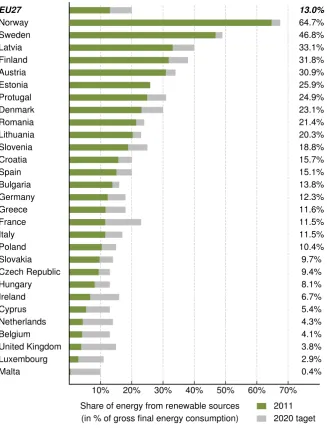
To indicate growth of renewable energy, the current progression on renewable energy in EU27 is selected to discuss. As mentioned that one of the main targets for the EU is to be reached by 2020 is a share of 20% renewable energy use in gross total electrical energy consumption. Thus, share of renewables in gross total electrical energy consumption is one of the headline indicators. In 2011, the average of energy contribution from renewable sources was estimated around 13.0% of gross final electrical energy consumption in the EU27, which has been increased around 5.1% from 2004. Whereas the consumption in some countries has almost reached 50%, some countries utilize around 4%. This big gap can be clearly seen in Fig. 2.1. It is worthy to mention that this data is provided by eurostat on 26 April 2013.
Sweden Latvia Finland
46.8% 33.1% 31.8%
Austria 30.9%
Estonia 25.9%
Protugal 24.9%
Denmark 23.1%
Romania 21.4%
Lithuania 20.3%
Slovenia 18.8%
Spain 15.1%
Bulgaria 13.8%
Germany 12.3%
Greece 11.6%
France 11.5%
Italy 11.5%
Slovakia 9.7%
Czech Republic 9.4%
Hungary 8.1%
Poland 10.4%
Ireland 6.7%
Cyprus 5.4%
Netherlands 4.3%
Belgium 4.1%
United Kingdom 3.8%
Luxembourg 2.9%
Malta 0.4%
EU27 13.0%
Croatia 15.7%
10% 20% 30% 40% 50% 60% 70%
Share of energy from renewable sources (in % of gross final energy consumption)
2011 2020 taget
Norway 64.7%
To reach the aim of low carbon city, “Energy Roadmap 2050,” it still needs a huge effort. For example, regarding Fig. 2.1, it is noticeable that ten countries have already reached the target of 2020, where the top three in share of renewable energy in gross final consumption are Norway (64.4%), Sweden (46.8%), and Latvia (33.1%). Conversely, there is also a big difference in share of renewable energy. Having a look on bottom three: Malta (0.4%), Luxembourg (2.9%), and United Kingdom (3.8%), this verifies and implies that the proceeding and developing is still needed in order to close this gap.
The transformation of electrical power supply system will not be happened overnight. The power plants, which will be utilized in coming decades, have to be planed and organized today in order to be ready for the transition in nearly future. The extension and improvement of grid has to be structured and prepared e.g. the bottleneck problem. In order to handle the future complex systems, the strategies and technologies have to be cautiously studied and clarified. Moreover, the growth of electricity cost has to be taken into account as well. The electricity market is also needed to handle the growing of electricity and penetrating of DG. Up to this point, it is obvious that the urgent issue, which is necessary to figure out, is the direction of future grid. Recently, the direction is discussed based on the term of “Smart
Grid” and “Smart Market”. To have a big picture, the following section is donated for the
explanation and the illustration of the interaction between both models.
2.2 Smart Grid and Smart Market
As many aspects to move towards sustainable electrical power supply systems, the responding is needed to start clarifying and structuring the direction of the future grid. The action time in order to build-up the sustainable electricity supply systems are now opening, since the energy conversion technology and the efficiency of grid infrastructure are dramatically increasing. Moreover, the penetration of distribution generation units in distribution network is also establishing the opportunity for the customer to be active for the electricity activity e.g. self-consumption. To take an advantage of new technologies, the vision and the concept of the grid evolution has to be setup. The objective must be able to ensure sustainable power supply by means of the energy efficiency, cost efficiency, safety and reliable system operation. To accomplish and realize those aims, the development effort needs to meet the principal aspects of the future grid. Consequently, the development aspects are expressed in bullet as following:
Improvement of generation and storage facilities
Expansion and replacement of grid infrastructure
To support the improvement of the generation units, the grid expansion as well as the replacement of aging infrastructure must be taken into account. Since this issue is improved, the operation and efficiency of the existing infrastructure, and developing novel concepts, technologies, and smart applications are able to be accomplished. For example, the installation of new distribution transformer to be ready for reversion energy flow process.
Development of energy resource interfacing unit
The energy converter is one of the most important units for the grid integration. Recently, the power electronic device technology is dramatically improved. This will enable the development of grid integration unit in order to obtain the maximum advantage of energy sources. Furthermore, this will be a key element for the implementation of advance control strategies.
Power systems control strategies
Lately, the trend of decentralized power systems has been considered as sustainable energy supply systems. This increases the grid integration ratio of DG units. According to this fact, it can be pointed out that the distributed energy resources (DERs) are expected to be a key element in future power systems. In order to deal and obtain an advantage of DG units, the development of future-oriented control strategies and architectures is necessary step to ensure the stability for decentralized power systems approach.
Information and communication technology
Due to the implementation of smart infrastructures, it will bring the complexity in the term of grid operation. Consequently, the information and communication technology (ICT) based technologies for network automation comes up in order to empower the safety and reliability of the system operation. Since the intelligent infrastructure will be developed from different platform or company, the standardization of communication protocol must be announced. Furthermore, the new measurement technology leads to production of massive information. In order to handle with this issue, the data processing capability and the visualization tool are needed as well.
Enabling the participation of customer
Regarding the development guidelines, they will improve the conventional network including existing grid. The information and advance control strategies will turn the conventional grid to be smart. According to this point, it is noteworthy to mention that the transmission network can be already implied as smart network, since many appropriated and powerful application have already been existed, e.g. monitoring of power flow and information service from DSOs to TSOs. The core developing issue for transmission network can be mainly focused on grid expansion in order to support the growing of energy capacity e.g. offshore connection. On the other hand, the distribution network has to be fully upgraded to become smart by adding the development approach as shown in guideline. The communication-, metering-, control- and automation technology will enhance quality, efficiency and capacity of the distribution grid as well as the entire grid. Consequently, the entire conventional grid will be turned to be the “Smart Grid.” Through those smart development approaches for the entire power systems, the target of sustainable power systems becomes more obvious. One of the indications stating the improvement of electricity grid is the penetration of RESs in distribution network.
Since the DG based RESs approach is successful, this leads to active electricity market application. The penetration of DG units in distribution network drives the customer to be able to involve in providing or purchasing electricity. This can be implied that the customer can select the utility in order to earn more benefits from providing or obtain the best price for purchasing. Based on this fact, the “Smart Market” term is evolved in order to handle the liberalization of energy market.
Smart Generation
Smart Distribution and
Transmission
Smart Storage Smart
Consumption
Interdisciplinary technologies:
Data collection, processing and recombination
Market
Grid Operation
Communication between System Components
Smart
Gird
Fig. 2.2: Action matrix of smart gird [53]
important to consider on both part: technical and economic part. Therefore, the interaction between principal aspects of both terms is pointed out. The action matrix between smart grid and smart market, which is introduced by DKE German Commission for Electrical, Electronic & Information Technologies of DIN and VDE in the cooperation with E-Energy, is selected for the explanation, as illustrated in Fig. 2.2, [53]. Regards the figure, it provides the clear vision of future grid player as well as their interaction.
According to Fig. 2.2, it is noticeable that the ICT is the major part as a communication media to interact between each player; additionally, to become a player of smart grid, each component has to be smartening as well. Thus, the classification of smart elements is taken into account. Their brief explanations are stated as following:
Smart generation
DG units have been taken into account as a future power generation and its technologies are becoming potential contributors of electricity supplied to electric utilities. This results in a high penetration in the grid of DERs based on RESs, e.g. wind turbine convertor systems and photovoltaic systems. Consequently, their grid interfacing unit, namely inverter, has been improved regarding the increase of the power electronic efficiency. These interfacing units open the gate way to other elements. Furthermore, the implementation of new control strategies and methodologies to inverter will empower and allow the smart generation. Finally, the DG units not only are power generation but also play an important role in network control.
Smart distribution and transmission
The electricity network operators, transmission system operators, distribution system operators are the important stakeholders for the deployment of future grid. In the future, they will allow the establishment of new market places. As energy service companies own the grid infrastructures, thus, they are a center of information communication between stakeholders [54]. Furthermore, they are responsible to undertake necessary investments to guarantee high levels of power quality and system security.
Smart storage
Smart consumption
Behavior of smart consumptions or grid users can be described as generation unit, storage unit, or normal consumption unit. Therefore, they can manage the usage of their own energy. Moreover, they will have the ability to sell the electricity back into the grid, and they have the right to choose their suppliers to earn more benefit. As a result, it can be implied that the smart consumption is one of the important market players in future.
Regarding Fig. 2.2 and mentioned smart elements, it can be realized that the smart grid is a drive factor to establish the functionality of grid operation and electrical energy market. Concerning electricity market point of view, the data collection and processing from the elements are necessary. The smart metering is lately become one of important issues; collecting billing data, market demand and regulatory can be observed. This evolution of conventional grid will lead to moving from centralized generation to distributed generation, executing the power systems automation and enabling new strategy for electricity market. Finally, smart grid, smart market and grid operation should be forced together to contribute and come out with intelligent solution. In order to illustrate the direction of grid improvement, the following section is stated for the discussion of recent smart grid research projects and the new approach for future grid.
2.3 Smart Grid Research Projects
To smarten electrical grid, it is not a short time process. Understanding of background is needed, and the development must be stepped wisely from historical power grid. An improving of power systems is already happening. As portrayed in Fig. 2.3, [55], it can be observed that present grid has been changed from the past; grid operation systems and power generation units have been spread out from the center.
Talking about an outlook of future smart grid, it must be stated that there are currently no final solution. Consequently, many pilot projects come up in order to demonstrate new electricity infrastructure, some circumstance solution, or full scale of smart grid technologies, which are deployed with existing grid. Having a look on a world leadership in an energy systems development, the Framework Programme of European commission has to be concerned. The European commission aims to forward an intelligent innovation and research in order to turn the current energy system into a more sustainable one. The present development projects are under the Seventh Framework Programme (FP7), which is in a period of year 2007 - 2013. The developments are mainly targeted to the grid integration of a diverse mixed energy sources in particular of RESs [56]. This will benefit to energy carriers and consumers through more energy efficient and energy costs in future. Furthermore, it will help to reduce the global climate problem, which will directly provide a great benefit to everyone. Since the FP7 is ended at the end of 2013, the European commission is already announced project Horizon 2020 [57], which is the biggest EU Research and Innovation Programme ever, started at the beginning of year 2014 to 2020. This framework is aimed to continue and forward current researches in order to accomplish the shared strategic objectives of Europe 2020.
To have an overview of the current development, this section is donated to present and discuss about the smart grid research projects, which are chosen from many outstanding researches. The selected projects are structured in the series of the power systems evolution. Based on evolution process, the main idea is subsequently transparent in order to show the trend of power systems development. Finally, a discussion based on those projects is provided. Advantages and disadvantages are distinguished; hence the direction of the future smart grid will be more obvious.
2.3.1 FENIX
aggregated into VPP, these groups of DER would have system visibility, controllability and impact similar to power plant in transmission level. This approach can be clarified through Fig. 2.4, [58]. If the VPP is connected to grid and its profiles are known, e.g. schedule of generating unit and operating cost, it can be implied that the VPP can be directly a market participant. On the other hand, the VPP can also provide ancillary services to grid e.g. active power / frequency control, and reactive power / voltage control. Therefore, the development of VPP concept is considered on commercial and technical activities [59]: Commercial Virtual Power Plant (CVPP) and Technical Virtual Power Plant (TVPP).
Fig. 2.4: FENIX VPP concept [58]
The CVPP is basically developed based on the market issue. The aggregation of the capacity of DERs units and the optimization of those units will forward the CVPP to be a part of wholesale electricity market. Then the main function of CVPP is to provide the representation cost and the operating characteristics for the DERs portfolio. Besides the commercial issue, the technical issue is needed in order to manage and accomplish the request form market side.
Consequently, the TVVP is in charge to collect the CVVP’s portfolio and contribute systems
management. Furthermore, TVPP approach can be considered as Active Distribution Network (ADN) operators [60], since it can provide ancillary services to other system operators. According to this fact, TVPP activities can handle the network control capabilities. With this TVPP capability, the DG units will turn the role and can join the grid control like centralized power plant.
schedules and operating parameters on to the TVPP. The TVPP is involved in local network system management as well as aggregating DER with local network parameters in order to transfer and present to TSO at transmission level. This can subsequently be used for balancing services, which TSO has to evaluate together with other offers or requests from other interconnected transmission systems. According to this scenario, the cooperation of TVPP and CVPP enables the DERs unit to join the transmission systems as a commercial and technical player. Individual DER gets a benefit from market, since it is able to gain access and visibility across all the energy markets. Additionally, the system operation also gains benefit from optimal use of all available capacity in system.
Fig. 2.5: CVPP and TVPP in system and market concept [58]
2.3.2 ADDRESS
The Active Distribution network with full integration of Demand and distribution energy RESourceS (ADDRESS) project is a five-year large scale project, which was supported by European Community's FP7 and launched from June 2008. The ADDRESS project has been
![Fig. 1.4: Structure overview of TSO grid operation [46]](https://thumb-us.123doks.com/thumbv2/123dok_us/102379.2011816/36.595.60.509.491.707/fig-structure-overview-tso-grid-operation.webp)
![Fig. 2.2: Action matrix of smart gird [53]](https://thumb-us.123doks.com/thumbv2/123dok_us/102379.2011816/45.595.189.495.479.686/fig-action-matrix-smart-gird.webp)
![Fig. 2.5: CVPP and TVPP in system and market concept [58]](https://thumb-us.123doks.com/thumbv2/123dok_us/102379.2011816/50.595.148.420.246.488/fig-cvpp-and-tvpp-system-and-market-concept.webp)
![Fig. 2.6: ADDRESS system architecture [63]](https://thumb-us.123doks.com/thumbv2/123dok_us/102379.2011816/51.595.151.480.228.515/fig-address-system-architecture.webp)
![Fig. 2.7: An example of power routing [68]](https://thumb-us.123doks.com/thumbv2/123dok_us/102379.2011816/53.595.88.525.390.669/fig-example-power-routing.webp)
![Fig. 2.8: Overview of ADINE concept [74]](https://thumb-us.123doks.com/thumbv2/123dok_us/102379.2011816/55.595.85.539.55.413/fig-overview-of-adine-concept.webp)
