Please cite this article as: J. Ghasemi, J. Rasekhi, Traffic Signal Prediction Using Elman Neural Network and Particle Swarm Optimization, International Journal of Engineering (IJE), TRANSACTIONS B: Applications Vol. 29, No. 11, (November 2016) 1558-1564
International Journal of Engineering
J o u r n a l H o m e p a g e : w w w . i j e . i rTraffic Signal Prediction Using Elman Neural Network and Particle Swarm
Optimization
J. Ghasemi*a, J. Rasekhib
a Faculty of Engineering & Technology, University of Mazandaran, Babolsar, Iran
b Faculty of Electrical and Computer Engineering, Babol University of Technology, babol, Iran
P A P E R I N F O
Paper history:
Received 18 August 2016
Received in revised form 20 September 2016 Accepted 30 September 2016
Keywords: Traffic Signal Neural Networks Particle Swarm Algorithm Wavelet Transform
A B S T R A C T
Prediction of traffic is very crucial for its management. Because of human involvement in the generation of this phenomenon, traffic signal is normally accompanied by noise and high levels of non-stationarity. Therefore, traffic signal prediction as one of the important subjects of study has attracted researchers’ interests. In this study, a combinatorial approach is proposed for traffic signal prediction, based on Neural Networks and Particle Swarm Optimization algorithm. Elman Neural Network is chosen from amongst many types of Neural Networks due to its feedbacked structure. To this purpose, Particle Swarm optimization algorithm is utilized for adequate training of the Neural Network, instead of common gradient descent based methods. In this work, wavelet transform is employed as a part of the preprocessing stage, for the elimination of transient phenomena as well as for more efficient training of the Neural Network. Simulations are carried out to verify performance of the proposed method, and the results demonstrate good performance in comparison to other methods.
doi: 10.5829/idosi.ije.2016.29.11b.09
1. INTRODUCTION1
The growth in the numbers of cars, besides providing comfort to society also brings about its own complications. Among the problems caused by the increasing numbers of cars on roads are traffic issues. Therefore, investigation of optimized traffic control methods constitutes one of the important research objectives for researchers. A variety of methods are employed in traffic control, including the use of traffic lights, commute restrictions, transmission of radio messages, etc.
One of the most important parameters affecting the success of the above mentioned methods is the numbers of cars passing on the relevant routes. In fact, having adequate predictions (estimates) on the numbers of future vehicles passing in a particular lane can be beneficial for the success of traffic management methods. As formation of traffic is based on human
1*Corresponding Author’s Email: [email protected] (J. Ghasemi)
decisions, the traffic signal is considered as a random process with high nonstationarity and large noise.
Until now, various methods such as Fixed Model, Linear Model, Statistical Model, Fuzzy Systems, and Hidden Markov Model have been used for short-term traffic prediction [1-5]. In several recent studies, authors suggested fuzzy Dempster–Shafer models for the prediction of traffic signal [6]. In these studies, with the goal of eliminating transient events in mind, the traffic signal was denoised using wavelet transform, and then prediction was accomplished based on Theory of Evidences.
In parallel with these methods, the exploitation of time series estimation capabilities of neural networks as one of the main research areas of traffic signal prediction has always attracted attentions from researchers [7-10].
Transient phenomena or noises are among the properties of the traffic signal, which in the proposed methods are usually eliminated through a single
preprocessing stage. One of the important
determining the appropriate learning procedure to achieve optimal weights of the network. In overall, learning in the neural networks can be regarded as an optimization problem. In fact, finding of the best network weights is an optimization problem in the space of weights. According to this point, various methods of finding weights have been proposed, a majority of which are based on back propagation algorithms and the gradient descent based methods. Along with and considering the drawbacks of gradient descent based methods, numerous researchers have proposed meta-heuristic approaches for the tackling of optimization problems [11]. Finding optimal weights for the neural networks is not an exception, and various studies exist seeking optimal network weights using meta-heuristic methods such as genetic algorithm [12-15]. In this research, recurrent Elman neural network is utilized for prediction of traffic signal. Moreover, particle swarm optimization (PSO) algorithm is employed here for a better training of Elman neural networks. Recurrent neural networks make use of feedback connections [16], and among the characteristics of these networks is the ability to learn patterns which bear correlations [17].
The rest of this paper is organized as follows: In section 2, such utilized tools in this research as recurrent Elman neural networks and particle swarm optimization algorithm are introduced. In section 3, the proposed method is presented, which is followed by section 4 where the procedure of applying the proposed method on traffic data as well as the obtained results are investigated. Finally, the paper ends by conclusions in section 5.
2. METHODS AND MATERIALS
The proposed system in this study is based on recurrent Elman neural networks and particle swarm optimization algorithm. These tools are therefore introduced in this section.
2. 1. Neural Networks and Recurrent Elman Neural Networks In recent decades, thanks to developments in computers, the neural networks inspired by the brain structure have found many applications as intelligent modeling tools [18, 19]. Based on their organization these networks are categorized either as feedforward or recurrent networks. Considering the feedback structure of the recurrent networks, these networks have been widely utilized in applications which deal with time series.
Among the most well-known recurrent neural networks is the Elmann network, which was first introduced in 1991 by Elman [16]. It is a partial type neural network, which is a combination of the classic perceptron neural network and the fully recurrent neural network. In contrast to the perceptron neural network which
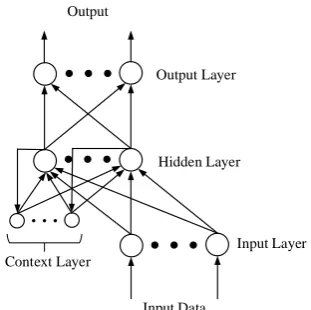
involves input, hidden and output layers as well as the weighted connections among neighboring layers, the recurrent layer of the Elman network employs a context layer which is sensitive to the history of input data [16]. Internal connectivity of Elman network guarantees the dynamical capability of network, and makes it superior compared to the feedforward networks. Figure 1 shows a schematic of the Elman network.
As seen from Figure 1, the network has four layers of input layer, hidden layer, context layer, and output layer. The context layer is used for memorizing the output from the hidden layer, and can be considered as a unit delay. The joint action of these four layers is sensitive to the past events of the input data. Furthermore, the internal feedback network increases the capability of processing temporal changes in data.
In order to investigate the relationships governing the Elman network, consider a network with n neurons in the input layer, m neurons in the hidden layer, and r neurons in the intermediate context layer. Moreover, name the input-to-hidden layer weights as w1, context-to-hidden layer weights as w2, and hidden-to-output layer weights as w3. Also assume u t( ) as the set of inputs at time t, x(t) as the output of the hidden layer,
( ) c
x t as the output of the context layer, and y(t) as the final output of the network. We have:
2 1
( ) ( c( ) ( ( 1)))
x t w x t w u t (1)
As seen from the above equation, xc(t)x(t1). Also,
denotes the transfer function of the hidden layer, for which the hyperbolic tangent is generally considered. The final output of Elman network is obtained as:
3 ( ) ( ( ))
y t w x t (2)
In Equation (2), is again the transfer function of the output layer, for which a linear function is normally opted.
Input Data Hidden Layer Output Layer Output
Context Layer
Input Layer
2. 2. Particle Swarm Optimization (PSO) Algorithm PSO was first introduced in 1995 by Kennedy and Eberhart [20]. Inspired by swarm behavior of the groups of animals such as birds, fishes and so on, this algorithm provides an optimization method [21]. PSO incorporates a population of particles in an n-dimensional space. The corresponding n-dim space constitutes the solution space for the intended optimization problem, and dimensions of this space contain all possible solutions. Each particle holds a specific location X in the search space, representing a possible solution for the problem. Each particle has also a velocity vectorv. Additionally, each particle has some
memory where it keeps the local best p (so far) and the global best g (so far). In every iteration, the global best is diffused among the whole population, and particles try to relocate towards this global best discovered in the search space. At any moment t, the velocity of particles are updated, and particles are moved from their previous locations towards new points by incorporating updated velocities. Therefore:
( 1) ( ) ( 1)
X t X t v t (3)
The following equation is utilized for updating to new velocities:
1
2 ( 1) . ( ) (0, ).( ( )
( )) (0, ).( ( ) ( ))
v t v t U p t
x t U g t x t
(4)
Traffic Data
Preprocessing
Elman Network Initialization
Initial Population for PSO
Reconstruction of Elman Network
Calculate MSE as Cost function
Check Stop Criteria
Calculate New Particle Position
Using Eq.3
Calculate Particle Velocity
using Eq.4
Calculate and ( ) p t g t( )
No
Yes
PSO Algorithm
Stop
Figure 2. Schematic illustration of an Elman Network
where U a b
, is a random number from [a,b] interval. is known as inertia parameter [22] and indicates the contribution of the previous velocity in determining the new velocity. Also 1 and 2 imply the importance of
(t)
p and g(t) respectively.
Furthermore, in every iteration the velocity vector of all particles are limited by the parameter vmax. The PSO algorithm is initiated by assigning all particles with random locations from the search space, through 1 and
2
uniform distribution. Moreover, elements of the initial velocity vector should be chosen from the [vmax
,vmax] interval.
3. PROPOSED METHODOLOGY
The proposed method of this research is based on the time series prediction capabilities of artificial neural networks, and consists of the major steps of data preprocessing, finding optimal weights for the Elmen neural network using PSO optimization algorithm, and eventually testing of the proposed system.
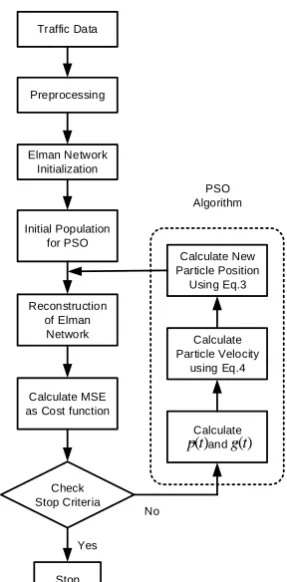
Before proceeding to the demonstration of system details, consider the block diagram of the proposed method in Figure 2. In this block diagram, we have tried to present the various stages of PSO algorithm separately, so as to facilitate the overall comprehension of the proposed method. As seen from Figure 2, first the input traffic signal sample of which is depicted in Figure 3 is preprocessed.
Because of the human intervention in traffic event generation process, traffic signal cannot be expressed according to a specific rule. Traffic signal is therefore usually considered as a random process with high degree of non-stationarity and large noise level.
In the case of time series prediction, when data contains high levels of noise, efforts are normally made to preprocess the input data in order to eliminate the effects of noise and transient events. In the proposed system, wavelet transform is utilized for the elimination of transient events.
Moreover, since in time series prediction using artificial neural networks specific patterns are searched within input data, input data for neural network is generated by applying proper delays to the input signal. Considering the property of recurrent Elman neural network, in deriving temporary patterns (also existing in the traffic signal as a time series), this network was chosen from amongst various network types. Among the issues related with artificial neural networks is the training of these types of networks [23]. In general, the training of artificial neural networks to obtain optimized weights can be considered as an optimization task within a high dimensional search space. Traditionally, gradient descent based methods such as back propagation are employed for training of the network and to find the optimal weights [23]. However, although the reduced gradient methods are listed among the best training methods for small dimension search spaces, but cannot achieve adequate solutions for high dimensional optimization problems. Overall, considering the NP-Hardness nature of the problem of finding optimized weights for neural networks, motivated authors to utilize meta-heuristic algorithms. Among these methods, PSO is a good and efficient algorithm for seeking optimal solution points, and therefore is employed here.
The cost function related to PSO algorithm is selected as the mean squared error (MSE) between the response of neural network and the real data used during network training. The procedure of PSO algorithm for optimizing Elman network involves supplying PSO algorithm with weights and thresholds of the Elman network, calculation of the cost function and finding of the optimal points until the stop criterion is reached.
Also, as it will be discussed in the section for results, in addition to error criterion the numbers of iterations is also used as another factor to stop optimization of the network.
4. SIMULATION AND RESULTS
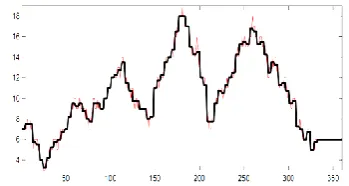
Before proceeding to the results, it should be noted that data was denoised using a three level wavelet transform scheme [6]. A sample traffic signal as well as its denoised counterpart are shown in Figure 4 for comparison. It is clear from Figure 4 that transient events are eliminated as the noise signals. This process facilitates system training. The utilized Elman network for the prediction of traffic signal is a three-layer artificial neural network.
The number of input and output neurons will be completely dictated by the problem. The number of input neurons depends on the dimension of delays embedded on input data. In this study, the number of delays is selected from 4 to 10 and the results are evaluated. Hence, the data suitable for training and testing of neural network is formed as Equation (5):
1 2 3
2 3 4 1
1 2
... ...
...
r
r
d r d r d r d
n n n n
n n n n
database
n n n n
(5)
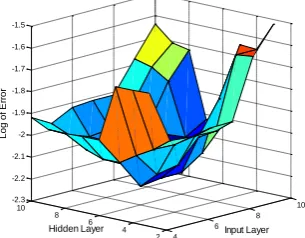
In Equation (5), d represents the total number of samples and r{4,5,6,7,8,9} indicates the embedded delay dimension. Also, based on above descriptions the number of output neurons is considered as 1. In this regard, the proposed system tries to predict the future sample based on the values of the past samples. The numbers of neurons in the hidden and context layers are also available as the degree of freedom for design. To avoid excessive complexity of the system on one hand and to guarantee obtaining of optimal weights on the other, the number of neurons in hidden and context layers were varied from 3 to 10. The parameters of particle swarm algorithm utilized in finding the optimal weights for the neural network included inertia parameter , and the coefficients of contributions from the local best and global best 1 and 2. We selected as 0.5, while the remaining two parameters were chosen from [0,2] interval ( 1 22). Moreover, two stop criterions of maximum 100 algorithm iterations and the MSE cost function value of 0.001 were opted. Simulation results are presented in TABLE 1 as well as Figure 5. It should be noted that since the resulting error values are very close to each other, logarithmic scaling is used for the z-axis of Figure 5 in order to achieve a more detailed view.
By considering the results shown in Table 1 and Figure 5, the best answer is obtained for 6 neurons in the input, hidden and context layers. Hence, in the proposed system the delay dimension was selected as r=6. Overall and according to above explanations, traffic signal prediction is achieved by the proposed method combining an Elaman neural network having 6 neurons in hidden and context layers, and 6 neurons in the input layer with the PSO algorithm for training of this network. Convergence results of the proposed method, comparison of the system output with the traffic signal data and the error diagram are all depicted in Figure 6. As shown in Figure 6, performance of the proposed system in estimating of traffic signal is desirable.
TABLE 1. Mean Square Error (MSE) of the proposed method with respect to changes in the number of hidden and input layer neurons
Hidden Layer
Input Layers
4 5 6 7 8 9 10
3 0.0205 0.0117 0.0115 0.0120 0.0121 0.0227 0.0302
4 0.0203 0.0103 0.0102 0.0106 0.0105 0.0223 0.0223
5 0.0203 0.0093 0.0072 0.0075 0.0095 0.0135 0225/0
6 0.0111 0.0083 0.0061 0.0063 0.0063 0.0073 0.0093
7 0.0111 0.0083 0.0074 0.0074 0.0091 0.0083 0.0095
8 0.0111 0.0088 0.0091 0.0094 0.0094 0.0144 0.0189
9 0.0111 0.0099 0.0092 0.0094 0.0112 0.0161 0.0197
10 0.0121 0.0107 0.0120 0.0122 0.0122 0.0169 0.0230
Figure 5. Logarithm of the errors achieved in simulation with respect to the numbers of neurons in the intermediate and input layers
Figure 6. The outcome of applying proposed method on traffic signal and the resulting error
For further investigation and comparison of the results obtained from our proposed method with the results achieved from other two methods, the corresponding mean squared error values are presented in Table 2.
TABLE 2. Comparison of the Mean Square Errors of the proposed method with two different reference methods
Method Mean Square Error
Reference Method [8] 0.0081
Reference Method [6] 0.0083
Neural Network without PSO 0.0193
Proposed Method 0.0061
The simulation results of back propagation based Elman recurrent neural network are also provided in Table 2 to demonstrate the advantages of PSO algorithm.
A quick investigation of Table 2 shows that compared to the other two methods, our proposed method has predicted the traffic signal by a favorable mean squared error.
5. DISCUSSION AND CONCLUSION
In this paper, we have proposed the combination of recurrent Elman neural network with particle swarm optimization algorithm for traffic signal prediction. Elman neural network is able to model past events due to its particular structure which accommodate feedback connections. The main scientific contribution of this paper is the use of optimization algorithm in finding weights for the recurrent network employed in traffic signal prediction, which more precisely can be categorized in two areas of tools and applications. From the tools perspective, usually the training of recurrent neural networks is somehow difficult due to the existing internal delays in these networks, and therefore the use of PSO algorithm in training was suggested. As we have demonstrated in this work, particle swarm optimization is able to adequately answer this requirement, proving the success of the proposed methodology. Also in the applications part, as discussed in the introduction section traffic signal prediction constitutes one of the challenging problems attracting interests from many researchers across the world. Overall, the proposed method can predict traffic signal with a relatively favorable accuracy, and the results outperform those without utilizing PSO algorithm. In fact, the use of PSO algorithm has resulted in an improved training of neural network and thereby in better results.
6. REFERENCES
1. Chrobok, R., Kaumann, O., Wahle, J. and Schreckenberg, M., "Different methods of traffic forecast based on real data", European Journal of Operational Research, Vol. 155, No. 3, (2004), 558-568.
4 6
8 10
2 4 6 8 10 -2.3 -2.2 -2.1 -2 -1.9 -1.8 -1.7 -1.6 -1.5
Input Layer Hidden Layer
L
o
g
o
f
E
rr
o
r
0 50 100 150 200 250 300 350 0
5 10 15 20
Time(min)
A
rr
iv
e
d
V
e
h
ic
le
s
p
e
r
M
in
u
te
expected predicted
0 50 100 150 200 250 300 350 -0.2
-0.1 0 0.1 0.2
Time (min)
E
rr
o
2. Li, L., Lin, W.H. and Liu, H., "Type-2 fuzzy logic approach for short-term traffic forecasting", in Intelligent Transport Systems, IEE Proceedings. Vol. 153, (2006), 33-40.
3. Porikli, F. and Li, X., "Traffic congestion estimation using hmm models without vehicle tracking", in Intelligent Vehicles Symposium, IEEE. (2004), 188-193.
4. Stathopoulos, A., Dimitriou, L. and Tsekeris, T., "Fuzzy modeling approach for combined forecasting of urban traffic flow", Computer‐Aided Civil and Infrastructure Engineering, Vol. 23, No. 7, (2008), 521-535.
5. Zhang, Y. and Ye, Z., "Short-term traffic flow forecasting using fuzzy logic system methods", Journal of Intelligent Transportation Systems, Vol. 12, No. 3, (2008), 102-112. 6. Zheng, J. and Tang, Y., "Fuzzy modeling incorporated with
fuzzy ds theory and fuzzy naive bayes", in Australasian Joint Conference on Artificial Intelligence, Springer., (2004), 816-827.
7. Abdi, J., Moshiri, B., Abdulhai, B. and Sedigh, A.K., "Forecasting of short-term traffic-flow based on improved neurofuzzy models via emotional temporal difference learning algorithm", Engineering Applications of Artificial Intelligence, Vol. 25, No. 5, (2012), 1022-1042.
8. Dia, H., "An object-oriented neural network approach to short-term traffic forecasting", European Journal of Operational Research, Vol. 131, No. 2, (2001), 253-261.
9. Dougherty, M., "A review of neural networks applied to transport", Transportation Research Part C: Emerging Technologies, Vol. 3, No. 4, (1995), 247-260.
10. Tan, G., Shi, H., Wang, F. and Deng, C., "Short-term traffic flow prediction based on parallel quasi-newton neural network", International Conference on Measuring Technology and Mechatronics Automation, IEEE. Vol. 3, (2009), 305-308. 11. Gogna, A. and Tayal, A., "Metaheuristics: Review and
application", Journal of Experimental & Theoretical Artificial Intelligence, Vol. 25, No. 4, (2013), 503-526.
12. Jaddi, N.S., Abdullah, S. and Hamdan, A.R., "A solution representation of genetic algorithm for neural network weights and structure", Information Processing Letters, Vol. 116, No. 1, (2016), 22-25.
13. Chong, S., Rui, S., Jie, L., Xiaoming, Z., Jun, T., Yunbo, S., Jun, L. and Huiliang, C., "Temperature drift modeling of mems gyroscope based on genetic-elman neural network", Mechanical Systems and Signal Processing, Vol. 72, (2016), 897-905. 14. Chanda, S., Gupta, S. and Pratihar, D.K., "A combined neural
network and genetic algorithm based approach for optimally designed femoral implant having improved primary stability", Applied Soft Computing, Vol. 38, (2016), 296-307.
15. Bukharov, O.E. and Bogolyubov, D.P., "Development of a decision support system based on neural networks and a genetic algorithm", Expert Systems with Applications, Vol. 42, No. 15, (2015), 6177-6183.
16. Elman, J.L., "Distributed representations, simple recurrent networks, and grammatical structure", Machine Learning, Vol. 7, No. 2-3, (1991), 195-225.
17. Giles, C.L., Lawrence, S. and Tsoi, A.C., "Noisy time series prediction using recurrent neural networks and grammatical inference", Machine Learning, Vol. 44, No. 1-2, (2001), 161-183.
18. Hashemi, S., Haji Kazemi, H. and Karamodin, A., "Verification of an evolutionary-based wavelet neural network model for nonlinear function approximation".
19. Neshat, N., "An approach of artificial neural networks modeling based on fuzzy regression for forecasting purposes", International Journal of Engineering-Transactions B: Applications, Vol. 28, No. 11, (2015), 1259.
20. Azami, H., Hassanpour, H. and Anisheh, S., "An improved automatic eeg signal segmentation method based on generalized likelihood ratio", International Journal of Engineering Transaction A: Basics, Vol. 27, (2014), 1015.
21. Kennedy, J., Particle swarm optimization, in Encyclopedia of machine learning. (2011), Springer.760-766.
22. Shi, Y. and Eberhart, R., "A modified particle swarm optimizer", in Evolutionary Computation Proceedings, World Congress on Computational Intelligence., International Conference, IEEE., (1998), 69-73.
Traffic Signal Prediction Using Elman Neural Network and Particle Swarm
Optimization
J. Ghasemia, J. Rasekhib
a Faculty of Engineering & Technology, University of Mazandaran, Babolsar, Iran
b Faculty of Electrical and Computer Engineering, Babol University of Technology, babol, Iran
P A P E R I N F O
Paper history:
Received 18 August 2016
Received in revised form 20 September 2016 Accepted 30 September 2016
Keywords: Traffic Signal Neural Networks Particle Swarm Algorithm Wavelet Transform
ديكچ ه
.تسا نْه سایست ىآ تیشیذه سد کیفاشت یٌیت صیپ ،ُذیذپ يیا یشیگ لکض سد اّ ىاسًا تلاخد ِت ِجَت ات کیفاشت لاٌگیس
نْه لیاسه صا یکی ىاٌَع ِت کیفاشت لاٌگیس یٌیت صیپ لیلد يیوّ ِت .ذضات یه ییلاات ییاتسیا مذع ٍ ضیًَ یٍاح لاَوعه
ِکثض شت یٌتثه ،یثیکشت نتسیس کی صٍّژپ يیا سد .تسا ىاشگطٍّژپ ِجَت دسَه ُساَوّ ،یطٍّژپ ٍ یثصع
نتیسَگلا ٌِیْت یصاس ماحدصا تاسر یاشت صیپ یٌیت لاٌگیس کیفاشت داٌْطیپ ُذض ِکثض ،یثصع یاّ ِکثض يیت سد .تسا
یاج ِت ،یثصع ِکثض ةساٌه شصَهآ سَظٌه ِت يیٌچوّ .تسا ُذض باختًا ىآ یکتذیف ساتخاس ِت ِجَت ات يولا یثصع
لا صا ،ىایداشگ صّاک شت یٌتثه لٍاذته یاّ شٍس ِت صٍّژپ يیا سد .تسا ُذض ُدافتسا تاسر ماحدصا یصاس ٌِیْت نتیسَگ
ِیلٍا شصادشپ صیپ صا یطخت ىاٌَع ِت کجَه لیذثت صا یثصع ِکثض شتْت شصَهآ یاشت ٍ اسزگ یاّ ُذیذپ فزح سَظٌه
ا ِتفشگ تسَص ییاّ یصاس ِیثض ،یداٌْطیپ شٍس دشکلوع یسسشت سَظٌه ِت .تسا ُذض ُدافتسا ضیً تاعلاطا جیاتً ِک تس
ذضات یه اّ شٍس شگید ات ِسیاقه سد یداٌْطیپ شٍس ةساٌه دشکلوع صا یکاح ،لصاح .