The influence of social networking, video games and general computer usage on parent-child relations
Ewelina Kroliczek
Email: [email protected]
Abstract
The aim of this project was to find out how parents feel about controlling the media/technology use of their adolescent children and how it influences their
parent/child relations. This is important because modern entertainment technologies are easily accessible and available to the population; thus they inevitably invade family space and influence family life. A gap in the literature is identified, indicating that existing research does not explore the reasons why parents control or do not control their adolescent children’s use of social media, video games and more. Additionally, there was no literature concerning how parents feel about such control and whether it was part of emotional labour; that being any activities that are
performed with a child’s well-being in mind. The project was carried out as the part of an undergraduate degree course by the final year student in sociology. The data was
collected through face-to-face and telephone semi-structured interviews with mothers and fathers of adolescents. It was observed that both mothers and fathers felt their control over children’s use of media and technologies influenced their
relations. Also the findings show a variety of reasons why parents choose to exercise their control in a particular way, and how it links to parent-child relations.
Keywords: emotional labour, social media, video games, adolescents, family relations, parenting, mediation
http://dx.doi.org/10.5920/fields.2015.1112
Introduction and literature review
This paper begins with a short, critical evaluation of existing academic literature and a brief explanation of the methodology and sampling used in this study. Following this, the project analyses the findings, comparing them to current theories. Lastly, there is the conclusion that summarises the findings of this study and provides suggestions for future research.
Sociology of family/ family studies
Family studies tend to look at the inner workings of relationships between family members, how they are constructed and how they are interpreted by society (Newman, 1991). This body of literature provides a theoretical background by outlining: parenting styles and habits (Mesch & Talmud, 2010; Newman, 1991; Plowman et al., 2010; Silverstone & Haddon, 1996); the influence of new media and entertainment technologies on children (Curran et al., 2012; Lohr & Meyer, 1991; Wartella et al., 2013); parental usage and their understanding of new media and technologies (Plowman et al., 2010; Ward, 2005; Wartella et al., 2013) and parent-child relationships (Chambers, 2012; Downing-Matibag, 2009; Steinberg, 2001). There is also a body of academic literature concerned with the use of technologies as educational aids and the parental roles in such involvement (Downey et al., 2007; Hollingworth et al., 2009; Passey, 2011; Plowman et al., 2010; Rogers & Wright, 2008), however those exclude children’s perceptions within studies as well as the influence of parent-child relationships.
There are two main academic perspectives of children and childhood: (1) Children as innocent beings in need of protection (Chambers, 2012; Haddon, 2004; Newman, 1999) (2) Children as ‘little monsters’ in need of control (Newman, 1999, p. 293). Throughout these seemingly opposite sides of the spectrum, an idea that children are unable to make meaningful and responsible decisions for themselves is
As a response to those stances, literature recognises different parenting styles. Halpenny et al. (2010) describe two types of parenting: (1) Authoritative parenting
which is characterised by warmth and reasoning, exercised with younger children (2)
Authoritarian parenting is characterised by high levels of control, exercised with adolescents. In terms of parenting and mediation of media/technology use, a variety of academic projects (Gentile et al., 2012; Kundanis, 2003) report three different media mediation styles: (1) Active: talking to the child about the media/technologies and explaining its mechanics to them (2) Restrictive: Setting strict rules of what can be accessed and in what amounts by the child (3) Coviewing: Only participating in the child’s media use. As Kundanis (2003) and Gentile et al.(2012) outline, active mediation is usually seen as optimal due to its beneficial effects on children’s
understanding of the media and technologies. Research conducted by Wartella et al. (2013) established different parenting categories, based on the parental involvement with media: (1) Media-centric parents who are greatly involved with media on a daily basis (2) Media-moderate parents who use media/technologies to some extent on a daily basis (3) Media-light parents who tend to not use media devices much and
clearly prefer other activities. The research found that children of media-centric parents are allowed to use media/technology much more compared to children of media-light parents (Wartella et al., 2013).
Child-parent relationships can undergo a dramatic change when minors enter adolescence, as teenagers start to seek more freedom of choice on everyday life matters (Downing-Matibag, 2009; Newman, 1999; Steinberg, 2001). Therefore parenting styles can change, if parents feel it is necessary in order to keep control over their children (Halpenny et al., 2010). The evolvement of screen/media-rich bedroom culture (Chambers, 2012, p. 87; Haddon, 2004, p.31), which is based on the idea of adolescents locking themselves away in their bedrooms with their devices, might be seen as a response to a more controlling parenting style (Gentile et al., 2012). Also the rise of adolescents using their devices and accessing the web in private causes parental concerns to rise (Kundanis, 2003; Gentile et al., 2012; Haddon, 2004; Rideout et al., 2010).
The term ‘emotional labour’ was first used by Hochschild (Scott & Marshall, 2009) and it refers to the use of personal emotions to enhance one’s working capability and to secure better outcomes (Hochschild, 2003, 2012). Hochschild (2012) also notes that emotional labour is mostly performed by women.
Emotional labour tends to be divided between the career sphere (Hochschild, 1983; Webb, 2012) and the domestic sphere (Gatrell, 2012). Emotional labour in the workplace is characterised by using one’s emotions to provide better services, although such efforts are usually unrewarded and taken for granted by employers (Hochschild, 2003). Emotional labour at home usually involves providing care to the needs of family members’ by a mother/wife; however as it is assumed that tasks within a family are unpaid, Hochschild (2003) refers to it as emotional work instead. Gatrell (2012) points out fathers can also have a substantial input into emotional work at home, especially towards children; she gives examples of men who abandoned their careers to have a larger input into their children’s lives (Gatrell, 2012, p. 142; Seddon, 2010). However, Gatrell also agrees that women are still
expected to provide most of emotional labour within marriage. Moreover, many women express their dissatisfaction with their male partners’ poor emotional
performance (Duncombe & Marsden, 1995); this could mean that while men provide
some of the emotional work at home, it is still a heavily gendered role. Thus the
concept of emotional labour bases on the understandings of gender roles within a family; it relates to traditional gender roles in particular by corresponding to an expressive role of women in a family structure (Strazdins & Broom, 2004).
Nonetheless, emotional labour towards children within a family is provided by both mothers and fathers; activities that involve emotional work can be such as taking care of an ill child; helping with schoolwork; playing with their child and so on.
The main criticism for the theory is the lack of consideration for alternative family types; for example same-sex marriages or single parent families. Thus there is no firm theoretical framework of how emotional work is divided between family members in unconventional families. However, parent-child relations are nevertheless
Existing literature has explored issues of emotional labour and modern technologies used at work (Pierson, 2005; Webb, 2012); however there is no available research that explores the area of emotional labour of media/technology mediation. This paper argues that this is a very important knowledge gap as general parenting is seen as a form of emotional work and technology mediation is a part of parenting.
Information Technology [I.T.] related studies
PEGI stands for the Pan-European Game Information age rating system, it launched in 2003 (PEGI, N.D.). A vast number of game software is rated by the organisation. PEGI’s main purpose is to allow parental control and provide reliable knowledge of games software, as well as to stop minors from legally buying games that are rated above their age group. Also according to the PEGI Annual Report (2012, p.11) all gaming consoles and operating systems have built-in parental controls that allow restriction of access to undesirable content. This implies that parents are able to gain control over their children’s game playing habits.
Wartella et al. (2013) found that parents tend to label video games as harmful to their children, whilst assuming that internet browsing and use of devices connected to internet is relatively safe. Furthermore, many parents find themselves struggling to understand modern entertainment technologies and how they work (Gentile et al., 2012; Ofcom, 2012; Yardi, 2012; Yardi & Bruckman, 2011) which means that parental controls might be useless in the parents’ eyes if they do not know how to use them. According to the Interactive Software Federation of Europe [ISFE]
Consumer Study (2012), the use of parental control settings on games consoles by British parents is 29% if their children are aged between 10-15 years. This data suggests that parental control is least restrictive for adolescents and it is contrary to the belief that parents tend to exercise a more authoritarian parenting style over teenage children. However the study does not explore the reasons why parental controls are or are not used.
allowed to use their services. However, as Social Media Today (2013) points out, many children under the age of 10 have created Facebook accounts, which would suggest that the age rules are just a formality with a lack of enforcement. Also many parents feel that they are unable to keep up with how social media evolves (Yardi, 2012; Yardi & Bruckman, 2011) therefore they might not know how to control social media use by their children. Due to the lack of technical skills and social media rules, parents might feel that their children are at risk of being exposed to inappropriate content without any organisation backing them up. Thus the responsibility of filtering the content and managing children’s use of social media lies solely with parents (Hobbs & Mendoza, N.D.; Yardi & Bruckman, 2011).
Aims and research questions
The aim of this project is to find out how parents feel about mediating the media/technology use of their children and how it influences their relations.
The first part of achieving this aim is to research parenting and mediation strategies employed to control adolescents’ use of social media and entertainment
technologies. This is due to assumptions in the academic literature about the way in which parents perform their mediation when handling their teenage children. The second part of this study is to research whether parental mediation of modern media and entertainment is a form of emotional work. This is based on the literature of emotional labour, which specifies that parenting on its own is a form of emotional work. However, as the only research concerning emotional labour and modern I.T. technologies is about paid work, it creates a literature gap which needs to be explored. The main literature gaps are identified as follows: (1) Scarcity of in-depth studies that would explain the reasoning behind particular parenting and mediation styles (2) Studies usually do not include teenagers (3) The assumption that
adolescents will rebel against parental mediation and control (4) Inadequacy of available qualitative research on the topic (5) Lack of research about implications of emotional labour at technology mediation by parents.
Consequently, as a result of these gaps, research questions are as follows:
(2) Do parents feel such control influences their relations with their children? (3) Do parents perceive mediating media/technology use as a form of
emotional labour?
As this project strives to answer those questions, it contributes to the current theories by:
(1) Filling in the knowledge gaps
(2) Addressing contemporary phenomenon that occurs on an everyday basis (3) Attempting to question ideas and beliefs that are often taken for granted (4) Giving an alternative point of view through the employment of less popular qualitative research.
While the findings from this project are not substantial for theory creation, they could point out new focus points for future research.
As the patterns and statistics are already available, this project aims to uncover meanings attached to decisions and parental dilemmas by the application of the qualitative methodological stance.
Methodology
Family relations were traditionally researched using quantitative methodology (Copeland & White, 1991), which means that insufficient focus given to details and life stories led to the creation of a knowledge gap. The majority of literature focuses on quantities of data; in order to fill the gap this research project aimed to gather insights of usually unasked questions and unexplored reasons why parents make particular choices. The most suitable research method for this is semi-structured interviews. The advantage of using this method is the ability to obtain both answers to research questions and possibly uncover new themes for future academic
research (May, 2002, 2011). The limitation of semi-structured interviews in this project give the possibility of leaving out any topics that were not mentioned by interviewees and were not thought of by researcher. In order to avoid this problem, a pilot interview was conducted.
Except for the general questions, the categories reflected the ones from the literature review in order to fulfil the aims and research questions of this project. As mentioned earlier, the first interview was a pilot in order to check if all questions were easy to understand or if there are any topics missing. The length of each interview varied; interviews with fathers were all shorter and more concise than interviews with mothers. Five interviews were conducted face-to-face in a public setting and one interview was conducted during a telephone call. The data was transcribed word by word from the audio recordings; the telephone interview was particularly challenging to transcribe due to the lower quality of the recording.
The project was approved by the university’s ethics panel on the principle that the interviews were to be undertaken in a public setting. No problems of an ethical nature arose during the project and all guidelines were followed at all times; moreover none of the participants expressed any signs of distress or discontent throughout the interviews. All participants agreed to be recorded and all have signed the consent form. No participant refused to answer any of the questions nor any
have asked to stop interviews before all questions were asked.
Due to the limited resources and time limits, this project used purposive sampling. This allowed the selection of an even number of mothers and fathers to participate in the study from different families. No other differentiations on the background of parental age, ethnic/national or social class backgrounds were made at the stage of obtaining the sample. The most important purpose was to select parents that had at least one child aged between 12 - 18 years. While parents are seen as a large group in British society, many of the approached parents refused to take part in the study as family relations is a very private and delicate topic to touch upon (Copeland & White, 1991, Thompson, 2004); this could be seen as one of the reasons for a small sample size. The sample consisted of six participants (see Table 1 below). All
However, it also meant a lack of representation of diverse family types or diverse parental backgrounds.
Participant #1 #2 #3 #4 #5 #6
Gender Male Male Female Female Male Female
Children aged 12-18
years
1 son 1 son 2 sons 1 son 1 son 1
daughter
Age [years] 51-60 51-60 51-60 31-40 41-50 31-40
Ethnicity White White White Black
African
White White
Table 1 – Sample information
This project employed thematic analysis as it allowed the breakdown of data into codes that could be systematically analysed (Bryman, 2008). This method of data analysis was especially suitable as the interview questions were grouped to reflect themes coming from the literature review. While there were rare occurrences of
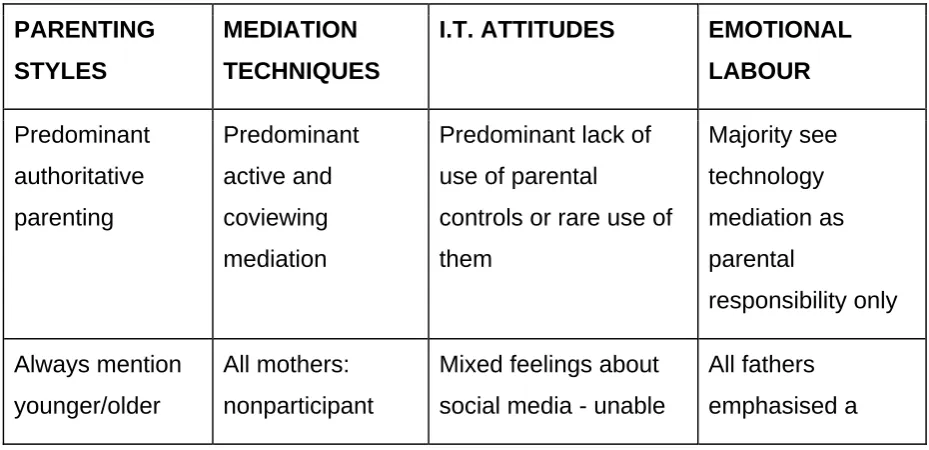
contradiction, most of the data was eligible for coding. The transcripts were coded by the major themes from the literature (see Table 2 below).
PARENTING STYLES
MEDIATION TECHNIQUES
I.T. ATTITUDES EMOTIONAL LABOUR Predominant authoritative parenting Predominant active and coviewing mediation
Predominant lack of use of parental
controls or rare use of them Majority see technology mediation as parental responsibility only Always mention younger/older All mothers: nonparticipant
Mixed feelings about social media - unable
siblings that do not count into the sample
All fathers: participant
to clearly define whether they are positive or negative
good relationship with their children
Occasionally changes in parenting styles were described by parents Active negotiation usually described instead of
mediation on its own
Mother’s unwillingness to engage with
technologies
Father’s willingness to engage with
technologies
Mothers willingly spoke of conflicts caused by their mediation
Tendency for children to use devices in their bedrooms
Occasionally changes in mediation styles were described
Emphasis on social media and cyber bullying
Most admit that the mediation
influences parent-child relations
Predominant knowledge of PEGI
(age ratings and violence/gambling ratings)
All put emphasis on the need to teach the children rights and wrongs of technologies and social media
Table 2 – Themes that emerged from coding transcripts
Findings and Analysis
Parenting styles and mediation techniques
Halpenny et al. (2010) determined that adolescents are subject to authoritarian parenting styles; however the data found showed that it is not always possible to simply determine such facts as a stabilised and unchangeable phenomenon (see Table 2). Moreover, both parenting strategies and mediation styles often intersect: “We don’t restrict it [media/internet usage] in any way, but what we’ve done is sat down with them and talked about it” (Participant #2). Here the participant expressed
made more complicated by how mediation styles are simultaneously applied as well. Also some parents experienced the change in their parenting and mediation
strategies; that is the idea that the change between the authoritative and
authoritarian parenting styles depends solely on the child’s age (Halpenny et al., 2010; Kundanis, 2003; Wartella et al., 2013) did not reflect in the data. A perfect example is the case of participant #3 (see Table 3 below).
Participant #3 case
Participant #3 has actively described how her experiences of media and technology
mediation of her older child has influenced her perceptions and expectations of how children
should be controlled and guided. As her parental attitude towards the older son was of an
authoritarian nature, she described the rise of conflicts between herself and the son: “So
we’ve set limits and we’d have the meetings where we’d agree OK you can spend that much
time on the screen (...) so we had all that and that caused a lot of friction”. Then she
explained the change in parenting to authoritative style as she and her husband decided to
be less restrictive towards the younger son; aside for the fear of more conflict she also
explained what seemed to be the rise in experience and confidence in the effectiveness of
her mediation strategies.
Table 3 – Participant #3 case description
Thus not only does the data contradict the literature, it also explored possible
reasons parents might have for changes in attitudes. However, parents with younger children often emphasised the differences in mediation towards younger and older children: “I monitor how much my four younger children are using devices; with my older daughter - I’ve left her to her own devices quite a bit” (Participant #6). This supports the notion that parenting styles differ due to children’s age; however
younger ones are policed more and in a stricter way, in contrary to Halpenny et al.’s (2010) findings. Furthermore, while the literature did not explore the possibility of links between technology mediation styles and a child’s age, the data suggests that younger children are subject to restrictive mediation styles, while older children are
more likely to experience an active or coviewing type of parental control.
focused on either parenting or media/technology mediation styles, the underlying assumption was that it was the parent who dictated the conditions of children’s use of technologies and social media. However, this was deterministic as it ignored the possibility of children influencing the creation of rules. Such input usually took the form of negotiating the allowed boundaries, no matter if the attempts were successful or not:
But you know, you’ll sort of go on the time and at the end of time we’d say OK you need to come off and he’d been discussing ‘oh I just want to finish this’ and we’d say ‘no, you need to come off now’. (Participant #3)
Additionally, there were instances when parents initiated a negotiation dynamic: “You let them think that they’re making up the time that they can spend on it, that you let them decide what realistically is” (Participant #1). Hence the discovery of this theme was an important finding, as it allowed a better understanding of the parent-child relation dynamics in terms of parenting styles and mediation styles.
Many of the participants mentioned the use of computers for children’s educational purposes: “90% of his homework my older son brings from high school, they are on internet. Their school have VLE [Virtual Learning Environment] and they have to go on it every now and again” (Participant #4). Educational needs also influenced parents to provide more technologies to their children: “He comes back from school 4 o’clock, so we can’t say ‘let’s go to library to do your homework’ because the library close at 5” (Participant #4). Even more, for some parents it was the main reason to engage with technologies along with their children: “Oh yeah, we do, laptops I do mind maps with my daughter [name removed] who needs bit more confidence in maths” (Participant #6). This links back to the literature that looks at the influence parents might have on children’s education and existing technologies (Downey et al., 2007; Hollingworth et al., 2009; Passey, 2011). While this project was not concerned with the links between education and media/technologies, it is an important finding that parents adjusted their mediation and parenting styles to
Another finding saw the mothers exercising a nonparticipant form of mediation, while the fathers participated in active/coviewing mediation. While most of the parents were media-moderate or media-light parents, it did not have a profound influence on the mediation style. Furthermore, participant #4 expressed positive feelings of social media in general: “It’s a good thing [social media] because it’s like everything in your life, it has both good and bad sides”, in the meantime being negative about children having access to it: “If you let children use it [social media] early enough, they won’t be able to rationalise (...) I’m sceptical of children using social media”. Therefore this is another finding that contradicts the literature; a media-centric parent does not necessarily give more freedom of using media to their children nor do media-light parent always restrict the access to media/technology. Also this in particular is interconnected with the literature of I.T. studies.
Last, but not least, the theme of media-rich bedroom culture appeared both in the academic writings (Chambers, 2012, p. 87; Haddon, 2004, p.31) and the findings. Participants #1, #5 and #6 spoke of their children having their own laptops in their
bedrooms and participants #3, #5 and #6 spoke of their children having the possibility to use mobile phones in their bedrooms. Parents also reported the
children using mobile devices whilst being with other family members: “Even if we’re all sat watching TV [television], the boys usually are on Facebook or Snapchat or texting or whatever” (Participant #5). Furthermore, most of them were well-aware of the limited ability to control accessed content while children used mobile devices: “Most of the time I’m not massively aware of what she’s doing on it” (Participant #6). While all participants except #4 allowed their children to use mobile devices out of their sight, the anxiety of being unable to protect children from inappropriate content was openly expressed. Hence the theory that adolescent use of internet in private causes their parents to worry was confirmed.
Attitudes towards I.T.
of information for parents about games and parental controls. However, some of the participants spoke about their lesser knowledge of devices compared to their
children: “Parental controls are limited. I mean, where you have a better content filter, my children’s technological knowledge outstrips mine significantly” (Participant #6). This statement supports the same point presented by literature (Gentile et al., 2012; Yardi & Bruckman, 2011) and thus presenting a limitation to usefulness of PEGI. Moreover, the use of PEGI’s advice is voluntary, meaning that no campaigns or ratings have any effect if parents chose to not use them. Nonetheless, parental acknowledgments of PEGI’s limitations did not completely override its usefulness in participants’ opinion.
ISFE’s (2012) findings about the low proportion of parents employing parental controls on devices used by adolescents were confirmed. The findings also apply to social media: “I know parental controls are all over them [devices], we haven’t activated them on the systems we’ve got” (Participant #2). Here the parent
expressed his knowledge of the parental controls available on devices owned, but
decided to not take the advantage of it. Furthermore, the data shows that the intensity of parental control lowers as the children grow: “On the laptop we used to [use parental controls] with the seventeen-year-old when he was younger, but we don’t do it now” (Participant #1). This again supports ISFE’s (2012) findings and contradicts the belief that parents tend to be stricter with adolescents (Halpenny et al., 2010). One of the participants was an exception and gave a very detailed account of how parental controls were used in their household:
Because their dad programmed it [device], they only use it on Saturday and Sunday, one hour each. So I think on Saturday it starts at 2 and it goes off by 4. So when it’s 2 o’clock, whichever one is ready goes first, and after an hour they switch places (...) During holidays they spend more time, but during school term it’s only two hours Saturday and Sunday. (Participant #4)
Thus it enforces the idea that parenting and mediation styles are adjusted by parents where appropriate.
The next discovery was similar to one of the findings that were analysed in previous section: mothers were unwilling to engage with technologies and media and fathers were happy to do so. All three mothers stated that they did not know how to use particular devices and/or social media because they did not wish to: “Uhm, no I don’t know how to use DS [Nintendo Dual Screen] consoles. But I mean, I would be able to if I wanted to - but I don’t want to… that’s why I never used them” (Participant #6). Fathers expressed the willingness to engage with technologies along with their children with limitations to it; when asked if he uses Xbox with his son, participant #1 replied: “Uhm, yeah, but not as often as he does...basically I can’t afford to sit there and play games hour on hour, but I will play some games with them”. Furthermore, in case of participant #4, it was the husband who operated the parental controls and engaged in activities with children; when asked about the ability to use them, she said: “Yes, yes. Well not me, but my husband. (...) We discussed it [parental controls
set up] with them, before my husband has set it up”. There is a degree of uncertainty whether this finding is a result of coincidence or if it has the potential to represent a wider social pattern.
Furthermore, while there is a clear link between both data findings, there is also a particular characteristic that made both themes distinctive from each other. The mothers’ lack of participation in the mediation did not mean actual lack of the mediation on its own; for example they did not need to play a videogame with their children to speak about any issues linked to them. Hence both the mothers and fathers were able to exercise their parental control. On the contrary, the mothers’ lack of willingness to learn about I.T. related activities meant that they were at a disadvantage compared to the fathers. This was due to their limited opportunities to learn about modern media and entertainment technologies their children used. This in turn might empower the fear of children using media/technologies in undesirable ways (Yardi and Bruckman, 2011).
Uhm, I feel that it can be a positive networking means of staying in touch with friends. I fear there are some disadvantages, because the fact that you
haven’t got a distinctive school stroke - home life, it all kind of...so if there are problems, I think it’s extenuated by social media. (Participant #6)
Thus parents always critically assessed strengths and weaknesses of social media in terms of what they thought of it and how it related to their children. For example, one of the fathers felt that social media is potentially threatening: “[It is] Dangerous (...) Because there is no regulation, it’s not policed” (Participant #5). This links back directly to the literature, in which it was explored that terms of use of particular social media is often just a formality with no possibility to enforce it. Furthermore, this supports the theory that parents often feel that there is no one to support them in policing the use of social media by minors (Yardi & Bruckman, 2011).
The second theme bases on the fears of social media specifically; in particular the
issue of cyber bullying. One of the mothers was prominent in voicing her concerns of cyber bullying through social media:
Because you see all these people, some of them will write ‘you’re not beautiful, you’re ugly’. Because you read those things (...) You are who you are, you can’t be somebody else (...) So children who get into social network media are there too early and if they weren’t already enlightened of the
consequences early enough before they...if you don’t do it early enough, they won’t listen to anybody. (Participant #4)
light. They knew that there are serious concerns, but that there are also ways of managing it. This links back to the advantages of active media mediation strategy; parents believe that it helps their children make right choices (Gentile et al., 2012; Kundanis, 2003).
Emotional Labour
As the topic of emotional labour provided the biggest gap in the literature, there is more data and themes to analyse. However, it also means this section has the least amount of academic writings to compare the findings to.
Firstly, most of the participants saw media/technology mediation as parental responsibility only: “They are your children; you have the first responsibility of care for them” (Participant #5). Furthermore, many of them held a very strong conviction that it was their own incentive, rather than being openly pressured, to do so: “No one
asked me to do it, I just do it, it’s just expected” (Participant #2). While the parenting and mediation styles varied and different reasons were put forward in order to
rationalise particular approaches, parents saw the responsibility to protect their children from any harm as the main priority: “I think it’s expected, if he’s throwing himself into danger so we must protect him and guide him” (Participant #1). There is also a notion of parents claiming that they decided for themselves that they need to mediate, but in the meantime mentioning that ‘it is expected’. Hence, although most of the participants did not speak of any social dynamics involved, some described social positions and functions that put even more pressure to perform mediation ‘properly’: “I work for youth offending team (...) and my wife is a teacher so we really got to police what comes into our house” (Participant #5). Therefore this father is well-aware of the many dimensions that influenced his choice of how to parent and mediate; yet it does not mean that the priority of protecting the child diminishes.
Secondly, the findings presented that the mediation of technology and media use
between relatives (Gatrell, 2012), this is the evidence for the claim that parents performing media/technology mediation is a form of emotional labour. The next step is to look at the differences between mothers’ and fathers’ perceptions of the links between emotions and parental control.
According to the findings, men primarily saw their mediation as the way of improving and stabilising a connection with their offspring. Furthermore, all three fathers heavily accented their good relationships with their children: “Yes, it [mediation] certainly strengthens it [relations] as I explained everything (...) I always give a reason [to control] (...) I think my relations with my boys is stronger than some parents’ with their kids” (Participant #5). Hence not only this established the role of emotional labour in mediation strategies, but also allowed an insight into men’s perceptions of what constitutes as the stereotypically female role (Gatrell, 2012). Another point of strength was pointed out by the fathers exercising participant mediation; again it allowed father-child bonding: “In a way that Xbox, I can play games with them, do something together, so you increase, improve your relationship with them”
(Participant #1). By directly speaking of relations with the children, those fathers nearly explicitly spoke of emotional work they put into controlling the access to media and technologies. However, the fathers rarely mentioned any form of conflict that the control might have caused.
Mothers, on the other hand, openly spoke of both positive and negative impacts: “Yes, I think as I’ve said I’ve had arguments with my oldest one, and the second one and the third one about how much they use it [devices]. So yeah, it does impact” (Participant #6). Here, the mother openly admitted that her mediation led to conflict, and also concluded that such disagreements had an influence on their relations. While it was not said directly, this statement suggests that it was a negative influence. Furthermore, the emotional strain the parents experienced due to such conflicts also had the power to change parenting strategies:
This quote provides evidence for a few points. It further enforces the thesis that the mediation styles are also the form of emotional labour. Moreover, it focuses on
difficulties of parenting, rather than just looking at parent-child bonding. Last but not least, it is an explicit proof for the conflict being one of the major factors that impact parenting mediation styles and their re-evaluation.
Mothers, however, also spoke of positive sides of parental controls when asked: “A positive side to me negotiating with them what they see? Uhm, I think it’s the idea that I do negotiate and just don’t let them do whatever” (Participant #6). At first it did not sound positive; however it could be explained with this mother’s individual approach. In her eyes it was positive to look after her children even if it caused friction; the care of one’s offspring was seen as the good attitude to have, therefore having a positive impact in the long-term. With the available data it is near
impossible to provide definite reasons why mothers spoke openly of conflicts and fathers barely mentioned them. Nonetheless, focus on either positive or negative
consequences of parenting provided the evidence of emotional involvement; hence again proving the existence of emotional labour in media/technologies mediation.
A concluding theme is the participants’ focus on the need to teach their children ‘right’ behaviour when engaging with social media and entertainment technologies:
There should be no parent who haven’t said that to their children, they should teach their children to rationalise. Because I’m Christian, I pray that when I won’t be there for them, they’ll know what to do; just teaching them for life. (Participant #4)
Whereas the religious affiliation of the participant was not considered as an active factor and was accepted as the matter of individual choice, this quote coined two important points. The first directed the responsibility at parents to educate their children about appropriate and healthy approaches to social media and
Furthermore, it links back to the literature discussing the creation and interpretation of childhood (including: Chambers, 2012; Haddon, 2004; Newman, 1999). The perceived need to teach children to self-control their habits intersects with the theories that children are unable to make a meaningful decision themselves, thus they need to be taught by their parents.
Discussion and conclusion
All of the findings contributed to answering the research questions this project aimed to answer. The first question asked: Do parents control their children using
computers/tablets/smartphones and/or video games consoles? The participants
spoke of their attempts to control it to some extent. Some chose to give more freedom to their children, but it did not mean that the controlling stopped. The reasons why parents chose to police their offspring in a particular way were unique to each participant, which included: the importance of their children’s development; the past experiences with the participants’ own parents and the emphasis on
protecting their children. While those reasons did not make up a theme on their own,
they were embedded in existing themes. Overall, each participant showed that they tried to control their children’s media/technology usage to some extent, but it varied per case.
The second question asked: Do parents feel such control influences their relations with their children? As the analysis showed, the majority of participants agreed that it did; the analysis also examined how it influenced those relations. While mothers explored both positive and negative impacts, the fathers focused nearly exclusively on positive impacts and detracted any signs of conflict: “They might frown a bit [because of restrictions] but neither of them will kick off about it” (Participant #5). Nonetheless, parents thought that their mediation influences relations between them and their offspring.
The last question inquired: Do parents perceive mediating media/technology use as
a form of the emotional labour? Although the participants did not directly assess their
parenting/mediation styles and I.T. studies, brought together a vast amount of
perceptions, feelings and views. Those were often described as the state of relations or emotions, such as: “it’s a good thing”, “emotionally draining”, “difficult”, “good relationship”, and so on. Furthermore as the participants saw their mediation as a part of parenting, and the parenting on its own as a form of emotional labour (Gatrell, 2012), the mediation and control of children access is the emotional labour
performed by parents.
However, the analysis of the findings not only surfaced valuable data, but also the limitations and further questions. The literature and the findings cannot explain the reasons why all mothers did not want to participate in using social media, video games and such while all fathers willingly participated. Furthermore, it cannot provide the reasons why fathers focused on the positive aspects of parental
mediation, while mothers extensively spoke of the conflicts instead. While it could be seen as a result of uneven distribution of emotional work within a family (Strazdins & Broom, 2004), it is not certain that this is a real reason for this discovery. Therefore
those ambiguities had to be left unanswered, as there is no sufficient data available to make any kind of assumptions.
Another limitation to this study is the lack of the representation of ethnic minorities and different family types. While the small sample size meant that generalisations could not be made, there was no chance to explore potential variations between different cultural/ethnic approaches to parenting. Furthermore, there was no possibility to compare different family types as all participants were from nuclear families. Per contra, the equal number of mothers and fathers allowed the insight into potential differences between parenting and parent’s gender, even if they were not explained by this project. Whereas an unsophisticated answer could arise from gender-stereotyped views, without the solid research and data on this issue it is not possible to give a meaningful explanation. Therefore exploring different
ethnic/cultural groups and gender differences in parenting could be one of recommendations for future studies.
the knowledge about the media-child-parent relationship was due to a great focus on young children and lack of attention on adolescent children. The findings proved that the parenting of adolescent children and controlling their access to social media and entertainment technologies is a part of emotional labour. Furthermore, the data opposed some of the assumptions about parenting youth: parenting strategies were most likely to be authoritative instead of authoritarian. Moreover, the data provided a rich source of details about the participants’ reasoning behind their rationale. The mechanisms of emotional labour in this context were also discovered, with the emphasis on the unique feelings each parent experienced and spoke about.
Therefore the findings serve the purpose of enhancing the existing theories rather than creating new ones, as the details interviewees spoke of were a part of existing theories. The contradictions between the findings and the literature could result from many factors, such as but not exhaustible to: different cultural contexts, differences in theoretical stands taken into account, different sample sizes and so on. Some of the empirical research presented originates from United States rather than from
Britain/Europe, which could be seen as a kind of weakness to this study. On the other hand, all of those locations are considered to be western societies; hence justifying the use of such sources.
Discovering the children’s side of the story was not considered to be one of the aims of this project. However, there might be potential in discovering a fuller picture of media-child-parent relations through the research of parents and their adolescent children. Although such a project would require a different focus from the academic literature, it could have the capacity to identify new themes and reasons for parents choosing particular mediation strategies.
References
Bryman, A. (2008). Social Research Methods (3rd ed). Oxford: Oxford University Press.
Chambers, D. (2012). A sociology of Family Life. Cambridge: Polity Press.
Curran, J., Fenton, N., & Freedman, D. (2012). Misunderstanding the Internet. Abingdon: Routledge.
Downey, S., Hayes, N. & O’Neill, B. (2007). Play and Technology for children aged
4-12. Centre for Social and Educational Research Dublin Institute of Technology.
Retrieved from http://www.dcya.gov.ie/documents/research/play_and_technology.pdf
Downing-Matibag, T. (2009). ‘Parents’ Perceptions of Their Adolescent Children, Parental Resources, And Parents’ Satisfaction with the Parent-Child Relationship’.
Sociological Spectrum: Mid-South Sociological Association, 29(4), 467-488.
http://dx.doi.org/10.1080/02732170902904632
Duncombe, J. & Marsden, D. (1995). ‘Workaholics’ and ‘whingeing women’: Theorising intimacy and emotion work – the last frontier of gender inequality? The
Sociological Review, 43(1), 150-169.
http://dx.doi.org/10.1111/j.1467-954X.1995.tb02482.x
Facebook. (2013). Statement of Rights and Responsibilities. Retrieved from https://www.facebook.com/legal/terms
Gentile, D.A., Nathanson, A.I., Rasmussen, E.E., Reimer, R.A., & Walsh, D.A.
(2012). Do You See What I See? Parent and Child Reports of Parental Monitoring of Media. Family Relations,61(1), 470-487.
http://dx.doi.org/10.1111/j.1741-3729.2012.00709.x
Haddon, L. (2004). Information and Communication Technologies in Everyday Life:
A Concise Introduction and Research Guide. Retrieved from http://www.ebrary.com
Halpenny, A.M., Nixon. E. & Watson, D. (2010). Parents’ Perspectives on Parenting
Styles and Disciplining Children. Retrieved from
http://www.dcya.gov.ie/documents/publications/Parents_Perspectives_on_parenting
Hobbs, R. & Mendoza, K. (N.D.). Growing Up Online: A Viewer’s Guide for Parents. Retrieved from
http://www-tc.pbs.org/wgbh/pages/frontline/teach/kidsonline/pguide.pdf
Hollingworth, S., Allen, K., Kuyok, A. K., Mansaray, A. & Rose, A. (2009) An exploration of parents’ engagement with their children’s learning involving
technologies and the impact of this in their family learning experiences. Retrieved
from
https://metranet.londonmet.ac.uk/fms/MRSite/Research/ipse/parents_engagement_c
hildren_final.pdf
Hochschild, A.R. (2003). The commercialization of intimate life. London: University of California Press.
Hochschild, A.R. (2012). Managed Heart: Commercialization of Human Feeling (3rd ed.). Retrieved from http://www.ebrary.com
Instagram. (N.D.). Terms of Use. Retrieved from https://help.instagram.com/478745558852511/
ISFE. (2012). Videogames in Europe: Consumer Study. European Summary Report. Retrieved from http://www.isfe.eu/videogames-europe-2012-consumer-study
Kundanis, R.M. (2003). Children, Teens, Families and Mass Media. Mahwah: Lawrence Erlbaum Associates.
Lohr, P., & Meyer, M. (1999). Children, Television and the New Media. Luton: University of Luton Press.
May, T. (2011). Social Research: Issues, Methods and Process (4th ed.). Maidenhead: Open University Press.
Mesch, G.S., & Talmud, I. (2010). Wired Youth: The Social World of Adolescence in
the Information Age. London: Routledge.
Newman, D.M. (1999). Sociology of Family. Thousand Oaks: Pine Forge Press.
Ofcom. (2012). Children and Parents: Media Use and Attitudes Report. Retrieved from
http://stakeholders.ofcom.org.uk/binaries/research/media-literacy/oct2012/main.pdf
Passey, D. (2011). Technologies involving parents and guardians with their
children’s learning. Education in a technological world (pp. 467-477). Retrieved from http://eprints.lancs.ac.uk/54643/
PEGI. (2012). Annual Report 2012. Retrieved from http://www.pegi.info/en/index/id/1068/nid/48
PEGI. (N.D.). Frequently Asked Questions. Retrieved from http://www.pegi.info/en/index/id/26#question_9
Pierson, J. (2005). Domestication at work in small businesses. In: T. Berker, M.
Hartmann, Y. Punie & K.J. Ward (Eds), Domestication of Media and Technology (pp. 205-223). Retrieved from http://www.ebrary.com
Plowman, L., Stephen, C., & McPake, J. (2010). Growing up with technology: Young children learning in a digital world. London: Routledge.
Rideout, V.J., Foehr, U.G. & Roberts, D.F. (2010). Generation M2: Media in the Lives of 8- to 18-Year-Olds. A Kaiser Family Foundation Study. Retrieved from
Rogers, R.R.H. & Wright, V.H. (2008). Assessing Technology’s Role in
Communication between Parents and Middle Schools. Electronic Journal for the
Integration of Technology in Education,7(1), 36-58. Retrieved from
http://ejite.isu.edu/Volume7/Rogers.pdf
Seddon, V. (2010). Father’s Experiences of Paid Work, Care, and Domestic Labour
(Doctoral thesis, Cardiff University). Retrieved from http://orca.cf.ac.uk/54130/1/U516706.pdf
Scott, J. & Marshall, G. (Eds.). (2009). Dictionary of Sociology (3rd ed.). Oxford: Oxford University Press.
Silverstone, R., & Haddon, L. (1996). Design and the domestication of information and communication technologies: technical change and everyday life. In R.
Silverstone & R. Mansell (Eds.), Communication by Design: The Politics of
Information and Communication Technologies (pp.44-47). Oxford: Oxford University
Press.
Social Media Today. (2013). 5 Surprising Social Media Statistics for 2013. Retrieved from:
http://socialmediatoday.com/docmarkting/1818611/five-surprising-social-media-statistics-2013
Steinberg, L. (2001). ‘We Know Some Things: Parent-Adolescent Relationships in Retrospect and Prospect’. Journal of Research on Adolescence, 11(1), 1-19. Retrieved from http://www.csun.edu
Strazdins, L. & Broom, D.H. (2004). ‘Gender Imbalance in Emotional Work and Women’s Psychological Distress’. Journal of Family Issues, 25(3), 356-378. http://dx.doi.org/10.1177/0192513X03257413
Journal of Social Research Methodology, 7(3), 237-257. http://dx.doi.org/10.1080/1364557021000024785
Tumblr. (2012). Terms of Service. Retrieved from http://www.tumblr.com/policy/en/terms_of_service
Ward, K. (2005). The bald guy just ate an orange. Domestication, work and home. In: T. Berker, M. Hartmann, Y. Punie & K.J. Ward (Eds), Domestication of Media and
Technology (pp. 145-163). Retrieved from http://www.ebrary.com
Wartella, E., Rideout, V., Lauricella, A.R., & Connell, S.L. (2013). Parenting in the
Age of Digital Technology: A National Survey. Northwestern University. Retrieved
from http://www.northwestern.edu
Webb, S. (2012). ‘Online tutoring and emotional labour in private sector’. Journal of
Workplace Learning, 24(5), 365-388. http://dx.doi.org/10.1108/13665621211239895
Yardi, S.A. (2012). Social Media at the Boundaries: Supporting Parents in Managing
Youth’s Social Media Use (Doctoral thesis, Georgia Institute of Technology).
Retrieved from:
http://yardi.people.si.umich.edu/pubs/yardi_sarita_a_201212_phd.pdf
Yardi, S. A. & Bruckman, A. (2011). Social and Technical Challenges in Parenting
Teens’ Social Media Use. GVU Center Georgia Institute of Technology. Retrieved
from