A Monthly Double-Blind Peer Reviewed (Refereed/Juried) Open Access International e-Journal - Included in the International Serial Directories
Indexed & Listed at:
VOLUME NO.4(2014),ISSUE NO.03(MARCH) ISSN 2231-5756
INTERNATIONAL JOURNAL OF RESEARCH IN COMMERCE, IT & MANAGEMENT
CONTENTS
Sr.
No.
TITLE & NAME OF THE AUTHOR (S)
Page
No.
1.
PERFORMANCE OF KHADI AND VILLAGE INDUSTRIES COMMISSION (KVIC) IN INDIA
SK.GHOUSE, K. RAJAIAH & P.R SIVASANKAR
1
2.
COST MANAGEMENT PRACTICES IN INDIA: AN ANALYTICAL STUDY
DR. SAMBHAVNA GUPTA, DR. R. K. SHARMA & DR. M.S.S. RAJU
6
3.
IMPLICATIONS OF INFLATION ON INVESTMENT DECISIONS: AN EMPIRICAL STUDY
DR. SANJIV MITTAL, RITESH GUPTA & DR. SUNIL GUPTA
10
4.
STUDY OF THE EDUCATIONAL LEVEL AND IT’S INFLUENCE ON MALL SHOPPING
BEHAVIOUR
DR. ANIL CHANDHOK & DR. BHAVET
14
5.
THE NETWORK CONFIGURATION OF AN OBJECT RELATIONAL DATABASE
MANAGEMENT SYSTEM: A REVIEW
DEEPSHIKHA
17
6.
ISLAMIC BANKING: AWARENESS AND PERCEPTIONS (A STUDY WITH SPECIAL
REFERENCE TO SOUTH INDIA, INDIA)
DR. A. MOHAMED SALI & DR. K. SALEEM KHAN
19
7.
A STUDY ON COMPETENCY MAPPING OF THE EXECUTIVES AND ITS IMPLICATION ON
THEIR PERFORMANCE WITH SPECIAL REFERENCE TO MNC, CHENNAI, INDIA
DR. VIMALA VENUGOPAL & RIZALDY RAPSING
24
8.
QUALITY MANAGEMENT PRACTICES IN HIGHER EDUCATION
SHEETAL DUBEY
28
9.
A STUDY ON IMPACT OF PROMOTIONAL STRATEGIES ON BRAND AWARENESS IN
DAIRY INDUSTRY
P SUJATHA
30
10.
AMERICAN AND CHINESE CULTURES: A COMPARATIVE STUDY
ROBIN INDERPAL SINGH
33
11.
PERCEPTION OF THE POLICYHOLDERS TOWARDS SERVICE QUALITY OF THE LIFE
INSURANCE CORPORATION OF INDIA IN BANGALORE DIVISION
DR. SHOBHA. C
37
12.
INTERPERSONAL COMMUNICATION SKILLS OF INDUSTRIAL ENGINEERS: A CASE
STUDY
CHIRAG PATHANIA & NUPUR KUMAR
43
13.
AN INVESTIGATION INTO DEFICIENCIES IN STRATEGIES OF MANAGING EMPLOYEE
DIVERSITY IN THE HOSPITALITY INDUSTRY IN KENYA: A SURVEY OF SELECTED HOTELS
IN MOMBASA COUNTY
VICTORIA TUMAINI & KARIM OMIDO
49
14.
TPAS: A CURE FOR THE INDIAN HEALTH INSURANCE SECTOR
MANJUSHREE S
57
15.
2011 CONTINENTAL ECONOMIC COMPARISON: AN EMPIRICAL INVESTIGATION
ABDURRAUF IDOWU BABALOLA
62
CHIEF PATRON
PROF. K. K. AGGARWAL
Chairman, Malaviya National Institute of Technology, Jaipur
(An institute of National Importance & fully funded by Ministry of Human Resource Development, Government of India)
Chancellor, K. R. Mangalam University, Gurgaon
Chancellor, Lingaya’s University, Faridabad
Founder Vice-Chancellor (1998-2008), Guru Gobind Singh Indraprastha University, Delhi
Ex. Pro Vice-Chancellor, Guru Jambheshwar University, Hisar
FOUNDER PATRON
LATE SH. RAM BHAJAN AGGARWAL
Former State Minister for Home & Tourism, Government of Haryana
Former Vice-President, Dadri Education Society, Charkhi Dadri
Former President, Chinar Syntex Ltd. (Textile Mills), Bhiwani
CO-ORDINATOR
AMITA
Faculty, Government M. S., Mohali
ADVISORS
DR. PRIYA RANJAN TRIVEDI
Chancellor, The Global Open University, Nagaland
PROF. M. S. SENAM RAJU
Director A. C. D., School of Management Studies, I.G.N.O.U., New Delhi
PROF. M. N. SHARMA
Chairman, M.B.A., Haryana College of Technology & Management, Kaithal
PROF. S. L. MAHANDRU
Principal (Retd.), Maharaja Agrasen College, Jagadhri
EDITOR
PROF. R. K. SHARMA
Professor, Bharti Vidyapeeth University Institute of Management & Research, New Delhi
CO-EDITOR
DR. BHAVET
Faculty, Shree Ram Institute of Business & Management, Urjani
EDITORIAL ADVISORY BOARD
DR. RAJESH MODI
Faculty, Yanbu Industrial College, Kingdom of Saudi Arabia
PROF. SANJIV MITTAL
University School of Management Studies, Guru Gobind Singh I. P. University, Delhi
PROF. ANIL K. SAINI
VOLUME NO.4(2014),ISSUE NO.03(MARCH) ISSN 2231-5756
INTERNATIONAL JOURNAL OF RESEARCH IN COMMERCE, IT & MANAGEMENT
DR. SAMBHAVNA
Faculty, I.I.T.M., Delhi
DR. MOHENDER KUMAR GUPTA
Associate Professor, P. J. L. N. Government College, Faridabad
DR. SHIVAKUMAR DEENE
Asst. Professor, Dept. of Commerce, School of Business Studies, Central University of Karnataka, Gulbarga
ASSOCIATE EDITORS
PROF. NAWAB ALI KHAN
Department of Commerce, Aligarh Muslim University, Aligarh, U.P.
PROF. ABHAY BANSAL
Head, Department of Information Technology, Amity School of Engineering & Technology, Amity
University, Noida
PROF. A. SURYANARAYANA
Department of Business Management, Osmania University, Hyderabad
DR. SAMBHAV GARG
Faculty, Shree Ram Institute of Business & Management, Urjani
PROF. V. SELVAM
SSL, VIT University, Vellore
DR. PARDEEP AHLAWAT
Associate Professor, Institute of Management Studies & Research, Maharshi Dayanand University, Rohtak
DR. S. TABASSUM SULTANA
Associate Professor, Department of Business Management, Matrusri Institute of P.G. Studies, Hyderabad
SURJEET SINGH
Asst. Professor, Department of Computer Science, G. M. N. (P.G.) College, Ambala Cantt.
TECHNICAL ADVISOR
AMITA
Faculty, Government M. S., Mohali
FINANCIAL ADVISORS
DICKIN GOYAL
Advocate & Tax Adviser, Panchkula
NEENA
Investment Consultant, Chambaghat, Solan, Himachal Pradesh
LEGAL ADVISORS
JITENDER S. CHAHAL
Advocate, Punjab & Haryana High Court, Chandigarh U.T.
CHANDER BHUSHAN SHARMA
Advocate & Consultant, District Courts, Yamunanagar at Jagadhri
SUPERINTENDENT
CALL FOR MANUSCRIPTS
We invite unpublished novel, original, empirical and high quality research work pertaining to recent developments & practices in the areas of Computer Science & Applications; Commerce; Business; Finance; Marketing; Human Resource Management; General Management; Banking; Economics; Tourism Administration & Management; Education; Law; Library & Information Science; Defence & Strategic Studies; Electronic Science; Corporate Governance; Industrial Relations; and emerging paradigms in allied subjects like Accounting; Accounting Information Systems; Accounting Theory & Practice; Auditing; Behavioral Accounting; Behavioral Economics; Corporate Finance; Cost Accounting; Econometrics; Economic Development; Economic History; Financial Institutions & Markets; Financial Services; Fiscal Policy; Government & Non Profit Accounting; Industrial Organization; International Economics & Trade; International Finance; Macro Economics; Micro Economics; Rural Economics; Co-operation; Demography: Development Planning; Development Studies; Applied Economics; Development Economics; Business Economics; Monetary Policy; Public Policy Economics; Real Estate; Regional Economics; Political Science; Continuing Education; Labour Welfare; Philosophy; Psychology; Sociology; Tax Accounting; Advertising & Promotion Management; Management Information Systems (MIS); Business Law; Public Responsibility & Ethics; Communication; Direct Marketing; E-Commerce; Global Business; Health Care Administration; Labour Relations & Human Resource Management; Marketing Research; Marketing Theory & Applications; Non-Profit Organizations; Office Administration/Management; Operations Research/Statistics; Organizational Behavior & Theory; Organizational Development; Production/Operations; International Relations; Human Rights & Duties; Public Administration; Population Studies; Purchasing/Materials Management; Retailing; Sales/Selling; Services; Small Business Entrepreneurship; Strategic Management Policy; Technology/Innovation; Tourism & Hospitality; Transportation Distribution; Algorithms; Artificial Intelligence; Compilers & Translation; Computer Aided Design (CAD); Computer Aided Manufacturing; Computer Graphics; Computer Organization & Architecture; Database Structures & Systems; Discrete Structures; Internet; Management Information Systems; Modeling & Simulation; Neural Systems/Neural Networks; Numerical Analysis/Scientific Computing; Object Oriented Programming; Operating Systems; Programming Languages; Robotics; Symbolic & Formal Logic; Web Design and emerging paradigms in allied subjects.
Anybody can submit the soft copy of unpublished novel; original; empirical and high quality research work/manuscriptanytime in M.S. Word format
after preparing the same as per our GUIDELINES FOR SUBMISSION; at our email address i.e. [email protected] or online by clicking the link online submission as given on our website (FOR ONLINE SUBMISSION, CLICK HERE).
GUIDELINES FOR SUBMISSION OF MANUSCRIPT
1. COVERING LETTER FOR SUBMISSION:
DATED: _____________ THE EDITOR
IJRCM
Subject: SUBMISSION OF MANUSCRIPT IN THE AREA OF.
(e.g. Finance/Marketing/HRM/General Management/Economics/Psychology/Law/Computer/IT/Engineering/Mathematics/other, please specify)
DEAR SIR/MADAM
Please find my submission of manuscript entitled ‘___________________________________________’ for possible publication in your journals.
I hereby affirm that the contents of this manuscript are original. Furthermore, it has neither been published elsewhere in any language fully or partly, nor is it under review for publication elsewhere.
I affirm that all the author (s) have seen and agreed to the submitted version of the manuscript and their inclusion of name (s) as co-author (s).
Also, if my/our manuscript is accepted, I/We agree to comply with the formalities as given on the website of the journal & you are free to publish our contribution in any of your journals.
NAME OF CORRESPONDING AUTHOR:
Designation:
Affiliation with full address, contact numbers & Pin Code: Residential address with Pin Code:
Mobile Number (s): Landline Number (s): E-mail Address: Alternate E-mail Address:
NOTES:
a) The whole manuscript is required to be in ONE MS WORD FILE only (pdf. version is liable to be rejected without any consideration), which will start from the covering letter, inside the manuscript.
b) The sender is required to mentionthe following in the SUBJECT COLUMN of the mail:
New Manuscript for Review in the area of (Finance/Marketing/HRM/General Management/Economics/Psychology/Law/Computer/IT/
Engineering/Mathematics/other, please specify)
c) There is no need to give any text in the body of mail, except the cases where the author wishes to give any specific message w.r.t. to the manuscript. d) The total size of the file containing the manuscript is required to be below 500 KB.
e) Abstract alone will not be considered for review, and the author is required to submit the complete manuscript in the first instance.
f) The journal gives acknowledgement w.r.t. the receipt of every email and in case of non-receipt of acknowledgment from the journal, w.r.t. the submission of manuscript, within two days of submission, the corresponding author is required to demand for the same by sending separate mail to the journal.
2. MANUSCRIPT TITLE: The title of the paper should be in a 12 point Calibri Font. It should be bold typed, centered and fully capitalised.
3. AUTHOR NAME (S) & AFFILIATIONS: The author (s) full name, designation, affiliation (s), address, mobile/landline numbers, and email/alternate email address should be in italic & 11-point Calibri Font. It must be centered underneath the title.
4. ABSTRACT: Abstract should be in fully italicized text, not exceeding 250 words. The abstract must be informative and explain the background, aims, methods,
VOLUME NO.4(2014),ISSUE NO.03(MARCH) ISSN 2231-5756
INTERNATIONAL JOURNAL OF RESEARCH IN COMMERCE, IT & MANAGEMENT
5. KEYWORDS: Abstract must be followed by a list of keywords, subject to the maximum of five. These should be arranged in alphabetic order separated by commas and full stops at the end.
6. MANUSCRIPT: Manuscript must be in BRITISH ENGLISH prepared on a standard A4 size PORTRAIT SETTING PAPER. It must be prepared on a single space and
single column with 1” margin set for top, bottom, left and right. It should be typed in 8 point Calibri Font with page numbers at the bottom and centre of every page. It should be free from grammatical, spelling and punctuation errors and must be thoroughly edited.
7. HEADINGS: All the headings should be in a 10 point Calibri Font. These must be bold-faced, aligned left and fully capitalised. Leave a blank line before each
heading.
8. SUB-HEADINGS: All the sub-headings should be in a 8 point Calibri Font. These must be bold-faced, aligned left and fully capitalised.
9. MAIN TEXT: The main text should follow the following sequence:
INTRODUCTION
REVIEW OF LITERATURE
NEED/IMPORTANCE OF THE STUDY
STATEMENT OF THE PROBLEM
OBJECTIVES
HYPOTHESES
RESEARCH METHODOLOGY
RESULTS & DISCUSSION
FINDINGS
RECOMMENDATIONS/SUGGESTIONS
CONCLUSIONS
SCOPE FOR FURTHER RESEARCH
ACKNOWLEDGMENTS
REFERENCES
APPENDIX/ANNEXURE
It should be in a 8 point Calibri Font, single spaced and justified. The manuscript should preferably not exceed 5000 WORDS.
10. FIGURES &TABLES: These should be simple, crystal clear, centered, separately numbered & self explained, and titles must be above the table/figure. Sources of data should be mentioned below the table/figure. It should be ensured that the tables/figures are referred to from the main text.
11. EQUATIONS:These should be consecutively numbered in parentheses, horizontally centered with equation number placed at the right.
12. REFERENCES: The list of all references should be alphabetically arranged. The author (s) should mention only the actually utilised references in the preparation
of manuscript and they are supposed to follow Harvard Style of Referencing. The author (s) are supposed to follow the references as per the following:
•
All works cited in the text (including sources for tables and figures) should be listed alphabetically.•
Use (ed.) for one editor, and (ed.s) for multiple editors.•
When listing two or more works by one author, use --- (20xx), such as after Kohl (1997), use --- (2001), etc, in chronologically ascending order.•
Indicate (opening and closing) page numbers for articles in journals and for chapters in books.•
The title of books and journals should be in italics. Double quotation marks are used for titles of journal articles, book chapters, dissertations, reports, working papers, unpublished material, etc.•
For titles in a language other than English, provide an English translation in parentheses.•
The location of endnotes within the text should be indicated by superscript numbers.PLEASE USE THE FOLLOWING FOR STYLE AND PUNCTUATION IN REFERENCES: BOOKS
•
Bowersox, Donald J., Closs, David J., (1996), "Logistical Management." Tata McGraw, Hill, New Delhi.•
Hunker, H.L. and A.J. Wright (1963), "Factors of Industrial Location in Ohio" Ohio State University, Nigeria.CONTRIBUTIONS TO BOOKS
•
Sharma T., Kwatra, G. (2008) Effectiveness of Social Advertising: A Study of Selected Campaigns, Corporate Social Responsibility, Edited by David Crowther & Nicholas Capaldi, Ashgate Research Companion to Corporate Social Responsibility, Chapter 15, pp 287-303.JOURNAL AND OTHER ARTICLES
•
Schemenner, R.W., Huber, J.C. and Cook, R.L. (1987), "Geographic Differences and the Location of New Manufacturing Facilities," Journal of Urban Economics, Vol. 21, No. 1, pp. 83-104.CONFERENCE PAPERS
•
Garg, Sambhav (2011): "Business Ethics" Paper presented at the Annual International Conference for the All India Management Association, New Delhi, India, 19–22 June.UNPUBLISHED DISSERTATIONS AND THESES
•
Kumar S. (2011): "Customer Value: A Comparative Study of Rural and Urban Customers," Thesis, Kurukshetra University, Kurukshetra.ONLINE RESOURCES
•
Always indicate the date that the source was accessed, as online resources are frequently updated or removed.WEBSITES
ISLAMIC BANKING: AWARENESS AND PERCEPTIONS
(A STUDY WITH SPECIAL REFERENCE TO SOUTH INDIA, INDIA)
DR. A. MOHAMED SALI
ASSOCIATE PROFESSOR
HKRH COLLEGE
UTHAMAPALAYAM
DR. K. SALEEM KHAN
COORDINATOR
COMMERCE RESEARCH CENTRE
HKRH COLLEGE
UTHAMAPALAYAM
ABSTRACT
Islamic Banks almost non-existent 30 years ago, has risen to become a trillion dollar industry to-day. The sector, though small in global terms, appears to have held up well in the present crisis, with the Asian Development Bank putting annual growth at more than 50% over the next 5-10 years. Long focused on a Potential global market of 2 billion Muslims, Islamic Banking is now drawing drastic attention from players all over the world. Now- a-days major establishments such as Al Rajhi Bank of Saudi Arabia, the Quwait Finance House and Malaysia’s Islamic Bank may compete with western financial institutions such as Barclays, HSBC and Deutsche Bank. Islamic banking has been on the rise in the Asia – Pacific region which now accounts for 60% of the global Islamic banking market. It is no longer a novel experiment. They come in all shapes and forms. If London, Singapore, Hank Kong, Tokyo and Paris can become hub and house of Islamic finance and banking, why not Mumbai and Cochin? The success of Islamic banking in India lies in the awareness and perceptions of the people in India about this system, despite its proven utility in the present global scenario. The present study is an earnest attempt in this direction.
KEYWORDS
Islamic banking, Shari’ah, Shari’ah index, Shari’ah compliant.
INTRODUCTION
slamic Banks almost non-existent 30 years ago, has risen to become a trillion dollar industry to-day. The sector, though small in global terms, appears to have held up well in the present crisis, with the Asian Development Bank putting annual growth at more than 50% over the next 5-10 years. Long focused on a potential global market of 2 billion Muslims, Islamic Banking is now drawing drastic attention from players all over the world. Now- a-days major establishments such as Al Rajhi Bank of Saudi Arabia, the Quwait Finance House and Malaysia’s Islamic Bank may compete with western financial institutions such as Barclays, HSBC and Deutsche Bank.
Several banks have setup separate Islamic financial services departments in their home markets as well. In the UK, The Financial Services Authority has introduced regulatory standards for Islamic financial products and has a separate department dealing with Islamic Financial Institutions. Moreover, non– Muslims make up as much as half of Islamic banking customers in some cases. Similar developments have taken place in Singapore, Japan, Hong Kong and France. Recently, France has amended its laws to issue SUKUK – Islamic bonds based on assets of one billion Euros. Even Vatican has offered Islamic finance principles to western banks as a solution for worldwide economic crisis. ‘The ethical principles, on which Islamic finance is based, may bring banks closer to their clients and to the true spirit which should mark every financial service’. (The Vaticans’ Official Newspaper L’ Osservatore Romano).
Islamic banking has been on the rise in the Asia – Pacific region which now accounts for 60% of the global Islamic banking market. They are allowed mostly to operate in the form of Non-Banking Financial Corporation (NBFC).
Islamic banking is no longer a novel experiment. They come in all shapes and forms- banks and non-banks, successful and unsuccessful, prudent and reckless, strictly regulated and free-wheeling etc.
If London, Singapore, Hank Kong, Tokyo and Paris can become hub and house of Islamic finance and banking, why not Mumbai and Cochin?
The success of Islamic banking in India lies in the acceptability of people which largely depends upon their awareness and perceptions about this system, despite its proven utility in the present global scenario. The present study is an earnest attempt in this direction.
ISLAMIC BANKING – CONCEPTS AND MISCONCEPTION
Islamic banking refers to a system of banking or banking activity that is consistent with the principles of the Shari’ah (Islamic ruling) and its practical application through the development of Islamic economics. The principles emphasis moral and ethical values in all dealings have wide universal appeal. The Shari’ah prohibits the payment or acceptance of interest charges (Riba – an Arabic term for interest) for the lending and accepting of money, as well as carrying out trade and other activities that provide goods or services considered contrary to its principles. Islamic banks were formed to provide an alternative basis to Muslims although it is not restricted to Muslims.
Western bankers have argued that savings and investments would soon dry up if interest is not paid. But this is due to identifying “Rate of Interest” and “Rate of Return”. In Islamic financial system, it is only the fixed, predetermined return on savings or capital that is forbidden, not an uncertain rate of return, such as making profit. The only difference between Islamic banking and Interest based banking is that the cost of capital in Interest based is pre-determined fixed rate, while in Islamic banking, it is expressed as a ratio of profit.
Thus, under an Islamic banking system, the cost of capital is not analogous to a ‘Zero-Interest’ as some people wrongly assume it to be.
ISLAMIC BANKING IN INDIA – OPPORTUNITIES AND CHALLENGES
Islamic Banking may be a non-starter in India, it has been gaining momentum after the recent global economic meltdown, and many countries, including India, are opening their doors for it. The first Islamic bank in the country is about to be set up in Kerala with the active involvement of the Kerala Government through the Kerala State Industrial Development Corporation (KSIDC), which is the designated agency for the formation of the bank, would hold an 11% stake in the proposed bank.
There are also moves in Jammu and Kashmir State, where Jamat Ahladith is planning to launch, Islamic banking and seeking permission of the Central Government.
Indian may soon get its first foreign Islamic bank with the RBI seeking Government approval to allow Turkey’s Bank Asya to offer Shari’ah complaint lending in the country.
VOLUME NO.4(2014),ISSUE NO.03(MARCH) ISSN 2231-5756
INTERNATIONAL JOURNAL OF RESEARCH IN COMMERCE, IT & MANAGEMENT
By eyeing scores of rich and religious Muslims who do not invest in interest yielding instruments, Tagwaa Advisory and Shari’ah Investment Solutions (TASIS) had launched a Shari’ah Index with 50 Shari’ah Compliant companies within the BSE 500. The index will be known as BSE TASIS Shari’ah 50. The four asset management companies – Reliance Mutual Fund, UTI Asset Management, Way & Wealth and Edelweis Mutual Fund have already launched Shari’ah- compliant Mutual funds and others are also planning to do so.
With a good financial structure and a strong presence of 150 millions Muslims, Islamic banking has a tremendous scope in India. Despite its rise in the rest of the region, however, the penetration of Islamic banking in India has been low. There is no doubt that a huge potential for Islamic banking in India exists, but will need some strong policy decisions to make it a reality. There is also a fear that Muslims may come to dominate the Islamic banking industry in India. Islamic banking, however, requires a professional expertise beyond religious belief, because it deals with commercial projects not just monetary credit and debit transactions. While Indian Muslims may have an edge in terms of Islamic ethics, they lack the professional expertise to manage modern commercial banking based on Islamic ethics, so perhaps this fear is misplaced.
Now, the ball is in Government’s court and it is up to come up with appropriate measures to introduce Islamic banking in the country. In addition to regulations, some experts feel that the infrastructure for Islamic banking is not yet in place and steps must be taken in this regard. Last but not least, considering the pluralistic nature of the Indian society, the Islamic banking has to be positioned as professional banking and not religion-based banking, which can have serious socio-religious and political ruptures which will be much more difficult to address.
LITERATURE REVIEW
Joseph Divanna & Antoine Sreith (2009) stated in their book that Corporations such as Tesco (UK) and Toyota (Japan) had met their capital requirements through Islamic financial instruments mostly subscribed by non-Muslims. David Testa (2010), CEO of Gatehouse Bank (one of the famous Islamic banks in UK) said that the current global market conditions had generated a great interest among non-Muslims especially Christians believed that Islamic Banks could do – help to fill the liquidity gap. Abdur Raqeeb (2011) stated that as trust in conventional markets continued to erode, Islamic finance as an industry was rapidly evolving into a viable alternative conventional sources and forms of capital for Muslims and non-Muslims business. A Euro money Publication (1997) observed that the propaganda by Western banks and media that savings and investments would soon dry up if interest not paid, had adversely affect the sentiments of the people of 21st century, as a result majority of them were not even care about knowing what Islamic banks could offer to them. Yusuf Talal Datorengo (2011), a well-
known and respected Shari’ah advisor, cautioned the clients of Islamic banks that it was their responsibility to determine whether the banking products complied with the principles of Shari’ah till a competent Shari’ah Supervisory Board took its shape at global level. A Study undertaken among the customers of Islamic banks in UK (2010) revealed that the major drawback of Islamic banking system was the lack of uniformity in their practices and further, a majority of respondents doubted its ability of integrating its operations into to-day’s world financial information and technology. AAOIFI (Accounting and Auditing Organisations of Islamic Financial Institutions) (2011) observed that unless the Islamic banks come out with clear cut ideas on banking products, securitization of assets, recovery/payment system, standards and risk management tools to hedge against high volatility in markets and on alternatives for public debts and tools of monetary management, they could not stand as a potential alternative to conventional banking.
RESEARCH OBJECTIVES
1. To study the awareness and knowledge of people about Islamic banking in India. 2. To know the challenges and opportunities of Islamic banking in India.
3. To know the perception of people in terms of advantages, disadvantages, apprehensions and expectations over Islamic banking. 4. To analyze the willingness of people in India to use Islamic Banking.
METHODOLOGY
Sample selection and date collection that followed had become a rocky road for the present study. The study is restricted to south India and based on both primary and secondary data.
A sample of 500 respondents from the 16 major cities of south India was selected using a ‘Purposive Convenience Sampling Method’. The sample comprises of 168 on line and 332 direct respondents. For the online selection of respondents, initially over 1000 email addresses of prominent personalities in Business and Industry, Politics, Education and different professions were collected by visiting the following websites.
http://www.niir.org/books/book-pdf/272/niir-business-directory-southindia-andhrapradesh-karnataka-kerala-tamilnadu. http://www.4shared.com/document/ZATe3rtte/company-email-id-list.htm
http://www.4shared.com/get/b6a5tg/n/emai.mailing-list-10000000-men.html
The contact yielded responses only from 168 respondents and a further 332 were contacted in person by paid interviewers. As the online respondents are scattered throughout south India, they are classified based on the nearness of their locations to the cities selected for the study. A structured questionnaire/schedule was used for eliciting information from the respondents. The Survey was conducted during the period of January - June 2013.
Statistical tools like percentage analysis and Chi-Square test were used for analyzing the data. To find the socio demographic characteristics of respondents and their awareness and perception on Islamic banking, percentage analysis was used.
To study the association between theselect socio demographic characteristics of the respondents’ andtheir willingness to use Islamic banking,relevant null hypotheses were framed and tested with the help of Chi-Square Test.The formula used for the study is,
Chi-square Value =
−
E
E)
(O
Σ
2With (c-1) (r -1) degrees of freedom Where,
O = Observed Value E = Expected Value
Total Grand Total Column Total Row
DATA ANALYSIS AND FINDINGS
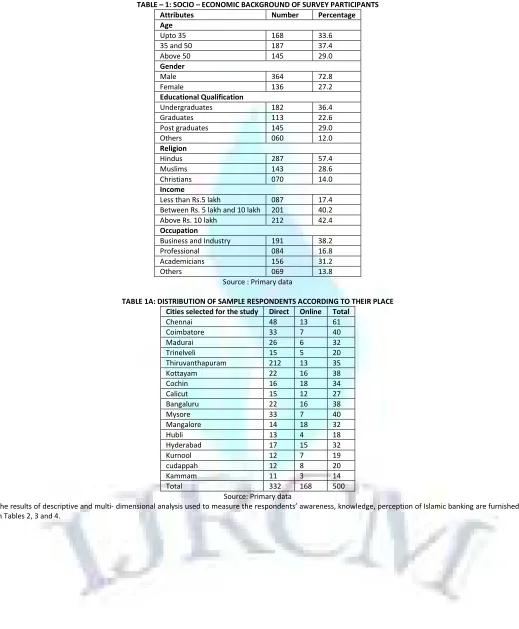
The Socio – Economic background of Survey participants was analyzed and presented in Table.1.
TABLE – 1: SOCIO – ECONOMIC BACKGROUND OF SURVEY PARTICIPANTS Attributes Number Percentage Age
Upto 35 168 33.6 35 and 50 187 37.4 Above 50 145 29.0
Gender
Male 364 72.8 Female 136 27.2
Educational Qualification
Undergraduates 182 36.4 Graduates 113 22.6 Post graduates 145 29.0 Others 060 12.0
Religion
Hindus 287 57.4 Muslims 143 28.6 Christians 070 14.0
Income
Less than Rs.5 lakh 087 17.4 Between Rs. 5 lakh and 10 lakh 201 40.2 Above Rs. 10 lakh 212 42.4
Occupation
Business and Industry 191 38.2 Professional 084 16.8 Academicians 156 31.2 Others 069 13.8
Source : Primary data
TABLE 1A: DISTRIBUTION OF SAMPLE RESPONDENTS ACCORDING TO THEIR PLACE Cities selected for the study Direct Online Total
Chennai 48 13 61 Coimbatore 33 7 40 Madurai 26 6 32 Trinelveli 15 5 20 Thiruvanthapuram 212 13 35 Kottayam 22 16 38 Cochin 16 18 34 Calicut 15 12 27 Bangaluru 22 16 38 Mysore 33 7 40 Mangalore 14 18 32 Hubli 13 4 18 Hyderabad 17 15 32 Kurnool 12 7 19 cudappah 12 8 20 Kammam 11 3 14 Total 332 168 500
Source: Primary data
VOLUME NO.4(2014),ISSUE NO.03(MARCH) ISSN 2231-5756
INTERNATIONAL JOURNAL OF RESEARCH IN COMMERCE, IT & MANAGEMENT
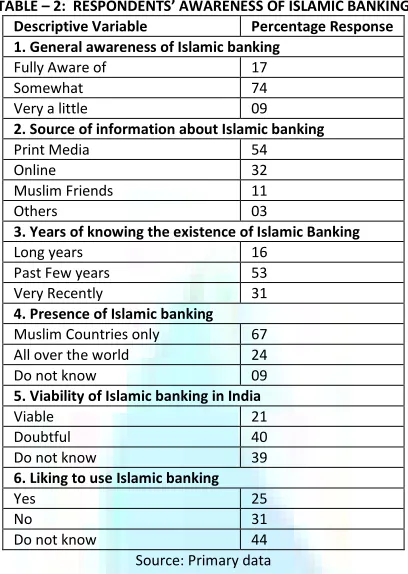
TABLE – 2: RESPONDENTS’ AWARENESS OF ISLAMIC BANKINGDescriptive Variable Percentage Response 1. General awareness of Islamic banking
Fully Aware of 17 Somewhat 74 Very a little 09
2. Source of information about Islamic banking
Print Media 54 Online 32 Muslim Friends 11 Others 03
3. Years of knowing the existence of Islamic Banking
Long years 16 Past Few years 53 Very Recently 31
4. Presence of Islamic banking
Muslim Countries only 67 All over the world 24 Do not know 09
5. Viability of Islamic banking in India
Viable 21 Doubtful 40 Do not know 39
6. Liking to use Islamic banking
Yes 25
No 31
Do not know 44 Source: Primary data
TABLE -3: KNOWLEDGE OF RESPONDENTS ABOUT ISLAMIC BANKING
Descriptive variable Yes % No % Do not know %
a) Interest free banking system 385 (77) 56 (11.2) 59 (11.8) b) Based on Islamic principles 401 (80.2) 80 (2.0) 89 (17.8) c) Based on profit sharing model 47 (9.4) 167 (33.40 286 (57.2) d) Moral and ethical way of banking 62 (12.4) 183 (33.6) 255 ( 54.0) e) Depositors treated as providers of funds and banks as managers of such funds 49 (9.8) 281 (56.2) 170 (34) f) Only in experimental stage 231 (46.2) 47 (9.4) 222 (44.4) g) Customers base is very limited 308 (61.6) 176 (35.2) 16 (3.2) h)Potential alternative to conventional Banking 282 (56.4) 153 (30.6) 65 (13) i) Loss if any, many reduce principal 33 (6.6) 403 (80.6) 64 (12.8) j) Mostly functioning as Non-banking form 21 (4.2) 183 (33.6) 296 (59.2)
Source: Primary data
TABLE 4: RESPONDENTS’ PERCEPTION OF ISLAMIC BANKING
Descriptive Variable Percentage Response
1. Advantages of Islamic banking
Free from interest and speculation 56 Making finance available at free of cost 10 No reward without risk – taking 28 Value based socio – economic system 06
2. Disadvantages of Islamic banking
Ethical banking is an utopian concept 25 Fixed return not guaranteed on deposits 33 In sufficient local expertise to sustain the industry 22 More statutory and regulatory problems 20
3. Apprehensions over Islamic banking
Dominated by Muslims 48 Opposed by people of other faiths 17 Savings and Investments would soon dry up, if interest not paid 32 More dependence on integrity and honesty of borrowers 14
4. Expectations of the respondents
Arabic words be suitably presented in the prevailing banking terms 25 Awareness programmes to remove misconception 40 Success stories be given wide publicity 29 More literature be made available 16
Source: Primary data The respondents’ perception of Islamic banking presented in Table – 4, is discussed below:
1. ADVANTAGES OF ISLAMIC BANKING
2. DISADVANTAGES OF ISLAMIC BANKING
When respondents were asked to select the disadvantages, 33% considered the ‘no fixed return guaranteed on deposits’ was one of the major disadvantages of the system. It is closely by other three disadvantages, which are ‘Ethical banking is an utopian concept’ (25%), ‘insufficient local expertise to sustain the industry’ (22%)’ and ‘more statutory and regulatory problems’ (20%). As all the four disadvantages received more or less equal opinion, it could be concluded that all of them are the major drawbacks of this system. They require serious consideration and rectification.
3. APPREHENSIONS OVER ISLAMIC BANKING
47% respondents fear that the banks may be ‘dominated by Muslims’ indicated that these banks may become more religion based. Another major concern of the 32% respondents is that ‘the savings and investments would soon dry up, if interest not paid’ raised a serious doubt over the very existence of Islamic banks. It is the responsibility of experts who advocate this system, to alloy these major apprehensions of the people.
4. EXPECTATIONS OF THE RESPONDENTS
40% of respondents expected that ‘more awareness programmes be undertaken to remove misconception among non-Muslims’. It clearly indicates that the acceptance of Islamic banking in India lies in fulfilling this expectation of the people. ‘Success stories be given wide publicity (29%) and ‘Arabic words be suitably presented in prevailing banking terms’ (25%) are another two major expectations, for which series of steps satisfying the people to be undertaken. Statistical ANALYSIS
Statistical analysis using Pearson’s chi-square test was carried out at 5% significance level to check the willingness of respondents to use Islamic Banking by framing relevant null hypotheses for the socio-economic attributes of respondents. The results are given in Table 5.
TABLE -5: THE RESULTS OF CHI-SQUARE TEST
Attribute Chi-square Value Table Value Remarks
Age 5.428 5.99 Accepted Gender 3.40 3.84 Accepted Religion 88.55 5.99 Rejected Educational Qualification 8.474 12.6 Accepted Income 4.124 5.99 Accepted Occupation 8.474 12.6 Accepted
Source: Computed data
Except ‘Religion’, the null hypotheses for the remaining attributes were accepted, leading to conclude that the attributes like age, gender, educational qualification, income and occupation of respondents did not influence their willingness to use Islamic banking.
RECOMMENDATIONS
To bring interest free Islamic banking, misunderstanding and misinformation among the Muslims as well as non-Muslims have to be removed, for which awareness programmes have to be undertaken on a mass – scale. Further, Islamic banks like Al Barakah, an Islamic Investment company in Kerala is allowed to function under Non-Banking Finance Corporation (NBFC) banner. As an initial step towards starting Islamic Banks in the country, conventional banks may be allowed to have Islamic windows. To make Islamic banking a reality the recommendations given by the Committee on Financial Sector Reforms (CFSR) headed by Dr. Raghuram Rajan and the Committee headed by Deputy Governor Dr. K. C. C Chakrabarthy, regarding interest-free banking a suitable legislative amendment in the Banking Regulations Act, has to be made by the Central government.
CONCLUSION
We need to offer an alternative in the form of Islamic finance free of interest and speculation, as all other strategies to promote world prosperity and peace are likely to fail if adequate finance is not available free of cost. It is the need of the hour to develop a practical mechanism to implement Islamic banking in the country. For which, the impediments and obstacles on the way to Islamic banking have to overcome ensuring the 21st century a worth living.
REFERENCES
BOOKS
1. ‘A New Financial Dawn – The Rise of Islamic Finance’ (2009) by Joseph Divanna & Antoine Sreih 2. ‘Adequacy of Disclosure in Islamic Financial Institutions (2011) By Mohammed Shabbir, Cyprus. 3. ‘An Introduction to Islamic Finance (2007) By Justice Nufti Mohamed Taqi Usmani
4. ‘Islamic Banking: True Modes of Financing (2010) by Dr.Shahid Hasan Siddiqui
5. ‘Islamic Investment Products Available in the UK’ (2010) By Prof Rodney Wilson, University of Durham, UK (2011)
6. ‘Issues and Relevance of Islamic Finance in Britain’(2010) By Iqbalkhan, MD, Head of Global Islamic Finance, (2009) HSBC Amanah Finance, UK. 7. ‘The Role of Central banks in Islamic Banking’ (2008) By Dr.Iraj Toutonuchian.
REPORTS
8. By Abdur Raqeab, Convenor of National Committee on Islamic Banking, 2010. 9. By Dr. Raghuram Rajan Committee on Financial Sector Reforms, (CFSR), 2008. 10. By Indian Centre for Islamic Finance (ICIF) 2008.
11. By working group, Headed by Mr.Anand Sinha, Chief Manager, Dept of Banking Operations and Development, 2009.
ARTICLES
12. Dharaj Tiwari, “India’s First Foreign Islamic Bank” ET, Burea, March 28, 2011.
13. Faya & Ahamed Lone, “Islamic Banking in India”, Dept of Commerce, Aligar Muslim University, April 1, 2011. 14. Joe A Scaria, ‘Kerela NRIs’ Bullish on Islamic NBFC For Infra, ET Business, Feb 4, 2011.
15. Padmapriya & Sreekala, “Students Now Eye Islamic Banking” TNN, June 1, 2006.
16. Sanjay Moolchandani “Islamic Banking! Now, What is that?” INDIATIMES NEWS NETWORK, July 11, 2005. 17. Seetharaman, “Islamic banking Ideal to Boost Green Finance” PTI, July 5, 2011.
WEBSITES
18. http://articles.economic times. Indiatimes.com/keyword/Islamic-banking
19. http://twocircles.net/2010mar 29/ problems and prospects Islamic banking – India road map – ahed.html 20. http://www.newhorizon-islamicbanking.com
VOLUME NO.4(2014),ISSUE NO.03(MARCH) ISSN 2231-5756
INTERNATIONAL JOURNAL OF RESEARCH IN COMMERCE, IT & MANAGEMENT
REQUEST FOR FEEDBACK
Dear Readers
At the very outset, International Journal of Research in Commerce, IT & Management (IJRCM)
acknowledges & appreciates your efforts in showing interest in our present issue under your kind perusal.
I would like to request you tosupply your critical comments and suggestions about the material published
in this issue as well as on the journal as a whole, on our [email protected] for further
improvements in the interest of research.
If youhave any queries please feel free to contact us on our E-mail
.
I am sure that your feedback and deliberations would make future issues better – a result of our joint
effort.
Looking forward an appropriate consideration.
With sincere regards
Thanking you profoundly
Academically yours
Sd/-
Co-ordinator
DISCLAIMER