A Monthly Double-Blind Peer Reviewed (Refereed/Juried) Open Access International e-Journal - Included in the International Serial Directories
Indexed & Listed at:
VOLUME NO.4(2014),ISSUE NO.07(JULY) ISSN 2231-5756
INTERNATIONAL JOURNAL OF RESEARCH IN COMMERCE, IT & MANAGEMENT
CONTENTS
Sr.
No.
TITLE & NAME OF THE AUTHOR (S)
Page
No.
1
.
EMPLOYER BRANDING: A NEW STRATEGIC ASPECT OF HUMAN RESOURCE
DR. RUCHI JAIN & SURINDER KAUR
1
2
.
EMPLOYEE ENGAGEMENT AND COMMITMENT: A STUDY CONDUCTED IN DELHI AND
NCR WITH SPECIAL REFERENCE TO TELECOM INDUSTRY
DR. ANIL CHANDHOK & DR. BHAVET
5
3
.
CORPORATE GOVERNANCE ATTRIBUTES AND THE LEVEL OF CORPORATE
VOLUNTARY DISCLOSURES IN ANNUAL REPORTS: THE CASE OF ETHIOPIA
HABTAMU BERHANU ABERA & MOHD. AKBAR ALI KHAN
11
4
.
WORK-LIFE BALANCE IN DUAL WORKING COUPLES IN MEDICAL SECTOR
DR. SNIGDHARANI MISHRA & RACHNA NIGAM
17
5
.
M-COMMERCE AS A PROMISING DESCENDENT OF E-COMMERCE: A LITERATURE
REVIEW
RAVINDER PANT & ANTRIKSHA NEGI
24
6
.
DEVELOPING A MODEL TO ENSURE SWIFT JUSTICE IN DEVELOPING COUNTRIES: A
STUDY ON SUIT JAMS IN BANGLADESH
SARUAR AHMED & ABDUL LATIF
27
7
.
AN ANALYSIS OF GROWTH PATTERN OF CHINA
DR. ASHOK KUMAR CHAUHAN & MANOJ KUMAR
32
8
.
BUYING PATTERNS OF CONSUMER DURABLES GOODS WITH REFERENCE TO
SELECTED ORGANIZED AND UNORGANIZED RETAIL OUTLETS IN CHENNAI CITY
P. ARIVAZHAGAN & DR. MATHIVANAN
36
9
.
DISCRIMINATION OF MEMBERS ON THE DIFFERENT REASONS TO JOIN SELF HELP
GROUPS: A STUDY IN SALEM DISTRICT, TAMILNADU
DR. P. UMA MAHESWARI
41
10
.
RESPONSIVE WEB DESIGN: A FORWARD-THINKING APPROACH TO WEBSITE
CREATION
SWATI BHAT
46
11
.
A STUDY ON CUSTOMER ATTITUDE TOWARDS SELECTED DURABLE GOODS WITH
SPECIAL REFERENCE TO COIMBATORE CITY
J. UDHAYAKUMAR & PRIYADHARSHINI
49
12
.
PERFORMANCE OF COIR INDUSTRY IN INDIA
SK. RAMEEZ RAJA & DR. K. EKAMBARAM
54
13
.
THE RIGHTS OF TEA WORKERS OF BANGLADESH IN THE LIGHT OF EXISTING LABOR
LAWS AND STANDARDS: A STUDY ON SELECTED TEA ESTATES OF SYLHET DISTRICT
SARUAR AHMED & SAMIUR RASHID CHOWDHURY
59
14
.
EXAMINING CONSUMERS’ ATTITUDE TOWARDS MOBILE ADVERTISEMENT IN
ETHIOPIA: CASE STUDY ON MOBILE USERS OF MEKELLE UNIVERSITY
ADEM MOHAMMED, YIBELTAL NIGUSSIE & ETSEGENET KIDANE
64
15
.
PARTICIPATION OF COMMERCIAL BANKS IN DEVELOPING MICRO, SMALL AND
MEDIUM ENTERPRISES (MSMEs) IN INDIA: AN OVERVIEW
RASHMI PANDEY
71
CHIEF PATRON
PROF. K. K. AGGARWAL
Chairman, Malaviya National Institute of Technology, Jaipur
(An institute of National Importance & fully funded by Ministry of Human Resource Development, Government of India)
Chancellor, K. R. Mangalam University, Gurgaon
Chancellor, Lingaya’s University, Faridabad
Founder Vice-Chancellor (1998-2008), Guru Gobind Singh Indraprastha University, Delhi
Ex. Pro Vice-Chancellor, Guru Jambheshwar University, Hisar
FOUNDER PATRON
LATE SH. RAM BHAJAN AGGARWAL
Former State Minister for Home & Tourism, Government of Haryana
Former Vice-President, Dadri Education Society, Charkhi Dadri
Former President, Chinar Syntex Ltd. (Textile Mills), Bhiwani
CO-ORDINATOR
AMITA
Faculty, Government M. S., Mohali
ADVISORS
DR. PRIYA RANJAN TRIVEDI
Chancellor, The Global Open University, Nagaland
PROF. M. S. SENAM RAJU
Director A. C. D., School of Management Studies, I.G.N.O.U., New Delhi
PROF. M. N. SHARMA
Chairman, M.B.A., Haryana College of Technology & Management, Kaithal
PROF. S. L. MAHANDRU
Principal (Retd.), Maharaja Agrasen College, Jagadhri
EDITOR
PROF. R. K. SHARMA
Professor, Bharti Vidyapeeth University Institute of Management & Research, New Delhi
CO-EDITOR
DR. BHAVET
Faculty, Shree Ram Institute of Business & Management, Urjani
EDITORIAL ADVISORY BOARD
DR. RAJESH MODI
Faculty, Yanbu Industrial College, Kingdom of Saudi Arabia
PROF. SANJIV MITTAL
University School of Management Studies, Guru Gobind Singh I. P. University, Delhi
PROF. ANIL K. SAINI
VOLUME NO.4(2014),ISSUE NO.07(JULY) ISSN 2231-5756
INTERNATIONAL JOURNAL OF RESEARCH IN COMMERCE, IT & MANAGEMENT
DR. SAMBHAVNA
Faculty, I.I.T.M., Delhi
DR. MOHENDER KUMAR GUPTA
Associate Professor, P. J. L. N. Government College, Faridabad
DR. SHIVAKUMAR DEENE
Asst. Professor, Dept. of Commerce, School of Business Studies, Central University of Karnataka, Gulbarga
ASSOCIATE EDITORS
PROF. NAWAB ALI KHAN
Department of Commerce, Aligarh Muslim University, Aligarh, U.P.
PROF. ABHAY BANSAL
Head, Department of Information Technology, Amity School of Engineering & Technology, Amity
University, Noida
PROF. A. SURYANARAYANA
Department of Business Management, Osmania University, Hyderabad
DR. SAMBHAV GARG
Faculty, Shree Ram Institute of Business & Management, Urjani
PROF. V. SELVAM
SSL, VIT University, Vellore
DR. PARDEEP AHLAWAT
Associate Professor, Institute of Management Studies & Research, Maharshi Dayanand University, Rohtak
DR. S. TABASSUM SULTANA
Associate Professor, Department of Business Management, Matrusri Institute of P.G. Studies, Hyderabad
SURJEET SINGH
Asst. Professor, Department of Computer Science, G. M. N. (P.G.) College, Ambala Cantt.
TECHNICAL ADVISOR
AMITA
Faculty, Government M. S., Mohali
FINANCIAL ADVISORS
DICKIN GOYAL
Advocate & Tax Adviser, Panchkula
NEENA
Investment Consultant, Chambaghat, Solan, Himachal Pradesh
LEGAL ADVISORS
JITENDER S. CHAHAL
Advocate, Punjab & Haryana High Court, Chandigarh U.T.
CHANDER BHUSHAN SHARMA
Advocate & Consultant, District Courts, Yamunanagar at Jagadhri
SUPERINTENDENT
CALL FOR MANUSCRIPTS
We invite unpublished novel, original, empirical and high quality research work pertaining to recent developments & practices in the areas of Computer Science & Applications; Commerce; Business; Finance; Marketing; Human Resource Management; General Management; Banking; Economics; Tourism Administration & Management; Education; Law; Library & Information Science; Defence & Strategic Studies; Electronic Science; Corporate Governance; Industrial Relations; and emerging paradigms in allied subjects like Accounting; Accounting Information Systems; Accounting Theory & Practice; Auditing; Behavioral Accounting; Behavioral Economics; Corporate Finance; Cost Accounting; Econometrics; Economic Development; Economic History; Financial Institutions & Markets; Financial Services; Fiscal Policy; Government & Non Profit Accounting; Industrial Organization; International Economics & Trade; International Finance; Macro Economics; Micro Economics; Rural Economics; Co-operation; Demography: Development Planning; Development Studies; Applied Economics; Development Economics; Business Economics; Monetary Policy; Public Policy Economics; Real Estate; Regional Economics; Political Science; Continuing Education; Labour Welfare; Philosophy; Psychology; Sociology; Tax Accounting; Advertising & Promotion Management; Management Information Systems (MIS); Business Law; Public Responsibility & Ethics; Communication; Direct Marketing; E-Commerce; Global Business; Health Care Administration; Labour Relations & Human Resource Management; Marketing Research; Marketing Theory & Applications; Non-Profit Organizations; Office Administration/Management; Operations Research/Statistics; Organizational Behavior & Theory; Organizational Development; Production/Operations; International Relations; Human Rights & Duties; Public Administration; Population Studies; Purchasing/Materials Management; Retailing; Sales/Selling; Services; Small Business Entrepreneurship; Strategic Management Policy; Technology/Innovation; Tourism & Hospitality; Transportation Distribution; Algorithms; Artificial Intelligence; Compilers & Translation; Computer Aided Design (CAD); Computer Aided Manufacturing; Computer Graphics; Computer Organization & Architecture; Database Structures & Systems; Discrete Structures; Internet; Management Information Systems; Modeling & Simulation; Neural Systems/Neural Networks; Numerical Analysis/Scientific Computing; Object Oriented Programming; Operating Systems; Programming Languages; Robotics; Symbolic & Formal Logic; Web Design and emerging paradigms in allied subjects.
Anybody can submit the soft copy of unpublished novel; original; empirical and high quality research work/manuscriptanytime in M.S. Word format
after preparing the same as per our GUIDELINES FOR SUBMISSION; at our email address i.e. [email protected] or online by clicking the link online
submission as given on our website (FOR ONLINE SUBMISSION, CLICK HERE).
GUIDELINES FOR SUBMISSION OF MANUSCRIPT
1. COVERING LETTER FOR SUBMISSION:
DATED: _____________
THE EDITOR
IJRCM
Subject: SUBMISSION OF MANUSCRIPT IN THE AREA OF.
(e.g. Finance/Marketing/HRM/General Management/Economics/Psychology/Law/Computer/IT/Engineering/Mathematics/other, please specify)
DEAR SIR/MADAM
Please find my submission of manuscript entitled ‘___________________________________________’ for possible publication in your journals.
I hereby affirm that the contents of this manuscript are original. Furthermore, it has neither been published elsewhere in any language fully or partly, nor is it under review for publication elsewhere.
I affirm that all the author (s) have seen and agreed to the submitted version of the manuscript and their inclusion of name (s) as co-author (s).
Also, if my/our manuscript is accepted, I/We agree to comply with the formalities as given on the website of the journal & you are free to publish our contribution in any of your journals.
NAME OF CORRESPONDING AUTHOR:
Designation:
Affiliation with full address, contact numbers & Pin Code: Residential address with Pin Code:
Mobile Number (s): Landline Number (s): E-mail Address: Alternate E-mail Address:
NOTES:
a) The whole manuscript is required to be in ONE MS WORD FILE only (pdf. version is liable to be rejected without any consideration), which will start from the covering letter, inside the manuscript.
b) The sender is required to mentionthe following in the SUBJECT COLUMN of the mail:
New Manuscript for Review in the area of (Finance/Marketing/HRM/General Management/Economics/Psychology/Law/Computer/IT/
Engineering/Mathematics/other, please specify)
c) There is no need to give any text in the body of mail, except the cases where the author wishes to give any specific message w.r.t. to the manuscript. d) The total size of the file containing the manuscript is required to be below 500 KB.
e) Abstract alone will not be considered for review, and the author is required to submit the complete manuscript in the first instance.
f) The journal gives acknowledgement w.r.t. the receipt of every email and in case of non-receipt of acknowledgment from the journal, w.r.t. the submission of manuscript, within two days of submission, the corresponding author is required to demand for the same by sending separate mail to the journal.
2. MANUSCRIPT TITLE: The title of the paper should be in a 12 point Calibri Font. It should be bold typed, centered and fully capitalised.
3. AUTHOR NAME (S) & AFFILIATIONS: The author (s) full name, designation, affiliation (s), address, mobile/landline numbers, and email/alternate email address should be in italic & 11-point Calibri Font. It must be centered underneath the title.
4. ABSTRACT: Abstract should be in fully italicized text, not exceeding 250 words. The abstract must be informative and explain the background, aims, methods,
VOLUME NO.4(2014),ISSUE NO.07(JULY) ISSN 2231-5756
INTERNATIONAL JOURNAL OF RESEARCH IN COMMERCE, IT & MANAGEMENT
5. KEYWORDS: Abstract must be followed by a list of keywords, subject to the maximum of five. These should be arranged in alphabetic order separated by commas and full stops at the end.
6. MANUSCRIPT: Manuscript must be in BRITISH ENGLISH prepared on a standard A4 size PORTRAIT SETTING PAPER. It must be prepared on a single space and
single column with 1” margin set for top, bottom, left and right. It should be typed in 8 point Calibri Font with page numbers at the bottom and centre of every page. It should be free from grammatical, spelling and punctuation errors and must be thoroughly edited.
7. HEADINGS: All the headings should be in a 10 point Calibri Font. These must be bold-faced, aligned left and fully capitalised. Leave a blank line before each
heading.
8. SUB-HEADINGS: All the sub-headings should be in a 8 point Calibri Font. These must be bold-faced, aligned left and fully capitalised.
9. MAIN TEXT: The main text should follow the following sequence:
INTRODUCTION REVIEW OF LITERATURE
NEED/IMPORTANCE OF THE STUDY
STATEMENT OF THE PROBLEM OBJECTIVES
HYPOTHESES
RESEARCH METHODOLOGY
RESULTS & DISCUSSION FINDINGS
RECOMMENDATIONS/SUGGESTIONS
CONCLUSIONS
SCOPE FOR FURTHER RESEARCH ACKNOWLEDGMENTS
REFERENCES
APPENDIX/ANNEXURE
It should be in a 8 point Calibri Font, single spaced and justified. The manuscript should preferably not exceed 5000 WORDS.
10. FIGURES &TABLES: These should be simple, crystal clear, centered, separately numbered & self explained, and titles must be above the table/figure. Sources of data should be mentioned below the table/figure. It should be ensured that the tables/figures are referred to from the main text.
11. EQUATIONS:These should be consecutively numbered in parentheses, horizontally centered with equation number placed at the right.
12. REFERENCES: The list of all references should be alphabetically arranged. The author (s) should mention only the actually utilised references in the preparation
of manuscript and they are supposed to follow Harvard Style of Referencing. The author (s) are supposed to follow the references as per the following:
•
All works cited in the text (including sources for tables and figures) should be listed alphabetically.•
Use (ed.) for one editor, and (ed.s) for multiple editors.•
When listing two or more works by one author, use --- (20xx), such as after Kohl (1997), use --- (2001), etc, in chronologically ascending order.•
Indicate (opening and closing) page numbers for articles in journals and for chapters in books.•
The title of books and journals should be in italics. Double quotation marks are used for titles of journal articles, book chapters, dissertations, reports, working papers, unpublished material, etc.•
For titles in a language other than English, provide an English translation in parentheses.•
The location of endnotes within the text should be indicated by superscript numbers.PLEASE USE THE FOLLOWING FOR STYLE AND PUNCTUATION IN REFERENCES: BOOKS
•
Bowersox, Donald J., Closs, David J., (1996), "Logistical Management." Tata McGraw, Hill, New Delhi.•
Hunker, H.L. and A.J. Wright (1963), "Factors of Industrial Location in Ohio" Ohio State University, Nigeria.CONTRIBUTIONS TO BOOKS
•
Sharma T., Kwatra, G. (2008) Effectiveness of Social Advertising: A Study of Selected Campaigns, Corporate Social Responsibility, Edited by David Crowther & Nicholas Capaldi, Ashgate Research Companion to Corporate Social Responsibility, Chapter 15, pp 287-303.JOURNAL AND OTHER ARTICLES
•
Schemenner, R.W., Huber, J.C. and Cook, R.L. (1987), "Geographic Differences and the Location of New Manufacturing Facilities," Journal of Urban Economics, Vol. 21, No. 1, pp. 83-104.CONFERENCE PAPERS
•
Garg, Sambhav (2011): "Business Ethics" Paper presented at the Annual International Conference for the All India Management Association, New Delhi, India, 19–22 June.UNPUBLISHED DISSERTATIONS AND THESES
•
Kumar S. (2011): "Customer Value: A Comparative Study of Rural and Urban Customers," Thesis, Kurukshetra University, Kurukshetra.ONLINE RESOURCES
•
Always indicate the date that the source was accessed, as online resources are frequently updated or removed.WEBSITES
RESPONSIVE WEB DESIGN: A FORWARD-THINKING APPROACH TO WEBSITE CREATION
SWATI BHAT
ASST. PROFESSOR
SINHGAD INSTITUTE OF BUSINESS ADMINISTRATION & COMPUTER APPLICATION
LONAVALA
ABSTRACT
Almost every new client these days wants a mobile version of their website. It’s practically essential after all. One design for the BlackBerry, another for the iPhone, i-pad, netbook, Kindle — and all screen resolutions must be compatible, too. In the next five years, we’ll likely need to design for a number of additional inventions. In the field of Web design and development, we’re quickly getting to the point of being unable to keep up with the endless new resolutions and devices. For many websites, creating a website version for each resolution and new device would be impossible, or at least impractical. Should we just suffer the consequences of losing visitors from one device, for the benefit of gaining visitors from another? Or is there another option? Responsive Web Design (RWD) is the approach that suggests that design and development should respond to the user’s behaviour and environment based on screen size, platform and orientation.
KEYWORDS
Graphics, media queries, RWD.
I. INTRODUCTION
esponsive Web Design (RWD) is a Web design approach aimed at crafting sites to provide an optimal viewing experience—easy reading and navigation with a minimum of resizing, panning, and scrolling—across a wide range of devices (from mobile phones to desktop computer monitors). The website
should have the technology to automatically respondto the user’s preferences. This would eliminate the need for a different design and development
phase for each new gadget on the market.
II. CONCEPT
A few years back we didn’t need to think about mobile phones, tablets and different screens, because there were not too many of them – or not at all. Well, the IT world has changed since then and now there are a bunch of screen sizes and platforms designers need to deliver for. Responsive Web Design is the concept of a website which should adapt to fit any device that chooses to display it. Not only mobile devices, but also stationery computers and tablets also. Users who access your websites through their mobile devices or other display screens really do not care what method you use, just as long as that they can effectively navigate your website on whatever device they happen to be using. For that reason, web developers to meet the challenge, and while responsive (RWD) design method are addressing the issue for rendering websites on mobile devices.
III. THE CHALLENGE
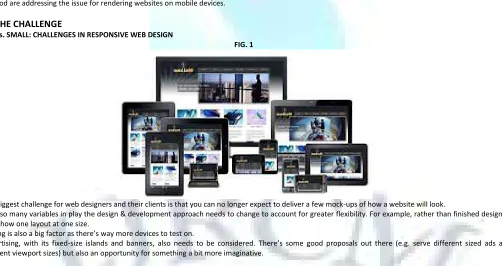
BIG vs. SMALL: CHALLENGES IN RESPONSIVE WEB DESIGN
FIG. 1
The biggest challenge for web designers and their clients is that you can no longer expect to deliver a few mock-ups of how a website will look.
With so many variables in play the design & development approach needs to change to account for greater flexibility. For example, rather than finished designs that show one layout at one size.
Testing is also a big factor as there’s way more devices to test on.
Advertising, with its fixed-size islands and banners, also needs to be considered. There’s some good proposals out there (e.g. serve different sized ads at different viewport sizes) but also an opportunity for something a bit more imaginative.
HOW TO MAKE A WEBSITE RESPONSIVE
When designing for responsive sites, we need to keep a few rules in mind.
1. Design Context: Here, we’re talking about screen context, and not necessarily user context. Responsive design reformats the look of a web page when it is viewed on a narrow screen the width of a smartphone.
2. Usability: The conventions of what is visible and what actions must be taken to navigate through a website are different in a mobile context than they are on a desktop, so you’ll want to be sure to consider what people are used to doing when accessing mobile sites.
3. Images and Graphics: Image size is an on-going concern in discussions about responsive design; is there a way to feed different size images to different devices? Do you need to upload multiple sizes of each image to your site for each screen type? No convention has been settled on yet, although developers are working on finding a solution across browsers and devices, and some workarounds do exist. For now, since you’re going to want to serve the same content to desktop and mobile users.
VOLUME NO.4(2014),ISSUE NO.07(JULY) ISSN 2231-5756
INTERNATIONAL JOURNAL OF RESEARCH IN COMMERCE, IT & MANAGEMENT
ADJUSTING SCREEN RESOLUTIONFIG. 2
In addition to designing for both landscape and portrait (and enabling those orientations to possibly switch in an instant upon page load), we must consider the hundreds of different screen sizes. Yes, it is possible to group them into major categories, design for each of them, and make each design as flexible as necessary.
IV. BENEFITS
The huge benefit of a responsive website is it is not device specific, but resizes fluidly based on screen resolution. Going forward websites should all be looking to move towards responsive web design which scales to the device used rather than dedicated mobile sites or apps (excepting for the likes of Facebook) as mobile devices become the main method people use to access the internet. This will also mean that more sites will have touch-compatible interfaces, which is a positive given that some desktop computers are already beginning to move towards touchscreen interfaces. It is therefore important to consider responsive design when building your website, in order to stay relevant going forwards. As we at Elemental always create our websites involving responsive design, we hope you will choose us to help you to future-proof your website
• Increasing your reach to tablet and mobile audiences
• Increase sales and conversion rates
• Consolidate your analytics and reporting
• Increase your visibility in search engines
• Save time and cost on mobile development
• Save time and cost on site management
• Enhance user’s offline browsing experience
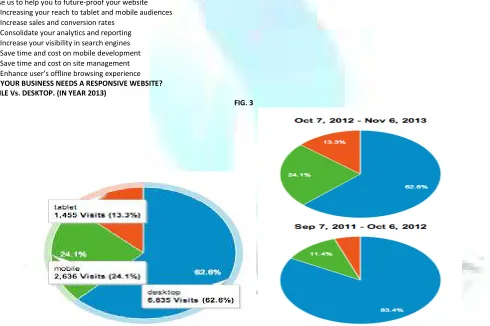
WHY YOUR BUSINESS NEEDS A RESPONSIVE WEBSITE? MOBILE Vs. DESKTOP. (IN YEAR 2013)
FIG. 3
This pie chart on the right shows the percentages for visitors coming using mobile, tablet, and desktop devices in 2013.In this case the website receives almost 40% of its traffic from mobile .Given that this website is not responsive, nor has a mobile version. Now we are seeing a comparison between mobile vs. desktop visitors for the past 12 months and the 12 months preceding those. The bottom line–this website’s mobile visitors doubled in one year. That by itself should be a compelling enough reason to go responsive.
V. CONCLUSION
Therefore, if you want a solution that’s easy to maintain, makes use of existing skills and that you can control, then Responsive Web Design is the approach for you. If you want a high quality user experience, better performance, faster implementation and seamless transactions, then you should select Mobile Web App for your business.
REFERENCES
1. en.wikipedia.org/wiki/Responsive_web_design
2. Responsive Web Design with HTML5 and CSS3 by Ben Frain
VOLUME NO.4(2014),ISSUE NO.07(JULY) ISSN 2231-5756
INTERNATIONAL JOURNAL OF RESEARCH IN COMMERCE, IT & MANAGEMENT
REQUEST FOR FEEDBACK
Dear Readers
At the very outset, International Journal of Research in Commerce, IT & Management (IJRCM)
acknowledges & appreciates your efforts in showing interest in our present issue under your kind perusal.
I would like to request you tosupply your critical comments and suggestions about the material published
in this issue as well as on the journal as a whole, on our E-mail
for further
improvements in the interest of research.
If youhave any queries please feel free to contact us on our E-mail
.
I am sure that your feedback and deliberations would make future issues better – a result of our joint
effort.
Looking forward an appropriate consideration.
With sincere regards
Thanking you profoundly
Academically yours
Sd/-
Co-ordinator
DISCLAIMER