A Monthly Double-Blind Peer Reviewed (Refereed/Juried) Open Access International e-Journal - Included in the International Serial Directories
Indexed & Listed at:
Ulrich's Periodicals Directory ©, ProQuest, U.S.A., EBSCO Publishing, U.S.A., Cabell’s Directories of Publishing Opportunities, U.S.A., Open J-Gage, India [link of the same is duly available at Inflibnet of University Grants Commission (U.G.C.)],
VOLUME NO.4(2014),ISSUE NO.05(MAY) ISSN 2231-5756
INTERNATIONAL JOURNAL OF RESEARCH IN COMMERCE, IT & MANAGEMENT
CONTENTS
Sr.
No.
TITLE & NAME OF THE AUTHOR (S)
Page
No.
1
.
AN EXPLORATORY STUDY OF THE POTENTIAL OF ‘KatSRS SYSTEM’ AS AN
EDUCATIONAL TECHONOLOGY IN FACILITATING LEARNERS’ ENGAGEMENT AND
FEEDBACK: A CASE STUDY OF BOTHO UNIVERSITY
WILLIAM NKOMO, BONOLO E. SAMSON-ZULU & RODRECK CHIRAU
1
2
.
MEASURES FOR ACTIVITY BASED COSTING SUCCESS: A REVIEW
SHAFEQ HAMOUD M. AL-SAIDI & H. NANJE GOWDA
10
3
.
ICT & WOMEN
S. S. PATHAK & SHUBHADA GALA
13
4
.
A STUDY ON LABOUR WELFARE MEASURES WITH REFERENCE TO TEXTILE
INDUSTRIES
DR. P. GURUSAMY, J. PRINCY & P.MANOCHITHRA
16
5
.
AN ANALYSIS AND EVALUATION OF A UNIVERSITY’s E-COMMERCE READINESS: A
CASE STUDY OF BOTHO UNIVERSITY
TERESSA TJWAKINNA CHIKOHORA & RODRECK CHIRAU
21
6
.
SUSTAINABILITY OF THE WASTE MANAGEMENT PRACTICES IN TOURIST
DESTINATIONS OF NAGALAND: A CRITICAL REVIEW
AIENLA & DR. T. R. SARMA
28
7
.
DETERMINANTS OF INTERNAL BRANDING FOR CUSTOMER-ORIENTATION
JASMINE SIMI
33
8
.
A CONCEPTUAL STUDY ON RETAIL BANKING
BHARAT N BASRANI & CHANDRESH B. MEHTA
38
9
.
IMPACT OF CELEBRITY ENDORSEMENT ON CONSUMER’S BUYING BEHAVIOUR
SUPREET KAUR
42
10
.
A STUDY ON THE FACTORS INFLUENCING CUSTOMER’s CHOICE OF RETAIL STORES
ANUPAMA SUNDAR D
46
11
.
GLOBALISATION, SEX INDUSTRY AND SEX MYTH: A COMPARATIVE STUDY OF SEX
MYTH AMONG ADULT MEN AND WOMEN IN CHHATTISGARH & WEST BENGAL
SIDDHARTHA CHATTERJEE & BIBHAS RANA
51
12
.
APPLICATION OF RESTRICTED LEAST SQUARES TO ECONOMETRIC DATA
IBRAHEEM, A. G, ADEMUYIWA, J. A & ADETUNJI, A. A
55
13
.
EFFECTIVENESS OF INTERNAL CONTROL SYSTEM OF ETHIOPIAN PUBLIC
UNIVERSITIES: THE CASE OF JIMMA UNIVERSITY
KENENISA LEMIE & MATEWOS KEBEDE
59
14
.
THE IMPACT OF CORPORATE SOCIAL RESPONSIBILITY - INITIATIVES ON
CONSUMER PSYCHOLOGY
PURTI BATRA
66
15
.
INVESTIGATION OF CUSTOMERS’ PRODUCT AWARENESS AND TRANSACTION GAP
IN LIFE INSURANCE CORPORATION OF INDIA
PARTHA SARATHI CHOUDHURI
69
INTERNATIONAL JOURNAL OF RESEARCH IN COMMERCE, IT & MANAGEMENT
CHIEF PATRON
PROF. K. K. AGGARWAL
Chairman, Malaviya National Institute of Technology, Jaipur
(An institute of National Importance & fully funded by Ministry of Human Resource Development, Government of India)
Chancellor, K. R. Mangalam University, Gurgaon
Chancellor, Lingaya’s University, Faridabad
Founder Vice-Chancellor (1998-2008), Guru Gobind Singh Indraprastha University, Delhi
Ex. Pro Vice-Chancellor, Guru Jambheshwar University, Hisar
FOUNDER PATRON
LATE SH. RAM BHAJAN AGGARWAL
Former State Minister for Home & Tourism, Government of Haryana
Former Vice-President, Dadri Education Society, Charkhi Dadri
Former President, Chinar Syntex Ltd. (Textile Mills), Bhiwani
CO-ORDINATOR
AMITA
Faculty, Government M. S., Mohali
ADVISORS
DR. PRIYA RANJAN TRIVEDI
Chancellor, The Global Open University, Nagaland
PROF. M. S. SENAM RAJU
Director A. C. D., School of Management Studies, I.G.N.O.U., New Delhi
PROF. M. N. SHARMA
Chairman, M.B.A., Haryana College of Technology & Management, Kaithal
PROF. S. L. MAHANDRU
Principal (Retd.), Maharaja Agrasen College, Jagadhri
EDITOR
PROF. R. K. SHARMA
Professor, Bharti Vidyapeeth University Institute of Management & Research, New Delhi
CO-EDITOR
DR. BHAVET
Faculty, Shree Ram Institute of Business & Management, Urjani
EDITORIAL ADVISORY BOARD
DR. RAJESH MODI
Faculty, Yanbu Industrial College, Kingdom of Saudi Arabia
PROF. SANJIV MITTAL
University School of Management Studies, Guru Gobind Singh I. P. University, Delhi
PROF. ANIL K. SAINI
VOLUME NO.4(2014),ISSUE NO.05(MAY) ISSN 2231-5756
INTERNATIONAL JOURNAL OF RESEARCH IN COMMERCE, IT & MANAGEMENT
DR. SAMBHAVNA
Faculty, I.I.T.M., Delhi
DR. MOHENDER KUMAR GUPTA
Associate Professor, P. J. L. N. Government College, Faridabad
DR. SHIVAKUMAR DEENE
Asst. Professor, Dept. of Commerce, School of Business Studies, Central University of Karnataka, Gulbarga
ASSOCIATE EDITORS
PROF. NAWAB ALI KHAN
Department of Commerce, Aligarh Muslim University, Aligarh, U.P.
PROF. ABHAY BANSAL
Head, Department of Information Technology, Amity School of Engineering & Technology, Amity
University, Noida
PROF. A. SURYANARAYANA
Department of Business Management, Osmania University, Hyderabad
DR. SAMBHAV GARG
Faculty, Shree Ram Institute of Business & Management, Urjani
PROF. V. SELVAM
SSL, VIT University, Vellore
DR. PARDEEP AHLAWAT
Associate Professor, Institute of Management Studies & Research, Maharshi Dayanand University, Rohtak
DR. S. TABASSUM SULTANA
Associate Professor, Department of Business Management, Matrusri Institute of P.G. Studies, Hyderabad
SURJEET SINGH
Asst. Professor, Department of Computer Science, G. M. N. (P.G.) College, Ambala Cantt.
TECHNICAL ADVISOR
AMITA
Faculty, Government M. S., Mohali
FINANCIAL ADVISORS
DICKIN GOYAL
Advocate & Tax Adviser, Panchkula
NEENA
Investment Consultant, Chambaghat, Solan, Himachal Pradesh
LEGAL ADVISORS
JITENDER S. CHAHAL
Advocate, Punjab & Haryana High Court, Chandigarh U.T.
CHANDER BHUSHAN SHARMA
Advocate & Consultant, District Courts, Yamunanagar at Jagadhri
SUPERINTENDENT
INTERNATIONAL JOURNAL OF RESEARCH IN COMMERCE, IT & MANAGEMENT
CALL FOR MANUSCRIPTS
We invite unpublished novel, original, empirical and high quality research work pertaining to recent developments & practices in the areas of Computer Science & Applications; Commerce; Business; Finance; Marketing; Human Resource Management; General Management; Banking; Economics; Tourism Administration & Management; Education; Law; Library & Information Science; Defence & Strategic Studies; Electronic Science; Corporate Governance; Industrial Relations; and emerging paradigms in allied subjects like Accounting; Accounting Information Systems; Accounting Theory & Practice; Auditing; Behavioral Accounting; Behavioral Economics; Corporate Finance; Cost Accounting; Econometrics; Economic Development; Economic History; Financial Institutions & Markets; Financial Services; Fiscal Policy; Government & Non Profit Accounting; Industrial Organization; International Economics & Trade; International Finance; Macro Economics; Micro Economics; Rural Economics; Co-operation; Demography: Development Planning; Development Studies; Applied Economics; Development Economics; Business Economics; Monetary Policy; Public Policy Economics; Real Estate; Regional Economics; Political Science; Continuing Education; Labour Welfare; Philosophy; Psychology; Sociology; Tax Accounting; Advertising & Promotion Management; Management Information Systems (MIS); Business Law; Public Responsibility & Ethics; Communication; Direct Marketing; E-Commerce; Global Business; Health Care Administration; Labour Relations & Human Resource Management; Marketing Research; Marketing Theory & Applications; Non-Profit Organizations; Office Administration/Management; Operations Research/Statistics; Organizational Behavior & Theory; Organizational Development; Production/Operations; International Relations; Human Rights & Duties; Public Administration; Population Studies; Purchasing/Materials Management; Retailing; Sales/Selling; Services; Small Business Entrepreneurship; Strategic Management Policy; Technology/Innovation; Tourism & Hospitality; Transportation Distribution; Algorithms; Artificial Intelligence; Compilers & Translation; Computer Aided Design (CAD); Computer Aided Manufacturing; Computer Graphics; Computer Organization & Architecture; Database Structures & Systems; Discrete Structures; Internet; Management Information Systems; Modeling & Simulation; Neural Systems/Neural Networks; Numerical Analysis/Scientific Computing; Object Oriented Programming; Operating Systems; Programming Languages; Robotics; Symbolic & Formal Logic; Web Design and emerging paradigms in allied subjects.
Anybody can submit the soft copy of unpublished novel; original; empirical and high quality research work/manuscriptanytime in M.S. Word format
after preparing the same as per our GUIDELINES FOR SUBMISSION; at our email address i.e. [email protected] or online by clicking the link online
submission as given on our website (FOR ONLINE SUBMISSION, CLICK HERE).
GUIDELINES FOR SUBMISSION OF MANUSCRIPT
1. COVERING LETTER FOR SUBMISSION:
DATED: _____________
THE EDITOR
IJRCM
Subject: SUBMISSION OF MANUSCRIPT IN THE AREA OF.
(e.g. Finance/Marketing/HRM/General Management/Economics/Psychology/Law/Computer/IT/Engineering/Mathematics/other, please specify) DEAR SIR/MADAM
Please find my submission of manuscript entitled ‘___________________________________________’ for possible publication in your journals.
I hereby affirm that the contents of this manuscript are original. Furthermore, it has neither been published elsewhere in any language fully or partly, nor is it under review for publication elsewhere.
I affirm that all the author (s) have seen and agreed to the submitted version of the manuscript and their inclusion of name (s) as co-author (s).
Also, if my/our manuscript is accepted, I/We agree to comply with the formalities as given on the website of the journal & you are free to publish our contribution in any of your journals.
NAME OF CORRESPONDING AUTHOR: Designation:
Affiliation with full address, contact numbers & Pin Code: Residential address with Pin Code:
Mobile Number (s): Landline Number (s): E-mail Address: Alternate E-mail Address:
NOTES:
a) The whole manuscript is required to be in ONE MS WORD FILE only (pdf. version is liable to be rejected without any consideration), which will start from the covering letter, inside the manuscript.
b) The sender is required to mentionthe following in the SUBJECT COLUMN of the mail:
New Manuscript for Review in the area of (Finance/Marketing/HRM/General Management/Economics/Psychology/Law/Computer/IT/ Engineering/Mathematics/other, please specify)
c) There is no need to give any text in the body of mail, except the cases where the author wishes to give any specific message w.r.t. to the manuscript. d) The total size of the file containing the manuscript is required to be below 500 KB.
e) Abstract alone will not be considered for review, and the author is required to submit the complete manuscript in the first instance.
f) The journal gives acknowledgement w.r.t. the receipt of every email and in case of non-receipt of acknowledgment from the journal, w.r.t. the submission of manuscript, within two days of submission, the corresponding author is required to demand for the same by sending separate mail to the journal.
2. MANUSCRIPT TITLE: The title of the paper should be in a 12 point Calibri Font. It should be bold typed, centered and fully capitalised.
3. AUTHOR NAME (S) & AFFILIATIONS: The author (s) full name, designation, affiliation (s), address, mobile/landline numbers, and email/alternate email address should be in italic & 11-point Calibri Font. It must be centered underneath the title.
VOLUME NO.4(2014),ISSUE NO.05(MAY) ISSN 2231-5756
INTERNATIONAL JOURNAL OF RESEARCH IN COMMERCE, IT & MANAGEMENT
5. KEYWORDS: Abstract must be followed by a list of keywords, subject to the maximum of five. These should be arranged in alphabetic order separated bycommas and full stops at the end.
6. MANUSCRIPT: Manuscript must be in BRITISH ENGLISH prepared on a standard A4 size PORTRAIT SETTING PAPER. It must be prepared on a single space and single column with 1” margin set for top, bottom, left and right. It should be typed in 8 point Calibri Font with page numbers at the bottom and centre of every page. It should be free from grammatical, spelling and punctuation errors and must be thoroughly edited.
7. HEADINGS: All the headings should be in a 10 point Calibri Font. These must be bold-faced, aligned left and fully capitalised. Leave a blank line before each heading.
8. SUB-HEADINGS: All the sub-headings should be in a 8 point Calibri Font. These must be bold-faced, aligned left and fully capitalised. 9. MAIN TEXT: The main text should follow the following sequence:
INTRODUCTION
REVIEW OF LITERATURE
NEED/IMPORTANCE OF THE STUDY
STATEMENT OF THE PROBLEM
OBJECTIVES
HYPOTHESES
RESEARCH METHODOLOGY
RESULTS & DISCUSSION
FINDINGS
RECOMMENDATIONS/SUGGESTIONS
CONCLUSIONS
SCOPE FOR FURTHER RESEARCH
ACKNOWLEDGMENTS
REFERENCES
APPENDIX/ANNEXURE
It should be in a 8 point Calibri Font, single spaced and justified. The manuscript should preferably not exceed 5000 WORDS.
10. FIGURES &TABLES: These should be simple, crystal clear, centered, separately numbered & self explained, and titles must be above the table/figure. Sources of data should be mentioned below the table/figure. It should be ensured that the tables/figures are referred to from the main text.
11. EQUATIONS:These should be consecutively numbered in parentheses, horizontally centered with equation number placed at the right.
12. REFERENCES: The list of all references should be alphabetically arranged. The author (s) should mention only the actually utilised references in the preparation of manuscript and they are supposed to follow Harvard Style of Referencing. The author (s) are supposed to follow the references as per the following:
•
All works cited in the text (including sources for tables and figures) should be listed alphabetically.•
Use (ed.) for one editor, and (ed.s) for multiple editors.•
When listing two or more works by one author, use --- (20xx), such as after Kohl (1997), use --- (2001), etc, in chronologically ascending order.•
Indicate (opening and closing) page numbers for articles in journals and for chapters in books.•
The title of books and journals should be in italics. Double quotation marks are used for titles of journal articles, book chapters, dissertations, reports, working papers, unpublished material, etc.•
For titles in a language other than English, provide an English translation in parentheses.•
The location of endnotes within the text should be indicated by superscript numbers.PLEASE USE THE FOLLOWING FOR STYLE AND PUNCTUATION IN REFERENCES: BOOKS
•
Bowersox, Donald J., Closs, David J., (1996), "Logistical Management." Tata McGraw, Hill, New Delhi.•
Hunker, H.L. and A.J. Wright (1963), "Factors of Industrial Location in Ohio" Ohio State University, Nigeria.CONTRIBUTIONS TO BOOKS
•
Sharma T., Kwatra, G. (2008) Effectiveness of Social Advertising: A Study of Selected Campaigns, Corporate Social Responsibility, Edited by David Crowther & Nicholas Capaldi, Ashgate Research Companion to Corporate Social Responsibility, Chapter 15, pp 287-303.JOURNAL AND OTHER ARTICLES
•
Schemenner, R.W., Huber, J.C. and Cook, R.L. (1987), "Geographic Differences and the Location of New Manufacturing Facilities," Journal of Urban Economics, Vol. 21, No. 1, pp. 83-104.CONFERENCE PAPERS
•
Garg, Sambhav (2011): "Business Ethics" Paper presented at the Annual International Conference for the All India Management Association, New Delhi, India, 19–22 June.UNPUBLISHED DISSERTATIONS AND THESES
•
Kumar S. (2011): "Customer Value: A Comparative Study of Rural and Urban Customers," Thesis, Kurukshetra University, Kurukshetra.ONLINE RESOURCES
•
Always indicate the date that the source was accessed, as online resources are frequently updated or removed.WEBSITES
INTERNATIONAL JOURNAL OF RESEARCH IN COMMERCE, IT & MANAGEMENT
ICT & WOMEN
S. S. PATHAK
VICE PRINCIPAL & ASSOCIATE PROFESSOR
M D COLLEGE OF ARTS, SCIENCE & COMMERCE
PAREL
SHUBHADA GALA
ASST. PROFESSOR
M D COLLEGE OF ARTS, SCIENCE & COMMERCE
PAREL
ABSTRACT
ICT has emerged as a powerful tool for gender empowerment. However, ensuring access to ICT tools is critical to bridging the gender digital divide and achieving empowerment. Equally significant is equipping women across all sections to make effective use of ICT by providing skills education and training. Currently, the ICT sector does not take full advantage of female talent. This is bad for the sector and bad for those women who could create new opportunities for themselves and their families with the ICT jobs that we know deliver better salaries and career paths than most other sectors. The ICT has a potential to bring development for a nation. It can reduce trade distortions, eliminate poverty, empower weaker segments including women, etc. The same is, however, possible only if a nation follows sound ICT strategies and policies. We have to set our priorities to those areas where we are lagging far behind. One such area is the unequal access of ICT to women. This paper looks at the avenues created by ICT-enabled networking processes for women’s empowerment. This study is based on sample size of 100 urban women and examines how women’s ‘power within’ has been enhanced through their access to and control of Information and Communication by use of ICTs. It discusses the main challenges and obstacles faced by women, suggests practical strategies to address those challenges and goes on to suggest ways to improve the conditions leading to women’s empowerment.
KEYWORDS
ICT, women empowerment.
INTRODUCTION
here can be no doubt that ICT is a major driver of economic and social modernization. Information and Communication Technologies are not just limited to research and employment but in almost all sections of the society including education, entertainment, public administration etc. Another significant facet of ICT has been that they have emerged as a powerful tool for gender empowerment. However, ensuring access to ICT tools is critical to bridging the gender digital divide and achieving empowerment. Equally significant is equipping women across all sections to make effective use of ICT by providing skills education and training.
The concept of gender equality is a common concern all over the World. The same has now acquired new dimensions with the advent of Information and Communication Technology (ICT). The ICT has a potential to bring development for a nation. It can reduce trade distortions, eliminate poverty, empower weaker segments including women, etc. The same is, however, possible only if a nation follows sound ICT strategies and policies. We have to set our priorities to those areas where we are lagging far behind. One such area is the unequal access of ICT to women.
ICTs are emerging as a powerful tool for gender empowerment in a developing country like India. There has been a rapid growth in the ICT sector since the late 1980s and the use of ICT has dramatically expanded since the 1990s. According to the World Bank, teledensity in India had reached 3.8% of the population by
2001. The number of internet accounts is growing at a rate of 50% per annum. The ITES-BPO1 sector alone grew at 59%, and employment had reached 106,000
by 2004 [NASSCOM 2004]. The IT and ITES sector is projected to grow 18% in the next five years to become an industry of Rs. 4.58 lakh crores by 2011, according
to an IDC2 release . But there is a strong digital divide in society. According to the 2004 report by the Cisco Learning Institute3 women comprise only 23% of
India’s internet users. This gender digital divide in India is characterised by low levels of access to technologies. Poverty, lack of computer literacy and language barriers are among the factors impeding access to ICT infrastructure, especially in developing countries.
BACKGROUND OF THE STUDY
Currently, the ICT sector does not take full advantage of female talent. This is bad for the sector and bad for those women who could create new opportunities for themselves and their families with the ICT jobs that we know deliver better salaries and career paths than most other sectors.
This paper looks at the avenues created by ICT-enabled networking processes for women’s empowerment. It discusses the main challenges and obstacles faced by women, suggests practical strategies to address those challenges and goes on to suggest ways to improve the conditions leading to women’s empowerment. The paper also analyses a case study from India and examines how women’s ‘power within’ has been enhanced through their access to and control of Information and Communication by use of ICTs.
ICT can deliver potentially useful information, such as market prices for women in small and micro-enterprises. For example, use of cellular telephones illustrates how technology can be used to benefit women’s lives, by saving traveling time between the market and suppliers, by allowing women to call for product prices and by facilitating the constant juggling of paid and unpaid family activities. However, use of ICT will be limited in impact wherever women have limited or no access to roads or transport, credit and other development inputs. ICTs require that users have some skills and one should not assume that providing the facilities means that everyone in the community will immediately embrace the technology. Two important aspects need to be mentioned. First, as Eva Rathgeber4 clearly stated, “the key issue is that the technologies should be adapted to suit women rather than that women should be asked to adapt to technology.” And secondly, ICT training is of utmost importance if women are to use the technology of their choice. Gaining the required skills further empowers women to use ICT in order to increase their employment choices and contribute to community development. Therefore, the provision of ICT facilities should be complemented with additional services and training. ICTs can become tools for women’s active participation in improving their situations. Simple access to information and improved communications can end the isolation of women and promote improved health, access to reproductive services, economic growth.
INDIAN SCENARIO
In developing countries like India, more than 90% of women work in the informal sector and sewing or rolling cigarettes, weaving of baskets and fabrics, working in cities as vendors – working without any contracts or benefits. These are the women who need and deserve poverty alleviation programmes more than any other. IT will expose these women to telecommunication services, media and broadcast services that will create markets for their products and services. The challenge will be to reach these women and provide them with ICT tools that they feel can make a difference in their income generation potential. For example,
the well-known Self-Employed Women’s Association [SEWA]5 in India has done extensive work to assist women in the informal sector and has established an ICT
programme aiming to increase efficiency of rural women. ICT has been used to bring education to the doorstep of the traditionally deprived gender The Self
VOLUME NO.4(2014),ISSUE NO.05(MAY) ISSN 2231-5756
INTERNATIONAL JOURNAL OF RESEARCH IN COMMERCE, IT & MANAGEMENT
Employed Women’s Association (SEWA) in India is an initiative to encourage women to become fully employed and self sufficient. SEWA’s initiative to start Rudi no Radio, the first community radio station in a village near Ahmadabad has made hundreds of women gain access to knowledge and information on career opportunities, education, health and sanitation and so on.
Kerala State IT Mission6 has initiated programmes aimed solely at women, especially women from the less privileged sections of the society.
According to the annual I-Cube Report jointly published by IAMAI7 and IMRB8, India's internet population is expected to grow to 121 million users by December
2011estimates based on a land survey conducted among 201,839 individuals spread across all 4 regions of the country between Apr-Mid June 2011 (covering 32,876 households in 104 cities and 15,889 households in 766 villages). Estimates cover both ‘regular’ and ‘occasional’ users as well as both ‘computer’ and ‘mobile’ based internet users.
India vision 20209 has estimated growth of number of telephone lines to increase by 34 to 203 per population of 1000 and number of personal computers to
increase by 3.3 to 52.3 per population of 1000. Computerisation of education will dramatically improve the quality of instruction and the pace of learning, so that many students will complete the first twelve years of school curriculum in as little as eight. Computerised distance education will catch on in a big way and enable tens of thousands more students to opt for affordable higher education.
In India cultural values, traditional beliefs, financial dependence on men, and restrictions to entering public places are some of the many reasons for gender disparity. A key point to note when understanding gender inequality in Education in India is that even when gender parity in enrolment is achieved, discrimination toward women still exists as girls are discouraged from choosing subjects at the secondary and tertiary levels which would lead to higher paying career opportunities.
ICT tools provide an opportunity to overcome some of these key barriers. However, initiatives have to be designed specifically for women and awareness needs to be generated among women on the advantages of ICTs and their potential to address specific problems faced by them. Empowering women through access to information is a critical requirement. This awareness raising is an important aspect, as quite often there is no reliable information on available options for women.
Encouraging women to use ICT remains however a challenging task since technology uptake of women and girls tends to be low in India, even in environments where computers are available; since it is generally the boys who are encouraged to use it. To ensure that ICT is used efficiently to deliver education and to overcome the gender gap, differential attention is needed for boys and girls in ICT schemes in Education. Positive discrimination or Affirmative Action in favor of girls, in provision of access to ICT facilities in schools needs to be explored in many of these traditional societies.
To find out the ICT awareness in women an empirical study was conducted
OBJECTIVES
1. To know the extent of use of ICT among women.
2. To know the extent of use of tools of ICT among women
ANALYSIS
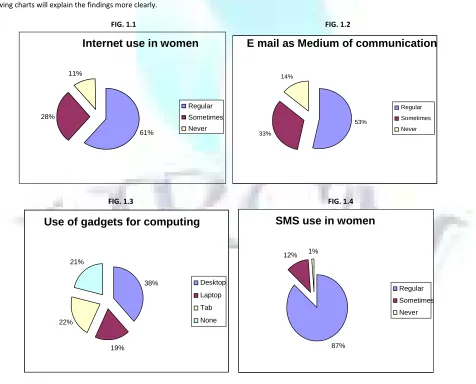
A sample of 100 women was selected, where 78 women fall under below 25 age category and while 22 were above 25 years of age, out of which 47 were working women and 53 were non working women. This paper primarily aims at finding out the exposure of communication technology to women users. The communication technology includes Computers, Mobile phones Television and Radio.
The following charts will explain the findings more clearly.
FIG. 1.1 FIG. 1.2
FIG. 1.3 FIG. 1.4
SMS use in women
87%
12% 1%
Regular
Sometimes
Never 38%
19% 22%
21%
Desktop
Laptop
Tab
None
Use of gadgets for computing
53%
33% 14%
Regular
Sometimes
Never
E mail as Medium of communication
Internet use in women
61% 28%
11%
Regular
Sometimes
INTERNATIONAL JOURNAL OF RESEARCH IN COMMERCE, IT & MANAGEMENT
FIG. 1.5 FIG. 1.6
OBSERVATIONS
The above charts are self-explanatory. 61 % women use Internet and 53 % women use internet as medium of Communication which shows substantial growth. 53 % women use email as medium of communication regularly and other 33 % sometimes show the change in communication media.
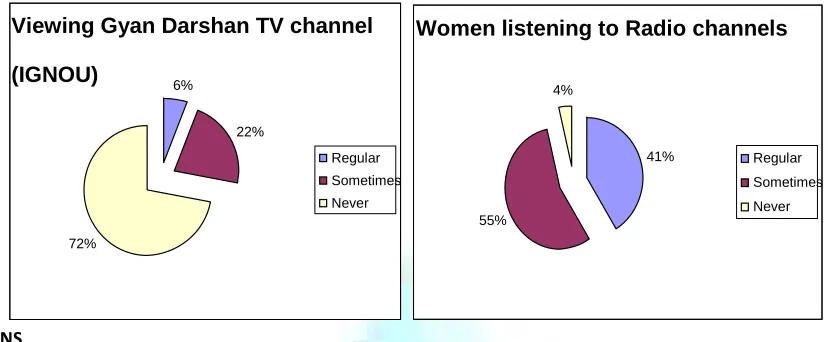
Use of gadgets is also substantial. But the SMS technology on mobile phones is used mostly by all regularly. Regular radio listening is again 55% which is quite high and can be explored to maximum capacity.
SMS since used by all should be more often used as aid in learning. Radio medium also should be developed more for learning process. But Television as medium for learning needs more awareness.
The advent of ICT has changed the global scenario and many unexplored areas are now open for encashment. It is for us to utilise the benefits to the maximum possible extent. The best part about ICT is that it is capable of various adjustments as per the requirements of the segment using the same. The same can also be adjusted as per the needs and requirement of women in India. So much so that it can be operated from every home irrespective of its location. This means that even the traditional and orthodox families can allow the women to participate and use ICT from their respective homes. In India there is an abundance of “women entrepreneurs” who are capable of making their mark at the global level. However, the awareness and facilities are missing drastically. The national policies and strategies have not yet considered this unexplored potential pool of intellectual inputs.
CONCLUSION &SUGGESTION
1. It is evident that Internet technology exposure and use of computing devices among women is good.
2. Women are using all type of devices and which can be used as advantage in teaching learning activity.
3. Gyan Darshan channel of IGNOU was introduced in year 2000 as 24 hr education channel but due to content quality and time table problems has failed the
purpose of this channel and has reached limited people.
4. With simple training and awareness programmes we can make a big difference. Further, we can also encourage the establishment of “Small and Medium
Enterprises” (SMEs), Small Scale Industries (SSIs), etc. The need of the hour is to show a positive will to achieve that much needed purpose.
5. Due to high rate of illiteracy & popularity of radio & TV, the communication channel should not be restricted to computer & internet. Integrated multimedia approach should be adopted.
NOTES
1. Information Technology Enabled Service/ Business process outsourcing.
2. International Data Corporation (IDC) is the premier global provider of market intelligence, advisory services, and events for the information technology,
telecommunications and consumer technology markets.
3. The Cisco Learning Network is a social learning community that is focused on the IT industry. The mission of the Cisco Learning Network is to provide learning tools, training resources, and industry guidance, to anyone interested in building an IT career through Cisco Certification. The certification preparation materials offered on the Cisco Learning Network do not constitute a complete self-study program; they represent a suggested starting point for your studies.
4. Eva M. Rathgeber is a consultant in international development. From 2002-2006 she held the Joint Chair of Women’s Studies at the University of Ottawa/
Carleton University in Ottawa, Canada and she continues to serve as an adjunct professor at both universities and was elected the new Chairperson of the Gender and Water Alliance (GWA) early August 2009.
5. Self Employed Women’s Association SEWA is a trade union registered in 1972. It is an organisation of poor, self-employed women workers.
6. It is an autonomous nodal IT implementation agency for Department of Information Technology, Government of Kerala which provides managerial support
to various initiatives of the Department.
7. Internet and Mobile Association of India (IAMAI)
8. Indian Market Research Bureau
9. The Planning Commission constituted a Committee on Vision 2020 for India in June 2000 under the chairmanship of Dr. S.P. Gupta, Member, Planning
Commission.
REFERENCES
1. Dalal P., Use of ICT for Women Empowerment in India
2. Enhancing Women Empowerment through ICT-A Report Submitted to Department of Women & Child Development Ministry of HRD, GOI, by Voluntary
Association For People Services.
3. Jain S., ICTs and women’s empowerment: Some case studies from India
WEBSITES
4. www.keralaitmission.org
5. www.sewa.org
41%
55% 4%
Regular
Sometimes
Never
Women listening to Radio channels
6%
22%
72%
Regular
Sometimes
Never
Viewing Gyan Darshan TV channel
VOLUME NO.4(2014),ISSUE NO.05(MAY) ISSN 2231-5756
INTERNATIONAL JOURNAL OF RESEARCH IN COMMERCE, IT & MANAGEMENT
REQUEST FOR FEEDBACK
Dear Readers
At the very outset, International Journal of Research in Commerce, IT & Management (IJRCM)
acknowledges & appreciates your efforts in showing interest in our present issue under your kind perusal.
I would like to request you tosupply your critical comments and suggestions about the material published
in this issue as well as on the journal as a whole, on our E-mail
[email protected]
for further
improvements in the interest of research.
If youhave any queries please feel free to contact us on our E-mail
.
I am sure that your feedback and deliberations would make future issues better – a result of our joint
effort.
Looking forward an appropriate consideration.
With sincere regards
Thanking you profoundly
Academically yours
Sd/-
Co-ordinator
DISCLAIMER