VOLUME NO. 5 (2015), ISSUE NO. 10 (OCTOBER) ISSN 2231-5756
VOLUME NO. 5 (2015), ISSUE NO. 10 (OCTOBER) ISSN 2231-5756
INTERNATIONAL JOURNAL OF RESEARCH IN COMMERCE, IT & MANAGEMENT
CONTENTS
Sr.
No.
TITLE & NAME OF THE AUTHOR (S)
Page
No.
1.
SYMBOLS: AN EFFECTIVE MARKETING COMMUNICATION TOOL IN BRANDING
DR. AJAY SAHNI
1
2.
INCORPORATING SUSTAINABILITY INTO HIGHER INDIAN EDUCATION
RAHUL BASU
5
3.
INTERLINKAGE BETWEEN FUND OF MUTUAL FUNDS RETURNS AND GDP IN THE INDIAN ECONOMY
M. GOWRI & MALABIKA DEO
11
4.
GROWTH OF INDIAN COMMODITY DERIVATIVE MARKET OVER THE YEARS AND ITS CURRENT SCENARIO
PRABHU C BASARKOD & DR. BASAVARAJ C S
16
5.
A STUDY ON JOB SATISFACTION OF PUBLIC, PRIVATE AND FOREIGN BANK EMPLOYEES IN CHANDIGARH
AND PUNJAB
MANVEEN GREWAL & S. K. BANSAL
21
6.
SYNTHETIC REVIEW: A REVIEW OF LITERATURE
DR. K. K. DAVE & SONAL SINGHVI
24
7.
A REVIEW OF THE FINANCES OF KERALA 1990-2015
DR. V JOHNSON
28
8.
GSCM PRACTICES AND ITS RELATIONSHIP WITH ECONOMIC PERFORMANCE IN SELECT ISO 14001
CERTIFIED COMPANIES IN (GUJARAT) INDIA
DR. HEENA SUNIL OZA & ANITA TOMAR
34
9.
TOURISM DESTINATION DEFICIENCY: A STUDY WITH REFERENCE TO KANNIYAKUMARI DISTRICT
DR. A. RAMACHANDRAN
38
10.
5S METHODOLOGY TO IMPROVE THE QUALITY AND ENVIRONMENT OF THE ORGANIZATION
K. MADHAVI & D. PRANAYA
41
11.
THE MAJOR ROLE AND EFFECTS OF SOCIAL MEDIA ON STUDENTS
JAYADATTA S & B.Y.KRISHNA MURTHY
43
12.
A STUDY ON THE IMPACT OF INFORMATION TECHNOLOGY ON ACCOUNTING PRACTICES WITH SPECIAL
REFERENCE TO AUDITING FIRMS IN BANGALORE
CAMILLO JOSEPH
45
13.
EMOTIONAL INTELLIGENCE AND EMOTIONAL LABOR: AN EMPIRICAL STUDY ON ORGANIZED RETAIL
SECTOR
ASHA CHAUDHARY
49
14.
A STUDY ON SWOT ANALYSIS WITH SPECIAL REFERENCE TO PERSONNEL MANAGEMENT IN AUROFOOD
LTD., PUTHUCHERRY
C. SURESH & DR. P. KOMARASAMY
55
15.
IMPORTANCE OF PERFORMANCE APPRAISAL AND ITS EVALUATION PARAMETERS OF EMPLOYEES IN
INSURANCE COMPANIES
RAJENDRA PRASAD G R & DR. MANJUNATH, K. R
58
16.
EVALUATION OF EQUITY FINANCE OPTION AND PERFORMANCE OF COOPERATIVE BUSINESS ENTERPRISES
IN NJIKOKA LOCAL GOVERNMENT AREA OF ANAMBRA STATE
TAIWO ABDULAHI OLABISI, LAWAL KAMALDEEN, A., AGBASI OBIANUJU E & OKAFOR IFEOMA P.
63
17.
A STUDY OF FINANCIAL PERFORMANCE: A COMPARATIVE ANALYSIS OF BANGALORE AND GULBARGA
MILK UNION
JAYALAKSHMI. H.Y
67
18.
POLITICAL- AWARENESS AMONG MUSLIM STUDENTS: A STUDY OF ALMORA TOWN (UTTARAKAND)
FAROOQ AHMAD BAKLOO & ASMA
72
19.
HISTORICAL DEVELOPMENT OF FINANCIAL DERIVATIVES AND ITS CURRENT POSITION IN INDIAN
DERIVATIVE MARKET
MUHAMMED JUMAN.B K
75
20.
GENDER BUDGETING: A DESCRIPTIVE STUDY
T. ARYAMALA
87
VOLUME NO. 5 (2015), ISSUE NO. 10 (OCTOBER) ISSN 2231-5756
CHIEF PATRON
PROF. K. K. AGGARWAL
Chairman, Malaviya National Institute of Technology, Jaipur
(An institute of National Importance & fully funded by Ministry of Human Resource Development, Government of India)
Chancellor, K. R. Mangalam University, Gurgaon
Chancellor, Lingaya’s University, Faridabad
Founder Vice-Chancellor (1998-2008), Guru Gobind Singh Indraprastha University, Delhi
Ex. Pro Vice-Chancellor, Guru Jambheshwar University, Hisar
FOUNDER PATRON
LATE SH. RAM BHAJAN AGGARWAL
Former State Minister for Home & Tourism, Government of Haryana
Former Vice-President, Dadri Education Society, Charkhi Dadri
Former President, Chinar Syntex Ltd. (Textile Mills), Bhiwani
FORMER CO-ORDINATOR
DR. S. GARG
Faculty, Shree Ram Institute of Business & Management, Urjani
ADVISORS
PROF. M. S. SENAM RAJU
Director A. C. D., School of Management Studies, I.G.N.O.U., New Delhi
PROF. M. N. SHARMA
Chairman, M.B.A., Haryana College of Technology & Management, Kaithal
PROF. S. L. MAHANDRU
Principal (Retd.), Maharaja Agrasen College, Jagadhri
EDITOR
PROF. R. K. SHARMA
Professor, Bharti Vidyapeeth University Institute of Management & Research, New Delhi
CO-EDITOR
DR. BHAVET
Faculty, Shree Ram Institute of Engineering & Technology, Urjani
EDITORIAL ADVISORY BOARD
DR. RAJESH MODI
Faculty, Yanbu Industrial College, Kingdom of Saudi Arabia
PROF. SANJIV MITTAL
University School of Management Studies, Guru Gobind Singh I. P. University, Delhi
PROF. ANIL K. SAINI
Chairperson (CRC), Guru Gobind Singh I. P. University, Delhi
VOLUME NO. 5 (2015), ISSUE NO. 10 (OCTOBER) ISSN 2231-5756
INTERNATIONAL JOURNAL OF RESEARCH IN COMMERCE, IT & MANAGEMENT
DR. MOHENDER KUMAR GUPTA
Associate Professor, P. J. L. N. Government College, Faridabad
DR. SHIVAKUMAR DEENE
Asst. Professor, Dept. of Commerce, School of Business Studies, Central University of Karnataka, Gulbarga
ASSOCIATE EDITORS
PROF. NAWAB ALI KHAN
Department of Commerce, Aligarh Muslim University, Aligarh, U.P.
PROF. ABHAY BANSAL
Head, Department of I.T., Amity School of Engineering & Technology, Amity University, Noida
PROF. A. SURYANARAYANA
Department of Business Management, Osmania University, Hyderabad
PROF. V. SELVAM
SSL, VIT University, Vellore
DR. PARDEEP AHLAWAT
Associate Professor, Institute of Management Studies & Research, Maharshi Dayanand University, Rohtak
DR. S. TABASSUM SULTANA
Associate Professor, Department of Business Management, Matrusri Institute of P.G. Studies, Hyderabad
SURJEET SINGH
Asst. Professor, Department of Computer Science, G. M. N. (P.G.) College, Ambala Cantt.
FORMER TECHNICAL ADVISOR
AMITA
Faculty, Government M. S., Mohali
FINANCIAL ADVISORS
DICKIN GOYAL
Advocate & Tax Adviser, Panchkula
NEENA
Investment Consultant, Chambaghat, Solan, Himachal Pradesh
LEGAL ADVISORS
JITENDER S. CHAHAL
Advocate, Punjab & Haryana High Court, Chandigarh U.T.
CHANDER BHUSHAN SHARMA
Advocate & Consultant, District Courts, Yamunanagar at Jagadhri
VOLUME NO. 5 (2015), ISSUE NO. 10 (OCTOBER) ISSN 2231-5756
CALL FOR MANUSCRIPTS
We invite unpublished novel, original, empirical and high quality research work pertaining to recent developments & practices in the areas of Computer Science & Applications; Commerce; Business; Finance; Marketing; Human Resource Management; General Management; Banking; Economics; Tourism Administration & Management; Education; Law; Library & Information Science; Defence & Strategic Studies; Electronic Science; Corporate Governance; Industrial Relations; and emerging paradigms in allied subjects like Accounting; Accounting Information Systems; Accounting Theory & Practice; Auditing; Behavioral Accounting; Behavioral Economics; Corporate Finance; Cost Accounting; Econometrics; Economic Development; Economic History; Financial Institutions & Markets; Financial Services; Fiscal Policy; Government & Non Profit Accounting; Industrial Organization; International Economics & Trade; International Finance; Macro Economics; Micro Economics; Rural Economics; Co-operation; Demography: Development Planning; Development Studies; Applied Economics; Development Economics; Business Economics; Monetary Policy; Public Policy Economics; Real Estate; Regional Economics; Political Science; Continuing Education; Labour Welfare; Philosophy; Psychology; Sociology; Tax Accounting; Advertising & Promotion Management; Management Information Systems (MIS); Business Law; Public Responsibility & Ethics; Communication; Direct Marketing; E-Commerce; Global Business; Health Care Administration; Labour Relations & Human Resource Management; Marketing Research; Marketing Theory & Applications; Non-Profit Organizations; Office Administration/Management; Operations Research/Statistics; Organizational Behavior & Theory; Organizational Development; Production/Operations; International Relations; Human Rights & Duties; Public Administration; Population Studies; Purchasing/Materials Management; Retailing; Sales/Selling; Services; Small Business Entrepreneurship; Strategic Management Policy; Technology/Innovation; Tourism & Hospitality; Transportation Distribution; Algorithms; Artificial Intelligence; Compilers & Translation; Computer Aided Design (CAD); Computer Aided Manufacturing; Computer Graphics; Computer Organization & Architecture; Database Structures & Systems; Discrete Structures; Internet; Management Information Systems; Modeling & Simulation; Neural Systems/Neural Networks; Numerical Analysis/Scientific Computing; Object Oriented Programming; Operating Systems; Programming Languages; Robotics; Symbolic & Formal Logic; Web Design and emerging paradigms in allied subjects.
Anybody can submit the soft copy of unpublished novel; original; empirical and high quality research work/manuscriptanytime in M.S. Word format
after preparing the same as per our GUIDELINES FOR SUBMISSION; at our email address i.e. [email protected] or online by clicking the link online
submission as given on our website (FOR ONLINE SUBMISSION, CLICK HERE).
GUIDELINES FOR SUBMISSION OF MANUSCRIPT
1. COVERING LETTER FOR SUBMISSION:
DATED: _____________
THE EDITOR IJRCM
Subject: SUBMISSION OF MANUSCRIPT IN THE AREA OF .
(e.g. Finance/Mkt./HRM/General Mgt./Engineering/Economics/Computer/IT/ Education/Psychology/Law/Math/other, please specify)
DEAR SIR/MADAM
Please find my submission of manuscript entitled ‘___________________________________________’ for possible publication in one of your journals.
I hereby affirm that the contents of this manuscript are original. Furthermore, it has neither been published elsewhere in any language fully or partly, nor is it under review for publication elsewhere.
I affirm that all the co-authors of this manuscript have seen the submitted version of the manuscript and have agreed to their inclusion of names as co-authors.
Also, if my/our manuscript is accepted, I agree to comply with the formalities as given on the website of the journal. The Journal has discretion to publish our contribution in any of its journals.
NAME OF CORRESPONDING AUTHOR :
Designation :
Institution/College/University with full address & Pin Code : Residential address with Pin Code : Mobile Number (s) with country ISD code : Is WhatsApp or Viber active on your above noted Mobile Number (Yes/No) : Landline Number (s) with country ISD code :
E-mail Address :
VOLUME NO. 5 (2015), ISSUE NO. 10 (OCTOBER) ISSN 2231-5756
INTERNATIONAL JOURNAL OF RESEARCH IN COMMERCE, IT & MANAGEMENT
NOTES:
a) The whole manuscript has to be in ONE MS WORD FILE only, which will start from the covering letter, inside the manuscript. pdf. version is liable to be rejected without any consideration.
b) The sender is required to mention the following in the SUBJECT COLUMNof the mail:
New Manuscript for Review in the area of (e.g. Finance/Marketing/HRM/General Mgt./Engineering/Economics/Computer/IT/ Education/Psychology/Law/Math/other, please specify)
c) There is no need to give any text in the body of mail, except the cases where the author wishes to give any specific message w.r.t. to the manuscript.
d) The total size of the file containing the manuscript is expected to be below 1000 KB.
e) Abstract alone will not be considered for review and the author is required to submit the complete manuscript in the first instance.
f) The journal gives acknowledgement w.r.t. the receipt of every email within twenty four hours and in case of non-receipt of acknowledgment from the journal, w.r.t. the submission of manuscript, within two days of submission, the corresponding author is required to demand for the same by sending a separate mail to the journal.
g) The author (s) name or details should not appear anywhere on the body of the manuscript, except the covering letter and the cover page of the manuscript, in the manner as mentioned in the guidelines.
2. MANUSCRIPT TITLE: The title of the paper should be bold typed, centeredand fully capitalised.
3. AUTHOR NAME (S) & AFFILIATIONS: Author (s) name, designation, affiliation (s), address, mobile/landline number (s), and
email/alternate email address should be given underneath the title.
4. ACKNOWLEDGMENTS: Acknowledgements can be given to reviewers, guides, funding institutions, etc., if any.
5. ABSTRACT: Abstract should be in fully italicized text, ranging between 150 to 300 words. The abstract must be informative and explain the background, aims, methods, results & conclusion in a SINGLE PARA. Abbreviations must be mentioned in full.
6. KEYWORDS: Abstract must be followed by a list of keywords, subject to the maximum of five. These should be arranged in alphabetic order separated by commas and full stop at the end. All words of the keywords, including the first one should be in small letters, except special words e.g. name of the Countries, abbreviations.
7. JEL CODE: Provide the appropriate Journal of Economic Literature Classification System code (s). JEL codes are available at www.aeaweb.org/econlit/jelCodes.php, however, mentioning JEL Code is not mandatory.
8. MANUSCRIPT: Manuscript must be in BRITISH ENGLISH prepared on a standard A4 size PORTRAIT SETTING PAPER. It should be free from any errors i.e. grammatical, spelling or punctuation. It must be thoroughly edited at your end.
9. HEADINGS: All the headings must be bold-faced, aligned left and fully capitalised. Leave a blank line before each heading. 10. SUB-HEADINGS: All the sub-headings must be bold-faced, aligned left and fully capitalised.
11. MAIN TEXT:
THE MAIN TEXT SHOULD FOLLOW THE FOLLOWING SEQUENCE:
INTRODUCTION
REVIEW OF LITERATURE
NEED/IMPORTANCE OF THE STUDY
STATEMENT OF THE PROBLEM OBJECTIVES
HYPOTHESIS (ES)
RESEARCH METHODOLOGY
RESULTS & DISCUSSION FINDINGS
RECOMMENDATIONS/SUGGESTIONS
CONCLUSIONS LIMITATIONS
SCOPE FOR FURTHER RESEARCH REFERENCES
APPENDIX/ANNEXURE
VOLUME NO. 5 (2015), ISSUE NO. 10 (OCTOBER) ISSN 2231-5756
12. FIGURES & TABLES: These should be simple, crystal CLEAR, centered, separately numbered & self explained, and titles must be above the table/figure. Sources of data should be mentioned below the table/figure. It should be ensured that the tables/figures are referred to from the main text.
13. EQUATIONS/FORMULAE: These should be consecutively numbered in parenthesis, horizontally centered with equation/formulae number placed at the right. The equation editor provided with standard versions of Microsoft Word should be utilised. If any other equation editor is utilised, author must confirm that these equations may be viewed and edited in versions of Microsoft Office that does not have the editor.
14. ACRONYMS: These should not be used in the abstract. The use of acronyms is elsewhere is acceptable. Acronyms should be defined on its first use in each section: Reserve Bank of India (RBI). Acronyms should be redefined on first use in subsequent sections. 15. REFERENCES: The list of all references should be alphabetically arranged. The author (s) should mention only the actually utilised
references in the preparation of manuscript and they are supposed to follow Harvard Style of Referencing. Also check to make sure that everything that you are including in the reference section is duly cited in the paper. The author (s) are supposed to follow the references as per the following:
All works cited in the text (including sources for tables and figures) should be listed alphabetically. Use (ed.) for one editor, and (ed.s) for multiple editors.
When listing two or more works by one author, use --- (20xx), such as after Kohl (1997), use --- (2001), etc, in chronologically ascending order.
Indicate (opening and closing) page numbers for articles in journals and for chapters in books.
The title of books and journals should be in italics. Double quotation marks are used for titles of journal articles, book chapters, dissertations, reports, working papers, unpublished material, etc.
For titles in a language other than English, provide an English translation in parenthesis.
Headers, footers, endnotes and footnotes should not be used in the document. However, you can mention short notes to elucidate some specific point, which may be placed in number orders after the references.
PLEASE USE THE FOLLOWING FOR STYLE AND PUNCTUATION IN REFERENCES: BOOKS
Bowersox, Donald J., Closs, David J., (1996), "Logistical Management." Tata McGraw, Hill, New Delhi. Hunker, H.L. and A.J. Wright (1963), "Factors of Industrial Location in Ohio" Ohio State University, Nigeria.
CONTRIBUTIONS TO BOOKS
Sharma T., Kwatra, G. (2008) Effectiveness of Social Advertising: A Study of Selected Campaigns, Corporate Social Responsibility, Edited by David Crowther & Nicholas Capaldi, Ashgate Research Companion to Corporate Social Responsibility, Chapter 15, pp 287-303.
JOURNAL AND OTHER ARTICLES
Schemenner, R.W., Huber, J.C. and Cook, R.L. (1987), "Geographic Differences and the Location of New Manufacturing Facilities," Journal of Urban Economics, Vol. 21, No. 1, pp. 83-104.
CONFERENCE PAPERS
Garg, Sambhav (2011): "Business Ethics" Paper presented at the Annual International Conference for the All India Management Association, New Delhi, India, 19–23
UNPUBLISHED DISSERTATIONS
Kumar S. (2011): "Customer Value: A Comparative Study of Rural and Urban Customers," Thesis, Kurukshetra University, Kurukshetra.
ONLINE RESOURCES
Always indicate the date that the source was accessed, as online resources are frequently updated or removed.
WEBSITES
VOLUME NO. 5 (2015), ISSUE NO. 10 (OCTOBER) ISSN 2231-5756
INTERNATIONAL JOURNAL OF RESEARCH IN COMMERCE, IT & MANAGEMENT
SYMBOLS: AN EFFECTIVE MARKETING COMMUNICATION TOOL IN BRANDING
DR. AJAY SAHNI
HEAD
DEPARTMENT OF FOREIGN LANGUAGES
BHARATI VIDYAPEETH DEEMED UNIVERSITY INSTITUTE OF MANAGEMENT AND RESEARCH
NEW DELHI
ABSTRACT
This research paper is conceptual and is written on the basis of secondary data. The communication strategies of the brand managers are tuned, to attract their target customers toward their advertising messages by various tools. Symbols and semiotics are one of the emerging areas in this aspect. Symbols are instrumental in depicting the theme of the message in a more creative and innovative way, that leads to brand association in the mind of the customers, which resultantly help in brand equity and loyalty. The culture has wide ramifications when advertisers apply symbols in the designing part of message. This is because of the prevalent norms, values and inferences that symbols represent. Hence, their application helps brand managers to leverage their well planned and researched consumers’ psychological perspectives for their brands’ positioning. Through this research some classic examples are cited in the form of logos, like that of Amazon, Eight, Pittsburgh, FedEx, that have been very strategically applied and have been able to garner the desired outcomes for these brands. These logos are a classical example of what symbols and semiotics can do in the ongoing competitive brand warfare, where brands are vying for a suitable space in consumers’ minds’ landscape.
KEYWORDS
brand, communication, empathy, oneness, symbols.
JEL CODE
M3- Marketing and Advertising; M37- Advertising.
INTRODUCTION
his conceptual research paper is based upon secondary research. It highlights the issues and trends prevalent in marketing communications, the most important being symbols that reflect the aspirations of target customers’ mindset. Devising an effective advertising massage is a challenging task for the brand managers, as they are addressing to a mega target audience. Either they could communicate through well researched and well selected words, phrases and sentences, or through the combination of verbal and non-verbal cues that appeal to the market. This research paper delves into this non-verbal message is the form of symbols that the advertisers entail, so that the resultant message reflects the cultural aspirations of the society with which their target market could connect instantly. For this they resort to all sorts of culturally accepted symbolic inferences, so that the interpretations and denotations are intersected in consumers’ mind and they are able to have a sense of oneness with the brands they are advertising and most importantly, the resultant brand position is created in the market.
REVIEW OF LITERATURE
Numebr of websites and books, as mentioned in the refrences are consulted and the contents mentioned on symbols, their interpretation, meanings, significance and related concepts were studied. In all these literary works, it was found, that there is a missing link in connecting the concepts to the practical aspect (s). Secondly, the concepts, theories and correlations are missing. The terms are defined only. Hence, there has been a need to bring these concepts and theories more relevant to the practical aspects of branding and communication strategies.
NEED AND IMPORTANCE OF STUDY
The study fulfill the need for a comprehensive and descriptive research study to collect the concepts, especially the symbolic, signs, and other signposts that advertisers resort to while crafting their marketing communication strategies. Most importantly, the challenging tasks of advertisers and brand creators are immense, owing to the competition, and changing consumers’ brand loyalties. Hence, the study of symbols and their relevance in adverting messages serves the need of the industry of bringing under one roof, the aspects, practicalities of communicational related symbol inferences that connect to the target market cultural norms and values. This study is important when viewed from the perspective of brand clutter that consumers mind space is experiencing, owing to competitive offering in the market place and ever increasing disposal income equation of consumers. In this era of information technology, when all the media are very expensive, this study has a very important dimension from the point of view of brand positioning, brand recalling and creating brand equity and corresponding brand association and loyalty. As, the brand managers also appreciate the fact that it is less costly to retain the brand loyal than to create them.
STATEMENT OF PROBLEM
The ever increasing brand clutter in consumers’ mind, calls for an innovative brand communication initiatives by the marketers, so that there is an instant connect between the product being branded and its consumers’, through emotions and empathy.
OBJECTIVES
This secondary data based, descriptive research study is undertaken with the following objectives:
(1) To investigate the possible communicative tools that a brand manager can resort to;
(2) To analyze and select the best possible communication toll, so that there is an optimum resource utilization;
(3) To strategically come out with advertising messages that connect with target market emotional and empathic perceptions, so that there is an instant association between brand personality, brand image with the corresponding self-personality and self-image of the consumer;
(4) To study the theories, meanings and conceptual framework of symbols, and their interpretation and denotations with reference to contexts, culturally accepted norms, so that an effective advertising message can be created for brand positioning, repositioning and recalling, all leading towards creation of brand equity.
HYPOTHESIS
The application of symbols in advertising creates the required bridge between the target market and the brand communicators through the cultural connotation, accepted norms, and help create the well researched and identified brand positioning in the market. These will happen due to the instant correlation that the target market derive vis-à-vis their inherited values, cultural and societal interpretations that the symbols are associate with. This non-verbal communication is faster and more effective, as it straightway propels the emotional quotient of the target market that will subsequently lead to better brand association.
VOLUME NO. 5 (2015), ISSUE NO. 10 (OCTOBER) ISSN 2231-5756
RESEARCH METHODOLOGY
This study is conducted on the basis of secondary data that would have been collected for some other related field. The research is descriptive and qualitative and explores the definitions, theories and concepts related to symbols, their inferences, the cultural connotations that symbols represent, and the resultant emotional triggers, that these symbols lead to and the target market’s behaviour towards the anticipated outcome of marketers, from the point of views of brand recall, loyalty and association.
RESULTS AND DISCUSSION
Advertising is a form of mass communication. The word communication is derived from the Latin word communis, which means "common." Communication then can be thought of as the process of establishing a commonness or oneness of thought between a sender/advertiser and a receiver/consumer. There must be a commonness of thought developed between advertiser and consumer if communication is to occur. The successful advertiser is the one who can establish that commonness or oneness between their company and its consumers via an effective advertising message.
Developing that oneness of thought between an advertiser and a consumer is extremely difficult because of the nature of mass communication. There are two basic forms of communication--mass and interpersonal. Both share the same basic purpose. However, several unique characteristics of mass communication make it quite different from interpersonal or face-to-face communication. For example, mass communication is indirect because it uses some technical vehicle like a television network or newspaper to connect the source with the receivers/consumers. To complicate matters, the receivers/consumers are removed from the source in time, space, or both. Since the sender/advertiser is virtually separated from its receiver/consumer because of a technical vehicle like TV or radio, there is no possibility for immediate feedback from the receiver/consumer.
A symbol is defined in various ways as per various dictionaries. Some important and relevant definitions are:
(1) A symbol is “a mark or character used as a conventional representation of an object, function, or process, e.g. a character that represents a particular musical
note that a musician or an instrument player understands. This is basically due to accepted norms and rules and processes that are passed on. It is an understanding that a particular symbol has to be interpreted as to carry that particular playing of an instrumental between a composer and instrument player. Hence a symbols is to be understood as pact between these two and other instrument players in the orchestra that help compose a beautiful symphony.
(2) Another inference that can be drawn thing that represents or stands for something else, especially a material object representing something abstract.
"TATA” symbolizes trust, ROLLS ROYCE symbolizes royalty.
imilarly, a shape or sign is used to represent something such as an organization, e.g. a Red Cross symbolizes Red Cross Organization.
(3) A symbol is a sign, shape, or object that is used to represent something else: A heart shape is the symbol of love. The wheel in the Indian flag is a symbol of
peace.
(4) A symbols is something that is used to represent a quality or idea: Water, a symbol of life, Sky stands for openness, infinity, letter, or sign used in mathematics, music, physics, chemistry, they all have some signs, structures as being accepted as per the structured systems that are accepted per se. The symbol for oxygen is O.
Even an an object can be taken as a representation or a symbol of something else if it seems to represent it because it is connected with it in a lot of people's
minds: The private jet is a symbol of wealth.
In the field of advertising and marketing communications, especially brand name, packaging, logo, design typography branding is one of the key pillars of a company’s identity. There is a lot of thought, philosophy, research work that is included in these. This is directly or indirectly related to psychology, perceptions, especially the emotional; and empathic connotations with the consumers’ mindsets.
To substantiate this fact following are the details of some logos that are classic examples of this aspect of brand management. Another emerging and scientific area related to use of symbology in marketing is brand semiotics that takes its roots from symbols only.
(1) THE FEDEX LOGO
The white space between the ‘E’ and the ‘X’ forms a perfect arrow, suggesting a company that is progressive and moving forward and looking ahead. It’s subtle, and very effective, while the arrow moving towards right side is culturally accepted norm that it signifies development and growth.
VOLUME NO. 5 (2015), ISSUE NO. 10 (OCTOBER) ISSN 2231-5756
INTERNATIONAL JOURNAL OF RESEARCH IN COMMERCE, IT & MANAGEMENT
THE EIGHT LOGO
In this clever design, each letter is made up of a certain part of the number ‘8’. The second image helps visualize this wonderful design that is so unique that brand association is at once drawn.
The arrow from ‘A’ to ‘Z’ in the Amazon logo, signifies the complete on line shopping experience, while “A’ is symbolic of beginning i.e. start, whereas “Z” connotes the end , a completion of. This symbol depicts that a customer will have one stop solution to all the on line shopping concerns, and that the Group operates on 360 degree level philosophy. The second semiotic is in the form of a smiley after joining A and Z, that projects a nice, satisfied and comfortable experience with Amazon.
According to anthropologists, the cultural symbolism of advertising and advertising figures is connected to the deep-seated ideals that people invest in goods. Hence logos, trademarks, brand name or celebrities used in marketing communications and brand management connotes the cultural values, ideals and socially accepted norms, and help consumers associate these through the symbols, which are now becoming an emerging areas by marketers and is termed as brand semiotics.
USE OF SYMBOLS IN ADVERTISING: A BRIEF HISTORY
Application of cultural symbols in advertising can be traced back to the 19th century when the first celebrity endorsements began to appear. Henry Ward Beecher, the preacher in the U.S.A. was the one who represented and endorsed “Pears” soap in the 1880s. The Company had thought to correlate the divinity symbols through this endorsement. Further notable contributions in this field were from Writers such as Judith Williamson and Matthew McAllister. They inferred that through this system of celebrity endorsement, the consumers will relate, and connect with the benefits of product to the character and personality of the celebrity. The flip side of this had been that consumers would also associate the not so appreciable qualities of the celebrity to that of the product that was being endorsed. The most successful and unique symbol ever in the history is that of Coca-Cola, to an extent that the French language has developed a new word for this beverage, although this being a proper noun. It is called as Coca in French. This brand has developed powerful brand equity globally, and the Company has been successful in making its forays in different markets, especially in India by imbibing the deep cultural values and symbols, and has been very successful. In India, as per its research initiatives, the drink has been positioned as a family drink. It is shown always as a drink that will be shared with family, friends, and cricket, the three most symbolic representations of deepest rooted cultural ethos of Indian society. Due to this, all its advertisements revolve around these three themes only. This helps its target market associate and correlate and as a result the Company is able to maintain optimum brand recall, equity and differentiation.
Apart from making deeper inroads in the domestic countries, the American majors like, Walt Disney Co.'s Mickey Mouse and McDonald's Corporation, Pepsi Co Inc. have been symbolically associated with the spread of American culture , values, systems and way of life.
When a communication is written from the point of view of an advertisement, there is a sentence, and, a sentence is a complete expression of a single thought. It makes complete sense and follows certain rules of grammar”. The word expression is noteworthy here. The term expression denotes that there is a thought pattern that is put forth through a sentences, and, when this thought pattern is extensively and intensely researched according to the consumers’ likes and dislikes, and some visuals, design elements, typography constructs are added with the colour sense and lay out plan, an advertisement is created, that corresponds to the market expectations. Hence, all the elements of colour, design, symbols, language, and within the language, the words, clauses, punctuation marks, verbs, and phrases, all put together form a communication structure. The symbols in the form of various cultural connotations and denotations act as a bridge between the sender and receiver in a short span of time. A symbol is a combination of ides, reflections, inferences and values that makes the message flow quickly and instantly with the overall impact that triggers the emotional frame of mind
Similarly, the punctuation marks, like comma, full stop, exclamation marks etc. are symbols / check points/sign post for the readers of any written communication, and help to bring the clarity of thought of the writer, and helps the reader to extract and connect with the thought pattern of the writer and derive the maximum benefit from the message that the advertiser aims to express in his target readers’ psychological perceptions and empathic connect. The use of full stop helps the copy writer to facilitate the reader towards the longest pause and separation. A comma makes the target customer go for ht e shortest pause etc. A semi- colon is an indicator given by the advertiser to the reader that he is expected to have a shorter pause than the full stop but longer than the comma. A colon indicates the longer pause than the semi-colon. Hence, these punctuation marks are a sort of symbols that make an empathic connect possible between the advertiser and his target readers/customers/consumers.
FINDINGS
The research led to some striking results. It was discovered that advertisers are in the process of resorting to usage of symbols in print media owing to the escalating cost of this media. Secondly, due to clutter in advertising space, they want to be different and stand out from the crowd. For this usage of symbols is an effective tool for brand managers. Symbols are easily identified, and due to instant connectivity with the consumers’ psychological perceptions, symbols serve to create the required synonymy between the products and brand i.e. the benefits through the advertised features that the brand creators are mentioning through the advertisement. Since the underlined component is cultural, the symbols are successful in positioning, and repositioning the brands vis-à-vis the competitors’ thanks to the excellent graphical, designs elements, colour schemes and tones, along with the requisite typography, font size, that all gel with the overall layout and design structure of an advertisement. The moment consumers see the symbols, the underlying cultural connotation that is deeply ingrained in their minds lead to denotation and interpretations, and helps the target market shop for the brands and leads to brand loyalty.
RECOMMENDATIONS AND SUGGESTIONS
VOLUME NO. 5 (2015), ISSUE NO. 10 (OCTOBER) ISSN 2231-5756 Since advertising is a one way form of communication, and advertisers and brand creators are not aware whether their advertisement has really appealed to the market as conceived, it calls for an effective combination of both art and science while creating an advertisement communication, and here the role of symbols and semiotics is noteworthy, as it enables the communication lead to instant empathetic association between the product, advertiser, consumers, and cultural inferences. The challenge for advertisers and brand managers is to create this bridge, the coherence and oneness, and this is done through proper selection of words and phrase, verbal and non-verbal clues. Sometimes, a particular word is difficult for the reader or target customer to understand. Here, the symbols evoke that contextual credibility through which the readers are able to extract the right meaning by inferring the contextual meaning. Mention may be made about Marlboro cigarettes, a classical example of advertising in the history of brands and marketing communications. Initially, the Company had the challenge of overcoming the wrong image of the product as a feminine one. With the depiction of cowboy as a symbolic interface, the brand was able to leverage the masculine appeal, as cowboy is synonymous with masculinity and adventurous spirit. Hence lending symbolic credibility to brand is helpful in the creation of right brand value, brand association and brand concept according to the corresponding self value, self association and self concept of the target consumer, provided the symbols are depicted according the cultural contexts with the right mix of other components of advertisement communicational aspects of advertising and establishing a commonness of thought with the audience.
LIMITATIONS
This research paper is not without limitations. Primary research could have been entailed, so that issues and challenges reflected through this study could have been reflected more factually. Secondly, due to limitation of time and resources, the study could have been made more empirical as well. But, the study would contribute towards the emerging area of brand semiotics that also studies the signs, symbols and their interpretations systematically and factually.
SCOPE FOR FURTHER RESEARCH
Since the marketing warfare is getting intense day by day and consumer is no more a king, but an emperor, this study of symbols as an effective instrument for playing the brand managers’ tune of brand equity. Further research can be conducted in this area, and, the field of brand semiotics is another emerging area, where this study can be further investigated through primary data collection for the purpose of quantitative analysis, so that factual and experiential dimensions could also be added on to this research study. In this digital marketing era, the research study on symbols and semiotics can further make the communication strategy of brands more distinctive and appealing to create the much required mind space in target markets’ mind for sustenance.
REFERENCES
BOOKS
1. Gupta C.B., (1986), English, Scholar
WEBSITES
2. adage.com/article/adage-encyclopedia/cultural-symbols/98427/Sep 15, 2003 consulted on 19/9/15 at 11:08 pm
3. dictionary.cambridge.org/dictionary/english/symbol consulted on 19/9/15 at 10:58pm
4. http://www.acrewebsite.org/search/view-conference-proceedings.aspx?Id consulted on 19/9/15 at 11:02 pm
5. http://www.google.co.in/gws_rd consulted on 19/1/15 at 10:50 pm
6. twistedsifter.com/2011/08/20_clever-logos-with-hidden-symbolism/Aug 29, 2011 consulted on 19/9/15 at 11:11 pm
7. www.collinsdictionasry.com consultd on 19/9/15 at 11:00 pm
8. www.freepatentsonline.com/article/Business-Perspectives/14412365.html consulted on 20/9/15 at 12:12am
9. www.google.co.in/search? Q=symbols + used + in + adverstising +biw=1366&bih consulted on 20/9/15 at 12:12 am
VOLUME NO. 5 (2015), ISSUE NO. 10 (OCTOBER) ISSN 2231-5756
INTERNATIONAL JOURNAL OF RESEARCH IN COMMERCE, IT & MANAGEMENT
INCORPORATING SUSTAINABILITY INTO HIGHER INDIAN EDUCATION
RAHUL BASU
PROFESSOR
SAMBHRAM INSTITUTE OF TECHNOLOGY
MS PALYA, BANGALORE
ABSTRACT
There is an increasing urgency in teaching sustainable practices to the public. Earlier, Science curricula had General Science, Home Science and similar core subjects as requirements. Now, the buzz word is “Sustainable”, and the topic has to be included to inculcate environmental consciousness into the younger school population. More importantly, implementation has to be done by those who preach it, in other words education should implement sustainability during its propagation. To this end, paperless class rooms, virtual schools and reusable and electronic media would have to be used to reach a greater proportion of the population. Education should be made available to all through various digital means, for example by Open Classrooms, MOOC’s – (Massively open online courses), at a low cost. This would be possible by avoiding high overheads of brick and mortar campuses. Several portals like EDX, MITX, COURSERA and UDACITY are offering online courses free of cost without paper and books in physical form, thereby saving students the cost of buying text books and of using reams of notepaper which at the end of the day go into the environment as waste. The lower use of paper will save millions of trees and help in cleaning the air of CO2. Indian Educational systems rely heavily on rote memorization and rigid curricula. Online paperless education can help in sustainability and giving a start to deserving students.
KEYWORDS
open learning, development, education, migration, , skill.
JEL CODE
I250 Education and Development.
INTRODUCTION
ndia has over 1/6th of the world’s population, but the proportion of land surface is far less. The population density of India is one of the highest on the globe.
Among these people a large proportion are below the poverty line. It is well known that poverty and degradation of the environment are interlinked. Any strategy to reclaim the environment must need to put this section of the population in the picture. The poor rely to a large part on the environment. People cut down forests because of easy access and low costs. As a result of the burning of wood and coal, India has the worst pollution record in the world with 30% more methane emissions together with that from two wheelers and coal burning plants.
According to various pundits ( Barbier, Grossman Kruger), there is a natural self correcting mechanism in the environment where after a certain level of prosperity, the pollution levels should come down. This concept is termed the EKC (Environmental Kuznets Curve). This is not to say that the poor do not care for the environment and only the prosperous do. On the contrary the poor care a great deal for the environment as is evinced by the practices of tribal and rural people where sacredness is attached to natural resources like forests, mountains, trees and rivers by tradition. As such it should not be difficult to get the common populace to accept sustainable practices. It is only out of dire necessity and extreme poverty that the practice of encroaching on river beds, lake beds and forests has occurred in recent times. In fact, although rural traditions emphasise the sacredness of the environment, and some well known institutions like Krishnamoorthy Foundation, the Centre for Environment and some NGO’s have worked around these ideas of sustainability, the Government has not capitalized on this by incorporating ESD into the rural educational ethos. In 1991 the Supreme Court enforced teaching of environmental studies at all levels of the curriculum as compulsory, but a separate ESD curriculum is yet to be established at the school level. Similarly Health education does not have a blue print like Sarva Shiksha Abhiyaan. Malnutrition is common among 1-5 year olds, (Joshi).
India has recognized at the outset that poverty and the environment are closely related. This was stated by the then PM Indira Gandhi in 1972 at Stockholm Conference on Human Environment in 1972. It was the then Prime Minister of India, Mrs. Indira Gandhi who focused attention of the Conference on this, stating that "environment cannot be improved in conditions of poverty". Soon after this a new Ministry of Environment and Forestry was set up. But, after this encouraging start, India has not been in the forefront of global activism for environmental protection, and has merely followed or endorsed various statements from World Bodies like the UN. Implementation of various schemes requires political will and institutional frameworks. ESD is generally seen as environmental
or science related by a cross-section of Government officials, NGO’s and academics. The Nagoya declaration reaffirms several oaths on 9th Nov 2014—the DESD
2005-2014, the Rio Declaration on Higher Education and Sustainability (Rio+20), and the IAU Iquitos Statement, besides setting new goals in the spirit of Sustainable
Goals. It specifically recognizes the role of Higher Education in the achievement of these goals, in recognizing the environmental limits of the planet through
education, research and outreach activities. (http:www.c-lnkage.com/gov/hesd/declaration.html)
SOME ACHIEVEMENTS OF THE DESD (DECADE OF ESD)
China designated 1000 schools for ESD and included ESD in National Plan for 2010-2020
Japan has integrated ESD into national curriculum and promotes ESD through 300 Unesco associated schools.
Every University in Sweden legally obligated to teach ESD.
79 out of 97 countries have national coordination offices for ESD.
CONTINUED USE OF FOSSIL FUELS
A further complicating factor is the continued use of fossil fuels in motive power sources, such as the I.C. engine. Education even today forces the youth to accept the I.C. engine as the acceptable power source and this is enforced through various syllabi from the matriculation to post graduate levels. It is only recently that renewable energy subjects have been included in syllabi and these are regarded as a curiosity scoffed at by many. Which self respecting Corporate executive would drive to work in an auto rickshaw powered by gobar gas in Bangalore or Mumbai? Or cycle to work in Chennai or Kolkata, whereas in Scandinavia even the Prime ministers and Head of State cycle to office or walk to the theatre.
INCORPORATING ESD INTO THE INDIAN CURRICULUM
The core subjects of the school curriculum, namely Science, Economics, and Civics would need to incorporate Sustainable ideas and concepts in them along with Ethics, History and social studies. Ethics would ensure that concern for common property is inculcated, and carried over into industry( where pollutants are routinely dumped into rivers and lakes which are common and often sacred property by tradition.) Traditional knowledge passed down by word of mouth is slowly getting lost, and this knowledge should be revived and made relevant to present realities.
The UN Decade on Education for Sustainable Development has recorded and recognized the important role that Education and Communication and allied processes have played in sustainable development efforts. Samvaad - Sustainable Rural Development and the International Conference on 'Education for a Sustainable Future', (CEE in December 2004 and January 2005) was held in Ahmedabad and initiated discussions in India, (Joshi 2005)
VOLUME NO. 5 (2015), ISSUE NO. 10 (OCTOBER) ISSN 2231-5756
Some important areas have been addressed in work by CEE, and given below:
IMPROVING BASIC EDUCATION
The net attendance in the primary level is only 66 per cent of enrolment. Sarva Shiksha Abhiyan (Education for All ) is process of integrating the educational system with the social structure of the people (social integration), but ESD must begin at the primary stage itself. The focus at present with the RTE and other schemes seems to be social integration, from primary to higher education with quotas for backward and depressed classes. Making children of the upper and middle classes mingle with underprivileged children in schools and colleges is perhaps a commendable social aim to reduce inequalities in outlook and vision but will do little to alleviate the problem of sustainability and degradation of the environment. The root cause in India is poverty, which has to be addressed first as stated in 1972.
Re-orienting Existing Programmes, Information and Communication Strategies for Water Education and Air Cleanliness ,Capacity-Building and Training
Teacher training on ESD must be given top priority, so that those who Preach can also be able to Practice and Train others.
GOVERNANCE AND POLICY
Most national policies reflect gender and equity concerns, access to education, and provision of basic services, these are often not translated into appropriate actions. Social justice and empowerment of backward classes by and large continues to be followed as a set of special programmes rather than as an integrated strategy. As stated before, the priorities of the central planners need to shift from providing a crutch to depressed classes to reform the outlook of the population to the environment. As example we can view the scene outside the railway compartment onto the side of the tracks near the stations, the trash mounting on the pavements outside swanky apartment buildings and the tendency to throw garbage into the neighbour’s backyard.
In addition, the OECD has emphasized that quality of higher education depends on overall perceptions of the national education system rather than the specific academic institutions OECD 2004, (Varges Hernandez 2013).
EDUCATION FOR SUSTAINABLE DEVELOPMENT
Education for Sustainable Development (ESD) has origins in the United Nations and is linked to international environmental movements. Agenda 21 of the UN Conference on Environment and Development, the Earth Summit in 1992, Johannesburg World Summit of Sustainable Development (WSSD) in 2002 broadened the vision of sustainable development and re-affirmed the educational objectives of the Millennium Development Goals and the Education for All Dakar Framework for Action. The United Nations General Assembly in its 57th Session in December 2002, proclaimed the Decade of Education for Sustainable Development as an intergenerational responsibility It seeks to empower people to assume responsibility for creating a sustainable future emphasizing on improving the quality of human life, while protecting the earth’s capacity for sustainability (in other words--regeneration). It has been acknowledged that there is no “single route” to sustainable development, and negotiating the process of achieving sustainability requires cooperation amongst many different stakeholders in sustainable development (i.e., governments, business group, educational institutions, media, youth, etc). The values held in a society helps to define how personal decisions are made and how national legislation is written. Given this, when we speak sustainable development from an educational perspective, it can be analyzed in terms of bringing different stakeholders together to strengthen the partnership with the aim of balancing their interests and priorities. Speaking of education as a way for sustainability, we need to encourage both people and stakeholders till they understand the value of education as a system. Their synergy in boosting the education system can also help sustaining the ethical values of the people concerned. It can be possible by incorporating the key elements of the sustainable development. Both education and sustainable development are complex issues. Therefore, it was crucially important to develop the Strategy through a participatory process involving governments, UNESCO, NGOs and other stakeholders.
MEANING OF ESD
There is a general lack of agreement on the meaning and significance of ESD, but there are two key assumptions to be understood, (UNESCO document 2014): First, the crises faced by the world: finance, economy, food, energy, climate change, social tensions- are serious challenges and not mere technical and political problems. Solving these requires change in fundamental attitudes and beliefs, and not just in developing smarter technologies and stronger regulations. A change in values and respect towards each other on the planet is needed.
Second: The most effective way to change values is through education however this needs changing education: Transforming curricula at all levels
Reforming non formal education Making learning systems flexible
Improving in service training of teachers who are among the most powerful change-agents in society.
Development of Info Tech, Engineering and Management talents, “problem solving” and portable skills (Buela Johnson 2013)
GLOBAL ESD STRATEGIES
(suggested by Matsura)
Geographical linked strategies Asia Pacific: knowledge systems
Latin America, Carribbean: literacy, biodiversity Arabic world: diversification, sustainable consumption Sub Saharan Africa: poverty
Europe: Vilnius strategy
TABLE 1: ENROLMENT BY LEVELS AND MAJOR DISCIPLINES Year PhD PG General Graduate
(Arts, Sc., Com.)
Technical Graduate (B-Ed, Engg, Medical)
Total
(Higher Education Degree)
Diploma Higher Education including Diploma
1980-81 2541 29134 18864 2392 24424 430126 2872579
1990-91 3246 35421 32857 4168 40892 796686 4885974
2000-01 4500 64733 72449 6886 86258 987279 9613161
2001-02 5311 64701 71394 7900 86296 1104594 9734276
2002-03 6535 78259 76331 10357 95167 1199785 10716558
VOLUME NO. 5 (2015), ISSUE NO. 10 (OCTOBER) ISSN 2231-5756
INTERNATIONAL JOURNAL OF RESEARCH IN COMMERCE, IT & MANAGEMENT
TABLE 2: HIGHER EDUCATION INSTITUTIONS AND ENROLMENT BY DIFFERENT MANAGEMENT
Source: University Grants Commission (India) and Agarwal (2006)
TABLE 3: REGION WISE GER IN HIGHER EDUCATION (2001-02)
INDIAN SCHOOL CURRICULA
Accorrding to Bhoi (2013), 18066 degree and PG colleges and 1902 women’s colleges were counted in 2008. 14400 were under the purview of the UGC, the rest came under AICTE, ICAR, MCI etc. In 2006-07 13.97 million students were enrolled with around 0.5 million faculty. In the case of women enrollment, Kerala had the highest at 66% and Bihar the lowest at 24.5% ( overall 40%), ( Source Annual Report of HRD 2008). There are a very complex set of different curricula and streams with various syllabi in English and local languages in the states and territories of India. Some go to 8th Standard and some stop at 10th some at 12th. There
are schemes like PUC, Intermediate, Matric, Higher Secondary, SSLC, ISC, ICSE, CBSE, and more in the local languages (eg Madhyamik in W Bengal). Urdu medium schools and Madrassas also exist which impart traditional education. Evaluation of these using a common yardstick is extremely complex.
Sarangi (2013),suggests improvement of quality may be possible by including involvement of students in Higher Education, and development of E-Learning. In the US, Student government is strong with student councils and representatives in different administrative councils. Similar councils in India exist but are affiliates of the political parties, and are usually looked upon as adversarial threats to faculty authority.It has been suggested that a return to the Gurukul system and a shift to Digital Education may benefit Indian education ( Basha(2013)). The strengths of Indian Textile education needs to be capitalized.
TABLE 4: INDICATORS OF EQUITY IN SCHOOL EDUCATION
Note: GPI = Gender Parity Index.
Source: Mehta (July,2006).
TABLE 5: DROP-OUT RATE AND RELATED INFORMATION IN MAJOR STATES OF INDIA MAIN PARAMETERS
Drop-out Rate; Cohort 2003-04
Percentage of working Children to Total workers: 1991
Percentage of Population Below Poverty line: 1999-2000
Literacy Rate:
2001
2 3 4 5
01. Andhra Pradesh
22.43 5.53 15.77 61.11
02. Bihar 9.36 3.35 42.60 47.53
03. Gujarat 4.77 3.07 14.07 66.43
04. Karnataka 5.61 5.16 20.04 67.04
05. Madhya Pradesh
10.13 4.79 37.43 64.11
06. Maharashtra 6.38 3.16 25.02 80.14
07. Orissa 10.80 3.80 27.15 63.61
08. Rajasthan 15.02 4.57 15.28 61.03
09. Tamil Nadu 3.17 2.34 21.12 73.74
10. Uttar Pradesh 15.50 3.14 31.15 57.36
11. West Bengal 11.78 3.23 27.02 69.22
Sources:Column No. 02 : Mehta ( July 2006, Table D27, p.138).
Column No. 03 : Saini ( 1997-98, Table –3, p.151). Column No. 04 : Ji Gopal & Bhakri, Suman (2005, p.47). Column No. 05 : Jagran Year Book (2002, p. 564).
Types of Institute By Management Universities & Colleges Higher Educational Institutes
Enrolment (in Thousands)
Year/Session Year/Session Year/Session
2000-01 2000-06 2000-01 2000-06 2000-01 2000-06
Government 4342 4493 4342 4493 3443 3752
Private Aided 5507 5760 5507 5760 3134 3510
Private Unaided 3223 7720 3223 7720 1822 3219
Total 13072 17973 13072 17973 8399 10481
Groups of Countries Gross Enrolment Rate
Countries in Transition 36.5 %
Developed Countries 54.6 %
Developing Countries 11.3 %
World 23.2 %
India (Tentative) About 10%
Items 2003 2005
01. Percentage of Girls Enrolment to Total Enrolment (Elementary Class I –VIII) T 46.56 46.99
R 46.15 46.79
U 48.28 47.84
02. Percentage of ST/SC Enrolment to Total Enrolment (Elementary Class I – VIII) ST 19.22 20.58
SC 11.04 10.18
03. Enrolment of Children with Dsability (Elementary Class I – VIII) Girls 386579 569460
Total 981164 1399343
VOLUME NO. 5 (2015), ISSUE NO. 10 (OCTOBER) ISSN 2231-5756 Separate Regressions on dropout rate vs the columns 3,4,5 in the Table above yields negative correlation ( -.46) for literacy and positive correlation (.54) for % of working children to total workers. Correlation coefficient for column 4 (poverty line) was negligible (.06), showing that poverty had no dissuading effect on the desire to learn and thus drop out rate. (Compare with Bhagat Oraon).
However the positive correlation with drop out rate to % of working children does point to the addition of school age children to the work force, which all educational programmes try to confront and avoid.
It goes without saying that online education aimed at children and general population will go a long way in giving needed skills and know how to children which is otherwise acquired through manual apprenticeship( “child labour”). Spare time spent online in gambling, anti social activities, viewing violence, pornography etc can be put to use by enrolling youngsters in online courses.
FIGURE 1: GROWTH OF ONLINE COURSES THRU THE YEARS
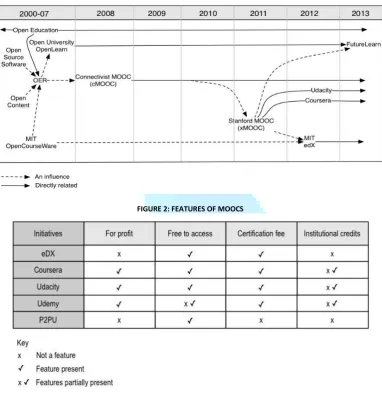
FIGURE 2: FEATURES OF MOOCS
Source: Yuan and Powell
Some experts feel that MOOC’s at present are mainly Branding and marketing tools for the Universities, as the courses are not of the rigid pedagogy associated with formal courses, and the learning experience is not high quality. One must ask however, which University today is High Quality, as Education has become a Business, with US colleges churning out graduates , and especially in India students complete degrees which many recruiters do not even recognize as being of value for their company work.
MOOC’s have the strength of being centres for non-traditional forms of teaching, with learners participating and learning from group discussions and helping each other through networking, and peer assessment.
OPEN SOURCE’ EDUCATION IN INDIA OVER RECENT YEARS
(Note : the word open source refers to accessibility to general public, not necessarily internet related courses as open source MOOC’s are nowadays.) IGNOU: It was the earliest mass education institution catering to all parts of India via distance/correspondence education
On line TV Doordarshan programmes: TV programmes beamed over national channel Doordarshan at certain hours where students could view clas room lectures. These were often in conjunction with IGNOU courses.
Satellite TV programmes: made use of by private players in the field of distance education and some private universities.
VOLUME NO. 5 (2015), ISSUE NO. 10 (OCTOBER) ISSN 2231-5756
INTERNATIONAL JOURNAL OF RESEARCH IN COMMERCE, IT & MANAGEMENT
FIGURE 3: MARKET DISRUPTION TENDENCY OF MOOC’s
FIGURE 4: MAPS OF STRATEGIES
INCORPORATING MOOC’s INTO INDIAN CURRICULA
Several players at the high end are already on the Indian Scene. Manipal University, KSOU, NPTEL and others mainly in Management are offering distance education with a net component. None are free, except the highly technical NPTEL’s, and some courses by IIT on EDX. The Doordarshan has educational programmes on TV which come on at certain times, and are linked to IGNOU programmes, whereas VTU and other Universities have satellite based tutorials which are beamed to campuses. These are not open source, and one has to be registered as a student to get access through campus viewing centers. Use of Internet and availability of high bandwidth Internet is essential for comfortable access and viewing online content is necessary for such use.
Considering the wide use of smart phones and tablets even among rural populace, it does not seem out of place to suggest that on line programmes could be made available through the media of the mobile tablet. Mobile networks have managed to appropriate large portions of spectrum and get bandwidth for video calls which translate into better internet access. Education content providers can make use of this feature.
CONCLUSIONS
VOLUME NO. 5 (2015), ISSUE NO. 10 (OCTOBER) ISSN 2231-5756 combines. The next generation of leaders is still in school, and would be making world impacting decisions in the next decade. A global consensus and effort is thus required.
REFERENCES
1. Bhagat LN and Oraon A, (2014)“Education for Sustainable Development: A Study of Actions, Achievements and Challenges with reference to School Education
in India”, http: dise.in
2. Bhoi,Dhaneswar,(2013), “Remapping Sustainable Educational Development in the Global Economy with the Emergence of Private Stakeholders in India”,
Open Access Scientific Reports, http://dx.doi.org/10.4172/scientificreports673//
3. Buela Johnson(2013): Involvement of students in Quality Enhancement of Higher Educational Institutions, p157,SAMS Bangalore, Excel Publishers, N Delhi
4. Centre for Environment Education, 2005, “Decade of Education for Sustainable Development - Taking it Forward Together; Inputs from the International
Conference 'Education for a Sustainable Future'”, Centre for Environment Education, Ahmedabad, India, 18-20 January, 2005
5. Chhokar, Kiran B., Mamata Pandya and Meena Raghunathan (Eds.), 2004 Understanding Environment; Sage Publications, New Delhi
6. Grossman GM and Kruger AB, “Environmental impacts of a North American Free Trade Agreement”, in Garber P (Ed), The US Mexico Free Trade Agreement,
Cambridge Press, MIT, 1993
7. GUNI (2006) Higher education in the world 2006, Palgrave, Macmillan, New York, USA
8. http://www.pdfebooksdownloads.com/wced-past-papers-business.html
9. Joshi, Madhavi and Shivani Jain, 2005,South Asia - Sub-regional Overview In "A Situational Analysis of Education for Sustainable Development in the
Asia-Pacific Region; UNESCO, Bangkok
10. Li Yuan and S.Powell (2013) MOOC’s and Open Education:Implications for higher Education, http://publications.cetis.ac.uk/2013/667
11. Matsura K, in “Training Guidelines on Incorporating Education for Sustainable Development (ESD) into the curriculum”, UNESCO 2014
12. Mehta AC (July 2006) Elementary Education in India,((Analytical Report 2004-05),National Institute of Education Planning and Administration, New Delhi
13. MHRD (2001) Sarva Shiksha Abhiyan, A Framework for Implementation, 2001, Dept of Elementary Education and Literacy, GOI, Nre Delhi
14. MHRD (2008) Ministry of Human Resource Development Report, New Delhi, India.
15. Nagoya Declaration: UN, http:// wwwic-linkage.com/gov/hesd/declaration.html.
16. Planning Commission, Government of India, 2001, Approach paper to the Tenth Five Year Plan (2002-2007)
17. Sadiq Basha PM, 2013): Involvement of students in Quality Enhancement of Higher Educational Institutions, p148,SAMS Bangalore, Excel Publishers, N Delhi
18. Sarangi SP,(2013): Involvement of students in Quality Enhancement of Higher Educational Institutions, p122,SAMS Bangalore, Excel Publishers, N Delhi
19. Sharma AP (2005) Privatizing Professional Education: With Reference to India and United States. University News 43: 10-15.
20. UNFPA, 2003,Missing... Mapping the Adverse Child Sex Ratio in India
21. United Nations (2002) Report of the World Summit on Sustainable Development, Johannesburg, South Africa.
22. Vargas Hernandez (2013): Involvement of students in Quality Enhancement of Higher Educational Institutions, p6,SAMS Bangalore, Excel Publishers, N Delhi
VOLUME NO. 5 (2015), ISSUE NO. 10 (OCTOBER) ISSN 2231-5756
INTERNATIONAL JOURNAL OF RESEARCH IN COMMERCE, IT & MANAGEMENT
INTERLINKAGE BETWEEN FUND OF MUTUAL FUNDS RETURNS AND GDP IN THE INDIAN ECONOMY
M. GOWRI
DEPARTMENT OF COMMERCE
PONDICHERRY UNIVERSITY
PUDUCHERRY
MALABIKA DEO
PROFESSOR
DEPARTMENT OF COMMERCE
PONDICHERRY UNIVERSITY
PUDUCHERRY
ABSTRACT
The Mutual Fund Industry has been growing rapidly in India with enlarged pooled funds that allowed the sector to participate actively in portfolio investments. It reflects possible growth prospect which gained much attention from the investors. The present study intends to examine the existence of a causal relation between the fund of mutual fund returns and GDP of the Indian economy. The investigation is done by using Johansen co-integration test for finding long-run relationship between the Fund of Mutual Fund returns and the GDP, and the Granger causality test based on the Vector Error Correction Model (VECM) for short-run relationship between these two variables to demonstrate the casual relationship. The data are collected from AMFI websites and respective AMC websites, from April 2007 to March 2014. The results displayed sufficient evidence to support long-run relationship between FOFs returns and the GDP. We found that all the five schemes of Fund of Mutual fund return and the GDP are interlinked and it was bidirectional for four out of five funds studied, only in case of Birla SL FOF was unidirectional from asset allocator to GDP. The findings suggest that the FOFs cause effective financial intermediation to generate long term saving to finance investment and that eventually could strengthen the country.
KEYWORDS
fund of mutual funds , schemes returns, GDP, stationaity, co-integration, VECM, causality.
INTRODUCTION
und of funds are particular investment vehicles to invest in more than two mutual funds. Ordinarily, it holds many funds in it. Globally, several FOFs pick breed of funds from across different fund houses and put them into one. These are called multi-managers fund of funds. Mutual fund industry is experiencing rapid growth in the form of fund of funds. These funds distinguish themselves by investing in shares of other mutual funds rather than buying individual securities. Fund of Funds are classified into four as Fund of mutual funds, Fund of hedge funds, Fund of exchange traded fund and Real estate fund. Investment in FOFs can be beneficial for retail and institutional investors due to the distinct features of this financial product. With FOFs, the retail investors can easily get exposure to sectors, asset classes, markets, and products which is otherwise not permissible easily. FOFs pool money from large diverse investor, and invest in assets that demand high minimum investments or that offer discounts to costs or loads, management fees. Retail investors do not have access to sophisticated data systems or information system and even if such access are at disposal, retail investors may find it difficult to appropriate investment decisions. The large and growing Fund of mutual funds have attracted majority of capital in FOFs. Intensive diversification benefits are another beneficial aspects of all FOFs. Fund of mutual funds deliver precious service to the investors by screening the mutual fund market, performing due diligence process, in selecting the most correct investment decisions.
Fund of Funds provide an efficient solution to the challenge of investing in mutual funds. Indeed, they have become the most common means of access for investors who are looking for diversified exposure to mutual funds, but who do not have the resources to research, monitor, and manage multiple mutual funds. The FOFs manager has two functions: One is to seek out investors, educate them on the investment benefits, accumulate the assets from investors, and report on and explain investment activities and performance: The second is to follow the mutual fund industry, determine strategy weightings, conduct due diligence, and select individual fund that are expected to outperform. A portfolio manager uses his or her experience and skill to select the best underlying funds based on past performance and other factors, and if the portfolio manager happens to be smart and talented, this can increase the return potential and decrease the risk potential of FOF.
For years researchers have attempted to analyse the relationship between the stock market and GDP. The stock prices reflect the profitability potential and profitability is assumed to be linked with economic activities. The individual investors do not always anticipate correctly the stock returns. Sometimes it moves in some unanticipated direction of the economy. Thus linking FOFs return and the economy represented by GDP makes sense for the investors so that they can anticipate their returns based on the GDP movements.
Two things that support the behaviors of the stock market predictability: One is when the stock market rises the investors are willing to purchase more, so the economy expands. On the other side with the stock market decline, the investors spend less, so the economic growth automatically decreases. On these behavior suggest that the stock market predict economy, although it can be argued that the causations are different if economy grows investments expands stock market goes up, with decline of economy stock market falls