A COMPUTER PROGRAM FOR SHORT CIRCUIT ANALYSIS OF ELECTRIC
POWER SYSTEMS
BY
G.C. EJEBE
DEPARTMENT OF ELECTRICAL/ELECTRONIC ENGINEERING UNIVERSITY OF NIGERIA, NSUKKA.
(Manuscript received 23rd May 1980 and in revised form 10th October 1980)
ABSTRACT
This paper described the mathematical basis and computational framework of a computer program developed for short circuit studies of electric power systems. The Short Circuit Analysis Program (SCAP) is to be used to assess the composite effects of unbalanced and balanced faults on the overall reliability of electric power system.
The program uses the symmetrical components method to compute all phase and sequence quantities for any bus or branch of a given power network resulting from the application of balanced and unbalanced faults at any location of the system. The Key to the efficient computer implementation of this program is the utilization of the triangular factorization of the positive and zero sequence admittance matrices, thus avoiding the time consuming direct formation of the sequence impedance matrices.
INTRODUCTION
The purpose of short circuit analysis of power systems is to assess the vulnerability of the system to abnormal conditions resulting from a partial or complete breakdown of insulation at one or more points of the system. Specifically in short circuit studies, the power system network is subjected to postulated fault conditions and the resulting faulted network is solved to determine the phase (and sequence) voltages, currents and power of any bus or transmission line of the system. From this analysis, the power system engineer determines the maximum and minimum currents that are likely to result from any of the array of available fault conditions such as – single line to ground fault (S – L – G fault), double line to ground fault (L – L – G fault), line – to – line fault (L – l fault), or a three – phase fault.
It is pertinent to state that the information obtained from short circuit analysis is an effective tool for use in areas of power system work such as system
the foregoing, it is obvious that the need for a reliable short circuit analysis of the power system cannot be over-emphasized. While many conventional fault programs are limited to output of phase quantities in the close neighbourhood of the fault point, the program presented here provides for computation of sequence and phase voltages and currents at all points in the power network. The mathematical basis, program framework and computational procedure as well as an example of its application are presented.
GENERAL PROGRAM DESCRIPTION
As it is usual in most short circuit studies, some basic assumptions are made to facilitate the computational task of fault analysis. These basic assumptions are as follows [1]
(i) All load currents are negligible.
(ii) All generated voltages are equal in phase and magnitude to the positive sequence pre-fault voltage.
(iii) The networks are balanced except at the fault points. (iv) All shunt admittances (line
charging susceptance, etc.) are negligible.
These basic simplifications have not been made in developing the program. Specifically the program developed includes explicit treatment of:
(a) Resistance, reactance and charging susceptance of all transmission branches.
(b) Loads represented as shunt admittances to ground.
(c) Generator internal voltage are set at actual magnitudes and phases as computed by a base case load flow.
In order to save computer storage, the program assumes that the positive and negative sequence networks are identical, and hence only one is stored.
The solution of power system networks under fault conditions requires the elements of the
driving point impedance matrix Z. Presently, two approaches [2] have been developed for obtaining the driving point impedance (or short circuit impedance) matriz Z. The first approach employs a building algorithm [2] for the direct formation of the impedance matrix. However this method has been found to be more difficult and time consuming. The second approach first forms the power system bus admittance matrix Y and then inverts this matrix to obtain the driving point impedance matrix Z. Conventionally to obtain the inverse of the admittance matrix, Gaussian elimination or Crout's method [3] are used. However these techniques require all elements of the admittance matrix throughout the execution. The program described here, makes use of matrix triangular factorization which today is widely applied as one of the powerful analytical tools, especially to load flow problems [4]. In this method, the admittance matrix is first formed and stored in a sparse triangular factored form, from which the short circuit impedance matrix is obtained by backward substitution.
PROGRAM DEVELOPMENT
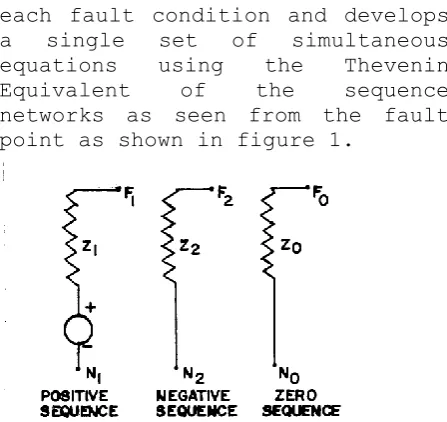
each fault condition and develops a single set of simultaneous equations using the Thevenin Equivalent of the sequence networks as seen from the fault point as shown in figure 1.
Fig. 1. Sequence Networks.
The solution of these equations for the sequence voltages is achieved in terms of the impedance matrices of the sequence networks as shown in the Appendix. The impedance matrices Z11 ,Z22 and z00
are fully populated, and hence for a large system, they would require considerable amount of computer storage, and as stated earlier their direct formation is inefficient in terms of computer time. To save computer storage, this program assumes that the positive sequence impedances Z11
and the negative sequence Impedance z22 are equal and
provides only one set of positive sequence data. Furthermore the development of the short circuit analysis program, SCAP, recognizes that the impedance matrices Z11
and z00 are the inverses at the
conventional bus admittance matrices Y22 and Y00. These
admittance matrices are sparsely populated and are easily formed and handled with excellent storage and time efficiency, using optimal ordering to preserve sparsity /4/ during manipulations. To obtain elements of the sequence impedance matrices for fault analysis, triangular factorization of the admittance matrices is carried out.
FACTORIZATION OF THE ADMITTANCE MATRIX
The admittance matrix Y of the power system network is a non- singular matrix, which can be uniquely factored into the following three matrices [8]:
Y = L D U
Where
L is a unit lower triangular matrix
D is a diagonal matrix
U is a unit upper triangular matrix
In fact, for a power system without phase shifting transformers, the Y matrix will be symmetric and hence there is no need to store the U matrix, since U will be the transpose of the L matrix. Thus, for a 4-bus system, the matrices become:
[ ] [ ]
Each term of the factored matrices can be successively determined as follows:
diagonal matrix:
dii = yii – ∑ (2)
for i=1,2,…,n
lower triangular matrix:
( ∑ ) (3)
for i = 2,3 … n and j = 1.2 … (i - 1)
where yij, yii are elements of the
admittance matrix
FORMATION OF SHORT CIRCUIT
IMPEDANCE MATRIX Z
The driving point impedance (or short circuit impedance matrix Z is
derived from the equation:
Y Z = I (4)
Replacing the admittance matrix by its factors we have:
L D Lt Z = I (5)
If we define a transition matrix G by
G = [L D]-1 = (6)
then since L-1 is a lower
triangular matrix and. D-1 is a
diagonal matrix, the transition matrix G is also a lower triangular matrix with its diagonal terms given by:
; i=1, 2, …, n (7)
Furthermore we define a transfer matrix,
T = I - Lt (8)
which is a strictly upper triangular matrix with zero diagonal terms.
Substituting equations (8) and (6) into (5), a simplified expression for the impedance matrix Z results as follows:
Z = G + T Z (9)
The simplification is now briefly illustrated by a 4-bus system, recalling that Z is symmetric we note that [ ] [ ]
applying equation (9) we obtain successively:
Z44 = g44
Z34 = t34 Z44
Z33 = g33 + t34Z43
Z24 = t23z33 + t24Z43
Z23 = t23Z33 + t24Z43
Z22 = g22 + t23Z32 + t24Z42
(10)
Z14 = t12Z24 + t13Z34 + t14Z44
Z13 = t12Z23 + t13Z23 + t14Z43
Z12 = t12Z22 + t13Z22 + t13Z32 + t14Z43
Z11 = g11 + t12Z21 + t13Z31 + t14Z41
The expressions of equation (10) indicate that the elements of the impedance matrix Z can be obtained by backward substitution. It is to be noted that only the diagonal terms of the transition matrix G which are the reciprocal of the corresponding terms of the diagonal matrix factor D of the admittance matrix are needed from the transition matrix.
COMPUTATIONAL PROCEDURE
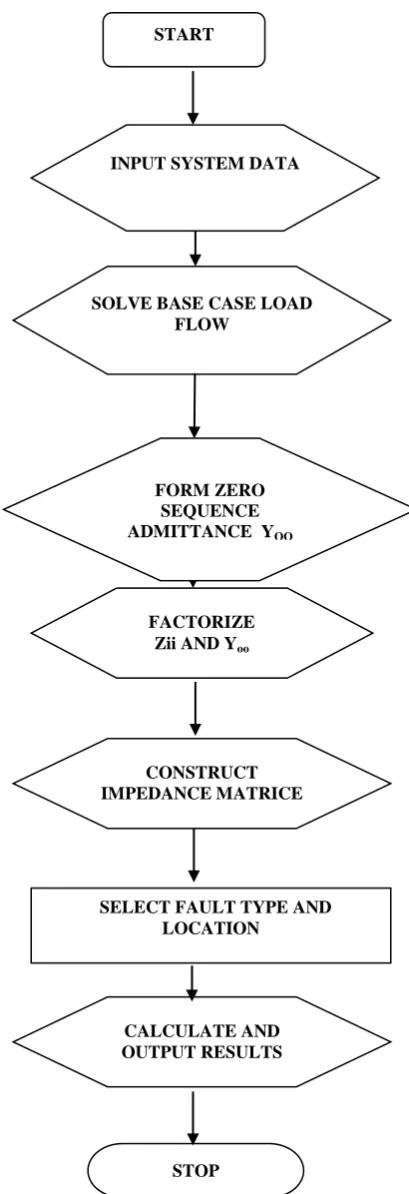
Step 1: Base Case Load Flow
Prior to the short circuit solution, a base case ac load flow of the system is performed. In the SCAP routine developed, the base ac
load flow may be executed by any of the Gauss-Seidel,
Newton-Raphson or the Stott's Fast Decoupled load flow methods (2) at the option of the user. The program first reorders the bus numbering to facilitate the formation of both the sparse positive sequence and the sparse zero sequence admittance matrices.
Step 2: Formation of Sequence Admittance Matrices.
The positive sequence admittance matrix Y11 is formed during the
base case load flow solution and is available at this point. Hence only the zero sequence admittance matrix Yoo is formed here.
Step 3: Triangular Factorization of Sequence Admittance Matrices
First the positive sequence admittance matrix Y11 is
decomposed into its lower and diagonal factors L11 and D11 using
the expressions of equations (3) and (2). Then the zero sequence admittance matrix Yoo is
factorized and stored. Since the admittance matrices are symmetrical, only the diagonal factors and the lower off – diagonal Clements are stored.
Step 4: construction of Sequence Impendence Matrices.
The elements of the positive sequence impendence matrix Z11 and
the zero sequence Zoo are now
formed from the factors of step 3 according to equation (9)
Step 5: Selection of fault type and location.
The specified fault type and location is now applied to the system and thereby the inter sequence connection selection selected. The program used has the option of specifying any of four common fault types S – LG, L – L, L – L – G and three phase fault at any bus location of the system.
Step 6: Calculation and output of Post Fault Quantities.
Using the appropriate inter sequence connection for the specified fault type at the specified bus location, the INPUT SYSTEM DATA
START
SOLVE BASE CASE LOAD FLOW
FACTORIZE Zii AND Yoo
CONSTRUCT IMPEDANCE MATRICE
ZII & ZOO
CALCULATE AND OUTPUT RESULTS SELECT FAULT TYPE AND
LOCATION
STOP
Fig. 2. Flow chart of computational procedure. FORM ZERO
SEQUENCE
program solves and computes the output conditions at the fault buses. At the option of the user, the program can also output any bus voltages in phase or sequence coordinates, transmission line currents, and transmission line complex power for the entire system.
EXAMPLE APPLICAION
For an example of the program's application the 6-bus system of Ward and Hale [7] shown in Fig.3 is considered for two common faults; a S-L-G, and a three-phase fault at different buses of the system. The system data includes
load data, and line shunt
susceptance in addition to the line, transformer and generator impedances. The line impedance data is given in per unit on a
system base of 100 MVA in Table 1.
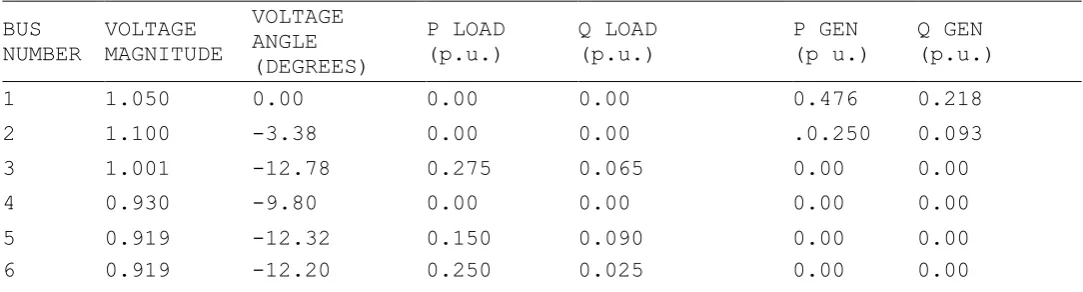
The bus load data with bas case load flow voltages are given in Table 2.
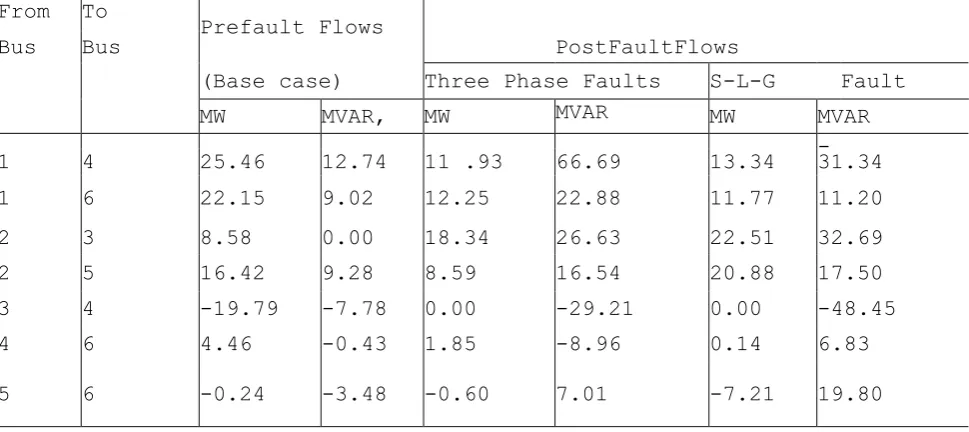
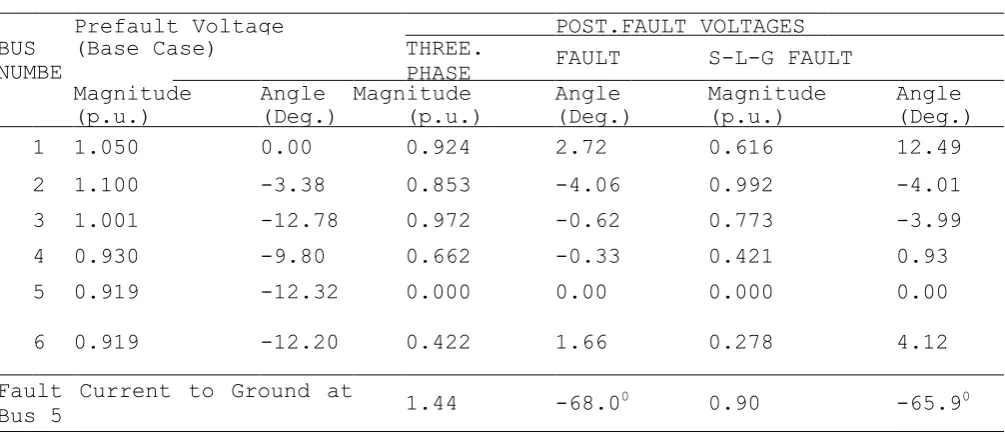
The computer results of the fault study in terms of the post fault
bus voltages and transmission
circuit flows are compared against
the corresponding prefault
quantities for the S-L-G and three- phase faults at buses 3 and 5 are shown in Tables 3 and 4 and
Also shown are the fault current to ground of the faulted buses. Fig. 4 shows a sample of the computer printout showing the sequence components of bus voltages and line currents for a S-L-G fault at buses
SEQUENCE IMPEDANCE ZERO SEQUENCE FROM TO POSITIVE
BUS BUS RI (p.u.) X1(p.u.) B(p.u.) RO(p·u.) XO(p·u.)
1 4 0.160 0.740 0.014 0.00 0.266
1 6 0.246 1.036 0.0198 0.00 0.600
2 3 1.446 2.100 0.000 0.800 1.850
2 5 0.564 1.280 0.000 0.984 2.084
3 4 0.000 0.266 0.000 3.780 5.260
4 6 0.194 0.814 0.0152 2.820 3.840
5 6 0.000 0.600 0.000 0.900 2.060
1 Gene- rator 1 0.020 0.240 0.000 0.000 0.0320
2 Gene- rator 2
TABLE 2l Bus Data:
BUS NUMBER
VOLTAGE MAGNITUDE
VOLTAGE ANGLE (DEGREES)
P LOAD (p.u.)
Q LOAD (p.u.)
P GEN (p u.)
Q GEN (p.u.)
1 1.050 0.00 0.00 0.00 0.476 0.218
2 1.100 -3.38 0.00 0.00 .0.250 0.093 3 1.001 -12.78 0.275 0.065 0.00 0.00
4 0.930 -9.80 0.00 0.00 0.00 0.00
Table 3: Bus Voltages for Fault at Bus 3:
TABLE 4: transmission Branch Flows for Faults at Bus 3 POST FAULT VCLTAGES
BUS PREFAULT VOLTAGES THREE·
PHASE FAULT S--L-G FAULT
NUMBER Magnitude Angle Magnitude Angle Magnitude Angle
(p. u.) (Deg.) (p. u.) (Deg.) (p, u.) (Deg.)
-
1 1.050 0.00 0.856 2.97 0•712 3.59
2 1.100 -3.38 0.908 -4.50 1.006 -3.89 3 1.001 -12.78 0.000 0.00 0.000 0.00 4 0.930 -9.80 0.253 8.07 0.359 -7.24 5 .0.919 -12.32 0.622 -6.19 0.687 -18.01
6 0.9191 12.20 0.541 -5.59 0.518 -11.04
Fault current to Ground at
Bus 3 1 .51, -65.4 0.98 -65.8
From To
Prefault Flows
Bus Bus PostFaultFlows
(Base case) Three Phase Faults S-L-G Fault MW MVAR, MW MVAR
MW MVAR - ,
1 4 25.46 12.74 11 .93 66.69 13.34 31.34
1 6 22.15 9.02 12.25 22.88 11.77 11.20
2 3 8.58 0.00 18.34 26.63 22.51 32.69 2 5 16.42 9.28 8.59 16.54 20.88 17.50 3 4 -19.79 -7.78 0.00 -29.21 0.00 -48.45 4 6 4.46 -0.43 1.85 -8.96 0.14 6.83
Table 5: Bus Voltages for Fault at Bus 5:
Prefault Voltage POST.FAULT VOLTAGES BUS (Base Case) THREE.
PHASE FAULT S-L-G FAULT NUMBE
R
Magnitude Angle Magnitude Angle Magnitude Angle (p.u.) (Deg.) (p.u.) (Deg.) (p.u.) (Deg.) 1 1.050 0.00 0.924 2.72 0.616 12.49
2 1.100 -3.38 0.853 -4.06 0.992 -4.01 3 1.001 -12.78 0.972 -0.62 0.773 -3.99 4 0.930 -9.80 0.662 -0.33 0.421 0.93 5 0.919 -12.32 0.000 0.00 0.000 0.00
6 0.919 -12.20 0.422 1.66 0.278 4.12
Fault Current to Ground at
Bus 5 1.44 -68.00 0.90 -65.90
TABLE 6: transmission Branch Flows for Faults at Bus 5
POST FAULT FLOWS
FROM TO
Prefault Flows
(Base Case) THREE PHASE FAULT S-L-G FAULT BUS BUS
MW MVAR MW MVAR MW MWAR
1 4 25.46 12.74 15.05 29.26 10.21 14.48
1 6 22.15 9.02 10.70 41.29 6.83 18.30
2 3 8.58 0.00 3.37 2.99 4.82 7.03
2 5 16.42 9.28 20.97 47.59 28.37 64.39
3 4 -19.79 -7.78 -11.62 -1.03 24.36 100.37
4 6 4.46 -0.43 1.64 18.87 0.91 7.06
CONCLUSIONS
The mathematical development and computational procedure for a computer program for short circuit analysis of power systems has been described. The efficient computational implementation of the procedure is based on triangular factorization of the sequence admittance matrices of the power network and the construction there-from of the sequence impedance matrices. The program employs the symmetrical component inter sequence connections to model any of the four common types of faults; and solves to compute phase or sequence quantities of any bus or transmission circuit of a given power network.
The program as presently implemented can only handle any of the
four common faults applied singly at any bus of the system. Further work is continuing to enhance the program to handle simultaneous application of at least any two of these faults at, any combination of system buses, bearing in mind that simultaneous faults may be represented by applying their appropriate inter sequence connections
simultaneously.
APPENDIX
MATHEMATICAL REPRESENTATION OF TWO COMMON FAULTS
A.1 Single Line-to Group (S-L-G) Fault.
To illustrate the mathematical formulation and solution of the common faults, a four bus system in which the short circuit matrices
for each of the positive sequence, negative sequence and zero sequence networks have been obtained is used. The notation used is as follows:
NOTATION:
Vk+ = positive sequence voltage at
bus k
Vk- = negative sequence voltage at
bus k
Vko = zero sequence voltage at bus
k
Zkk+ = K-th diagonal element of
positive sequence impedance matrix.
Zki+ = k-i off-diagonal element of
positive sequence impedance matrix.
Zkk0 = K-th diagonal element of
zero sequence impedance matrix. Zki0 = k-i off-diagonal element of
zero sequence impedance matrix. Vko = Prefault (base case ) bus
voltage at bus k (for phase “a”) Vk = post fault bus voltage at bus
k
Iaf = fault current in phase “a”
to ground
The intersequence network for the S-L-G fault is solved for the sequence voltages and currents. For any bus k, the sequence voltages are Obtained for the case where bus I is faulted to ground from the equations:
(A1) (A2) (A3)
The Phase “a” voltage at bus K is obtained from the equation:
Vk = Vk+ + Vk- + Vk0 (A4)
Hence substituting (A1), (A2) and A (A3) into (A4)yields,
(A5)
The fault current to ground of phase “a” at bus 1 is given by:
(A6)
A. 2: LINE-TO-LINE (L-L) FAULT
Fig. A2 shows the inter sequence connection for a line-to-line fault
at bus I; in which only the positive sequence and negative sequence net- works are connected in series.
Fig.A2. Intersequence network for L-L fault at Bus 1
Sequence voltages are given at bus k by:
(A7)
(A8)
Using the synthesis equation of (A4) the phase “a” voltage at bus k is given by:
(A9)
REFERENCES
1. Anderson, P.M., Analysis of Faulted Power Systems, Iowa State University Press,. Ames, 1973
2. El-Abiad, A.H. and Staff, G.W. Computer Methods in Power Systems Analysis, McGraw- Hill, New York, 1963.
4. Ogbuogbiri, E.C. et al "Sparsity-Directed
Decomposition for Gaussian Elimination of Matrices", IEEE Transactions on Power Apparatus and Systems, Vol. PAS 89, No.1, January 1968, pp. I 4 I -I 49 .
5. Electrical Transmission and Distribution Reference Book, Westinghouse Corporation East Pittsburgh, 1964.
6. Tinney, W.F. and Hart, C.E., "Power Flow Solution by Newtons Method", IEEE
Transactions on Power Apparatus & Systems, Vol.PAS 86; No.11, Nov.1967, pp , 1449-1456.
7. Ward, J.B. and Hale H.W., "Digital Solution of Power Flow Problem" Trans. A.I.E.E., 75 pp.398-404, 1956.
8. Takahashi, K. et al, "Formation of A Sparse Bus Impedance