Please cite this article as: F. Rouhiolyaee, S. B. Ebrahimi, M. Nezhad Afrasiabi, Utilizing Decision Making Methods and Optimization Techniques to Develop a Model for International Facility Location Problem under Uncertainty, International Journal of Engineering (IJE), TRANSACTIONS A: Basics..Vol. 29, No. 1, (January 2016) 68-77
International Journal of Engineering
J o u r n a l H o m e p a g e : w w w . i j e . i rUtilizing Decision Making Methods and Optimization Techniques to Develop a
Model for International Facility Location Problem under Uncertainty
F. Rouhiolyaeea, S. B. Ebrahimib*, M. Nezhad Afrasiabic
a Department of Industrial Engineering, Iran University of Science and Technology, Tehran, Iran b Department of Industrial Engineering, K.N.Toosi University of Technology, Tehran, Iran c Department of Industrial Engineering, K.N.Toosi University of Technology, Tehran, Iran
P A P E R I N F O
Paper history:
Received 09 August 2015
Received in revised form 16 December 2015 Accepted 24 December 2015
Keywords:
International Facility Location Multi-Criteria Decision Making (MCDM) Covering Techniques
Uncertainty
A B S T R A C T
The purpose of this study is to consider an international facility location problem under uncertainty and present an integrated model for strategic and operational planning. The paper offers two methodologies for the location selection decision. First, the extended VIKOR method for decision making problem with interval numbers is presented as a methodology for strategic evaluation of potential countries based on international economic indicators available in the Global Competitiveness Report. Then, regarding these assessments and several quantitative factors, a set covering multi-objective optimization model is presented to consider additional operational criteria in decision making process. An efficient approach for location finding and a novel application of combined VIKOR and global criterion methods can be considered as the main contributions of this paper. Incorporating the theories of international economics in Operations Research models is another contribution of the paper.
doi: 10.5829/idosi.ije.2015.29.01a.10
Parameters
Left and right bounds of construction associated with choosing
location i Possible decision i
Left and right bounds of (output of phase 2) Decision maker j
Left and right bounds of production capacity of location i the rating of alternative with respect to criterion
Left and right bounds of demand of destination j Interval i
Distance between origin i and destination j the weight of criterion
Covering matrix; Is equal to 1 if the distance between origin i and
destination j is less than the covering radius; otherwise, 0. Variables
R Covering radius Binary variable that is equal to 1 if the feasible country i is suitable for locating facility; otherwise, 0.
v weight of the strategy Binary variable for allocation i to j
1. INTRODUCTION
In recent years, we have witnessed greater political and economic world. As a result, a new business freedom in many regions of the landscape has emerged characterized by globalization of business activities and intensified competition. It can be found that companies in developed countries are establishing facilities in countries with better potential conditions in order to reduce their production costs while maintaining or even improving quality attempting to survive in the global business scene. In their attempts to enter foreign markets, firms confront major issues including identification several alternatives of the countries that best serve the firm’s strategic and operational objectives.
So, International facility location problems can be considered as an extension of the facility location problem. Therefore, in international facility location problems, facilities can be located in different countries which are operating in different environments (labor costs, tariffs, taxes, government incentives, exchange rates, political risks, inflation rates, demand changes, etc.) and catering customers within the same country and other countries as well [1].
The site selection process in international context is a complex decision and stems from factors that have to be taken into account in order to reach an optimal decision. Country-specific factors such as exchange rate variability, different interest rates, availability of loanable funds and differences in economic incentives are some major sources of the mentioned complexity. This complexity has caused researchers to use few international factors and their objective function is not suitable or real to cover the problem. For example, they investigate the international facility location problem in a deterministic environment which is unreal.
Here, we mention some of these problems. The factors such as production inputs and proximity to markets, that can be quantified and measured, are incorporated within a mathematical model. For example, Pomper [2] investigated the problem as a capital budgeting problem and adopted a dynamic programming approach to solve it. Jucker [3] used a break-even analysis approach and Hodder and Jucker [4] utilized a quadratic programming approach to the international facility location problem. Naik and Chakravarty [5] used fuzzy set theory for international site selection problem. Canel and Khumawala [1] presented a modelling approach using Mixed-Integer Linear Programming (MILP) to investigate the international facility location problem in a deterministic environment, assuming that all costs, prices, demand, etc. are deterministic. In their paper, they presented a detailed exposition of various factors to be considered in the location of manufacturing facilities. Syam [6]
discussed a Multi-period Capacitated Location (MCL) problem and investigated capacity expansion issues in overseas markets. He adopted a heuristic based upon Lagrangian relaxation to solve the MCL problem. The author considered production variables (labour and manufacturing costs), transportation costs, capacity of the facility, and the number of facilities. The paper dealt exclusively with capacity expansion issues without considering distribution or investment and also did not consider any international trade factors. Verter [7] investigated the facility and capacity decisions incorporating the impact of technology acquisition in the global firm. The author set up the model as a cost minimization formulation and then solved the model using a progressive piecewise linear underestimation algorithm. The model did not include factors such as exchange rates and tariff costs. Hamad and Gualda [8] proposed a MILP model that solved the international facility location problem through minimization of the total logistic cost. Main contribution of the model was the pioneer carrying cost calculation. Vahdani et al. [9] proposed a compromise model, based on a new method, to solve the multi-objective large-scale linear programming problems with block angular structure involving fuzzy parameters. But they did not indicate two major factors effective in objective function.
By applying the combinational approaches, some studies have tried to consider both qualitative and quantitative factors involved in international facility selection process simultaneously. Hoffman and Schniederjans [10] presented a two-step model for international facility location and used the goal programming approach, but many qualitative factors were ignored. Kaboli et al. [11] presented a holistic approach of the MCDM methodology to select the optimal location(s), which fits best for both investors and managers. Tavakkoli-Moghaddam et al. [12] present a novel multi-objective mathematical model for capacitated single allocation hub location problem, and due to NP-Hard property of their problem, the model is solved by a multi-objective imperialist competitive algorithm (MOICA). Badri [13], proposed the use of analytical hierarchy process and multi-objective goal
programming methodology as aids in making
[15] investigated two qualitative factors (environmental friendly materials and using clean technology) in a closed-loop supply chain network under uncertain demand and return. Bogataj et al. [16] have studied some aspects of activity cell locations in an extended MRP model, extended by distribution and reverse logistics components in a compact form, cf. [17]. They have presented the importance of knowing the time delay due to transportation and congestions. Tavakkoli-Moghaddam et al. [18] proposed a robust optimization approach to design a dynamic cellular manufacturing system (DCMS) under uncertainty of processing time of products. In addition, a mathematical model considering cell formation, inter-cell design and production planning under a dynamic environment (i.e., product mix and demand are changed in each period) is presented. Das [19] introduced a new approach for modelling four types of SC flexibility measures and integrating said measures into the strategic SC decision making process. Bashiri et al. [20] developed a MILP model for the design and expansion planning of a four echelon dynamic production–distribution network in which different resolutions for strategic and tactical decisions are considered based on the main concepts and definitions of strategic and tactical planning in supply chain management. But they haven’t considered some financial aspects such as loan management in the expansion planning of supply chain. Badri et al. [21] proposed an integrated strategic and tactical planning in a supply chain network design with a heuristic solution method. By their proposed model some decisions such as supplier selections, production facility locations, warehouse locations, the amount of raw materials to be supplied from each supplier and the amount of each product to be produced at each facility can be made. In their proposed model, the expansion of a supply chain is planned according to the cumulative net profit and funds supplied from external sources. Tavakkoli-Moghaddam et al. [22] integrate two decision making methods, namely AHP and VIKOR, in order to make the best use of information available, either implicitly or explicitly.
Although the prices, tax rates, demands, etc. are highly volatile in international environment, unfortunately the above mentioned combinational studies have not included these uncertainties in their models. As mentioned before most of studies have used simple assumptions like few factors related to international facility location and didn’t have considered uncertainty in their model. In other words, as Lee and Wilhelm [23] pointed out, none of these studies have incorporated theories of international economics. While, prior OR/MS1 models have addressed a range of traditional factors, none has explicitly incorporated the
1Operations Research/ Management Science
theories of international economics (i.e. comparative advantage, competitive advantage and the competitiveness of a country including Porter’s Diamond explanation of competitive advantage) and related (individual) indicators (i.e. measures) from annual competitiveness reports. A host of indicators (i.e. measures) related to these theories is published in annual competitiveness reports that provide a wealth of information that might potentially be used to enhance strategic planning, including the Global Competitiveness Report (GCR) of the World Economic Forum (WEF).
Based on the mentioned gaps in the literature, in this paper, we are concerned with the issue of the identification of the countries that best serve the firm’s strategic and operational objectives. The rest of the paper is organized in the following manner: Section 2 is dedicated to describing the proposed methodology. The case study and computational results are discussed in Section 3. Finally, in section 4, conclusions are discussed.
2. METHODOLOGY
The paper offers two methodologies for the location selection decision. First, the extended VIKOR method for decision making problem with interval numbers is presented as a methodology for strategic evaluation of the potential countries based on international economic indicators available in GCR. Second, regarding these assessments and some quantitative factors, a set covering multi-objective optimization model is presented to consider additional operational criteria in decision making process.
We present our methodology in 3 phases including followings:
2. 1. Phase 1. Determining the Attributes that
Influence the Utility of Countries In this
2. 2. Phase 2. Using Appropriate MADM Technique (VIKOR Method) to Assess the Utility of the Alternatives (Countries) which Are Potentially Suitable for Locating Facilities
In this phase, we use the interval VIKOR technique to determine the interval . In the multi-objective model, which will be presented in the next phase, minimizing the interval will be one of the objective functions of the model and this will guarantee the utility maximization of the selected countries.
2. 2. 1. Extended VIKOR Method for Decision
Making Problem with Interval Numbers The
VIKOR method was introduced as one applicable technique to be implemented within MCDM problem and it was developed as a multi-attribute decision making method to solve a discrete decision making problem with non-commensurable (different units) and conflicting criteria [24]. This method focuses on ranking and selecting from a set of alternatives, and determines compromised solution for a problem with conflicting criteria, which can help the decision makers to reach a final solution.
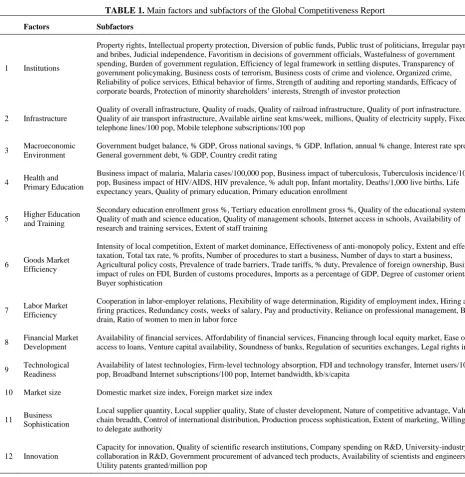
TABLE 1. Main factors and subfactors of the Global Competitiveness Report
Factors Subfactors
1 Institutions
Property rights, Intellectual property protection, Diversion of public funds, Public trust of politicians, Irregular payments and bribes, Judicial independence, Favoritism in decisions of government officials, Wastefulness of government spending, Burden of government regulation, Efficiency of legal framework in settling disputes, Transparency of government policymaking, Business costs of terrorism, Business costs of crime and violence, Organized crime, Reliability of police services, Ethical behavior of firms, Strength of auditing and reporting standards, Efficacy of corporate boards, Protection of minority shareholders’ interests, Strength of investor protection
2 Infrastructure
Quality of overall infrastructure, Quality of roads, Quality of railroad infrastructure, Quality of port infrastructure, Quality of air transport infrastructure, Available airline seat kms/week, millions, Quality of electricity supply, Fixed telephone lines/100 pop, Mobile telephone subscriptions/100 pop
3 Macroeconomic Environment
Government budget balance, % GDP, Gross national savings, % GDP, Inflation, annual % change, Interest rate spread, General government debt, % GDP, Country credit rating
4 Health and Primary Education
Business impact of malaria, Malaria cases/100,000 pop, Business impact of tuberculosis, Tuberculosis incidence/100,000 pop, Business impact of HIV/AIDS, HIV prevalence, % adult pop, Infant mortality, Deaths/1,000 live births, Life expectancy years, Quality of primary education, Primary education enrollment
5 Higher Education and Training
Secondary education enrollment gross %, Tertiary education enrollment gross %, Quality of the educational system, Quality of math and science education, Quality of management schools, Internet access in schools, Availability of research and training services, Extent of staff training
6 Goods Market Efficiency
Intensity of local competition, Extent of market dominance, Effectiveness of anti-monopoly policy, Extent and effect of taxation, Total tax rate, % profits, Number of procedures to start a business, Number of days to start a business, Agricultural policy costs, Prevalence of trade barriers, Trade tariffs, % duty, Prevalence of foreign ownership, Business impact of rules on FDI, Burden of customs procedures, Imports as a percentage of GDP, Degree of customer orientation, Buyer sophistication
7 Labor Market Efficiency
Cooperation in labor-employer relations, Flexibility of wage determination, Rigidity of employment index, Hiring and firing practices, Redundancy costs, weeks of salary, Pay and productivity, Reliance on professional management, Brain drain, Ratio of women to men in labor force
8 Financial Market Development
Availability of financial services, Affordability of financial services, Financing through local equity market, Ease of access to loans, Venture capital availability, Soundness of banks, Regulation of securities exchanges, Legal rights index
9 Technological Readiness
Availability of latest technologies, Firm-level technology absorption, FDI and technology transfer, Internet users/100 pop, Broadband Internet subscriptions/100 pop, Internet bandwidth, kb/s/capita
10 Market size Domestic market size index, Foreign market size index
11 Business Sophistication
Local supplier quantity, Local supplier quality, State of cluster development, Nature of competitive advantage, Value chain breadth, Control of international distribution, Production process sophistication, Extent of marketing, Willingness to delegate authority
12 Innovation
The interval numbers are more suitable to deal with the decision making problems in the imprecise and uncertain environment, because they are representing uncertainty in the decision matrix. The interval numbers require the minimum amount of information about the values of attributes. Specifying an interval for a parameter in decision matrix indicates that the parameter can take any value within the interval [25]. An interval number signifies the extent of tolerance or a region that the parameter can possibly take.
According to these facts, when determining the exact values of the attributes is difficult or impossible, it is more appropriate to consider them as interval numbers. Sayadi et al. [26] extended the VIKOR method to solve MADM problem with interval numbers. Details on this method can be expressed as follows:
Suppose that a decision matrix with interval numbers has the form as in Table 2, where are possible among which decision makers have to choose, criteria with which performance of alternatives is measured, the rating of alternative with respect to criterion and not known exactly; and we only know and is the weight of criterion . The extended VIKOR method consists of the following steps:
(a) Determine the PIS and NIS.
{ }
{ | }
(1)
{ }
{ | }
(2)
where I is associated with benefit criteria, and J is associated with cost criteria. and are PIS and NIS respectively.
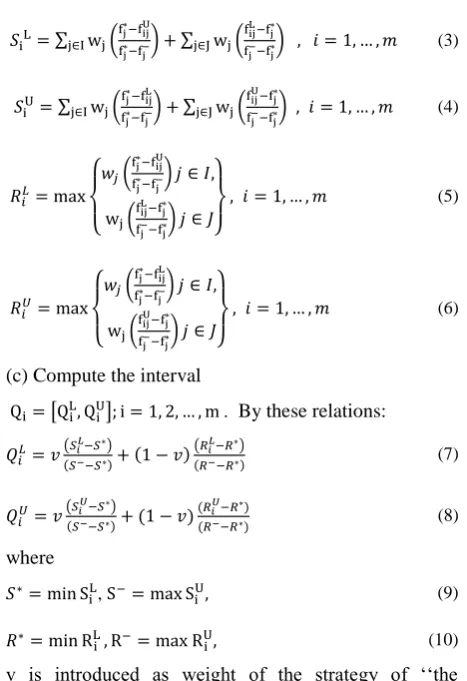
(b) Compute and intervals as below:
TABLE 2. Decision Matrix
…
…
]
…
… …
… …
…
…
]
∑
(
) ∑ (
) (3)
∑ (
) ∑ (
) (4)
{
(
)
(
) }
(5)
{
(
)
(
) }
(6)
(c) Compute the interval
[ ] . By these relations:
( ) ( ) (7)
( ) (8)
where
, (9)
(10)
v is introduced as weight of the strategy of ‘‘the majority of criteria” (or ‘‘the maximum group utility”)
(d) Based on the VIKOR method, the alternative that has minimum is the best alternative and it is chosen as compromised solution. But, here are interval numbers. Sayadi et al. [26], introduced a new method for comparison of interval numbers. But as mentioned before in our research, in order to determine the minimum , we will incorporate these interval as a minimization objective function in the interval linear model which will be presented in the next phase. This will integrate the strategic and operational decisions.
The interval numbers of the decision matrix are extracted from two versions of GCR in different years.
2. 3. Phase 3. Using a Multiple Objective Set Covering Location-Allocation Model to Find the
Best Locations and Allocations In this phase
we use a multiple objective set covering location-allocation model to find the best locations and allocations.
lies within a pre-specified distance of that facility. Using the classification proposed by Daskin [27], covering problems are divided into two main classes: set (total) covering problems which consist of covering all demand points with the minimum number of facilities; and maximal (partial) covering problems which consist of covering a maximum number of demand points with a fixed number of facilities [28]. The modern trend in Operations Research methodology deserves modelling of all relevant vague or uncertain information involved in a real decision problem. Generally, vagueness is modelled by a fuzzy approach and uncertainty by a stochastic approach. In fuzzy programming problems, the constraints and goals are viewed as fuzzy sets and it is assumed that their membership functions are known. On the other hand, in stochastic programming problems, the coefficients are viewed as random variables and it is also assumed that their probability distributions are known [29]. However, in reality for a decision maker (DM), it is not always easy to specify the membership function or probability distribution in an inexact environment. An interval number can be thought as an extension of the concept of a real number [30]. However, it is not usually used in decision problems.
Therefore in our model, we have tried to consider all those uncertain parameters as interval numbers to make our problem closer to real world problems.
The mathematical model is presented as:
∑ [ ] (11)
∑ (12)
∑ ∑ (13)
Subject to
∑
∑
∑ [ ] [ ]
{ }
(14)
The objective function (11) ensures that the minimum numbers of facilities are located. The objective function (12), by minimizing , maximizes the quality of selected facilities. The objective function (13) minimizes the transportation cost of allocation i to j. In objective function 2, 10 is the number of years in programming horizon and 2 is the unit cost of transportation from i to j. The constraint (14) ensures that if a country is not selected for establishing the facility, no allocation to this country is decided. This constraint also ensures that for each destination (j), a sourcing facility (i) is considered. Next it ensures that
the covering radius is regarded. At the end, it ensures that the production capacity of facility (i) is greater than or equal to the demand of destination (j).
Sengupta et al. [29] defined an interval linear programming problem as an extension of the classical linear programming problem to an inexact environment. On the basis of a comparative study on ordering interval numbers, inequality constraints involving interval coefficients were reduced in their satisfactory crisp equivalent forms and a satisfactory solution of the problem was defined:
∑ [ ]
Subject to
∑
(15)
Crisp equivalent of the model:
∑
(16)
Subject to:
∑
∑
∑
(17)
In the above model, is the optimism level and is determined by the decision maker.
We use the same approach to make a crisp equivalent of our interval model as follows:
∑ (18)
∑ ( ) (19)
∑ ∑
s.t. ∑
∑
∑
∑ ( ) ( )
∑ ( )
{ }
(20)
We have used “utility function” method. Since forming a suitable utility function is not simple, we have formed a simple utility function, using Global Criterion method as follows:
2. 3. 1. Global Criterion Method The method of
global criterion for a MODM problem solves the problem by following objective function subject to the model constraints [30].
∑ [ ] (21)
(22)
As Boychuk and Ovchinnikov [31] have suggested, we set , although it is possible to choose any other values for P. By putting , we will face a linear programming problem which can be solved by all LP solvers:
(23)
2. 3. 2. Utility Function Method In order to use
this method, we should form a utility function before solving the MODM. This utility function would take account of the decision maker’s preferences. As mentioned before, by applying the global criterion method, we can determine the utility function as follows:
(( ∑ ) ⁄ )
((∑ ) ⁄ )
((∑ ∑ ) ⁄ )
(24)
The methodology developed in our study incorporates the international economic indicators of GCR (Table 1) and utilizes variousMCDM andlocation techniques to make better strategic and operational location decisions.
3. APPLICATION
In order to illustrate the application of the proposed methodology, a composite example is used. However, in the first phase of the methodology, we have used the opinions of experts in Iranian pharmaceutical industry. In the second phase, we have used real data from GCR.
3. 1. The Problem A pharmaceutical company is
evaluating five potential plant location sites in five European countries namely France, Germany, Sweden, United Kingdom and Hungary. The production plants
are to serve eleven demand countries namely Norway, Finland, Denmark, Romania, Italy, Spain, Bulgaria, Austria, Poland, Ireland and Ukraine. Given the covering radius of 881 km, limitations and preferences, decision makers need to determine the related optimum locations and allocations.
3. 2. Results
3. 2. 1. Phase 1 Results The mean ratings of
GCR factors are presented in Figure 1. According to the experts’ opinions in pharmaceutical industry of Iran, the most significant factors of GCR for establishing plant facilities in this industry include: macroeconomic environment, revealed comparative advantage (an alternative for market size), infrastructure, financial market development and good market efficiency.
The relative importance of 36 subfactors for these major factors was also identified. The summary of these ratings on a normalized 0 to 1 scale are:
ω
3. 2. 2. Percentage of Pharmaceutical Companies
Involved in the Survey The questionnaire
respondents were chief managers and supervisors of pharmaceutical industry of Iran. A total of 13 respondents in Aburaihan pharmaceutical Co., Exir pharmaceutical Co. and Sobhandarou pharmaceutical Co. took part in the survey. Figure 2 represents the participation rate of these three companies in the survey.
Figure 1. The Mean Ratings of GCR
6.7 6.2 6.1 6 5.8 5 4.9 4.9 4.5 3.8 3.2 3.1
0 2 4 6 8
Macroeconomic Environment Revealed Comparative…
Figure 2. The Participation Rates of Aburaihan, Exir and Sobhandarou in the Survey
3. 2. 3. Phase 2 Results Using data taken
from GCR (2009-2010, 2012-2013) and the determined weights in phase 1, the VIKOR method is applied to assess the utilities of the potential countries for plant establishment. Table 3 represents the VIKOR method final results ([ ]).
3. 2. 4. Phase 3 Results Given the interval
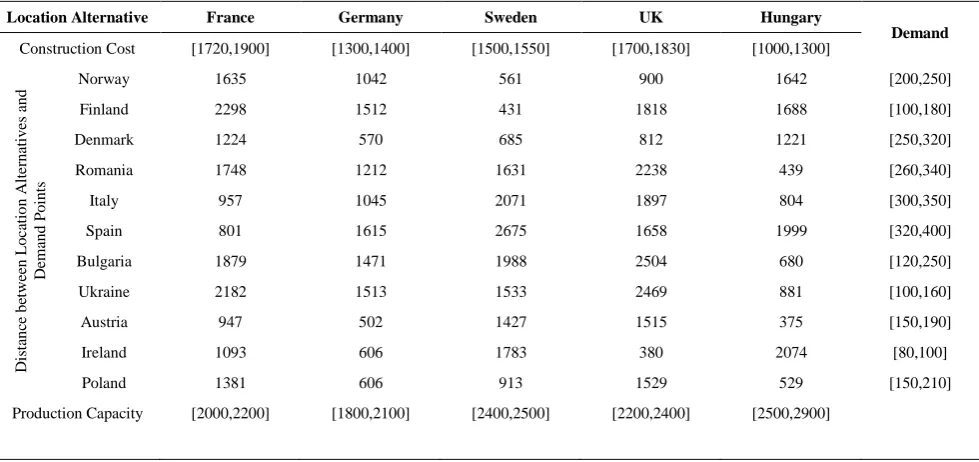
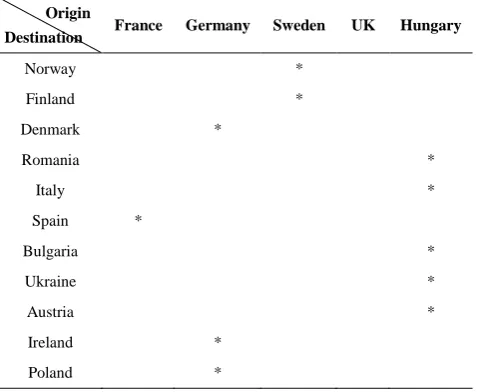
VIKOR results Table 3 the covering matrix in Table 4 and the resource data in Table 5, the model example is solved using AIMMS software in an INTEL Core 2CPU, T7200, 2.0 GHZ, 2GB RAM computer. The model results including selected countries for plant establishment and the optimum allocations are presented in Table 6.
TABLE 3.[ ]
Country
France [0.6825,0.7883]
Germany [0.3959,0.492]
Sweden [0.117733,0.334534]
UK [0.02343,0.325013]
Hungary [0.60073162,1]
TABLE 4.Covering Matrix (covering radius=881 km)
Origin Destination
France Germany Sweden UK Hungary
Norway 0 0 1 0 0
Finland 0 0 1 0 0
Denmark 0 1 1 1 0
Romania 0 0 0 0 1
Italy 0 0 0 0 1
Spain 1 0 0 0 0
Bulgaria 0 0 0 0 1
Ukraine 0 0 0 0 1
Austria 0 1 0 0 1
Ireland 0 1 0 1 0
Poland 0 1 0 0 1
TABLE 5. Resource Date of Location Alternatives and Demand Points
Location Alternative France Germany Sweden UK Hungary
Demand
Construction Cost [1720,1900] [1300,1400] [1500,1550] [1700,1830] [1000,1300]
D
ist
an
ce
b
et
w
ee
n
Lo
ca
ti
o
n
A
lt
er
n
at
iv
es a
n
d
D
eman
d
P
o
in
ts
Norway 1635 1042 561 900 1642 [200,250]
Finland 2298 1512 431 1818 1688 [100,180]
Denmark 1224 570 685 812 1221 [250,320]
Romania 1748 1212 1631 2238 439 [260,340]
Italy 957 1045 2071 1897 804 [300,350]
Spain 801 1615 2675 1658 1999 [320,400]
Bulgaria 1879 1471 1988 2504 680 [120,250]
Ukraine 2182 1513 1533 2469 881 [100,160]
Austria 947 502 1427 1515 375 [150,190]
Ireland 1093 606 1783 380 2074 [80,100]
Poland 1381 606 913 1529 529 [150,210]
Production Capacity [2000,2200] [1800,2100] [2400,2500] [2200,2400] [2500,2900] 0.41
0.33 0.25
Aburaihan
Exir
TABLE 6. Selected Countries and Allocations
Origin
Destination France Germany Sweden UK Hungary
Norway *
Finland *
Denmark *
Romania *
Italy *
Spain *
Bulgaria *
Ukraine *
Austria *
Ireland *
Poland *
4. CONCLUSIONS
International location decision is a risky and complicated decision due to uncertainty and volatility of international environments which includes various qualitative and quantitative factors. Unlike most of the prior studies, which have focused on traditional qualitative factors and investigated the international facility location problem in a deterministic environment, we incorporated international economic indicators under uncertainty in our model (strategic phase). We also considered quantitative factors like resource limitations (operational phase). In this paper we presented a 3-stage procedure in which, considering the situation, we applied different techniques and models like VIKOR method, set covering, global criterion and utility function method and binary programming in each stage. The application of these methods enabled us to present an integrated approach for solving our problem. The paper illustrated how the VIKOR method for interval numbers can be combined into a multi-objective interval linear model. One way to improve this paper is asking question from experts in some industries instead of a specific industry. Another option could be to use other softwares in order to solve the model.
5. REFERENCES
1. Canel, C. and Khumawala, B.M., "Multi-period international facilities location: An algorithm and application", International Journal of Production Research, Vol. 35, No. 7, (1997), 1891-1910.
2. Pomper, C.L., "International investment planning: An integrated approach, North-Holland, Vol. 22, (1976).
3. Jucker, J.V., "The transfer of domestic-market production to a foreign site", AIIE Transactions, Vol. 9, No. 4, (1977), 321-329.
4. Hodder, J.E. and Jucker, J.V., "International plant location under price and exchange rate uncertainty", Engineering Costs and Production Economics, Vol. 9, No. 1, (1985), 225-229. 5. Naik, B. and Chakravarty, A., "A strategy for locating a network
of international manufacturing facilities", in Proceedings of the Symposium on Globalization of Technology, Manufacturing and Service Operations, Tulane University New Orleans, LA., (1994), 7-8.
6. Syam, S.S., "A model and methodologies for the location problem with logistical components", Computers & Operations Research, Vol. 29, No. 9, (2002), 1173-1193.
7. Verter, V., "An integrated model for facility location and technology acquisition", Computers & Operations Research, Vol. 29, No. 6, (2002), 583-592.
8. Hamad, R. and Gualda, N.D.F., "Model for facilities or vendors location in a global scale considering several echelons in the chain", Networks and Spatial Economics, Vol. 8, No. 2-3, (2008), 297-307.
9. Vahdani, B., Salimi, M. and Mousavi, S., "A new compromise decision-making model based on topsis and vikor for solving multi-objective large-scale programming problems with a block angular structure under uncertainty", International Journal of Engineering, Vol. 27, No. 11, (2014).
10. Hoffman, J.J. and Schniederjans, M.J., "A two-stage model for structuring global facility site selection decisions: The case of the brewing industry", International Journal of Operations & Production Management, Vol. 14, No. 4, (1994), 79-96.
11. Kaboli, A., Aryanezhad, M., Shahanaghi, K. and Tavakkoli-Moghaddam, R., "A holistic approach based on mcdm for solving location problems", International Journal of Engineering Transactions A Basics, Vol. 20, No. 3, (2007), 148-153.
12. Tavakkoli-Moghaddam, R., Gholipour-Kanani, Y. and Shahramifar, M., "A multi-objective imperialist competitive algorithm for a capacitated single-allocation hub location problem", International Journal of Engineering-Transactions C: Aspects, Vol. 26, No. 6, (2013), 605-612.
13. Badri, M.A., "Combining the analytic hierarchy process and goal programming for global facility location-allocation problem", International Journal of Production Economics, Vol. 62, No. 3, (1999), 237-248.
14. Sarkis, J. and Sundarraj, R., "Hub location at digital equipment corporation: A comprehensive analysis of qualitative and quantitative factors", European Journal of Operational Research, Vol. 137, No. 2, (2002), 336-347.
15. Amin, S.H. and Zhang, G., "A multi-objective facility location model for closed-loop supply chain network under uncertain demand and return", Applied Mathematical Modelling, Vol. 37, No. 6, (2013), 4165-4176.
16. Bogataj, M., Grubbström, R.W. and Bogataj, L., "Efficient location of industrial activity cells in a global supply chain", International Journal of Production Economics, Vol. 133, No. 1, (2011), 243-250.
17. Grubbstrom, R.W., Bogataj, M., Bogataj, L. and McDonnell, L.B.R., "A compact representation of distribution and reverse logistics in the value chain, Faculty of Economics, KMOR, (2007).
19. Das, K., "Integrating effective flexibility measures into a strategic supply chain planning model", European Journal of Operational Research, Vol. 211, No. 1, (2011), 170-183. 20. Bashiri, M., Badri, H. and Talebi, J., "A new approach to tactical
and strategic planning in production–distribution networks", Applied Mathematical Modelling, Vol. 36, No. 4, (2012), 1703-1717.
21. Badri, H., Bashiri, M. and Hejazi, T.H., "Integrated strategic and tactical planning in a supply chain network design with a heuristic solution method", Computers & Operations Research, Vol. 40, No. 4, (2013), 1143-1154.
22. Tavakkoli-Moghaddam, R., Heydar, M. and Mousavi, S., "An integrated ahp-vikor methodology for plant location selection", International Journal of Engineering-Transactions B: Applications, Vol. 24, No. 2, (2011), 127-137.
23. Lee, C. and Wilhelm, W., "On integrating theories of international economics in the strategic planning of global supply chains and facility location", International Journal of Production Economics, Vol. 124, No. 1, (2010), 225-240. 24. Tzeng, G.-H., Teng, M.-H., Chen, J.-J. and Opricovic, S.,
"Multicriteria selection for a restaurant location in taipei", International Journal of Hospitality Management, Vol. 21, No. 2, (2002), 171-187.
25. Choobineh, F. and Behrens, A., "Use of intervals and possibility distributions in economic analysis", Journal of the Operational Research Society, (1992), 907-918.
26. Sayadi, M.K., Heydari, M. and Shahanaghi, K., "Extension of vikor method for decision making problem with interval numbers", Applied Mathematical Modelling, Vol. 33, No. 5, (2009), 2257-2262.
27. Daskin, M.S., "Network and discrete location: Models, algorithms, and applications, John Wiley & Sons, (2011). 28. Church, R. and Velle, C.R., "The maximal covering location
problem", Papers in Regional Science, Vol. 32, No. 1, (1974), 101-118.
29. Sengupta, A., Pal, T.K. and Chakraborty, D., "Interpretation of inequality constraints involving interval coefficients and a solution to interval linear programming", Fuzzy Sets and Systems, Vol. 119, No. 1, (2001), 129-138.
30. Moore, R.E. and Moore, R., "Methods and applications of interval analysis, SIAM, Vol. 2, (1979).
31. Boychuk, L. and Ovchinnikov, V., "Principal methods of solution of multicriterial optimization problems (survey)", Soviet Automatic Control, Vol. 6, No. 3, (1973), 1-4.
Utilizing Decision Making Methods and Optimization Techniques to Develop a
Model for International Facility Location Problem under Uncertainty
F. Rouhiolyaeea, S. B. Ebrahimib, M. Nezhad Afrasiabic
a Department of Industrial Engineering, Iran University of Science and Technology, Tehran, Iran b Department of Industrial Engineering, K.N.Toosi University of Technology, Tehran, Iran c Department of Industrial Engineering, K.N.Toosi University of Technology, Tehran, Iran
P A P E R I N F O
Paper history:
Received 09 August 2015
Received in revised form 16 December 2015 Accepted 24 December 2015
Keywords:
International Facility Location Multi-Criteria Decision Making(Mcdm) Covering Techniques
Uncertainty
ديكچ ه
ناکم لئاسم یسررب قیقحت نیا فده نیب حطس رد یبای
تیعطق مدع نتفرگرظنرد اب یللملا لدم کی نآ لابند هب هک تساه
یم هیارا یتایلمع و کیژتارتسا یزیر همانرب یارب یقیفلت میمصت شور ود فده نیا هب ندیسر یارب .دوش
ناکم رد یریگ
-یم هیارا یبای شور ادتبا رد .دوش
VIKOR
میمصت لئاسم یارب هتفای هعسوت یم هیارا لصاوف دادعت اب یریگ
نآ زا هک ،دوش
نیب یداصتقا یاهروتکاف ساسارب هوقلاب یاهروشک کیژتارتسا یبایزرا یارب رد دوجوم یللملا
شرازگ تباقر یاه یریذپ
یم هدافتسا ناهج .دوش
سپس ، یبایزرا نیا هب هجوت اب اب هفدهدنچ یششوپ لدم کی یمک یاهروتکاف زا یدادعت و اه
یم هیارا هدش هدوزفا یتایلمع یاهرایعم نتفرگرظنرد ناکم یارب اراک یشور هیارا هلاقم نیا یلصا یروآون .دوش
یبای تسا هک
زا یدیدج لدم کمک هب
VIKOR
یم ققحت یناهج یاهرایعم و یقیفلت دبای
و هیرظن یریگراکب هلاقم نیا رگید تعدب یاه
نیب داصتقا لدم رد للملا یم تایلمع رد قیقحت یاه
.دشاب